




Abstract
The behavior of embedded planar elliptical cracks within square prismatic bars that are commonly used as torque-resisting structural components motivates this work, as the literature for such stress intensity factors is evidently deficient. The stress intensity factors are evaluated using the dual boundary element program of Beasy, and studied by considering the elliptical aspect ratio and the eccentricity in the sense of an offset from the centroid. The variation of shear mode stress intensity factors for a penny crack situated near to the free surface and the square corner is also reported for the first time, complementing the available results for tensile mode.
Keywords
Introduction
Prismatic bars are ubiquitously used as structural components in mechanisms, machineries, and other engineering applications. As engineers explore limits to design products, materials defects and flaws must be examined, and fracture analysis becomes essential. Embedded cracks in solids as material flaws are invariably present as defects of material processing or as coalescence of micro-cracks due to dislocations pile up during services. The approach of examining cracks using fracture mechanics requires the stress intensity factors (SIFs); relevant solutions and off-the-shelf data for such are often sought to develop, validate, and support non-destructive techniques for evaluation of embedded defects in solids. However, very few and limited studies on embedded elliptical cracks have been reported in the literature, as this problem poses formidable challenges for both analytical and experimental solutions. The state of the art for material cutting and joining is perhaps still too limiting for creating experimental samples with embedded crack, and samples deliberately obtained by controlling metallurgical processing are often too difficult to study as crack density, size, location, and orientation almost never appeared favorably for experimental purposes. On the other hand, the analytical formulation of the boundary value problem for embedded elliptical crack is complex and challenging, and it is only amenable for special geometry and loading conditions.
Green and Sneddon 1 and Sadowsky and Sternberg 2 represent the earlier work on the stress field due to an elliptical crack in infinite solid under normal loading. Various results of SIFs for infinite solid under special loading can be obtained from, among others, Kassir and Sih, 3 Sneddon and Lowengrub, 4 Sih, 5 and Keer. 6 The handbook of Tada et al. 7 collected the work of many authors who contributed to the advances on the treatment and the analysis of embedded cracks. Ang and Clements 8 and Ang 9 considered material inhomogeneity in their work. Gao and Rice 10 and Gao 11 developed a new perturbative approach based on the technique of Rice 12 to obtain the SIFs of the nearly circular tensile and shear mode cracks. Another approach for the slightly non-circular tensile crack was formulated by Panasyuk. 13 Livieri and Segala14,15 presented an analytical technique based on the first-order expansion of the Oore–Burns integral to treat arbitrarily shaped embedded crack fronts obtained by homotopic transformations of a reference disk. Wang and Glinka 16 reported the SIFs of embedded elliptical cracks under complex two-dimensional loading conditions using the weight function method. Based on the properties of weight functions and the available weight functions for two-dimensional cracks, they proposed new mathematical expressions using the point load weight function. Atroshchenko et al. 17 analytically developed a three-dimensional unbounded-domain boundary value problem of elasticity for an elliptical crack and proposed solutions for arbitrary normal loadings composed as linear combinations of basis polynomials. Of great practical interest is the study of crack situated near the free boundary. Smith and Alavi, 18 Fischer et al., 19 and Shah and Kobayashi 20 analytically treated the problem of a tensile crack close to the free surface of the half space; Kobayashi et al. 21 presented a procedure for estimating the SIFs for tensile cracks near a square corner. No corresponding results for shear mode SIFs are available in the literature.
For some finite-domain problems with special geometry and loading, the results could be expressed using the Fredholm integrals, an example is the long circular cylinder.22,23 Newman and Raju 24 obtained empirically the closed-form solutions for SIFs of an embedded elliptical crack located centrally within a rectangular prismatic bar subjected to tension and bending based on simulation results from the finite element method (FEM), and these closed-form solutions are the first of its kind. Le Delliou and Barthelet 25 elaborated the influences of crack size, shape, and the free surface on SIFs for embedded cracks in a plate using FEM. Lee 26 presented the solution for a pressurized elliptical crack within a long circular cylinder. Qian 27 reported the effects of crack aspect ratio, crack eccentricity, and effect of pipe thickness on the SIFs of an embedded elliptical crack axially oriented in a pressurized pipe using the interaction integral approach on a three-dimensional finite element crack front model. Liu et al. 28 investigated embedded cracks in a welded joint of pressure vessels loaded uniaxially. Imran et al. 29 presented the SIFs of an embedded elliptical crack in a circular cylinder with different crack aspect ratios, eccentricities, and inclinations under normal and torsional loadings.
We present the results for the SIFs of embedded elliptical cracks within square prismatic bar under torsion. No solution of SIFs for such finite domain under torsion has been reported in the literature to date. The effects of elliptical aspect ratio and eccentricity in the sense of an offset from the cross-sectional centroid are studied. An approximate variation of shear mode SIFs for a penny crack located near the free surface and the square corner is also reported. This brief graphical description represents the first report on shear mode penny crack situated near the free surface and the square corner, and may complement the work on opening mode by Smith and Alavi, 18 Fischer et al., 19 Shah and Kobayashi, 20 and Kobayashi et al. 21 All simulation results are performed using the fracture mechanics package of Beasy, 30 a relatively new program based on the dual boundary element method (DBEM). Notwithstanding the need for vigorous assessment on a broader scale, especially in terms of accuracy, convergence, and flop count, its validity has been variously confirmed for problems described in the literature.31–34
Simulation of embedded elliptical cracks and evaluation of Beasy
Evaluation of SIFs using DBEM implemented in Beasy fracture mechanics package
Adopting the crack front coordinate system in Figure 1, the SIFs can be expressed as follows as the material point

These SIFs are evaluated in Beasy by way of the J-integral concept of Rice
35
and Cherepanov,
36
which gives, for crack opening in the

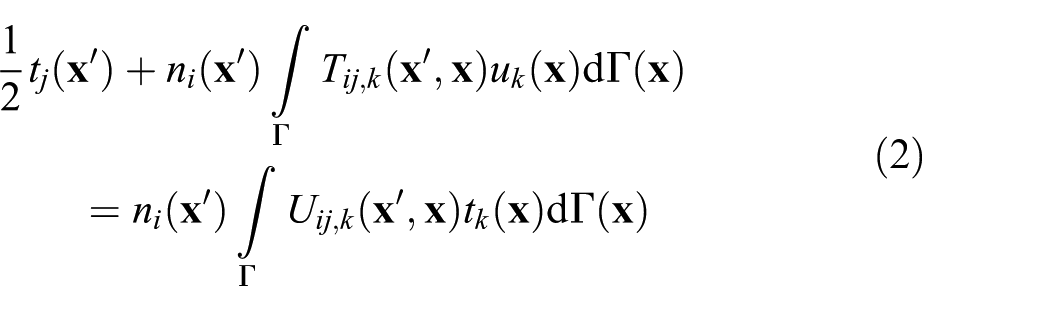
Leading to equations (1) and (2) is Somigliana’s identity expressed as an integral equation involving

Crack front coordinate system.
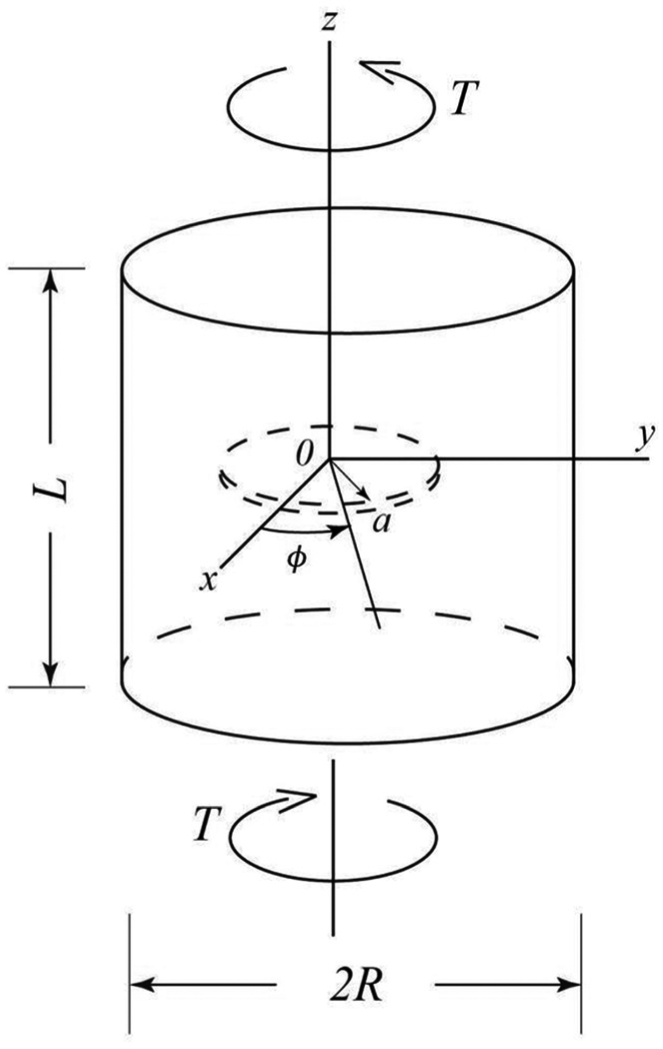
Model geometry and embedded crack shape
This simulation for the SIFs uses a prismatic square bar with the cross section of 10 × 10 mm2 and length of 40 mm. It is twisted with a torque

The model of an embedded crack in a square bar under torsion and the parameters and notations used in this study.
Evaluation of Beasy with some available solutions
The problem of embedded crack contained in bounded domain of general geometry is not amenable to analytical solution. For some special geometry, it can be treated using the dual integral equations technique with solution presented as integral equations of the Fredholm type.22,23 To assess the accuracy of the solutions obtained from the DBEM fracture mechanics package of Beasy, some of the available solutions for penny cracks within infinite solid under shear loading provided in Kassir and Sih, 3 Sneddon and Lowengrub, 4 and others are used. In addition, the Newman–Raju (NR) empirical solution 24 for embedded elliptical crack in a square bar loaded normally is used to benchmark the results of the same obtained from Beasy. In these simulations for the evaluation of Beasy, fine mesh of a similar typical size with that for the study for embedded cracks under torsional shear stress is used.
Embedded penny crack under axisymmetric torsion
The infinite solid containing a penny crack is subjected to an axisymmetric torsion (see Figure 3), where the shear stress varies linearly in the radial direction r in accordance with


Penny crack of radius a in an infinite solid under axisymmetric torsion T.
The SIFs due to axisymmetric torsion for a penny crack of radius a embedded centrally in circular cylinders of radius R and length L (see Figure 4) are compared with the solutions for infinite solid, that is, equation (3). The axisymmetric torque T is loaded in such a way that the shear stress is linearly varying in the radial direction and assumes the same value as that in Figure 3 at the radial distance of r = a. A length of L = 6R is used. This bounded-domain boundary value problem could be treated using the dual integral equations technique with the results presented using the Fredholm integral equations.5,22,23 The results for crack radius of a = 0.5 mm contained in cylinder of various ratios of R/a are shown in Figure 5. Normalized SIF
Penny crack of radius a in a circular cylinder of radius R and length L under axisymmetric torsion T.

Normalized stress intensity factor as a function of R/a.
Penny crack under uniform shear
A penny crack in an infinite solid is subjected to a uniform shear on one of its crack surface as depicted in Figure 6. The other crack surface is subjected to the same load, but in the opposite direction. Kassir and Sih
3
give


Penny crack of radius a in an infinite solid. The crack surfaces are subjected to a uniform inclined shear stress
We compare the SIFs for infinite solid, that is, equations (4) and (5), with that of a penny crack of radius a embedded centrally in circular cylinders of radius R and length L under equal and opposite uniform shear (see Figure 7). Similar to the previous problem, this bounded-domain boundary value problem could be treated using the dual integral equations technique with the results presented by the Fredholm integral equations.5,22,23 The long cylinder has a radius of R = 15 mm, length of L = 120 mm, and a crack radius of a = 0.5 mm. It is well known that under such shear loading at the ends of the cylinder, the shear stress would vary quadratically on the cross section (assuming crack free) of the long cylinder, with the maximum value at the neutral axis which equals to 1.5 times the uniform shear stress applied at the cylinder ends. Furthermore, over a domain with the size of the crack surface radius of a = 0.5 mm, that is, with the range of 0 < r/R < a/R = 0.033, the shear stress is almost constant as depicted in Figure 8. This maximum shear stress will be applied in equations (4) and (5) for assessment of the results of Beasy. Figure 9 depicts the comparison of the results from Beasy and the analytical results. The distributions are observed to be correct, and excellent accuracies of

Penny crack of radius a in a circular cylinder of radius R and length L under equal and opposite uniform shear
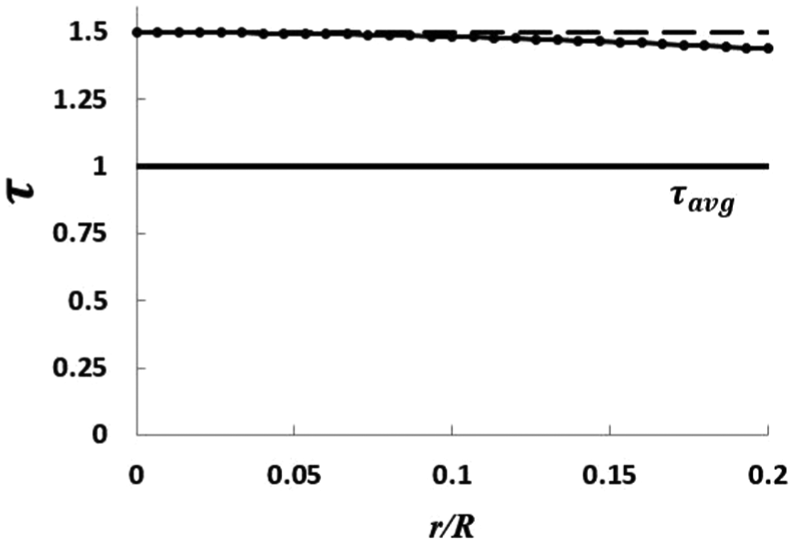
The shear stress distribution on the circular cross section of radius R. r/R is the normalized radial position.

Normalized stress intensity factors along the crack front for uniform shear loading.
Comparison with NR’s solution for square prismatic bar under normal loading
In the absence of any kind of solutions for SIFs of elliptical cracks embedded within square prismatic bar under torsional loading, we compare the results of Beasy using normal loading with NR empirical solution.
24
The results of K1 for aspect ratios b/a = 0.5, 1, and 2 subjected to far-field normal stress
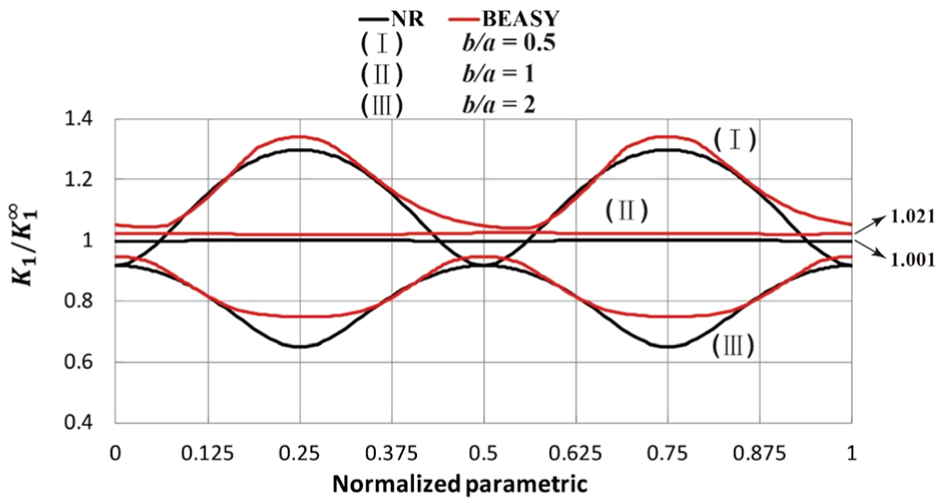
K 1 due to normal loading on an embedded elliptical crack with aspect ratios b/a = 0.5, 1, and 2 within a square bar of dimensions 20 mm × 20 mm × 80 mm.
Numerical results and discussion
Prelude: results from elasticity
The theory of elasticity (see, for example, Timoshenko and Goodier
40
) gives the xz and yz components of the shear stress of a rectangular in Figure 11(a) twisted with torque

The above are normalized by
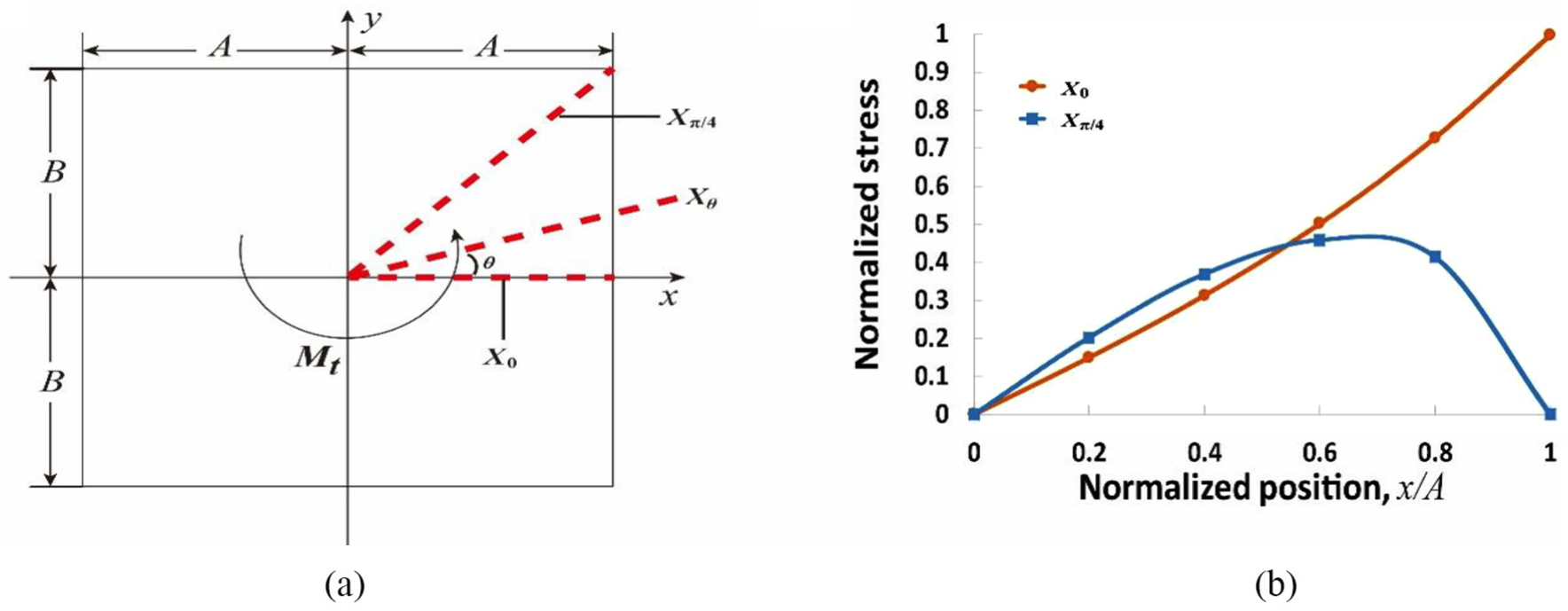
(a) Geometry of a rectangular bar with torque of Mt and (b) shear stress distributions.
Center cracks of different aspect ratio
Figure 12 depicts SIFs K2 and K3 for center cracks with aspect ratio

K 2 for embedded center cracks with different aspect ratios e (b = 0.5 mm).

K 3 for embedded center cracks with different aspect ratios e (b = 0.5 mm).

The magnitude and position of
Eccentric cracks
We define the eccentricity
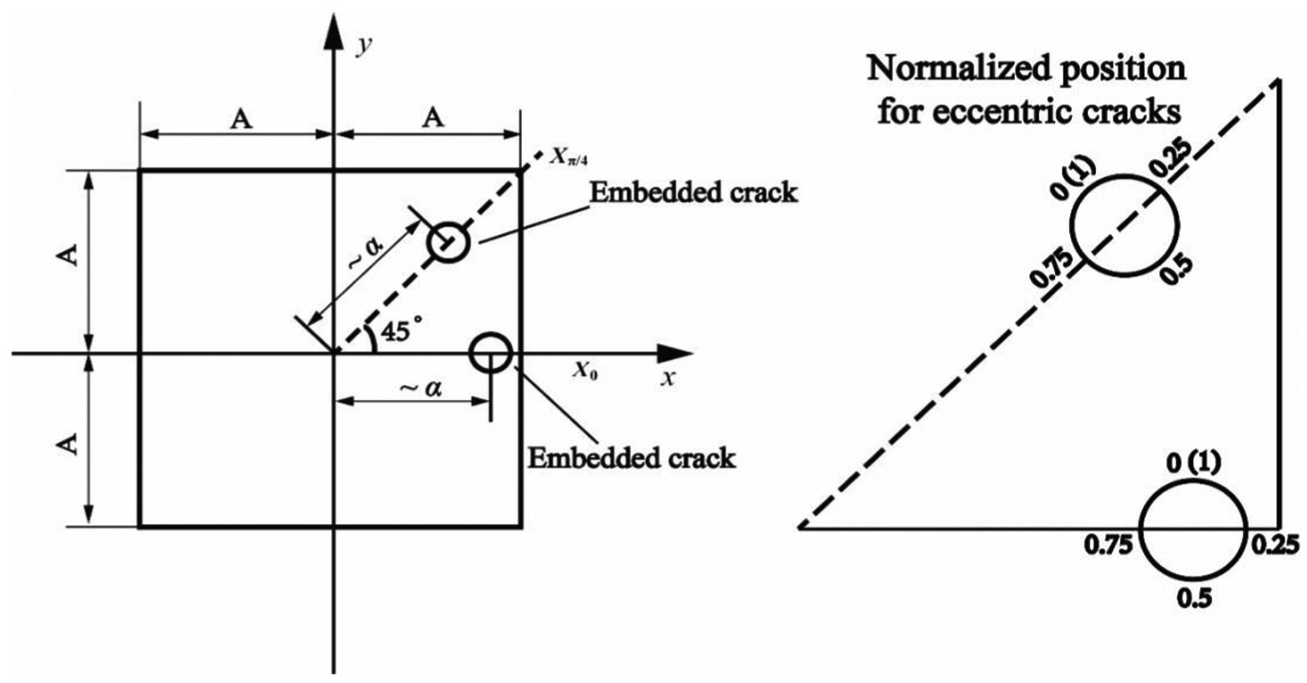
Eccentric embedded crack with aspect ratio b/a = 1.
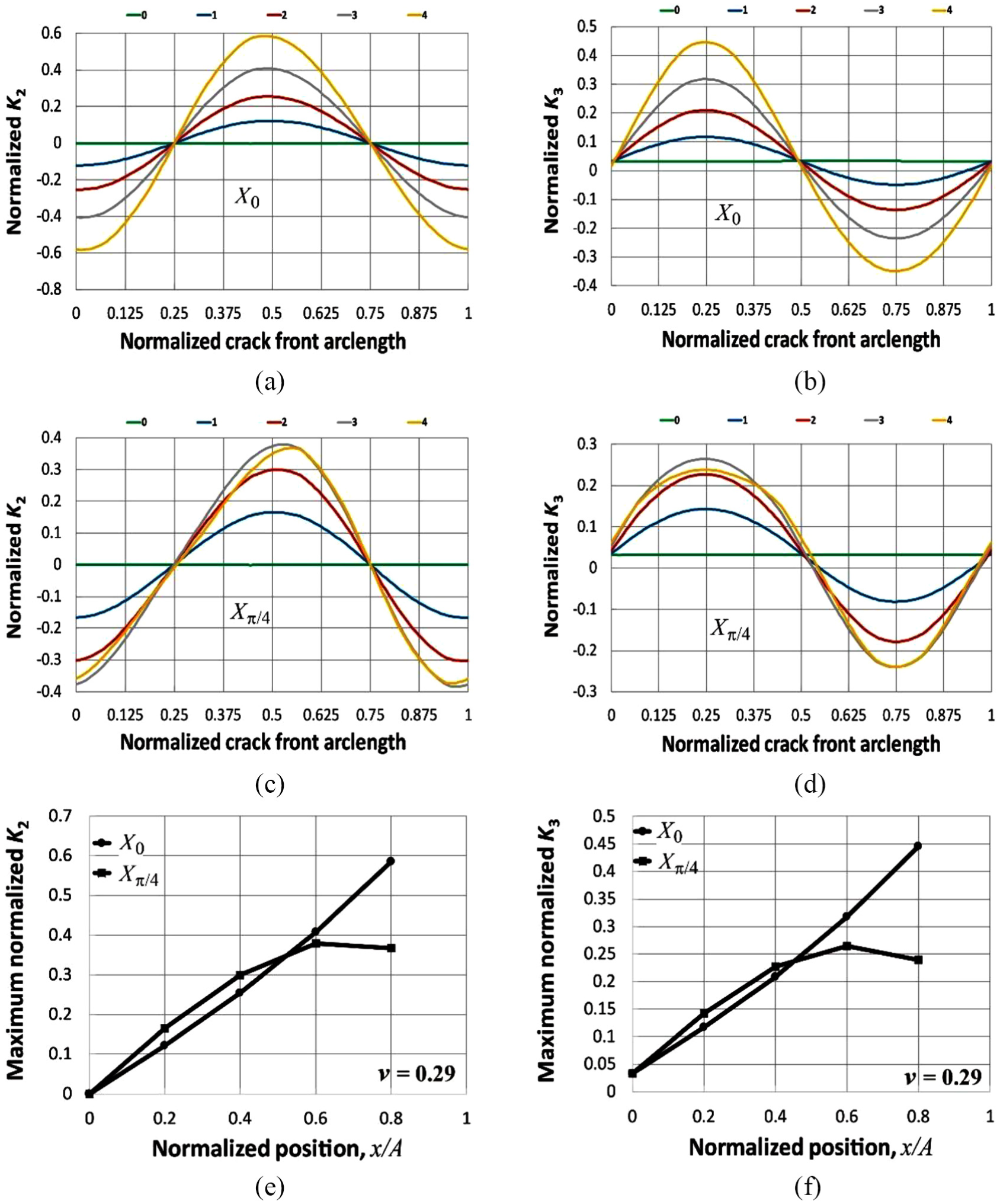
SIFs for eccentric cracks of
Penny crack located near to the free surface and corner under shear mode
Of practical interest is the variation of SIFs for penny crack situated close to the free surface and corner as illustrated in Figure 17. Smith and Alavi, 18 Fischer et al., 19 and Shah and Kobayashi 20 presented some results for crack under opening mode near the free surface; Kobayashi et al. 21 evaluated the tensile crack near a square corner. No results of any kind have been reported to date in the literature for penny cracks situated near free surface or corner loaded by shear stress.
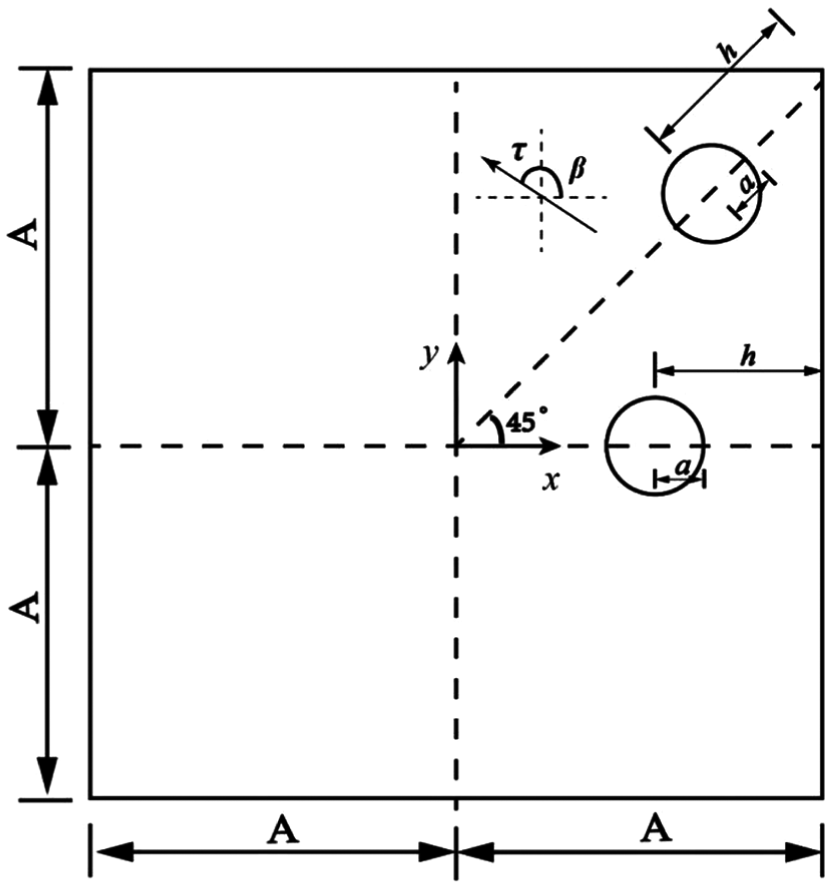
Penny crack situated close to the free surface and corner.
Due to the fourfold symmetry and anti-symmetry of geometry and torsional loading (Figure 11) of the square prismatic bar studied, the shear stress is orthogonal to both

Behavior of SIFs
Conclusion
The SIFs for elliptical embedded cracks in a square prismatic bar subjected to torsion are evaluated by considering the elliptical aspect ratio and the eccentricity in the sense of an offset from the centroid. Using the results of eccentric cracks, the approximate shear mode SIFs of a penny crack situated close to the free surface and the square corner are also presented. In general, the results conform to the expectation by way of theory of elasticity. As the aspect ratio b/a increases, both in-plane and anti-plane SIF increase, and the most severe location is at or close to the semi-major axis. With offset, K2 is maximal at a location close to the major axis while K3 is maximal close to the minor axis. For penny crack situated near the free surface and subjected to uniform shear,
Footnotes
Appendix 1
Handling Editor: Davood Younesian
Declaration of conflicting interests
The author(s) declared no potential conflicts of interest with respect to the research, authorship, and/or publication of this article.
Funding
The author(s) disclosed receipt of the following financial support for the research, authorship, and/or publication of this article: This work was supported, in part, by the UM-BKP Grant (UM.TNC2/IPPP/PPGP/638/BK007-2015) and Malaysia MOHE High Impact Research Grant (UM.C/625/1/HIR/MOHE/ENG/33).
