In this article, we have examined the three-dimensional flow of heat and mass transport of carbon nanotube–based nanoliquid over a rotating stretchable disk. A uniform magnetic field is applied in a transverse direction to the flow of nanofluid. Moreover, we have considered carbon nanotube nanoparticles termed as single-walled carbon nanotubes within the base liquid (water). In addition, at the boundaries of current problem, the effect of velocity slip and thermal convection is deliberated. The heat transport mechanism is also incorporated thermal radiation. The pertinent strong nonlinear ordinary differential system after utilizing the appropriate variables is intended. Homotopy analysis method technique is employed to estimate the analytical results for velocities and thermal fields. For the sake of comparison, the numerical method ND-Solve solution is also obtained. The results are found to be in an excellent agreement. Various graphs have been plotted in order to study the effect of different model variables on the velocities and thermal fields. The main features of physical quantities of flow like (local skin friction coefficient), and (heat transfer rate) have been formulated and deliberated graphically. It is found that velocity is reduced under the influence of the exterior magnetic field. Concluding remarks are pinched under the analysis of complete investigation.
In recent years, nanoliquids have gained tremendous concentration of scientists and engineers due to their fascinating thermal transport characteristics in different practical fields. Various classical heat transport liquids such as oil, water, and ethylene glycol have stumpy heat transport features. Nanofluids which are the homogeneous mixture of solid nanoparticles of dimension 1–100 nm in classical fluid are utilized to enhance the thermal conductivity of conventional heat transfer base liquids. Carbon nanotubes (CNTs) are the most favorable nano-elements in terms of their wonderful and high capability to conduct heat. There are numerous types of CNTs; however, they are commonly classified as single-walled carbon nanotubes (SWCNTs)/multi-walled carbon nanotubes (MWCNTs). SWCNTs are similar to a usual straw with just single wall having a diameter of 0.4–3 nm, while MWCNTs are the group of nested tubes with diameter ranges from 0.4 to 30 nm. In the present analysis, the thermal enhancement properties of water-based nanoliquid in the presence of SWCNTs are presented. The dispersion of SWCNTs in a based liquid forms a wide network of SWCNTs that accelerates thermal conductivity. The emerging problems in heat and mass transport enhancement depend on the use of nanoliquids.1–4 Nadeem and ijaz5 investigated the analysis of blood flow of variable nanoliquid viscosity in the presence of SWCNTs nanoparticles through a multiple stenosed arteries. Kamali et al.6 examined the heat transport enhancement by using CNT-based non-Newtonian nanoliquids. The laminar flow of CNT-based nanoliquid is discussed by Wang et al.,7 and the squeezing motion of CNTs water-based nanoliquid between similar disks is illustrated by Haq et al.8 Ellahi et al.9 considered the magneto hydrodynamics (MHD) streaming of CNT-based nanoliquid. Arani et al.10 computed the flow and heat transport water-based SWCNTs in a new proposal of double-layered micro-channel. Mahanthesh et al.11 examined the influence of nonlinear thermal radiation on CNT-based nanoliquid flow with Marangoni convection. Recently, Hayat et al.12 scrutinized the importance of CNTs considering chemical reaction, melting heat, and Darcy–Forchheimer.
Currently, the flow due to rotating disk has been an advanced area of investigation for the researchers and engineers because of their wide-ranging applications in several fields of science and modern technologies. In aeronautical discipline, disk-shaped bodies are usually encountered. In various real-life areas and scientific uses, such studies consist in rotating viscometers, computer storage appliances, rotors of gas turbines, centrifugal pumps, crystal growing developments, medicinal equipments, thermal-power producing system, air vacuuming apparatuses, chemical industries, and many other rotating mechanisms. The flow of liquid over a rotating disk was first defined by Karman.13 He obtained the approximate solution of partial differential equations for rotating disk by using the well-known similarity transformation. Later, several researchers of the world studied the Karman famous work in different aspects for several physical problems. Cochran14 used the appropriate variables proposed by Karman13 to describe the rotating disk streaming by using numerical integration method. Mellor et al.15 investigated and formulated the flow between the rotating disks. The characteristics of heat exchange between rotating disks are explained by Arora and Stokes.16 Turkyilmazoglu and Senel17 examined and computed numerically the effect of mass and heat transport in a rotating flow of liquid due to permeable disk. The characteristics of flow and heat transfer over a rotating disk immersed in five distinct nanofluids have been investigated by Turkyilmazoglu.18 Sheikholeslami et al.19 computed the mathematical results of the nanoliquid flow problems due to the inclined rotating disk. Turkyilmazoglu20 examined the heat transfer and liquid flow produced by the unsteady motion of the rotating disk, moving upright downward and upward direction. Moreover, Qayyum et al.21 and Aziz et al.22 explained the effect of MHD and slip aspects in different nanoparticles flow between rotating stretchable disks. The recent study on CNTs with rotating system and their application can be seen in literature.23–25 Furthermore, recent investigations and theoretical research on nanofluids using dissimilar phenomena, with modern applications, possessions, and properties with the use of diverse approaches, can be demonstrated in previous works.26–32 The prime objective of this endeavor is to explore water-functionalized CNT three-dimensional flow of nanoliquid over a stretchable disk in the presence of slip velocity and uniform magnetic field. The innovative idea of this investigation is considered as using CNTs nanoparticles called SWCNTs within the classical liquids. Heat transport mechanism is explored via convective condition and thermal radiation. The governing nonlinear expression of velocity and heat is computed through homotopy analysis method (HAM) approach.33–35 The recent investigation of nanofluid can be studied in Sheikholeslami et al.37–39 Solution with this method is important because it involves all the physical parameters of the problem, and we can easily discuss its behavior. Recently, HAM is mostly used due to its fast convergence.40–45
Moreover, the behavior of some sundry parameters appeared in mathematical modeling is elaborated through some tabular aids and graphs. The dependency of the (local skin friction coefficient) and (heat transfer rate) on the sundry variables is mathematically presented via plots.
Mathematical modeling
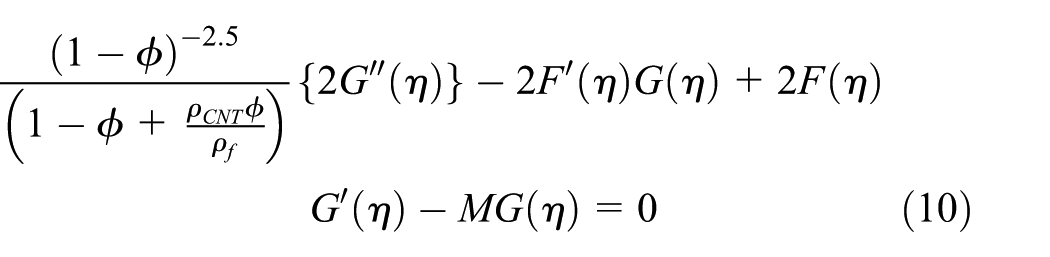
Consider the incompressible three-dimensional flow of water-based SWCNTs nanoliquid over a stretchable rotating disk. The characteristics of energy transport mechanism are inspected, such as thermal radiation and thermal convection. From the physical interpretation of flow model in Figure 1, we assume that disk rotates at with constant angular velocity . Furthermore, the derivatives of are ignored due to the axial symmetry of motion. refer to the disk surface and ambient liquid temperature, respectively. A uniform magnetic field of strength acts in z-direction. Also, describes the velocity components in the form of cylindrical coordinate . In view of above-mentioned assumptions, the resulting momentum and energy equation for three-dimensional flows take the form22
Here, equation (1) describes the law of conservation of mass (continuity equation), which confirmed automatically while equations (2)–(5) define the momentum expression and thermal field. Furthermore, the various model physical quantities embedded in equations (2)–(5) are the effective density of nanoliquid, dynamic viscosity , electrical conductivity , thermal conductivity coefficient, effective heat capacity of nanofluid, Stefan Boltzmann constant, mean absorption coefficient, and temperature (fluid, ambient).
Physical interpretation of flow and coordinate axis.
Some proposed thermophysical properties for CNTs nanoliquid are5,8
From the engineering point of view, the factors , (skin friction), and (Nusselt number) have played a dynamic role. These parameters are defined by the following formulae in non-dimensional form
Here, in the above expression, depicts local Reynolds number and .
Solution by HAM
In this section, the nonlinear ordinary differential equations (9)–(11) with boundary condition (equation (12)) have been solved by using HAM. Liao in 1992 suggested HAM scheme, which is applied to compute the series solution of highly complex nonlinear problems. Furthermore, HAM techniques have some benefits, such as it confirms the convergence of results and delivers full independence to choose the base function and primary gauss. To continue with HAM, it is very essential to state the initial guess and linear operator like .23,24
To control and improve the convergence of problem, we sued auxiliary constant .24 A selection of initial gasses is
, and are linear operators such that
The general result of , and is
Zero-order problem
Here, the embedding variable is with auxiliary variables , and . So, equations (9)–(12) deform for zero order as
Therefore, the resulting nonlinear operators are
By using Taylor’s series,24 are expressed in terms of
where
ith-order deformation problem
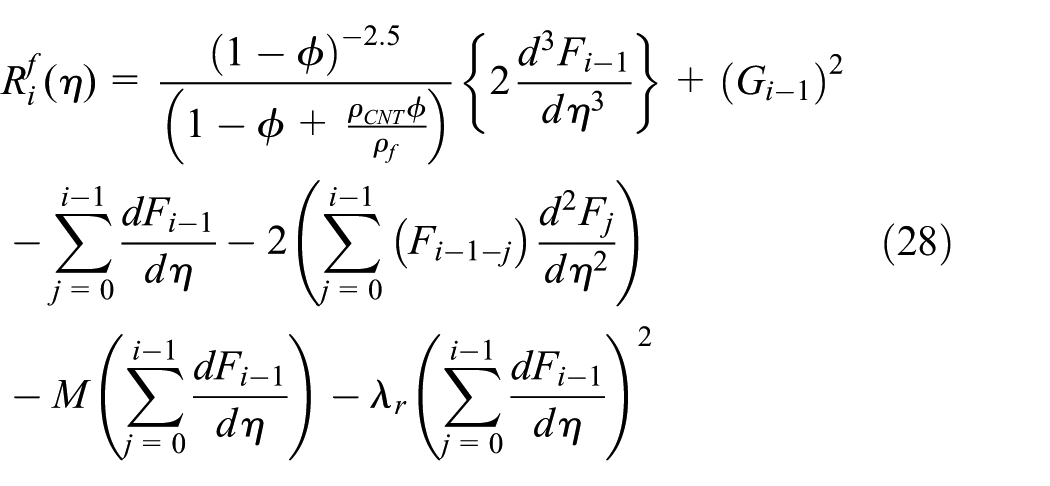
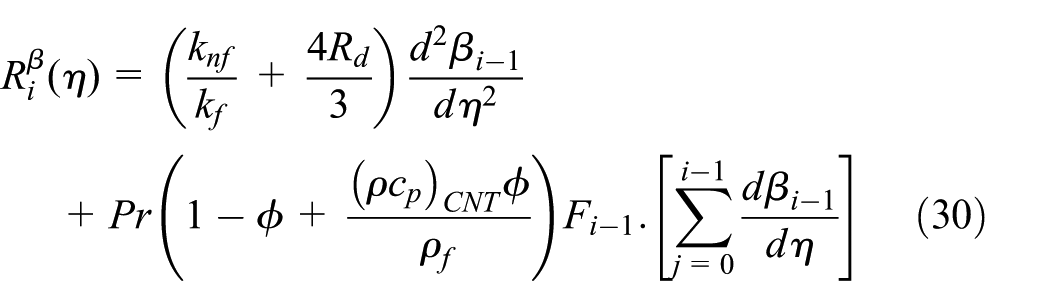
Differentiating the zeroth order equations time to achieve the -order deformation equations with respect to
The corresponding resultant boundary conditions are
where
Convergence of HAM
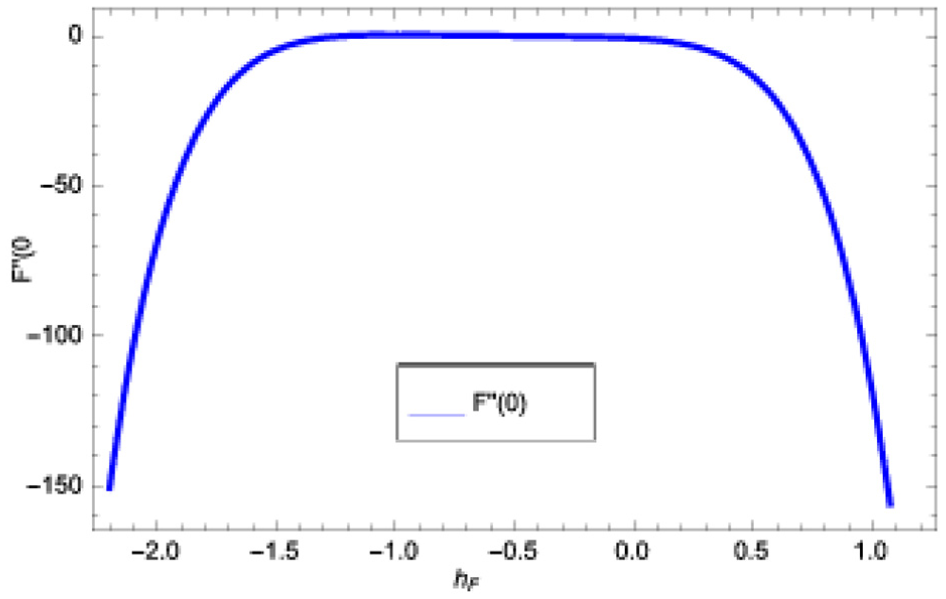
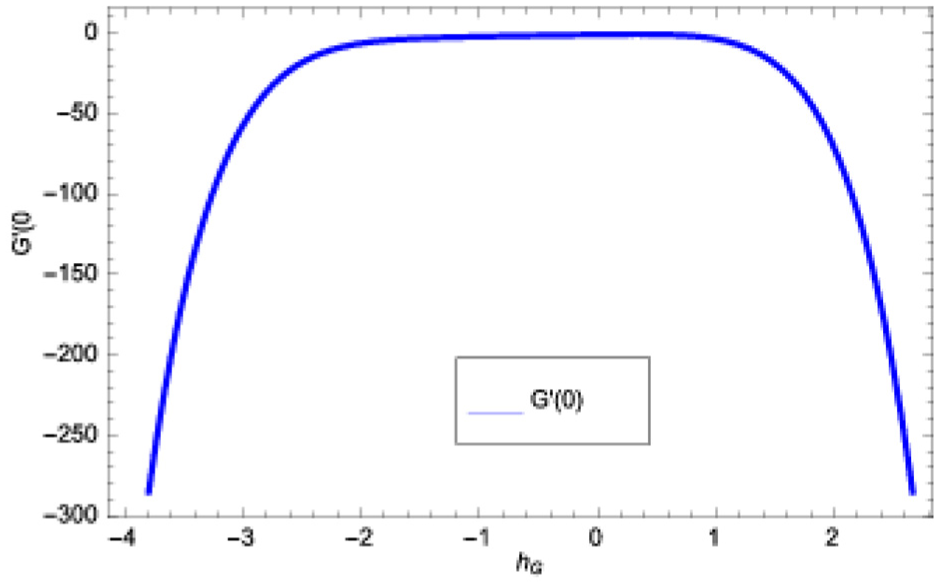
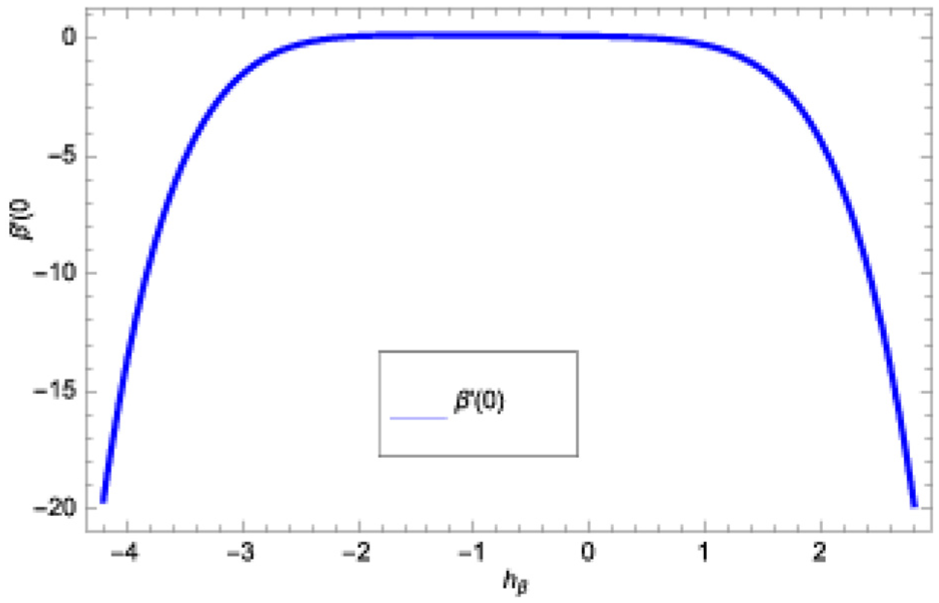
HAM scheme has the auxiliary constants , and that control and modify the convergence of the solution. For appropriate value of , and , we perform 20th order approximation. The appropriate region of , and lies between , and it is plotted in Figures 2–4, respectively.
Sketch of h-curve for .
Sketch of h-curve for .
Sketch of h-curve for .
Graphical analysis
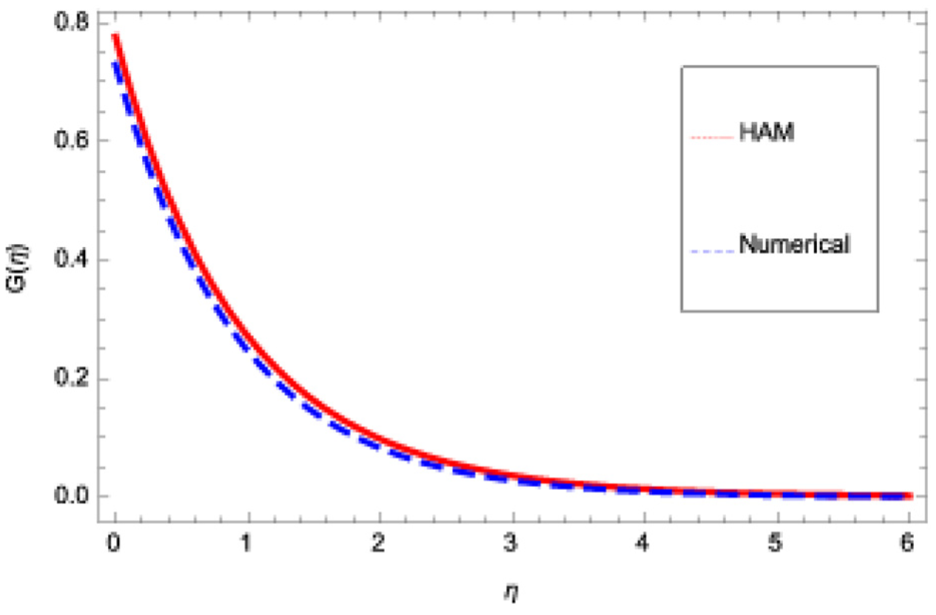
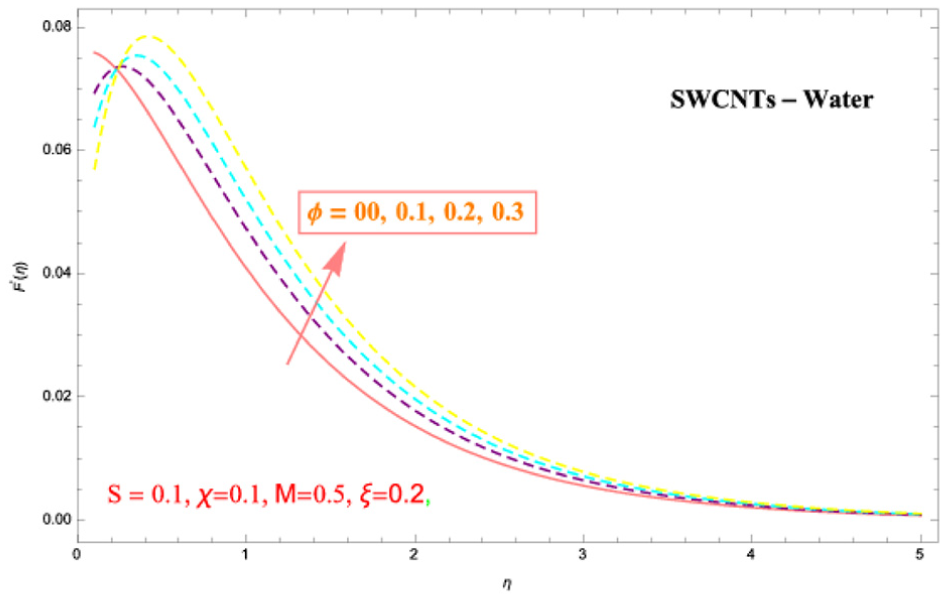
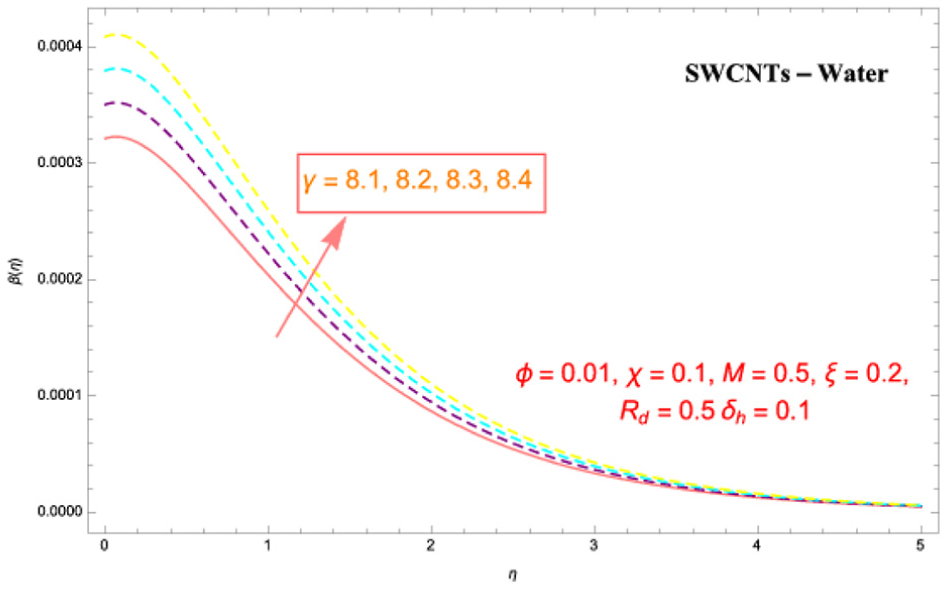
This section demonstrates the behavior of various physical parameters like , , , and on , , , , and versus SWCNT nanoparticles. The physical interpretations of model flow and coordinate axis are elaborated through Figure 1. Figures 2–4 represent h-curves for , , and . The comparison of HAM and numerical scheme has been shown graphically in Figures 5–7 for velocities and and temperature , respectively. The characteristics of various pertinent physical quantities like versus for SWCNTs are addressed in Figures 8 and 9. Figure 8 is sketched to display the variation in for various values of . An increase in (magnetic field) leads to decrease in . This is due to the fact that the presence of magnetic field in the flow creates a force known as the Lorentz force, which acts as a retarding force, and consequently, the momentum boundary layer thickness decelerates throughout the flow on the rotating disk. corresponds to hydro-magnetic flow and displays hydro-magnetic flow situation. Impact of on profile in the presence of SWCNTS is shown in Figure 9. From Figure 9, we can perceive that displays the increasing trend corresponding to higher magnitude of . Actually, directly relates with convective flow. The features of different appropriate physical factors against filed for SWCNTs nanoparticles are elaborated through Figures 10 and 11. Figure 10 demonstrates the variation in for varying (magnetic parameter). It has been observed that field declines when increases. The impact of on in the presence of SWCNTS is revealed in Figure 11. From Figure 11, we can witness that displays snowballing behavior corresponding to large value of . Figures 12 and 13 are sketched to disclose the performance of various suitable model factors like against thermal field with SWCNT nanoparticles. The outcome of on is established in Figure 12 in the presence of SWCNTs nanoparticles. Here, the larger magnitude corresponds to the increase in field and enhances the related viscosity of thermal film. Physically, strengthening transmits extra heat to operational nanoliquids. Figure 13 addresses the significance of on profile and thermal boundary film with SWCNTs as nanoparticles. The field boots when magnitude of is enhanced. The stronger or disk convection parameter leads to the increase in the surface temperature that permits the thermal effect to penetrate deeper into the quiescent nanofluid.
The comparison between HAM and numerical solution for profile.
The comparison between HAM and numerical solution for profile.
The comparison between HAM and numerical solution for profile.
Plots of via (magnetic parameter).
Plots of via (nanoparticle volume fraction).
Plots of via (magnetic parameter).
Plots of via (volume fraction).
Plots of via (radiation parameter).
Plots of via (Biot number).
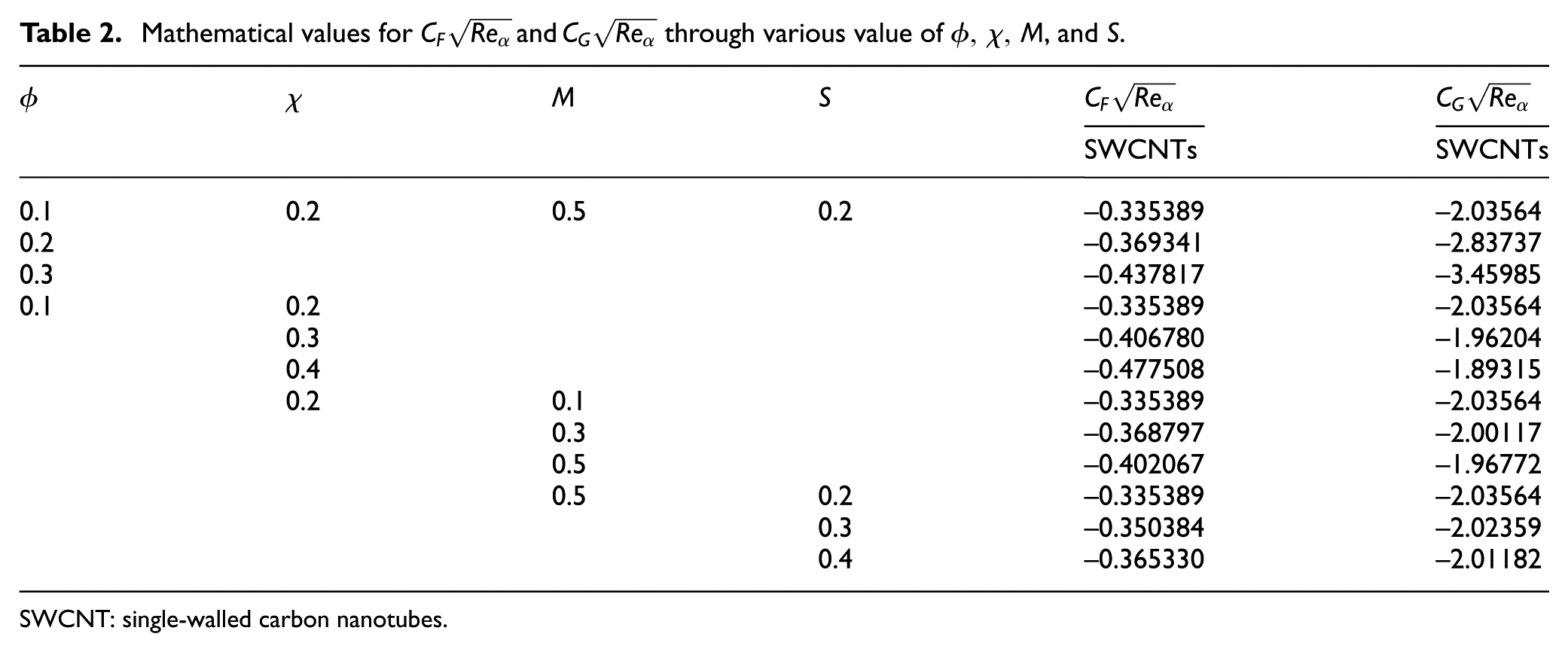
Table 1 portrays certain thermophysical properties of water and nanoparticles specifically SWCNT. Different numerical characteristics of , and against for SWCNTs water are defined in Table 2. Clearly, Table 2 shows that of SWCNTs is reduced for various increasing values of , and but shows increments for higher approximation of . Similarly, from Table 2, we can also observe the behavior of , and against . Table 3 explains the influence of against for both cases of nanoparticles (SWCNTs). From Table 3, we noticeably observed that the model parameters relate to enrichment. The comparison of HAM and numerical solutions for the velocity fields is shown in Tables 3 as well as in Table 4, and from both results, a close agreement between these two methods has been perceived (Table 5).
Particular thermophysical properties of water and nanoparticles (SWCNT).8,9
Physical properties
Base liquid
Nanoparticle
Water
SWCNT
997
2600
4197
425
0.613
6600
0.05
106
SWCNT: single-walled carbon nanotubes.
Mathematical values for through various value of , and .
SWCNTs
SWCNTs
0.1
0.2
0.5
0.2
−0.335389
−2.03564
0.2
−0.369341
−2.83737
0.3
−0.437817
−3.45985
0.1
0.2
−0.335389
−2.03564
0.3
−0.406780
−1.96204
0.4
−0.477508
−1.89315
0.2
0.1
−0.335389
−2.03564
0.3
−0.368797
−2.00117
0.5
−0.402067
−1.96772
0.5
0.2
−0.335389
−2.03564
0.3
−0.350384
−2.02359
0.4
−0.365330
−2.01182
SWCNT: single-walled carbon nanotubes.
Mathematical values for through various values of , and .
SWCNTs
0.2
0.2
6.2
8
−0.104190
0.3
−0.104115
0.4
−0.104039
0.2
0.2
−0.104190
0.4
−0.103618
0.6
−0.103068
0.2
6.2
−0.104190
6.3
−0.106642
6.4
−0.109085
6.2
8
−0.104190
8.1
−0.106602
8.2
−0.109014
SWCNT: single-walled carbon nanotubes.
The relationship between HAM and ND-Solve for velocity field .
HAM solution
Numerical solution
Absolute error
0
0.860613
0.771675
0.5
0.537335
0.504868
1.0
0.332745
0.333967
1.5
0.204600
0.222710
2.0
0.125178
0.149294
2.5
0.076335
0.100258
3.0
0.046454
0.067045
3.5
0.028233
0.044015
4.0
0.017145
0.027217
4.5
0.010407
0.013543
5.0
0.006315
0.006378
HAM: homotopy analysis method.
The relationship between HAM and ND-Solve is shown for .
HAM solution of
Numerical solution
Absolute error
0
0.776819
0.729503
0.5
0.455582
0.424247
1.0
0.270592
0.245929
1.5
0.162014
0.142277
2.0
0.097490
0.082196
2.5
0.058845
0.047421
3.0
0.035586
0.027297
3.5
0.021545
0.015641
4.0
0.013054
0.008865
4.5
0.007912
0.004891
5.0
0.004797
0.002512
5.5
0.002909
0.001021
6.0
0.001764
0.00000
HAM: homotopy analysis method.
Conclusion
Here, in present communication, the significance of MHD-radiated three-dimensional flows of nanofluid containing CNT (SWCNTs) nanoparticles due to stretchable rotating disk with velocity slip impact is described. Heat transport mechanism is explained by convective boundary condition. The critical points of this work are pinpointed in the following
The acts of against field are qualitatively comparable.
An increase in leads to decline in fields.
Both fields drop for large magnitude of (velocity slip factor).
High value of (stretching strength factor) displays an increase in , but opposite trend is observed in .
Higher values of yield an enhancement in .
Thermal field increases with increase in the magnitude of .
The thermal layer is enhanced via higher value of .
is enhanced for larger value of .
is upraised for longer magnitude of for both cases of nanoparticles.
The accuracy of the HAM results has been verified via numerical scheme.
Footnotes
Handling Editor: Takahiro Tsukahara
Declaration of conflicting interests
The author(s) declared no potential conflicts of interest with respect to the research, authorship, and/or publication of this article.
Funding
The author(s) received no financial support for the research, authorship, and/or publication of this article.
ORCID iDs
Zahir Shah
Waris Khan
References
1.
ChoiS. Enhancing thermal conductivity of fluids with nanoparticles. In: SiginerDAWangHP (eds) Developments applications of non-Newtonians flows, vol. 6.Ann Arbor, MI: American Society of Mechanical Engineers, 1995, pp.99–105.
2.
LiYZhouJTungSet al. A review on development of nanofluid preparation and characterization. Powder Technol2009; 196: 89–101.
3.
HsiaoKL. Nanofluid flow with multimedia physical features for conjugate mixed convection and radiations. Comput Fluids2014; 104: 1–8.
NadeemSIjazS. Single wall carbon nanotube (SWCNT) examination on blood flow through a multiple stenosed artery with variable nanofluid viscosity. AIP Adv2015; 5: 107217.
6.
KamaliKBineshA. Numerical investigation of heat transfer enhancement using carbon nanotube-based non-Newtonian nanofluids. Int Commun Heat Mass2010; 37: 1153–1157.
7.
WangJZhuJZhangXet al. Heat transfer and pressure drop of nanofluids containing carbon nanotubes in laminar flow. Exp Therm Fluid Sci2013; 44: 716–721.
8.
HaqRUHammouchZKhanWA. Water-based squeezing flow in the presence of carbon nanotubes between two parallel disks. Therm Sci2014; 20: 148–156.
9.
EllahiRHassanMZeeshanA. Study of natural convection MHD nanofluid by means of single and multi-walled carbon nanotubes suspended in a salt water solutions. IEEE T Nanotechnol2015; 14: 726–734.
10.
KarimipourATaghipourAMalvandiA. Developing the laminar MHD forced convection flow of water/FMWNT carbon nanotubes in a microchannel imposed the uniform heat flux. J Magn Magn Mater2016; 419: 420–428.
11.
AraniAAAAkbariOASafaeiMRet al. Heat transfer improvement of water/single-wall carbon nanotubes (SWCNT) nanofluid in a novel design of a truncated double-layered microchannel heat sink. Int J Heat Mass Tran2017; 113: 780–795.
12.
MahantheshBGireeshaBJShashikumarNSet al. Marangoni convective MHD flow of SWCNT and MWCNT nanoliquids due to a disk with solar radiation and irregular heat source. Physica E2017; 94: 25–30.
KarmanTV. Über laminare and turbulente Reibung. Z Angew Math Mech1921; 1: 233–252.
15.
CochranWG. The flow due to a rotating disk. Math Proc Cambridge1934; 30: 365–375.
16.
MellorGLChapplePJStokesVK. On the flow between a rotating and a stationary disk. J Fluid Mech1968; 31: 95–112.
17.
AroraRCStokesVK. On the heat transfer between two rotating disks. Int J Heat Mass Tran1972; 15: 2119–2132.
18.
TurkyilmazogluMSenelP. Heat and mass transfer of the flow due to a rotating rough and porous disk. Int J Therm Sci2013; 63: 146–158.
19.
TurkyilmazogluM. Nanofluid flow and heat transfer due to a rotating disk. Comput Fluids2014; 94: 139–146.
20.
SheikholeslamiMHatamiMGanjiDD. Numerical investigation of nanofluid spraying on an inclined rotating disk for cooling process. J Mol Liq2015; 211: 577–583.
21.
TurkyilmazogluM. Fluid flow and heat transfer over a rotating and vertically moving disk. Phys Fluid2018; 30: 063605.
22.
QayyumSKhanMIHayatTet al. Comparative investigation of five nanoparticles in flow of viscous fluid with Joule heating and slip due to rotating disk. Physica B2018; 534: 173–183.
23.
AzizAAlsaediAMuhammadTet al. Numerical study for heat generation/absorption in flow of nanofluid by a rotating disk. Results Phys2018; 8: 785–792.
24.
NasirSIslamSGulTet al. Three-dimensional rotating flow of MHD single wall carbon nanotubes over a stretching sheet in presence of thermal radiation. Appl Nanosci2018; 8: 1361–1378.
25.
ShahZDawarAIslamSet al. Darcy-Forchheimer flow of radiative carbon nanotubes with microstructure and inertial characteristics in the rotating frame. Case Stud Therm Eng. Epub ahead of print 12October2018. DOI: 10.1016/j.csite.2018.09.007
26.
MuhammadSAliGShahZet al. The rotating flow of magneto hydrodynamic carbon nanotubes over a stretching sheet with the impact of non-linear thermal radiation and heat generation/absorption. Appl Sci2018; 8: 482.
27.
HammedHHaneefMShahZet al. The combined magneto hydrodynamic and electric field effect on an unsteady Maxwell nanofluid flow over a stretching surface under the influence of variable heat and thermal radiation. Appl Sci2018; 8: 160.
28.
AbdullahShahZIdressMKhanWet al. Impact of thermal radiation and heat source/sink on Eyring–Powell fluid flow over an unsteady oscillatory porous stretching surface. Math Comput Appl2018; 23: 20.
29.
IshaqMAliGShahZet al. Entropy generation on nanofluid thin film flow of Eyring–Powell fluid with thermal radiation and MHD effect on an unsteady porous stretching sheet. Entropy2018; 20: 412.
30.
ShahZBonyahEIslamSet al. Radiative MHD thin film flow of Williamson fluid over an unsteady permeable stretching. Heliyon2018; 4: e00825.
31.
JawadMShahZIslamSet al. Darcy-Forchheimer flow of MHD nanofluid thin film flow with Joule dissipation and Navier’s partial slip. J Phys Commun2018; 2: 115014.
32.
KhanNZuhraSShahZet al. Slip flow of Eyring-Powell nanoliquid film containing graphene nanoparticles. AIP Adv2018; 8: 115302.
33.
KhanAShahZIslamSet al. Darcy–Forchheimer flow of micropolar nanofluid between two plates in the rotating frame with non-uniform heat generation/absorption. Adv Mech Eng2018; 10: 1–16.
34.
LiaoSJ. Homotopy analysis method in non-linear differential equations. Heidelberg: Springer and Higher Education Press, 2012.
35.
TurkyilmazogluM. Convergence accelerating in the homotopy analysis method: a new approach. Adv Appl Math Mech2018; 10: 1–24.
36.
TurkyilmazogluM. Parameterized Adomian decomposition method with optimum convergence. ACM T Model Comput S2017; 27: 1–22.
37.
SheikholeslamiMKHanITliliI. Non-eq32 model for nanofluid free convection inside a porous cavity considering Lorentz forces. Sci Rep2018; 8: 16881.
38.
SheikholeslamiM. Application of Darcy law for nanofluid flow in a porous cavity under the impact of Lorentz forces. J Mol Liq2018; 266: 495–503.
39.
SheikholeslamiMLiZShafeeA. Lorentz forces effect on NEPCM heat transfer during solidification in a porous energy storage system. Int J Heat Mass Tran2018; 127: 665–674.
40.
ShahZIslamSGulTet al. Three dimensional third grade nanofluid flow in a rotating system between parallel plates with Brownian motion and thermophoresis effects. Results Phys2018; 10: 36–45.
41.
ShahZGulTKhanAMet al. Effects of hall current on steady three dimensional non-Newtonian nanofluid in a rotating frame with Brownian motion and thermophoresis effects. J Eng Technol2017; 6: 280–296.
42.
ShahZIslamSAyazHet al. Radiative heat and mass transfer analysis of micropolar nanofluid flow of Casson fluid between two rotating parallel plates with effects of hall current. J Heat Transf2018; 141: 022401.
43.
ShahZIslamSGulTet al. The electrical MHD and hall current impact on micropolar nanofluid flow between rotating parallel plates. Results Phys2018; 9: 1201–1214.
44.
ShahZIslamSBonyahEet al. Impact of thermal radiation on electrical mhd rotating flow of carbon nanotubes over a stretching sheet. AIP Advances2019; 9: 015115.
45.
NasirSShahZIslamSet al. Darcy Forchheimer nanofluid thin film flow of SWCNTs and heat transfer analysis over an unsteady stretching sheet. AIP Advances2019; 9: 015223.