



Abstract
With the development of the economy and the increase in passenger flow, the contradiction between urban rail transit demand and capacity is becoming more and more prominent. Increasing the number of on-line vehicles can ease this situation. Because of no increase in investment, the total number of subway vehicles is fixed. And the total vehicles include the maintenance vehicles and the on-line vehicles. Therefore, this article aims to optimize advanced maintenance cycle, so that the maintenance vehicles reduce and the on-line vehicles increase. First, the minimum value of the key components safe and reliable operating mileage is determined. Then, the Queuing Theory is used to obtain the optimized advanced maintenance cycle. Finally, reasonable maintenance plans are arranged based on the optimized maintenance cycle. The on-line vehicles increase by the optimized advanced maintenance cycle, which can relieve passenger flow pressure and meet urban rail transit demand. In addition, the reasonable maintenance plans can ensure that vehicles at the same level of reliability and within the specified mileage to complete the advanced maintenance and ensure the safe and reliable operation of vehicles.
Introduction
As a major mode of travel, urban rail transit has taken on a large amount of passenger traffic. For such a large passenger load intensity situation, large number of urban rail vehicles on the line and a high level of operational reliability are necessary. The advanced maintenance cycle of the urban rail transit vehicle has a direct impact on the on-line level of the vehicle and the operational safety service. In fact, the total number of subway vehicles (total number of vehicles = number of on-line vehicles + number of maintenance vehicles) is fixed. The number of vehicles parked in the repair library is also fixed. If the vehicle maintenance cycle can be optimized (the maintenance interval can be increased), the number of vehicles in the repair library will be reduced. Thereby, the number of vehicles on the line will be increased to improve the level of operation reliability.
Many methods have been proposed to optimize the maintenance cycle of advanced maintenance. H Wu 1 established a multi-objective umbrella maintenance decision-making model based on the actual security needs of the equipment. Martorell S 2 believed that in the case of increasing passenger flow, the number of on-line traffic of urban rail transit vehicles can meet the needs of passengers within a certain range. Through the study of maintenance mode of electromechanical equipment, S Yan et al. 3 reached a conclusion that reasonably adjusting the maintenance cycle and maintenance frequency can ensure the safety and reliable operation of urban rail transit vehicles. The study of HK Lo 4 showed that vehicle utilization is closely related to the number of vehicles being repaired and the vehicles to be repaired. KW Pang focused on the reliability management of the operation and maintenance of urban rail transit and emphasized the relationship between maintenance and operation time, cost, and safety culture. S Xu 5 used multi-objective fuzzy theory to establish the model to solve the door system to form the best maintenance cycle of the switch. Y Sun 6 applied the fuzzy decision theory to choose the best maintenance cycle. But they all discussed the maintenance cycle of some parts and did not consider the maintenance cycle of the entire vehicle.
There are many reliability analysis methods of components that are worth learning. Bollinger and Salvia 7 studied independent identically distributed components, using different methods to calculate the reliability of k components taken out from continuous n. Lambiris and Papastavridis 8 proposed the exact formula for the reliability of linear and ring systems in the case of independent and homogeneous distributions. Fu and Hu 9 used the embedded Markov chain technique and proposed the formulas for the reliability of k/n systems in the case of independent but different distributed components. L Qin and Z Lixin 10 used stochastic process and reliability theory to study the distribution law and reliability analysis method of component failure rate of rail transit vehicle. Y Zhao 11 explored the reliability and security of rail transit vehicle wheel. S Liu et al. 12 have optimized equipment reliability and maintenance economics, combined with multi-objective optimization methods, established a rail vehicle maintenance cycle optimization model. Z Bi et al. 13 used discrete modeling techniques to construct an armored vehicle scheduling model based on preventive maintenance. S Lv et al. 14 made appropriate repairs to existing equipment, and proposed adjustment methods for maintenance intervals.
This article aims to optimize the advanced maintenance cycle based on the key component selection and reliability analysis, and arrange advanced maintenance plans. The remainder of this article is organized as follows. Section “Maintenance cycle optimization” presents the maintenance cycle optimization. Section “Reasonable maintenance” presents maintenance plan. Section “Conclusion” concludes the article.
Maintenance cycle optimization
The urban rail transit managers maintain the vehicles according to the standard of advanced maintenance. In addition, the standard refers to the advanced maintenance cycle provided by the supplier, which is 600,000 km. In fact, 600,000 km is conservative, and most metros choose to maintain the vehicles when their operating mileages are over 600,000 km. Therefore, we use the analytic hierarchy process (AHP) method based on ABC classification to select key components (but we do not describe specifically in this article). Then, we analyze the reliability of the key components. We take the minimum value of the operating mileages about key components as the maximum value of maintenance mileages according to the cask effect. The maintenance mileages, which is mean to the maintenance cycle, is determined.
Definitions
Advanced maintenance
According to the GB50157-2003 “Code for design of metro” 15 provisions, the subway vehicles running 5–6 years or running mileage of 50–60 million kilometer or so need to carry out advanced maintenance.
Advanced maintenance cycle
Advanced maintenance cycle refers to time interval or operating mileage interval when the urban rail transit vehicles are into advanced maintenance each time.
Selection of key components
The entire vehicle system is very large and numerous. If the reliability of all the components is analyzed, much manpower and time will be spent. If regardless of primary, severity, and urgency, it is easy to make inappropriate reliability analysis and ultimately affect the analysis results. From the view of maintenance engineering, the following four aspects are considered as the criteria for selecting key components:
Operational safety
Judge the component impact on the urban rail transit operation safety. The severity of vehicle failure is influenced by the damage level of components as well as vehicle delays, casualties, and economic losses caused by the vehicle failure.
Operational service
Judge the component impact on the rail transit operation service. The components failure or damage influences on the level of rail transit services and passenger comfort.
Maintenance cost
Maintenance cost, which refers to the actual cost incurred during the maintenance process, including labor costs and spare parts costs.
Failure rate
Since the results caused by different types of components are different, the failure rate classification should consider the components failure occurrence times. If the components failure will be a direct impact on vehicle operation safety, the probability that the components failure occurrence by one time will be as a basis for judging. If the components failure will have little influence on the security of vehicle operation but have great impact on service reliability of vehicle operation, the times of the components failure is the basis of judgment of failure rate.
According to the four criteria, we can establish a component classification AHP model (Figure 1).

AHP model of component classification.
Meanwhile, the classification result used by ABC principle is shown in Table 1.
Classification result.
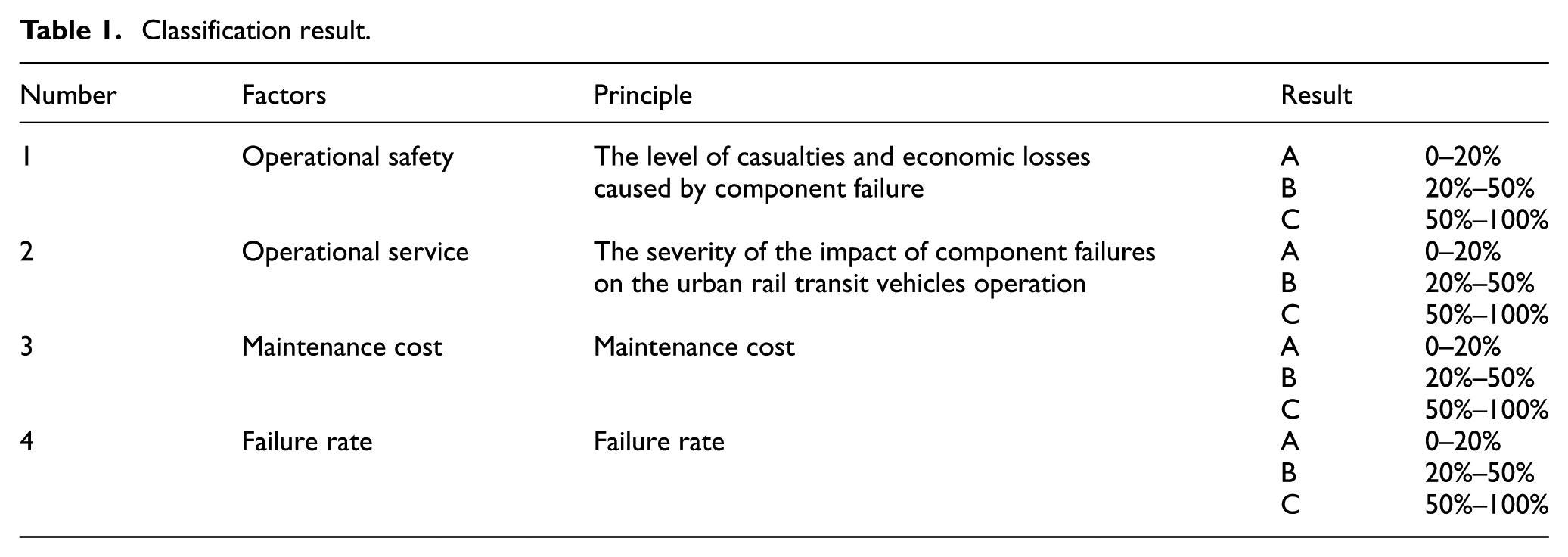
Therefore, the key components we selected are bogie system, brake system, traction system, automatic train control (ATC) system, and train control and management system (TCMS) system.
Key component reliability analysis
After the classification of urban rail transit component, the key components reliability data will be counted, and the change law of the key components will be analyzed to determine its reliable state. Component life refers to the duration the component is used from the beginning to the time of failure. Therefore, the statistics of urban rail transit vehicle life should be based on the number of operation kilometers. Advanced maintenance cycle of urban rail transit vehicle can be seen as the life of its components. Therefore, in the collection of statistical vehicle data, the running mileage of urban rail transit vehicles when the vehicle has failed should also be reported.
Optimization results
N Metro advanced maintenance center provides the fault conditions of the key components which enters the standard of advanced maintenance (the standard of advanced maintenance refers to the advanced maintenance cycle provided by the supplier, which is 600,000 km). The figures of the failure trend of the key components are shown in Figures 2–6, respectively. Horizontal coordinate represents running mileage (10,000 km). Vertical coordinate represents the failure rate under corresponding running mileage. And according to the reliability standard (which is shown as Table 2), we can obtain the running mileage of each key component (green number) when the reliability is 0.09.
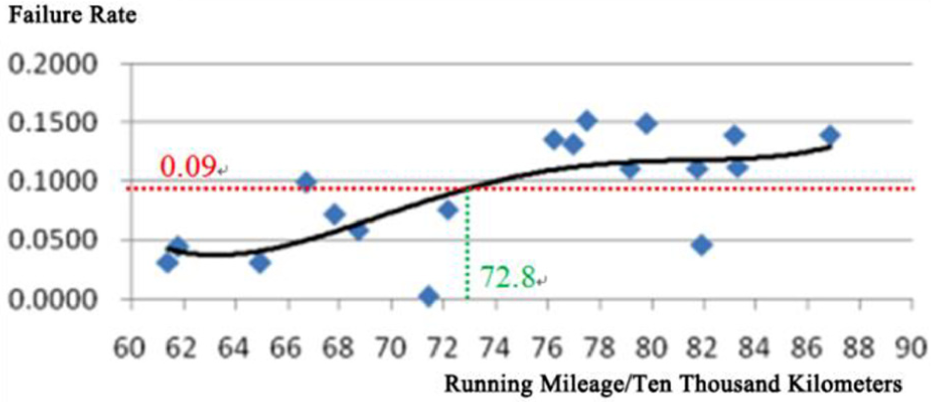
Bogie system.

Brake system.
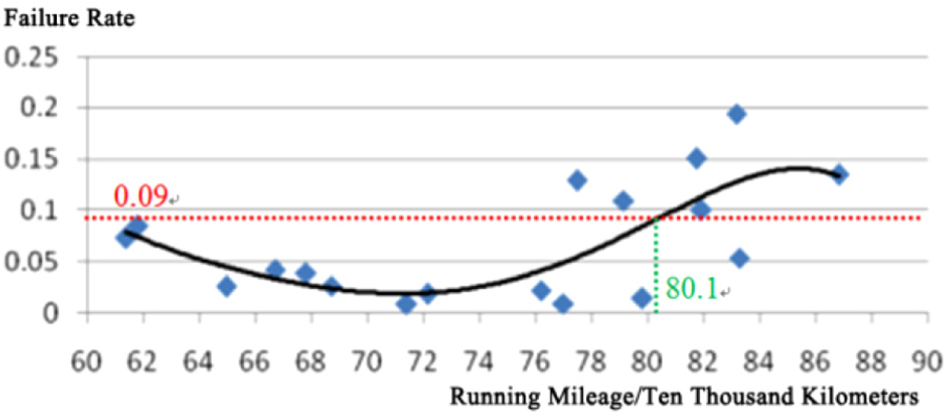
Traction system.

ATC system.

TCMS system.
Reference standard.

The reliability state evaluation of the components is in accordance with the standard in the national standard “GB/T 50438-2007 Standard for the Operation Safety Assessment of Existing Metro.” 15 The reference standard is shown in Table 1. It can be seen that 0.09 is a threshold.
It can be seen that the safe and reliable operating mileage range of key equipment components is L = {728,000, 772,000, 801,000, 872,000, and 801,000 km}, respectively.
If any of the selected key components fail, the vehicle will be out of service. According to the buckets effect, in order to ensure the safe and reliable operation of the vehicle, the minimum value 730,000 km is chosen as the optimized vehicle maintenance cycle. The advanced maintenance mileage standard provided by N Metro is 600,000 km. Therefore, when operating mileage of the vehicle is greater than 600,000 km, the vehicle can be in the advanced maintenance. At the same time, ensure that the operating mileage of all vehicles which into the advanced maintenance cannot exceed 730,000 km. Therefore, the optimized advanced maintenance cycle is [600,000, 730,000 km].
Reasonable maintenance
In section “Maintenance cycle optimization,” we obtain the optimized advanced maintenance cycle and bring it into the queuing model. In addition, we already have the number of vehicles and that of advanced maintenance desks. Therefore, we can get the optimized maintenance duration range. Furthermore, we can confirm maintenance duration by arranging maintenance plans.
Queuing theory
M/D/c queuing model
This model can be used to solve the following queuing system. The customer arrives at Poisson flow with a parameter of λ (λ > 0). The service time required for each customer is independent constant D. There are c (c ≥ 1) service stations in the system. System capacity is infinite, which obeys the first come first served (FCFS) service rules. The system-state probability and latency probability of the M/D/c queuing model are shown in the following equations

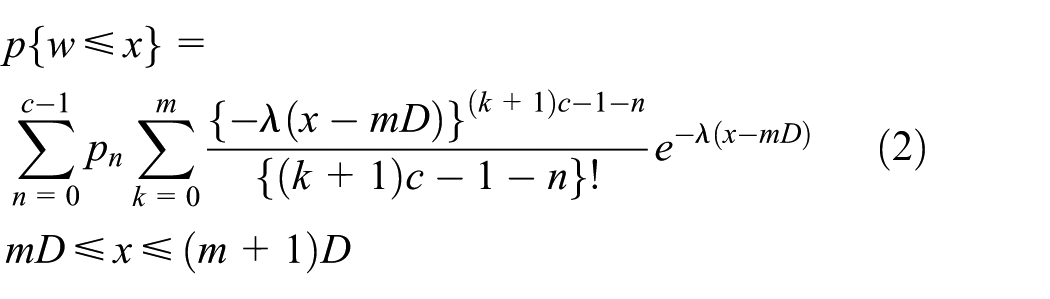
However, a convenient solution method based on the fast Fourier transform (FFT) was used. The expression of the parent function P(z) of the state probability Pj is as follows
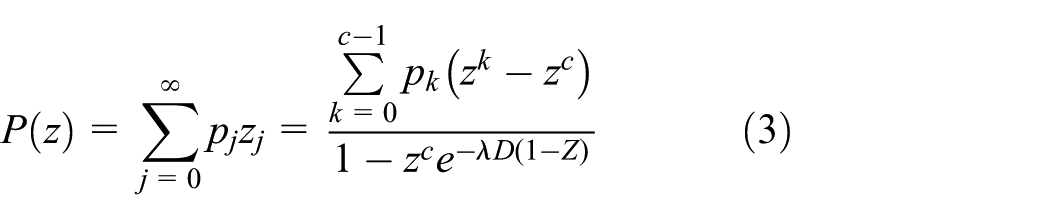
Transform a form in which an FFT method can be applied
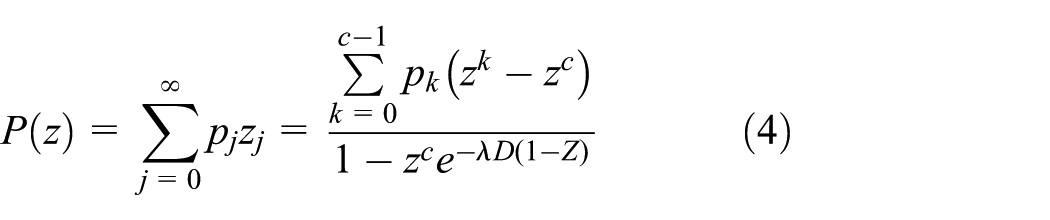
The operational indicators of the system are as follows



The average length of stay and the waiting time are obtained by the little formula


where
Application examples
Assume that the advanced maintenance desk number in N Metro is 2. Taking the vehicles of N Metro Line 2 as the research object, so there are 23 trains on Line 2 waiting to be maintained on maintenance desk. According to the formula of M/D/c queuing model, make queuing length ≤Φ. The actual vehicle on-line rate (Φ) is decided by the metro.
N metro early peak is a period when the number of on-line vehicles is the largest in a day. The number of on-line vehicles of Line 2 in early peak is 32(Φ ≤ 5).
If Φ =5,
Maintenance plan
If one key component is already in an unreliable state, the vehicle must exit the mainline operation into advanced maintenance.
If the key components are in a reliable state, the optimized maintenance cycle range is [600,000, 730,000 km]. Take N Metro Line 2, as an example 15 vehicles which to be repaired and an advanced maintenance work desk for an example to arrange maintenance plans, as shown in Table 3.
Advanced maintenance schedule.

First, sort the running kilometers up to now from the largest to the smallest. A train with a mileage which is much closer to 730,000 km should be at the top of the maintenance plan because the upper limit of the maintenance cycle is 730,000 km. There is only one advanced maintenance work desk, which means that every time, only one train can be maintained. First, repair train 0001, of which the maintenance cycle is more close to 730,000 km. When train 0001 is being repaired, train 0002 still needs to run. Assuming the train runs 400 km a day, the duration of the advanced maintenance is N2 days. Therefore, when train 0002 enters advanced maintenance, the running mileage of train 0002 = the running mileage before (B) + 400*N2. This is same for the leaving trains which are waiting for being repaired. But, when all the trains are into the advanced maintenance, their mileage cannot be more than 730,000 km. Therefore, a formula can be obtained

where NN1 is the running mileage when the train is into the advanced maintenance, NN is the running mileage when the first train is into the advanced maintenance, N2 is the maintenance time, and n is the ranking of the team waiting to be repaired.
Through the above formula, we obtain the final N2 ≤ 27 (days). And according to the maintenance, time range based on the queue theory is N2 ≥ 27 (days). Therefore, the chosen duration of the advanced maintenance is 27 days. When the maintenance time last 27 days, an advanced maintenance work desk can achieve the advanced maintenance of 15 trains that lasted 405 days, ensure the mileage of each train is not more than 730,000 km when into the advanced maintenance, and ensure that there is no lack of the maintenance.
Considering that the distance between the 35 trains of Line 2 should be pulled to around 10,000 km, the mileage gap between the trains will be maintained at a balanced value. Therefore, when a train is being repaired for 27 days, the operating mileage of the other train is the sum of original operating mileage and the operating mileage of the 27 days (in accordance with the 400 km/day to consider), which just reaches the advanced maintenance standards. This advanced maintenance plan, not only can reduce the train lack of repair but can also take full advantage of the maintenance time and maintenance of space resources.
The operating mileage distance of some trains is slightly smaller, so consider the distance to be expanded to 10,000 km by human. Therefore, these trains considered to absent during the operation of peak hours and park in the maintenance library for a month, to balance the mileage gap between each train.
Conclusion
The key equipment of the urban rail transit vehicle is selected, the reliability analysis is carried out, and the advanced maintenance cycle is optimized based on the reliability analysis. According to the fault data of key components provided by N Metro, after the reliability analysis, the optimized maintenance cycle range obtained is [600,000, 730,000 km]. The optimization of maintenance cycle can increase the maintenance interval and the number of vehicles on the line, which can alleviate the contradiction between urban rail transit demand and capacity, ease the problem of urban traffic congestion to some extent.
Based on the M/D/c queuing model and the data provided by N Metro, the maintenance duration of the vehicle entering the advanced maintenance is ≥27 days.
After obtaining the optimized maintenance cycle range and the maintenance time, based on the queuing theory and the data provided by N Metro, arrange the maintenance plan of N Metro Line 2 reasonably. Reasonable maintenance plans can ensure that vehicles at the same level of reliability and within the specified mileage to complete the advanced maintenance and ensure the safe and reliable operation of vehicles. It can also make reasonable use of maintenance time and maintenance space resources and improve the quality and the effectiveness of urban rail transit vehicles maintenance.
Footnotes
Acknowledgements
The authors would like to thank all the participants in their experiment.
Handling Editor: Hai Xiang Lin
Declaration of conflicting interests
The author(s) declared no potential conflicts of interest with respect to the research, authorship, and/or publication of this article.
Funding
The author(s) disclosed receipt of the following financial support for the research, authorship, and/or publication of this article: This research is supported by National Key R&D Program of China (grant no.: 2017YFB1001801), the Fundamental Research Funds for the Central Universities (grant no.: 30917012102), and the Natural Science Foundation of Jiangsu Province, China (rant no.: BK20171426).
