



Abstract
In this article, reduced graphene oxide/Ni/multi-walled carbon nanotubes/Fe3O4 filled paste is synthesized with the aim of developing a novel shielding material. To do so, nano-dispersion presenting homogeneous distribution is made by ultrasonic dispersing technology. Next, the effects of nano-absorbent content on the fluidity, mechanical strength, pore structure, resistivity, and absorbing reflectivity of paste are studied. At the end, the microstructure of composite is uncovered by scanning electron microscopy, Fourier transformer infrared, X-ray diffraction images as well as the pore size distribution and absorbing reflectivity are revealed. The results indicate that a small load of reduced graphene oxide and other nano-absorbents can significantly reduce the fluidity and resistivity of paste, but its pore structure is improved so that its mechanical properties are increased. Scanning electron microscopy images indicate that reduced graphene oxide promotes the increasing and thickening of the cement hydration products as well as the growth of a large number of flower-like and compact bulk crystals. Furthermore, the minimum reflectivity of −10.6 dB is obtained in the range of 2–18 GHz while the effective bandwidth of 16 GHz is obtained when reflectivity is less than −5 dB. This research provides a new pathway for the preparation of monolayer cement–based absorber.
Introduction
Cement-based materials, which possess the advantages of rich raw materials, perfect environmental suitability, high compressive strength, long service life, and so on, have become the main sources of building materials. However, its tensile strength and flexural strength are lower while its electrical conductivity and microwave absorbing efficiency are poorer. Nevertheless, its properties such as strength, durability, absorbing properties can be improved by mixing with fillers. 1 Besides, some researchers considered that cement-based materials added with fillers as a kind of advanced composite material, differ from usual composites in the organization of their material constituents could be used in various engineering applications aerospace, mechanical, structural applications and others.2,3
Carbon nanotube (CNT) is hollow and seamless tubular structure, which is composed of single layer or the multilayer curling flake of graphite. It exhibits excellent mechanical properties,4,5 thermal properties, 6 electrical properties, 7 hydrogen storage properties, 8 and field emission properties. 9 And it can also be easily functionalized through different preparation methods and surface functional modification, so that it meets the requirements for areas like aerospace, electronics, chemical, and biological medical. 10 Multi-walled carbon nanotubes (MWCNTs), as a kind of CNTs, which possesses similar structure to graphene, having excellent properties such as high heat resistance, corrosion resistance, impact resistance, electrical conductivity, and biocompatibility. In particular, its absorbing properties have attracted the interest of many scholars at home and abroad. 11 Li et al. 12 reported the mechanical property of MWCNTs reinforced paste was better than that of single walled CNT-reinforced paste, due to the strong interfacial reaction between the functional specimens on the surface of MWCNTs and the covalent bonding of matrix, MWCNTs could be better anchored in the matrix to improve the load transfer efficiency of composite. Wang et al. 13 found that a proper amount of MWCNTs could significantly improve the fracture energy and the flexural toughness of OPC; Young’s modulus and the flexural strength of composite were increased by 45% and 25%, respectively. Besides, it is shown in scanning electron microscopy (SEM) images that the C-S-H gel in matrix tightly adheres to the surface of MWCNTs, which may be the main reason of the enhancement in the mechanical strength of composite. Kim et al. 14 developed the Ni-coated MWCNTs-filled epoxy matrix nanocomposites prepared by the method of electroless nickel plating. The results show that this method significantly improves the electromagnetic shielding effectiveness of composite. The longer plating nickel time, the better the shielding effect, and the EMI shielding effectiveness are increased by 65% when the plating nickel time increases from 10 to 30 min. Farukh et al. 15 investigated the electromagnetic interference (EMI) shielding property of MWCNTs entrenched poly(3,4-ethylenedioxythiophene) nanocomposite (PCNT). The results show that the maximum shielding effectiveness value of composites in the Ku band is 58 dB, and the shielding mechanism of the PCNT is mainly the absorption attenuation rather than the reflection attenuation. Similarly, Huang et al. 16 developed the MWCNT/polypyrrole/EVA nano-polymeric composites (MWCNTs/PPy) by chemical polymerization. And the shielding effectiveness value of MWCNTs/PPy composites is 55 dB when the contents of MWCNTs and PPy are 18% and 75%, respectively.
Two-dimensional reduced graphene oxide (rGO), as an intermediate product in the oxidation of graphite oxide to graphene, exhibits excellent physical and mechanical properties as graphene. There are numerous active specimens such as hydroxyl (–OH), carboxyl (–COOH), and epoxy (–O–) in its structure which widen the lamellar spacing of graphite and make it possible for the surface attachment of metal particles or inorganic nonmetallic particles. Subsequently, rGO is hydrophilic and easily dispersed into dispersion or formed intercalation complex with other substances.
Present studies mainly focus on the effects of rGO on the hydration process, crystal structure, and mechanical properties of paste.17–21 But researches about paste mixing with rGO, nickel-coated multi-walled carbon nanotubes (Ni/MWCNTs), and Fe3O4 nanoparticles (nano-Fe3O4) are rarely reported. In this article, we take a monolayer of cement-based absorbers as the research objects, to investigate the effect of rGO, Ni/MWCNTs, and nano-Fe3O4 on the fluidity, mechanical strength, microstructure, resistivity, and wave absorbing property of paste. It aims to do theoretical discussions in developing a new type of monolayer cement–based absorber mixing with rGO, Ni/MWCNTs, and nano-Fe3O4.
Experimental procedure
Material
Portland cement type P·II 42.5 (Jiangsu Conch Cement Factory) and silica fume (Shanghai Lidian Silicon Powder Materials Co., Ltd.) are used as the cementitious material. The performance index of silica fume is as follows: the total alkalinity of <1.5%, the SiO2 content of >85%, a specific surface area of 15 m2/g, an active index of >105%, a water content of <3.0%, and a water absorption of <125%. Experiments were conducted with rGO, Ni/MWCNTs, and nano-Fe3O4 (Zhongke Leiming Technology Co., Ltd.). The performance index of rGO is as follows: the purity of >99 wt%, the thickness of 0.55–1.2 nm, a diameter of 0.5–3 µm, and layers of 1–5. The performance index of Type CNT805 Ni/MWCNTs is as follows: the purity of >98 wt%, a diameter of 20–30 nm, a length of 10–30 µm, a surface area of >110 m2/g, the bulk density of 0.27 g/cm3, and a conductivity of 150 s/cm. The performance index of Fe3O4 is as follows: the purity of >99.9 wt%, an average diameter of 20 nm, an apparent density of 0.84 g/cm3, and an absolute density of 4.8–5.1 g/cm3. Whereas, polycarboxylicacid superplasticizer with a water reducing rate of 45% (Shanghai Sanrui Polymer Materials Technology Co., Ltd.) is use to enhance the fluidity of paste.
There are several main apparatuses and facilities used in experiment: type BS-110S electronic analytical balance was manufactured by Beijing Saiduolisi Balance Co., Ltd.; NJ-160A grouting machine was manufactured by Wuxi Jianyi Instrument & Machinery Co., Ltd.; DHG-9146A electrothermal thermostatic blasted drying oven was manufactured by Shanghai Jing Hong Laboratory Instrument Co., Ltd. The microcomputer controlled electronic universal testing machine was manufactured by Wuxi Zhongke Building Materials Co., Ltd.; specific surface area and pore size analyzer (model: Backman, Coulter, SA3100) was produced by American Backman Coulter Company; scanning electron microscope (model: Quanta200, Vantage, DSI) was produced by Thermo Electron Corporation of the United States; VC890D multimeter was manufactured by Shenzhen Vichy Technology Co., Ltd.; HP8722ES vector network analyzer was manufactured by Xintong Electronic Instrument Co., Ltd.
Mix design
Electromagnetic wave will generate reflection transmit into absorbers or be absorbed on the incident surface when it irradiates on the absorbers in any shape, transmit into absorbers or be absorbed. According to the law of conservation of energy, the sum of the incident energy should be the sum of reflected energy, transmitted energy, and absorbed energy. Thus, absorber is designed to achieve the requirement of wide frequency absorption, impedance matching, in simple shape. The cement-based material is a poor conductor of electricity as well as a transparent body of electromagnetic wave. Its imaginary part of magnetic permeability (µ″) in dry state is quite small, and the minimum value is 0.07. Its resistivity for 28d is about 13,200 Ω cm. 22 The degree of perfection of the conductive network formed by the conductive filler in the composite and the barrier potential of the electron transition marginally affected the conductivity while the type and content of absorbents marginally affected its wave absorbing property.
For the requirement of a higher permeability and a better conductivity, absorbents used in monolayer cement–based absorber are particularly important. Nano-absorbents have features of “thin, light, wide, and strong” and advantages such as environmental adaptation, high temperature resistance, high resistance to chloride erosion and impact.
Nano-absorbents such as rGO, Ni/MWCNTs, and nano-Fe3O4 with larger specific surface area exhibit well in conductivity and permeability and absorb waves by interfacial polarization and multiple scattering. To ensure similar fluidity of paste with different amounts of nano-absorbents, the mix design of monolayer cement–based absorber combined with the results of preliminary research was shown in Table 1 (take the quality of cement as 1). The specimen dimensions are 300 × 300 × 30 mm3.
Mix proportion.
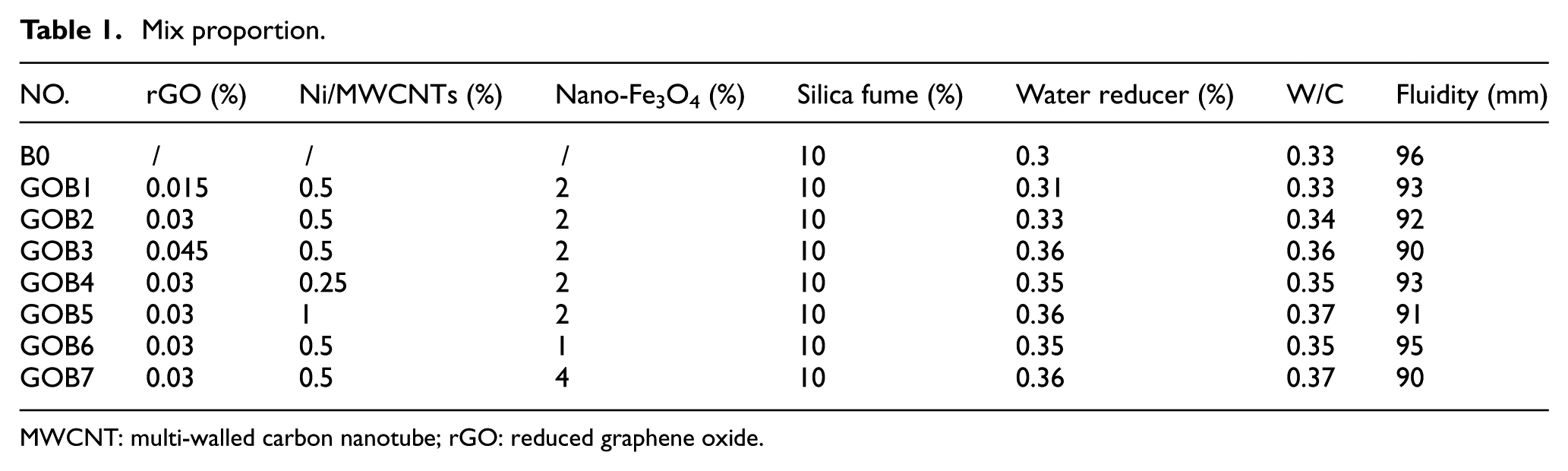
MWCNT: multi-walled carbon nanotube; rGO: reduced graphene oxide.
Measurement
Paste preparation: First, cement and silica fume were added into a planetary mixer and mixed well, then Ni/MWCNTs and nano-Fe3O4 were added and mixed for 2.5 min, then rGO dispersion, water, and water reducer were added and mixed for 2.5 min at low speed, stop for 20 s, and stir for 2.5 min at high speed.
Specimen preparation: The result mixture was cast in 40 × 40 × 160 mm3 and 25 × 25 × 25 mm3 oiled molds, respectively, for mechanical test and conductivity test while its specimens were shaped by vibration. Henceforth, two brass-wire electrodes are embedded in specimens to measure the electrical resistivity. The specimen dimensions for reflectivity test specimen are 180 × 80 × 30 mm3; At least three specimens were fabricated for each specimen and unmolded after 24 h in standard curing box for 28 days subsequently.
Test method: 1. The fluidity paste was measured by self-made miniature slump tester according to “GB/T8077-2000.” The self-made micro slump tester is a steel cylinder with a diameter of 30 mm and a height of 50 mm (net size), as shown in Figure 1. 2. The strength of specimen was measured by the universal testing machine as shown in Figure 2 according to “DL/T 5126-2001.” The compressive strengths of specimens were tested by microcomputer controlled electronic universal testing machine in load-controlled mode with a loading rate of 2.4 kN/s while the flexural strength of specimens was tested at a loading rate of 20 N/s. Whereas, the compressive strengths of specimens can be calculated by

where Fc is the failure load of specimen and A is the cross-sectional area of specimen.

Fluidity test of composite.

Resistivity test of composite.
The flexural strengths of specimens can be calculated by

where Ff is the failure load of specimen, L is the distance between the two support cylinders, and b is the length of cross-section of specimen.
3. The 7d and 28d electrical resistance in conductive concrete is measure by multimeter. The resistivity of specimens is in equation (3)

where R is the electrical resistance of specimen, S is the cross-sectional areas of specimen, and L is the distance between the two electrodes. The specimen is shown as shown in Figure 2.
4. The reflectivity test system is a bow shaped system made up of signal source, vector network analyzer and test antenna. The test is implemented on the basis of radar absorbing material testing standard “GJB2038-2011.”
Result and discussions
The characterization of rGO and MWCNTs
Figure 3 shows the SEM and EDS images of rGO and Ni/MWCNTs.

SEM and EDS images of (a) rGO and (b) MWCNTs.
Figure 3(a) shows the corrugated structure of rGO with rough surface, which may be analogous to a layer of transparent thin film, provides a possibility for its adsorption of heterogeneous particles when it is modified. Figure 3(b) shows the worm-like tubular structure of Ni/MWCNTs. It is about 20–30 nm in diameter and 10–30 µm long, and its surface roughness may be due to the plated Ni. The elements of rGO and Ni/MWCNTs can be obtained from EDS images, as shown in Table 2, Ni/MWCNTs contain chemical elements such as P, Na, S, and Al, which is likely to be mixed with impurities during the preparation process.
Chemical composition of rGO and Ni/MWCNTs.

MWCNT: multi-walled carbon nanotube; rGO: reduced graphene oxide.
Fluidity of paste
The proportion of nano-absorbents in the slump test was carried out as shown in Table 1 to study the effect of nano-absorbent contents on the fluidity of paste. It required the W/C value and the water reducing agent content unchanged; the values were 0.35% and 0.35%, respectively. The fluidity test results of the eight groups of fresh paste were shown in Table 3. It can be seen that the fluidity of paste is in a decreasing trend with the addition of nano-absorbents while it dramatically decreases with the increase of rGO content. The fluidity of specimen GOB3 decreases by 19.6% compared with that of specimen GOB1. Ferroferric oxide nanoparticles and Ni/MWCNTs significantly degrade the workability of paste when the rGO content is constant. Since there are numerous active specimens on the surface of nano-absorbents such as hydroxyl (–OH), carboxyl (–COOH) and epoxy (–O–) in its structure which drastically absorb free water molecules in the cementitious materials because of van der Waals force and result in the obviously reduced fluidity of paste. 23 In general, the fluidity of paste reduces with the increase of the amount of nano-absorbents.
Result of slump test.

Infrared analysis
Figure 4 shows the infrared spectrum of the specimen B0-GOB7.

FTIR spectra of B0-GOB7.
It can be seen in Figure 4, there is a wide absorption band at around 3436 cm−1, corresponding to the antisymmetric flexural vibration band of O–H bond in the rGO, and the EDS spectra supports that there are 31.52% of oxygen elements in rGO. The peak at around 3640 cm−1 arises due to the stretching vibration of free O–H bond.
The peaks at 1631 cm−1 arise due to −C = O− bond stretching, conjugating to the C = C bond and moving to low wavenumbers, which indicates the presence of the −COOH bond. The peak at 1114 cm−1 corresponds to the C–O–C bond stretching, indicating the presence of −O− bond. Furthermore, the peaks at 1631 and 1429 cm−1 are the skeleton vibration of the benzene ring structure in graphene. The peak at 876 cm−1 shows the flexural vibration of C–H bond in the phenyl ring structure of graphene. In general, the peak intensity increases with the increase of rGO content, which indicates that rGO can accelerate the hydration reaction of cement. 21
X-ray diffraction analysis
X-ray diffraction (XRD) patterns of cement-based composites with different mix proportions show no significant difference as shown in Figure 5, indicating all specimens possess similar mineral composition. There are characteristic peaks of Ca(OH)2, CaCO3, C3S, and SiO2 in 0° < 2θ < 70°. And the position of the characteristic peaks of different specimens is basically in coincidence as well as no new phase produced. There were differences among the molding time of specimens B0-B3 and B4-B7, and the different ages of composite caused the content of CaCO3 in B0, B1, B2, and B3 were lower than that of B4-B7. In addition, there are almost no characteristic peaks of rGO observed in the XRD spectra because the amount of rGO is small.

XRD patterns of B0-GOB7.
SEM analysis
The microstructure of paste at 28 days is revealed by the SEM images of specimen B0-GOB7 as shown in Figure 6.

SEM images of specimens at 28 days: (a) B0, (b) GOB1, (c) GOB2, (d) GOB3, (e) GOB4, (f) GOB5, (g) GOB6, and (h) GOB7.
SEM images show the main crystallization products of paste with nano-absorbents are mainly AFt, AFm, CH, and C-S-H gel as well as lots of flaky and dense bulk crystals. The crystals show different shapes with the change of nano-absorbent content. Figure 6(a) shows a large number of pores and blisters but no crystals in special shape, which are due to the large value of W/C and no nano-absorbents are added. Figure 6(b) shows a large number of flake crystals superimposing and crowding together while there are some lumpish crystals shown in Figure 6(c) and (d). And the bulk crystallization is neat, dense, and texture clear in Figure 6(d); Figure 6(f) shows that the Ni/MWCNTs cluster together, which may be due to the uneven dispersion of nano-absorbents; Figure 6(h) shows that the petal-like crystal is evenly dispersed and intertwined together. Besides, crystal in scattered state is also observed, which may be nano-Fe3O4 particles. Zhao et al. 24 reported that the active functional specimens on the surface of rGO can absorb plenty of free water; therefore, the cement particles near active functional specimens gradually hydrated along with the continuous hydration reaction. As a result, compacted crystals are formed near the active functional specimens and it can significantly improve the mechanical properties of paste.
The pore structure of paste
The specific surface area, total pore volume, and pore size distribution of specimen GOB1~3 were investigated to study the effect of rGO content on the pore structure of paste, as shown in Table 4. The specific surface area and total pore volume of specimens were computed by Barret–Joyner–Halenda (BJH) method while the pore size distribution of specimens was computed by density functional theory (DFT) method. Table 4 shows that the total pore area, total pore volume, and average pore size of paste are greatly reduced with the increase of rGO content, and these values of specimen GOB3 are respectively decreased by 19.2%, 18.2%, and 19.4% compared with that of specimen GOB1. Furthermore, the pore size distribution of paste is also affected by the increasing rGO content. There is a marked increase in the number of microporous (size < 20 nm) and a marked decline in the number of large pores (size > 80 nm) as well as little change in the number of mesopore. The number of microporous in specimen GOB3 is increased by 16.4% compared with that of specimen GOB1 while the number of large pores is reduced by 51.7%. This change trends conform to research results of Lv et al. 25
Result of pore structure in cement paste.

It is obvious that paste is a kind of cementitious material with high porosity and contains a variety of pore and micro fracture in its structure. rGO, Ni/MWCNTs, and nano-Fe3O4 with small size effect are able to fill pores and micro cracks in cementitious materials. Moreover, nano-absorbents also promote the growth of the hydration products as well as the formation of compact structure and thick texture of hydration products. As a result, the total pore area, total pore volume, and average pore diameter of paste are greatly reduced. Meanwhile, the large pore and micro cracks in paste provide enough room for the growth of hydrated product.
Figure 7(a)–(c) presents the SEM micrographs of pore and micro cracks in the specimen GOB1, GOB2, and GOB3, respectively. It can be observed an interesting phenomenon that both sides of pores or cracks are no longer traditional smooth surface, but surface with petal-like crystals intertwined together which grow straightly in the direction of pores. It proves that nano-absorbents improve the pore size distribution of paste and significantly decrease the number of large pores which is also one reason for the improvement of the mechanical strength in paste.

SEM images of specimens of three different proportions at 28 days: (a) GOB1, (b) GOB2, and (c) GOB3.
The mechanical properties of paste
Figure 8 presents the compressive strength and flexural strength of paste with different proportions. It can be observed that rGO is successful in enhancing the mechanical properties of paste especially for flexural strength. The 7d compressive strength and flexural strength of specimen GOB3 are 73.9 and 9.9 MPa, respectively, which is increased by 34.9% and 50% compared with the values of specimen GOB1. The 28d compressive strength and flexural strength of specimen GOB3 are 98.7 and 12.1 MPa, respectively, which is increased by 38.4% and 30.1% compared with the values of specimen GOB1. The results conform to research results of M Saafi et al. 26

(a) Compressive strength and (b) flexural strength of paste.
The mechanical properties of paste increase with Ni/MWCNTs content, but reduced with nano-Fe3O4 content. Furthermore, the compressive strength and flexural strength of specimen GOB1 and specimen GOB7 are no better than that of specimen BO (control specimen). It is the unique corrugated structure of graphene oxide nanosheets, which can act as templates and provide sites for the hydrated crystal of paste in the hydration process, thickening the hydration product crystals, playing an important role in reinforcing as well as toughening the paste. As the result, that improve the mechanical properties of paste. Wang et al. 6 investigated the hydration process of paste with rGO. The results show that rGO can accelerate the nucleation, growth, and separation process of hydration product.
The conductivity of paste
Figure 9 shows that the conductive properties of paste can be effectively improved between conductor and insulator when incorporated with nano-absorbents. The measurement of resistivity in specimen GOB1-7 is larger compared with the research result of Chen et al. 22 Because a little of nanoparticles in matrix is irregularly dispersed, and the distance between nanoparticles is too large to cross barrier. As a result, nano-absorbents have little influence on the conductivity of composites. However, nanoparticles gradually form the conductive phase clusters with the increase of nano-absorbent content and form a conductive network in matrix. In conclusion, the absorber is converted from an insulator to a semiconductor or a conductor.
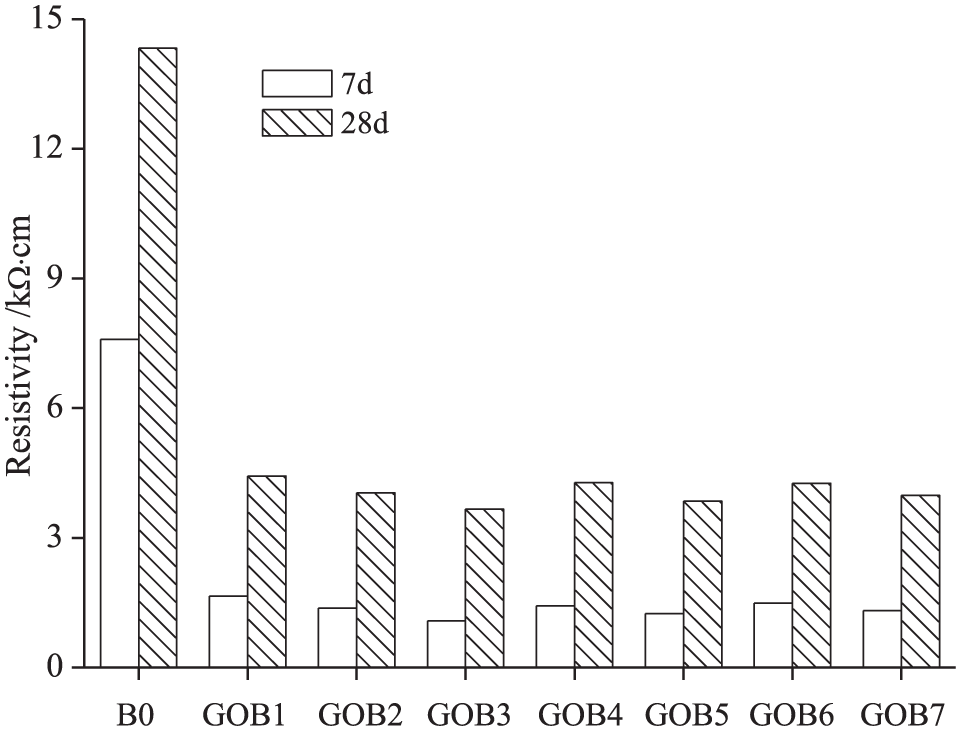
Resistivity of paste.
For the specimens of same proportion, the resistivity of specimen at 28 days is higher than that of specimen at 7 days. Because free water molecules in matrix reduce continuously with the growth of age, and the possibility of water molecules linking with nano-absorbents decreases, resulting in the increase of resistivity.
Influence of rGO on the reflectivity of paste
According to the theory of electromagnetic shielding, reflectance is an important indicator of absorbing properties evaluation. Thereby, electromagnetic wave absorbing and shielding materials can be used in general building when the absorbing material reflectance is less than −5 dB, whereas they can be used reliably to use in critical military equipment or facilities when the absorbing material reflectance is less than −7 dB. 27 According to the Schelkunoff Principle, the total shielding effectiveness SEtotal = SEA + SER + SEM, where SEA is the absorption loss, SER is the reflection loss, and SEM is the inner multiple reflections loss. When SEA > 15 dB, SEM is negligible and SEtotal = SEA + SER, and SEA is a function of the electrical conductivity and magnetic permeability of material 19

where d is thickness of sample (cm), e is a constant of 2.718, and σ is conductivity, ur is relative magnetic permeability, ω = 2πf. From equation (4), it can be known that SEA increases with electrical conductivity and magnetic permeability and the electrical conductivity is inversely proportional to the resistivity. Most researches show that the material with a resistivity in range of 10–103 Ω cm has better absorption and electromagnetic shielding ability. The 28d reflectivity of specimen GOB2 and specimen GOB5 is shown in Figure 10.

Reflectivity of absorbers.
Figure 10 shows the minimum reflectivity of specimen GOB2 in the range of 2–18 GHz appeared in at 2.22 GHz, reaching −9.9 dB. Its effective bandwidth of 16 GHz can be achieved when the frequency is less than −5 dB. The minimum reflectivity of specimen GOB5 in the range of 2–18 GHz appeared in at 3.16 GHz, reaching −10.6 dB. Its effective bandwidth of 16 GHz can be achieved when the frequency is less than −5 dB as well as the effective bandwidth of 165 MHz can be achieved when the frequency is less than −10 dB. It is obvious that the minimum reflectivity is significantly affected by Ni/MWCNTs content. The minimum reflectivity of the absorber in the frequency range of 2–18 GHz is less than −5 dB, confirming that absorbers achieve the full coverage of the test frequency and the goal of broadband absorption.
Hereafter, an appropriate amount of nano-absorbents is mixed well to form closed conductive network in matrix while part of the electromagnetic wave is converted to thermal energy through inner part generated vortex.28,29 Meanwhile, as the single domain magnetic particles, nano-Fe3O4 with large effective anisotropy causes the high hysteresis loss of cement-based absorbers. These mechanisms give the cement-based absorbers a good ability to absorb electromagnetic waves.
Conclusion
A kind of monolayer cement–based absorber with thickness of 3 cm was prepared in this article through mixing cementitious material with nano-absorbents such as rGO, Ni/MWCNTs, and nano-Fe3O4. It has excellent absorption efficiency, especially for the absorption of electromagnetic wave in high frequency, and achieves the goal of broadband absorption. The results show that the minimum reflectivity of specimen in the range of 2–18 GHz appeared in at 3.16 GHz, reaching −10.6 dB, and its effective bandwidth can reach 16 GHz. The SEM images show that there are a lot of flaky and dense bulk crystals in matrix, and the mechanical properties of specimen are obviously improved by nano-absorbents.
The research results have changed the trend that the mechanical properties of cement-based absorbing materials always decrease when mixed with traditional absorbents. And the prepared monolayer absorber has potential application prospects in the field of the electromagnetic shielding and absorption in important civil buildings and military installations.
Footnotes
Acknowledgements
The authors would like to acknowledge the Joint Research Fund of Jiangsu Province and the Chinese National Natural Science Fund Project.
Handling Editor: Grzegorz Golewski
Declaration of conflicting interests
The author(s) declared no potential conflicts of interest with respect to the research, authorship, and/or publication of this article.
Funding
The author(s) disclosed receipt of the following financial support for the research, authorship, and/or publication of this article: This study was financially supported by the Joint Research Fund of Jiangsu Province (BY2016065-27) and the Chinese National Natural Science Fund Project (51478408).
