



Abstract
The vortex-induced vibration and energy harvesting of two cylinders in side-by-side arrangement with different attack angles are numerically investigated using two-dimensional unsteady Reynolds-Averaged Navier–Stokes simulations. The Reynolds number ranges from 1000 to 10,000, and the attack angle of free flow is varied from 0° to 90°. Results indicate that the vortex-induced vibration responses with attack angle range of 0°≤ α ≤ 30° are stronger than other attack angle cases. The parallel vortex streets are clearly observed with synchronized vortex shedding. Relatively large attack angle leads to a phase difference between the wake patterns of the two cylinders. Hydrokinetic energy can be obviously harvested when Re > 4000. Compared with the larger attack angle case, the two side-by-side cylinders with smaller attack angle have better performance on energy conversion. The maximum energy conversion efficiency of 21.7% is achieved. The optimum region for energy conversion is 5000 ≤ Re ≤ 7000 and 0°≤ α ≤ 30°.
Introduction
Vortex-induced vibration (VIV) is widely concerned with the rapid development of ocean engineering, wind engineering, aerospace, and nuclear engineering. As a common physical phenomenon, the flow past a bluff body and the oscillations induced by the vortex shedding have attracted a widespread attention during the past several decades, not only in theory but also in the engineering applications of the hydrodynamics. Rich fundamental fluid mechanics have been revealed.1–4 VIV is typically treated as a destructive phenomenon because the fatigue damage may be potentially introduced. Unlike previous efforts to alter vortex shedding and suppress the occurrence of VIV, Lee et al. 5 and Bernitsas et al.6,7 have successfully utilized this potentially disastrous phenomenon to generate power with the VIVACE (Vortex-Induced Vibration for Aquatic Clean Energy) converter from ocean and river. The simplest oscillatory system of the VIVACE converter consists of a rigid circular cylinder mounted on end linear springs. A power take-off system is connected to the oscillatory system by a transmission mechanism. 8 Abujarad et al. 9 reviewed researches on integration of intermittent renewable energy resources into the power networks. With increasing attention in the field of energy harvesting from ocean and river, higher energy density and efficiency are demanded. In order to enhance the hydrokinetic energy harvesting of the VIVACE converter, multiple circular cylinders are developed for the oscillatory system. The present study aims at analyzing the VIV responses of two side-by-side cylinders and achieving the best efficiency of energy conversion. The characteristics of flow around multiple cylinders are more complex than that of isolated cylinder, because of the interaction between each cylinder. The arrangement of cylinders has obvious influence on the vortex shedding, the wake patterns, and the characteristics of body motions. Amount of researches on multi-cylinder system has been reported.10,11
For VIV of an isolated cylinder, the vortex shedding mode is closely correlated to the vibration of the cylinder. The Williamson–Roshko wake mode maps were established based on a large number of test results. Various wake pattern modes can be obtained for a rigid cylinder with low mass and low damping, including the 2S, 2P, P + S, 2P + 2S, and so on.12–15
For VIV of two-cylinder system, there is a partition method of the near-wake structures as well. Zdravkovich and colleagues16,17 found that the near-wake structure varies with different center-to-center distance ratio d/D of two tandem cylinders: the downstream cylinder is affected by near-wake of the upstream cylinder at d/D < 4. For the side-by-side configuration, three main wake patterns were observed, including single-bluff-body behavior, biased flow pattern, and parallel vortex streets. Different kinds of wake patterns are affected by Reynolds number, the center-to-center distance, and the experimental conditions. At comparatively low Reynolds number and small center-to-center distance ratio T/D (1 < T/D < 1.1–1.2), the wake pattern is single-bluff-body behavior. A single vortex street forms in the combined wake.18–20 The drag of both two cylinders is reduced, the vortex of each cylinder couples, and the vortices are shed from the outside shear layer only. In this condition, the two side-by-side cylinders can be treated as the isolated cylinder. At relatively high Reynolds number and large distance ratio T/D (T/D > 2–2.5), the parallel vortex streets can be observed. The two cylinders have the same frequency of vortex shedding while oscillating independently.21–23 It should be noticed that the parallel vortex streets are shown to be synchronized as in-phase or anti-phase due to the specific distance between the two cylinders. The biased flow pattern can be observed at intermediate distance ratio T/D when Reynolds number ranges from 1000 to 3000. 17 In biased flow pattern, the near-wake flow is unsymmetrical. One cylinder has wider near-wake, while the other cylinder has narrow near-wake.24–26 For different Reynolds numbers and center-to-center distance ratios, the frequency of vortex shedding of the two cylinders shows different characteristics.
Apart from Reynolds number and the center-to-center distance ratio, the direction of flow also has significant influence on the VIV of two side-by-side cylinders. In engineering applications, the direction of free stream is changeable. The direction of free stream has significant effect on the vortex shedding and wake trajectory of the two cylinders. The research on this topic is still in the stage of exploration and needs to be intensively studied. In this article, the effect of attack angle on the VIV of two circular cylinders in side-by-side arrangement is numerically investigated. The results can provide additional information for understanding the mechanism of side-by-side configuration and improving the adaptation of two-cylinder system in engineering practice.
In the present study, the VIV and energy harvesting of two cylinders in side-by-side arrangement are studied using two-dimensional Unsteady Reynolds-Averaged Navier–Stokes (2-D URANS) simulations. The objective of this study is to investigate the influence of incoming flow condition on the cylinder dynamics and improve the energy harvesting efficiency. The physical model and running parameters are presented in “Physical model” section. In “Governing equations” section and “Mathematical model for energy harvesting” section, the numerical approach is described. Boundary conditions and grid requirement are presented in “Computational domain and grid generation” section. The simulation results of amplitude responses, frequency responses, near-wake structures, and energy conversion for the two cylinders are shown in “Results and discussion” section. Conclusions are presented at the end.
Physical model
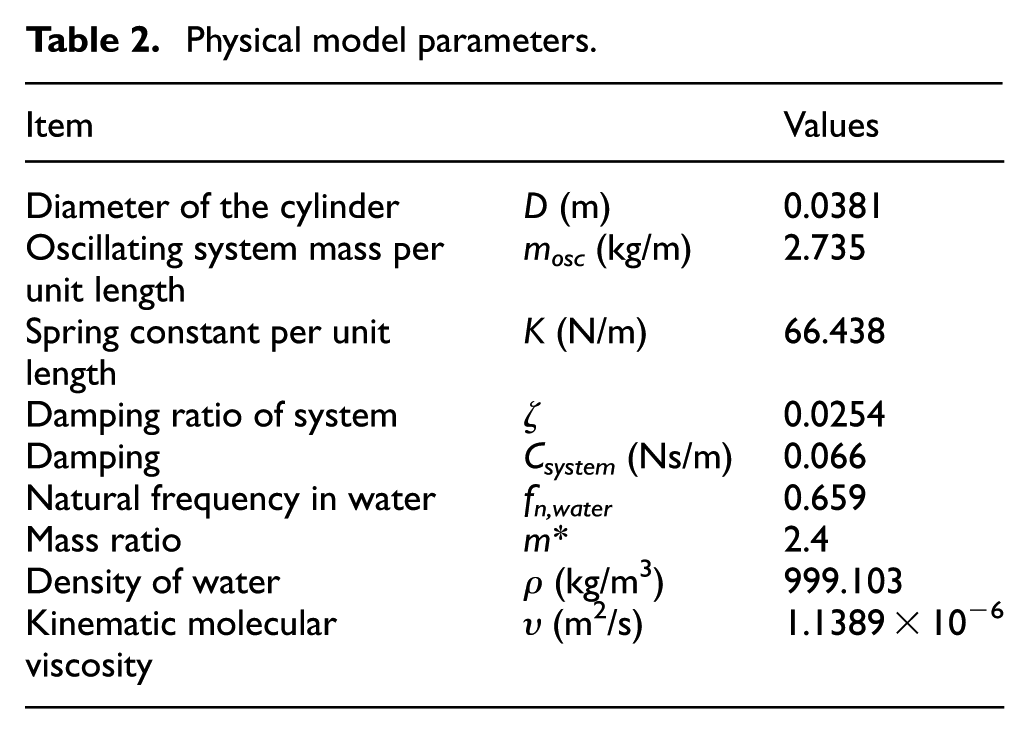
The physical model considered in this article consists of an oscillatory systems mounted on end linear springs as shown in Figure 1. The elements of the oscillatory system are two rigid circular cylinders of diameter D. K is the stiffness of the supporting linear springs, and the system damping Csystem due to friction (Table 1 and Table 2). In the present study, the two circular cylinders are rigidly connected with each other. There is no relative displacement between the two side-by-side cylinders when VIV occurs. The two cylinders are constrained to oscillate in a single degree of freedom motion in the y-direction only. The center-to-center distance of the two cylinders, T, is fixed at 2D. In this study, the system parameters in the numerical simulation are the same as those used in the corresponding experiments by Khalak and Williamson. 27 The system parameters of the model in the simulation are listed in Table 2.
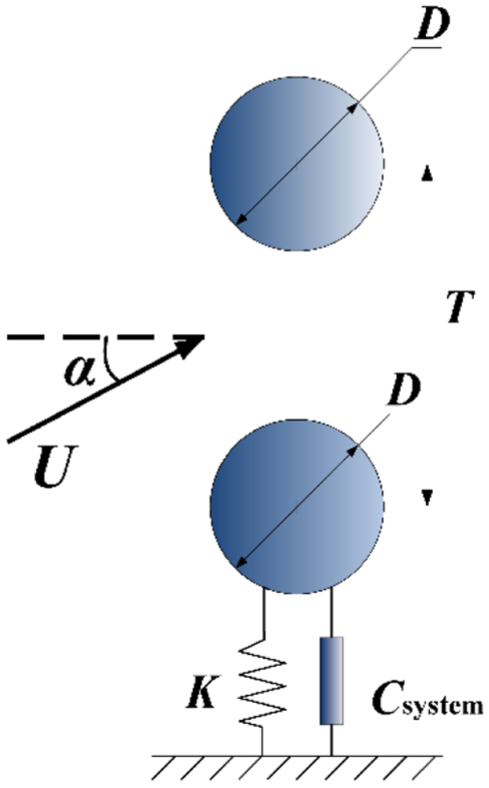
Schematic of the physical model.
Nomenclature.

Physical model parameters.
Governing equations
In this study, the flow is assumed to be 2D unsteady incompressible flow. The flow is modeled using the2D-URANS equations together with the Spalart–Almaras (S-A) one-equation turbulence model. As a one-equation model, the S-A model solves for one transport equation for eddy viscosity like variable
The basic URANS equations are


where υ is the molecular kinematic viscosity and

where Ui is the mean-flow velocity vector and
The Boussinesq eddy-viscosity approximation is employed to solve the URANS equations for the mean-flow properties of the turbulence flow

where

Since that the fluctuating kinematic energy k is ignored in the S-A model, the relationship between Reynolds stress and the mean velocity gradient is

where µt is turbulence eddy viscosity.
In the S-A model, the turbulent eddy viscosity is computed from

where


where
The dynamic of the cylinders is simplified as the classical linear oscillator system using the mass-spring-damper oscillator model

where

where Cstructure is the structural damping and Charness is defined as the added damping to harness energy. The value of system damping is referred to our earlier work. 8
In this study, the simulation is performed using a solver built on the open source computational fluid dynamics (CFD) tool OpenFOAM. As a collection of C++ libraries, OpenFOAM is developed to solve continuum flow mechanics problems with the finite volume discretization procedure. A control volume integral of spatial derivative terms can be converted to a cell surface integral by Gauss’s theorem. The divergence, gradient, and the Laplacian terms in the governing equations are integrated over the control volume based on the Gauss integration using second-order linear interpolation method in space. The second-order backward Euler integration is used in the time integration. A pressure implicit with splitting of operators (PISO) algorithm is used for solving momentum and continuity equations together in a segregated way. Automatic time step is employed in the present study. To achieve temporal accuracy and numerical stability, the Courant number, Co = Δt|U|/Δx (where Δt is the time step and Δx is the cell size), less than 1 is required. Since the surface-tracking algorithm is considerably more sensitive than the standard flow calculations, an upper limit Co = 0.5 is considered in this work. The oscillator equation is two-way coupled and strong coupling algorithm is used. In one time step, the computational process is shown in Figure 2.

Computational process in one time step.
Mathematical model for energy harvesting
In this section, the mass-spring-damper oscillator model of the oscillator system in equation (8) is used to calculate the harnessed energy. The power generated from the flow via the vibrating cylinders per oscillation cycle is given as

Plugging equation (10) into equation (12), the power can be rewritten as

Since the VIV responses of rigid circular cylinders are assumed to be nearly sinusoidal,8,10 the displacement of the cylinders is

where A is the amplitude, and

The velocity and acceleration of the cylinders in the y-direction are


Inserting equations (14) to (17) into equation (13), the power in the oscillation system can be expressed as

The elastic power of the oscillation system is

Thus, the converted power is

Based on the Bernoulli equation, the kinetic pressure head is defined as

The fluid force acting on the cylinder is

The power in the fluid can be calculated as

The power ratio is defined as the ratio of converted power to the power in the fluid, which can be written as

Computational domain and grid generation
As shown in Figure 3(a), the computational domain in the present work is a circle with diameter of 50D. The two side-by-side cylinders are located in the center of the computational domain. The computational domain can be divided into the upstream and downstream subdomains by the straight line which is perpendicular to the flow velocity direction and passes through the domain center. The boundary of the upstream is the inflow and the boundary of the downstream is the outflow. The inflow and outflow boundaries vary with the attack angle of the free stream velocity. The inflow velocity is considered as constant and uniform. A zero gradient condition is specified for velocity at the outflow boundary. When the cylinders undergo VIV, a moving wall boundary condition is applied for the two cylinders.

(a) Computational domain and (b) close-up of the grid for two side-by-side cylinders.
The flow field is meshed in structured grid with local grid refinement as illustrated in Figure 3(b). The attack angle, α, which is defined as the angle between the x-direction and the free stream, is varied from 0° to 90°. The simulations are conducted in Reynolds number ranging from 1000 to 10,000.
In order to determine the overall grid independence to achieve a convergent and accurate solution in reasonable computational time, a grid sensitivity study was conducted on three different grid levels. The three grids are named based on the number of cells, which increases with a factor of approximately 1.5 in circumferential and radial direction. The detailed parameters of grid independence study are listed in Table 3. The flow parameters were calculated for comparison, where CD and CL are the time-average value of the drag coefficient and the lift coefficient. In the present study, all three grids obtain similar results. In view of the computer resources and computing time, cell numbers of 80,400 were chosen for all cases. Based on the turbulence model and wall functions which are used for simulating the VIV of the two cylinders, the first grid spacing y+ about 30–70 is employed in this study.
Grid independence study (Re = 2000, α = 5°).

Results and discussion
In this section, VIV of the two side-by-side cylinders at different attack angles is numerically investigated. The responses of amplitude, frequency, wake patterns, and energy conversion of cylinders with different attack angles are discussed.
Amplitude responses
In this section, the amplitude responses of the two circular cylinders in side-by-side arrangement are discussed. The traditional measurement of VIV response is the peak amplitude of oscillation. This measurement admits harmonic body oscillations only, which means that the peak amplitude and frequency of the oscillating cylinders are required to fully describe the motion. In case that the flow is not completely synchronized to the body motions, the root-mean-square amplitude can provide a more meaningful measure of magnitude of asymmetric oscillation. Instead of the peak amplitude ratio, the variation of root-mean-square amplitude ratio (ARMS/D) with respect to the attack angle and Reynolds number is presented in Figure 4. Since the Reynolds number range is 1000 ≤Re ≤ 10,000, the corresponding reduced velocity range is 1.19 ≤
2.38 ≤
3.57 <
7.14 <
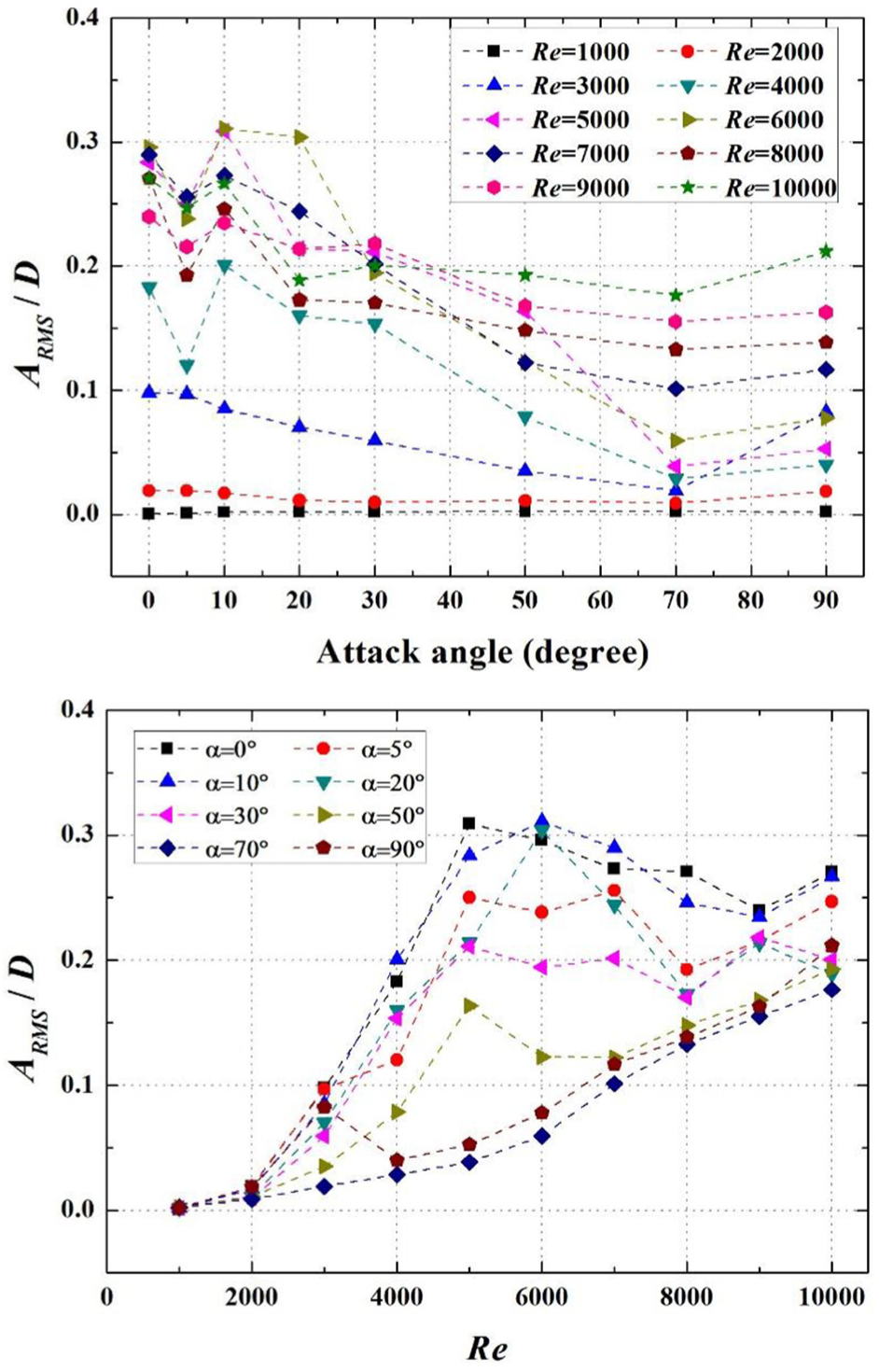
Amplitude ratios of the cylinders in VIV.
From above, the amplitude ratio increases significantly as the reduced velocity rises. Relatively high velocity leads to comparatively complex vortex street interaction in the wake of the two cylinders. In addition, the variation range of the amplitude for 4.76 ≤
Frequency responses
The simulation records for the two side-by-side cylinders are processed using Fast Fourier Transform (FFT). The frequency of oscillation is calculated and plotted versus the attack angle in Figure 5. The frequency of oscillation (fosc) for the two cylinders is non-dimensionalized by the corresponding system natural frequency in water, fn,water.
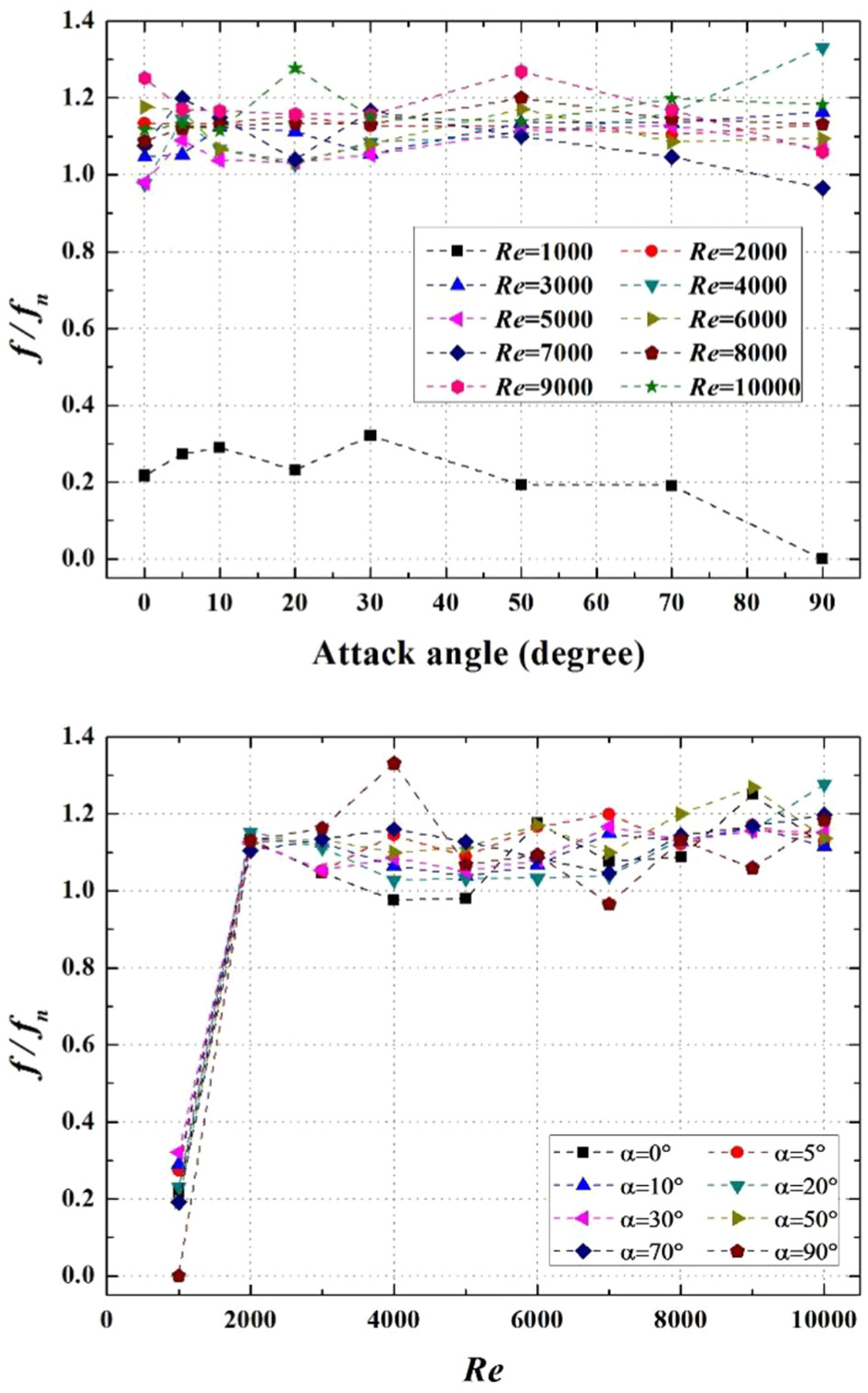
Frequency ratios of the cylinders in VIV.
1.19 <
1.19 <
7.14 <
10.91 <
From the discussion above, the vibration of the two cylinders is almost not initiated when Re = 1000. Comparatively, low-frequency ratios of the two cylinders are obtained. The frequency ratios are fairly close in the variation of 2000 ≤ Re ≤ 10,000 and stay around 1.1. The frequency ratio reaches the highest value of 1.33 at Re = 4000 and α = 90°.
Near-wake structures
In this section, the simulation results of vortex patterns are discussed. For the two circular cylinders in side-by-side arrangement, the wakes of the two cylinders interact with one another on either side of the gap between the two cylinders, which results in more complex vortex structure than that for the isolated circular cylinder. The vortex shedding patterns at different attack angles of flow for Re = 2000, Re = 4000, Re = 6000, and Re = 8000 are presented in Figures 6–9, respectively.

Vortex structures of the two cylinders in side-by-side arrangement at different attack angles of flow for Re = 2000.
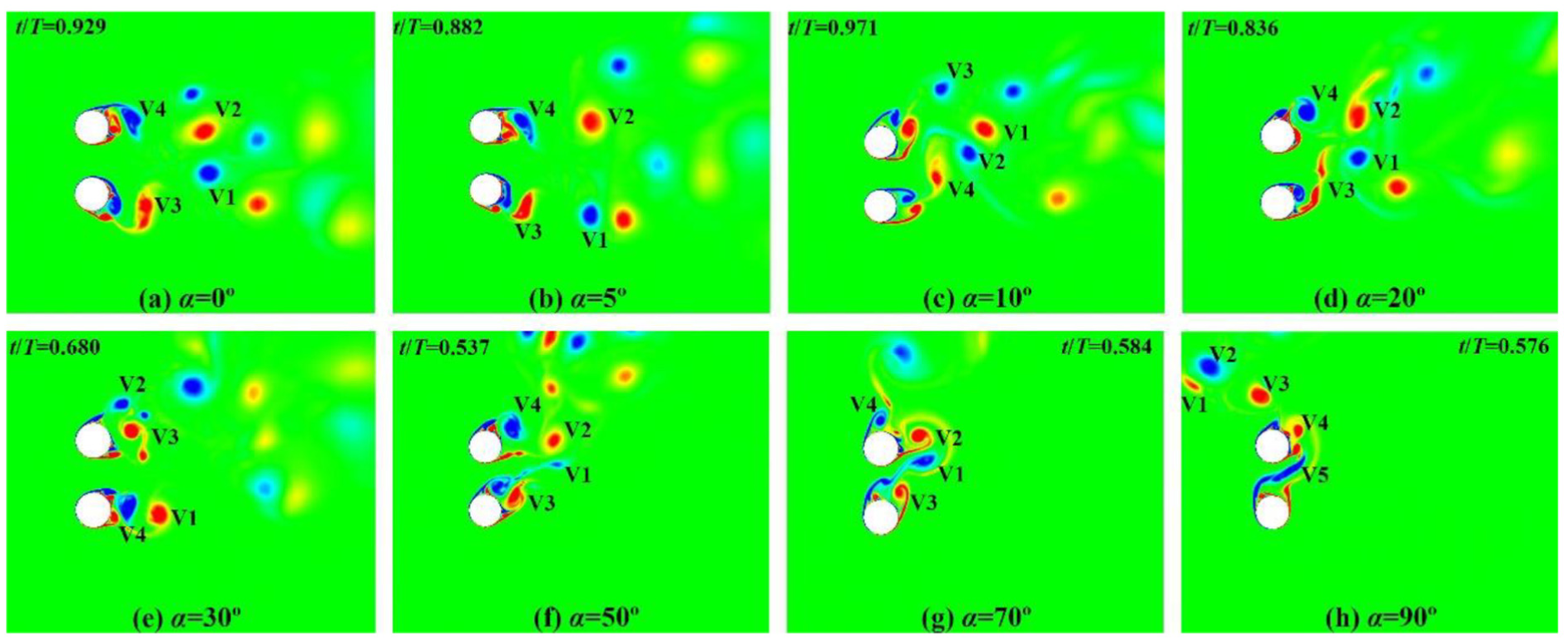
Vortex structures of the two cylinders in side-by-side arrangement at different attack angles of flow for Re = 4000.

Vortex structures of the two cylinders in side-by-side arrangement at different attack angles of flow for Re = 6000.

Vortex structures of the two cylinders in side-by-side arrangement at different attack angles of flow for Re = 8000.
Energy conversion
This section presents the energy conversion comparison of two cylinders in side-by-side arrangement with different attack angles. Based on the responses of amplitude and frequency, the power that can be harnessed is discussed. The mathematical model for the converted power is summarized in the “Mathematical model for energy harvesting” section. Results of harnessed powers by VIV of two cylinders in side-by-side arrangement with different attack angles versus Reynolds number are shown in Figure 10. The system damping ratio for energy harvesting is ζ = 0.0254 for all cases. The system damping coefficient value per unit length is Csystem = 0.066 Ns/m. Since that VIV is suppressed when damping is too high, 30 relatively low mass damping is chosen for this study. The system damping calculated in this study is the same as the value for experiment of Khalak and Williamson. 27

Harnessed power of two cylinders in side-by-side arrangement with different attack angles.
As shown in Figure 10, when
The energy conversion efficiencies of VIV for the two cylinders in side-by-side arrangement with different attack angles are calculated by equation (22). The comparison of power efficiencies is depicted in Figure 11. The optimum regime to harvest hydrokinetic energy is evaluated in this study. As shown in Figure 11, the maximum energy conversion efficiencies with investigated attack angles are obtained in the region of 5.95 ≤

Power conversion efficiency of two cylinders in side-by-side arrangement with different attack angles.
Conclusion
In this study, the VIV of two rigid circular cylinders in side-by-side arrangement with different attack angles of flow is investigated using 2-D URANS simulations with the S-A one-eq26 turbulence model. The two cylinders are mounted on end linear springs with one degree of freedom. Numerical simulations are conducted in Reynolds number range from 1000 to 10,000. The attack angle of flow is varied from 0° to 90°. Some main conclusions concerning the results are summarized as follows:
VIV of two side-by-side circular cylinders is obviously influenced by the attack angle of flow. The numerical tool can successfully simulate the effect of attack angle on the VIV behavior of two cylinders in side-by-side arrangement.
No obvious VIV is observed at Re = 1000. When 2000 ≤ Re ≤ 10,000, the minimum amplitude ratio of the two cylinders is observed at α = 70° in the varied attack angles. The VIV responses with attack angle range of 0°≤ α ≤ 30° are obviously stronger than other attack angle cases. The maximum amplitude 0.31D is achieved
Comparatively low-frequency ratios of the two cylinders are obtained at Re = 1000. The frequency ratios are fairly close in the variation of 2000 ≤ Re ≤ 10,000 staying around 1.1 in the investigated attack angles.
The vortex shedding pattern changes from one mode to another with Reynolds number corresponding to amplitude and frequency responses. The parallel vortex streets are clearly observed with synchronized vortex shedding at α = 0°. With attack angle increasing to 30°, the oscillation of the two cylinders is not fully synchronized due to the specific distance between the two cylinders, lead to a phase difference between the wake patterns of the two cylinders.
Hydrokinetic energy can be obviously harvested by VIV of the two cylinders in side-by-side arrangement when Re > 4000. The two parallel cylinders with smaller attack angles (0°≤ α ≤ 30°) have better performance on energy conversion than the larger attack angle cases. The maximum energy conversion efficiency of 21.7% is achieved. The optimum region for energy conversion is 5000 ≤ Re ≤ 7000 and 0°≤ α ≤ 30°.
In future work, the influence of the spacing on the VIV behavior and energy harvesting of the two separated cylinders in side-by-side arrangement will be studied. And two-degree-of-freedom vortex-induced vibrations of multiple cylinders will be considered as well.
Footnotes
Handling Editor: Ali Kazemy
Declaration of conflicting interests
The author(s) declared no potential conflicts of interest with respect to the research, authorship, and/or publication of this article.
Funding
The author(s) disclosed receipt of the following financial support for the research, authorship, and/or publication of this article: This work was supported by the National Natural Science Foundation of China (Grant No. 51776021); Natural Science Foundation of Chongqing, China (Grant No. cstc2016jcyjA0255); and Fundamental Research Funds for the Central Universities (Grant No. 106112016CDJXY145505).
