



Abstract
The new generation healthcare monitoring system combines technologies of wireless body sensor network, cloud computing, and Bigdata, and there are still limitations in protocol security, response delay, and prediction of potential severity disease. In response to the above situation, an Internet Protocol Version 6 (IPv6)-based framework for fog-assisted healthcare monitoring is proposed. This framework is composite of body-sensing layer, fog layer, and cloud layer. The body-sensing layer generates physiological data, and fog computing node in fog layer collects and analyses time-sensitive data. Fog layer sends physiological data to cloud computing node in cloud layer for further processing. Mobile intelligent device connects fog computing node and helps individuals to predict the potential disease with its level of severity. The proposed framework uses advanced techniques such as IPv6-based network architecture, cloud–fog resource scheduling algorithm based on time threshold, and classification model of chronic diseases based on cascaded deep learning and so on. In order to determine the validity of the framework, health data were systematically generated from 45 patients for 30 days. Results depict that the proposed classification model of chronic diseases has high accuracy in determining the level of severity of potential disease. Moreover, response delay is much lower than Internet Protocol Version 4 (IPv4)-based cloud-assisted environment.
Introduction
The increasing population and chronic diseases bring high pressure on quality and quantity of healthcare. According to the Chinese Cardiovascular Health Index (2017), mortality caused by cardiovascular and cerebrovascular diseases is rising. There are about 290 million patients with vascular disease, including 13 million stroke, 11 million coronary heart disease, 5 million pulmonary primary heart disease, 2.5 million rheumatic heart disease, and 2 million congenital heart disease. From the statistics above, we know that the prevention and monitoring of cardiovascular disease (CVD) is urgent, especially for sudden heart disease. If it is possible to monitor subtle signs and take effective measures in advance, 70%–80% of patients can avoid death.
Recent technological trends such as wireless body area network (WBAN), cloud computing and Bigdata provide a strong infrastructure and offer a true enabler for healthcare monitoring that can not only prevent CVD but also quickly respond to the occurrence of disease. The architecture of cloud-assisted healthcare monitoring includes three main components: WBAN, Internet-connected gateways, and cloud and big data support. Sensors attached to users are made available to caregivers, family members, and authorized parties giving them the ability to monitoring patients with vascular disease at anywhere at any time. Gateways generally act as a hub between a sensor layer and cloud services, which is responsible for protocol conversion between Internet Protocol Version 4 (IPv4) and wireless short-distance protocols (Bluetooth, ZigBee, 6LoWPAN) with wireless body sensor network (WBSN). WBAN can benefit from the virtually unlimited capabilities and resources of cloud to compensate its technological constraints (e.g. storage, processing, and energy). IPv4-based cloud-assisted healthcare monitoring systems generate a huge amount of data, but it is difficult for cloud layer to process it in real time due to long-distance communication overhead. Healthcare applications require expeditious analysis of health monitoring data and immediate decision which is not feasible in cloud computing. Furthermore, existing wireless short-distance protocols (Bluetooth, ZigBee, 6LoWPAN) and IPv4 cannot guarantee the security and privacy of monitoring data. Finally, the system allows users to obtain prediction of potential severity disease based on pre-established rules of reasoning and guidance to achieve better health self-management. Because physiological data are imprecise, incomplete, and inconsistent, rough set theory is often useful for rule induction from incomplete data sets. There is much room for improvement in the intelligence and accuracy of classification algorithms of chronic disease for physiological data.
In order to overcome protocol security, network latency, and prediction of potential severity disease of IPv4-based cloud-assisted healthcare monitoring, some nascent technologies are introduced as follows:
Fog computing reduces network latency by moving computing infrastructure geographically closer to the servers at the network edge where health data are collected and stored. Fog computing was first introduced by Cisco in 2012, to describe a compute, storage, and network framework for supporting Internet of Things (IoT) applications. The main feature of fog computing is its ability to support applications that require low latency, location awareness, and mobility.1,2
Internet Protocol Version 6 (IPv6) is an Internet layer protocol for packet-switched internetworking and provides end-to-end datagram transmission across multiple IP networks, closely adhering to the design principles developed in the previous version of the protocol, IPv4. Device mobility, security, and configuration aspects have been considered in the design of the protocol. The design of IPv6 intended to re-emphasize the end-to-end principle of network design that was originally conceived during the establishment of the early Internet. In this approach, each device on the network has a unique address globally reachable directly from any other location on the Internet. Furthermore, the IPsec Authentication Header (AH) and the Encapsulating Security Payload (ESP) header are implemented as IPv6 extension headers. 3
Machine learning is a method used to devise complex models and algorithms that lend themselves to prediction. Deep learning is a class of machine learning algorithms that use a cascade of multiple layers of nonlinear processing units for feature extraction and transformation. Each successive layer uses the output from the previous layer as input. Machine learning algorithms can be used to process and manage massive physiological data on cloud-based computing platform. Time-sensitive data can be processed at the network edge instead of sending a vast amount of physiological data to cloud.
In this article, an IPv6-based framework for fog-assisted healthcare monitoring was presented. A fog layer is added between WBAN and cloud by providing data processing and storage services at the edge of network devices. This framework is composite of body-sensing layer, fog layer, and cloud layer. The body-sensing layer generates physiological data, and fog computing node in fog layer collects and analyses time-sensitive data. Fog layer sends physiological data to cloud computing node in cloud layer for further processing. Mobile intelligent device connects fog computing node and helps individuals to predict the potential disease with its level of severity. The main contributions of this paper include: (1) proposing an enable framework for IPv6-based fog-assisted healthcare monitoring; (2) forming an IPv6-based network architecture; (3) scheduling cloud–fog resource based on time threshold to reduce response delay; (4) proposing classification model of chronic diseases based on cascaded deep learning; (5) developing prototype system to prevent CVD or quickly respond to the occurrence of disease and accidents.
This article is framed in different sections. Section “Related works” provides an overview of some of the important literature in the field of cloud computing and fog computing in healthcare monitoring system. The proposed hierarchical structure of IPv6-based fog-assisted health monitoring is presented in section “Proposed framework.” Section “Some key technologies of proposed framework” discusses some key technologies of proposed framework. Section “Experimental setup and analysis” describes the experiments and performance analysis of prototype system. Finally, section “Conclusion” concludes the paper with some appropriate remarks.
Related works
Cloud computing in healthcare system
In 2014, H-P Chiang et al. 4 proposed a green cloud-assisted healthcare service on WBAN and considered the sensing frequency of the physiological signals of various body parts, as well as the data transmission among the sensor nodes of WBAN. Transmission in WBSN is coordinated according to the number of sensor nodes worn by each user and the detection frequency of the various sensor nodes; personal physiological signals are regularly and efficiently transmitted to the cloud network for processing. PhysioDroid 5 used a wearable chest belt with sensors for ECG, heart and respiration rates, skin temperature, and body motion. It shows the severity of health vital signs using different colors and generates an emergency call according to them. In 2016, S-L Wang et al. 6 propose a framework which integrates cloud computing wireless communication and wireless sensor networks technology and applies a collaborative filtering (CF) technique to develop a mobile health information recommendation service to help users to obtain their preferred health information more efficiently. In 2016, RT Hameed et al. 7 developed health monitoring system based on wearable sensors and cloud platform. The sensors measure various parameters, such as a glucometer, airflow, and patient position, which are transmitted via microcontroller by a gateway to a cloud storage platform. In 2018, P Verma and SK Sood 8 proposed cloud-centric IoT-based disease diagnosis healthcare framework consists of three phases. In phase1, users’ health data are acquired from medical devices and sensors. The acquired data are relayed to cloud subsystem using a gateway or local processing unit (LPU). In phase 2, the medical measurements are utilized by medical diagnosis system to make a cognitive decision related to personal health. In phase 3, an alert is generated to the parents or caretakers in context of person’s health.
Fog computing in healthcare system
In 2016, CS Nandyala and H Kim 9 proposed architecture for IoT-based u-healthcare monitoring with the motivation and advantages of cloud to fog (C2F) computing which interacts more by serving closer to the edge (end points) at smart homes and hospitals. In 2016, M Ahmad et al. 10 proposed a framework of Health Fog where fog computing is used as an intermediary layer between the cloud and end users. The design feature of Health Fog successfully reduces the extra communication cost that is usually found high in similar systems. B Negash et al. 11 focus on a smart e-health gateway implementation for use in the fog computing layer, connecting a network of such gateways, both in home and in hospital use. Home-based and in hospital patients can be continuously monitored with wearable and implantable sensors and actuators. AM Rahmani et al. 12 proposed to exploit the concept of fog computing in healthcare IoT systems by forming a geo-distributed intermediary layer of intelligence between sensor nodes and cloud. A prototype of a Smart e-Health Gateway called UT-GATE is presented for implementation. They also implemented an IoT-based early warning score (EWS) health monitoring to practically show the efficiency of the system by addressing a medical case study. SK Sood and I Mahajan 2 designed a fog-assisted cloud-based healthcare system to diagnose and prevent the outbreak of chikungunya virus. The state of chikungunya virus outbreak is determined by temporal network analysis at cloud layer using proximity data. In 2018, P Verma and SK Sood 13 proposed the remote patient health monitoring in smart homes using the concept of fog computing at the smart gateway. The proposed model uses advanced techniques and services such as embedded data mining, distributed storage, and notification services at the edge of the network. Event triggering-based data transmission methodology is adopted to process the patient’s real-time data at fog layer. Temporal mining concept is used to analyze the events adversity by calculating the temporal health index (THI) of the patient.
In summary, many researchers have proposed IPv4-based cloud (fog) assisted healthcare monitoring systems but have not laid emphasis on protocol security and prediction of potential severity disease. Response delay is solved only with fog computing but not co-processing of cloud computing and fog computing.
Proposed framework
In this article, we propose an IPv6-based framework for fog-assisted healthcare monitoring which is composite of body-sensing layer, fog layer, and cloud layer. IPv6-based network architecture provides the protocol foundation for interaction among layers. Wearable and implantable physiological sensors of body-sensing layer generate physiological data. Fog layer is an intermediate computing layer between cloud layer and body-sensing layer. Fog layer consists of fog computing nodes, located at the network edge. Moreover, fog layer provides real-time interactive services, mobility support, and scalability. Cloud layer consists of cloud computing nodes which implement data warehouse and data analytics. Cloud layer realizes effective scheduling of resources through cloud–fog coordinator, which supports applications that require low latency. Hierarchical structure of IPv6-based fog-assisted health monitoring is shown in Figure 1.

IPv6-based framework for fog-assisted healthcare monitoring.
Body-sensing layer
Body-sensing layer is composed of a series of intelligent physiological sensors, including fingertip oxygen sensors, blood glucose sensors, ECG sensors, implantable sensors of blood pressure, to measure some basic physical vital information of the patients, like temperature, blood pressure, blood sugar, pulse rate, heart condition, respiration. Each sensor is equipped with the physiological signal conditioning circuits, a microcontroller, and a short-distance protocol interface. These sensors can be selectively configured to monitor the respective physiological signal depending on the diagnostic demands of a patient’s disease. The patient’s physiological signals are collected and initially processed by the physiological sensors at patient end, and then, the preprocessed data are transmitted to the coordinator node (fog computing node), which is a part of gateway module, via wireless one of short-distance protocols (Bluetooth, ZigBee, 6LoWPAN) connection.
Fog layer
Fog layer is built from multiple geographically distributed fog servers. Each fog server is as gateway which supports the switch from short-distance protocols to IPv6. The fog computing server is virtualized into several fog computing nodes. All nodes are assigned an m-bit identifier using consistent hashing. Fog layer uses Chord as a protocol and algorithm for a peer-to-peer distributed hash table. Physiological sensors select the nearest fog computing node to send physiological data. Fog computing node also performs protocol conversion and provides other higher level services such as data aggregation and dimensionality reduction, and classification model of chronic diseases based on cascaded deep learning. And then fog computing node sends selected data to cloud computing node for further analysis (e.g. health risk assessment (HRA)). Fog layer also enhances location awareness and high quality of service for real-time applications.
Cloud layer
Cloud layer consists of several cloud computing nodes and cloud–fog coordinator. Cloud–fog coordinator is responsible for maintaining the registration information of fog computing nodes and coordinating fog computing nodes. Cloud–fog coordinator is supplemented by both the means to control the cloud and the means to manage the underlying fog computing nodes. Such control is performed continuously or on-demand, depending on system events, for example, if new fog computing server appears and can be used to deploy fog computing nodes. The fog computing node selects the nearest cloud computing node and uploads physiological data collecting from physiological sensors. Cloud computing node implements broadcasting, data warehouse, HRA, and classification of chronic diseases based on cascaded deep learning.
Mobile intelligent device connects the nearest fog computing node with WIFI. It received feedback and alarm messages from fog layer. Some visualization results are shown in mobile intelligent device including real-time monitoring data, health assessment report, potential disease level of severity, alarm messages, and diet, sports and other related suggestions to improve health.
Some key technologies of proposed framework
IPv6-based network architecture
In this article, we proposed an IPv6-based network architecture, because IPv6 can effectively overcome limitations of conventional healthcare monitoring system in protocol security of monitoring data. IPv6-based network architecture is composed of body monitoring network, IPv6 transmission network, fog computing node, cloud computing node, and mobile intelligent device, as shown in Figure 2.
Body monitoring network is composed of many sensor nodes attached to the body surface, which is responsible for collecting physiological data and converging to the nearest fog computing node. Body monitoring network consists of several sensor nodes and one boundary node, which constitute a wireless sensor network based on one of short-distance protocols (Bluetooth, ZigBee, 6LoWPAN). For example, ECG sensor node integrates ECG sensor module, data conversion module, power module, storage unit, wireless transceiver, and other major functional modules. ECG sensors are responsible for collecting ECG parameters. The wireless transceiver is responsible for the communication between sensor nodes and boundary nodes. The protocol stack of sensor node from bottom to top includes Bluetooth Physical Layer, Bluetooth Link Layer, Logical Link Control and Adaptation Protocol, 6LowPAN, µIPv6.
Fog computing node (fog server) has a built-in Bluetooth gateway as boundary node of body monitoring network. The protocol stack of fog computing node from bottom to top includes Bluetooth Physical Layer, Bluetooth Link Layer, Logical Link Control and Adaptation Protocol, 6LowPAN, and IPv6. It also supports Physical Layer, Link Layer, and IPv6 in dual protocol stack.
The protocol stack of cloud computing node from bottom to top includes Physical Layer, Link Layer, and IPv6.
Mobile intelligent device support IPv6 protocol in WIFI mode.
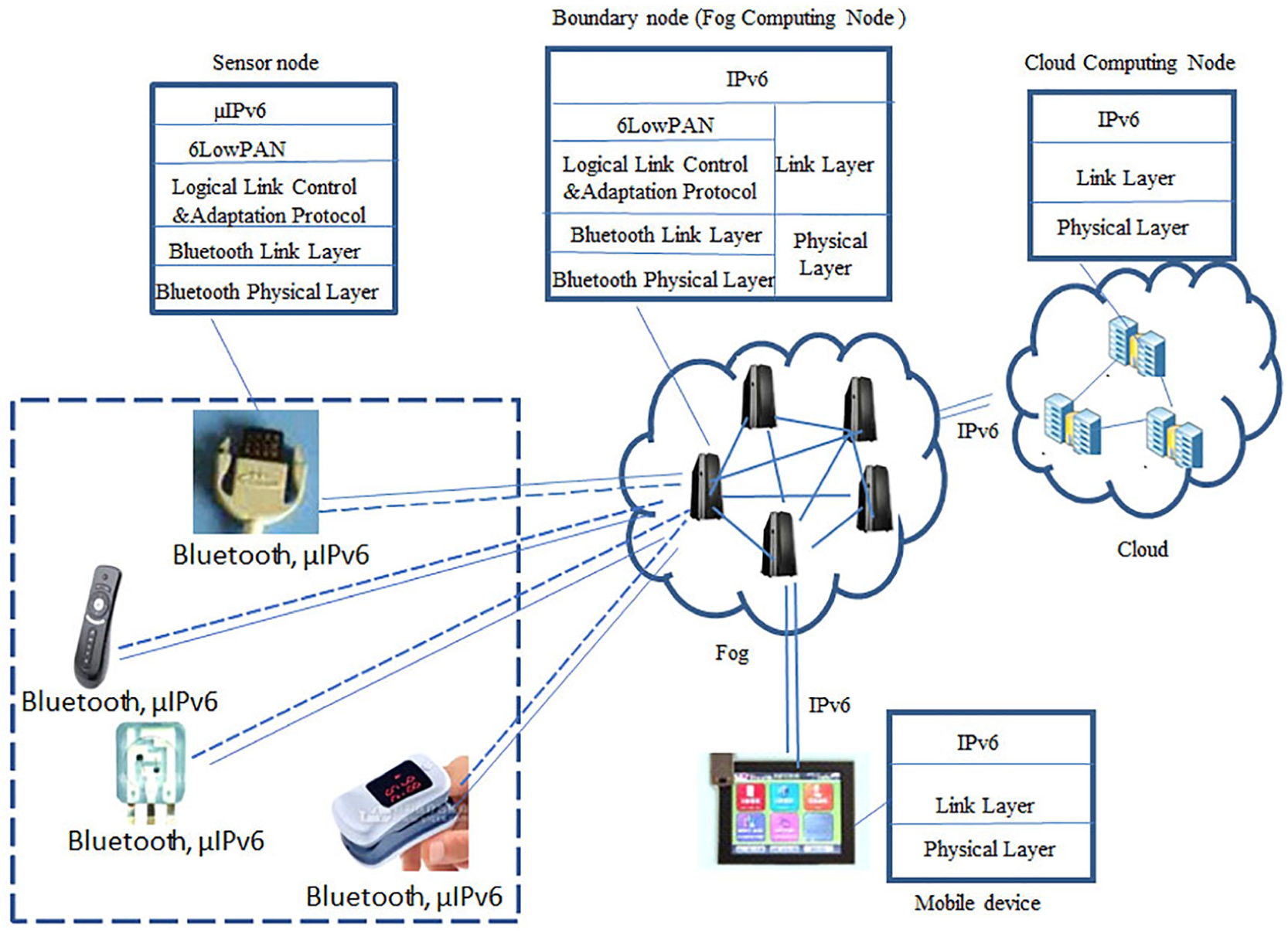
IPv6-based network architecture.
IPv6 is introduced because of its superiority over IPv4, including stateless address autoconfiguration (SLAAC). The design of IPv6 intended to re-emphasize the end-to-end principle of network design that was originally conceived during the establishment of the early Internet. In this approach, each device on the network has a unique address globally reachable directly from any other location on the Internet. For example, ECG sensor nodes have unique IPv6 addresses, which are configured automatically by global routing prefix, subnet ID, and interface ID. Each sensor node has EUI-48 bit Bluetooth device address, so the interface ID can be obtained by the IEEE EUI-64 translation mechanism. To convert an EUI-48 Bluetooth device address into an EUI-64, the interface ID appends the two octets FF-FE and then copies the organization-specified extension identifier. The interface ID plus the routing prefix FE80::/64 and automatically configures the 128-bit local link address.
IPv6-based network architecture introduces IPv6 protocol which has stronger mobility, security, and routing features than IPv4 protocol. In IPv6, IPsec can be used more often than in IPv4 for router-to-router, host-to-host, and site-to-site communications. When IPsec is implemented in an IPv6-based network architecture, it will work as intended. The source and destination IPv6 addresses will be globally unique, and AH can be implemented much easier because of the absence of Network Address Translation (NAT) in an IPv6 network. IPsec can be used to secure mobile communications and secure tunnel transition mechanisms. Therefore, IPv6 can guarantee more security of healthcare monitoring system in protocol level.
Cloud–fog resource scheduling algorithm
To overcome the limitations of physiological sensor nodes in energy and storage, and reduce the long-distance interaction with the cloud, physiological sensor node selects the nearest fog computing node to connect. In particular, cloud–fog resource scheduling algorithm based on threshold can reduce response delay effectively. Workflow of IPv6-based fog-assisted healthcare monitoring framework is as follows:
Fog computing node calculates its network distance with physiological sensor nodes by fast point location algorithm on triangular meshes. 14 According to the listening strength of short wireless signals, fog computing node determines the geographic location of physiological sensors.
Physiological sensor node chooses to connect with the nearest (distance) fog computing node and maintain interaction. The calculation of network distance adopts Euclidean distance based on network coordinates as follows:
Let fog computing node’s network i coordinate be
Fog computing node receives physiological data and realizes data preprocessing, dimensionality reduction, and classification model of chronic diseases based on cascaded deep learning. Moreover, fog computing nodes are programmed to synchronize the whole data collected from physiological sensors over a universal time stamp.
Mobile intelligent device connects the nearest fog computing node based on wireless WIFI. Fog layer and cloud layer use a resource scheduling algorithm based on time threshold to process requests and ensure low latency. The algorithm is shown in Figure 3, where
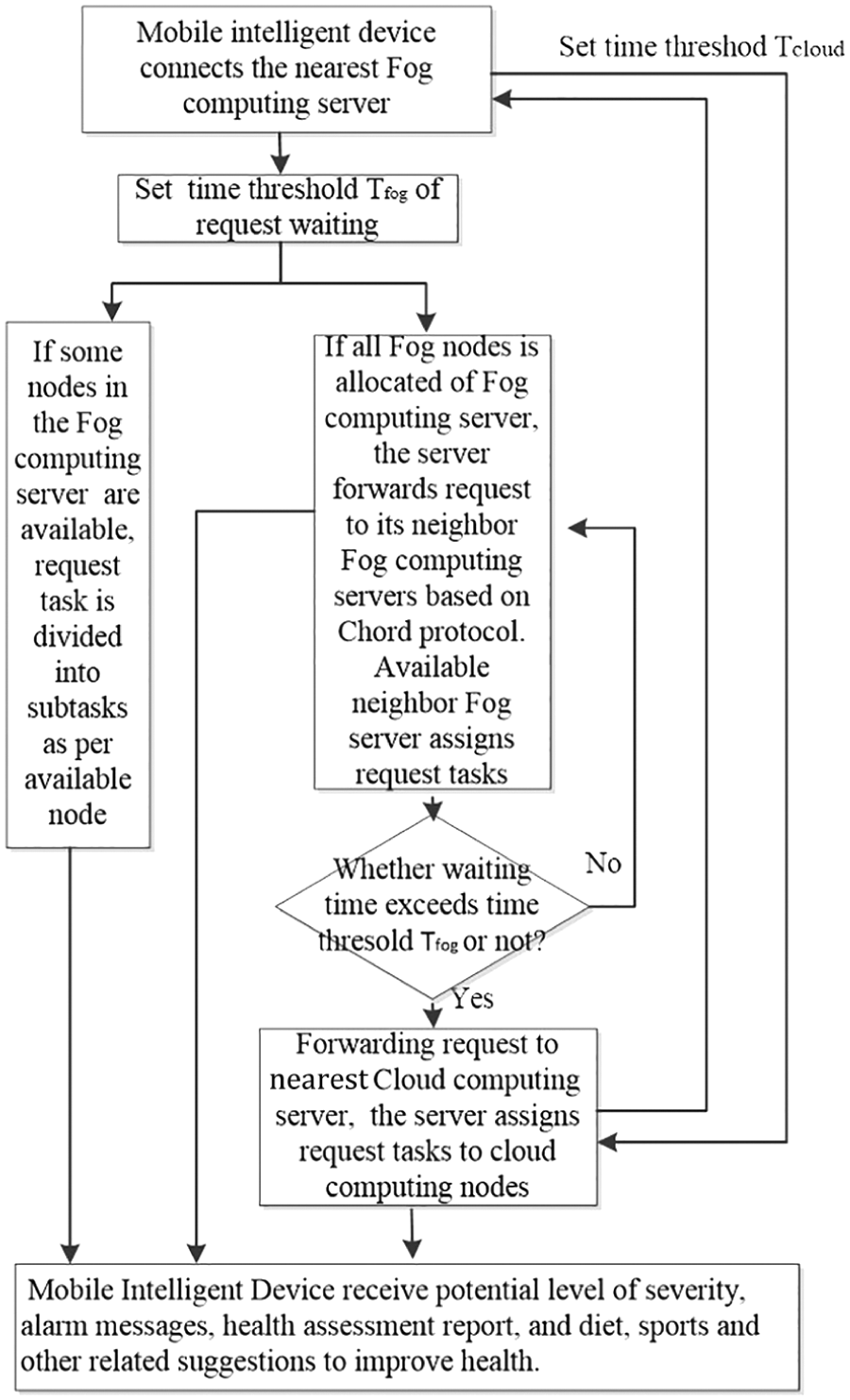
Cloud–fog resource scheduling algorithm based on time threshold.
To reduce response delay, cloud–fog resource scheduling algorithm emphasizes time threshold. Specific time thresholds are applied in the following aspects: (1) In request waiting time
Classification model of chronic disease based on cascaded deep learning
Fog computing nodes collect physiological data, which is imprecise, incomplete, and inconsistent. Physiological data also involve many attributes. Rough set theory is useful for rule induction from incomplete data sets. Using this approach, we can distinguish between three types of missing attribute values: lost values, attribute-concept values, and “do not care” conditions (the original values were irrelevant). Furthermore, physiological data are often available as a high-dimensional data. For example, there are more than 40 attributes associated with diabetes. Thus, physiological data are converted into a complete set in the preprocessing stage. On this basis, a classification model of chronic disease based on cascaded deep learning is proposed to deal with physiological data and make a cognitive decision related to personal health. Classification model is a multi-layer structure, which includes singular value decomposition (SVD)-based data dimensionality reduction, and boosting-based attribution reduction. The output of the lower layer is the input of the upper layer, and the attribution set of lowest layer is closest to the original attribute set. The high-level features can provide complementary information for the low-level features and ultimately realize the classification of chronic diseases. This multi-layer structure is shown in Figure 4.

Classification model of chronic disease–based cascaded deep learning.
Data preprocessing layer
Compatible matrix and heuristic algorithm 15 are used to transform incomplete data sets into complete data sets.
Definition 1
(Compatible matrix) Let

SVD-based dimensionality reduction
SVD is applied to remove noise from physiological data effectively. Given a symmetric matrix

where

where
The first r non-zero singular values are obtained, and the corresponding singular vectors represent the main characteristics of the matrix.

Boosting algorithm–based attributions selection
Boosting is a machine learning ensemble meta-algorithm for primarily reducing variance in supervised learning. While boosting is not algorithmically constrained, most boosting algorithms consist of iteratively learning weak classifiers with respect to a distribution and adding them to a final strong classifier. When they are added, they are typically weighted in some way that is usually related to the weak learners’ accuracy.16,17 After a weak learner is added, the data are reweighted. The main processes of attribution reduction are as follows:
All combinations of attribute sets are represented by binary encoding, that is, “1” indicates the presence of attributes and “0” indicates the absence of attributes.
Consider the following classifier

where
The weighted least squares method is used to get the error values

By comparing binary attribute sets, attribute set C are replaced by attribute combination set
To delete redundant all zero rows and form the smallest reduction attribute set.
Classification of chronic disease based on EML2 algorithm classification rules
Definition 2
The degree of precision and coverage of classification rule


where
The main processes of chronic disease classification are as follows:
Initial classification rules are obtained using classification algorithm EML2 and stored in the classification rule base.
Reading the incremental data set
Classifying
Outputting the current classification rule set.
Using optimal set of classification rules to classify chronic disease.
HRA
The fog computing node selects the nearest cloud computing node and uploads physiological data collecting from physiological sensors. In addition to collaborating with fog computing nodes to implement classification of chronic diseases, cloud computing node further conducts HRA. HRA is used to provide individuals with an evaluation of their health risks and quality of life. The Framingham risk assessment model is a classic HRA model, which is used to predict risk of individual CVD in the next 10 years. Because of different countries and regions, people’s living habits are different and Framingham Risk Score (FRS) is not universal. Relative risk is one of HRA models; it refers to the ratio of the probability of an outcome in an exposed group to the probability of an outcome in an unexposed group.
Definition 3
(Baseline incidence) Let
Definition 4
(Relative risk) Risk score = Baseline incidence × Relative risk. Let P be the combination of m factors
As long as you know baseline incidences and the patient’s relative risks of all risk factors, it is easy to calculate his relative score. In practice, MapReduce is a programming model and an implementation for processing HRA in Bigdata sets. Combined with personal physiological monitoring data, IPv6-based framework for fog-assisted healthcare monitoring provides HRA, which helps the patients to have a comprehensive understanding of personal health condition.
Experimental setup and analysis
In this section, experiments to test the enable framework for IPv6-based fog-assisted healthcare monitoring are provided. We developed the prototype system of proposed framework, which connected with Health Fog and Health Cloud. Health Fog has 10 fog computing servers. Each server is configured with Linux operating system, Xen VMM and 5 virtual machines. Health Cloud has cloud resource pool with 40 vCPU, 100 G memory, 10 T storage, support a variety of health archives management including physiological factors (such as “age,”“sex,”“height,”“weight,”“smoking,”“diabetes family history,”“ECG,”“SpO2”). Health Cloud has collected personal health records more than 50,000 copies. Body monitoring network is composed of physiological sensors, including oxygen sensor, glucose sensor, accelerometer, and so on. IPv6-based network architecture is composed of body monitoring network, IPv6 transmission network, Health Fog, and Health Cloud, mobile intelligent device.
The working process of the system is as follows (see Figure 5): (1) mobile intelligent device connects Health Fog based on wireless IPv6 WIFI and registers personal information, including personal data (age, sex, marriage, etc.), life preferences (smoking, drinking, exercise, etc.), routine physical examination data (body mass index (BMI); weight, height, waist circumference, hip circumference), waist-to-hip ratio (WHR)). (2) Body monitoring network generates physiological data, including systolic blood pressure, SpO2, blood glucose, and heart rate. (3) Health Fog has a built-in Bluetooth gateway as boundary node of body monitoring network and collects physiological data. (4) Health Fog sends physiological data to Health Cloud, and Health Cloud implements health archives management and personal physiological data. (5) Mobile intelligent device receives the classification result of chronic diseases, alarm messages, and HRA, where response delay is solved with the cooperation of cloud computing and fog computing. (6) Health Fog, Health Cloud, and third-party health centers share healthcare monitoring information and provide medical service, dietary recommendation, emergency ambulance service, and caregiver service. The prototype system can prevent CVD or quickly respond to the occurrence of disease and accidents.

IPv6-based fog-assisted healthcare monitoring system.
Classification test of chronic diseases based on cascaded deep learning
In order to evaluate classification accuracies of chronic disease, we compared the accuracy rates of the system before and after adopting proposed cascaded deep learning. The experimental data were taken from 1310198 records health monitoring data in Jimei District of Xiamen. Health monitoring data of 45 patients were systematically generated for 30 days. Each data included personal data, life preferences, routine physical examination data, and monitoring data (electrocardiogram, heart rate, blood pressure, SpO2, blood glucose), with an average age of 64.9 years. Diabetes Data Set DS1 has 40 attributes, Hypertensive Disease Data Set DS2 has 35 attributes, Coronary Heart Disease Data Set DS3 has 35 attributes, and Health Risk Scale (H (high risk), M (medium risk), and L (low risk)).
Dimensionalities and attributes of Diabetes Data Set are reduced by SVD and boosting algorithm. Main attributes of chronic diseases are shown as Table 1. Table 2 shows classifications of diabetes based on cascaded deep learning. Because some physiological data are dynamic changes, intervals are used to represent the range of attribute values. Attributes of diabetes include age (


Main attributes of chronic diseases.

BMI: body mass index; WHR: waist-to-hip ratio.
Classification results of chronic disease–based cascaded deep learning.
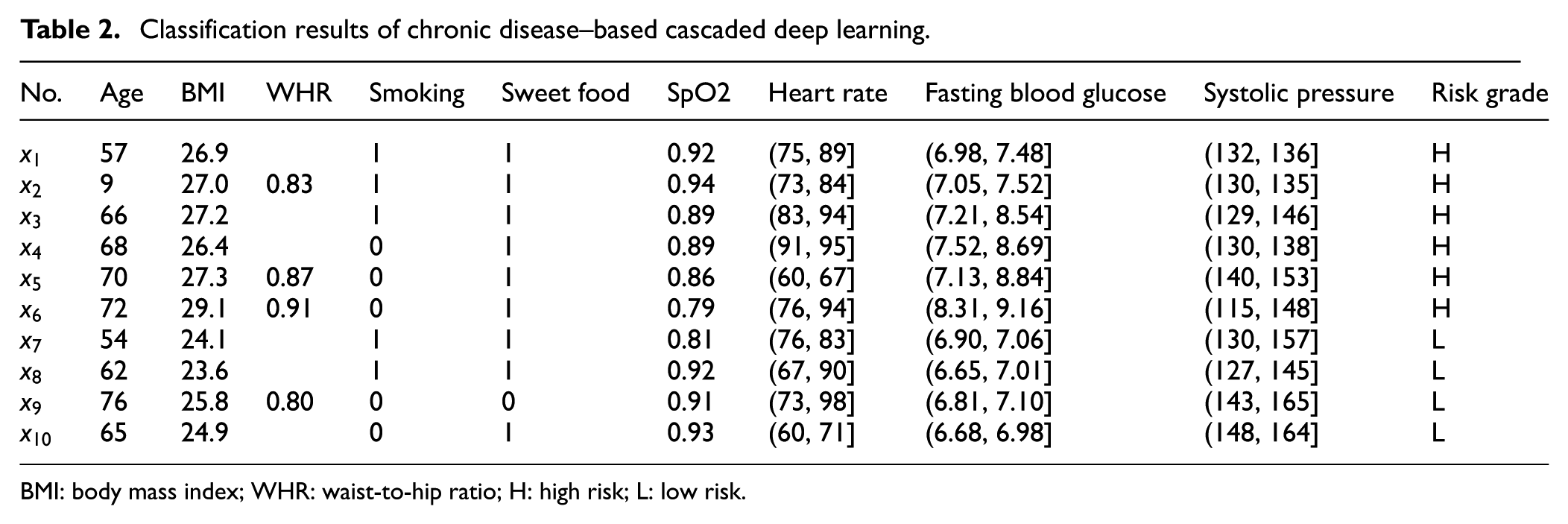
BMI: body mass index; WHR: waist-to-hip ratio; H: high risk; L: low risk.
Take sample
The classification accuracies of chronic disease based on cascaded deep learning (CDL) are 96.43%, 95.12%, and 94.45%, respectively, when rule sets are applied to Diabetes Data Set DS1, Disease Data Set DS2, and Coronary Heart Disease Data Set DS3. If DS1, DS2, and DS3 are processed directly by EML2 algorithm without cascaded deep learning (without CDL), the classification accuracies of chronic disease are 91.23%, 90.02%, and 88.12% (Figure 6). Classification model of chronic disease–based cascaded deep learning adopts SVD algorithm to reduce dimensions and boosting algorithm to extract more accurate feature attributes. The process of cascaded deep learning consumes more time but improves the intelligence and accuracy of data processing.

Comparison of classification accuracy with CDL and without CDL.
Response delay
Figures 7 and 8 show that three polylines of response delay have similar upward trends with the increase of selected attributes. Diabetes data set DS1, hypertensive disease data set DS2, and coronary heart disease DS3 have many common attributes and the same order of attributes. Response delay of the average system in IPv4-based cloud-assisted environment is 118.43 ms, and that in IPv6-based fog-assisted environment is 26.42 ms. The main reasons for the differences among three polylines are as follows:
In IPv4-based cloud-assisted environment, mobile intelligent device needs long-distance communication overhead with Health Cloud. In cloud computing where raw data are transferred from sensor nodes to cloud, if network condition is unpredictable, it may cause uncertainty to response delay. However, in IPv6-based fog-assisted environment, mobile intelligent device is close to Health Fog with short-distance communication. In Health Fog where implementing data analytics and making time-sensitive decisions within the local network makes the proposed system more robust and predictable.
The efficiency of data preprocessing, attribute reduction, and classification based on cascaded deep learning are similar in the two environments. The number of attributes of DS1, DS2, and DS3 is 45, 35, and 30, respectively. The main attributes overlap greatly.

Response delay of IPv4-based cloud-assisted environment.

Response delay of IPv6-based fog-assisted environment.
Therefore, response delay of IPv6-based fog-assisted environment in this article is much lower than that of IPv4-based cloud-assisted environment. Proposed framework reduces data traffic over the Internet in fog computing environment.
Conclusion
Fog computing nodes as smart gateways at the proximity of sensor nodes can tackle many challenges in IoT-based healthcare monitoring system such as mobility, scalability, and network latency. In this article, an IPv6-based framework for fog-assisted healthcare monitoring is proposed. IPv6 is introduced because of its superiority over IPv4, including SLAAC, SLAAC privacy extensions, and IPsec extensions. This framework is composite of body-sensing layer, fog layer, and cloud layer. The body-sensing layer measures physiological signals and fog computing node in fog layer collects this information. Fog layer predicts the potential disease with its level of severity for patients immediately. Finally, physiological monitoring data are transferred to cloud layer for further processing and analysis, including HRA. Mobile intelligent device connects the nearest fog computing node with WIFI and receives feedback and alarm messages from fog layer and cloud layer on time. The proposed framework uses advanced techniques such as IPv6-based network architecture, cloud–fog resource scheduling algorithm based on time threshold, and classification model of chronic diseases based on cascaded deep learning. In order to determine the validity of the system, health data were systematically generated from 45 patients for 30 days. Results depict that the proposed classification model of chronic diseases has high accuracy in determining the level of severity of potential diseases. Moreover, response delay is much lower than IPv4-based cloud-assisted environment. The next step is to improve the classification model of chronic diseases based on cascaded deep learning and reduce communication delay in the presence of large-scale data collection.
Footnotes
Acknowledgements
The authors would like to thank the reviewers for their detailed reviews and constructive comments, which have helped improve the quality of this article.
Handling Editor: Fei Yu
Declaration of conflicting interests
The author(s) declared no potential conflicts of interest with respect to the research, authorship, and/or publication of this article.
Funding
The author(s) disclosed receipt of the following financial support for the research, authorship, and/or publication of this article: This work was supported by the CERNET Innovation Project under grant no. NGII20160708, no. NGII20170620; Xiamen Science and Technology Foundation under grant no. 3502Z20173035, no. 3502Z20183047; Fujian Provincial Natural Science Foundation of China under grant no. 2018J01570; Open Research Fund Project of Key Laboratory of Internet of Things Application Technology of Fujian Province under grant no. XMUTIoT201803.
