



Abstract
In order to improve the reliability analysis accuracy of the aircraft high-lift, an approach based on the Copula function theory and Bayesian updating is proposed. Considering the influence of the random variables’ correlation in the process of updating, choosing the reasonable prior joint distribution and likelihood function is crucial. Under the condition of the incomplete probability information, the analytic expressions of the prior joint distribution and likelihood function of the correlated random variables are derived through the Copula function. Then, the posterior joint distribution is obtained by Bayesian updating. The reliability of the lifting device is calculated based on the posterior distribution. The case analysis shows that the reliability results based on the proposed approach are more accurate and more coincident with the factual situation than the reliability analysis results based on the independence assumption of random variables.
Introduction
The high-lift device is used to improve take-off weight and add lift for take-off and landing of civil airplanes. 1 The safety of airplanes has close relationship with the reliability of the high-lift device. With the development and service of civil airplanes around the world, airworthiness of civil airplanes puts forward higher request to the reliability of the high-lift device. Therefore, analyzing the reliability of the high-lift device accurately is a vital issue in the design phase of civil airplanes.
Focusing on the above issue, the statistical approach has been applied to calculate and analyze the reliability and failure probability of the high-lift device mechanism in the design process of civil airplanes. 2 Because the sample data available are often limited in practical engineering, the probability distribution functions of random variables cannot be obtained precisely. The application of statistical methods is restricted. In order to solve the problem of data deficiency, Bayesian updating approach is adopted to obtain the more accurate probability distribution estimation of random variables through the integration of the experimental data. 3 Bayesian updating has been widely used in many engineering fields, such as machinery, electronic, and civil engineering.4–9 Due to the computation complexity, few studies consider the correlation of random variables in the updating process. In light of this situation that the correlation has to be considered, some approximate methods are adopted to deal with the problem of the correlation of random variables. Zhu and Frangopol 3 assume that the correlated random variables follow the multidimensional normal distribution when assessing the reliability of ship structures using Bayesian updating. An et al. 10 assumed that the correlated random variables follow the multidimensional normal and lognormal distributions, and use Bayesian statistics method to estimate the wear coefficient and predict the wear volume in the revolute joint. For the sake of convenience, Lin and Chen 11 adopt the assumption of independence in their research. However, in the above approximate methods, there exist obvious disadvantages: the assumption of independence may lead to large errors in some cases; different types of multidimensional joint distribution assumptions can cause different Bayesian updating results. Tang and colleagues12,13 state that the correlation between the shear strength parameters has a great influence on the stability reliability of the slope, and the reliability of the slope will be underestimated obviously if the correlation is neglected. Tang et al. 14 also state that the simulated load–displacement hyperbolic curves of the single pile dramatically deviates from the measured load–displacement hyperbolic curves without considering the correlation between geomechanical parameters. The analysis results of An et al. 10 show that using different types of joint distributions to construct the likelihood functions leads to significant difference in the posterior distribution. In comparison, the incomplete probability information, namely, the correlation coefficients and the marginal probability distributions of random variables, is more easily obtained in engineering.15,16 However, if the joint probability distribution function of the variables is not the multidimensional normal distribution, the prior joint distribution and the likelihood function cannot be uniquely determined by the incomplete probability information. 17 Under the condition of the incomplete probability information, how to choose a reasonable prior joint distribution and likelihood function is the key problem to be solved.
Under the condition of the incomplete probability information, the Copula function provides an effective way to construct the joint distribution of random variables. The application of Copula function theory is first seen in the data analysis of the financial finance field, 18 and there have also been research achievements about the hydrology and the civil engineering reliability in recent years.12–14,17,19–21 However, the research results in the field of mechanism reliability are rarely published. For the correlated random variables, the Copula function is introduced to construct the prior joint distribution and the likelihood function before Bayesian updating of the aircraft lift device. Then, the posterior joint distribution of random variables is obtained by updating, and the reliability of the lifting device is calculated.
Basic theory of Bayesian updating and Copula function
Bayesian updating
Bayesian updating theorem
Based on the traditional statistical approach, a large amount of samples are required to construct the probability distributions of random variables precisely. However, the sample data are shortage in most engineering cases. The traditional statistical approach is no longer applicable. By incorporating the prior knowledge with the new information, such as the experimental data and empirical data, we can obtain the more precise probability distribution estimations. This is the main idea of the Bayesian updating approach. 6
Let the symbol

where k is the normalizing constant and given by 5

By the Bayesian updating approach, the prior joint PDF of the random vector
Markov chain Monte Carlo method
Through the Bayesian updating approach, we can obtain the expression of the posterior joint PDF of
Step 1. Initialize the vector
Step 2. For
Sample
Step 3.
If

Then

Else

where
When there are a large enough number of samples, we can well get the posterior distribution characteristics of the random vector. According to previous studies, some approaches have been provided to diagnose and analyze the convergence of the MCMC method. 23 For reasons of simplicity, the graphical method is adopted to analyze the convergence in this article.
Copula function
In the Bayesian updating process, ignoring the correlation of random variables will lead to imprecise posterior probability distribution and further lead to even wrong reliability analysis results. Therefore, constructing the prior joint PDF and likelihood function of the correlated random variables is crucial. Due to the limited data, we can only obtain the marginal probability distributions and correlation coefficient.15,16 The issue is that the prior joint PDF and likelihood function cannot be determined uniquely by these data. 17 To solve the issue, the Copula function theory is applied in this article. With the Copula function, we can build the prior joint PDF and likelihood function of correlated random variables using only the marginal probability distributions and correlation coefficient. Sklar first proposed the Copula function theory in 1959. 24 The Sklar’s theorem is as follows.
Assume the symbol

where
If the function
Furthermore, through calculating the derivative of

in which

The Copula function theory simplifies the construction of the joint distribution into two independent steps: the estimation of the marginal distribution and the selection of the Copula function. There are various kinds of Copula functions, such as Gaussian Copula function, t-Copula function, Gumbel Copula function, Clayton Copula function and Frank Copula function. Nelsen gives the function expression and Copula parameter range of these Copula functions. 24 Because Gaussian Copula function only needs the marginal distribution and the correlation coefficient to determine the joint distribution uniquely, and can reflect the positive and negative correlation between variables (the range of correlation coefficient can reach (−1, 1)), 21 it is adopted to construct the prior joint distribution and the likelihood function in the Bayesian updating process of the aircraft lift device.
Reliability model of the high-lift device mechanism
Construct the wear model of the high-lift device mechanism
The high-lift device of civil airplanes is mainly made up of the pulley rack and sliding rail mechanism, the pinion and rack mechanism, the support arm and rocker arm mechanism, and so on. The pinion and rack mechanism is taken as the study object in this article, and its reliability is analyzed based on the wear mechanism. The sketch of the pinion and rack mechanism is shown in Figure 1.

Pinion and rack mechanism.
Based on the Archard 25 wear theory, the wear model of the pinion and rack mechanism is given by

where H is the material hardness, K is the wear coefficient, P is the normal load,

in which the length of contact line
By looking up the metallic materials data handbook, K is
Normal load P
Contact between the pinion and rack can be regarded as the contact of two gears whose axes are parallel from each other, but the diameters are different under a normal load P. The Hertz contact theory suggests that the normal load P is transferred through a point or line. Considering the deformation of the contact point after being loaded, the contact stress

where
To simplify the calculation, assume that the main contact area of the pinion and rack locates in the pitch point in the meshing process of the pinion and rack. Therefore, the radii of pitch points of the pinion and rack can be acquired based on the involute equations and geometrical relationship of tooth profiles of the pinion and rack. The tooth profiles meshing schematic is shown in Figure 2. 27

Tooth profiles meshing.
The involute polar equations of the two contact tooth profiles are given by

where


in which m is the module, and m is 4.25;
Substitute equations (10) and (11) into equation (8), we can obtain the normal load P based on the Hertz contact theory

Sliding distance S
The meshing process of the pinion and rack is the addendum of the pinion engaging-in the dedendum of the rack. Therefore, the sliding distance S can be regarded as the length of the tooth profile involute of the pinion approximately. Establish the involute equation of the pinion in the Cartesian coordinates as follows 28

where

Substituting equation (14) into equation (13), we can obtain

By the integration of equation (15), we can obtain the sliding distance S (the length of involute)

where the pressure angle of the addendum circle of the pinion is given by

where addendum coefficient
Substituting equation (17) into equation (16), we can see that the value of S is 9.5 mm. Then, substituting equation (7), equation (12), and the value of S into equation (6), we can obtain the wear model of the pinion and rack mechanism

in which a is constant, and
Construct the wear reliability model of the high-lift device mechanism
In order to facilitate the calculation, the elastic modulus

where

Actually, the elastic modulus

in which
The correlation between
Reliability analysis of the high-lift device mechanism
Update cases
Case 1: update both E1 and G1 separately
In this case, both
Assume that both of the prior probability distributions of


Besides the prior PDF, we also need the likelihood function to calculate the posterior PDF. The experimental data are obtained from the research project with the First Aircraft Institute: Reliability Analysis of High-lift Device Mechanism. In this research project, the measurement experiment about the elastic modulus, Poisson’s ratio, and shear elasticity of materials used for making the high-lift device mechanism is carried out.
Based on the above experimental data, the mean value


According to equations (1) and (2), the posterior PDFs of

Trace of iteration in case 1: (a) trace of iteration of E1 and (b) trace of iteration of G1.

Histogram and fitted PDFs of the generated posterior samples in case 1: (a) PDF of E1 and (b) PDF of G1.
Figure 3(a) represents the traces of 10,000 samples of
Figure 4 shows the estimated PDFs of
Based on the above posterior samples, the mean value, standard deviation, and coefficient of variation of
Comparing the posterior with the prior, it is found that:
The distributions of
The mean values of
The standard deviations and coefficients of variation of
We can see easily from the above point 3 that the integration of experimental data effectively reduces the epistemic uncertainty of
Case 2: update E1 and G1 simultaneously, considering the correlation
Different from case 1,
1. Construct the prior joint probability distribution using the Gaussian Copula function.
Based on the uniform distribution assumption in case 1, the prior marginal CDFs of


The Gaussian Copula density function of

in which
To acquire the prior joint PDF of

in which
2. Construct the likelihood function using the Gaussian Copula function.
We also use the Gaussian Copula density function to construct the likelihood function of

in which

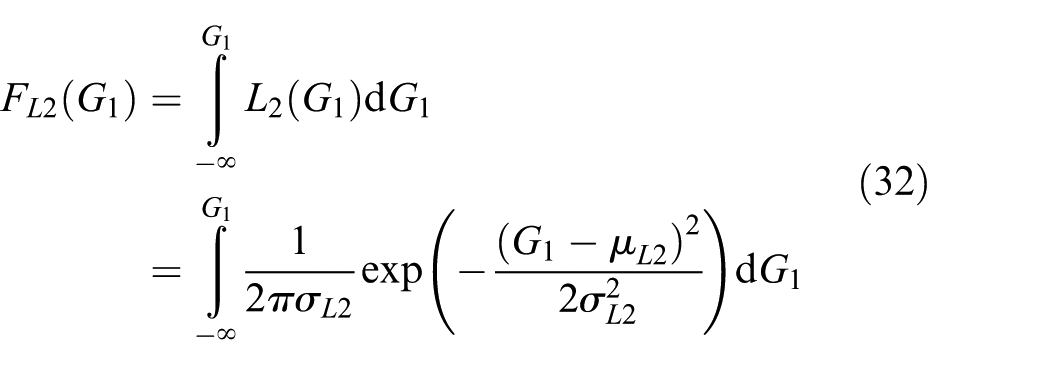
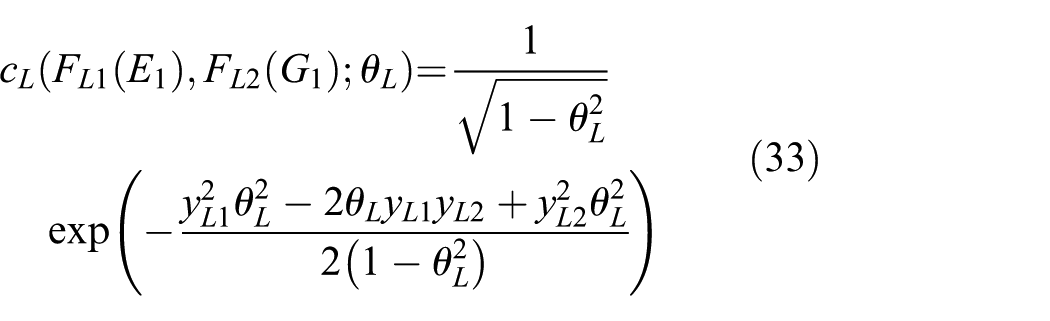
where
Then, substituting equations (31)–(33) and the value of
3. Update the prior joint PDF.
With the prior joint PDF and the likelihood function, the posterior samples of

Trace of iteration in case 2: (a) trace of iteration of E1 and (b) trace of iteration of G1.

Histogram and fitted PDFs of the generated posterior samples in case 2: (a) PDF of E1 and (b) PDF of G1.
Figure 5(a) shows the traces of 10,000 samples of
Figure 6 shows the estimated posterior marginal PDFs of
In this case, according to the posterior samples, the mean value, standard deviation, and coefficient of variation of
The posterior marginal probability distributions of
Similar to the observations in case 1, the mean value of
Similar to the observations in case 1, the mean values of
Compared with case 1, the differences in the standard deviations and coefficients of variation between the prior and posterior in this case are more significant. The reason is that the two random variables
The correlation between
The posterior joint PDF is also different from the prior joint PDF, as shown in Figure 7.

Prior and posterior joint PDFs of E1 and G1: (a) prior joint PDF of E1 and G1 and (b) posterior joint PDF of E1 and G1.
Reliability analysis
According to equation (20), the performance function

Before calculating

The instantaneous reliability
It is extremely difficult to analyze

Then,

According to equations (36) and (37), the above time-dependent reliability problem can be converted to a time-independent one. The key to realize this conversion is to calculate the global minimum value
In summary, the calculation of
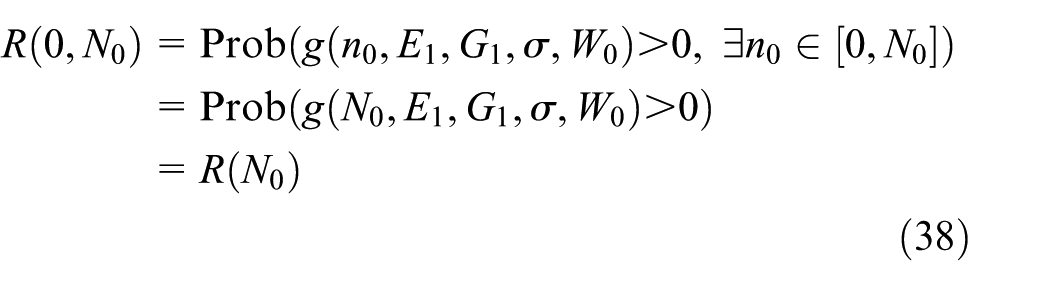
Thus, the existing reliability analysis approach, such as the first-order second moment (FOSM) method, the second-order second moment (SOSM) method, and Monte Carlo (MC) method, can be conveniently used.
Assume that the contact stress

Probability distributions of W0 and σ.

The generalized reliability indices of the pinion and rack mechanism associated with cases 1 and 2 are plotted in Figure 8. It is seen that:
The prior generalized reliability index (Gbeta01 curve, before updating and without considering correlation) is the lowest;
The generalized reliability index associated with updating the
Because of the integration of the partial data (containing no correlation information), the generalized reliability index associated with updating both

The generalized reliability indices before and after updating.
The gap of generalized reliability indices associated with case 1 and case 2.

According to the above analysis, we can see that the differences between the posterior probability distribution considering correlation and that without considering correlation is obvious. Because
Conclusion
Under the condition of the incomplete probability information, this article presents an approach for improving the reliability analysis accuracy of the aircraft high-lift by introducing the Copula function theory into Bayesian updating. The prior joint PDF and likelihood function of correlated random variables are constructed by the Copula function. The posterior joint PDF is obtained by Bayesian updating.
Taking the pinion and rack mechanism of the aircraft high-lift device for an example, two cases associated with updating (a) two random variables separately and (b) two correlated random variables simultaneously are investigated. The analysis of two cases shows that the reliability results based on the proposed approach are more accurate and more coincident with the factual situation. This approach can also be applied to other products’ reliability analysis and extend the application scope of Bayesian updating effectively.
Footnotes
Acknowledgements
The authors express sincere appreciation to the editor and reviewers for their efforts to improve the quality of the paper.
Handling Editor: Jose Ramon Serrano
Declaration of conflicting interests
The author(s) declared no potential conflicts of interest with respect to the research, authorship, and/or publication of this article.
Funding
The author(s) disclosed receipt of the following financial support for the research, authorship, and/or publication of this article: This work was supported by National Natural Science Foundation of China (Nos 51675026 and 71671009).
