




Abstract
To study the problem of highway traffic safety in cold regions, a thorough statistical analysis using traffic accident historical data is used to evaluate the influencing factors on highway traffic safety. A road traffic safety indicator system for cold regions is developed to evaluate the weight of these influence factors, such as driver performance, vehicle capacity, road condition, and general impact of the traffic environment. An index system of highway traffic safety influencing factors for cold regions is developed, and an evaluation model for traffic road safety influencing factors in cold regions based on attribute recognition theory is proposed. The weight of the model is determined using an analytic hierarchy process combined with expert scoring. The evaluation model is based on single-index attribute measure values and multi-index comprehensive attribute measurement values, using the confidence criterion to identify the influence of road traffic safety factors on road traffic safety in cold regions. In addition, the fuzzy comprehensive evaluation method is used for comparative evaluation, and the evaluation results were consistent and verified the correctness and feasibility of the attribute recognition model. Results showed that the evaluation system was in good agreement with actual traffic conditions in cold regions.
Introduction
The rapid development of the economy in recent years has increased the quantity of motorized traffic on roads and served to enhance rapid developments in the transportation industry. The increasing number of motor vehicles and increased traffic flows have led to the construction of new roads. The scale, quantity, and scope of roads have also been increasing, and the service quality has been continuously improved. Travel has become more convenient, fast, and comfortable. However, these improvements have also brought many serious traffic safety problems and negative social impacts to the country. Road traffic accidents occur frequently, especially serious traffic accidents, resulting in casualties and property losses. The contradictions between people, vehicles, roads, and the environment are increasing. Traffic safety issues are at the forefront, and these issues are attracting more attention.
Many methods have been applied to evaluate traffic safety, such as the principal component method, 1 the analytic hierarchy process (AHP), 2 clustering analysis,3,4 back propagation (BP) neural networks, 5 genetic algorithm,6,7 and the fuzzy comprehensive evaluation. 8 In recent years, many scholars have adopted improved methods to evaluate road traffic safety and discovered new ideas for road traffic safety evaluation. An improved gray correlation degree combination weighting method was applied to construct an improved model for highway safety evaluation by CF Yang et al. 9 An improved generalized data envelopment analysis (DEA) evaluation model of regional road traffic safety was proposed by XX Dang et al., 10 which evaluated the safety level of regional road traffic effectively. An evaluation model that combined the analytic hierarchy process and the fuzzy comprehensive evaluation method was proposed by LZ Guo et al., 11 which provided a new idea for evaluation of expressway safety. A comprehensive evaluation model based on hierarchical entropy and vector similarity based on a combination of subjective and objective factors was constructed by JE Chen et al. 12 D Liu et al. 13 proposed a regional traffic safety evaluation model based on the improved TOPSIS method to dynamically evaluate the road traffic safety level in the regional road traffic safety. WX Zhang 14 improved the road fuzzy comprehensive evaluation method and established a fuzzy evaluation method for urban road safety based on gray relational weighting method, which realized the combination of subjective and objective methods.
After the attribute recognition model is proposed, the model has been widely used in other fields, such as water safety and environmental safety evaluation. Later, some scholars applied the attribute recognition model to road traffic safety evaluation. The attribute recognition theory was introduced into the highway safety assessment system, and a highway traffic safety evaluation model based on attribute identification was established by QZ Hu et al., 15 which can be used to find out the causes and limited factors of highway traffic safety, and provide scientific decision-making basis for highway planning and reconstruction. The attribute recognition theory was introduced into the highway traffic safety facilities evaluation system, and a comprehensive evaluation model of highway traffic safety facilities system attributes based on attribute recognition theory was proposed by YY Guo et al., 16 the example analysis in the paper shows that the limiting factors affecting the highway traffic safety facilities can be found out, and the scientific theoretical basis for the reconstruction of highway traffic facilities is provided. It can be seen that the attribute recognition model has strong applicability in road traffic safety evaluation.
However, most of the current research on road traffic safety evaluation is for highways and non-cold regions, and highway safety evaluations for cold regions have not been adequately addressed in the research.
Cold regions account for 43.5% of land area in China. 17 Road traffic accidents are particularly severe in these areas due to the challenging geography and severe climatic conditions. Therefore, a study investigating the relationship between highway safety and the factors that influence it in cold regions will help to establish a traffic safety evaluation index system for these areas. Then, appropriate traffic safety road assessment techniques can be developed. In this study, a method is proposed that can provide a reliable and effective method of highway traffic safety evaluation for the special environmental conditions in cold regions. This method provides theoretically significant guidance and has important application value for improving road traffic safety, improving road traffic capacity, and improving operational efficiency. The factors that influence cold region highway safety are analyzed based on static data from January 2014 to June 2016, and an assessment index system is proposed. Attribute recognition theory is used to evaluate traffic safety at various locations on roads in these areas. The results provide a reliable and effective road traffic safety evaluation method that can be used for special environmental conditions in cold regions and reduce accident rates.
Analysis of factors affecting traffic safety in cold regions
Due to the specific geographical location and climatic characteristics, road traffic accidents in cold regions show unique distribution patterns. Starting from the time distribution law of accidents, the important factors affecting road traffic safety in cold regions are analyzed. The establishment of the influencing factor indicator system provided the basis.
Statistical analysis of accident distribution characteristics
Accident month distribution
Figure 1 shows the monthly distribution of highway accidents in Heilongjiang Province based on the static accident data from 2014 to 2015. It can be seen that the monthly distribution of accidents in this cold region has obvious seasonal characteristics.
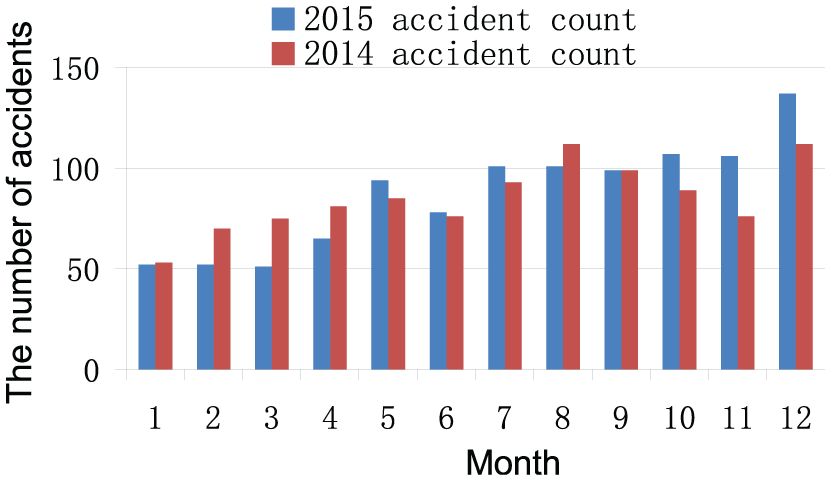
Monthly distribution of road traffic accidents in Heilongjiang Province from 2014 to 2015.
Figure 1 shows that the incidence of traffic accidents increased significantly during the winter ice and snow period. December occurs during the winter ice and snow season, and the climate is harsh in the Heilongjiang region. The temperature is relatively low and the amount of snow is heavy. Road snow often causes poor visibility, which affects the driver’s safety. In addition, the temperature difference between day and night is larger than in summer, therefore water, snow, and ice appear alternately on the road. When the friction coefficient of the road surface decreases significantly, the low friction coefficient can lead to an extension in braking distance and the speed of vehicle, which can not only increase the possibility of accident but also affect the safety of other vehicles on the road. However, the climate in January and February also has the characteristics of low temperature, large snowfall, and low visibility in the Heilongjiang region, but the number of traffic accidents is less than that in December, due to the lowest temperature during this period and the obvious decrease in traffic demand, which shows that the impact of winter climatic conditions on road traffic safety is very significant.
Accident hour distribution
Statistics of accidents that occurred at different hours in 2014 and 2015 in the Heilongjiang Province are shown in Figure 2. These data provide a reliable basis to investigate the influencing factors that can affect road safety.

Hourly distribution of road traffic accidents in the Heilongjiang Province from 2014 to 2016.
Figure 2 shows accidents that occurred during the day in a 24-h period. The highest incidence of accidents occurred at approximately 17:00. This was likely due to this period having a higher flow of people, the late peak in traffic, and the gradual descent of night. Especially in winter, cold regions get dark at 17:00, which causes bad road conditions, and when the driver is in a hurry to get home early, they drive faster. This acceleration in speed also increases the occurrence of traffic accidents. In cold regions, winter sunshine is minimal and the temperature difference between day and night is large. The temperature suddenly drops after 17:00, and the snow on the road is frozen. Therefore, the coefficient of road friction is reduced, which also greatly increases the occurrence of traffic accidents.
Climate and road conditions are the main factors that affect road traffic safety in cold regions compared to non-cold regions. Bad weather has a great impact on drivers and road vehicles, and ice and snow on the roads affect driving safety. Low air temperatures will also affect the performance of vehicles, which causes traffic accidents and influence highway traffic safety.
Screening of factors that affect traffic safety
Many factors affect road traffic safety. Generally, these are analyzed from four perspectives: people, vehicles, roads, and the traffic environment. Therefore, the establishment of an index system for the influencing factors of road traffic safety in cold regions is also based on these four perspectives. The geographical features of cold regions differ from other regions, and traffic safety features also differ in cold regions.
Therefore, the following lists the construction of multi-level and multi-target construction ideas.
Human factors
Human factors are the main cause of traffic accidents. In traffic safety, the research of human factors primarily focuses on studies of the driver’s behavior. The driver, as a user of transportation tools, occupies an important guiding position in the road transportation system. They are the backbone of the system and the most important factor that affects road traffic safety. If drivers display unsafe behavior, this can have a huge impact on road traffic safety. Driver’s driving skills, driving habits, and their own qualities have a great impact on road traffic safety.18,19 Usually, when a car is driving, the driver obtains information from the traffic environment through visual, auditory, and tactile organs. They then process this information through the brain, make reflections and judgments, and then manipulate the car to operate on the road according to the driver’s will. A driver’s success is influenced by the driver’s own quality, driving skills, and habits, and if any errors occur in any part of the collection, processing, and judgment of information, these errors will endanger the smoothness of traffic flow and, hence, traffic safety.
Traffic accidents caused by speeding and driving fatigue are common. In cold regions, especially in winter, drivers will more likely feel tired while driving because of low outdoor temperatures and relatively high temperatures inside the car. If the driver is in a state of fatigue, traffic accidents will often occur when the vehicle is in bad weather conditions, or driving near a cliff, a waterfront, or a corner. In the cold winter, the road tends to freeze due to snow, which reduces the friction coefficient between the tire and the road surface. When a vehicle drives on an icy road, the braking distance increases greatly, when the driver is driving at rapid speeds. Therefore, the vehicle cannot be stopped within the normal distance if it is in danger. Heavy snow weather also tends to reduce visibility. When the driver is driving at rapid speeds, rear-end collisions or rollovers can occur during cornering.
Vehicle factors
Vehicles are one of the important factors that affect road traffic safety. The technical performance of vehicles can directly affect driving safety. 20 In cold regions, during the rainy season and the snowy season, the road friction coefficient is reduced. This can cause the vehicle to slide during the braking process, resulting in traffic deviations, side slips, and collisions. Studies have shown that among poor braking, steering failure, tire puncture, brake failure, lighting failure, and other mechanical failures in cold regions, a vehicle’s poor brake performance, steering failure, and light failure are most important factors that lead to traffic accidents. The result of this can be casualties and huge economic losses.
Road factors
Road factors play an important role in factors that influence traffic safety. Statistics indicate that approximately 20% of traffic accidents in China are closely related to road conditions. 21 In cold regions, road conditions and road linear conditions are the most important factors. In the cold regions of China, the extremely low temperatures in winter and the relatively high temperatures in summer tend to change the soil quality that underlies the road. Spring “frozen tumbling” and winter road icing often lead to extremely poor road conditions. In winter, the road friction coefficient is significantly reduced by snow and ice. Relevant research shows that if the road friction coefficient decreases by a magnitude of one, the braking distance is extended by a magnitude of one. In addition, if vehicle speed is doubled, the braking distance is extended by a magnitude of four, which invisibly increases the possibility of accidents.22,23 Therefore, road conditions play a large role in road safety in cold regions and this must be considered.
Environmental factors
Environmental factors are an important factor that affects road traffic safety in cold regions. Bad weather such as rain, snow, haze, and fog not only reduces visibility but also reduces the friction coefficient of the road surface, greatly jeopardizing the driver and driving safety. Studies have shown that about 5% of highway traffic accidents are closely related to bad weather in the cold regions of the Heilongjiang Province. 24
The road traffic system is a coupling system composed of people, vehicles, roads, and environmental factors. These components are each an independent subsystem. Each element has an important impact on traffic safety. Starting from the time distribution law of accidents, the characteristics of accident distribution in cold regions can be obtained from the accident monthly distribution chart of Figure 1 and the accident hourly distribution chart of Figure 2. The main factors influencing road traffic safety and causing accidents are analyzed, that is, the special climate in winter is one of the main factors influencing accidents. According to the characteristics of the accident distribution from the Heilongjiang Province, factors affected road traffic safety in cold regions, which are human, vehicle, road, and environment. This study also clarifies the specific content of these influencing factors and analyzes the specific mechanisms. Combining the law of accident distribution with the cause of accident, the relationship among the factors leading to the accident can be obtained. That is, in winter environmental factors, such as low temperature and heavy snowfall, lead to worse pavement conditions, lower pavement friction coefficient, and lower pavement friction coefficient that will lead to poor braking of vehicles, resulting in improper operation of drivers and traffic accidents. In addition, the winter climate environment will affect the performance of vehicles and drivers’ operation behavior, resulting in traffic accidents, which shows that the factors affecting road traffic safety are closely related to each other.
Establishment of an index system for influencing factors of traffic safety in cold regions
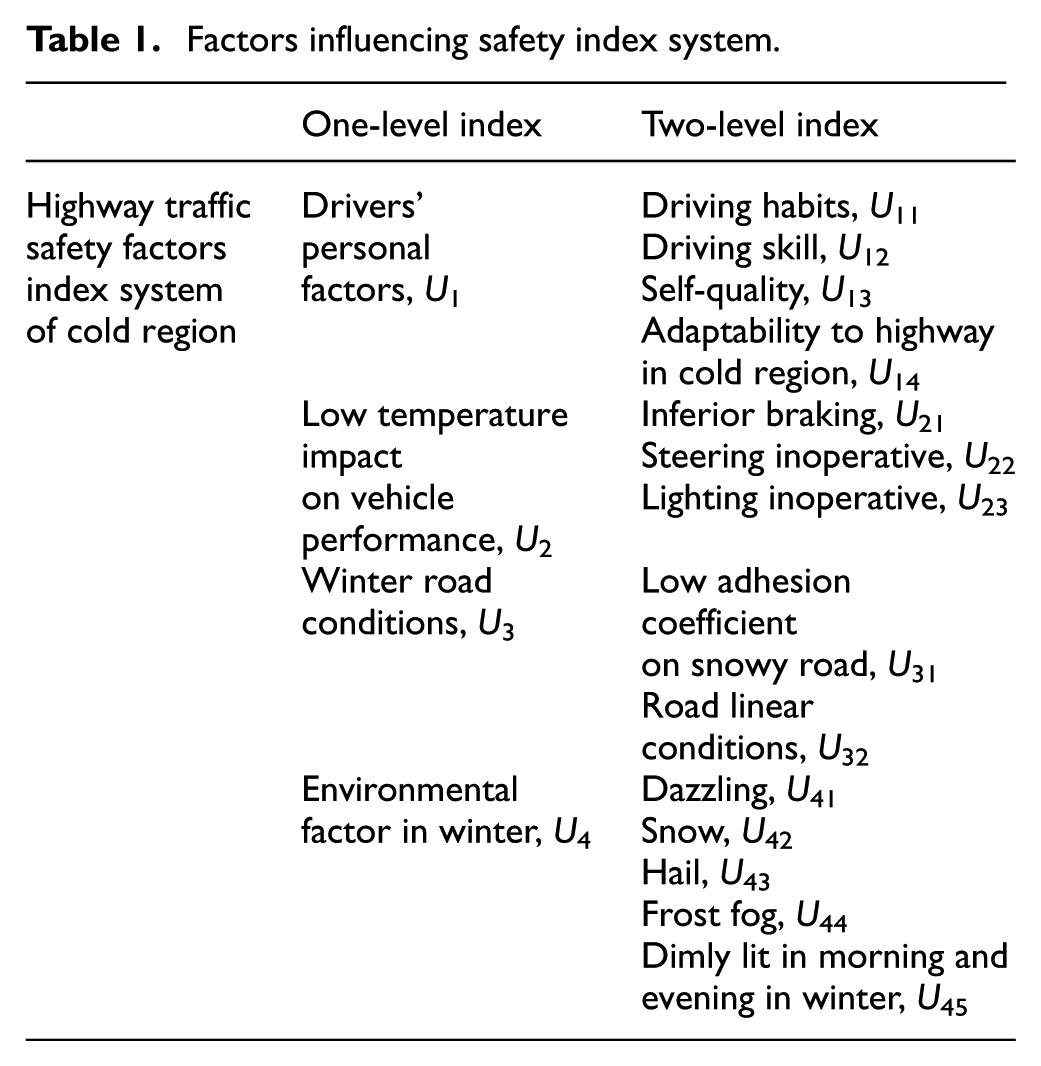
The influencing factor index system is the premise of traffic safety diagnosis, dangerous point identification, safety control, and management. It is also a new evaluation index system that is different from the current general safety management system. The construction of the system follows these basic principles: systemic and hierarchical principles, validity and operability principles, and static and dynamic principles. According to the climatic characteristics of a cold region, the Heilongjiang province was used as the study area to analyze insecure elements of road traffic safety. Winter conditions were assumed and then the four aspects of people, vehicles, roads, and the environment were used to determine the traffic insecurity. Four one-level indices were established: driver personal factors, low temperature impact on vehicle performance, winter road conditions, and environmental factors in winter. A total of 14 two-level indices were selected to construct the evaluation index system shown in Table 1.
Factors influencing safety index system.
Determination of rating criteria
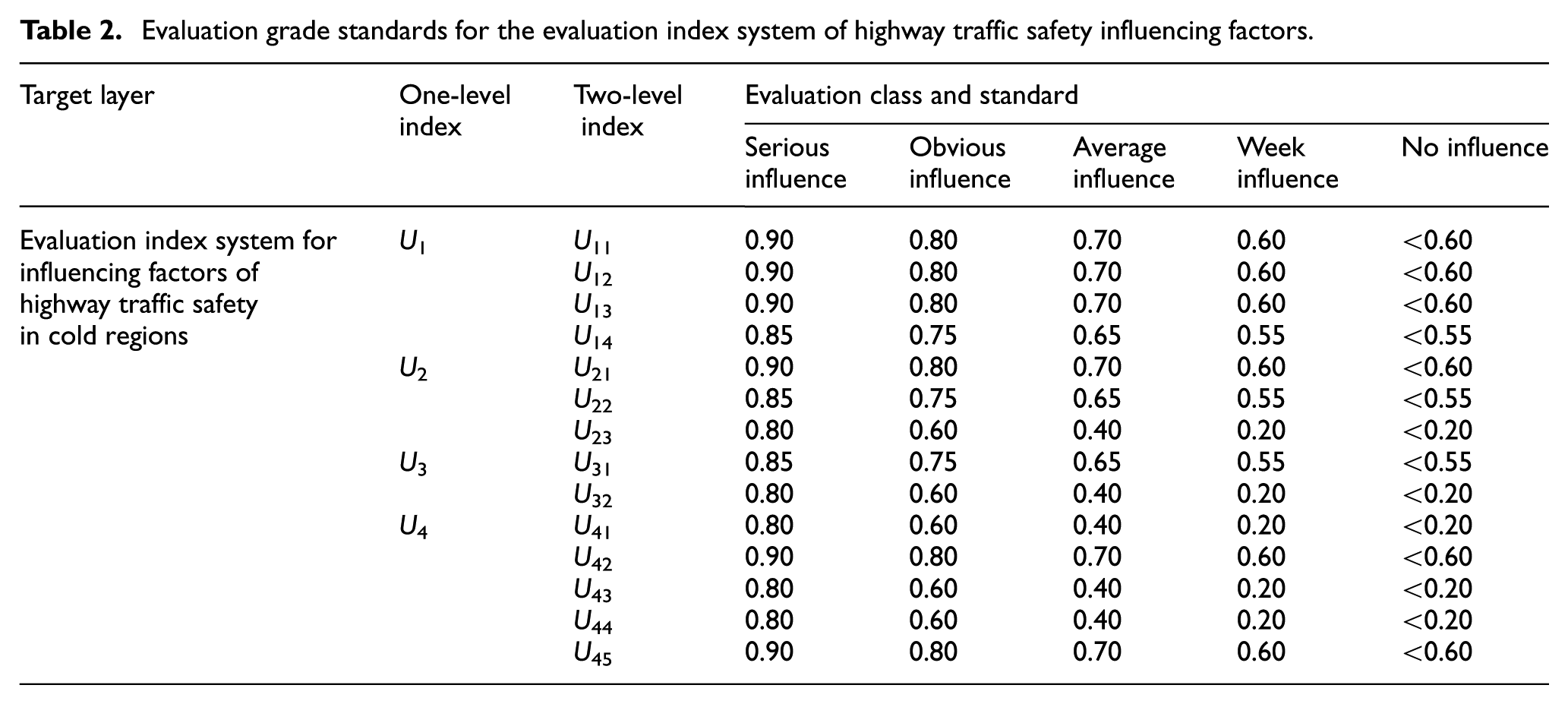
To scientifically and effectively evaluate the impact of influencing factors on road traffic safety in cold regions, each indicator in the evaluation index system identified in Table 1 was divided into five evaluation levels: serious influence, obvious influence, average influence, weak influence, and no influence, where C1={serious influence}, C2={obvious influence}, C3={average influence}, C4={weak influence}, and C5={no influence}.
The choice of the appropriate evaluation grade standard was a key to determine whether the evaluation was reasonable. Because this research studies the influence of road influence factors on road safety in cold regions, the rating criteria determined for each indicator was based on a commonly used percentage method. That is to say, representative transportation engineering experts, traffic civil engineering experts, and experienced drivers are used to establish the critical value of each evaluation level by the percentage method, so as to establish a reasonable evaluation level standard. The specific evaluation level standards are shown in Table 2.
Evaluation grade standards for the evaluation index system of highway traffic safety influencing factors.
Evaluation model for influencing factors of traffic road safety in cold regions
Evaluation principle
The attribute recognition theory, proposed by Professor Cheng, 25 established a theoretical model of attribute recognition that has been applied to the field of evaluation. A water safety attribute recognition model was established by LY Zhang et al., 26 which was applied to evaluate the water security status of Shandong Province. HY Cao and YD Bian 27 introduced the application of attribute recognition theory for the evaluation of surrounding rock quality classifications in the field of underground engineering. The attribute recognition theory was developed on the basis of the fuzzy theory, and the ordered segmentation class is effectively identified according to confidence criterion.
To begin the calculation, n samples, x1, x2, …, xn, are selected from the study space X, and each sample has m measurement indicators. The indicator measured value of j in sample i is xij. The sample i can be expressed as: xi = (xi1, xi2, …, xim), 1 ≤ i ≤ n. Suppose F is a certain kind of attribute space in X, and (C1, C2, …, CK) is an ordered series of K levels in the attribute space F and meets the condition C1 > C2 >…> CK, 28 then the following steps can be used for the calculation of the attribute measure.
Based on the evaluation index system of highway traffic safety influencing factors in cold regions, a comprehensive evaluation model for the influencing factors was developed based on attribute recognition theory. The model used the analytic hierarchy process to determine the weight of each indicator. The attribute identification theory was used to determine the single-index attribute measure and the multi-index comprehensive attribute measure. The influence of the determined safety influence factors was quantitatively measured by applying the attribute recognition theory evaluation model. The degree of influence was comprehensively reflected using the property identification theory and its attribute measurement value, and finally, the model was used to determine which evaluation level xi belongs to in the cold road traffic safety influencing factors. The evaluation process is shown in Figure 3.

Impact factor evaluation process.
Calculation of the attribute measure
1. Determine the attribute class Ck of uijk, which stands for the attribute measure of xij, where uijk = u (xij∈ Ck).
F is a certain kind of attribute space in X, and (C1, C2, …, CK) is an ordered series of K levels in the attribute space F and meets the condition C1 > C2 >···> CK. If the classification criterion of each index is known, the classification standard matrix can be written as

where
Suppose
Then, the attribute class, Ck of
When

When

When

2. Determine

where
Determination of the attribute class of xi
When C1 > C2 > …> CK, based on the confidence criterion, take

When C1 < C2 < …< CK, take

Here, λ is the confidence value ranging generally from 0.6 to 0.7.
The score criterion model is described as follows

where
Weight calculation based on analytic hierarchy process
The relationship between the various factors in the influencing factors system of road traffic safety in cold regions is extremely complicated. The evaluation of the system is a multi-index and multi-attribute problem. Sections “Screening of factors that affect traffic safety” and “Establishment of an index system for influencing factors of traffic safety in cold regions” analyze the four aspects of people, vehicles, roads, and traffic environment and establish a road traffic safety evaluation index system for cold regions. The influencing factors of the system are organized and layered, and an ordered hierarchical structure model is constructed. This model uses the analytic hierarchy process (AHP) in system engineering theory to determine the weight of each indicator of road traffic safety in cold regions. 29 AHP divides the various factors in complex problems into related ordered levels and makes them organized. It is an effective method that combines quantitative analysis with qualitative analysis. The steps in the AHP to determine the weights are as follows:
1. Construct a judgment matrix
The target is A, and ui, uj (i, j = 1, 2, …, n) represent factors. uij represents the relative importance value of ui to uj. And the A-U judgment matrix P is composed using uij

where the choice of uij usually adopts the 1–9 scale method and compares two elements of the same level. The scale of 1–9 is shown in Table 3.
The meaning of each element in the judgment matrix and the scale of 1–9.

2. Calculate the order of importance
According to the judgment matrix, the feature vector, w, corresponding to the maximum eigenvalue, λmax, is obtained. The equation is as follows

The obtained feature vector, w, is normalized, which is the importance order of each evaluation factor, as in the weight contribution.
3. Consistency test
Even if the weight contribution is reasonable, a consistency check of the judgment matrix is also needed. The test formula is as follows

where CR is the random consistency ratio of the judgment matrix; and CI is the general consistency indicator of the judgment matrix, which is given by

RI is the average random consistency index of the judgment matrix, and the RI values of the judgment matrix of the first to ninth order are shown in Table 4.
The value of average random consistency indicator RI.

When CR of the judgment matrix P is less than 0.1 or λmax = n, CI = 0. Therefore, P is considered to have satisfactory consistency. Otherwise, the elements in P need to be adjusted to have satisfactory consistency.
Index system evaluation of factors that affect traffic safety in cold regions
Table 1 shows the factors that affect traffic safety in cold regions. The attribute recognition model was applied for evaluation. It was first necessary to determine the weight and attribute measure of each impact factor. Then, a comprehensive evaluation was performed to determine the safety impact factors in cold regions. Traffic safety influencing factors for cold regions established by the inspection institute are in agreement with the traffic conditions used in this article.
Calculation of indicator weight
The factors affecting driving safety in cold regions are divided into two layers, as shown in Table 1. The first level is the one-level indicator that includes the impact of low temperature on vehicle performance, bad weather in cold regions, road attachment conditions, personal driver factors, and short lighting time, which is U = {U1, U2, U3, U4}. The two-level includes 14 second-level indicators, that is, U1 = {U11, U12, U13, U14}, U2 = {U21, U22, U23}, U3 = {U31, U32}, and U4 = {U41, U42, U43, U44, U45}. The construction of the judgment matrix is a key component for the calculation of the weight. The values of the elements in the judgment matrix are determined by comparing the evaluation indicators. Because the process is relatively subjective, in order to avoid the computational bias caused by subjective factors, multiple experts to be invited to construct the judgment matrix. Although the opinions of different experts on the impact of a specific indicator are not completely consistent, the opinions of many experts can reflect the objective law of the impact indicators. Then, the judgment matrix constructed by each expert is sequentially calculated according to the *steps given in section “Weight calculation based on analytic hierarchy process,” and the average value is the weight of each factor that affects the safety of the traffic road in the cold regions. The experts selected are highly representative in the field of transportation industry. They have rich experience and strong judgment. There are related experts from Heilongjiang Transportation Department, professors and senior engineers from universities, and so on. Calculating weights with AHP involves a large number of matrix calculations, and the calculations are complicated and cumbersome. Therefore, MATLAB was used to calculate the weights, which made the calculation simple and fast. The weights of the factors that affect traffic safety in the cold regions are shown in Table 5.
Influence factors weight.

Evaluation of influence factors
To make a reasonable evaluation of existing highway traffic safety in Heilongjiang, the degree of influence of each influencing factor on road traffic safety can be obtained through expert investigation. 30 In order to ensure the scientific rationality of the evaluation results, relevant experts are invited from Heilongjiang Transportation Department, professors and senior engineers from universities, and experienced drivers to establish 14 secondary indicators. The scores of impact on road traffic safety and a percentage system was used. The data obtained are compiled and shown in Table 6.
Influential factors evaluation score.

Then, the attribute recognition model was used to comprehensively evaluate the attribute identification system of traffic safety factors in cold regions. The specific evaluation process was as follows.
Determine attribute measure values for each influencing factor
The attribute measure values of each influencing factor were determined according to equations (2)–(4), as shown in Table 7.
Attribute measures of influence factors.

Single factor evaluation
The data from Tables 5 and 7 were substituted into equation (5), and the attribute measure values for the five one-level evaluation indexes were obtained, as shown in Table 8.
Attribute measures of one-level evaluation index.

The data from Table 8 were substituted into equation (6) to analyze safety factors for the one-level index. A confidence value of λ = 0.65 was used. For U1: 0.6207 + 0.1703 = 0.7910 > 0.65, k = 2, and the influence degree of U1 belonged to C2, which means that driver personal factors had an obvious influence on traffic. For U2: 0.2284 + 0.5114 = 0.7394 > 0.65, k = 2, which means that the influence degree of low temperatures on vehicle performance belonged to C2 and had a marked influence. For U3: 0.6750 > 0.65, k = 1, and the influence degree of U3 belonged to C1, which means that winter road conditions had a significant impact on traffic safety. For U4: 0.5126 + 0.3687 = 0.8814 > 0.65, k = 2, which means that the influence degree of U4 belonged to C2, meaning that winter environmental factors had obvious influence on traffic.
The influence degrees of the one-level safety evaluation indexes U1, U2, and U4 all belonged to the C2 level, which meant there was an obvious influence, and the evaluation score can be calculated using equation (8). According to scores,
Multi-factor comprehensive analysis
The comprehensive attribute measure matrix U = (0.5274, 0.3432, 0.0858, 0.0587, 0.0181) was obtained by substituting the weights in Table 5 and the data in Table 8 into equation (5). According to equation (6), the calculation result is k = 2, with the condition of λ = 0.65. That is to say, a comprehensive influence of safety factors determined using this method was two-level, which means these factors have strong effects on traffic safety in cold regions.
Comparative analysis of the fuzzy comprehensive evaluation method
To avoid unreasonable evaluation results of the single-class method, the fuzzy comprehensive evaluation method (2007) was selected as the comparison method. To make the fuzzy comprehensive evaluation method and the attribute identification analysis method consistent in the evaluation of the influencing factors of highway traffic safety in cold regions, evaluation criteria and indicator set evaluation criteria were classified into five levels, as shown in Table 9. The weight of the index was also determined using the analytic hierarchy process. The determination of the membership degree of the evaluation index level was represented using the lower half trapezoid method.
Evaluation criteria and indicator set evaluation level standards.

The cold region road traffic safety factor index membership degree matrix, Rl (l = 1, 2, 3, 4), is developed below.
The driver personal factors membership matrix, R1, is

The low temperature impact on vehicle performance membership matrix, R2, is

The winter road conditions membership matrix, R3, is

The environmental factors in winter membership matrix, R4, is

According to the two-level indicator weights wl (l = 1, 2, 3, 4) listed in Table 2, w1 = {0.2545, 0.2544, 0.2485, 0.2426}; w2 = {0.4667, 0.3471, 0.1862}; w3 = {0.7500, 0.2500}; and w4 = {0.2438, 0.3152, 0.0971, 0.0971, 0.2468}. According to the single-index evaluation vector Bk = Rlwl (k, l = 1, 2, 3, 4), the fuzzy evaluation matrix for evaluation of influencing factors is as follows

According to the one-level indicator weight w = {0.2628, 0.2159, 0.3254, 0.1859} in Table 2, the final fuzzy comprehensive evaluation result for determining the influencing factors of highway traffic safety in cold regions is

Using the weighted average method, the interval maximum of the evaluation set was taken to form an evaluation vector V = {1.0, 0.9, 0.8, 0.7, 0.6}. Therefore, the final comprehensive evaluation result of the influence of highway traffic safety factors on road traffic safety established in this study was found to be V = 0.8174. This result was combined with Table 9 to get the evaluation level for the two levels. Therefore, the influencing factors of road traffic safety in cold regions established in this study have a significant impact on the road traffic safety in cold regions. The evaluation results of this method are consistent with the evaluation results of the attribute recognition method.
The two evaluation methods were used to comprehensively evaluate the influencing factors of road traffic safety in cold regions, which can avoid the error of the single-class method due to model defects. It can be seen from the case study that the influencing factors system of road traffic safety in cold regions is in good agreement with actual traffic situations in cold regions.
In summary, the impact of safety factors on road safety in cold regions was ranked according to their degree of influence: winter road conditions, winter environmental factors, driver personal factors, and the impact of low temperatures on vehicle performance. The model concluded that winter road conditions and winter environmental factors had the greatest impact on road traffic safety in cold regions. The main reason is because winter temperatures are low and snowfall can be substantial, resulting in a poor driving environment and reduced road adhesion coefficient. Therefore, after snowing, snow should be removed as soon as possible to prevent the snow on the road surface from being compacted and then frozen at low temperatures, which would reduce the road surface adhesion coefficient and increase traffic accidents.
Discussion
With the rapid increase in the number of motor vehicles, the traffic safety problem has become increasingly prominent and has received much attention. Many scholars, at home and abroad, have done a significant amount of research regarding traffic safety evaluation methods.
In the 1940s, foreign countries have carried out road safety evaluation research, and the research on the influencing factors of road traffic safety, and the theory and methods of traffic safety evaluation. The main methods in traffic safety evaluation include relative accident rate method, time series analysis method, regression analysis method, system analysis method, and traffic conflict method. 31 Many improved methods have been proposed by continuous research. According to the results of accident data analysis of 20 typical expressways in eight European countries, a dangerous road segment identification method based on comprehensive evaluation thought is proposed by R Elvik. 32 LAURESHYN established a framework for judging the level of traffic safety based on behavioral data at the microlevel. 33 Domestic research on traffic safety evaluation started in the mid-1980s. Subsequently, domestic scholars used BP neural network method and fuzzy comprehensive evaluation method to conduct extensive exploration and practice on highway safety. In recent years, some improved evaluation methods have been proposed. HZ Bi et al. 34 used the gray clustering evaluation method to cluster the index system, and divided the safety level of the intersection into five grades according to the gray class, and applied the example. XY Liang et al. 35 improved the fuzzy comprehensive evaluation method of domestic macro-road traffic safety, and proposed a weight calculation method based on triangular fuzzy numbers, and applied examples. The results show that the evaluation method is accurate and reasonable. However, research on road traffic safety at home and abroad is almost exclusively for highways and non-cold areas, and there are few studies that investigate influencing factors that contribute to cold region road safety. Therefore, the research on road traffic safety assessments in cold regions is still not complete.
Considering the shortcomings of existing evaluation methods, the highway of Heilongjiang Province was taken as an example to establish an influencing factors system for road traffic safety in cold regions. A theoretical attribute recognition model was used to evaluate the influencing factors in cold regions. A comprehensive evaluation level of the system belonged to the two-level, and the fuzzy comprehensive evaluation method was used for a comparative evaluation. The evaluation results were consistent. Therefore, the established evaluation system of influencing factors is consistent with the traffic situations in cold regions, and the system can have a significant impact on traffic safety improvements in cold regions. The special environment of cold regions is the main cause of traffic accidents.
However, there are many factors that affect the road traffic safety in cold regions. Due to the constraints of the experimental data and the limitations of the considerations, the index system for the influence factors in cold regions is not comprehensive enough. A future research consideration should be to expand on the influencing factors used in this system and develop assessment methods for traffic safety that are more reliable and effective.
According to the evaluation and analysis results of road traffic safety influencing factors in cold regions, combined with the winter snow and ice weather conditions, relevant road traffic departments should adopt corresponding management and protective measures to ensure traffic safety under cold and snow conditions to reduce road traffic accidents. This study proposes the following improvement measures:
1. Pay attention to drivers’ training and safety education.
According to the analysis, the driver’s driving skills and driving habits are the main factors affecting road traffic safety. Therefore, improvement measures are proposed from these aspects. Strict training should be required for drivers so that the driver can drive skillfully on cold roads and be familiar with the driving environment. In addition, relevant departments should strengthen the safety education of vehicle drivers and reduce illegal behaviors, such as fatigue driving, and take corresponding measures to educate or punish violators. As a result, drivers can improve their basic traffic safety awareness.
2. Strengthen the maintenance and management of the vehicle.
It is necessary for the driver to develop a habit of checking the vehicle frequently. The vehicle should be routinely maintained and inspected at regular intervals. They should check the parts of the vehicle that are closely related to safe driving.
3. Strengthen the ability to prevent bad weather disasters and ensure normal traffic flow.
Bad weather such as rain, snow, fog, and haze not only cause great difficulty in driving but also seriously interfere with a driver’s normal driving, which can easily lead to accidents. Therefore, the relevant expressway departments should work closely with other departments, such as the Meteorological Bureau and the Flood Control and Drought Relief Command Center to develop scientific and effective measures to master weather predictions and inform drivers of environmental information using broadcasting and radio communications.
4. Improve road traffic safety facilities and improve the modernization level of traffic management.
For high-grade highways in cold regions, it is particularly important to strengthen the construction of traffic safety measures due to the high severity of accidents. Improving the modernization level of traffic management is an urgent problem in the current traffic management infrastructure. Radio command communication networks, road traffic management information systems, vehicle and driver management systems, motor vehicle automatic detection systems, and traffic accident rapid alarm rescue systems should be established and improved. All of these measures are very important to improve the traffic safety level of high-grade roads in cold regions.
Conclusion
The Heilongjiang Provincial Highway was taken as the study area, and the factors affecting traffic safety in cold regions were determined. In addition, the influencing factors for traffic road safety in cold regions were established. The influence weights of various influencing factors in traffic accidents were determined using an analytic hierarchy process, and a theoretical model of attribute recognition was used. Traffic safety influencing factors in the cold region were evaluated, and a fuzzy comprehensive evaluation was used for comparative evaluation analysis. The conclusions are as follows:
According to the results of single-factor evaluation, the influence degrees of traffic safety factors in cold regions were ranked in threatening order as: winter road conditions, environmental factors in winter, driver personal factors, and the influence of low temperatures on vehicle performance. Evidently, winter road conditions displayed the most threat to road traffic safety in cold regions, with the main reason being that the winter road surface snow adhesion coefficient is reduced.
According to the multi-factor comprehensive evaluation result, k = 2 shows that the safety evaluation factor belonged to the second grade. The impact system for cold region safety determined in this study had a significant effect on traffic safety. The influence factors of cold regions identified in this study had a significant effect on traffic safety in cold regions. To avoid the unreasonable evaluation results of single-class methods, the fuzzy comprehensive evaluation method was selected as the comparison method in this article and obtains the calculation according to the fuzzy comprehensive evaluation method. The fuzzy comprehensive evaluation method was consistent with the evaluation result of the attribute recognition evaluation method, and the evaluation level of the cold region safety influencing factor system belonged to the two-level.
According to the attribute recognition model established in this article, the evaluation results of the road traffic safety influencing factors in the cold area are available. The traffic safety factor system established in this article is in line with the traffic situation. Based on the evaluation results of the model based on the model, combined with the winter snow and ice weather conditions in the cold regions, the corresponding management and protective measures are proposed for the relevant departments of road traffic, which has certain realistic meaning for reducing the road traffic accident rate and improving road traffic safety in cold regions.
Footnotes
Handling Editor: Jiangchen Li
Declaration of conflicting interests
The author(s) declared no potential conflicts of interest with respect to the research, authorship, and/or publication of this article.
Funding
The author(s) disclosed receipt of the following financial support for the research, authorship, and/or publication of this article: The research reported in the paper was supported by the Central University special fund (2572017DB01), the National Major Program 2017YFC0803901, the National Natural Science Foundation Youth Fund (51108068), and the Transport Department of Heilongjiang Province (E201350).
