



Abstract
In the printing section of the shaft-less drive gravure printing machine, as the web material is sensitive to temperature, the web outside the drying devices will be affected by the changes of the environment temperature. In order to improve the printing precision in gravure printing machine, the effects of environment temperature on web tension in the printing section are studied in this article. Based on the law of mass conservation, the tension model including the factor of environment temperature is derived. Then some theoretical analyses and simulations are conducted to in-depth study the effects of environment temperature from the relations between inputs and output in a web span. Finally, some experiments are carried out to verify the characteristics of the tension subsystem including environment temperature. The result shows that the settling times decrease with the rise of the environment temperature in the transient responses, and the absolute changes of the steady-state tension decrease with the rise of the environment temperature in the steady-state responses as the inputs are the velocities of the printing rollers. The study on the effects of environment temperature on web tension would benefit the tension control and the register control for the further study.
Introduction
Social development has given rise to escalating demand for printing product quality. Gravure printing machine is an important printing device for its higher printing speed and quality. The shaft-less drive technology has been widely used in the gravure printing machines. Web tension system and register system are two important parts in gravure printing machines, and web tension system is the basis of the register system. The tension control precision is the main crucial factor to evaluate its performance in gravure printing machine. In order to improve the tension control precision, in-depth study on the web tension model is required.
The schematic diagram of a four-color gravure printing machine is shown in Figure 1. The gravure printing machine is mainly composed of three sections: unwinding, four-color printing, and rewinding. In the printing section, each printing roller is driven by an independent servo motor, that is, shaft-less drive mode. Two dancer rollers are installed in unwinding and rewinding sections to reduce web tension fluctuations and measuring tension signals. Load cells are set up in the web spans to measure the web tensions too. Photoelectric sensors are installed in the printing section to detect register errors. Drying devices are set up behind each printing roller to dry the ink. The web tension system and the register system are coupled together in the printing section.

Diagram of the four-color gravure printing machine.
There are different requirements of web tension in the three sections because of the difference in technical processes. Some researchers focus on the unwinding and rewinding sections. In these researches, the unwinding tension model and rewinding tension model were studied and then various kinds of control algorithms were adopted to achieve higher tension precision. Shao et al. 1 researched the modeling method of winding system for gravure printing machine. The control algorithms for unwinding or rewinding tension include back propagation (BP) neural network control, 2 active disturbance rejection control (ADRC), 3 fixed-order H∞ control, 4 fuzzy adaptive proportion-integral-differential (PID) control, 5 nonlinear sliding-mode control, 6 adaptive gain control, 7 and so on. The mentioned research works give some solutions to the stability and precision of the web tension in unwinding and rewinding sections, but cannot improve the precision of the web tension in the printing section.
In the printing section, the tension system and the register system are coupled together. Some research works are related to the register model and register control algorithm, but these research works are based on the conventional tension model of roll-to-roll web printing system.8–11 Some research groups studied the web tension system in the printing section, and the tension control algorithm is the research priority. Choi’s group used back stepping-based control algorithm and fuzzy decoupling method to reduce the propagation of tension disturbances in a roll-to-roll system.12,13 Knittel’s group analyzed the influence of the master roller placement, velocity, and tension bandwidths on web tension of the roll-to-roll systems, 14 and then they developed a three-dimensional finite element model of the web and applied robust control algorithm to control the web tension. 15 These researches do not take into account the thermal effects in the roll-to-roll printing section.
The effects of temperature on the tension system and register system in gravure printing section are remarkable and attract some researchers’ attention recently. Pagilla’s group developed a model to determine the temperature distribution in moving webs due to heating by radiation panels.16,17 Shin’s group studied the tension behavior with consideration of thermal effects in roll-to-roll E-printing 18 and then researched the dynamic thermal characteristic of a register of roll-to-roll multi-layer printing systems. 19 The aforementioned research works are not applied to gravure printing and do not involve the effects of the environment temperature. The research on the effects of environment temperature on web tension characteristics in gravure printing system is rare.
In the printing section of the gravure printing machine, the drying temperatures inside the drying devices are constant. However, the web temperature outside the drying devices always changes with the environment temperature. The range of the environment temperature is from 0°C to 40°C, and the room temperature inside the workshop is usually from 10°C to 30°C. The environment temperature means outdoor temperature and room temperature means indoor temperature. The buildings (wall, windows with glass) of the workshop have thermal insulation functions which make a difference between the environment temperature and room temperature. The better thermal insulation conditions will cause a larger temperature difference between the environment temperature and room temperature. The biaxially oriented polypropylene (BOPP) material is sensitive to the temperature, and Young’s modulus of BOPP reduces almost half as the web temperature increases 40°C. It is obvious that the changes of the environment temperature would affect the web tension system by Young’s modulus of web material.
With the higher requirement for printing quality and the increase of the printing speed, the effects of the environment temperature on web tension need to be studied in-depth in order to obtain the characteristics of the web tension system including the environment temperatures, which will make the tension model more accurate. In this article, we first set up the mathematical model of the web tension between two adjacent printing rollers including the environment temperature and drying temperature. Then some theoretical analyses and numerical simulations are carried out to study the effects of environment temperature on tension model based on the relations between subsystem inputs and output. At last, some experiments are conducted to verify the effects of the environment temperature.
Mathematical model including temperature
Figure 2 shows the schematic diagram of the two-color printing subsystem in the gravure printing machine. The subsystem includes two printing units, web and a drying device which is set between the two adjacent printing units to dry the printing ink.
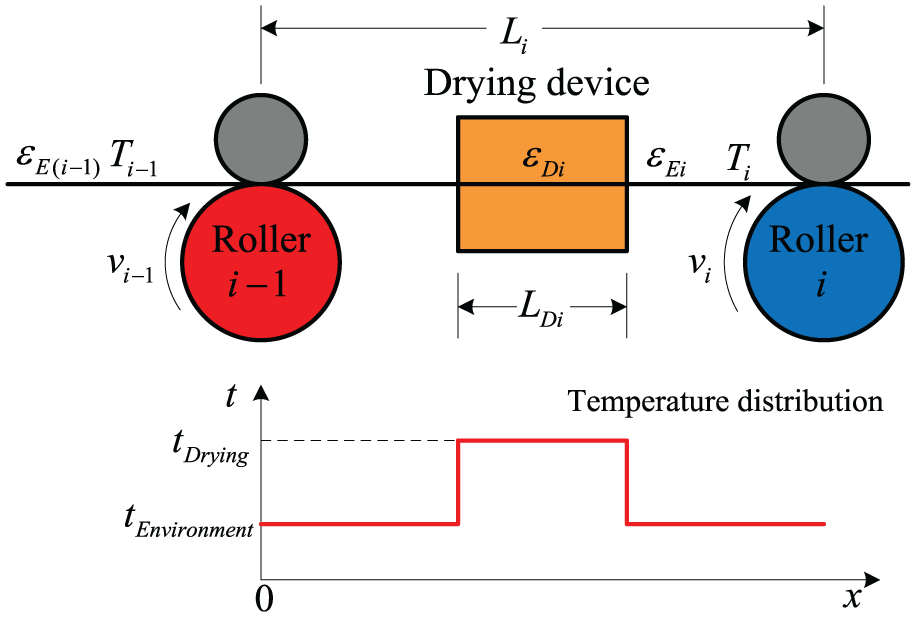
Schematic diagram of the two-color printing subsystem.
Because of the existence of drying device in web span, the distribution of web temperature is not uniform. The web temperature inside the drying device is much higher than that outside the drying device. As the web is very thin (usually 10–45 μm) and the heat transfer process is fast, the duration of heat transfer can be considered as 0. There is a cooling roller to decrease the web temperature outside the drying device, and the cooling roller could also shorten the duration of heat transfer. Therefore, it can be considered that the web temperature inside the drying device is equal to the drying temperature and the web temperature outside the drying device is equal to the environment temperature. The web temperature distribution in a web span is shown in Figure 2.
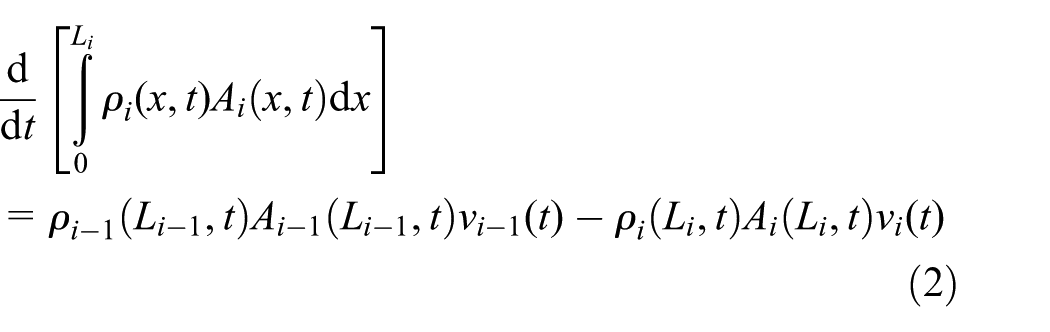
For the web span between two adjacent printing rollers, the variation of the web mass is equal to the difference between the entering web mass and the export web mass in unit time, that is, the law of conservation of web mass. Based on the law of conservation of web mass, the mass conservation equation for the web span in Figure 2 can be obtained as follows

The detailed mass conservation equation can get by substituting
where
Assuming the web material is perfectly elastic, the mass of a web element will not change with the stretched state, that is

where the subscript

where

The web density and cross-sectional area in the un-stretched state do not change with the position and time, so we get

Based on equation (6), equation (5) can be written as

Because of the non-uniformity of the web temperature, the strain of the web is not uniform within the web span for a given web tension value. Computing the integral in equation (7), we have
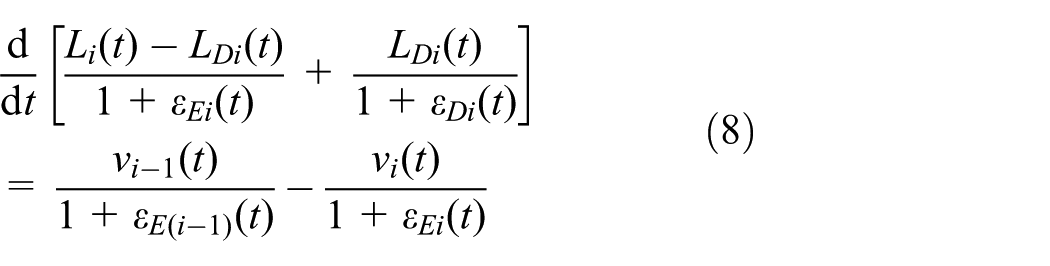
where
Setting

where
As the strain

Substituting equation (10) into equation (9), equation (11) can be obtained

Ignoring the changes of the web length

Using Hooker’s law,

where
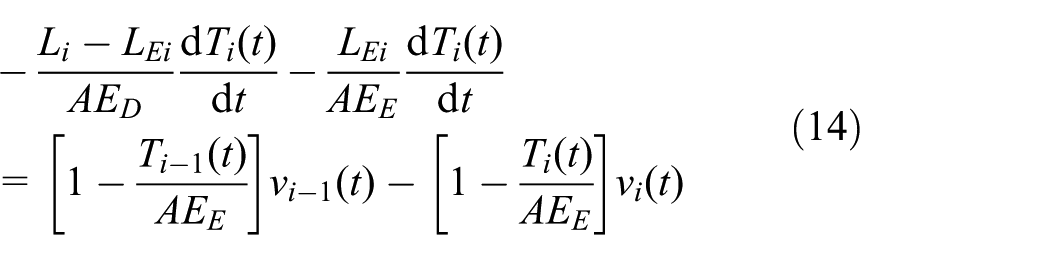
Equation (14) can be written as

Equation (15) represents the mathematical model of the web tension between two adjacent printing rollers in shaft-less drive mode gravure printing systems. Substituting

where
Assuming the circumferences of the printing rollers are equal to each other, that is,

Equation (17) is the tension model of the two-color gravure printing subsystem. The mathematical model shows that the two-color gravure printing subsystem is a MISO system. According to Figure 1, set the number of the first printing roller as 1, the tension model can be extended to the four-color system as follows

It is obvious that the adjacent web spans are coupled together with each other by rotation speed and tension.
Model analyses and simulations
The mathematical model of the gravure printing subsystem shows that the environment temperature affects the web tension between two adjacent printing rollers by the web Young’s modulus at environment temperature (
As

where
As

Equation (20) shows that Young’s modulus
As
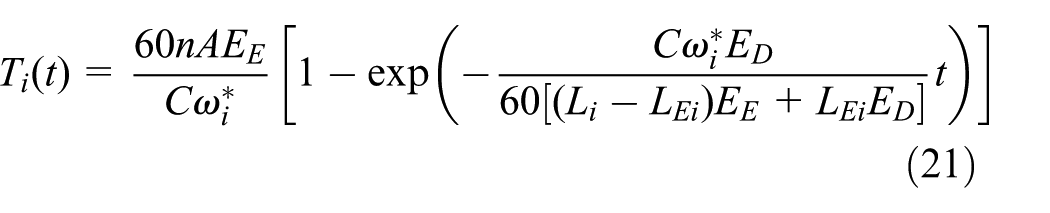
Equation (21) is similar to equation (20) but the mark is opposite. Similarly, Young’s modulus
For further studying the characteristic of the web tension system, the relations between the subsystem inputs and output including environment temperature are studied through numerical simulations using MATLAB/Simulink. In Figure 2, setting
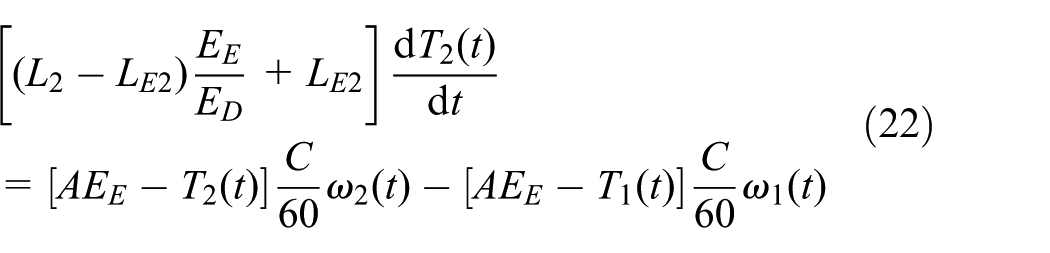
The mechanical parameters of the printing subsystem are summarized in Table 1, which are consistent with the parameters of the experimental setup.
Mechanical parameters of the printing subsystem.

The environment temperature range of the workshop is usually between 0°C and 40°C, and the drying temperature is 70°C. As web material is bi-oriented polypropylene (BOPP), the relations between web temperature and Young’s modulus are shown in Table 2.
Relations between temperature and Young’s modulus of BOPP.

The process parameters are as follows: the steady-state value of upstream web tension
T1 is input, T2 is output, ω1 and ω2 are constants

The responses of the tension
The steady-state values of T2(t) increase 10N and 20N when ΔT1 are 10N and 20N, respectively, at different environment temperatures, that is, the environment temperature does not affect the steady-state tension
In the transient response, the settling time
In Figure 3(a) and (b), the ratios between the decreases of the settling times
ω1 is input, T2 is output, T1 and ω2 are constants

The responses of the tension
For the steady-state response in Figure 4(a), the steady-state values of
In Figure 4(a) and (b), the ratios between the differences of the steady-state values of
In Figure 4(a), the differences between the steady-state values of
For the transient response in Figure 4(a) and (b), the settling times
ω2 is input, T2 is output, T1 and ω1 are constants

The responses of the tension
For the steady-state response in Figure 5(a), the steady-state values of
For the transient response in Figure 5(a) and (b), the settling times
Experiments
In order to verify the correctness of mathematical model and the effects of the environment temperature on the web tension in printing section of the gravure printing machines, some experiments about the step responses at different environment temperatures are studied in this section.
Figure 6 shows the four-color shaft-less drive gravure printing experimental setup, which consists of three sections: unwinding, printing, and rewinding. In the printing section, all of the driving shafts are driven by servo motors (YASKAWA SGMGH-44), and the speeds of the printing rollers are obtained by the position encoders on the servo motor. Tension signals are picked up by load cells (MITSUBISHI LX-030TD) mounted on the idle rollers and then amplified by the tension amplifiers (MITSUBISHI LM-10TA). The whole system is controlled by a multi-axis controller (GOOGOLTECH T8VME). The web material is bi-oriented polypropylene (BOPP).

Four-color shaft-less drive gravure printing experimental setup.
The step response experiments are implemented at different environment temperatures based on the relations between subsystem inputs and output. The mechanical parameters and process parameters are same as the numerical simulations in previous section. The sampling period of the experiment is 250 ms, and the average value of every four data is recorded as a data point.
T1 is input, T2 is output, ω1 and ω2 are constants
The step response experiments as

The responses of the tension
ω1 is input, T2 is output, T1 and ω2 are constants
The step response experiments as

The responses of the tension
ω2 is input, T2 is output, T1 and ω1 are constants
The step response experiments as

The responses of the tension
Conclusion
To obtain higher printing precision and printing speed, the characteristics of the web tension system in gravure printing machine need to be studied in-depth. In this article, the effects of environment temperature on web tension in the printing section are studied. First, the tension model including environment temperature and drying temperature is derived based on the law of mass conservation. Then the effects of environment temperature on web tension are studied using theoretical analyses and numerical simulations from the relations between subsystem inputs and output. In the transient responses, the settling times decrease with the rise of the environment temperature, and the decrease rate is about 6% for each 10° rise in environment temperature. In steady-state responses, the environment temperature does not affect the steady-state values of web tension output when the input is upstream web tension. The absolute changes of the steady-state tension decrease with the rise of the environment temperature as the inputs are the velocities of the printing rollers, and the decrease rate is about 12% for each 10° rise in environment temperature. Finally, some step response experiments are carried out to verify the effects of the environment temperature on web tension. It shows that the experimental results agree well with the theoretical analyses and numerical simulations. The in-depth research work on the tension model in printing section including environment temperature is conducive to improve the tension control precision and register control precision in the future study.
Footnotes
Handling Editor: Yangmin Li
Declaration of conflicting interests
The author(s) declared no potential conflicts of interest with respect to the research, authorship, and/or publication of this article.
Funding
The author(s) disclosed receipt of the following financial support for the research, authorship, and/or publication of this article: This project is supported by the National Natural Science Foundation of China (grant no. 51505376), the Natural Science Basic Research Plan in Shaanxi Province of China (grant no. 2016JQ5038), and Project funded by China Postdoctoral Science Foundation (grant no. 2016M602844).
