



Abstract
The nano-mixed oxides CeO2-TiO2 was synthesized by gel combustion method using polyvinyl alcohol as fuel and mixtures of titanium trichloride and cerium(IV) nitrate at a relatively low calcination temperature of 550°C for 2 h. The prepared CeO2-TiO2 nanoparticles with a specific area of 65.70 m2 g−1 were dispersed in polyurethane matrix in different concentration conditions from 0.0 to 1.5 wt% to study ultraviolet durability following HONDA HES D 6501-97 standards. After 400 h of testing in the QUV accelerate weathering tester, the thin film containing 1 wt% CeO2-TiO2 nano-mixed oxides has presented the noticeable capacity for absorbing ultraviolet light by only 6.8 g.u change in specular gloss at 60° and ΔE = 3.66 in color difference.
Introduction
TiO2 was well-known with advantageous properties such as conversion efficiencies, remarkable chemical stabilities, being abundant, and low cost along with safety.1–4 To overcome the limitation of TiO2 system which is seriously impeded due to inevitable agglomeration, various composite materials were developed. Among the candidates, cerium oxide nanoparticle has attracted extensive research attention because of their potential applications in a variety of research fields, including catalysis, optics, and biomedicines.5–7 Moreover, CeO2 are also biocompatible, since there has been no report on health risk concerning ceria nanoparticle. These materials present unique capabilities in the absorption of ultraviolet (UV) light.8,9 In recent years, scientists are taking their advantages to synthesize the inorganic–organic hybrid materials which have highly anti-UV capacity in minimization to the destructive effect of sunlight.8,9
The hybrid materials which are expected to produce novel and desired performances entails challenges and opportunities.10–13 These hybrid combinations keep or enhance the best properties of each of the components while eliminating or reducing their particular limitations. Incorporation of the metal nanoparticles dispersed in organic matrix polymers was intensively studied in recent years.14–16 To date, numerous methods on improving the compatibility between inorganic particles and polymer matrix have been proposed, such as physical adsorption, 17 grafting technique, 18 solvent exchange process, 19 and micro-emulsion. 20 However, these methods are complicated, inconvenient, and expensive. In this work, the nano-mixed oxides CeO2-TiO2 were homogeneously grinded by the grinding mill equipment then dispersed in the matrix of polyurethane. Polyurethane composite often uses to protect the material under the exposure of light and increase the mechanical properties of material at the same time. 21 Besides, polyurethane was use as absorbent in the form of polyurethane foam. 22 The prepared materials propose to increase the UV-durable and mechanical properties. The artificial conditions used in this work are provided in the weather box according to HONDA HES D 6501-97 standards. 23
Experiment
Chemicals
All agents at analytical grade including Ce(NO3)3. 6H2O 99.9%, TiCl3 99.9%, polyvinyl alcohol (PVA) 99%((C2H4O)n), polyisocynate 99.9% ((R-NCO)20), acrylic polyol 99.8%, meta-Xylene were purchased from Sigma-Aldrich and Merck without any modification.
Some additive components were used to prepare thin film including anti-settling additive, surface leveling additive, electrostatic additive, and curing accelerator with total volume of 1%.
CeO2-TiO2 nanoparticles preparation
PVA was dissolved in distilled water at 80°C to a solution of 5 wt% PVA. The solution was continuously stirred with a magnetic stirrer while slowly adding Ce(NO3)3 and TiCl3 at the molar ratio of 1:1 until a very viscous and light-yellow transparent gel is obtained. The viscous gel was dried out for 4 h in air at 120°C, then its product was calcined at 550°C in air for 2 h.
Nanoparticles characterization
The micromorphology of the nanoparticles was synthesized at calcination temperature of 550°C, and the hybrid material was evaluated by field emission scanning electron microscopy (FE-SEM) by Hitachi S-4800 microscope (Japan). The specific area of the synthesized nanoparticles was determined by nitrogen adsorption at 77 K and the linear portion of the Brunauer–Emmett–Teller (BET) model using Quantachrome Autosorb-iQ Station 1 (USA). The Fourier transform infrared (FTIR) spectra were recorded on a Cary 630 FTIR spectrometer (USA) in range of 4000–650 cm−1. A total of 128 scans were taken at a resolution of 4 cm−1.
Thin film preparation
Nanoparticles agglomerated inevitably due to large linking force, so to disperse it into the matrix, we used grinding mill method which has the maximum volume of 5 L, grinding temperature of 8°C–10°C, and a 1-mm ZrO2 ball.
Weigh a proportional amount of the synthesized nano-mixed oxides CeO2-TiO2, then dispersed in the acrylic polyol, solvents, and additives grinding. Following a mechanical stirring for 15 min, the mixture was ground eight rounds (30 min/round). When the mixture routed into the suspension, the paste was filtered through 37-μm filter and adjusted with solvents to 100 g. Various concentrations of the nanomaterials with same solvents and curing components were prepared, respectively, 0.0 wt%; 0.3 wt%; 0.5 wt%; 1.0 wt%; and 1.5 wt%. Finally, the original paint was mixed with isocyanate hardener and solvent in additional 30 min, and the mixture’s viscosity is 12.5 m2 s−1. The mixture was sprayed by paint gun IWATA W71 on cellophane to test the mechanical and anti-UV properties.
Anti-UV capability of the thin film
The QUV accelerated weathering tester was employed for 400 h to evaluate the anti-UV properties of the thin film containing CeO2-TiO2 nanoparticles. Five samples were tested with the concentration of nanomaterials that varied as 0 wt%; 0.3 wt%; 0.5 wt%; 1.0 wt%; and 1.5 wt%. The specimens were prepared according to the HONDA HES D 6501-97 standards. The mechanical properties of prepared material were also determined according to the standards.
Results and discussions
Preparation and characterization of the materials
BET surface area of calcined powder was found to be 65.7 m2 g−1. The obtained data of the nanoparticles CeO2-TiO2 could be applied in catalysis and absorption.24,25
From Figure 1, by gel combustion method using PVA, the nanoparticles CeO2-TiO2 was synthesized with an average size of 25 nm. Then, the dispersion of the nanopowders into the matrix of polyurethane was conducted by grinding mill method following the dissolution of the solvent, hardener, and original paint. As a result, the paste, which has the viscosity of 12.5 m2 s–1, was coated as a thin film with a thickness of 25 μm. The Figure 2 showed a uniform distribution of the nanoparticles in the polyurethane matrix. Only small part of the nanoparticles can realize in figure due to the low concentration of the powder and the binding between metal oxide and polyurethane. The characterization of these binding will be discussed in FTIR spectra.

FE-SEM images of the CeO2-TiO2 powder samples with Ce:Ti molar ratio of 1:1 calcined at 550°C for 2 h.

FE-SEM micrographs revealing fracture surfaces with 1.0 wt% CeO2-TiO2 dispersed in the polyurethane matrix.
Anti-UV properties
The mechanical properties of the coating such as film-forming ability, expression film, stiffness, flexural strength, adhesion, impact resistance, and durability solvents were significantly improved. Then the thin film coat was exposed to the QUV weathering tester. These works pointed out that the color difference increases during the time of exposure. The UV light–absorbing capacity of the nanoparticles CeO2-TiO2 was represented by the deviation color between the sample embedded CeO2-TiO2 with the pure one. From the results, the coating containing the CeO2-TiO2 nanoparticles has high UV durability.
Figures 3 and 4 showed the color difference and specular gloss at 60°, after 400 h of testing in the QUV weathering tester, and represented the anti-UV performance of the hybrid material embedded with CeO2-TiO2 nanoparticles. The sample in an appropriate mode after every 100 h was removed to test the color difference and the gloss specular.

The specular gloss at 60° of the materials with different concentration of CeO2-TiO2 nanoparticles/polyurethane thin film, 0.0 wt%; 0.3 wt%; 0.5 wt%; 1.0 wt%; and 1.5 wt%, respectively for 400 h of exposure.
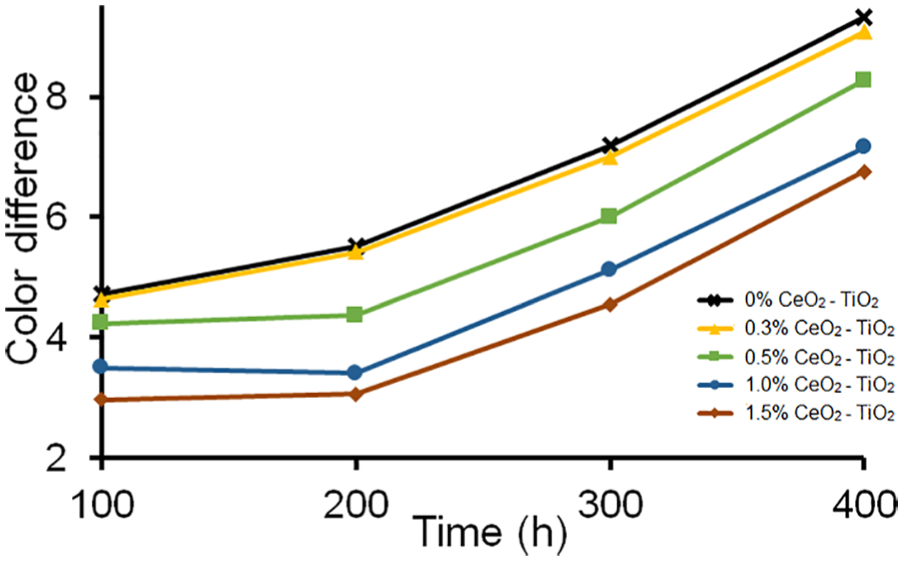
The color difference of the materials with different concentration of CeO2-TiO2 nanopaticles/polyurethane thin film, 0.0 wt%; 0.3 wt%; 0.5 wt%; 1.0 wt%; and 1.5 wt%, respectively, for 400 h exposure.
As can see from Figure 3, the specular gloss at 60° increases with the decrease in the amount of nanoparticles due to higher surface roughness, as well as coverage of the thin film. However, the specular gloss of the samples containing a higher concentration of the nanoparticles was recorded more stable during 400 h of exposure. It was presented by the decreasing slope with increasing nanoparticle content. The pure coating (with 0% of nanoparticle) has specular gloss difference almost 17 g.u, whereas the 1.5 wt% of the nanoparticles CeO2-TiO2 embedded material was only 3.79 g.u. Therefore, the CeO2-TiO2 has performed significantly with the ability to resist UV light as a UV-absorber in the hybrid materials system. Takeshita et al. 26 and Zhang et al. 27 also studied the weathering effect by different material systems which were reported with similar durability. Among these, the 0.5 and 1.0 wt% of CeO2-TiO2 nanoparticles were noticeable for gloss difference.
Color difference is one of the most important parameters for the thin film. The color difference (ΔE) was calculated as follow

where Δ
Due to the self-light-yellow color of the CeO2 particles, the difference of nanoparticle content already has the insignificant color difference. However, the coatings contain a small quantities of the CeO2-TiO2 nanoparticles, so that, the color difference is negligible.
Saadat-Monfared et al. 28 and Allen et al. 29 also reported the gradual increase of color difference during time exposure which is as same as our study. From Figure 4, the value of ΔE varies depending on the exposure conditions. The thin film that has a high concentration of CeO2-TiO2 nanoparticles was more stable than the lower ones because of the strong UV absorbability of nanoparticle CeO2. The color difference once again confirms the anti-UV properties of the CeO2-TiO2 embedded in the polyurethane matrix. Among these materials, the 0.5 and 1 wt% revealed the better performance in the same conditions.
From FTIR absorption spectrum in Figure 5, there is a specific peak at 1125 cm−1 that represents for the CeO2-TiO2 nanoparticles. In contrast, the FTIR spectra of the pure polyurethane have some characteristic peak. Nevertheless, the initial hybrid material has no characteristic peaks for these constituents. This means that there is not only dispersion of the nanoparticles into the polyurethane matrix but a new hybrid combination also exists. 30 This linkage is characterized by peaks at 1144 and 1138 cm−1 in both FTIR pattern of initial material and after 400 h of exposure in the QUV weathering tester, respectively. There is almost no change in the FTIR spectra of the material after 400 h tested which illustrates the strong anti-UV of the hybrid material.

FTIR absorption spectrum of the pure polyurethane, pure nano-mixed oxides CeO2-TiO2, and the hybrid materials with 1.0 wt% of CeO2-TiO2 embedded before and after 400 h of the exposure.
Conclusion
Nano-mixed oxides CeO2-TiO2 was successful synthesized with an average size of 25 nm and specific area of 65.70 m2 g–1 at a relatively low temperature at 550°C for 2 h. The prepared nanopowder was dispersed into the polyurethane matrix to manufacture a hybrid material with strong anti-UV properties. The anti-UV characteristics were carried out by the specular gloss at 60°, and the color difference of the thin film in the QUV accelerate weathering tester for 400 hours. There is a significant change in specular gloss of the thin film that has no nanoparticles CeO2-TiO2 about 17 g.u in comparision with 6.8 g.u of the 1.0 wt% CeO2-TiO2 embedded film, while the color difference ΔE is only 3.66. The materials that contain 1.0 wt% of the CeO2-TiO2 nanoparticles had better anti-UV properties than the others.
Footnotes
Acknowledgements
All authors have contributed equally for this paper.
Handling Editor: Denni Kurniawan
Declaration of conflicting interests
The author(s) declared no potential conflicts of interest with respect to the research, authorship, and/or publication of this article.
Funding
The author(s) received no financial support for the research, authorship, and/or publication of this article.
