



Abstract
Modular design can shorten the product development cycle and enhance the product research and development capability of enterprises. To better solve the problem of module interface coupling after module partition, the present modular product design method has been improved based on the theory of inventive problem solving and axiomatic design theory. This article summarizes the engineering parameters commonly used in modular design based on the requirement analysis and conflict problems of modular structure design. And in the process of dividing the functional modules by fuzzy clustering algorithm, we propose defining and classifying the principle (technical) correlation between parts by these parameters. Then the coupling relation of each module interface is analyzed by the design matrix of axiomatic design and the conflict solving tool of the theory of inventive problem solving is utilized for decoupling. Finally, the high chair is taken as the design object and the design process is used to verify the feasibility of this method.
Keywords
Introduction
Modular design is an important method to shorten the product development cycle, enhance company competitiveness, and make the product easy to disassemble, repair, and recycle, thereby reducing the waste of resources. In order to meet the requirements of users, the existing product is divided into several functional modules based on the functional and structural analyses. The product is formed by the selection and combination of these functional modules. 1
The general process of modular design usually falls into the following steps: investigation of users’ demand, product function analysis and parameter determination, module partition, module structure design, modeling design, and product optimal design. 2 L Jiang et al. 3 proposed a modular design method on the basis of the matter element model and the extension method for the problem of lack of a proper formal description model in a modular design process. XY Teng and JT Zhang 4 set up a matrix after comprehensively considering the correlation between parts, applied the fuzzy cluster analysis method to divide the modules, and formed the modules in the light of requirements. TU Pimmler and SD Eppinger 5 proposed using the design structure matrix (DSM) to solve the module decomposition problem. XF Cheng and C Chen 6 constructed the design association matrix and clustered to divide the modules based on axiomatic design (AD) and DSM in order to complete module partition. CS Wang et al. 7 systematically integrated theory of inventive problem solving (TRIZ), DSM, and interpretive structural modeling (ISM) into product development, divided and rearranged modules with DSM to express the relationship between modules, and then used the ISM to derive component execution procedure and logical sequence framework in order to eliminate the repetitive design problem. Q Li et al. 8 proposed applying multidimensional scaling (MDS) and clustering to build the DSM of the product parts.
The research of the modular design method above mainly solves the module partition problem. The existing research on modular design is less focused on the interface; however, after module partition, the functional requirements for modular products have to be proposed, such as ease of disassembling. The original connection structure may be difficult to meet these new requirements.
Interface design is an important aspect of modular design. Interface is a connection shared between components, modules, and subsystems of a given product architecture,9,10 reflecting the combined state between the two components. 11 The design and planning of module interface have a direct influence on the implementation of modularization. 12 Modular products construct flexible structures by standardized interfaces, so interfaces are the basis for module identification. 13 Besides, the type of interfaces limits the combination mode of modules. 9
Aiming at the problem of module interface design, Hillstrom 14 proposed to help designers understand how the interface affects the module function and select the most suitable interface location using the AD theory and the design for manufacture and assembly (DFMA) tool. Fixson 15 established an interface evaluation model based on product architecture, which selects the most suitable interface by product parameter analysis and evaluation. Scalice et al. 16 put forward a module interface design method which defines the type of interface by morphological matrix for the modular product family development. Yassine 17 suggested a comprehensive method to define and identify modular product architecture by DSM, which is mainly used to define modular interfaces. The existing research on the module interface mainly focuses on defining the interface type, but still there is a lack of the structure of the module interface or a systematic approach of solving the structural problem. Therefore, the emphasis of this study is on the interface structural problem by analyzing the module interface structure effectively and improving the unreasonable interface structure.
Currently, the integrated method of TRIZ and AD has been widely utilized. Although AD provides a criterion for judging the design, which can help designers find problems quickly and effectively, in practice, the coupled design is commonly used. The AD lacks a concrete method to solve the coupled problem, so designers need to improve the scheme based on their experience, while, although TRIZ provides a variety of effective tools to solve contradictions, it can hardly help designers find the fundamental problem. Therefore, it is necessary to integrate the TRIZ and AD theory in order to overcome their shortcomings, respectively. D Mann 18 proposed the advantages of integration by studying the characteristics of TRIZ and AD. R Zhang et al. 19 analyzed the paper machine by AD and decoupled with the TRIZ theory to obtain the solution. YJ Kang 20 utilized the conflict matrix in TRIZ to decouple to satisfy the principle of functional independence in AD. CL Zhang et al. 21 put forward a rapid decoupling method of an integrated design model of AD and TRIZ.
Based on the research status above, in order to solve the existing problems in modular design, this article proposes combining the advantages of TRIZ and AD into the modular design process and establishes the modular innovation design method based on the TRIZ and AD theory. The AD is used to discover module interface structure problems, while TRIZ tools are further applied to solve contradiction problems. Aiming at the unreasonable interface structure and other problems after module partition, the AD can help designers to identify the problem, but still lacks specific problem-solving tools. 22 However, the TRIZ theory can effectively solve the problem of “how to do.” Besides, according to the requirements of modular design, we summarized the engineering parameters commonly used in modular design and use it to define the principle (technical) correlation of parts in the fuzzy clustering algorithm stage.
The modular innovation design process integrated with TRIZ and AD proposed in this article is divided into functional decomposition of product, module partition by fuzzy clustering algorithm and fuzzy evaluation method, establishment of module design matrix, and decoupling with TRIZ tools. Finally, we took the modular design of the high chair as an example and proposed a solution to solve the problem of module interface coupling and verified the feasibility of this method.
Main innovative methods
Summarized engineering parameters commonly used in modular design
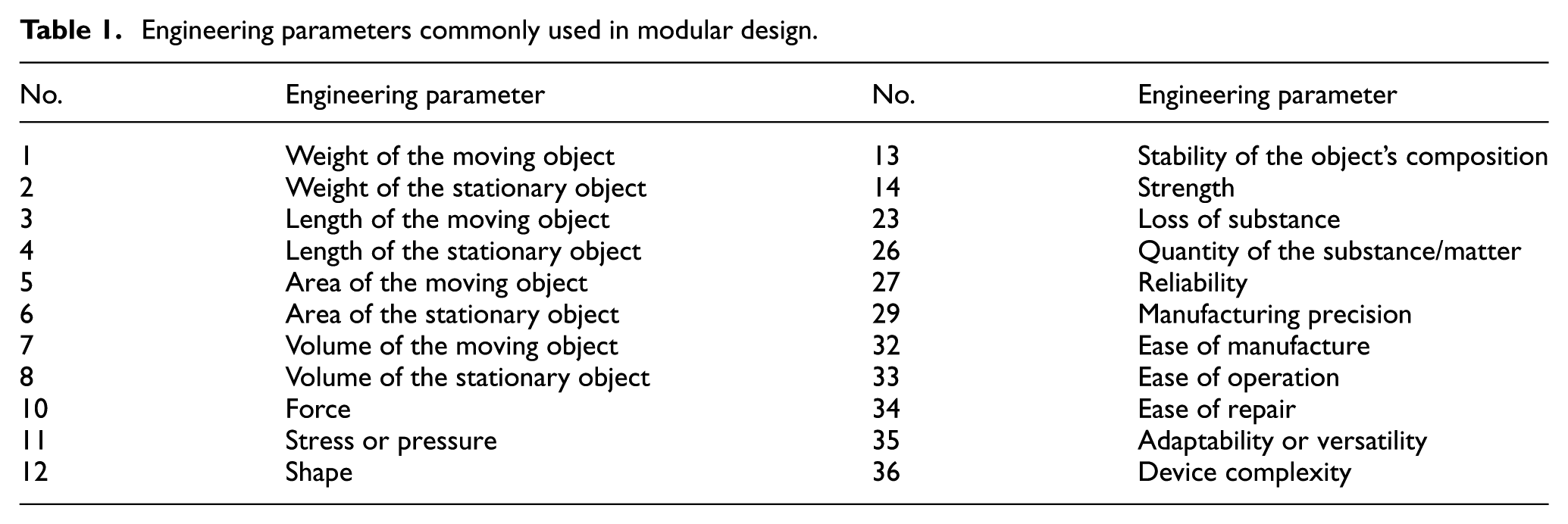
In the process of decoupling by TRIZ, the conflict problem needs to be transformed into standard engineering parameters. To facilitate the search and use of general engineering parameters in the modular design process, we summarized 22 engineering parameters which are commonly used in the modular design from 23 related references.
Modular design is devised based on the requirements of generalization, standardization, and serialization of product. The unit modules are required to be interchangeable, universal, and relatively independent. 23 Therefore, in order to increase the utilization and save the costs, product unit modules usually adopt the standardized interface design, 24 so that modules can be exchanged between the same-series and cross-series products. At the same time, the unit modules can complete some functions independently, which do not affect each other in the process of manufacturing, maintenance, and repair. The efficiency of production and maintenance in enterprises is improved in this way.
SX Song et al. 25 proposed an innovative connection method for the problem of complex fixation and difficult disassembly of the laptop, but it may lead to other problems, such as weak connection and increased cost. For this reason, two pairs of conflicts are extracted, loss of substance and shape, automation level, and force. S Xu et al. 26 proposed a modular design scheme for the television cabinets which are not only easy to be disassembled, but also easy to be loosened. He identified the conflict as adaptability or versatility and manufacturability. To solve the problem of the plug-in structure of the roof module in which the shape of the top plate is easy to be damaged during slotting, the conflict of the shape and the volume of the stationary object is determined. As to the problem of reduced strength of the plug interface, the conflict is determined as the stability of the object’s composition and its shape. Zhao and Ma 27 proposed a flexible machine scheme, which also brings about some problems, such as increased functional redundancy, complex structure, and increased cost. Two pairs of conflicts are redefined as adaptability or versatility and device complexity, productivity, and adaptability or versatility. As special tools are needed to separate the convex platform and lower the disassembly efficiency when disassembling the liquid crystal display (LCD), SX Song et al. 28 improved the detachability without changing the structure of the panel. Thus, they determined the conflict as maintainability and shape. A modular treadmill designed by CS Wang et al. 7 is to save the space, but it may lead to some other problems, such as increased weight, reduced power, reduced reliability, and difficulty in production. Therefore, the parameters suggested to be improved are the volume of the moving object, force, shape, and waste of time, and the deterioration parameters are the weight of the moving object, strength, reliability, and manufacturability.
By reviewing the literature and analyzing the above researches which applied inventive principles to solve modular design problems, based on the requirement analysis in the process of modular structure design and the identification of conflicts, we obtained the modular design requirements and the engineering parameters which are commonly used in modular design, as shown in Table 1.
Engineering parameters commonly used in modular design.
Modular design requirements, including users’ demand for products and production requirements of the product, are listed as follows: unit modules should be generalized to enable modules to combine into different products and easy to replace damaged modules; the connection of unit modules should be firm and difficult to loosen, so that the modular product can be disassembled and assembled multiple times. For the convenience of users, the unit module has to be easily disassembled and assembled with a simple process and no damage to the module itself during the assembly process. From the production point of view, the unit module should be easy to manufacture and easy to maintain.
Based on the above design requirements, in order to facilitate the search and use engineering parameters in the process of transforming the conflict problem, the selected engineering parameters are divided into four categories, the parameter for module generality is No. 35; relevant parameters of the module connection fastness are No. 10, No. 11, No. 13, No. 14, and No. 27; parameters about easy disassembly and assembly multiple times are No. 1–No. 8, No. 12, No. 23, No. 26, No. 33, and No. 36; parameters for easy manufacturing and maintenance are No. 23, No. 29, and No. 34.
A new method for defining the principle (technical) correlation
The principle (technical) correlation is one of the factors for establishing the fuzzy relation matrix. At present, the commonly used method to define the principle (technical) correlation of product parts is to clarify the principles utilized in parts and judge the correlation degree by comparing these principles.29–31 XY Teng 32 proposed judging the principle (technical) correlation by the function of the part based on the functional-principle (technical) mapping in the F-P(T)-B-S model. However, the evaluation method of the principle (technical) correlation is subjective and the process is relatively complex. Therefore, in order to describe the principle (technical) correlation degree of the part and define the range of related values, this article classifies the engineering parameters commonly used in modular design according to the principle (technique), as shown in Table 2.
Method for defining the principle (technical) correlation for engineering parameters.
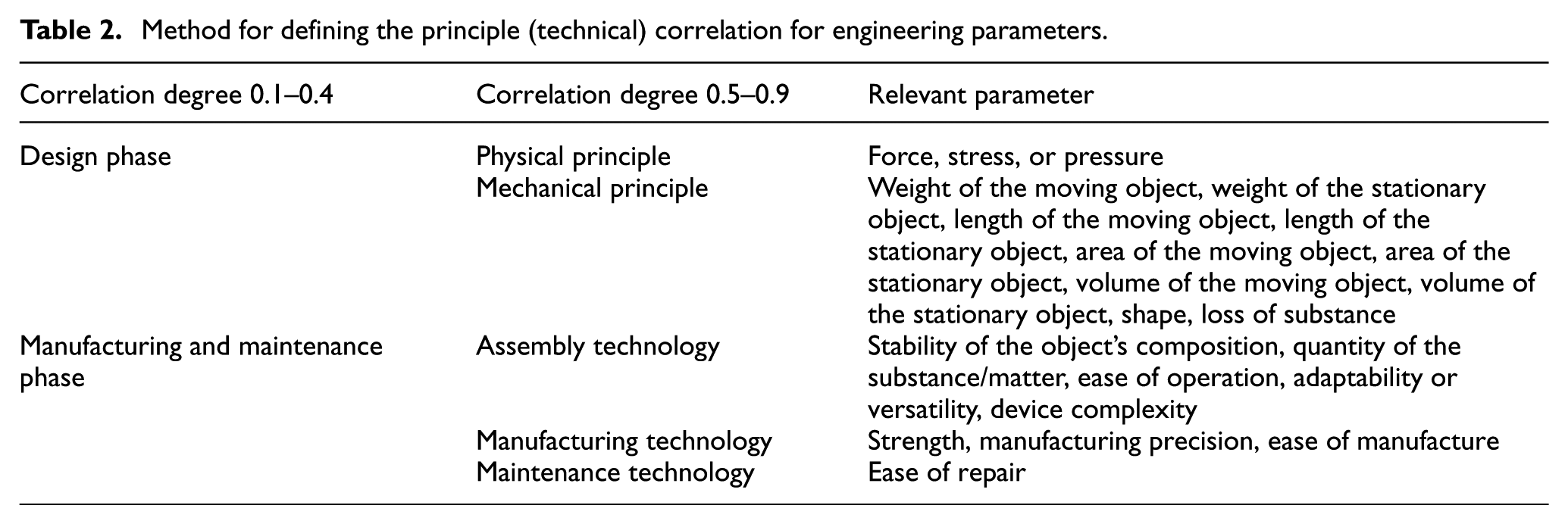
The parameter is the dominant measurement of the material attribute in a certain state, meanwhile the contradiction between the parameters is the contradiction between the material attribute. In TRIZ, the general engineering parameters are common geometry and physical or practical parameters. It is the attribute parameter that the substance shows in the specific state, the extraction and induction of the special parameters. 33 The concrete expression of principle (technology) is the change of a certain parameter, that is, the principle (technology) is used to realize the function by changing the parameter. Therefore, the parameters are related to the principles (techniques) adopted by the parts.
In this way, the relevant parameter is determined based on the function of the part and then the corresponding principles of the parts will be found. The corresponding correlation degree is obtained by comparing the principles (technologies) of the two parts. Therefore, the principle (technical) correlation can be easily defined and the influence of subjective factors on the outcome will be avoided to some degree.
Modular design method based on TRIZ and AD
Modular design process based on TRIZ and AD
Based on the advantages of TRIZ and AD, a design process model for modular products is proposed.
First, the function and structure of the product are decomposed by zigzag mapping of AD. Then the function modules are divided by the fuzzy clustering algorithm and the most reasonable module partition scheme is evaluated. After that, the design matrix is established and the coupling relationship of the module is observed. If the design matrix is a coupling matrix, it is necessary to combine the TRIZ theory to convert the coupling problem into standard engineering parameters. Because most modular design problems are technical conflicts, this article uses the invention principles to solve the conflict problem of module connection and obtains the innovative solution.
The design model is mainly divided into product function decomposition, module partition, establishment of the design matrix, and decoupling with TRIZ tools, as shown in Figure 1.

Modular design model based on the AD and TRIZ theory.
Here is the application process of the modular design method based on TRIZ and AD.
Product function decomposition
First, users’ demand and similar product in the market are investigated to understand the actual demand of the target users and the potential problems of the existing product. Based on the results, the product should be decomposed to get the component list according to which the mapping from function to structure with the AD is completed.
Module partition
The main parts of the product are obtained based on the analysis of function requirements and users’ demand. The close parts are grouped into a module using the fuzzy clustering algorithm, and the modules have to be comprehensively evaluated by the clustering evaluation method to develop a suitable module partition scheme. And then it is judged whether the scheme is reasonable. If it does not meet the design requirements, it is necessary to rebuild the module relation matrix and consider whether there is an error of defining the correlation. If the scheme is reasonable, the design matrix is established.
Design matrix establishment
According to the AD theory, the function requirements and design parameters of the product are analyzed after module partition. A design matrix is established and the coupling relationship between the function and the design parameters of the module is analyzed according to the form of the design matrix. It is necessary to consider whether it has met the design requirements if it is a decoupled design. For coupling design, we have to analyze whether there is a conflict between modules.
Decoupling with the conflict matrix
The conflict matrix is used to solve conflict problems in coupling design. First, the modules with technical conflict are identified and the conflict problem is converted into standard engineering parameters. Then the conflict matrix is searched to find invention principles to solve this problem and the appropriate invention principle to design is selected. Finally, the improved scheme is evaluated. If the scheme leads to a new technical conflict, the invention principle should be re-selected to formulate the design scheme.
Module partition
The modular design is characterized by integrating closely related parts into modules for ease of manufacture and assembly. In terms of module partition, the commonly used methods are heuristic algorithm, fuzzy clustering algorithm, genetic algorithm (GA), and so on. 34 P Gu and S Sosale 35 proposed an integrated modular design method for product life cycle from the aspects of assembly, service, and recycling. RB Stone et al. 36 proposed three heuristic methods as dominant flow, branch flow, and conversion transfer function chain, which provide a systematic method for identifying modules from functional models. VB Kreng and TP Lee 37 proposed a systematic approach for modular product design in four major phases, using heuristic grouping genetic algorithm to find the optimal modular structure. HE Tseng et al. 38 added engineering attributes in the liaison graph model to evaluate part connection and clustered parts by grouping genetic algorithm (GGA). H Li et al. 39 adopted a “top-down” module partition method and established a comprehensive correlation matrix based on the correlation.
Although the above methods can fairly complete the module partition, the process is so complex, and most of the production and customer factors are neglected. S Pan 40 proposed a module partition method comprehensively considering customers’ requirements, product assembly, cost, and maintenance. He analyzed the functional, geometric, and physical criteria of module clustering and established the corresponding mathematical evaluation model.
In order to effectively obtain the optimal module partition scheme, improve the module partition efficiency, simplify the module partition complexity, and consider the customer factors, in this article, the fuzzy clustering algorithm is used to divide modules and the module partition evaluation is carried out based on the evaluation model proposed by S Pan. 40
In view of judging the correlation of parts, Pahl et al. 41 proposed a logical framework, comprehensively considering function, principle, and structure of parts for analyzing the relation between parts. Because the module partition method based on the function–principle–structure model is more in line with thinking habits, it can effectively express the correlation degree between parts. Therefore, in this article, the fuzzy relation matrix is constructed through the functional correlation, principle (technical) correlation, and structural correlation analyses between parts. After that, the fuzzy similarity matrix is built to express the similarity between parts. The fuzzy equivalent matrix is built by the transitive closure method to clustering analysis and then the module partition scheme is formed. 28 Finally, the appropriate module partition scheme is selected through the comprehensive evaluation of customer satisfaction, variant design complexity, and assembly complexity.
Establishment of the fuzzy relation matrix
Functional correlation
Functional correlation means that, to satisfy the functional independence of modules, some components should be converged into one module based on the functional requirements. 39 In this article, the functional correlation of parts is evaluated by the product functional decomposition model established in the functional decomposition stage. The evaluation criteria for the functional correlation between parts are shown in Table 3.
Criteria for evaluation of functional correlation.

Principle (technical) correlation
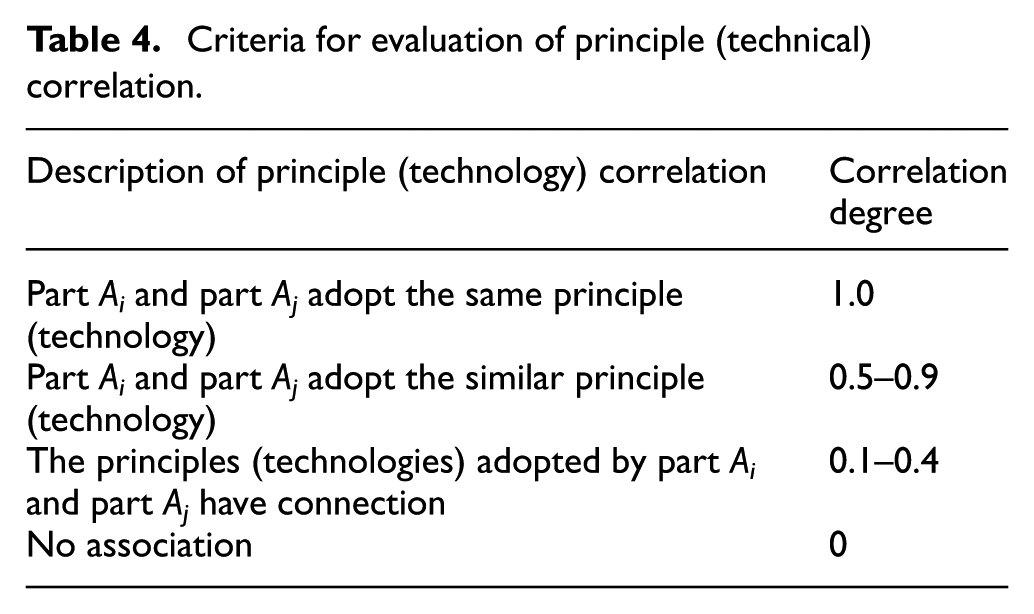
A variety of principles (techniques) are often used in the modular design of a complex product system. Therefore, the principle (technology) classification of product applied should be fully considered in the module partition process. Parts with relevant principles (technologies) should be assembled into a module to make each module contain a major principle (technology). 29 The principle (technical) correlation evaluation criteria between parts are shown in Table 4.
Criteria for evaluation of principle (technical) correlation.
Structural correlation
Structural correlation means that the internal structure of the module should have certain relevance, while the overall structure of the module is relatively independent to ensure the independence of the module structure. Modular products achieve the product function by part assembly. The assembly relationship is essentially achieved by the structure of the parts, so it reflects the structural correlation degree between the parts. 31 The structural correlation between parts is defined by the way the parts are disassembled. The evaluation criteria of structural correlation between parts are illustrated in Table 5.
Criteria for structural correlation evaluation.

Establishment of the fuzzy relation matrix
According to the fuzzy relationship between parts, after the weighted average calculation, the correlation value between part i and part j is as follows
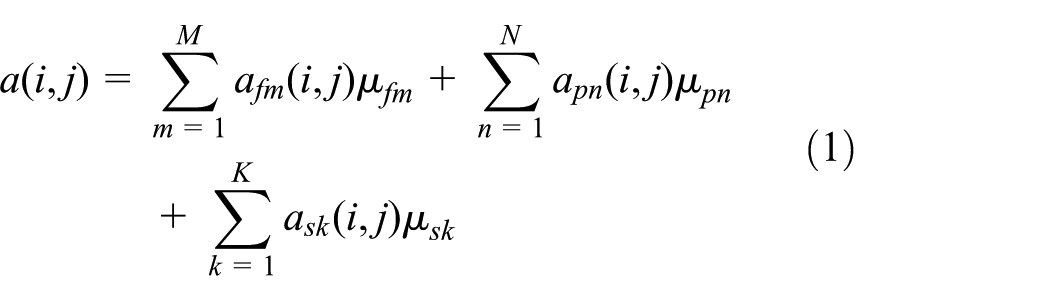
where
Thus, the fuzzy relation matrix

Fuzzy clustering used to form module
It is necessary to transform the fuzzy relation matrix
Fuzzy similarity matrix
The methods of converting the fuzzy relation matrix into the fuzzy similarity matrix include the dot product method, angle cosine method, related coefficient method, and exponential similarity coefficient method. Because the angle cosine method is relatively simple and easy to implement, it is used in this article to obtain the fuzzy similarity matrix

where
Fuzzy equivalent matrix
Since the fuzzy similarity matrix

where
Finally, the fuzzy equivalent matrix is clustered by the λ cut matrix. The elements of
Fuzzy clustering evaluation
Customer satisfaction
The more reasonable the relationship between the parts of the module, the greater the expected utility value of the module and the higher the degree of customer satisfaction.
43
The customer requirements are denoted by
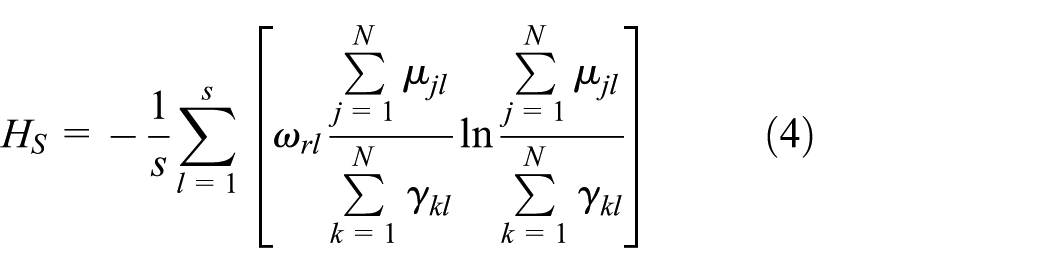
where S is the total amount of customer requirements; N is the total number of parts and modules;
Variant design complexity
In the module partition process, the characteristic parameters of product design have to be determined according to the customer requirements, so as to adjust the structure parameters to reduce the variant design complexity.44,45 The characteristic parameters of product design is denoted by


where D is the total number of product characteristic parameters; M is the number of parts in module j;
Assembly complexity
The finer the module granularity, the more the module interfaces and the more complex the assembly process.
46
From the point of view of manufacturing, assembly complexity is a critical factor affecting the production and assembly time of modular products, thus affecting the product costs.
44
From the perspective of the user, assembly complexity also affects the operating experience of the product. The mathematical model of assembly complexity

where
The evaluation function is given as

where
Examples
Due to the rapid growth and change of children, the life cycle of children’s products is short with fast update, which easily leads to the waste of material resources and space resources. Therefore, furniture for kids also needs to have the property of “growth” or multifunctionality to meet the requirements of children of different ages. At the same time, it saves the cost of purchasing multiple pieces of furniture and is convenient for assembly and storage to save space. This article takes the high chair as an example, applying the modular design method based on the TRIZ and AD theory to improve design.
Functional decomposition and determination of related parameters
By analyzing existing products, the components of the high chair are shown in Table 6 and the number and name of the principal parts in Table 7. By decomposing the functions and structures of the product based on the product components, we obtain the decomposition diagram of functional requirements and design parameters, as shown in Figure 2.
Component analysis of the high chair.

Main parts of the high chair.


Decomposition diagram of functional requirements and design parameters of the high chair.
Module partition
This article uses the fuzzy clustering algorithm to obtain several module partition schemes and selects the suitable scheme by module clustering evaluation.
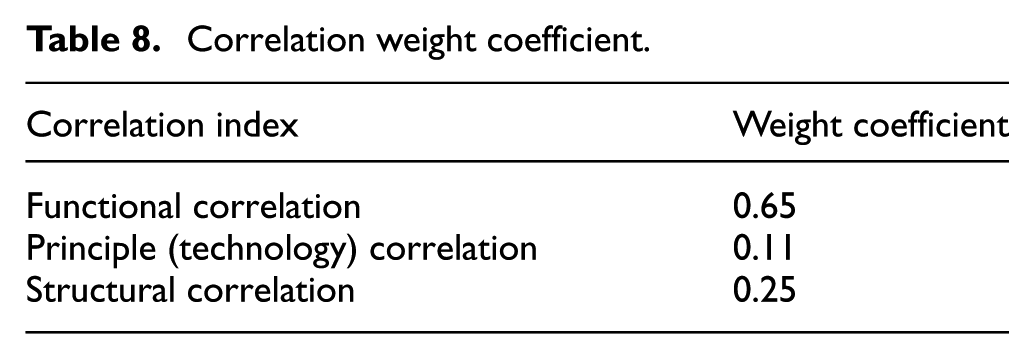
First, the correlation weight coefficients are determined by the relationships between parts, as shown in Table 8. The related values of functional correlation, principle (technical) correlation, and structural correlation are determined by evaluating the association degree between the parts. The definition of the principle (technical) correlation of the high chair parts is shown in Table 9. This determines that parts 1, 2, 3, and 8 use the same principle, parts 4 and 5 use the same principle, parts 6, 7, and 10 use the same principle, and all belong to the physical principle. The related value between parts of the same principle is 1. The related value between parts of the similar principle is 0.4–0.9. For example, the related value of parts 1 and 2 is 1, and the related value of parts 1 and 4 is 0.5. A fuzzy relation matrix A is established based on the related values
Correlation weight coefficient.
Principle (technical) correlation.

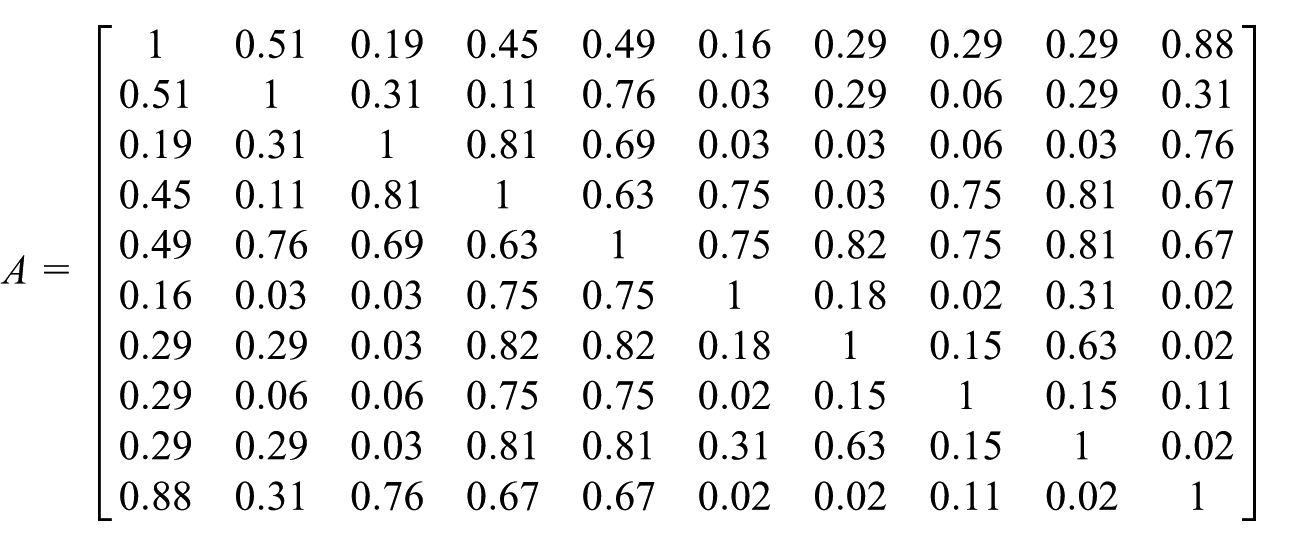
Then, the fuzzy correlation matrix is used to calculate the similarity coefficient by the angle cosine method to obtain the fuzzy similarity matrix R. The transfer closure is synthesized using the square method, and the fuzzy equivalent matrix R* is obtained

The threshold values of λ = 0.95, 0.88, 0.84, 0.83, 0.82, 0.76, 0.66, 0.59, respectively, are used and a dynamic clustering tree is formed (Figure 3).
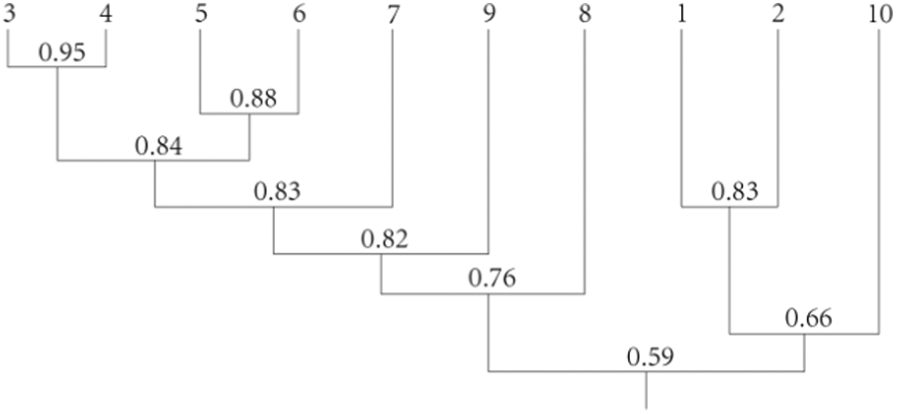
Dynamic clustering tree.
Comprehensive evaluation of customer satisfaction, variant design complexity, and assembly complexity was performed for each module partition scheme. The weighting factors for each evaluation indicator are shown in Table 10.
Weighting factor for evaluation indicator.

Based on the configuration features of the high chair, the customer requirements are defined as the connection between modules is stable, and the product is conveniently stored and can be used repeatedly. Weighting factors calculated by AHP are 0.251, 0.653, and 0.096, respectively. The design parameters of the product determined by the customer requirements are assembly accuracy, assembly and disassembly speed, and module damaged degree. The weighting factors are 0.699, 0.194, and 0.107, respectively.
The module partition results should be evaluated in turn according to the customer satisfaction, variant design complexity, and assembly complexity, and the evaluation indicators of the module partition results are obtained, as shown in Table 11.
Evaluation indicators of module partition results.

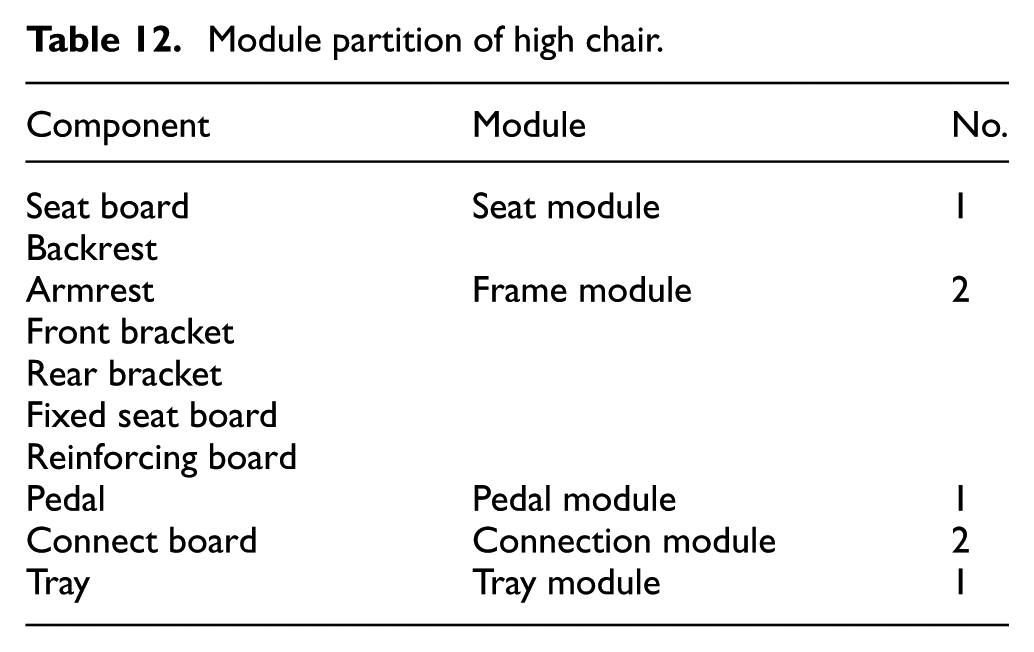
When the threshold value is
Module partition of high chair.
Establishment of the design matrix
At present, most high chairs are connected with screws. Because the modular high chair should be assembled and disassembled as many times as needed, the modules should be easily assembled and cannot be broken during the disassembly process for reassembly.
However, disassembling the screw multiple times can easily lead to the deformation of the screwed hole. And the more parts it has, the more complicated the disassembly process. Therefore, we need to devise a new design scheme to make the module easy to be assembled and avoid damage to the module during the disassembly process.
It is determined that the purpose of the connecting piece is to fix two modules and no damage can be caused during the disassembly process for repeated assembly. According to the analysis of AD, the functional requirements and design parameters of the product are as follows:
FR1—fix two modules;
FR2—no damage to the module when disassembling for repeated assembly;
DP1—applied force;
DP2—wear of the module.
After analysis, although the module can be fixed by the screw, repeated disassembly screw will deform the threaded holes of the unit module and the joint will easily loosen. The design matrix is

According to the design matrix, it is a decoupled design that does not meet the design requirements. This case needs to be decoupled to improve the design.
Decoupling with the conflict matrix
Since the threaded holes are easily deformed by disassembling the screws repeatedly, the operability of the module connection will be reduced. The conflict matrix can be used to solve this problem. Conflicts are turned into standard engineering parameters:
FR1—10 force and 14 strength;
FR2—23 loss of substance and 33 ease of operation.
The engineering parameters are used to search the conflict matrix and the corresponding inventive principles are obtained as follows: No. 1—Segmentation, No. 2—Taking Out, No. 3—Local Quality, No. 5—Merging, No. 8—Anti-weight, No. 25—Self-service, No. 28—Replace Mechanical System, No. 31—Porous Materials, No. 32—Color Change, No. 35—Parameter Change, and No. 40—Composite Materials.
In this case, the original plan uses screws to fix the modules which makes sure that the vibration of the seat will not cause the deviation of module position and prevent the module from falling, as shown in Figure 4.

Screw fastening.
To solve the wear problem of screw on the module, the first solution is to separate the threaded hole from the module using the segmentation principle and the local quality principle. The embedded thread of the metal material is fixed on the unit module to avoid direct contact of the screw with the module, as shown in Figure 5. Based on the first solution, the second solution applies the principle of Merging to combine the magnetic screw with the module. In the assembly process, the magnet in the magnetic screw is rotated by the electric tool and then the screw is pushed to rotate and fastened with the threaded hole, therefore to avoid the damage of screw to module, save assembly time, and make the appearance tidier, as shown in Figure 6.

Scheme one.
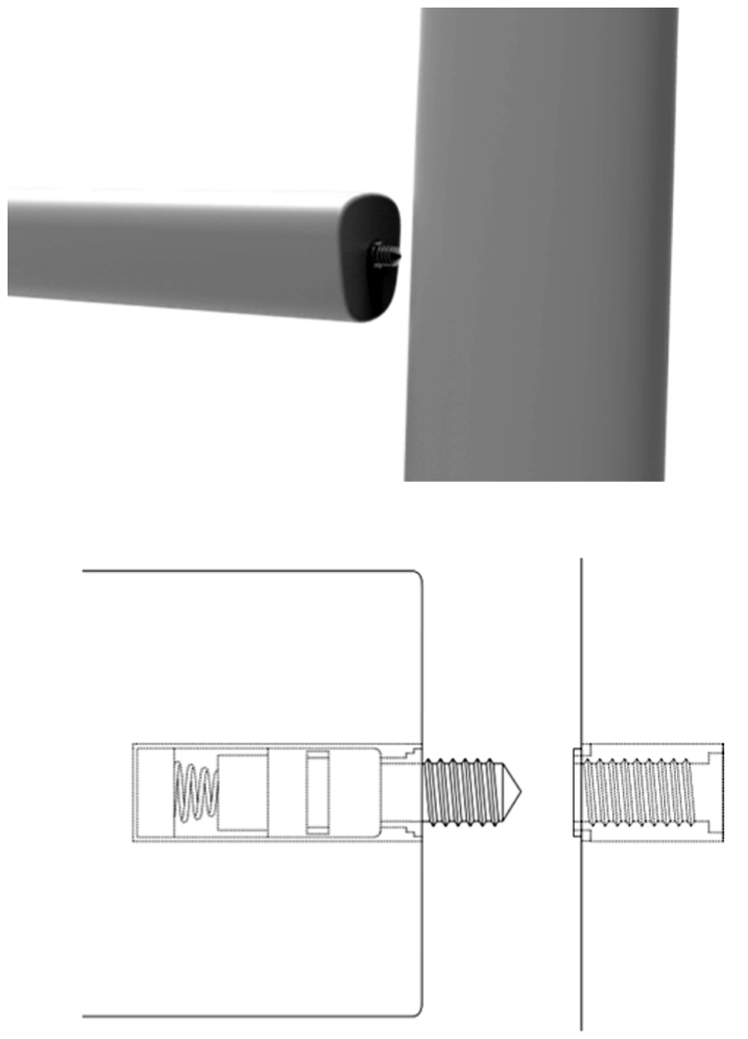
Scheme two.
Conclusion
This article focuses on the module interface structure design problem of the existing modular design method. Based on the TRIZ and AD integration model, we improve the existing modular design method. This method uses AD to analyze the coupling relationship between the module interface and the functional requirements and then uses the conflict solution tool in TRIZ to decouple and propose a suitable connection structure for modular product. To find relevant general engineering parameters conveniently, this article analyses the requirements and conflicts in the module structure design and summarizes the 22 general engineering parameters commonly used in modular design. In order to facilitate defining the principle (technical) correlation between parts, in the stage of dividing modules by fuzzy clustering algorithm, we introduce general engineering parameters as auxiliary tools. Finally, the innovative design of the high chair verified the feasibility of the modular design method based on TRIZ and AD. However, from the module partition to the design matrix for unit modules there are still a lack of method guidance and certain subjectivity, so it is not easy to find the relationship between potential functional requirements and design parameters. Therefore, it is necessary to further study how to quickly find problems by establishing module interactions and facilitate to establish the design matrix to improve design efficiency.
Footnotes
Handling Editor: Shengfeng Qin
Declaration of conflicting interests
The author(s) declared no potential conflicts of interest with respect to the research, authorship, and/or publication of this article.
Funding
The author(s) disclosed receipt of the following financial support for the research, authorship, and/or publication of this article: This research was supported by the National Science and Technology Basic Project (Grant No. 2017IM040100), the National Natural Science Foundation of China (Grant No. 51575158), and the Scientific Research Foundation for the Returned Overseas Scholars of Hebei Province (Grant No. CL201706).
