



Abstract
This article mainly concerns the high-performance motion control of valve-controlled hydraulic actuators with input saturation and modelling uncertainties. The nonlinear mathematic model including a continuously differentiable static friction model is constructed, and then adaptive robust design framework is adopted to cope with the modelling uncertainties, which always impede the progress of high-performance motion controller. Input saturation, which frequently exists in most physical systems, has been found to be prone to performance decay. To address this specific issue, an embedded anti-windup block containing two adjusting mechanisms is properly designed to improve the motion controller to ensure the stability and performance preservation in circumstance of input saturation, which is proved via rigorous Lyapunov analysis. Typical simulation is implemented to illustrate the availability of the proposed control method.
Introduction
Hydraulic actuators have been widely utilized in modern industry and defence because of the advantages of high power density, low calorific value and the ability to apply large force/torques compared to electro-motor counterparts, 1 such as aircraft actuators, 2 robots and manipulators, 3 rolling mill, 4 punching machine 5 and hardware-in-the-loop equipment. 6 However, hydraulic actuators always have a number of modelling uncertainties and inherent nonlinear behaviours, which inevitably complicate the design and development of the high-performance motion controller. Generally, the modelling uncertainties include structured and unstructured uncertainties. Examples of structured uncertainties include the change in load and the parametric variations combined with known basis functions. Other common uncertainties, such as the unpredictable external disturbances, unmodelled friction force, dead zone, hysteresis and external leakage, whose exact describing models are not known, are called unstructured uncertainties. When the control strategy is synthesized based on the nominal mathematic model, the modelling uncertainties will inevitably cause performance degradation, or even make the system unstable.
The approaches to cope with modelling uncertainties have attracted great attentions and various practical control methods are developed. Typical examples are adaptive control, 7 sliding mode control 8 and intelligent control.9,10 Besides, in the last 20 years, adaptive robust control (ARC), 11 which is characterized with rigorous theoretical basis, has achieved great development3,12,13 and also provides a practical design framework for derived high-performance controller.
Although all the control strategies mentioned above have been extensively utilized and realized excellent motion tracking performance, a notable fact is that input saturation, which frequently exists in most physical systems, is rarely considered. Input saturation has been found to be prone to cause performance degradation. Generally, input saturation may be inescapable when system operates under some critical conditions, such as unmatched initial condition, serious external disturbances and physical restriction. At this time, the input value calculated by the controller may overstep the certain physical limit; control effort will hard to act on the actuators and eventually performance deterioration will be unavoidable. To address this problem, many available methods are developed, such as bounded function methods, 14 model predictive control 15 and anti-windup compensation.16–18 The first method can achieve asymptotic tracking performance in the input saturation circumstance. But specific assumption about unstructured uncertainties is needed, which makes the controller conservative in some cases. The second method is capable of coping with hard control constraint. But its effectiveness may face challenges in the presence of modelling uncertainties. The last method employs an anti-windup compensator, which comes into operation once saturation occurs, to adjust the performance degradation and force the input amplitude to an acceptable level. However, it does not consider the mismatched uncertainties. Although the last method has been tried on hydraulic actuators by Guo et al., 18 the inevitable existing parametric uncertainties are neglected. Other approaches such as in Zhu et al., 19 the saturation nonlinearity is regarded as disturbance, and estimation methods are adopted to compensate the disturbance, which is passive and may cause high-gain feedback risk when the saturation is severe.
Motivated by the above analysis, an interesting idea is to develop a novel controller which can simultaneously cope with input saturation and modelling uncertainties trying to achieve excellent motion control performance. This is because in many cases, the two issues may be encountered at the same time. For this consideration, the inspiration naturally rises for this article. The main contribution of this study is to propose an integrated controller based on the ARC framework. Two adjusting filter dynamics, which make up the anti-windup block, are purposefully adopted for input saturation circumstance and can be integrated with the designed adaptive robust controller, while the stability is proved via rigorous Lyapunov analysis.
The remainder of the article is organized as follows. In section ‘Nonlinear model and preliminaries’, the nonlinear model of hydraulic linear actuators and preliminaries are given. Then, the saturated adaptive robust control (SARC) with anti-windup compensator is designed in detail and the performance results are given in section ‘Controller design and main results’. The availability of the proposed control methods is demonstrated via simulation results in section ‘Simulation experiment and performance analysis’. Section ‘Conclusion’ gives some conclusions and future work plan.
Nonlinear model and preliminaries
The considered hydraulic linear actuator is the same as in Yao et al., 6 and the principle diagram is illustrated in Figure 1.

The principle diagram of the considered hydraulic linear actuator.
The dynamics of the inertia mass can be described as follows

where m is the inertial mass; y and
For the friction dynamic in model equation (1), a continuously differentiable model is adopted as 20

where a1, a2 and a3 represent the different friction levels; and c1, c2 and c3 denote the various shape coefficients to approximate various friction effects. The nominal values of those friction parameters and the detailed identification experiment can be found in previous works. 21 The static mapping relation between velocity and friction force is shown in Figure 2.

Static fiction force and its curve fitting.
The pressures dynamic in the actuators can be described as 22

where βe denotes the effective bulk modulus; Ct denotes the internal leakage coefficient of the cylinder; V1 and V2 represent the total control volume of the two chambers respectively; PL = P1−P2 is the load pressure of the actuator; and Q1 and Q2 are the supplied flow rate and the return flow rate, respectively, which can be modelled as 22

where xv is the spool displacement; Ps and Pr are the supply pressure and the return pressure, respectively;

The valve dynamics can be neglected as in Yao et al. 23 and the function relationship of the spool displacement xv and the control input u is a known static proportional mapping, 24 that is, xv = ki u, where ki is a positive servo valve gain. The main reason is that the dynamic frequency of servo valve is higher than the overall system frequency. Therefore, if the dynamic of servo valve is included, additional sensors will be required to measure the spool displacement, while performance improvement may be less for motion tracking
Therefore, equation (4) can be rewritten as

where kgt = kqki is the total flow gain with respect to the control input.
Define the state vector

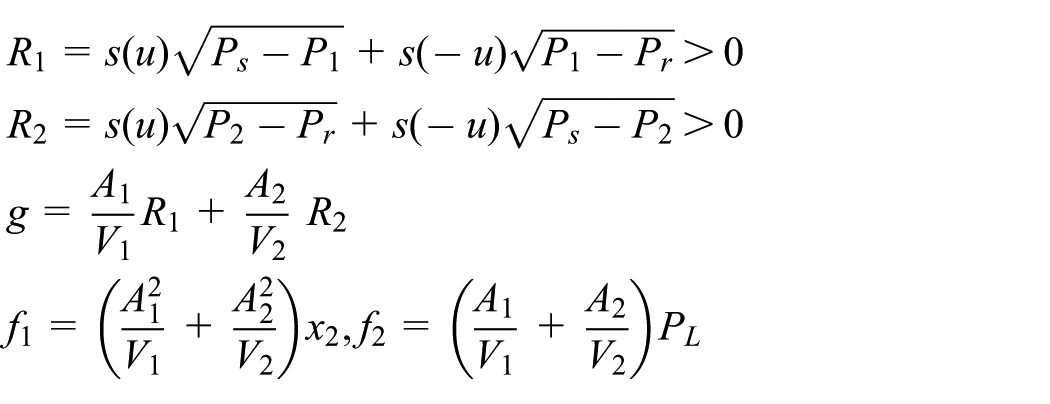
where θ1 = a1/m, θ2 = a2/m, θ3 = a3/m, θ4 = (kgtβe)/m, θ5 = βe/m, θ6 = (Ctβe)/m, Sf = tanh(
Assumption 1
The unknown system parameters and the unstructured term d meet the following features

where
Assumption 2
The states x1, x2, P1 and P2 are available for measurement.
In this article, the hydraulic actuator considered is likely to be subjected to input saturation and the saturation amplitude bound is umax, that is,

Given a desired position trajectory x1d, the design objective is to synthesize an effective control input u such that the system output y = x1 tracks x1d as accurately as possible while input saturation and modelling uncertainties simultaneously exist.
Controller design and main results
Controller design
Define z1 = x1−x1d as the output position tracking error, and the intermediate error signals as follows 17

where Δu = u−satumax(u); ξ1 and ξ2 are designed to adjust the error when saturation occurs and their values are undated by filter dynamic equation (10); and kξ1, kξ2, kΔ1 and kΔ2 are positive parameters to be designed.
For the positive semi-definite function

Let α1 =

For the positive semi-definite function
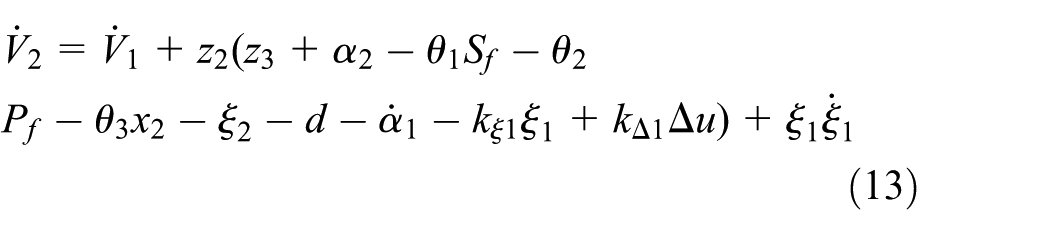
From equation (13), we can see that the ARC design techniques in Yao and Tomizuka 11 can be used to construct the visual control input α2 as follows

where ks2 is the positive design parameter; and
Substituting equation (14) into equation (13), we have

where

where ε1 is the positive design parameter and α2s2 is given as follows6,11

where
From equations (15) and (16), we have

Then, given the final positive semi-definite function

where

Based on the ARC design techniques 11 and equation (19), we can get the final controller as follows

where Proj(*) denotes the discontinuous mapping which can ensure that the parameter estimation process is controllable;
11

where ρ−, ρ+, ω and kλ are positive chosen parameters.
Substituting equation (21) into equation (19), we have

The nonlinear robust term us2 should guarantee the following properties6,11

where ε2 is the positive design parameter and us2 is chosen as6,11

Through the above design, we can further obtain

It is obvious that

Furthermore, from equations (26) and (27), we have

where ψ = ε1 + ε2 + kΔ1||Δu|| 2 + kΔ2||Δu|| 2 . By choosing λm = min{k1, ks2, θ4(ks3–kμ), (kξ1–kΔ1/4), (kξ2–kΔ2 /4)}, we can infer that

Main results
If we define the compact set

Thus, we know that V3(t) is bounded and its upper bound depends on its initial value and the control gains. Furthermore, from the definition of V3(t), we know that the tracking error z1 and auxiliary signal z2, ξ1 and ξ2 are all bounded. Because the position trajectory x1d and its derivatives are bounded, we can infer that the control input defined in equation (21) is bounded. Finally, the proposed controller can guarantee that all the signals are bounded in the presence of input saturation and modelling uncertainties, that is, the closed-loop stability is achieved.
The selected dynamics in equation (22) can achieve the designated properties: 16 when saturation occurs, the adjustable parameter μ rises to 1 rapidly to propel the amplitude of u into acceptable region while preserving the position tracking performance; when the control input is small enough, μ goes back to zero and the normal closed-loop tracking performance recovers.
Remark 1
The key point of the proposed control method is the two adjusting mechanisms designed in equations (10) and (22). They are all triggered by Δu and have different functions while cooperating with each other. The first can urge the adjusting parameters ξ1 and ξ2 to change towards the opposite direction of the errors and thus weaken the error fluctuation caused by input saturation. The second in equation (22) can generate the adjusting parameter μ needed by anti-windup design in the final controller.
Simulation experiment and performance analysis
The availability of the proposed high-performance motion controller for hydraulic actuator was verified via a simulation model shown in Figure 3. Specifications of hydraulic system components are listed in Table 1.

The simulation model utilized for performance verification.
Specifications of the hydraulic actuators.

The following typical controllers are used for comparison:
SARC: This is the proposed saturated adaptive robust control with anti-windup compensation and the detailed form is given in section ‘Nonlinear model and preliminaries’. Parameters of the controller are chosen as in Table 2.
ARC: This is the known adaptive robust control proposed in Yao and Tomizuka, 11 which is commonly used in industries. Based the constructed system model in equation (7), the controller has the following form

Parameters of the proposed controller.

Meaning of the ARC parameters is the same as the corresponding parameters in SARC. The desired tracking trajectory is chosen as x1d = 100 sin(πt). The saturation amplitude umax is set as 2 V. The simulation results are shown in Figures 4–6.

Tracking errors.

Control inputs.

Curve of Δu and parameter μ.
The position tracking errors of the two compared controllers are exhibited in Figure 4. Obviously, for both the controllers, the tracking error shows large fluctuation once the control input touches the saturation bound. What is more notable is that the proposed SARC controller, especially the filter designs in equation (10), can adjust the tracking error timely and effectively, which can be further revealed by comparing the maximum tracking error calculated via Me = max{|z1|}. The maximum tracking errors of SARC and ARC are 1.427 and 1.172 mm, respectively. This means a 17.8% reduction, which verified the desirability and positive significance of the proposed controller for which the maximum tracking error is a key performance indicator in many hydraulic applications. It is easy to see that all of them gradually return to normal error level after saturation disappears.
The control inputs are exhibited in Figure 5. Obviously, the saturation occurs once the amplitude exceeds 2 V, which corresponds to the error fluctuation in Figure 4. The difference is that for SARC, the control input will recover to acceptable region faster than ARC, which benefits from the ingenious design of us1. The change curve of Δu and the updated dynamics given in equation (22) are shown in Figure 6. Evidently, the parameter μ rises to 1 rapidly when saturation occurs and goes back to 0 after saturation disappears, thus ensuring a timely adjusting manner for control input.
What needs illustration is that the designed adjusting anti-windup compensator will inevitably influence the tracking error dynamics, especially slow down the rate of convergence after saturation disappears (e.g. 1–2 and 4.5–5.5 time intervals) and cause the unexpected peaks (e.g. 3.5–4 time interval). How to improve them is certainly worth further concerning and automatically becomes the research direction for our future efforts.
Conclusion
In this article, a novel saturated motion tracking controller for hydraulic actuators is proposed to address the issues of input saturation and modelling uncertainties. The modelling uncertainties are handled well via ARC based on the nonlinear mathematic model including a continuously differentiable static friction model. The integrated anti-windup compensator containing two adjusting filter dynamics, which respectively adjust the control input and tracking error, is utilized to cope with the saturation circumstance. The stability is proved via Lyapunov analysis. In comparison with traditional ARC, the maximum tracking error value decreases significantly when saturation occurs, which verified the desirability and positive significance of the proposed controller. The future works may focus on how to improve the rate of convergence after saturation disappears and the unexpected peaks, as well as applying the proposed control strategy to other practical systems, such as vehicles, robot manipulators and hardware-in-the-loop systems.
Footnotes
Handling Editor: Zengtao Chen
Declaration of conflicting interests
The author(s) declared no potential conflicts of interest with respect to the research, authorship and/or publication of this article.
Funding
The author(s) disclosed receipt of the following financial support for the research, authorship and/or publication of this article: This work was supported by the National Natural Science Foundation of China (grant no. 51605145); the Henan Provincial Key Scientific Research Project of Colleges and Universities of China (grant no. 18A460020); and the Henan Provincial Science and Technology Project of China (grant no. 172102410071).
