




Abstract
The diffusion influence of seawater on the static and interlayer cracking properties of a polyvinyl chloride foam sandwich structure is investigated in this study. After soaking specimens in seawater for various durations, various comparison tests are performed to investigate the effects of seawater. Compression tests for H60 and H200 polyvinyl chloride foam specimens are conducted to study strength and modulus degradation, and the results show that immerging time and temperature have significant effects on polyvinyl chloride foam properties. Tensile tests for glass-fibre-reinforced plastic panels, four-point bending tests and double cantilever bending tests for polyvinyl chloride foam sandwich specimens are also performed. The results show that seawater immerging treatment has a noticeable influence on glass-fibre-reinforced plastic tensile properties and interlayer critical energy release rate values, but has almost no effect on bending properties of foam sandwich specimen. Furthermore, a rate-dependent phenomenon is observed in double cantilever bending tests, in which higher loading rate will lead to larger critical energy release values. Numerical simulation is also performed to illustrate the cracking process of double cantilever bending tests and shows a certain accuracy. The simulation also demonstrates that the viscoelasticity of foam material after immerging treatment results in the rate-dependent characterization of double cantilever bending tests.
Introduction
As a type of advanced composite structure, foam sandwiches have been widely used in engineering practice for their incredible features, such as high strength, lightweight, good stability and superior corrosion resistance. In addition, its fatigue resistance, shock resistance and noise reduction properties have made it a promising application prospect in marine engineering and shipbuilding.1–3 However, under seawater environments, strength, rigid, durability and toughness of foam sandwich structure may have different degradation mechanisms. Therefore, studying the influence of seawater on the mechanical properties of a foam sandwich is important and fundamental for its application in shipbuilding practice.
The most commonly used foam sandwich is composed of polymer foam core and fibre-reinforced plastic (FRP) faceplates. Foams types include polyvinyl chloride (PVC) foam, polyurethane (PU) foam and polymethacrylimide (PMI) foam. FRP faceplate types often include glass-fibre-reinforced plastic (GFRP) and carbon-fibre-reinforced plastic (CFRP). Considering cost and structural demand, a PVC foam sandwich with GFRP faceplates is the most suitable solution for application on ship structures.
Water or moisture diffusion in foam products has a significant influence on their mechanical properties. Many studies focus on diffusion principles of water diffusion. Katzman et al. 4 studied the moisture transfer pattern in a foam sandwich and derived the moisture migration calculation formula according to the Fickian diffusion law. Avilés and Aguilar-Montero 5 utilized the Fickian diffusion law to calculate seawater diffusion in a rectangular plate manufactured using a PVC foam sandwich with GFRP faceplate. Comparing with experimental result, PVC foam in sandwich structure performs the predominant role in water absorption. In addition to these studies, other researchers found that water diffusion in foam is more likely to show non-Fickian effects, especially for closed foam cells. Earl and Shenoi 6 studied seawater diffusion in PVC foams, and the results show that the diffusion curve appears in three steps; in each step, diffusion velocities show piecewise linearity. Grace and Altan 7 proposed a three-dimensional hindrance diffusion calculation method based on the Langmuir-type diffusion model proposed by Carter and Kibler. 8 In their analysis, physical and chemical interaction between water and matrices was considered. Whetsell 9 investigated the water absorption behaviour of closed-cell diffusion in PU foam under isothermal and freeze-thaw environmental conditions.
Water diffusion in foams makes the mechanical properties change to different extents. Sadler et al. 10 compared water absorption properties of PVC foam, PMI foam and balsa wood. The results show that PVC foam shows more noticeable deterioration after being immerged in seawater than pure water. Li and Weitsman 11 studied the water absorption properties and fracture toughness of PVC foam. The results show that water absorption reaches the maximum value after immerging in water for 2000 h. Although water diffusion increases fracture toughness of foam itself by 31% (H100) and 8% (H200), the interlayer crack propagation resistance between layers and foams decreased by 36% (H100) and 17% (H200).
Bending failure often appears in foam cracks or interlayer debonding; therefore, interlayer properties of a foam sandwich determine the ultimate strength of a sandwich structure. Kabir et al. 12 carried out static and dynamic fracture test for PVC foam with a type I crack and observed crack propagation in cell walls. Marsavina et al.13,14 conducted crack propagation tests for PU foam with a type II crack and utilized the digital image correlation (DIC) technique to monitor strain during crack propagation. Rizov and Mladensky 15 investigated fatigue and fracture performance of H30 PVC foams using compact tension (CT) specimens with type I cracks.
Interlayer properties investigation for foam sandwich is mainly conducted using single cantilever beam (SCB) and double cantilever beam (DCB) test. Siriruk et al. 16 studied the seawater immerging influence on interlayer fracture properties of foam sandwich using an SCB test. The results show that soaking a specimen in seawater will lead a 30% decrease in the critical energy release rate. Kolat et al. 17 conducted Mode-I Cracked Sandwich Beam tests for several sandwich structures containing various core materials (wood, plywood, PU and coremat). The result shows that the mechanical properties of foam sandwiches containing PU core and coremat improve considerably after immerging in seawater. Ramantani et al. 18 combined finite element method (FEM) analysis with DCB test for foam sandwiches with type I cracks and introduce cohesive elements to simulate the crack process. The result shows considerable agreement between experiments and simulations.
FRP faceplates also show mechanical properties degradation after soaked in water. Meng et al. 19 studied the influence of moisture (50°C) on the failure modes of CFRP. The result shows that the boundary effect makes mechanical properties deteriorate considerably in the short term. However, the interlamination property between fibre and metrics decreases significantly in the long term. Sun and Zhang 20 investigated ultimate loads, compressive strength and elastic modulus of GFRP bars under seawater environment corrosion. The result shows that as immerging time increases, ultimate loads, compressive strength and modulus of elasticity show a certain decline.
The objective of this study is to investigate the seawater effects on static loads and interlayer cracking performance of PVC foam sandwich. A series of tests, including compressive tests for PVC foam, tensile tests for GFRP penal, four-point bending and DCB tests for foam sandwich structures, are conducted to study seawater immergence effect. Furthermore, numerical simulation is conducted to describe the interlayer cracking process.
Experimental setup and specimens
To conduct static and interlayer tests of the foam sandwich panel, the preparation of specimens, experimental setup and testing method are illustrated in detail. The foam sandwich panel consists of two types of material, foam core and GFRP faceplates. We conduct static tests of foams and faceplates before conducting foam sandwich panel tests. Thus, the failure mechanism of a sandwich panel affected by seawater can be revealed and studied.
Specimen preparation
Two types of PVC foam materials, H60 and H200, produced by DIAB Ltd, which have a PVC foam density of 60 and 200 kg/m3, are used to manufacture the specimens. Cutting foam plates into small cubes of 50 mm × 50 mm × 30 mm size (Figure 1(a)), compression tests can be conducted in a universal testing machine to measure mechanical properties after immerging treatment. The initial mechanical properties nominal values, modulus and strength for various types of loads for PVC foams are listed in Table 1.

Test specimens: (a) compression test specimens and GFRP faceplate specimens, (b) four-point bending test specimens and (c) DCB test specimens.
Properties of PVC foam.
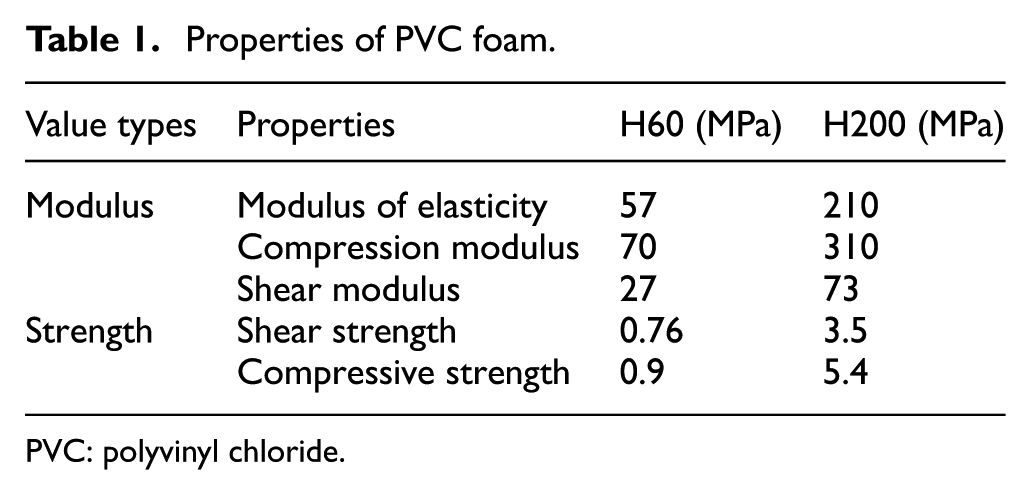
PVC: polyvinyl chloride.
Fibreglass gridding cloth, with 100 g/m2, 0.1-mm thickness and a density of 2.4 g/cm3, accompanied with epoxy resin E-51, is utilized to fabricate foam sandwich panel using the vacuum-assisted resin injection moulding (VARTM) method. 21 First, 30 layers of glass fibreglass are laid on the top and bottom of a PVC foam plate separately. Next, a guide network and demoulding cloth are laid on the exterior of the specimen (Figure 2(a)). Using a PVC film accompanied with seal gum, the specimen is sealed. Next, we start the vacuum pump and make specimen in a vacuum. In the next step, we mix the epoxy resin and inject the resin from a guide tube. Keeping the specimen solidifying in normal temperature for 24 h, we finally obtain a complete foam sandwich panel. The panel is cut into small specimens of size 250 mm × 60 mm × 30 mm and 200 mm × 25 mm × 30 mm separately, which are used to carry out four-point bending tests and prepare interlayer cracking test specimens.
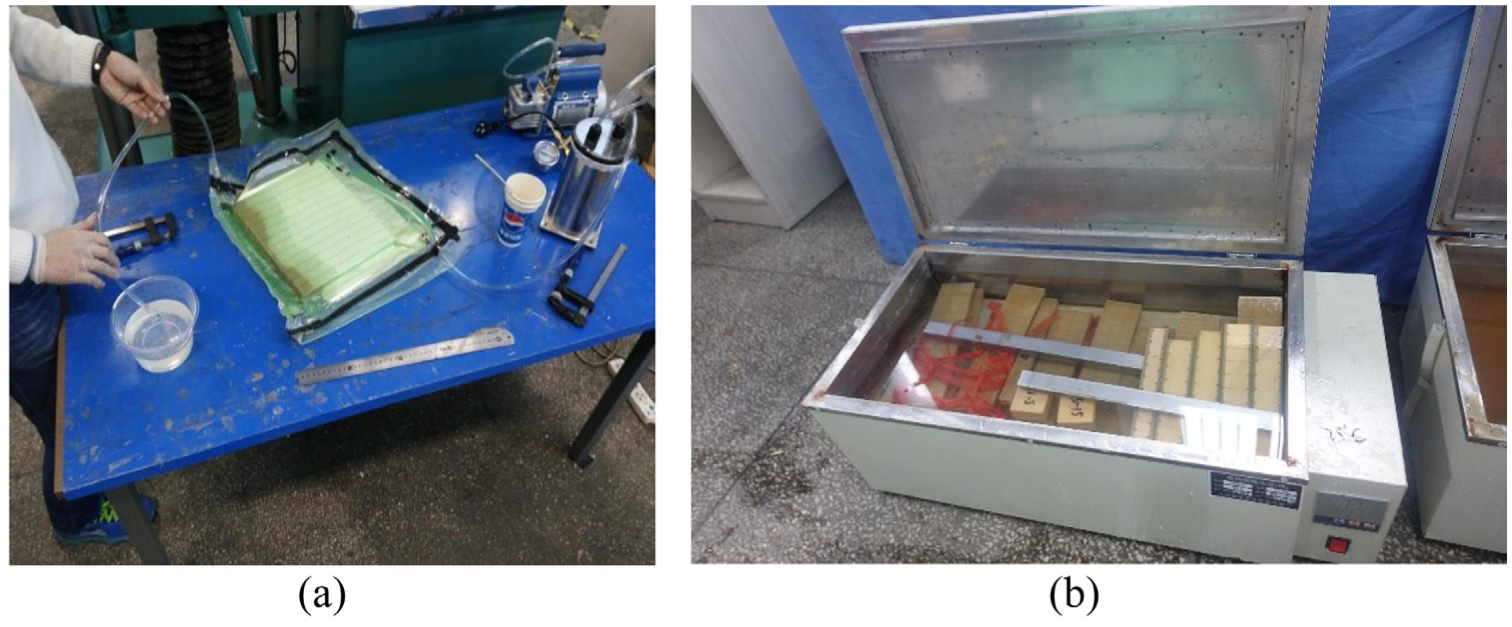
Preparation of specimens: (a) preparation of foam sandwich plate and (b) immerging process of sandwich specimens.
GFRP plate specimens are also made using the VARTM method, similar to the pervious procedure of foam sandwich specimen. The size of tensile experiment specimen is 180 mm × 20 mm × 5 mm, and thickness of the GFRP faceplate is 5 mm, as shown in Figure 1(a).
DCB tests are conducted to measure the interlayer cracking properties for a specimen with a size of 200 mm × 25 mm × 30 mm (Figure 1(c)). Initial crack length is 50 mm, which is prepared by a steel saw. At the end of the specimen, a rolling bearing accessory is stuck on the top and bottom faceplate.
Artificial seawater is created by mixing purified water and synthetic sea salt. The proportion of artificial water is listed in Table 2. Two environmental testing chambers are utilized to immerge specimens at 25°C and 60°C, respectively (Figure 2(b)).
Proportion of artificial seawater.

Static experimental setup
Static experiments consist of three parts: compression tests for PVC foams, tension tests for GFRP faceplates and four-point bending tests for sandwich specimens. All of these tests are conducted using the Instron 5505 universal testing machine in the Mechanics Lab of Harbin Engineering University.
Seawater immersion influence on the mechanical properties of PVC foam is studied based on the compression tests. Two types of PVC foam specimens (H60 and H200) are immerged in seawater solutions on different days and at different temperatures (25°C or 60°C). The specimens used in the compression experiments have a size of 50 mm × 50 mm × 30 mm, and the experimental setup is shown in Figure 3. The loading speed during the compression test is 2 mm/min. Each experiment is stopped when the foam under continuous loading exhibited a yield point or the relative compression deformation reached 20%.

Compression experimental setup and specimens: (a) experimental setup and (b) specimens after compression.
Immerging in seawater may affect the strength of GFRP faceplates, so tensile tests for GFRP specimens are conducted to study the influence of seawater. GFRP tensile specimens are also soaked in seawater for different times and temperatures (25°C or 60°C). To prevent sliding between the clamp and specimen, the aluminium sheets of 50 mm × 20 mm × 1 mm size were stuck to the two ends of GFRP specimens using glue and were later solidified at room temperature for 24 h before the tests. The size of the specimen is 180 mm × 20 mm × 5 mm and the loading rate is 2 mm/min. The experiment stops automatically after the glass fibre breaks. The setup of the tensile experiment and specimens is shown in Figure 4.
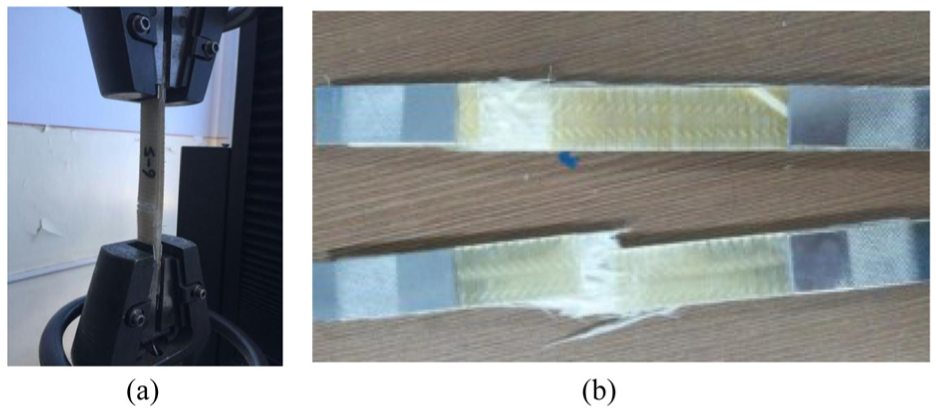
Tensile tests for GFRP specimens: (a) specimen and experimental setup and (b) failure specimens.
Four-point and three-point bending tests are traditional experimental methods for measuring the mechanical properties of a material under different loading methods. A four-point bending test is selected in this work because the shear resistance of the PVC sandwich plates can be obtained accurately.
For the four-point bending tests, the standard size of the specimen is 250 mm × 60 mm × 30 mm, loading speed is 3 mm/min, total span L is 180 mm and span ratio is 1:3. The failure process of the specimen is mainly divided into three stages (Figure 5): (1) initial loading and sandwich plate bending; (2) visible cracking between the glass fibre panel and the foam core layer on both sides of the sandwich plate; and (3) reaching the foam sandwich shear limit and visible vertical cracking.
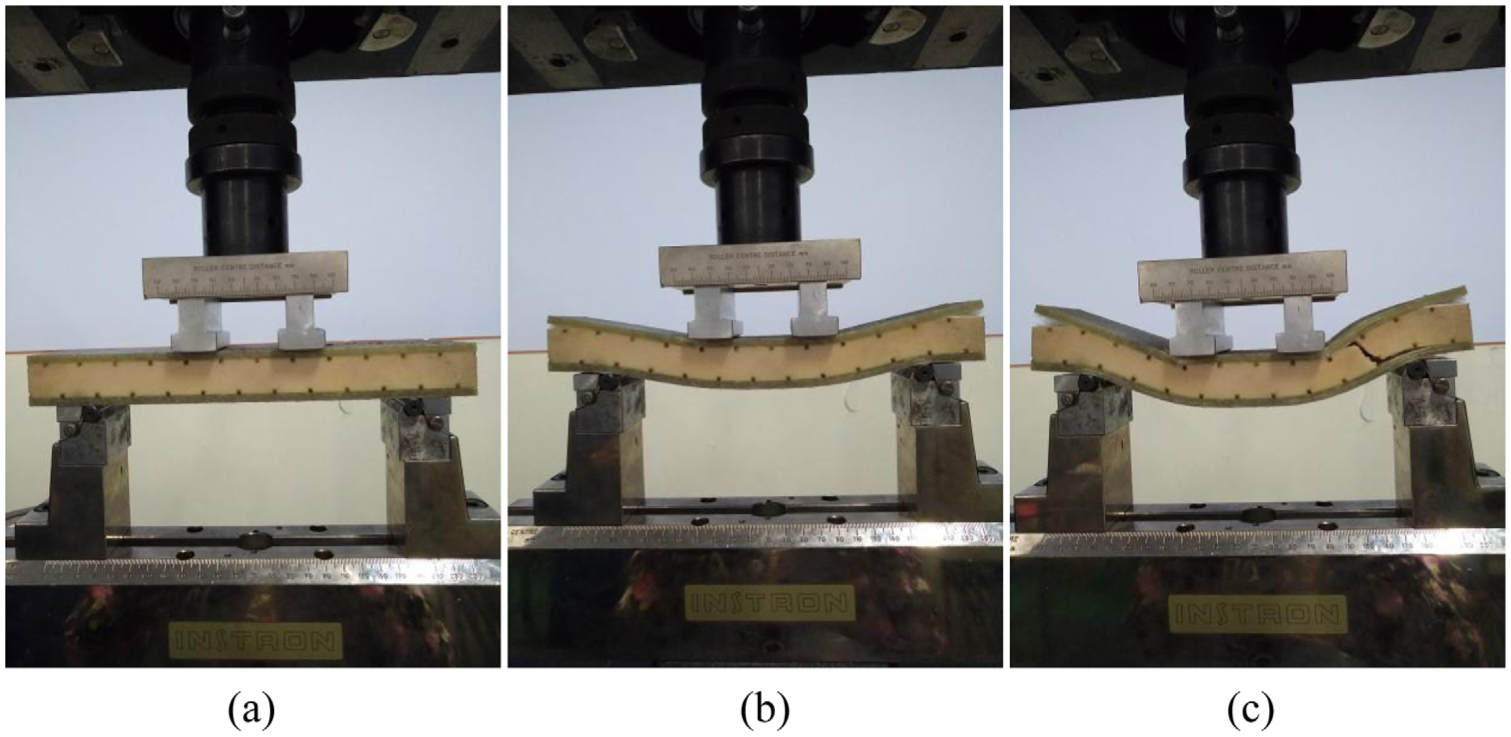
Failure process of four-point bending test of foam sandwich specimen: (a) beginning of test, (b) beginning of failure and (c) failure of specimen.
Results and discussion for static experiment
Compression properties of PVC foam
The experimental data are processed based on equation (1) and are presented in Table 3.

where
Compression results of two density foams in seawater immersion.
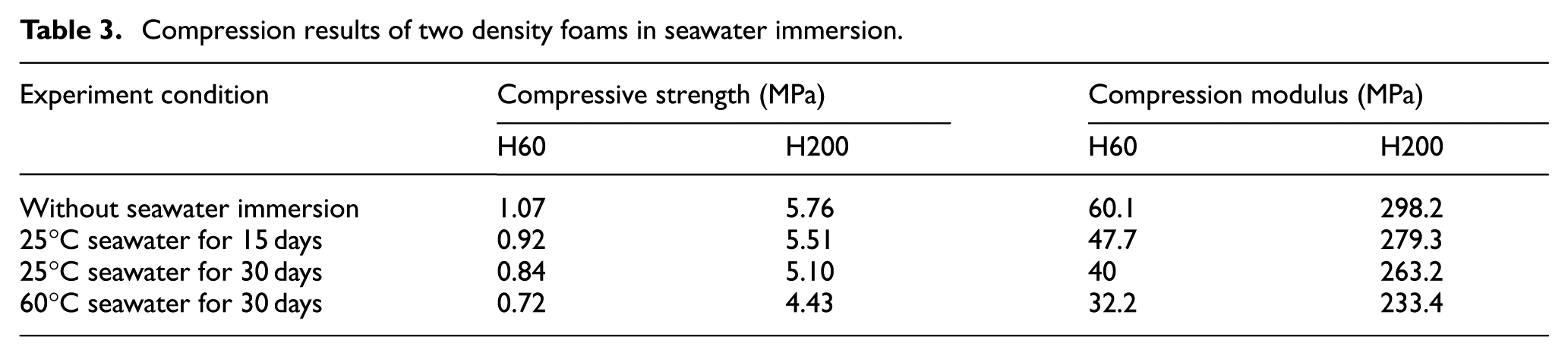
Figure 6 presents the compression testing curves of two types of PVC foams with different immerging times. The compression results of two foams with different densities after seawater immersion are listed in Table 3. It can be observed that the compressive strength is reduced by varying degrees after seawater immersion, and the compressive strength decreases more rapidly for longer soaking times. The strength of H60 PVC foam immersed in 25°C for 30 days decreases by 21.4% compared to foam without immerging treatment, while for H200 PVC foam, the decrease is 11.5%. These differences are because the variation in density has different porosity characterization, which induces different water absorption rates. Regarding the influence of the seawater temperature (Figure 7), the compressive strength of the H60 PVC foam soaked for 30 days at 60°C is 14% lower than that soaked at 25°C. For the H200 PVC foam, the corresponding decline in compressive strength is 13%, which means heating can accelerate the ageing effects of PVC foams in case of seawater immersion.
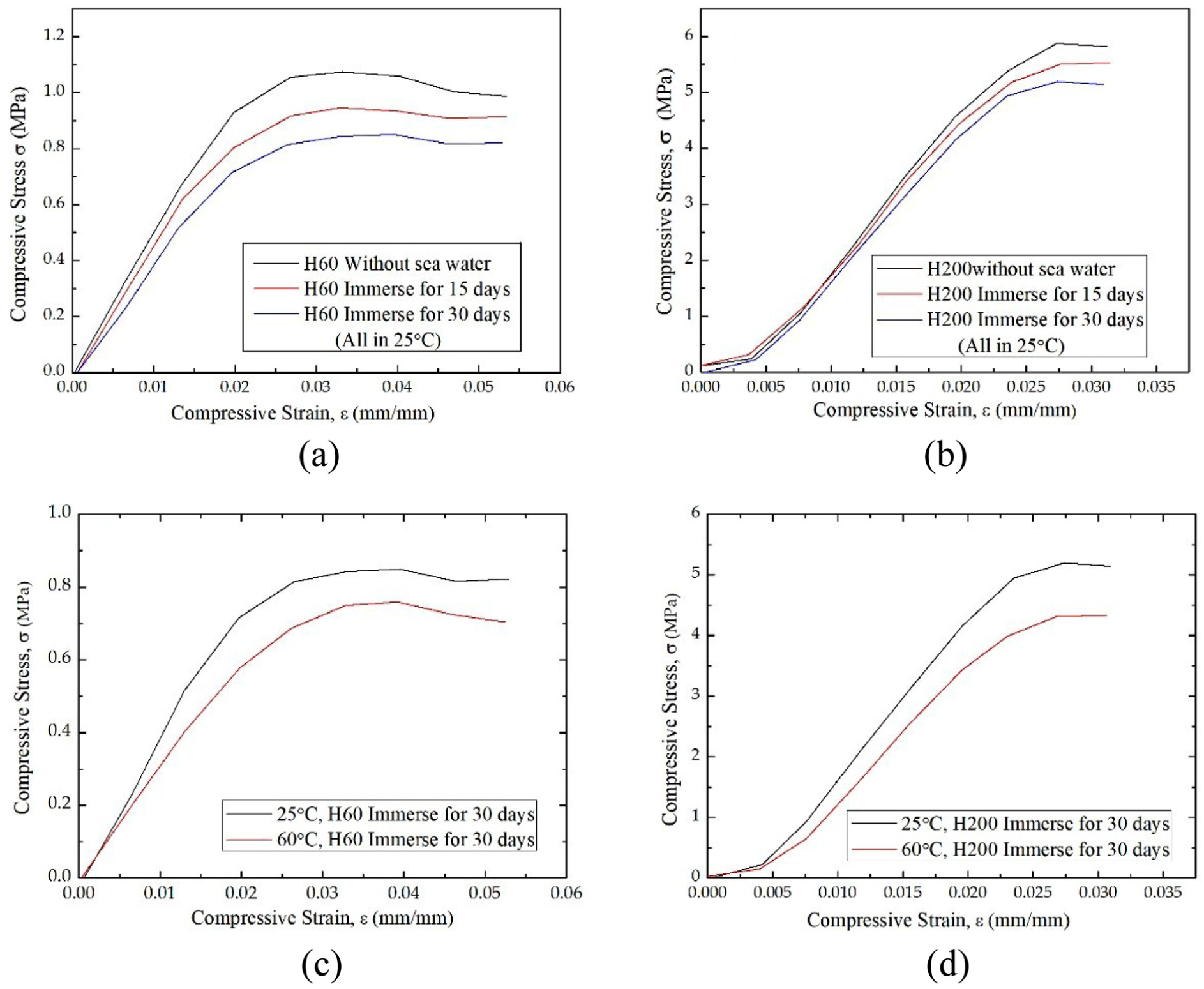
Compression testing results with different immersion times and immerging temperatures: (a) H60 foam, 25°C; (b) H200 foam, 25°C; (c) H60 foam, 60°C; and (d) H200 foam, 60°C.

Tensile curves for GFRP specimens with various soaking time and temperatures: (a) Specimens soaked in 25°C seawater for different durations; and (b) Specimens soaked in seawater with different temperatures for 30 days.
Simultaneously, with the reduction of the compressive strength, the compressive modulus of elasticity also decreases in varying degrees. Compared to specimens without seawater immersion, 25°C seawater treatment for H60 leads to 20.63% and 33.4% decrease for 15 and 30 days, respectively. For H200 foam, 25°C seawater treatment for H60 lead to 6.34% and 11.7% decrease for 15 and 30 days, respectively. In addition, for 60°C and 30 days seawater treatment, the decrease amplitude is 46.4% and 21.3% for H60 and H200 foams, respectively.
Figure 7 shows compressive loading curves. All the compressive curves have a platform after surpassing maximum values. Combining specimens after tests in Figure 3(b), it can be seen that the specimen will not break under compressive loads, but appears inhomogeneously squeezed.
Tensile test results of GFRP specimen
Tensile test results of the GFRP specimen in various environmental conditions are shown in Figure 8. Tensile strength and modulus of elasticity are listed in Table 4, which are obtained according to the same formula as equation (1).

Four-point bending test results: (a) sandwich specimen immerging in different times and (b) sandwich specimen immerging in temperature seawater.
Tensile strength and modulus of GFRP under seawater immersion.

GFRP: glass-fibre-reinforced plastic.
The data in Table 4 show that the tensile strength of the GFRP gradually decreases as the soaking time increases. The tensile strength of the panels immersed in seawater at 25°C for 30 days is 19.1% lower than that without seawater immersion, and similarly, the tensile modulus of elasticity is reduced by 17.3% compared to the panels without seawater immerging. Curves in Figure 7 show the sudden failure of specimens. Before fracture failure happens, testing curves have no preliminary indication. Regarding the influence of temperature, compared to tensile strength of plates immersed in 25°C seawater, the tensile strength of specimens soaked in seawater at 60°C for 30 days decreased by 6.3%, but the tensile modulus decreased by 29.8%. Therefore, we can conclude that the effect of seawater immersion on the GFRP panel is considerably smaller than that of PVC foam. The capacity difference of water absorption between faceplates and foams is observed because the resin in the GFRP panel does not absorb moisture easily, which leads to better seawater environmental resistance.
Four-point bending test results
Four-point bending test results are shown in Figure 8, and the relationship between bending displacement and bending load under various soaking conditions is obtained. During the loading process (Figure 5), large deformation first happens because of bending loads, and then, an initial crack appears between the faceplate on the upper side and foam core at the end of the specimen. The crack appears in both ends. As the interlayer crack propagates, the applied load still increases slowly. The crack at the end propagates until another crack appears near the loading points and penetrates in the middle of foam core, and the load subsequently begins to fall.
From the available experimental data, in the case without the influence of water, the maximum bending load of the sandwich plate under four-point bending is 22,386 N; but when it was immersed in 25°C seawater for 15 days, the maximum bending load is 21,894 N, that is, 2.2% lower. The maximum bending load for the specimen that underwent seawater immersion for 40 days is 21,241 N, 3% lower than the maximum bending load for the specimen without immersion.
Comparing the different seawater immersion temperatures, the maximum bending load of sandwich structure under seawater immersion at 60°C for 40 days was 20,629 N, which was 2.9% lower than that at 25°C. The results show that the influence of 40 days of seawater immersion on the flexural properties for the sandwich panels is not very substantial, because the overall strength of the high-density H200 foam sandwich panels is relatively high, which makes it less susceptible to seawater.
We can conclude that although seawater immerging treatment has an obvious influence on GFRP tensile properties and interlayer critical energy release rate values, it has almost no effect on the bending properties of foam sandwich specimen. This negligible influence on four-point bending tests is because the sealing effect from faceplates, which protects the foam core from moisture immersion. In short-term immerging tests, moisture only affects the two lateral sides of foam core, and the inner part of foam core is not affected by seawater. This means that the test result shows a size effect; the larger the specimen, the lower the influence of seawater diffusion. When considering short-term immersion effect of seawater, degradation of whole structure primarily arises due to foam absorption.
Interlayer experiments results and numerical analysis
Numerical method of interlayer crack analysis
Numerical analysis is an efficient way to design composite structures, replace experiments and reveal failure mechanisms. In this study, the Abaqus software is used to analyse the interlaminar cracking of PVC foam sandwich panels with different foam cores. DCB test is the most commonly used method to characterize interlayer cracking properties of sandwich panels. The energy release rate G is a reasonable parameter corresponding to cracking properties.
The energy release rate criterion is based on the perspective of conservation of energy. In the process of crack propagation, the energy for crack propagation can be derived from the work of external force. We can assume the width of the sandwich plate is

The left side of the formula indicates the energy released when the crack grows by da. The right side of the formula indicates the energy dissipated when the crack length is da. The magnitude of this value depends on the fracture toughness of the material. The energy release rate is defined as the energy released by the unit length of crack propagation, which is recorded as G. The total potential energy is

To simulate the interlaminar cracking problem by FEM, the properties of interlaminar crack growth interface should be defined by identifying relevant parameters of all layers’ material. Sandwich panel specimen FEM model has a dimension of 200 mm × 25 mm × 30 mm, with 5-mm-thick faceplates and a 20-mm-thick foam core. The mechanical properties of the face sheets and the foams used for the FEM model are from previous experiments. The isotropic linear elastic constitutive model is used in both sheet and core materials, as listed in Table 5.
Material parameters of sandwich plates.

To simulate interlayer crack propagation, a cohesive element layer is used in the FE model to simulate crack behaviour. Crack interfaces between foam core and top layers are defined as the contact interface in which inhibited cracks are defined as the cohesive layers by settings contact pair. A plane analysis finite element (FE) model is constructed, which is shown in Figure 9. According to the experimental process, the left endpoints of the bottom layer are fixed. Displacement constraints in the x and y directions are applied to the left endpoints of the top layer. The plate and foam core model are meshed using CPE4R elements with a dense grid. The crack layer is constructed by COH2D4 cohesive elements with zero thickness and then combined with GFRP faceplate and foam model. The initial crack is 50 mm long, and the cohesive layer begins on the left crack tip section. A linear-triangle cohesive force relationship and traction-separation-based illustration are used to illustrate crack propagation properties of cohesive elements. Cohesive layer stuffiness K is equal to 57 and 210 MPa/mm for H60 and H200 foam, respectively; cohesive layer strength is 1.07 and 5.76 MPa. A total of 10,500 elements are used to simulate the specimen.
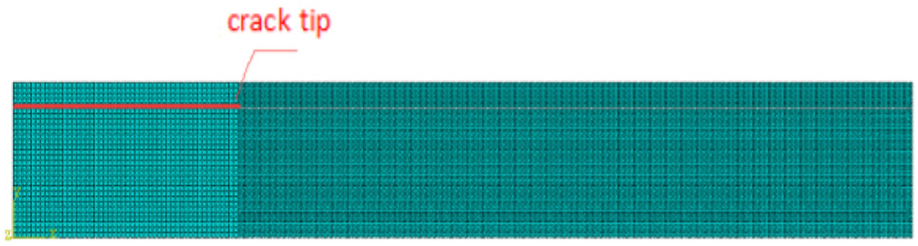
DCB experimental model.
When considering the interlayer cracking specimen with seawater immersion, the material parameters of modulus of plasticity and other interlayer properties are modified to simulate the influence of seawater immersion. These properties values are determined by specimens’ tests after immersion, which are shown in Table 3.
Softening effect due to immerging into seawater will lead to rate-dependent testing result. In order to prove it is the viscoelasticity of immerged foam materials which brings out this phenomenon, numerical simulations considering viscoelasticity on crack propagation were conducted. When simulating, loading rates affect the interlayer cracking of sandwich plate, the properties of PVC foam in sandwich are changed into viscoelastic constitute model, and the loading speed is consistent during loading process, namely, 2, 10 or 20 mm/min.
Interlayer crack analysis for specimen without seawater immersion
Numerical simulation results of interlayer cracks of PVC foam sandwich structure without seawater immersion are shown in Figure 10. The stress contour plots show that the crack in the specimen with H60 PVC foam core is longer than specimen with H200 PVC foam core, and the maximum stress occurs at the tip of the crack.

Coloured contour plots of the simulation result: (a) sandwich structure with H60 PVC core and (b) sandwich structure with H200 PVC core.
The DCB test specimen and experimental setup are shown in Figure 11. Foam sandwich panel specimens are also immerged into seawater for various numbers of days (15, 30, 90 and 180 days). The loading rate applied to the specimen is 2 mm/min until the crack length extends 30 mm.

DCB tests specimen and experimental setup: (a) DCB test specimen, (b) DCB test setup and (c) specimen after test.
According to mode I interlaminar fracture energy testing standard ASTM D5528-01,
23
the calculation formula of

where F is the applied load,
Figure 12 shows a comparison of load–displacement curves between DCB experiments and simulations. For the load–displacement curve of a specimen with H60 PVC foam core, there is a stable increasing trend before it reached a peak value of 170 N. Later, the curve presents a zigzag variation and declines at a slower rate because of the stable propagation of the crack. There is a similar trend for H200 PVC foam sandwich specimen with a peak load value of 340 N, except for a more significant decrease at the end of curves. This finding means that foam sandwiches with a H200 PVC core have larger crack propagation resistance capacity than specimens with a H60 core. However, once the crack begins to propagate, a foam sandwich with a H200 core has a more obvious unloading effect than a specimen with a H60 foam core.

Load–displacement curves of specimen without seawater immersion between experiment and simulation: (a) H60 foam sandwich panel and (b) H200 foam sandwich panel.
By comparing the load–displacement curves between the DCB experiments and numerical simulations, we can observe that the result of the numerical simulation is slightly lower than the experimental result. This finding is observed because the cohesive element layer properties used in the Abaqus simulation cannot completely match the experimental model. Ignoring the fluctuation at the end of load–displacement curve obtained by the experiments, they have a similar variation trend not only in the increasing part of the curves but also in the decreasing part. This finding demonstrates that the loading process of DCB experiment can be simulated by Abaqus with a certain accuracy.
The critical energy release rate
Energy release rate and peak values of DCB experiment and numerical simulations.

DCB: double cantilever beam.
Effect of seawater immersion on interlayer cracking properties
The load–displacement curves from the DCB tests for two types of foam sandwich with different soaking time are shown in Figure 13. From the load–displacement curves, it can be concluded that the soaking time has a considerable influence on the interlayer cracking properties of PVC foam sandwich panels. For the H60 foam sandwich panel soaked in seawater for 15, 30, 90 and 180 days, their peak loads measured in the experiment are 167, 147, 135 and 130 N, respectively. Comparing to the peak load of 170 N for the panel without immerging treatment, decreasing values are 1.8%, 13.5%, 20.6% and 23.5%, respectively. For the H200 foam sandwich specimens, after soaking in seawater for 30, 90 and 180 days, peak loads are 301, 259 and 192 N, respectively. Compared to the peak load of 340 N for specimens without immerging treatment, peak values decrease by 11.5%, 23.8% and 43.5%.

Load–displacement curve in different soaking time obtained from the DCB test: (a) H60 foam sandwich panel and (b) H200 foam sandwich panel.
These significant decreases for the two types of specimen are because seawater diffuses in foam cells from the crack interfaces. Unlike the previous four-point bending specimen, seal effect is very weak in the crack tips for DCB specimens. Therefore, seawater can affect the foam cells directly and degrade its mechanical properties. Therefore, in engineering practice, foam core must be prevented from getting into contact to seawater. Otherwise, mechanical properties will be degraded in a short time.
Table 7 lists the critical energy release rates of the sandwiches obtained from the DCB experiments in the seawater environments. Compared to the specimen without immersion treatment, critical energy release rates decrease tremendously for the H60 and H200 foam sandwich panels. After 180 days of immerging treatment, the values of critical release rate for H60 and H200 are 1548 and 1913 N m−1, corresponding to decrease 41.4% and 23.8%, respectively. The reduction magnitude for H60 foam core sandwich is much larger than for H200 specimen. This demonstrates that the interlayer property for H60 foam core sandwich is more sensitive than for the H200 foam core sandwich.
Critical energy release rate of foam sandwich in varied soaking times.

Loading rate influence on interlayer cracking properties
Softening effects will occur after immerging treatment for PVC foam, which leads to viscoelastic characteristics in foam mechanical properties. The viscoelastic feature of foam may result in rate-dependent effect on interlayer cracking properties. In this study, DCB experiments with various loading rates are conducted to verify its viscoelastic feature. Three DCB specimens with H60 foam core, after being immerged for 30 days, are selected to apply loading rate at 2, 10 and 20 mm/min separately.
Load–displacement curves of DCB experiments in various loading rates compared with simulation results are shown in Figure 14. The critical release rates are listed in Table 8. From Figure 14, it can be seen that as loading rate increases from 2 mm/min and 10 mm/min to 20 mm/min, peak load values increase from 147 N and 154 N to 169 N, which correspond to increasing by 4.8% and 9.7%, respectively, comparing to 147 N in 2 mm/min. Critical energy release rates have a similar variation trend. As loading rate increases, the critical energy release rate increases by 4.7% for 10 mm/min and 9.9% for 20 mm/min. This trend indicates that the viscoelasticity of the foam core in a sandwich cannot be ignored. The fracture properties are rate-dependent, with higher loading rate leading to larger critical energy release values.

Comparison of load–displacement curve between experiment and simulation for various loading rates.
Critical energy release rate for various loading rates.

Numerical simulations considering viscoelasticity of PVC foam moisture absorption are also shown in Figure 14. The result is obtained by assuming PVC foam to be a viscoelastic material. This assumption is inconsistent with reality because softening effect only appears at crack tips and other parts that are directly in contact with seawater. However, there is no cohesive element available to reflect viscoelasticity of interlayer crack, and from experimental observation, the crack propagates along with inner part of PVC foam. Consequently, in crack propagating simulation, it is reasonable to assume that the foam material is viscoelastic. The simulation curves show a similar trend with experiments. This supports the previous conclusion that it is representative of the viscoelasticity of foam after immerging treatment results in rate-dependent characterization.
Conclusion
This study mainly focuses on the effect of seawater on the static and interlayer cracking properties of PVC foam sandwich panels by performing experiments and numerical simulations. Conclusions can be drawn as follows:
Seawater immersion treatment and seawater temperature have significant influence on the compressive strength and elasticity modulus for PVC foams. Compared to foam cores that are not subjected to immersion treatment, after 30 days immerging in 25°C seawater, 21.4% and 11.5% degradation are observed on the compressive strength of H60 and H200 PVC foams, respectively. Similarly, compression modulus shows a 33.0% and 11.7% decrease for the two types of foams. In the case of immerging in 60°C seawater for 30 days, 32.7% and 23.1% degradation in strength and 46.4% and 23.1% decrease in modulus will appear compared to foams that have not been subjected to immerging treatment. The reason for the difference is the density variation between the two types of foams, which leads to different moisture absorption capacities.
Seawater immerging treatment also influences the GFRP panel’s mechanical properties. Similar to PVC foams, higher immerging temperature will lead to more significant degradation not only in strength but also in tensile modulus of elasticity. The tensile strength of the panels immersed in seawater at 25°C for 30 days is 19.1% lower than that without seawater immersion, and similarly, the tensile modulus of elasticity is reduced by 17.3%.
Seawater immerging has no such apparent degradation effect on four-point bending performance of a PVC foam sandwich plate. When the specimen was immersed in 25°C seawater for 15 and 40 days, the maximum bending load is 2.2% and 3% lower than that without soaking treatment, respectively. This is because the seal effect from the GFRP faceplate can prevent moisture immerging into the PVC microcells.
Seawater immerging also has an obvious effect on the interlayer cracking properties. Comparing the H60 and H200 foam sandwich DCB experimental results, longer immerging time will lead to more of degradation on peak load and critical energy release rate. The H60 foam specimens have a larger amplitude of degradation than H200 foam specimens.
A rate-dependent phenomenon is found in DCB tests. As loading rate increases, the critical energy release rate increases to a certain extent. This is because seawater diffusion in foam microcells produces softening effect on PVC foams, which leads to viscoelasticity of foam materials. Numerical simulation is also performed to illustrate the cracking process of DCB tests and shows a certain accuracy. It also proves that it is the viscoelasticity of foam material after immerging treatment that results in rate-dependent characterization of DCB tests.
Footnotes
Handling Editor: Jia-Jang Wu
Declaration of conflicting interests
The author(s) declared no potential conflicts of interest with respect to the research, authorship and/or publication of this article.
Funding
The author(s) disclosed receipt of the following financial support for the research, authorship and/or publication of this article: This work was supported by the National Natural Science Foundation of China (grant number 51409056), the Fundamental Research Funds for the Central Universities (HEUCF180204), and the Taishan Scholar Priority Discipline Talent Group Program funded by the ShanDong Province of China.
