




Abstract
A spindle system is one of the key subsystems of machine tools, whose reliability affects machining precision and production cycle directly. In the field, spindle systems expose to operating environmental conditions and complex working conditions that are referred to as stresses in this article collectively, which can accelerate or decelerate the process of failure. In order to analyze field reliability of spindle systems, the main structure, failure modes of spindle systems are analyzed, and main stresses involved with reliability are determined preliminarily. Then, based on the failure mode and the characteristics of stresses, a linear relationship of stresses and field reliability is built based on generalized Arrhenius models assuming that stresses are independent of each other. The non-linear, coupling relationship of stresses is described by a support vector machine model, whose parameters are selected by cross-validation. Then, two models are integrated to a composite model for minimum assessment error using optimal combined forecasting method. Finally, the proposed model is validated by a real case study, and the assessment errors conform to the production requirement.
Keywords
Introduction
A spindle system is one of the key subsystems of machine tools, which rotates the tools or workpiece precisely in space and transmits the required energy to the cutting zone for metal removal. 1 Performance halt caused by failure components or degradation in machining precision of a spindle system is defined as “failures,” which affects product quality and production efficiency directly. Field reliability of spindle systems depends on the inherent reliability, setup, storage, and operation stresses. 2 The inherent reliability is a built-in attribute and keeps constant after assembly, while field reliability considering stresses is important to users and manufactures. In order to evaluate field reliability of spindle systems accurately, a reasonable reliability index and a model associating stresses in operation with reliability are indispensable.
The selection of reliability index depends on the target failure mechanism and failure mode. The main failure modes of spindle system conclude catastrophic failures and degradation failures. Spindle systems are high-reliability products with mature technology, a majority of failures belong to degradation failures. When degradation failures are analyzed, rotation accuracy, run-out, and vibration are often employed as indexes. Wu et al. 3 employed contouring accuracy obtained from the circular paths as a reliability index, and the reliability level of computer numerical control (CNC) equipment was estimated with few machining performance degradation sample by a least squares support vector machine (LS-SVM) model. Jiang et al. 4 measured radical run-out and vibration of grinding motorized spindle periodically and extended the sample with virtual augmented sample method. Reliability of motorized spindle was evaluated by Bayesian method. As vibration signals in operation were often mixed with disturbance and noise, 5 the discrimination information of maximum entropy probability density distribution in X2 direction was used as a degradation index of grinding machines in the study by Dong et al. 6 While in the study by Dong and Zhang, 7 the complexity value of the measured vibration signal was used as the index to monitor degradation statuses of spindle systems, which was effective to degradation analysis of spindle systems with short calculation time and strong resisting disturbance. In the field, test equipment is not allowed to install on the object. Reliability indexes are generally time variables, such as remaining useful life (RUL), the mean time between failures (MTBF), and availability. In the study by You et al., 8 a two-zone proportional hazard model (PHM) was investigated to predict the RUL of a single unit, which statistically provided a more accurate and reliable RUL prediction than the traditional PHM. The MTBF describes the arithmetic mean (average) time between failures of a group of systems, which is generally used in engineering. The availability considers reliability and maintainability, 9 which can be analyzed based on the MTBF information.
The form of reliability models considering the effects of stresses can refer to acceleration models, which relate accelerating variables to time acceleration. The models can be generally divided into physics models and statistics-based models. Physics models are built based on a well understanding of failure physics, experiment data, and statistics law, which can provide reasonable extrapolation. 10 With regard to thermal stresses, the Arrhenius equation and Eyring model are often used to describe the effect of thermal stress on reliability. 9 As for non-thermal stress, the inverse power relationship is in common use to describe the stress effect on reliability, such as voltage and pressure. For multiple stresses, physical models are built by combining effect of single stress and statistics law, such as generalized Eyring models 11 that describe the effects of temperature, voltage, and interactive effect of these two stresses and generalized Arrhenius models 12 that provide a general function form of multiple kinds of stresses. However, when the failure mechanism is complex and there is little knowledge of failure process, statistic models may be the only alternatives with a good fitness capacity. Accelerated failure time 13 (AFT) model assumes that failure time is inversely proportional to the stress, which is suitable for common practice when lifetime is assumed to have a log-location-scale distribution, such as lognormal distributions and Weibull distributions. And the proportional hazards model 14 (PHM) assumes that the effects of stresses conform to an exponential form and are independent of each other, whose underlying life distribution is Weibull. But in these models, the effects of stresses are assumed to be independent, and possible interaction of stresses is not taken into account. And spindle systems are high-reliability products; when the failure data are not sufficient, the estimation of model parameters may have a gap with reality. So some researchers introduce artificial intelligence technique, such as support vector machine 15 (SVM), to describe the complex relationship between stresses and reliability for its good capacity of fitness and prediction with small size of samples. However, most of the artificial intelligence techniques cannot provide a clear physical explanation and a specific function expression.
The goal of this article is to build a novel field reliability model for spindle systems with small size of samples. Section “The characteristic of spindle systems” introduces main structure and main failure modes of spindle systems. Stresses related to reliability are determined preliminarily and their effects are analyzed. In section “Field reliability models,” the effects of stress are described by physics-based models according to their characteristics. A linear model is created to describe the possible linear relationship between stresses and reliability index based on generalized Arrhenius models, while an SVM model is introduced for possible non-linear, coupling relationships between stresses with good capacity of dealing small sample size. Then, the two models are integrated to a composite model for minimum assessment error with optimal combined forecasting method. In section “Case study,” a validation of the proposed model for spindle systems is presented by a real case study.
The characteristic of spindle systems
An externally driven spindle system is composed of a spindle, a drive motor system, a transmission mechanism, an electrical system, a tool clamping mechanism, and auxiliary systems (cooling and lubrication). The transmission mechanism transmits power from the drive motor to the spindle. In motorized spindles, there are no mechanical transmission elements like gears and couplings, and the motor is often arranged between two bearing systems.16,17
As for electrical components, environment stresses, such as thermal stress, humidity stress, and vibration, can be realized by an environment and vibration chamber and electrical stresses like voltage and current can be managed by designed circuits. However, spindle systems are complex mechanical-electrical systems, the main failure mechanisms are degradation, overstress, and overuse, which involve stress–strength interference model and fatigue damage accumulation hypothesis. High cutting force and high rotation speed can speed up the degradation or damage of bearings, which influence MTBFs of a spindle. And frequent tools changing may also lead to failures in the tool magazine and the clamping accessory. Moreover, the effect of cutting fluid in operation cannot be underestimated, which mainly contributes to lubrication and cooling. The lubrication can reduce friction and improve the machinability of the materials. Besides, the thermal energy that influences electrical components generally comes from two aspects: the test environment and the operation process. The average temperature in the field is collected, and the energy from the operation process is determined by cutting powers, which is expressed as the product of the cutting force S1 and the rotation speed S2. Hence, with regard to entire spindle systems, the cutting force S1, the rotation speed S2, the numbers of tool changing S3, the environment temperature S4, and the use of cutting fluid S5 are taken into account. And possible interactive relationship between cutting force S1 and rotation speed S2, and interaction between cutting force S1 and the use of cutting fluid S5 cannot be neglected during assessment.
Field reliability models
A linear model of stresses
As for non-thermal stresses, such as pressure-like stress, cycling rate, and voltage, the inverse power relationship deduced from kinetic theory is used for insulation materials initially and then extends to other products and devices that can be modeled by a stress–strength interference model. The inverse power relationship is as follows


where

As for thermal stresses, the Arrhenius equation is put forward based on the plenty of experiment data, while the Eyring model is deduced by quantum mechanics, which is similar to Arrhenius equation when the change of temperature is small. As for the environment temperature S4, temperature almost keeps constant in the workshop. So the Arrhenius equation is employed, which can be written as


where A4 is an unknown non-thermal constant;
Generalized Arrhenius models describe the influence of stress xi on the reliability index τ well and provide reasonable extrapolation within a certain stress range, which are often used for multiple kinds of stresses assuming that stresses are generally independent of each other. The analysis of stress effect above shows that reliability index τ is inversely proportional to the single stress. When spindle systems withstand multiple kinds of stresses, the overall influence on systems is the combined action of stress effects, and the effects are multiplicative to the system. A linear model is built to describe a series and linear relationship of stress effects. This form of model belongs to generalized Arrhenius models, which can be written as

where
An SVM model
SVM is a novel machine learning method based on the statistical learning theory, which is suitable for classification and regression problems with small numbers of samples, nonlinearity, high dimension, and local minima.17,18 The lib-SVM tool box 19 is employed due to its high capacity of solving regression problems. The built-in optimization algorithm of this tool box is sequential minimal optimization (SMO), which possesses the property of quick convergence and small storage of kernel matrix.
Consider a measurement data set

where w is the weight vector and b is the bias term.

s.t.

where R is the function with structural minimized risk, and

Here,

According to equation (10), the function between target volume yi and input xi can be written as

The input data are mapped into the feature space by a map

where g that is tuned by users is the scale factor. When the value of g is high, the kernel function decays too fast; when the value of g is small, it may result in over-fitting problems. Thus, the free parameters g and C adjusted by users need to be determined for best SVM outputs. As the data set is small, a grid search is used to obtain global optimum solution for parameters g and C in a short time.
The composite model of stresses
Composite models can take full advantage of combined models, extend application range, and achieve a rational result.
As for spindle systems, the stress independence and possible interaction cannot be overlooked. The combination of a linear model and an SVM model can provide better assessment result for field reliability with small size of samples, which can be written as

where

s.t.

The building procedures of the composite model are as follows:
The failure data and the corresponding load data are collected from the field, and the main stresses related to field reliability and sound reliability indexes of the lifetime are determined.
Based on the form of generalized Arrhenius models and stress type, the linear relationship between stresses and the reliability index is assumed. The coefficients of stresses are calculated by least square method.
As for the SVM model, the stresses from the field are taken as input vectors, while the chosen reliability index is the output vector. The two parameters g and C are selected by a grid-search technique.
The weight coefficients for the two models are calculated and then the composite model is established by minimizing variance.
Case study
The test data are collected from 520 machining centers in the field in user enterprises. The machine tools accord with product standard and have went through an early failure examination, so main failure reasons are stochastic failures of components, which usually comes from poor quality, improper assembly, overuse, and overstress. A total of 178 pieces of failure information in spindle systems are sorted out, and corresponding failure subsystems are shown in Figure 1.

Failure ratio of subsystems in spindle systems.
Figure 1 shows the spindle has the most failures followed by a drive motor system, a tool clamping mechanism, an electrical system, a transmission mechanism, and an auxiliary system. The main failure phenomenon and failure reason of spindle system are shown in Table 1.
Failure phenomenon and failure reason.

Table 1 shows that the main failure modes are the degradation failures (abrasion/fatigue) of components and the loose of connecters. The abrasion and degradation of bearings are main failure reasons in spindle and drive motor, so the cutting force, the rotation speed, environment temperature, and assembly should be considered, which accords with the stress analysis in section “The characteristic of spindle systems.” Eight groups of cutting parameters and MTBFs are shown in Table 2.
Test data from spindle systems.
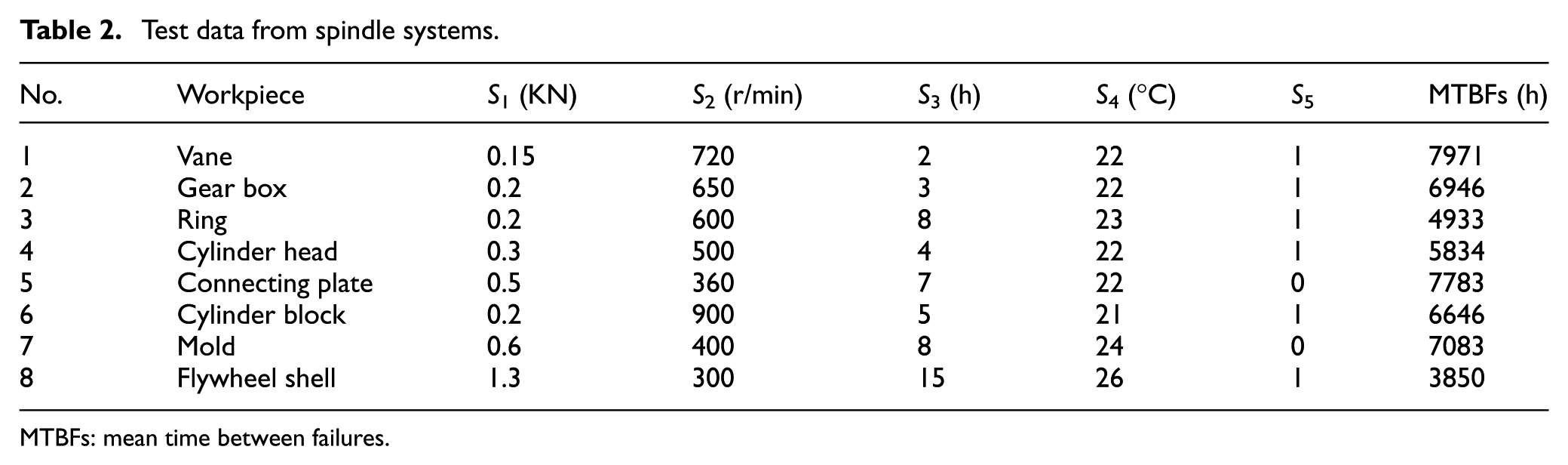
MTBFs: mean time between failures.
The linear model of stresses
The effects of stresses are assumed to be independent of each other, and the sum effects on the reliability is assumed to follow the generalized Arrhenius model as follows

The MTBF is selected as a reliability index. By least square estimation, the multiple R of regression is 0.99, and the adjusted R2 is 0.99, which means these stresses show a strong correlation with MTBFs and the stresses in equation (15) can explain 99% of MTBFs. The regression parameters are shown in Table 3.
Regression parameters of first selection.
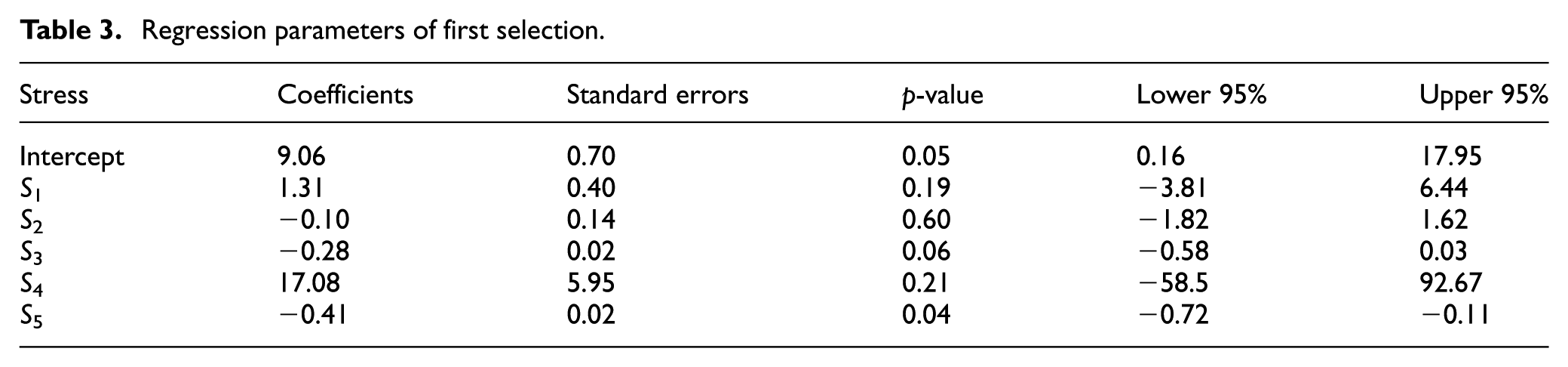
In the first Enter method in regression, the significance F is 0.06, which means the coefficients in equation (15) are not zeroes completely. 95% confidence intervals of the cutting force S1, the rotation speed S2, number of tool changing S3, environment temperature S4, and the stress interaction contain zero, and the p-values of stresses S1, S2, and S4 are greater than 0.1, while the p-value of stress S3 is less than 0.1. So the coefficient of number of tool changing S3 is not zero, and stresses S3 and S5 are significant and reserved temporarily. Then, S3 and S5 are selected by Enter method again to obtain accurate coefficients, and the results are shown in Table 4.
Regression parameters of second selection.

The significance F is 8.18E−04, and the multiple R is 0.97, which means stresses S3 and S5 show a strong correlation with MTBFs and their coefficients are not zero completely. The adjusted R2 is 0.91, so stresses S3 and S5 can explain 91% of MTBFs. The p-values of number of tool changing S3 and the use of cutting fluid S5 are lower than 0.05, which means these two stresses are significant and have great effects on reliability. The relationship between MTBFs and stresses S3 and S5 is shown as follows

Sensitivity analysis is necessary to identify stress contributions and rank significant stresses. The reliability sensitivity is defined as the partial derivatives of the reliability function to the stresses. In the log-linearized equation, the sensitivity value is equal to the coefficients of stresses exactly. From Table 4, it can be seen that contributions made by stresses S3 and S5 are close. The negative values mean the negative effect on the reliability.
The SVM model of stresses
In order to avoid the errors from different orders of magnitude in each stress, normalization has been adopted to the rotation speed S2 and environment temperature S4. As there are only eight groups of data, all five machining parameters of eight groups are used to train the SVM model adequately and provide accurate results. A threefold cross-validation on the training set is used to find out the optimal values for penalty parameters C and kernel function parameter g. First parameters C and g are selected within a large range (0.0156, 64). The results of first parameter selection are shown in Figure 2.

First parameter selection: (a) contour map of parameter selection and (b) 3D view of parameter selection.
From Figure 2, it can be seen that the best C is 2.00 and best g is 0.50, and the corresponding best cross-validation mean square error (MSE) is 0.40. So the range of parameter C can be reduced to (0.25, 4), and the range of parameter g can be reduced to (0.0625, 4). Second parameter selection is conducted within the reduced range with the step size 3, and the interval of accuracy rate is 0.1. The results are shown in Figure 3.

Second parameter selection: (a) contour map of parameter selection and (b) 3D view of parameter selection.
Figure 3 shows the best C is 1.41 and best g is 0.35, and the corresponding best cross-validation MSE is 0.39. The SVM model is trained with optimized parameters C and g, and the SVM performance and error are shown in Figure 4, compared with the results of the linear model.
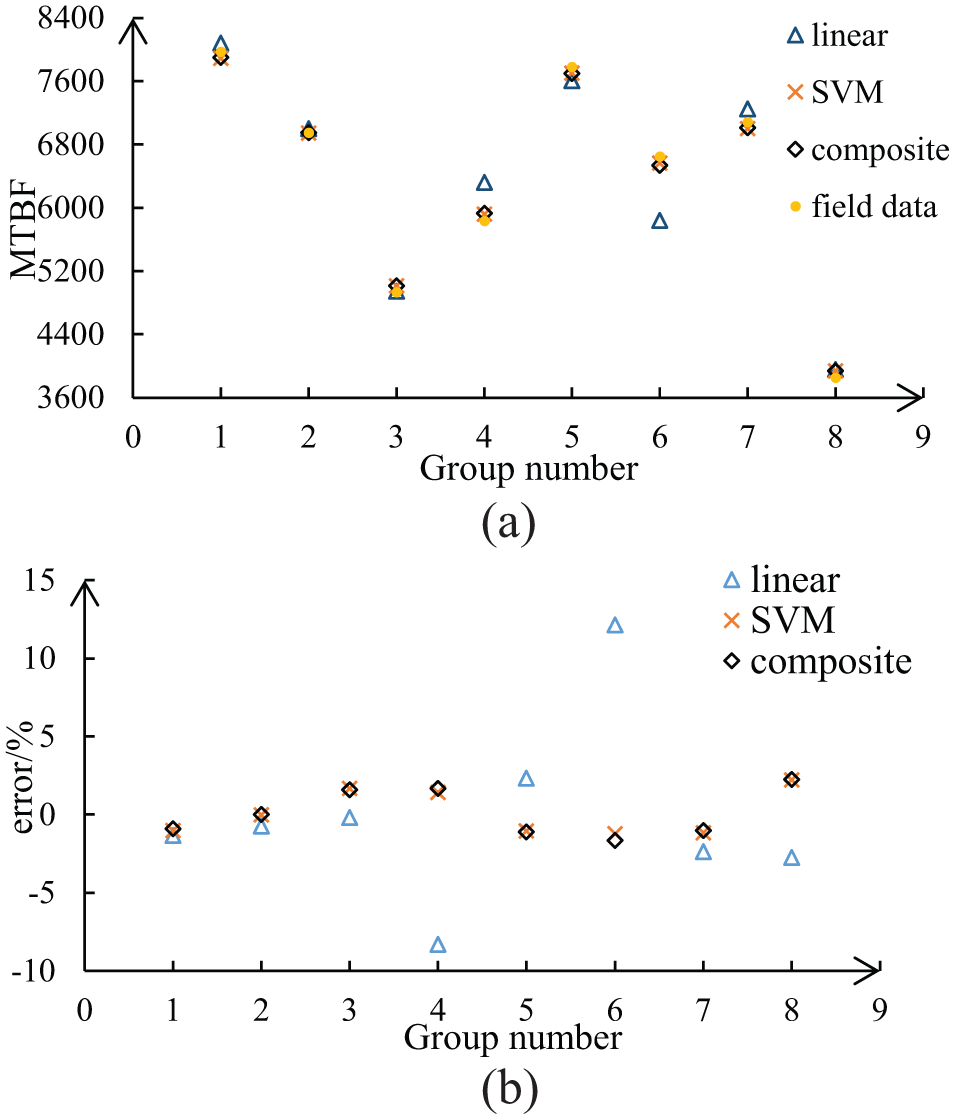
Assessment of MTBF by three models: (a) results of assessment and (b) errors of assessment.
The composite model
When the linear model and the SVM model are determined, w1 and w2 are calculated by minimizing assessment variance. In this case study, when the coefficients w1 = 0.04 and w2 = 0.96, the fitting variance is the smallest. The results of the composite model are also shown in Figure 4.
Figure 4 shows the following: (1) in Figure 4(a), the assessment results of three models are close to the MTBFs in the field, and the results from the SVM model and the composite model are more approximate to the field reliability in general; (2) in Figure 4(b), the errors of three models conform to the production requirement, which are kept within the acceptable range of the project; and (3) the errors from the composite model are medium or lowest in three models, which means the composite model proposed in this article has a good capacity of assessment.
Above all, the linear model can provide acceptable results with significant stresses: the numbers of tool changing S3 and the use of cutting fluid S5. When the failure mechanism and significant stresses are preferred, the linear model is recommended with a good description of stress effects on failures and an acceptable assessment with significant stresses. The SVM model is good at dealing with non-linear relationships and possible interactions among stresses, which is recommended with higher assessment accuracy and computing power. When the assessment accuracy and failure mechanism are taken into account, a composite model of the SVM model and linear model is more practical.
Conclusion
In this article, a novel field reliability model for spindle systems of machine tools is built by combining a linear model and an SVM model. The MTBF is selected as the field reliability index of spindle systems. The main structure and main failure modes of spindle systems are introduced. Stresses related to field reliability are determined preliminarily, including the cutting force S1, the rotation speed S2, the numbers of tool changing S3, the environment temperature S4, and the use of cutting fluid S5. The effects of non-thermal stresses are assumed to follow the inverse power relationship, while the effect of thermal stress is described by the Arrhenius equation. The linear relationship between stress effects and MTBFs is described by a linear model based on generalized Arrhenius models. The reliability sensitivity of each stress is analyzed. The non-linear, coupling relationships and other underlying influences of stresses are illustrated by the SVM model, whose parameters are selected by threefold cross-validation. The two models are integrated to a composite model for minimum assessment error with optimal combined forecasting method. A validation of the proposed model is realized by a real case study, and the assessment errors are kept within the acceptable range of the project. According to the assessment results, the applications of three models are as follows: the linear model can provide a good description of stress effects and screen significant stresses by the field data; the SVM model is good at dealing with non-linear relationship and possible interactions among stresses, which is recommended with higher assessment accuracy and computing power; a composite model of the SVM model and the linear model is more practical in engineering for its highest assessment accuracy and a clear explanation of failure mechanism.
Footnotes
Handling Editor: Zengtao Chen
Declaration of conflicting interests
The author(s) declared no potential conflicts of interest with respect to the research, authorship, and/or publication of this article.
Funding
The author(s) disclosed receipt of the following financial support for the research, authorship, and/or publication of this article: This work was supported by National Natural Science Foundation of China (Grant No. 51675227), National Natural Science Foundation of China (Grant No. 51505186), Jilin Province Excellent Researcher Foundation (Grant No. 20170520103JH), Jilin Province Science and Technology Development Funds (Grant No. 20160204006GX), and Key Research and Development Plan of Jilin Province (Grant No. 20180201007GX). Finally, the paper is supported by program for JLU Science and Technology Innovative Research Team (JLUSTIRT).
