




Abstract
A hybrid process of articulated resin transfer molding and vacuum-assisted resin infusion, called double-bag progressive compression method, has been invented to fabricate composite parts. In double-bag progressive compression method, the secondary bag is divided into several segments. During resin infusion, the double bag is drawn upward by vacuum, and the initial flow resistance offered by the loose preform is low. Once the resin infusion is completed, the vacuum on the segmented bags is progressively released to ambient pressure, and the segmental compression is sequentially performed until unnecessary resin is completely removed. This research is to experimentally investigate the influence of double-bag progressive compression method processing parameters, including vacuum pressure in the cavity, number of segments, initiating time of the next compression, temperature of the heated air, initiating segment of the heated air, initial height of the mold cavity, and excess infused resin, on the mechanical property of the part. The design of experiments adopts Taguchi’s method. Results show that the double-bag progressive compression method significantly reduces total filling time and maximally increases the flexural modulus of the part by 17.81% as compared with the typical vacuum-assisted resin infusion. A preferable parameter condition is proposed by taking both the flexural modulus and the operation complexity into account.
Keywords
Introduction
Polymer composites have been broadly applied to automobile and aerospace components as a result of their low weight, high mechanical strength, and good resistance to corrosion. Liquid composite molding (LCM) is an important process for manufacturing high-quality composite components. Both resin transfer molding (RTM) and compression resin transfer molding (CRTM) are familiar LCM processes. In the processes, a fiber preform is preplaced within a set of rigid molds. Thermosetting resin is then injected into the cavity where resin saturates the fabrics. Once the filling process is finished, resin cures and binds the fibers into a solid composite. A main difference between RTM and CRTM is that a partial closed mold is employed in CRTM, and the loose preform is thus present. After the completion of resin injection, the mobile mold compacts the preform and drives the resin through the remaining dry preform.
In the last few decades, many researchers have investigated the mechanical performance of polymer composites. They reported that the presence of voids and poor wetting had severe adverse influences on the mechanical properties in terms of longitudinal tensile strength, transverse tensile strength, and inter-laminar shear strength.1–4 For the sake of reducing the void formation, the common method is applying vacuum during the filling process. Hayward and Harris 5 found the significant improvements in the void content and in the mechanical performance for RTM components manufactured with vacuum assistance. In addition, the non-uniform resin flow provides the potential for mechanical entrapment of air as a result of the intra-tow permeability being much less than the inter-tow one.6–10 Kaynak et al. 11 reported that the application of vacuum, an intermediate mold temperature and an increase in the initial resin temperature could attain high mechanical properties of RTM components. Wu and Pan 12 analyzed the unidirectional flow and radial flow in injection/compression LCM and conducted a three-point bending test for the parts. They pointed out that injection/compression LCM could not only reduce the injection pressure but also can improve the part quality. Chang et al. 13 discussed the influence of mold opening distance, injection pressure, compression pressure, preheated mold temperature, resin temperature, and cure temperature on the ultimate strength of CRTM parts and found that using a low compression pressure and high resin temperature were significant methods for improvements in the mechanical properties of the part. Aurrekoetxea et al. 14 investigated the impact behavior of carbon fiber/epoxy composites made by vacuum-assisted CRTM and showed that a 30.25-J penetration energy threshold was deduced from the energy plot.
Another popular LCM process is the vacuum-assisted resin infusion (VARI), also known as the vacuum-assisted resin transfer molding (VARTM), where a flexible vacuum bag replaces one side of the mold in RTM/CRTM. When vacuum is drawn in the cavity, the resin is driven into the compressed preform. Once the preform is totally saturated, the resin inlet is sealed while unnecessary resin is forced to flow out of the cavity through the vacuum vent, called post-filling stage, in order to achieve the uniform part thickness. Some research was available concerning the properties of composites made from polyester resin and glass fiber by VARI.15–18 Tekalur et al. 15 reported that the E-glass fiber composite had continuous damage progression when subjected to shock blast loading; various failure modes were observed such as permanent deformation, fiber breakage, and delamination. Lee et al. 16 employed Taguchi’s method and an axiomatic design to study the optimizing process for glass fiber–reinforced plastic parts, and the optimal conditions were deduced. Rodriguez et al. 17 compared the characterization of composites based on natural and glass fibers and reported that natural fiber composites, with 30% volume of fiber content, had lower mechanical properties than glass fibers composites. Agarwal et al. 18 investigated the effect of structure on mechanical properties of vinyl ester resins and their glass fiber–reinforced composites and found that with increase in bridge length, mechanical properties decreased significantly; however, with increase in the number of methylene groups in the order 2–8, there was increase in the tensile strength and flexural strength. Shivakumar et al. 19 described the processing of the composites reinforced with carbon and glass fibers and then compared the specific properties of these composites. They reported that the glass composites had higher specific strength but lower specific modulus than marine steel. Cecen and Sarikanat 20 investigated the anisotropy of glass fabric and polyester composites and discussed the effects of directions of fiber orientation on the strength of laminates fabricated with chopped strand mat and woven roving fabric. They pointed out that the direction of the fibers played a decisive role in the inter-laminar shear strengths for the case of woven fabric laminates. Kedari et al. 21 investigated the influences of mold temperature, inlet pressure, and vent pressure on the void formation for polyester/E-glass fiber composites and found that using high mold temperature, high vacuum, and appropriately reduced inlet pressure could produce a VARTM part with high fiber volume fraction and low void content.
In VARI, resin infusion process is relatively long because the maximum infusion pressure is only one atmospheric pressure and the flow resistance offered by compressed preform is high. Some variants of the process have been employed to reduce the filling process. Two common methods are the Seemans’ resin injection molding process, where a distribution medium is placed on the preform as a flow enhancement, and “channel in the core” method in which the channels cut into the core of the sandwich accelerate resin flow.22,23 Some methods are to create resin distribution channels by vacuum pulling the bag upward such as the fast remotely actuated channels system 24 , flow flooding chamber method 25 , vacuum-assisted CRTM, 26 progressive compression method, 27 and so on. Heider et al. 28 developed an infusion methodology where the distribution media were placed on both sides of the preform and the inter-laminar flow media were integrated into the preform. Chang and Li 29 placed several air cushions beneath a vacuum bag and then created the resin channels between air cushions when the cavity is evacuated.
This study explores a compression method of resin delivery, called double-bag progressive compression method (DBPCM), which can be regarded as a variation of the articulated RTM. 30 This process shares the concept with the fixed rigid mold like RTM, double-bag, 24 non-isothermal filling, 27 and segmented compression. 30 Figure 1 illustrates the resin progression for a case of three-segment compression DBPCM. The secondary bag is divided into two segments and every segment can be controlled individually. During resin infusion, the secondary and primary bags are lifted by vacuum utilized in between the bags and the upper mold. Resin easily flows into the loose fabrics as shown in Figure 1(a). Once the prescribed quantity of resin is infused, the resin inlet is closed. The vacuum on the segmented bags is progressively released to ambient pressure allowing the inflated bags to compact the wetted preform. The sequential inflation of the segmented bag squeezes the surplus resin from the wetted preform and forces the resin through the loose dry preform, as shown in Figure 1(b) and (c). The heated air is inhaled on the primary bag to force resin to completely fill the preform and then remove the unnecessary resin for achieving uniform part thickness, as shown in Figure 1(d). In a practical application, the heated air can be initiated at any segment for adjusting heated resin time and reducing the filling process.

Schematic diagram of DBPCM: (a) resin infusion, (b) the first segmented compression, (c) the second segmented compression, and (d) the last compression.
In this work, an experimental study of the mechanical properties of unsaturated polyester/E-glass fiber composites fabricated by DBPCM is presented. In spite of a large number of investigations on LCM, the processing parameters are much complicated and interrelated in DBPCM. The major factors, including vacuum pressure in the cavity, number of segments, initiating time of the next compression, temperature of the heated air, initiating timing of the heated air, initial height of the cavity, volume of infused resin, resin/fiber properties, and mold geometry, may affect the qualities of the DBPCM parts. The resin/fiber properties and mold factor are excluded so as to correctly evaluate the effect of chosen processing parameters on the component qualities in this study. The flexural modulus of the part measured by a three-point bending test serves as an indicator of the component quality. The design of experiments adopts Taguchi’s method. 31 An experiment of typical VARI is also performed for comparison purposes.
Experimental study
Materials and equipment
Resin system used the commercial unsaturated polyester resin (Eternal Chemical, 2597PT-6) including 0.5% of the catalyst. Resin and hardener (MEKPO) were mixed in a weight ratio of 100:1 before resin infusion. The resin viscosity in room temperature was 0.6 Pa s. In the work, the manufacture of composite laminate with high–fiber volume fraction and the comprehension of the resin infiltration into small interstices within fiber bundles were attempted. Thus, the preform was made of four plies of the E-glass woven roving with high areal density (Taiwanglass, TGFW-600), which possessed the equal permeability in the main directions, that is, machine direction and cross direction. The mass of the fabric per unit area was 0.6 kg/m2.
The mold was composed of a lower mold, two flexible bags, and an upper mold. The bags were made of polyethylene, while the lower mold and upper mold were made of aluminum AL-5083. A rectangular cavity was cut within the lower mold, and the dimensions were 0.28 m × 0.15 m. The resin inlet and one vent were located on both sides of the mold cavity, respectively.
For the sake of segmental compression, the upper mold and the bags were designed as shown in Figure 2. The boundary of the first segment was determined by volume of infused resin. For three-segment compression, the other boundary was set to the middle position of the remaining cavity. In order to enhance circulation of the heated air, two hot air inlets and one air outlet were constructed by drilling holes about 6 mm in diameter on the upper mold for each segment. The air flow was supplied by air compressor, which was adjusted by pressure regulating valve and flow control valve. The compressor pressure was set to 10 kPa higher than the ambient pressure, and the velocity of the air outflow was about 4.24 m/s by measurement of the flow rate.
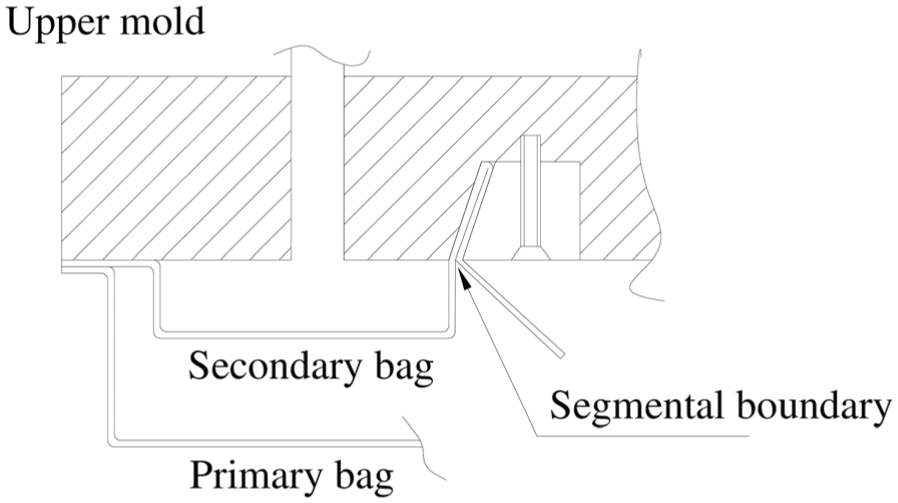
Upper mold and double-bag.
Figure 3 shows the experimental equipment schematically. Once the setup was assembled, the double-bag was lifted by vacuum employed in between the bags and the upper mold. The vacuum was then applied in the cavity and the resin was driven into the preform. The approximately unidirectional resin flow was expected by creating a gap of 0.01 m between the three resin inlets and the preform. Once the predetermined amount of the resin was infused, the resin inlets were sealed, and the vacuum on the segmented bags was progressively released to ambient pressure, allowing the inflated bags to compact the wetted preform. The sequential inflation of the segmented bag was to squeeze the surplus resin from the wetted preform and drive the resin through the loose dry preform. When the last compression was initiated, the primary bag could totally compact the preform and the unnecessary resin was then removed from the cavity.

Experimental setup.
As VARI, the excess infused resin is essential due to the bag flexibility. In the work, the duration of draining the unnecessary resin was estimated by visually inspecting the draining resin volume in transparent tube connected to between the vacuum vent and the vacuum pot. After the completion of the filling process, the composite component was cured in room temperature for 3–4 h.
Mechanical testing
To investigate the mechanical property of the molded part, three-point bending tests were conducted for both VARI and DBPCM samples. The fiber volume fraction of the parts was different resulting by applying various vacuum pressures and imprecise post-filling stage by visual inspection. Hence, the flexural modulus was chosen as an indicator of the part quality to evaluate the effect of various fabrication conditions. Test strips were cut from flat samples and the dimensions were according to ASTM D790. The locations and dimensions of the test strips are shown in Figure 4.

Locations and dimensions of the test strips.
Taguchi’s method
In this work, the authors chose seven important processing parameters that may affect the qualities of the DBPCM parts. All variables and their two levels are listed in Table 1. These factor levels defined the interesting regions of the parameters. Notice that factor A adopts the absolute pressure, that is, zero pressure denotes the absolute vacuum. Number of segments includes the primary bag compression for factor B. Two conditions of the preform states are considered for factor F. One is that the loose preform can fully occupy the mold cavity at low level and the resin flows directly through the preform. The other is that a gap exists between the preform and the bag at high level, and the resin flows above and then is pushed through the preform.
Factors and factor levels selected in the matrix experiment.

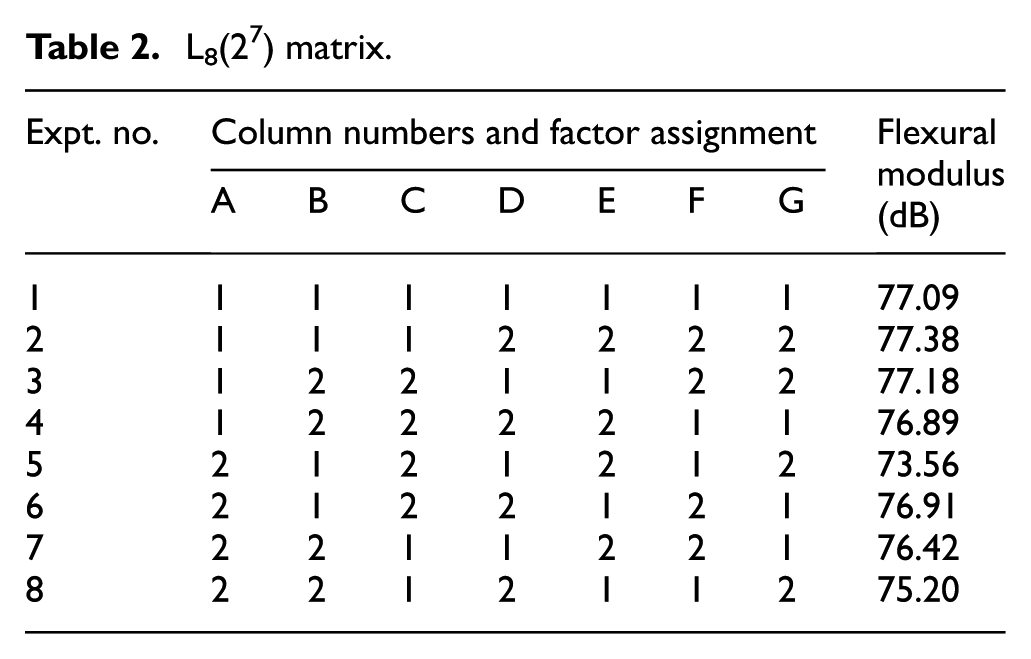
By calculating the degrees of freedom (DF) of all factors, the L8(27) standard matrix is applicable and given in Table 2. It consists of eight individual experiments corresponding to eight rows.
L8(27) matrix.
The objective in the composite project is to maximize the flexural modulus of the sample. For a description of the “larger the better” characteristic, a signal-to-noise (S/N) ratio, also denoted by

where n is the number of samples and xi represents the flexural modulus of the sample in experiment i. The S/N ratio can depict the measured quality characteristics deviating from the desired values. The measured flexural modulus is compiled in decibel (dB) according to equation (1).
Analysis of variance (ANOVA) is a collection of statistical models utilized to analyze the differences among group means and their associated procedures in a sample. Taguchi’s method can also conduct the ANOVA to evaluate the relative contribution of each factor to overall response. It can typically utilize the equation as follows

where m is the average of the eight values of
The goal of maximizing flexural modulus is equivalent to maximizing

Finally, verification experiments are conducted with the predicted optimal variable conditions. By comparing the measured value of
Results and discussion
In this work, seven important processing parameters were chosen to investigate the influence on the quality of the DBPCM part. For simplification, the material and mold factor were excluded and all rectangular samples were made from four plies of TGFW-600 mats and unsaturated polyester resin. The fiber volume fraction of the sample was 0.45 ± 0.04.
Table 3 lists the average
ANOVA table.

DF: degree of freedom; SS: sum of squares; MS: mean square; R: variance ratio.
Is the optimum level; **Indicates sum of squares added to estimate the pooled error sum of squares indicated by parentheses.
According to the “larger the better” characteristic, the predicted optimum settings are A1B2C1D2E1F2G1 by analyzing the S/N values in Table 3. Namely, the optimum conditions are a high vacuum pressure, three-segment compression, premature initiation of the next compression, hot air initiated at the first segment, high thickness of the initial cavity, and low excess resin. This is because a high vacuum reduces the entrapped air as discussed in previously published papers,6–9 and the multi-segment compression is expected to be helpful for removal of the voids. 30 The premature initiation of the next compression and hot air initiated at the first segment can increase the heated resin time and resin viscosity is thus reduced. The loose dry preform reduces the flow resistance when a high thickness of the initial cavity is used. 13 These conditions are helpful for the resin penetration into the interstices of the preform. Excess infused resin degrades the composite performance because resin may be incompletely degassed.
After the optimum parameter conditions were determined, the predicted response under these conditions could be calculated by equation (3). Then, authors conducted verification experiments using the optimum conditions and compared the measured value of η with the prediction. The predicted
The DBPCM part under the optimum conditions has the flexural modulus of 7.84 GPa and total filling time of 444 s, including post-filling stage; contrarily, that under the worse settings has the flexural modulus of 4.77 GPa and total filling time of 887 s. The typical VARI part has the flexural modulus of 6.66 GPa and total filling time of 1238 s. Although factor interactions exist, the DBPCM under the optimum conditions increases the flexural modulus of the part by 17.81% and reduces at least half of total filling time as compared with the typical VARI. In addition, the surface finish of DBPCM part is almost identical to that of VARI by human visual observation. However, the operation of the three-segment compression in DBPCM is complicated, and the boundary of the second segment is not easy to be precisely determined. The quality loss function can be used to make the necessary trade-offs. By changing from B2 to B1,
The surface of composite section was observed by scanning electron microscope (SEM). Figure 5 shows the SEM images of the fracture sample in machine direction and cross direction. No distinct voids were found in the images but the debonding between the fibers and matrix was observed in cross direction maybe due to poor interfacial adhesion.

Images of the fracture sample in (a) machine direction and (b) cross direction.
Conclusion
The purpose of this article was to investigate the influence of seven processing parameters on the mechanical performance of the DBPCM part by applying Taguchi’s method. These factors included vacuum pressure, number of segments, initiating time of the next compression, temperature of the heated air, initiating segment of the heated air, initial height of the mold cavity, and volume of infused resin. Experimental results show that the optimum settings are A1B2C1D2E1F2G1 for the flexural modulus of the part and the factor interactions exist. Even so, the optimal DBPCM increases the flexural modulus by 17.81% and reduces over half of total filling time as compared with VARI. The preferable DBPCM settings are A1B1C1D2E1F2G1 by taking both the flexural modulus and the operation complexity into account. Through observation of the surface of the composite section, no distinct voids are found but the debonding between the fibers and matrix are observed.
Although the functionality of the DBPCM is verified, the investment cost of the DBPCM mold is expensive particularly for a complex mold. In the work, the investment cost in DBPCM is roughly three times more than that in VARI.
Footnotes
Handling Editor: Daxu Zhang
Declaration of conflicting interests
The author(s) declared no potential conflicts of interest with respect to the research, authorship, and/or publication of this article.
Funding
The author(s) disclosed receipt of the following financial support for the research, authorship, and/or publication of this article: The study was performed by the financial support of the Ministry of Science and Technology of Republic of China under grant [MOST 105-2221-E-244-006].
