




Abstract
Mine disasters often happen unpredictably and it is necessary to find an effective deformation forecasting method. A model between deformation data and the factors data that affected deformation is built in this study. The factors contain hydro-geological factors and meteorological factors. Their relationship presents a complex nonlinear relationship which cannot be solved by ordinary methods such as multiple linear regression. With the development of artificial intelligence algorithm, Artificial Neural Network, Support Vector Machine, and Extreme Learning Machine come to the fore. Support Vector Machine could establish a deformation prediction model perfectly in the condition that there is less input data and output data. The deformation forecast model that uses quantum-behaved particle swarm optimization algorithm is selected to optimize the Support Vector Machine. The optimum configuration of Support Vector Machine model needs to be determined by two parameters, that is, normalized mean square error and correlation coefficient (R). Quantum-behaved particle swarm optimization could determine the optimal parameter values by minimizing normalized mean square error. It investigates the application effect of the proposed quantum-behaved particle swarm optimization–Support Vector Machine model by comparing their performances of popular forecasting models, such as Support Vector Machine, GA-Support Vector Machine, and particle swarm optimization–Support Vector Machine models. The results show that the proposed model has better performances in mine slope surface deformation and is superior to its rivals.
Keywords
Introduction
Mine slope deformation monitoring and prediction are very important for mine safety management and decision-making. Mine slope disaster predictions are extremely difficult because there are many kinds of disasters and disastrous mechanisms. However, mine slope deformation forecast can analyze the extent of the disaster by small deformation changes and is easy to predict. 1 By consulting literature and field research, the deformation forecast considers that various factors such as geologic structure, hydro-geology, and atmosphere are relatively few at present. 2
As a kind of natural geological disasters, landslide has caused huge loss of lives and properties. The landslide hazard has become the second damaging natural disaster after earthquake hazard. 3 It is necessary to predict the deformation of the high-risk monitoring area in order to avoid or reduce the occurrence risk of disasters. 4 The suitable prediction model of monitoring area is the kernel of the landslide prediction research. Because of the complexity of the landslide hazard, various prediction models have their own superiorities and inferiorities. 5
Landslide forecast empirical formula was first proposed by the Japanese scholar Zhaiteng in 1960s. 6 During the landslide prediction research period, many national and international experts have continuously presented a variety of landslide forecast theoretical models and methods. Summarizing the prediction model and the proposed method from domestic and international, they can be divided into the following three categories: determinacy forecast models, statistical forecast models, and nonlinearity forecast models. 7
The representative methods of the determinacy forecast models are Zhaitengdixiao model, Hock method, K·Kawawura method, Su aijun method, and Fu you slope time prediction method. These methods are applied to predict the slope during the accelerated creep stage. 8 The deterministic model is quantizing various landslide and environmental parameters utilizing rigorous analysis methods especially the mathematical and physical methods. This kind of prediction models reflect the physical substance of the landslide and are suitable for the monomer landslide prediction. 9 However, this prediction method has larger deviation so that it reduces the prediction veracity. 10
The statistical forecast models contains GM (1, 1) model, pearl model, Verhulst model, Verhulst inverse function model, curve regression analysis model, multivariate nonlinear correlation analysis, exponential smoothing, Kalman filtering method, time series forecasting model, Markov chain prediction model, fuzzy mathematical method, Poisson cycle method, GM DH forecast model, and so on. 11 They are all applied to predicting the medium- and long-term landslide prediction except for the GM (1, 1) model. The statistical prediction model mainly utilizes various statistical methods and theoretical models. The methods survey and analyze the relation between existing landslide, geological environment, and other external factors. These methods have relation to the number of monitoring data and time series data. Comparing to the deformation prediction of the mine slope, this kind of method is more suitable for the macroscopic decision-making about the territorial development and regional land use.
With the development of nonlinear science and its wide application in various fields, slope deformation prediction is a complex system which studies gray and white, certainty and randomness, gradual change and sudden change, equilibrium and non-equilibrium, and ordered and unordered. The neural network prediction model, collaborative forecasting model, and catastrophe theory forecast model belong to the nonlinearity forecast models. They have advantages in terms of short-term landslide forecasting. They also have the highest accuracy than any other methods. 12
The artificial intelligence method is used to apply in the practical prediction of slope deformation of mine. The collected data, that is, meteorological factors, hydro-geological factors, and deformation monitoring data, are taken into account in the proposed model. 13 Support Vector Machine (SVM) method established the nonlinear mapping relationship between deformation values and other deformation factor values at the same time. In addition, the quantum-behaved particle swarm optimization (QPSO) algorithm is applied to optimize the SVM to enhance the forecasting performance. 14
The proposed algorithm and research method
QPSO-SVM and its optimization
As a kind of new machine learning algorithm, SVM is widely used in data classification and regression analysis.
15
First, it briefly introduces the regression analysis principle of SVM.

Subjected to

Through the function
Through a combination of the quantum system and traditional PSO, QPSO was created and applied for the engineering application.
17
The state of a particle with momentum and energy can be depicted by its wave function

where

where

where parameter

Keeping in view the vital position of L for convergence rate and performance of the algorithm, an improvement was proposed to evaluate parameter L. The mean best position (mbest) is defined as the center of pbest positions of the swarm. The computational formula of the mbest is

In the common SVM model,
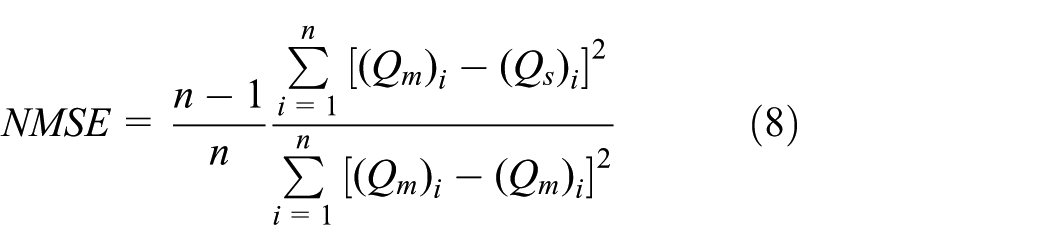
In the above formula, Q represents the streamflow value,
The proposed forecasting approach
In the previous studies, many works on the deformation prediction model have been done in recent years. Various kinds of artificial intelligence algorithms are used to predict mine slope deformation based on the meteorological data, such as Artificial Neural Network (ANN), 22 GRNN, 23 and Extreme Learning Machine (ELM). 24 In the study of deformation prediction model, input factors selection and method of building ontology model are two keys. Hence, more suitable factors influencing the deformation of mine slope, more faster, and more accurate prediction model should be selected. So, it could get more satisfactory predictive ability.
The selection of influencing factors
Input factors mainly include meteorological data acquired by meteorological station in the previous studies. However, the influencing factors of the mine slope deformation are multitudinous and complicated. The artificial mining activities within the mining area, meteorological environment, and groundwater under the mining area are three important factors which most likely lead to the deformation of the mine slope. The artificial mining activities influencing factors are too complex and difficult to collect data. Hence, in order to eliminate the influence of blasting and mining on deformation, first, study period when there are no perforation, blasting, rock discharge, and other mining activities is selected. Second, the meteorological data contain the cumulative rainfall, relative humidity, refractive index, temperature, and atmospheric pressure influencing factors as before. Third, the slope deformation is seriously affected by the groundwater condition under the mine slope. Hence, the groundwater temperature and the groundwater level height into the input of the prediction model are added. Finally, the hydro-geological factors and meteorological factors as the input are selected and collected. The deformation value collected by ground-based synthetic aperture radar (GB-SAR) is taken as the output of the model. These two deformation factors are used to predict the mine slope deformation.
The selection of prediction model
The forecasting model selection is also very important for convergence time and prediction accuracy. ANN, 22 GRNN, 23 and ELM 24 were used to study and build prediction models. However, each method has its disadvantages. ANN has strong ability of self-study and promotion, and it has a slow convergence rate. ELM has the same network structure as single hidden layer back propagation (BP) network; it is just that the weights of the connections between their internal neurons are calculated differently. It has fast convergence speed and inferior prediction accuracy compared with SVM. It is often used to solve rapid learning problems of large samples. SVM algorithm is simple and has good robustness which is more suitable for small sample learning. In this research, fewer data samples needed analysis. Hence, accuracy and robustness of the prediction model were key points and SVM is selected to build deformation prediction model selection in this study.
In order to improve the prediction accuracy and convergence speed of SVM, the value of NMSE and correlation coefficient (R) are the key points. It is very important to select an appropriate and efficient optimization algorithm. Genetic algorithm (GA) is a metaheuristic inspired by the process of natural selection. GA are commonly used to generate high-quality solutions to optimization and search problems by relying on bio-inspired operators such as mutation, crossover and selection. Through the comparison of GA, PSO, and QPSO, the QPSO is selected as the optimization algorithm finally. PSO and GA are two similar approaches, and they have many commonalities: (1) both randomly initialize the population, (2) both use adaptive values to evaluate the system, (3) both are randomly searched according to the fitness values, and (4) neither system is guaranteed to get an optimal solution. PSO and GA have several differences: (1) PSO has no genetic manipulation such as crossover and mutation and it determines search action based on the speed of particle and the particle has the memory ability. (2) Information sharing is different. In GA algorithm, chromosomes share information with each other, and the whole population is moving uniformly to the optimal region. In PSO algorithm, gBest (or IBest) give information to other particles and it is a one-way flow of information. The entire search update followed the process of the current optimal solution. Compared with GA, in most cases, all particles may converge to the optimal solution faster. The biggest weakness of PSO is the phenomenon of premature convergence and poor ability of partial search when dealing with multi-peak function optimization problems. This is because the convergence of particles is in orbit, and the particle’s velocity is always limited. The particle search space is a limited area in the search process, and it cannot cover the whole feasible space. There is no guarantee that a certain search will yield a global optimal solution. QPSO algorithm model is proposed based on PSO from the point of view of quantum mechanics, and it studied the convergence behavior of particles. In this algorithm, the properties of particles satisfying aggregation state are completely different and particles are searched in the whole feasible solution space to find the global optimal solution. QPSO is far superior to all developed PSO algorithms in search capability. Therefore, in the study on the prediction model of deformation, the performance of QPSO-SVM model is better than SVM, GA-SVM, and PSO-SVM models. In conclusion, it selected the QPSO-SVM prediction model and the above influencing factors. Figure 1 shows the concrete prediction processes.
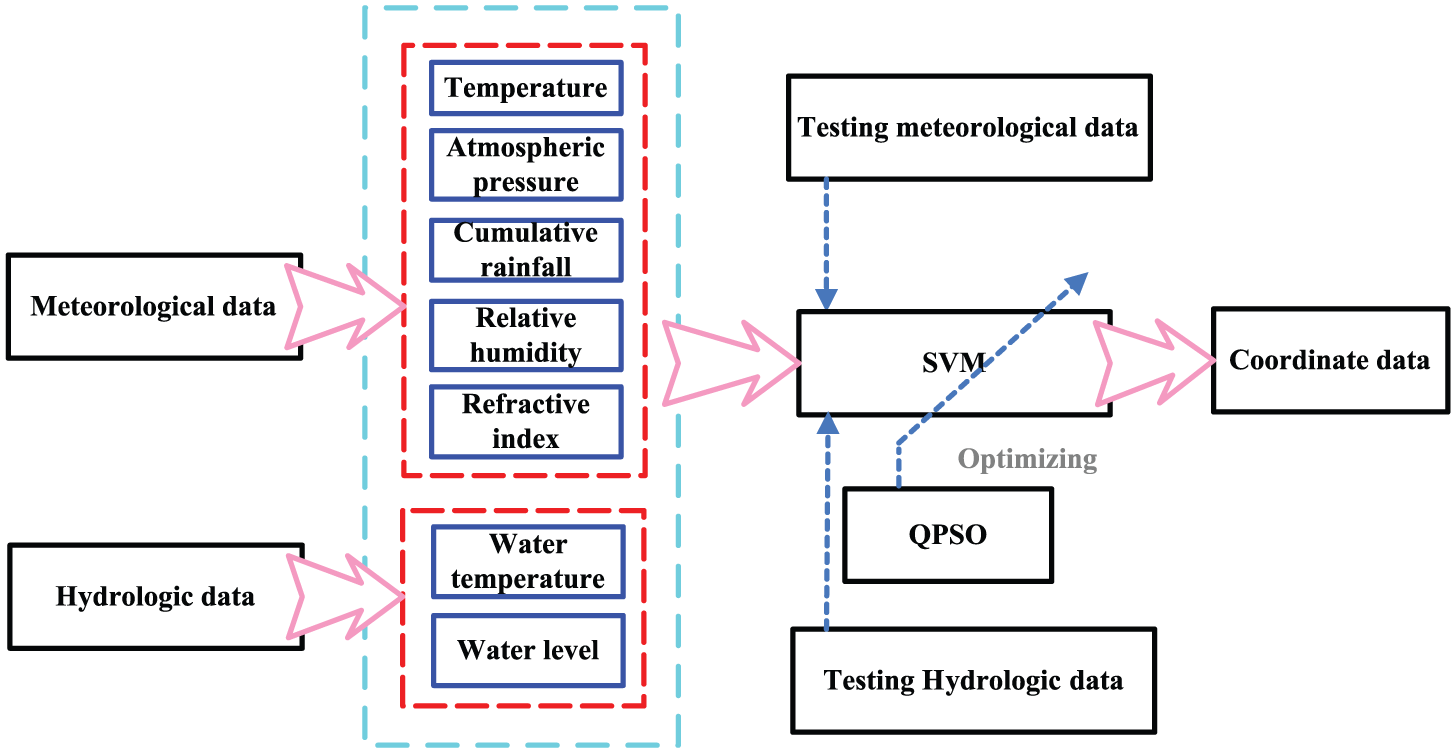
The diagram of the QPSO-SVM prediction model.
Deformation mechanism
The comprehensive observation data contain the meteorological data and the hydrologic data. The meteorological data are collected by the meteorological sensors installed on the GB-SAR. The multi-functional high-precision weather station WXT510 could collect following parameters, that is, cumulative rainfall, refractive index, temperature, relative humidity, and atmospheric pressure. The hydrologic data are collected by the hydrologic sensors installed on the underground of the Anjialing mines. The hydrologic data include the groundwater temperature data and the groundwater level data.
There are many influenced factors that can lead to the slope deformation and even landslide. Among the factors, the geomorphology, geological structure, engineering geology, hydro-geological condition, the composition, and the architectural feature of the slope are the internal factors leading to the unstability of slope. 25 The meteorological factors, rainfall, scour, the change of underground water level, weathering, and physical and chemical reactions are the external factors leading to the possible landslide. In our study area, the composition material of the mine slope is homogeneous cohesive soil. The geological disaster such as collapse, landslide, and debris flow is closely associated with the water. 26
The steady research of the slope is a complex problem and the influenced factors include several aspects. The physical and mechanical properties of the slope body, shape and size of the slope body, and reinforcement measure belong to the internal factors. The meteorological data and the hydrologic data belong to the external factors. Among them, water is one of the most important contributing factors of the slope landslide. The rainfall factor in the meteorological factors and the groundwater level and temperature in the hydrologic factors are two important parameters. Generally speaking, the influence of water on the slope is mainly the following two aspects: one aspect is increasing the shear stress of the slope soil and the other is decreasing the shear strength of the slope soil. 27
Two important hydro-geological influence factors of the condition for the stability of the mine slope are groundwater level and the groundwater temperature. Under the condition of the lower groundwater level, vibration from the large-scale production activities and other disturbance could increase the pressure of the interstitial hydraulic and lead to the storage effect. The continuous increasing of the interstitial hydraulic pressure could lead to the accumulative displacement of the slope. When the displacement value reaches to critical threshold, the slope is prone to instability. Alternatively, the pressure of the pore water is difficult to accumulate and has little influence to the dynamic stability of side slope. The groundwater temperature also influences the stability of the mine slope. In the process of the seepage, a hydrodynamic pressure of the geotechnical particles is applied by the groundwater. The hydrodynamic pressure is a body force; the force size is connected with the volume, volume-weight, and hydraulic gradient of the water; and the force direction is the same as the flow direction. 28
Experimental setup and tests
In this experiment, deformation, hydro-geological, and meteorological factors data should be collected by GB-SAR, hydrologic monitoring instrument, and meteorological station. The data collection experiment began on 23 July and ended on 29 July 2017. The experiment test area was determined on the China Coal Pingshuo Group Co., Ltd. In these experiments, deformation data of the mine slope were collected by secondary surveillance radar (SSR), hydro-geological data were collected by hydrologic monitoring instrument, and the meteorological data were collected by meteorological station. The hydro-geological data contain the groundwater temperature and the groundwater level height; the meteorological data contain the cumulative rainfall, relative humidity, refractive index, temperature, and atmospheric pressure; and the deformation data include east, north, and elevation coordinates. After data collection, the collected data were used to establish a nonlinear model to forecast the deformation of the mine slope.
Figure 2 shows the data acquisition experiment test area with several mining platforms in the mine slope. The SSR was installed at the stable bedrock which was on the other side of the mining platform. The SSR could collect deformation data of the entire mine slope. The max deformation monitor distance of the experiment is 2.3 km, and it was in rated distance scope 4 km.

The overview of the monitoring area in the experiments.
The automatic meteorological station (WXT510) was responsible for collecting the meteorological data in the mining area. Figure 3 shows the structure of the WXT510. It could collect six weather parameters, that is, precipitation, temperature, relative humidity, wind speed, wind direction, and atmospheric pressure. The collected meteorological information can be used as the input of the SVM.
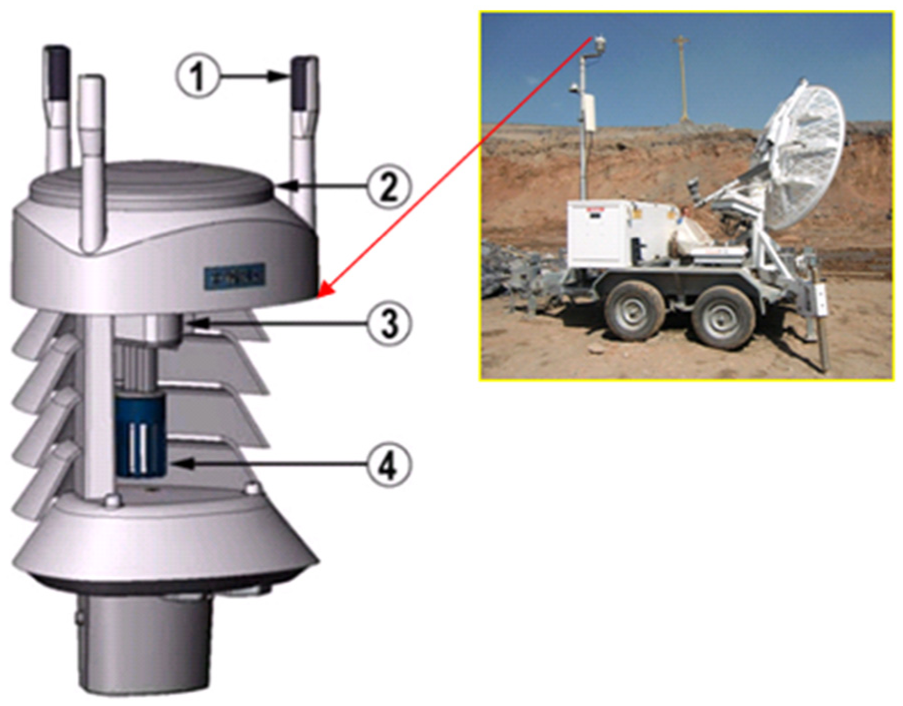
The cutaway view of the WXT510.
The groundwater temperature and the groundwater level height data were collected by underground water temperature sensor and underground water level sensors which were distributed in 56 groundwater information test points. The collected hydro-geology information can be used as the input of the SVM.
In addition, the deformation information was collected by deformation scanning module of the SSR. It could collect the deformation information of overall mine slope in all weather operations. The collected deformation information can be used as the output of the SVM.
Results
In this experiment, four kinds of different modeling methods were used, that is, SVM, GA-SVM, PSO-SVM, and QPSO-SVM. Figure 4 shows the comparison of the prediction values of four methods. From the comparisons results, it can be seen that QPSO-SVM has the higher prediction precision than other models. In addition, QPSO-SVM has smaller prediction error than other models. From the prediction results comparison between SVM and other models, it can be seen that the GA, PSO, and QPSO optimization algorithm are necessary in improving network structure parameters. From the prediction results comparison among GA-SVM, PSO-SVM, and QPSO-SVM, it can be seen that the QPSO optimization algorithm has stronger parameter searching ability. So, the deformation prediction effect of QPSO-SVM is superior to other models.

Comparison of (a) forecast results and (b) forecast error.
Figure 5 shows the behavior comparison of the convergence process between PSO and QPSO. At the beginning of the convergence process, SVM acquired a higher mean square error. In order to obtain a more accurate prediction effect, PSO and QPSO are used to optimize the network structure parameters to improve prediction ability of the SVM. PSO-SVM showed the lowest mean square error after about 28 steps of iteration calculation and QPSO-SVM showed the lowest mean square error after about 5 steps. Hence, QPSO could help the SVM show the lowest mean square error in a shorter time and has faster forecasting speed. QPSO optimization algorithm could be used in some practical engineering applications with high demand for convergence speed.

(a) PSO optimization convergence curve and (b) QPSO optimization convergence curve.
Tables 1 and 2 list the prediction value and the prediction error using above prediction methods. From the prediction value comparison between the prediction data and the real value, it can be seen that the QPSO-SVM is the best prediction model in mine slope surface deformation prediction.
Prediction value comparison using diverse methods.

SVM: Support Vector Machine; PSO: particle swarm optimization; QPSO: quantum-behaved particle swarm optimization.
Prediction error using diverse methods.
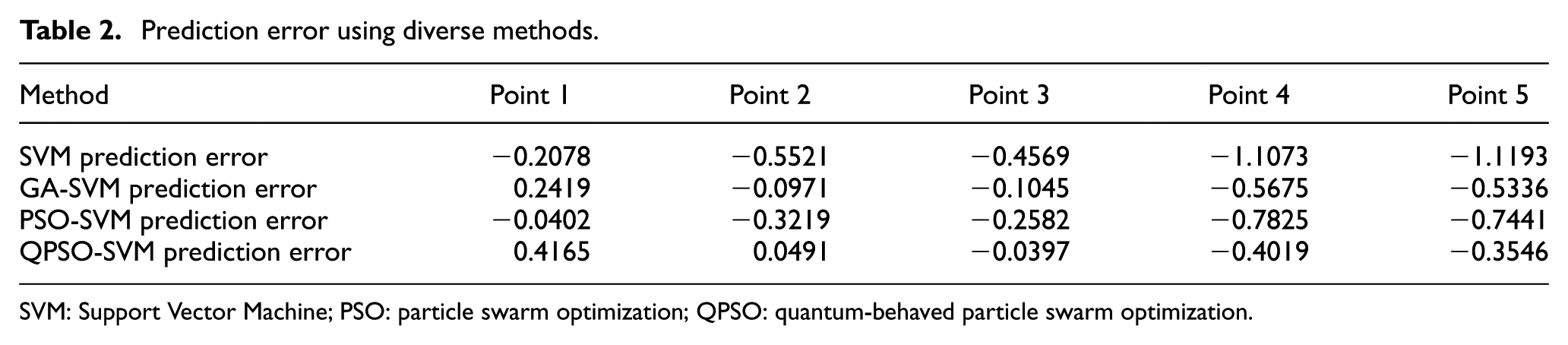
SVM: Support Vector Machine; PSO: particle swarm optimization; QPSO: quantum-behaved particle swarm optimization.
Table 3 shows the prediction accuracy index using SVM, PSO-SVM, GA-SVM, and QPSO-SVM. The index of prediction accuracy is mainly included mean absolute error (MAE), mean absolute percentage error (MAPE), and root-mean-square error (RMSE). It can be seen that QPSO-SVM algorithm has better performance than other models.
MAE, MAPE, and RMSE using diverse methods.
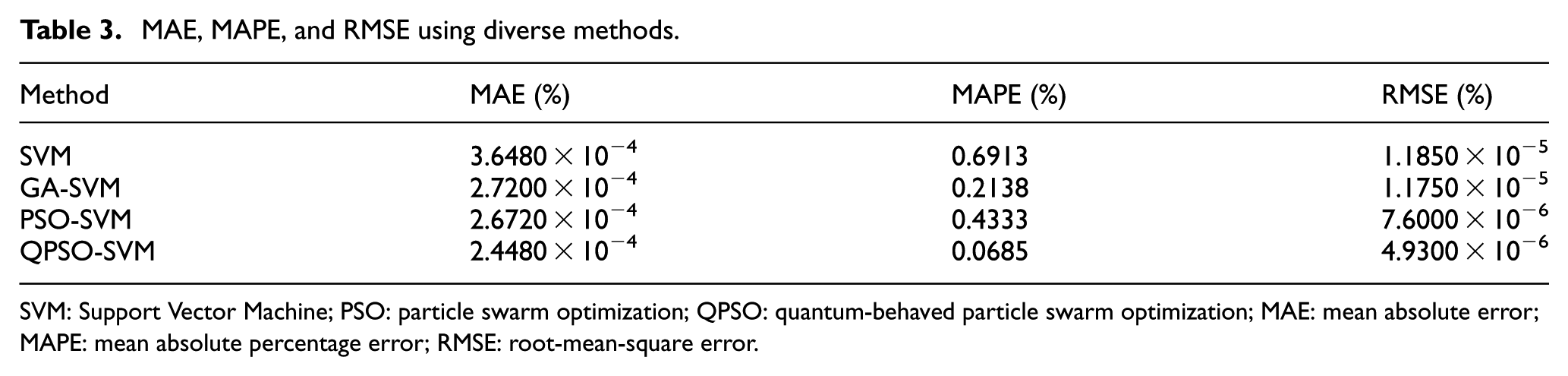
SVM: Support Vector Machine; PSO: particle swarm optimization; QPSO: quantum-behaved particle swarm optimization; MAE: mean absolute error; MAPE: mean absolute percentage error; RMSE: root-mean-square error.
By comparing their prediction results, it can be seen that QPSO has unique and larger advantages in optimizing SVM. Hence, the presented QPSO-SVM model is an effective and efficient deformation prediction model of mine slope.
Discussion
It can be seen from Figures 4 and 5 that the proposed model has better performances in mine slope deformation forecast. QPSO optimization increased the convergence speed and the generalization ability of the SVM. From Tables 1 to 3, it can be seen from the actual prediction values that QPSO-SVM model has beaten its rivals. By comparing the various forecast result parameters of the above deformation prediction models, it can be seen that the proposed model has higher prediction accuracy and faster convergence speed. Thus, QPSO-SVM model could provide satisfactory performance in mine slope deformation prediction and other engineering prediction which need fast forecasting speed.
Conclusion
By applying the proposed model in the practical engineering application cases, the deformation forecast performance of the mine slope has been investigated and compared with several kinds of traditional methods, that is, SVM, GA-SVM, and PSO-SVM. The proposed QPSO-SVM model mainly includes two parts: QPSO optimization algorithm and SVM modeling approach. SVM constructed best prediction model through the judgment of the prediction error. QPSO could select the best optimal parameters of the SVM, so it has best forecasting accuracy and faster convergence speed than other methods. In the QPSO algorithm, particles have quantum behavior and their search capability is far superior to traditional algorithms. Hence, QPSO could help SVM to choose the most appropriate parameter and stimulate its best modeling performance. The experiment result shows that the proposed model is not just valid but also excellent in mine deformation forecast. In addition, hydro-geological factors and meteorological factors have been considered to forecast the mine slope surface deformation in this study. In future, more influence factors’ analysis can be added to the scope of influencing deformation variables and the prediction model will become more precise and reliable.
Footnotes
Handling Editor: Zhixiong Li
Declaration of conflicting interests
The author(s) declared no potential conflicts of interest with respect to the research, authorship, and/or publication of this article.
Funding
The author(s) disclosed receipt of the following financial support for the research, authorship, and/or publication of this article: This project is sponsored by the grants from the National High Technology Research and Development Program of China (863 Program, no.2013AA122301), and support from the Coal Quality and Geologic Survey Department of China Coal PingShuo Group Co., Ltd.
