




Abstract
Complex geographical environment brings tremendous challenges to get information of localization in underground coal mines. Sequence-based localization is a simple method; without calculating distance during the positioning stage in real time, this method uses the received signal strength indication matched degree between unknown node and regions to locate. However, sequence-based localization has a great issue on poor marginal nodes localization. Sequence–centroid localization contributes to improving this issue, but the location error on the boundary of whole area is unsatisfactory as well. This article proposes an improved sequence-based localization method which is integrated with quantum-behaved particle swarm optimization, as quantum-behaved particle swarm optimization makes good use of the search performance of global optimal solution. In our simulation, we consider that ZigBee devices can be used to construct wireless sensor networks and locate personnel location. The results prove that the improved sequence-based localization algorithm provides comparable accuracy than sequence-based localization.
Introduction
Over the past decades, the security problem of coal mines has been an important factor of constraining the development of coal industry around the world. In China, accidents in coal mine happen every year; the frequent occurrence of accidents causes heavy loss of life and property. Faced with this issue, adopting underground mines environment monitoring1–4 and miner localization can reduce losses and ensure miners’ safety as far as possible. Recently, the application of wireless sensor networks (WSNs) has got much attention and became a hot research point in the location system of coal mine, because of their advantages of self-organization, distributed function, low cost, and high reliability.5,6 Location service is crucial for information extraction in WSNs. Most of sensory data with location information are meaningful, especially the real-time underground information of miners’ location. Therefore, a great deal of localization algorithms and mechanism is proposed to realize the accurate localization in WSNs through different techniques. The application of localization in WSNs is quite different between open environment and underground environment in coal mines. In general, there is a multipath effect and shadowing in coal mine tunnel environment, so it is important to select an appropriate method to realize the underground localization.
Localization algorithms in WSNs include two categories: range-based algorithm and range-free algorithm.7,8 For range-based algorithm, the relative or absolute position of an unknown node can be calculated by the coordinates of three reference nodes. The absolute distance between reference node and an unknown node is determined based on Euclidean distance. Giving an example, trilateration is the representative of range-based algorithm. For range-free algorithm, connectivity information is used to achieve localization, such as multi-dimensional scaling map (MDS-MAP) 9 and DV-HOP. 10 The range-based algorithm has the ability to obtain higher localization accuracy at the expense of more hardware cost. The range-free algorithm does not require complex hardware support, it is typically less accurate than range-based algorithm. In consideration of the work conditions in underground coal mine is comparatively odiously, we come up with a novel hybrid localization method to achieve precise position of miners. Yedavalli and Krishnamachari 11 proposed a new method called sequence-based localization (SBL), and it expounds that the localization area can be classified into many different regions which can be uniquely identified by received signal strength indication (RSSI) sequences. These sequences represent the ranking of distances from reference nodes to each region. 11 The SBL method spends much time on the stage of RSSI sequence construction; the estimated location is calculated from the centroid of a region matched with the corresponding sequence on the positioning stage. 12 The method is suitable for the personnel localization in coal mine environment. However, the location errors around the adjacent regions are probably high. The RSSI value of a node at the border of the neighbor regions most likely matches the RSSI value of neighbor regions, thus it may cause the region mismatch. To address this drawback, a new algorithm called sequence–centroid localization (SCL) in Liu 13 was presented. The concept of SCL is to optimize the process of matched region selection based on SBL method. Unlike SBL, the process of matched region selection in SCL is to check the centroids of three nearest detected regions that relate to unknown node, and the centroid of the triangle formed by three centroids mentioned above is the finally estimated location of unknown node. However, SCL algorithm is probably inaccurate when calculating the position of unknown node which is near the boundary of the whole location area.
In this article, we use quantum-behaved particle swarm optimization (QPSO) algorithm to overcome the marginal node localization problem. QPSO algorithm has an advantage of fewer parameters and simple calculation. After calculating the nearest region based on SBL method, the centroid of the nearest region is the input of QPSO. According to the object function depicted by sequence approximation coefficient, the estimated location can be calculated by the QPSO iteration. The simulation results in section “Simulation” show that compared with SBL and SCL algorithms, the improved SBL method has a better performance in solving marginal node localization. Similar to other iterative algorithm, the introduction of QPSO algorithm decreases the efficiency of new proposed method as well, and then choosing appropriate parameters is a way to alleviate the efficiency issue.
The rest of this article is organized as follows. Section “Related works” gives the related works of our research. In section “Localization using improved SBL algorithm,” the content and application in details of improved SBL method are illustrated. Simulation results are given in section “Simulation” to demonstrate the performance of the promoted scheme, and some conclusions and future works are given in section “Conclusions and future work.”
Related works
SBL
SBL technique just focuses on RSSI since the signal strength from receiver is proportional to distance between transmitter and receiver. Sensor nodes are randomly deployed in localization area, and the key point of SBL technique is localization space division. The region is divided by the perpendicular bisectors of lines from any two reference nodes. Therefore, the divided area contains three different types of regions: vertices, edges, and faces, as shown in Figure 1. The centroid of a vertex is the vertex itself, the centroid of an edge is its midpoint, and the centroid of a face is the centroid of the polygon that bounds it. The centroid of three types of regions can be calculated by equations (1)–(4). Each region has its own RSSI sequence set which saves the RSSI value of every reference nodes’ radio signal measured from this region, and a smaller RSSI value demonstrates that the reference node is closer to a region. Therefore, each region has a unique RSSI set. In positioning stage, unknown node measures RSSI location sequence which is collected from each reference node. Location sequences of all regions are listed and the nearest localization sequence compared with unknown node sequence is chosen. The nearest localization sequence is selected by calculating the parameter
1. The centroid of an edge is given by 11

where
2. The centroid of a face is given by 11


where M is the number of vertices that bound a given face,

3. Spearman’s rank-order correlation coefficient is shown as follows 11

where

Sequence-based localization.
SBL works without sophisticated hardware; however, SBL still yields big error due to some kinds of noise interferences and calculation errors. Beyond that, for SBL method, it may choose a wrong localization sequence if two or more regions are both closer to the unknown node, such as edge 2 and Face 3 in Figure 1.
SCL was proposed to solve the above-mentioned issue about region similarity,
13
and Figure 2 illustrates the principle of SCL. First, we measure the RSSI of node U and generate a RSSI set u of node U. Second, we work out Spearman’s coefficient

Sequence–centroid localization.
The SCL algorithm improves the problem of SBL about region similarity. However, if the unknown nodes are close to the boundary of the whole two-dimensional (2D) plane, the results may not be exact. As we can observe from Figure 3, unknown node U is close to the boundary of the whole region; the centroid of triangle JKL computed by SCL is the location estimation of U. In comparison with its actual location, the deviation of the measured location is conspicuously a large number.

Localization problem of marginal nodes in SCL.
RSSI measurement
The log-normal shadowing model is a function that is widely used to measure RSSI, and the equation is given by 14

where
This foregoing model is applied without considering the existence of obstructions such as walls, devices, and even human body. If obstructions are considered, the above equation needs to add some extra parameters which depend on the type and number of obstructions. 11 In this article, there is no obstruction in our experiment environment, so we choose equation (6) as the RSSI measurement model.
ZigBee wireless sensor
The reference nodes in our positioning system use ZigBee wireless sensor with a CC2530 chip, 15 as shown in Figure 4. CC2530 was built in a received signal strength indicator so as to measure the RSSI. The RSSI is the 8-bit number which can be obtained from register or attached to the received frame. RSSI is the average power received by CC2530 in 128 µs, which consists with IEEE802.15.4. RSSI is the complement of a binary signed number, and the logarithmic scale is the step size of 1 dB. The RSSI_VALID status of the RSSISTAT register must be checked before reading RSSI register, this status indicates whether the RSSI is valid in RSSI register. When the value of RSSI_VALID is set as 1, it represents that the CC2530 radio frequency (RF) receiver has received information within 8 symbol period at least. In order to calculate the actual RSSI value with reasonable accuracy, it must add an offset. The equation of actual RSSI value is shown as follows

where the typical RSSI offset is 73 dB. Hence, if the RSSI value read from RSSI register is −10, the input power of RF is about −83 dB.

ZigBee wireless sensor with CC2530.
Localization using improved SBL algorithm
SBL method is a solution that more regions are selected as the potential estimated position of unknown nodes. However, the positioning performance of marginal nodes is far from ideal. Thereupon, we come up with a new method by combining SBL and QPSO, which is used to solve the problem of marginal nodes location and reduce positioning error.
Overview of QPSO
QPSO was proposed by the analysis of quantum system and the convergence of the traditional particle swarm optimization (PSO).
16
In the quantum space, the velocity and the position of a particle cannot be determined simultaneously, and the quantum state of a particle is described by its wave function

where

where
In Sun et al.,
17
parameter

where

Sun et al. 19 put forward a new method called mainstream thought to evaluate the parameter L. The meaning of mainstream thought is to select the center of personal best position of particle i in the swarm, which is selected as the iteration control parameter of L. Its equation is given by 18
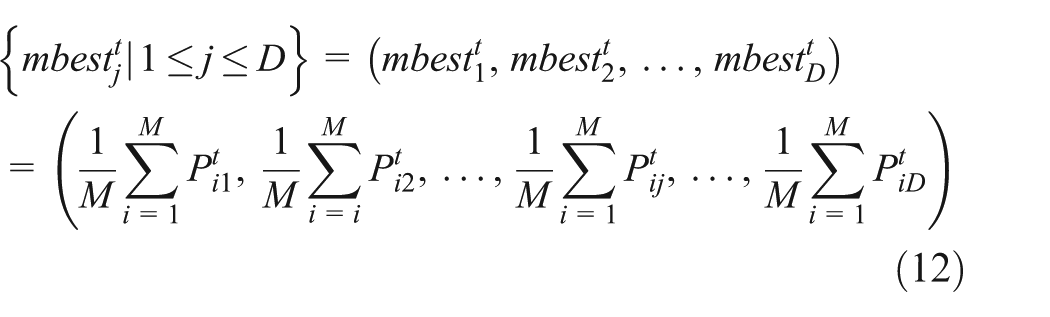
where M is the population size of swarm, D is the dimension of the particle, and

Therefore, the position updated equation of particle is given by 18

In summary, the PSO algorithm with equation (14) is QPSO. The operation process of QPSO is shown as the following steps: 18
Step 1. Initialize the population size M, maximum iteration T, the initial position, the dimension of particles and
Step 2. Compute the mean best position mbest by equation (12).
Step 3. If
Step 4. Let
Step 5. Determine whether the iteration continues, if
The proposed QPSO will be adaptable to diverse applications and highly effective; it has many advantages on few parameter and well global optimization compared to the standard PSO algorithm. In this article, we use the property of fast global searching of QPSO to improve SBL.
The principle of improved SBL method
The improved SBL method adopts the operation mechanism of SBL method. As shown in Figure 5, on the positioning stage, we find the approximate estimated location

QPSO refinement in improved SBL method.
The dimension of QPSO is 2. The estimated coordinate
The procedures of improved SBL method
The localization process of improved SBL method is given as follows:
Step 1. Construction of location sequence table. Step 1.1. Deploy the reference nodes and subdivide the location area into three kinds of regions such as vertex, edge, and face, and consider the line between any two reference nodes and draw their perpendicular bisector. Step 1.2. Calculate the centroid of each region using equations (1)–(4), and these centroid can be seen as reference locations. Then, compute the RSSI values between reference locations and anchor nodes. Each region has its unique location sequence and store all location sequences of each region in a location sequence table.21,22
Step 2. Positioning stage. Step 2.1. When miners who carry the ZigBee device (it can be seen as an unknown node) enter the location area, the unknown node connects with each reference node in its communication range and calculates the RSSI measured from reference nodes. Thus, the unknown node gets its location sequence by handling the RSSI measurements. Step 2.2. Calculate the matching degree Step 2.3. Initialize the QPSO and set the number of particles M, the maximum number of iteration T, and the
The performance analysis of improved SBL method
The performance of improved SBL method discussed here is mainly about the time complexity and space complexity of algorithm. The SBL and SCL algorithms spend the main time in constructing the location sequence table and selecting the nearest location sequences. In addition to the two aspects of time consumption mentioned above, the proposed algorithm also spend more time on the iteration of QPSO.
In Step 1.1, constructing bisector lines takes
Simulation
Subject to conditions, the experimental environment is arranged on the fifth floor corridor of the School of Information and Electrical Engineering. This environment is similar to the coal mine tunnel environment. The plane of fifth floor corridor is shown in Figure 6, and the length and the width of corridor are 69 and 3 m, respectively. The reference nodes are deployed on both sides of the wall in equal horizontal distance, the deployment height of nodes is 1 m from the floor, and the user carries the positioning device which can be seen as the unknown node. The sink node is used to collect and calculate the data of user node and reference nodes.
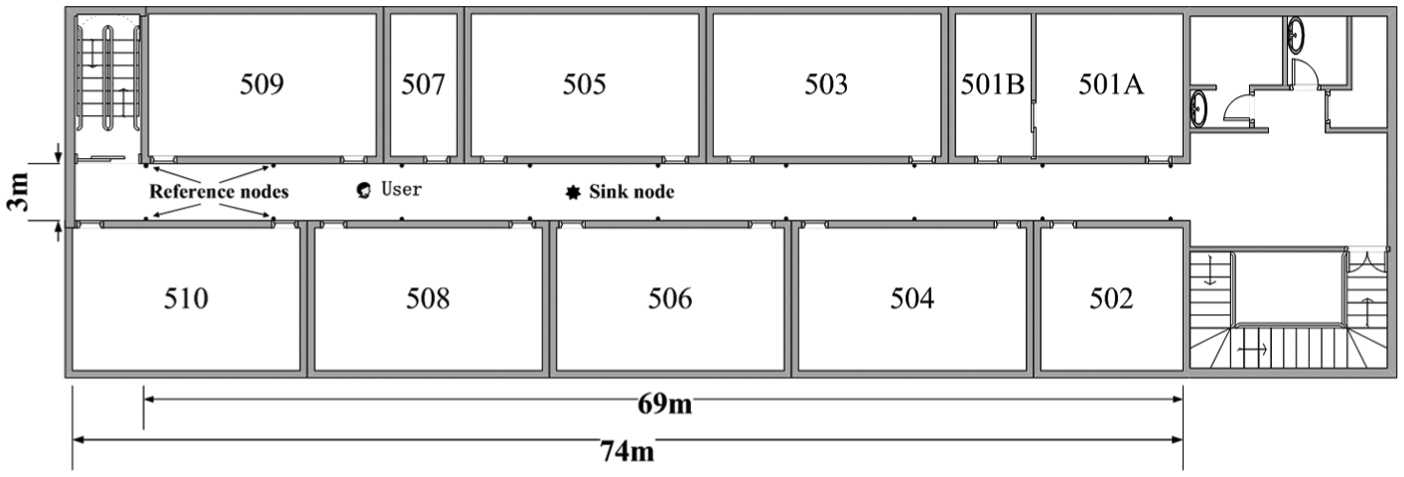
The plane of experimental environment.
The performance of improved SBL method is evaluated by the location error with reference of the radio range of sensor nodes, and its equation is shown as follows

where r is the radio range of sensor nodes,
The performance of improved SBL method is influenced by many factors such as sensor nodes communication radius, the number of reference nodes, and the parameters of QPSO. In addition to comparing the improved SBL method with SBL and SCL algorithms, the following experiments analyze the influence of the above factors. Our experiments use the Monte Carlo simulation method repeatedly to enhance the reliability of simulation results. 23
Channel parameters
The appropriate channel parameters are important to the RSSI measurement. Due to the multipath fading effects in the real world, the value of
Channel parameters.

Simulation results
We assume that all reference nodes and unknown nodes have the same communication radius. In the first experiment, we compare the improved SBL method with SBL and SCL under different conditions of reference node number n and sensor node communication radius r. In each independent experiment, user equipped with positioning device stands at 10 different locations randomly, and then, the user’s location is calculated for 10 times. The final results are the average location error of 100 results from each independent experiment. The final results are shown in Figure 7.

Comparison of SBL, SCL, and improved SBL with different r: (a) r = 15 m, (b) r = 20 m, (c) r = 25 m, and (d) r = 30 m.
Obviously, the improved SBL method has a better performance than the others. It can be inferred from Figure 7 that much more reference nodes are beneficial to promoting the accuracy of three algorithms. Due to the increase in number of reference nodes, the location area is divided into more regions, so there are more refined regions to select, and the centroid of the selected region is closer to the actual location. The larger communication radius r is useful because the large communication radius means that the signal strength of nodes is strong. RSSI values which are detected in different regions have a large degree of discrimination; the nearest region to the actual location is more likely to be identified. The increase in r leads to more energy consumption, and deployment of more reference nodes reduces the algorithm efficiency.
In QPSO, the number of population size M and maximum iteration T are both crucial factors for the performance of algorithm.
25
In practice, we hope that the optimal solution capability coordinates with the efficiency of improved SBL method. Under certain conditions, the efficiency may be more important. The results of the influence of population size and maximum iteration are shown in Figure 8. In this experiment, the number of reference node is
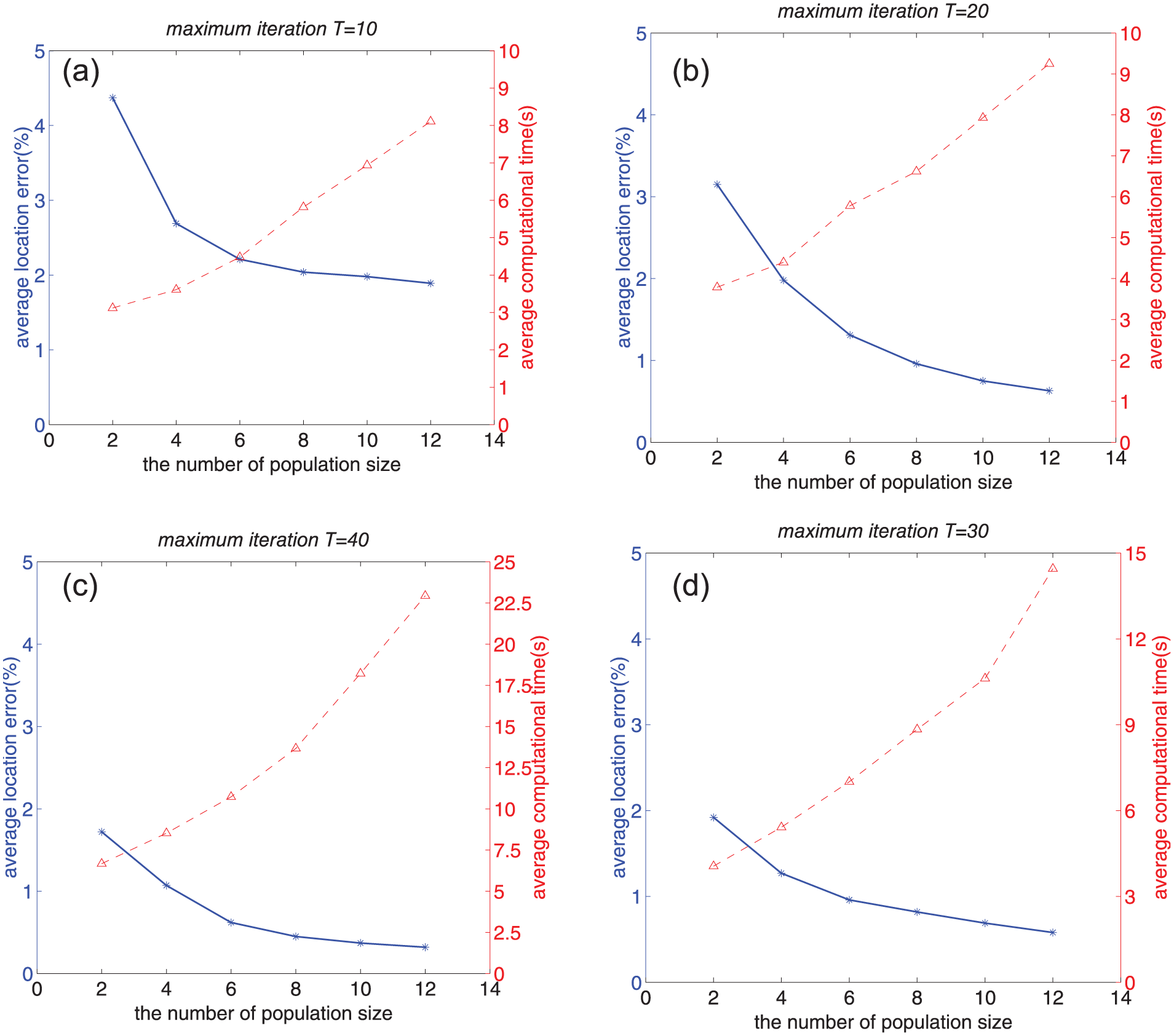
The influence of population size M and maximum iteration T: (a) T = 10, (b) T = 20, (c) T = 30, and (d) T = 40.
The results in Figure 8 illustrate that larger size M and more iteration T for the proposed algorithm are both useful to reduce the location error. However, it takes a lot of time on QPSO process. For Figure 8(c) and (d), though the average location error is very small, the results are insignificant caused by the huge time delay. If the application is the target tracking, the delay constraint will be more rigorous. In our application, we choose the parameters
As mentioned previously, the improved SBL method is good at polishing up the marginal nodes localization. Figure 9 shows the schematic diagram of this experiment: 26 nodes are deployed on both sides of the wall with equal separation distance and sink node is deployed on the center of the whole network. Six test positions of user which are named as P1, P2, P3, P4, P5, and P6 are shown in Figure 8, and P1, P2, P5, and P6 belong to the marginal locations. The results with improved SBL, SBL, and SCL are presented in Figure 10.

Marginal nodes localization.

The results of marginal nodes localization.
The simulation results of P3 and P4 in Figure 10 show that SCL algorithm has a better performance than SBL, and its average location error is about 5%. When user stands on the boundary of corridor, the average location error of P1, P2, P5, and P6 for SCL and SBL are both unsatisfactory. This is because the SCL only selects a centroid of nearest region as the estimated location, and it does not consider the nearest point around the actual location of user. Distinguished with SCL, the improved SBL uses random disturbance in candidate solutions to find the nearest point measured by RSSI and
Conclusion and future work
This article presents a new method which combines the SBL method and QPSO algorithm for coal miner localization optimization. If the parameters selection of improved SBL method is reasonable, the simulation results illustrate that improved SBL method can decrease location error under 5%. Future work will concentrate on applying to three-dimensional and more complicated environments. In this research, we select the experiment environment where exists no obstruction. More related works will be needed for the application of miner personnel localization in complicated environments. Except that, the path loss formula for distance measurement could be optimized in the future researches.
Footnotes
Academic Editor: Gang Wang
Declaration of conflicting interests
The author(s) declared no potential conflicts of interest with respect to the research, authorship, and/or publication of this article.
Funding
The author(s) received no financial support for the research, authorship, and/or publication of this article.