




Abstract
A finite element method, boundary element method, and genetic algorithm combined method is developed for the optimization of natural frequencies of fluid-loaded plates. In this method, the coupled finite element method–boundary element method is used for the free flexural vibration analysis of plates with arbitrary fluid loading effects and arbitrary elastic boundary conditions, and the genetic algorithm method is combined with the finite element method–boundary element method for searching the optimal values of plate’s boundary parameters. By using this method, multiple natural frequencies of a given fluid-loaded plate can be optimized simultaneously to different target values. The coupled finite element method–boundary element method is first validated by comparing with earlier published results. The proposed optimization method is then applied to the optimal boundary condition design of four different cases. The results show natural frequencies of a fluid-loaded plate are sensitive to its boundary conditions. The possibility of optimizing the natural frequencies of a fluid-loaded plate by modifying boundary conditions is demonstrated, as well as the effectiveness of the proposed method as a structural optimization tool. According to the authors’ knowledge, this study is the first attempt of optimizing fluid-loaded plate natural frequencies by considering arbitrary boundary conditions as optimization variables.
Keywords
Introduction
The study of plate-like structures can serve as a prerequisite for the analysis of the dynamic performance of more complicated structures.1,2 A variety of approaches have accordingly been developed for the optimization of the natural frequencies of plate structures. 3 These methods include modification of the dimension of the plate,4–6 addition of masses to the plate, 7 modification of the topology of the structure,8,9 and so forth. The optimization targets are usually maximizing the fundamental natural frequency,4,10 maximizing the difference between two particular natural frequencies, 9 and modifying the natural frequencies to some particular desired values.11,12
Among these optimizations, the approach of changing the given natural frequencies to some particular target values is valuable and can have extensive applications in engineering. 12 For instance, it can be applied to improve the acoustic behavior of the panel sound absorbers 13 or music instruments. 14 It can also be used to the optimal design of vibro-impacting structures intended for energy harvesting applications,15,16 where a vibration-based energy harvester generates higher output powers when it is working at the resonant frequency coinciding with the ambient source frequency. Moreover, it can be useful in the design of smart structural systems, since the structural natural frequencies significantly affect the performance of the sensor or actuator that is embedded into or surface bonded with structures. 17
The plate’s boundary condition is one of the most significant factors that affect the natural frequencies of a plate structure. Over the past few years, the dynamic analysis of plate structures with various boundary conditions has received considerable attention.18,19 Approximate solution techniques20,21 have been developed for the analysis of the effects of general boundary conditions. Among these techniques, the finite element method (FEM) has been widely considered and proved to be especially suitable for the structures with complex boundary conditions.22–24 Based on the FEM method and genetic algorithm (GA), an optimization method has recently been developed by the authors for optimizing the natural frequencies of plate structures. 12 The optimization results demonstrate that the plate’s natural frequencies can be effectively optimized even only modifying the plate’s boundary conditions. 12 This kind of optimization techniques only require the modification of boundary supports and therefore can be extremely valuable when the given constraints do not allow modifying the body and appearance of the structure (e.g. the mass, dimension, shape, and surface of the plate). 12 However, this method is developed by neglecting the effects of fluid loading and is only suitable for plates in vacuum.
It is well known that the natural frequencies of structures in contact with or immersed in a heavy fluid (like water) are quite different from those in vacuo. The natural frequency changes because of the presence of the fluid should be carefully calculated and considered in the design of structures that are in contact with or immersed in fluid. 25 Even in a light fluid medium (like air), the effect of fluid loading is proved to be a significant factor in near-resonant frequency regions. 22
This work is an extension of the authors’ earlier work 12 on the natural frequency optimization of plate structures by considering arbitrary boundary conditions as optimization variables. The developed optimization method in this article takes into account the effects of fluid loading and is suitable for structural optimization in arbitrary fluid domains. Generally, the FEM, boundary element method (BEM) and GA are combined in the proposed method. The layout of this article is as follows. The coupled FEM-BEM model for the fluid-loaded plate natural frequency analysis is introduced in section “Hydroelastic vibration analysis model,” as well as the validation of this model. The GA approach is briefly introduced in section “Optimization methodology,” where the procedure of the FEM-BEM-GA combined optimization method is also present. In section “Illustrative examples,” the numerical studies are conducted to examine the performance of the proposed optimization method, and a brief discussion of these studies is given in section “Discussion.” Finally, section “Conclusion” presents the conclusions.
Hydroelastic vibration analysis model
Coupled FEM-BEM model
Consider a rectangular thin plate mounting on an infinite rigid baffle (see Figure 1). Both sides of the plate are in contact with fluid (fluid medium V1 and fluid medium V2). The plate is with arbitrary elastic boundary supports along the edges and its length, width, and thickness are

A fluid-loaded plate structure: (a) the front and back surfaces of the baffled plate are in contact with fluid media V1 and V2, respectively; (b) boundary condition of the plate.
The vibration response of the undamped plate system with fluid loading is determined by the coupled FEM-BEM method18,26 as

where
The sound pressures on the both sides of the plate surface by the BEM model can be given as18,22,27,28


where

The characteristic equation of the plate system can then be given as

The eigenvalue
In order to consider arbitrary boundary conditions, the stiffness matrix

where

The elastic supports, as in references,22–24 are modeled as a combination of translational and rotational springs, with
In the FEM model, the total strain energy

where the stain energy of the plate body element

and


and

where

where

where
The boundary parameters (
Model validation
The first four fundamental modes of a clamped rectangular plate (with different aspect ratios) in contact with water are predicted using the proposed coupled FEM-BEM model. In the calculations, the element number used is 32 × 32. The results are compared with the existing results given by Kwak,
30
which are given in Table 1. For convenient comparison, the natural frequency results are converted into NAVMI (non-dimensional added virtual mass incremental) factors, which are the same as those given by Kwak. The NAVMI factor, defined as
NAVMI factors for clamped plates of different aspect ratios in contact with water.

NAVMI: non-dimensional added virtual mass increment.
Optimization methodology
There are at least two challenges in developing an optimization method that can be used to regulate the plate’s multiple natural frequencies by optimizing the boundary conditions. 12 One is that multiple boundary parameters need to be optimized simultaneously and each of them can take on an infinite number of possible values. The other is that multiple natural frequencies are supposed to be optimized simultaneously; however, every slight change of the boundary conditions leads to a new value of each natural frequency. To deal with these difficulties, intelligent optimization techniques that can perform a parallel search in the possible solution spaces are required. In this work, a GA method is adopted and combined with the proposed FEM-BEM method for the development of optimization model.
GA
GA is a bionic algorithm inspired by natural evolution which is especially suitable for parallelizing the algorithm since the calculations of each generation are independent of one another.12,31–33 As one type of metaheuristic algorithms, GA works by iteratively improving themselves with past data after each iteration rather than performing a stochastic or exhaustive search. Initialization, crossover, selection, and mutation are four basic bio-inspired operators used in the procedure of GA. The initialization process generates the initial population randomly. The population then evolves by the last three bio-inspired operators (i.e. crossover, selection, and mutation). Selection operator selects excellent individuals in the current generation for breeding the next generation individuals. To avoid local convergence, the mutation operator changes one or more gene value in a chromosome for individuals in the next generation. In the whole process, evaluation operator weights the fitness (quality) of individuals in each generation. The fitness function used in this work is given as

where
FEM-BEM-GA integrated optimization approach
Figure 2 shows the flowchart of the optimization strategy, in which the GA and the coupled FEM-BEM method are combined. The procedure includes (a) inputting the plate’s known parameters (such as size and density), the parameters of the fluid environment (such as the density and sound speed) on each side of the plate, and the constraints of the plate’s boundary parameters; (b) identifying the natural frequencies to be optimized, and calculating their possible ranges under the given constraints of boundary parameters (using the coupled FEM-BEM method); (c) setting target values within their possible ranges for each natural frequency of interest, as well as their corresponding weighting coefficients; and (d) defining the termination criteria and running the FEM-BEM-GA combined method to get the optimal solutions.
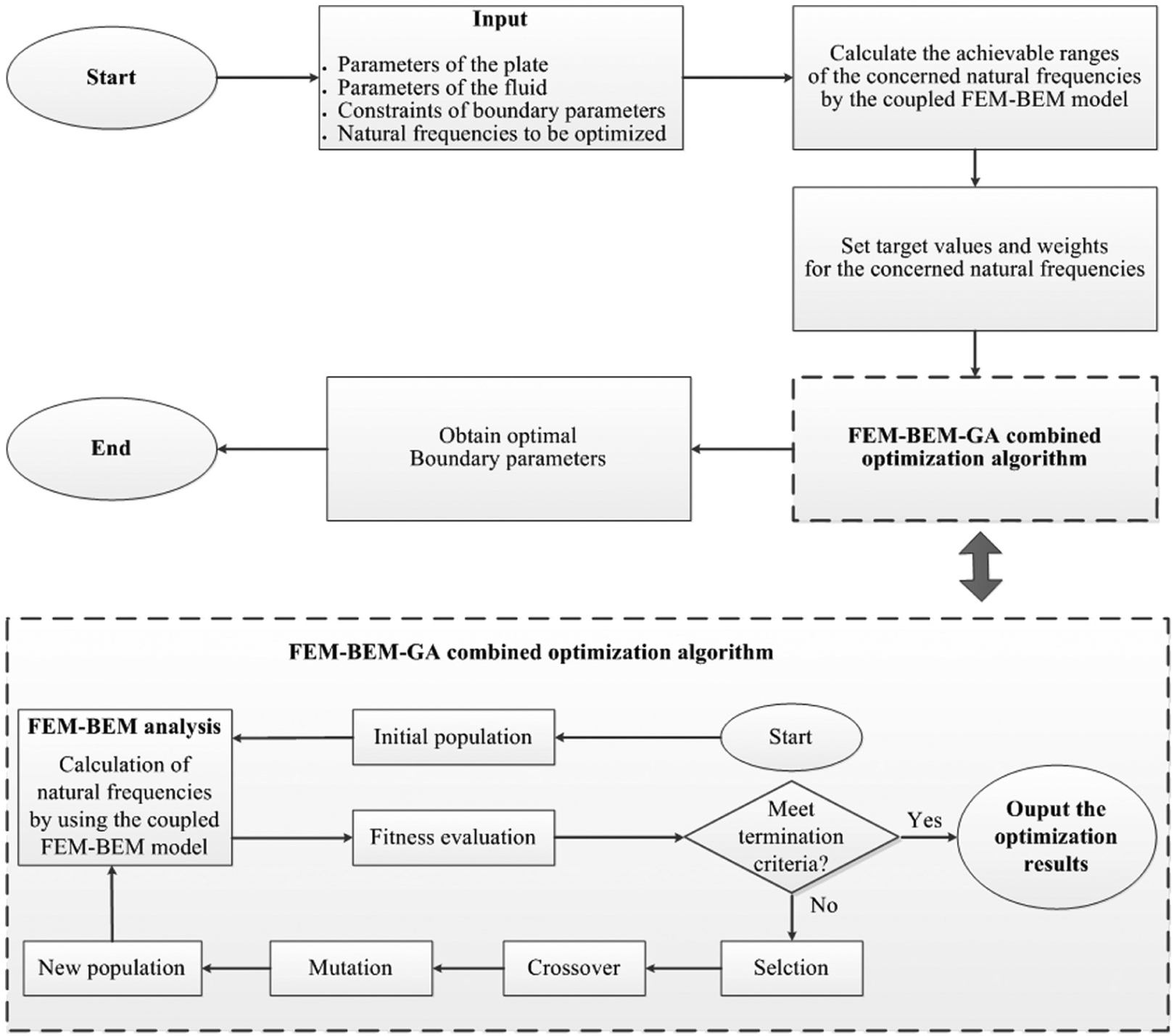
Flowchart of FEM-BEM-GA integrated optimization method.
Illustrative examples
Based on the proposed method, four optimization examples of fluid-loaded plate structures are presented in this section. The parameters used in these examples are as follows. (a) The element number used in the coupled FEM-BEM model is 32 × 32 (the same as in section “Hydroelastic vibration analysis model”). (b) The infinite large value of boundary parameter is represented by 1×10¹⁰. (c) The initial population and maximum generation number defined in the GA are 100 and 1000, respectively. (d) The termination criterion is that the program terminates when
Case 1
In this case, the plate in contact with water on one side is considered. The medium V1 is air and medium V2 is water (see Figure 1). The parameters of the plate and fluid media are given in Table 2. The constraints of boundary conditions of the plate are also given in the table, where
Known parameters of case 1.

The optimization target is given in Table 3. The concerned natural frequencies are
Optimization target and optimal results of case 1

For this case, as also shown in Table 3, the optimal boundary parameters are found to be
Case 2
The parameters of the plate, fluid media, and constraints of boundary conditions in this case are the same as those in case 1 (also see Table 2), but the concerned natural frequencies are changed to be
The optimization target is given in Table 4. The concerned natural frequencies are
Optimization targets and results of case 2.
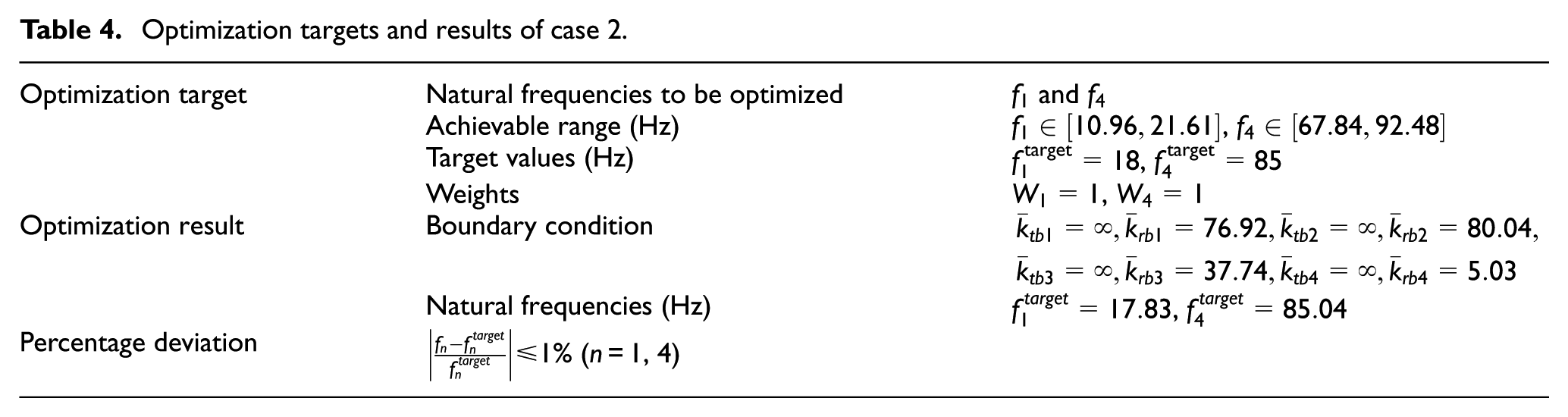
For this case, as also shown in Table 4, the optimal boundary parameters are found to be
Case 3
In this case, the plate fully immersed in the water (i.e. both sides of the plate are in contact with water) is considered. The parameters of the plate and fluid media are given in Table 5, as well as the constraints of boundary conditions.
Known parameters of case 3.

The optimization target is given in Table 6. The concerned natural frequencies are
Optimization targets and results of case 3.

For this case, as also shown in Table 6, the optimal boundary parameters are found to be
Case 4
The parameters of the plate in this case are shown in Table 7. The plate is fully immersed in the water, that is, both sides of the plate are in contact with water. The optimization targets are shown in Table 8. The concerned natural frequencies are
Known parameters of case 4.

Optimization targets and results of case 4.

For this case, as also shown in Table 8, for the first set of weighting coefficients, the optimal boundary parameters are found to be
Discussion
The plate’s actual natural frequencies are highly related to its boundary conditions. For instance, in each of the above calculation cases, the values of the plate’s target natural frequencies can be adjusted within a relatively wide range, even only considering its boundary parameters as design variables. In addition, with different target natural frequencies, although the given plate and fluid parameters are totally the same, the values of optimal boundary parameters of case 1 and case 2 are found to be quite different.
The fluid loading effect is another important factor that significantly influences the plate’s natural frequencies. Taking case 3 as an example, with all the known parameters remaining the same but considering the plate immersed in the air, the achievable ranges of
The GA is suitable for the optimization problem considered in this study. Taking case 4 as an example, six boundary parameters are set as the optimization variables and each of them has an infinite number of possible values. Moreover, natural frequencies of four different orders need to be optimized to their responding target values at the same time. It is impossible or extremely difficult to conduct a traditional search for these tasks. The adoption of the intelligent search algorithm (GA) in the proposed method is necessary and useful.
It is also worth mentioning that in some specific cases (e.g. case 4), it cannot guarantee to optimize all the concerned natural frequencies to be exactly the target values by changing the boundary conditions within the predefined search space. However, even in this situation, the optimization approach can help establish the optimal boundary conditions which can minimize the value of the weighted objective function (i.e. ensure the multiple natural frequencies of interest to be as close to their corresponding targets as possible). In this situation, the selected weighting coefficients will influence the final results of the optimization.
In a word, the results of the numerical studies above demonstrate that (a) every natural frequency of a given fluid-loaded plate is sensitive to its actual boundary conditions; (b) the plate’s multiple natural frequencies can be effectively optimized even only taking its boundary conditions as design variables; (c) users can consider arbitrary fluid loading using the proposed method; and (d) users can freely set the constraints of the plate’s boundary conditions according to practical needs, and identify the optimal boundary conditions within these constraints according to their natural frequency targets.
Conclusion
An optimization approach is developed for the optimization of natural frequencies of fluid-loaded plates using the FEM, BEM, and GA combined method. In this approach, the coupled FEM-BEM method is employed for the free flexural vibration analysis of plates and is demonstrated to be suitable for studying the effects of arbitrary elastic boundary conditions and arbitrary fluid loading. Moreover, the GA is combined with the coupled FEM-BEM method for determining the optimal values of plate’s boundary parameters.
Parametric studies are carried out. The results demonstrate the proposed optimization approach can effectively identify the optimal boundary parameters so that multiple natural frequencies of a given fluid-loaded plate can be adapted at the same time to their corresponding targets. To our knowledge, the proposed method is the first algorithm that can optimize fluid-loaded plate natural frequencies by considering arbitrary boundary conditions as optimization variables; hence, the idea and the method proposed in this work can be useful for both academic and practical applications.
Footnotes
Appendix 1
Handling Editor: Pietro Scandura
Declaration of conflicting interests
The author(s) declared no potential conflicts of interest with respect to the research, authorship, and/or publication of this article.
Funding
The author(s) disclosed receipt of the following financial support for the research, authorship, and/or publication of this article: The work was supported by the National Natural Science Foundation of China (51578252), Program for New Century Excellent Talents in Fujian Province University (2017), a grant from the Hong Kong Polytechnic University (PolyU Project account: G-YBFP), and High Level Talent Innovation and Entrepreneurship Program of Quanzhou City, China (2017G039).
