




Abstract
Conventional decoupling approaches usually employ first-order reliability method to deal with probabilistic constraints in a reliability-based design optimization problem. In first-order reliability method, constraint functions are transformed into a standard normal space. Extra non-linearity introduced by the non-normal-to-normal transformation may increase the error in reliability analysis and then result in the reliability-based design optimization analysis with insufficient accuracy. In this article, a decoupling approach is proposed to provide an alternative tool for the reliability-based design optimization problems. To improve accuracy, the reliability analysis is performed by first-order asymptotic integration method without any extra non-linearity transformation. To achieve high efficiency, an approximate technique of reliability analysis is given to avoid calculating time-consuming performance function. Two numerical examples and an application of practical laptop structural design are presented to validate the effectiveness of the proposed approach.
Keywords
Introduction
Most engineering structures inevitably involve many uncertainties, such as geometric sizes, material parameters, loads, and work conditions.1,2 Although these uncertainties are usually small, the combined effects can lead to large fluctuations and even failure in the structural performance.1,3 Reliability-based design optimization (RBDO)4,5 can assess the reliability of design option under uncertain factors in the optimization process; therefore, it can achieve a reliable optimal result. A two-layer nested optimization is involved in RBDO, which contains the design optimization in the outer layer and the reliability analysis in the inner layer. For most practical problems, the nested optimization is computationally expensive. Two aspects to improve accuracy and efficiency for solving RBDO are: (1) to select an appropriate reliability analysis method and (2) to combine it effectively with the design optimization in the outer layer. 6 At present, the first-order reliability method (FORM),7–11 such as the reliability index approach (RIA)7,8 or the performance measurement approach (PMA) 9 has been adopted by many important RBDO approaches.12–14 The FORM can perform reliability analysis efficiently by establishing a linear approximation at the most probable point (MPP) for the constraint function transformed into the standard normal space. Yu et al. 15 introduced the RIA into the overall framework which contained a set of interactive design steps with trade-off analysis and what-if study. Cheng et al. 16 performed RBDO by solving a sequence of sub-programming problems that consist of an approximate objective function subjected to a set of approximate constraint functions. In the approach, the reliability index and its sensitivity can be obtained approximately. In the sequential optimization and reliability assessment (SORA) proposed by Du et al., 17 the PMA was used to conduct reliability analysis and formulate the approximate equivalent feasible domain of the probabilistic constraints, and whereby the reliability analysis is decoupled from the design optimization. Due to the high efficiency of SORA framework, a series of important variants are further developed to enhance the performance in terms of efficiency,18–22 accuracy,23,24 or convergence.25–27 In the above RBDO methods, the efficiency is improved by employing FROM, but the accuracy may be not enough because of the limitation of FORM.28,29 In the FORM, each non-normal variable is required to be transformed into the standard normal variable, and the performance function is linearized at MPP in the standard normal space. The transformation is non-linear and may increase the non-linearity of a performance function. As a result, the error of FORM will also increase, and the overall accuracy of RBDO will be reduced. Therefore, it is significant for enhancing the accuracy of RBDO to conduct the constraint reliability analyses in the original space.
At present, there are few researches30,31 on such RBDO algorithms. In the work by Chan et al., 32 each probability constraint is transformed into a deterministic constraint in the original space, and then an adaptive sequential linear programming algorithm is proposed for the solution of the updated optimization problem. This algorithm exhibits high efficiency, but it is not suitable for problems with non-normal random variables. The SORA-SPA algorithm 30 adopted the existing decoupling framework of SORA; 17 the difference is that the constraint reliability analyses are carried out by first-order saddle point approximation (FOSPA) 31 in the original space to improve the accuracy of RBDO. Therefore, it is named as SORA-SPA. Because the original FOSPA method is only for reliability calculation, but performing SORA requires the percentile performance of each constraint. For calculating the percentile performance, the original FOSPA process is modified into a sequence steps with solving three optimization problems. Objectively speaking, when the non-normal-to-normal transformation increases the non-linearity of constraint functions, SORA-SPA can exhibits a higher efficiency than the FORM-based RBDO method. However, there are also some disadvantages. First, the flowchart of modified FOSPA is complex; comparing with the FORM, the FOSPA involves several optimization processes and is more prone to convergence problems. Second, the entire iterative process of SORA-SPA still needs to conduct reliability analysis many times, and each reliability analysis requires repeatedly calculating the constraint functions. The constraint functional evaluation is generally very time-consuming for practical engineering problems. Therefore, there is still a gap between the efficiency of SORA-SPA and actual demand in many cases.
To improve accuracy and maintain efficiency, the proposed approach in this article performs the constraint reliability analysis in the original space, and develops an efficient decoupling framework for RBDO problems. The rest of this article is organized as follows. The general concepts and decoupling strategies of RBDO are reviewed in section “RBDO problem and decoupling strategy.” The formulation of proposed approach is given in section “Formulation of the proposed approac.” The effectiveness of the proposed approach is demonstrated by two numerical examples and an application of practical laptop structural design. A conclusion is made in section “Conclusion.”
RBDO problem and decoupling strategy
Statement of RBDO problem
A typical RBDO problem can be expressed as follows 17

where

where
In the optimization process, reliability analysis needs to be conducted for any design point to determine whether it satisfies a probabilistic constraint. Currently, FORM is the most commonly used method of handling constraint reliability analysis. Among them, PMA 10 usually exhibits a higher efficiency in RBDO analysis because of its fixed search scope. 33
In PMA, the constraint function is first mapped from the original random space into the normal standard space. Second, an optimization problem is formulated to search the MPP. If the functional value at MPP is greater than or equal to zero, the probabilistic constraint is satisfied.
Since there is no need to distinguish the random design variables from random parameters, the nZ-dimensional random vector

where

where G is the constraint function g in the U space. The advanced mean value method
10
can be used to solve the above equation to obtain the MPP
Through the above analysis, performing RBDO involves a two-level nested optimization with the outer level being the optimization for design variables and the inner level being reliability analysis. In practical engineering problems, performance functions are usually based on time-consuming numerical simulation technology, such as finite element models (FEMs) 34 and multi-body dynamics models. 35 Nested optimization with simulation models usually result in extremely low computational efficiency. 36
Decoupling approach
Decoupling approach has now become the most effective method to solve the nested optimization in the RBDO. And the SORA 17 is a widely used decoupling strategy. Its basic idea is to convert the nested optimization into a sequence cycles of reliability analysis and deterministic optimization. In each iteration step, the reliability analysis by using the PMA is first conducted for the precious design point to search the MPP at each probabilistic constraint. Second, according to the MPP, each probabilistic constraint is equivalent to the conventional deterministic constraint, and whereby the updated deterministic optimization is formulated. After solving it, the current solution is obtained.
The detailed steps of SORA are described below. In the first iteration step

Here, the random variables in equation (1) are replaced by the corresponding mean values. And the solution

By moving the boundary

The above equation is solved to get the solution
In SORA, the non-linear transformation for the constraint function in PMA introduces the extra error into the reliability analysis. To enhance accuracy, the SORA-SPA
30
algorithm was developed as a variant of SORA. It employs FOSPA
31
to perform the constraint reliability analyses in the original space without converting the constraint performance functions to the standard normal space. In the kth iteration step, the reliability analysis for a constraint at the current design point
To establish linear approximation
To calculate the performance measure value for the target reliability index by solving the nested optimization problem
To search for another MLP (namely
Each of these steps needs to solve the optimization problem. In the first step, the performance functional evaluation is involved; and the second step contains the nested optimization with the outer layer being the root-finding problem and the inner layer being the reliability analysis.
Formulation of the proposed approach
The SORA-SPA is more accurate than the FORM-based RBDO methods when the non-normal-to-normal transformation increases the non-linearity of probabilistic constraints. However, it can be observed that the constraint reliability analysis of SORA-SPA is complicated, and there is no guarantee of convergence due to the three optimization problems involved in it. Furthermore, each constraint reliability analysis contains the performance functional evaluation, which is time-consuming for most engineering problems. The whole optimization process needs a number of reliability analyses, especially for problems with several constraints. Therefore, the issues of efficiency seem still challenging for SORA-SPA when dealing with more complex engineering problems.
In this section, a decoupling approach is formulated to provide an alternative tool to enhance accuracy and efficiency for performing RBDO. Similar to the SORA, the framework of proposed approach converts the nested optimization into the sequential reliability analysis and design optimization steps. The calculation of the shifting vector is the key point for the proposed approach and also the fundamental difference from the SORA 17 and its varieties.18–26,32 On one hand, the shifting vector determines the deviation between the actual boundary of the probabilistic constraint and the equivalent boundary of the deterministic constraint in the iterative process. Due to the equivalent boundaries driving the design point to approach the optimal solution, the small deviation between the two boundaries can speed up the convergence. On the other hand, the formulation of the shifting vector also directly affects the overall efficiency of RBDO. The proposed approach calculates the shifting vector based on the result of reliability analysis. The features of the process can be summarized as: (1) the first-order asymptotic integration method is employed for the reliability analysis in the original space to enhance the accuracy; (2) an approximate technology is given for avoiding calculate the time-consuming constraint function to improve efficiency; and (3) an increment is used for fine-tuning the value of the shifting vector between successive iterations to ensure the convergence. The procedure of proposed approach is detailed below.
Constraint reliability analysis
In the first iteration, the deterministic optimization as equation (5) is solved to obtain the design point
The MLP is the point with the maximum joint probability density at the limit-state boundary of

where
The linear approximation of the constraint function is established at

Here,
For

Let
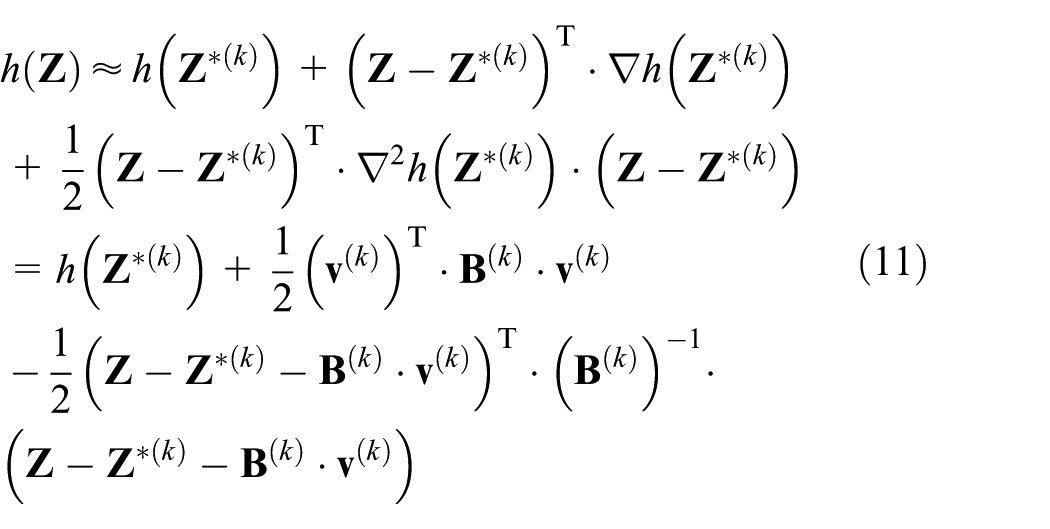
where

The mean and variance of the constraint functional values are calculated by

The constraint reliability index obtained by the first-order second-moment method 9 is

So far, the MLP
Compared with performing the reliability analysis by equation (10) based on the linear approximation at other points, the error of that at the MLP is smallest.
38
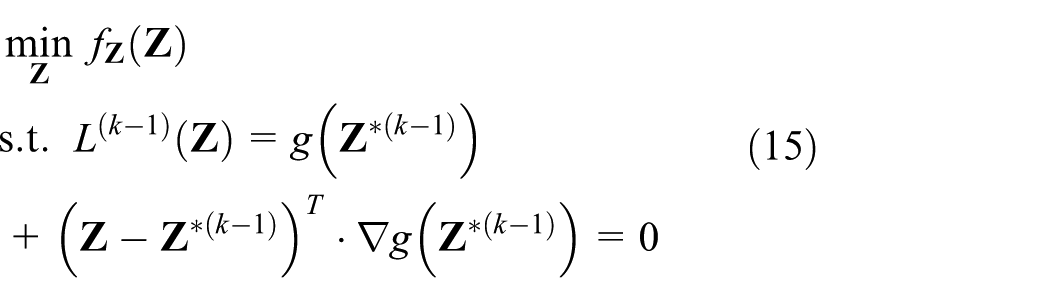
Moreover, the solutions’ difference between the two adjacent iteration steps is generally small, and thus that of corresponding MLPs of a constraint is small. With the iteration conducting, the difference becomes smaller. As shown in Figure 1, in the proposed algorithm,

The approximate algorithm for searching the MLP.
The calculation of the constraint function
The calculation of the shifting vector
The SORA and its variants determine the equivalent constraint boundaries by recalculating the shifting vectors in each iteration step. For some complex cases, such as the constraint with multiple MLPs, the differences between the shifting vectors of adjacent iteration steps can be large, which may lead to numerical oscillations and whereby impact the convergence of the iteration process.
30
To improve convergence, the concept of increment
40
recently proposed by the authors is introduced, which is calculated in the kth iteration step for fine-tuning the shifting vector in the (k-1)th iteration step. This fine-tuning process can be expressed as
Figure 2 is used to illustrate the calculation process of the increment. For ease of description, the constraint function contains only two random variables.

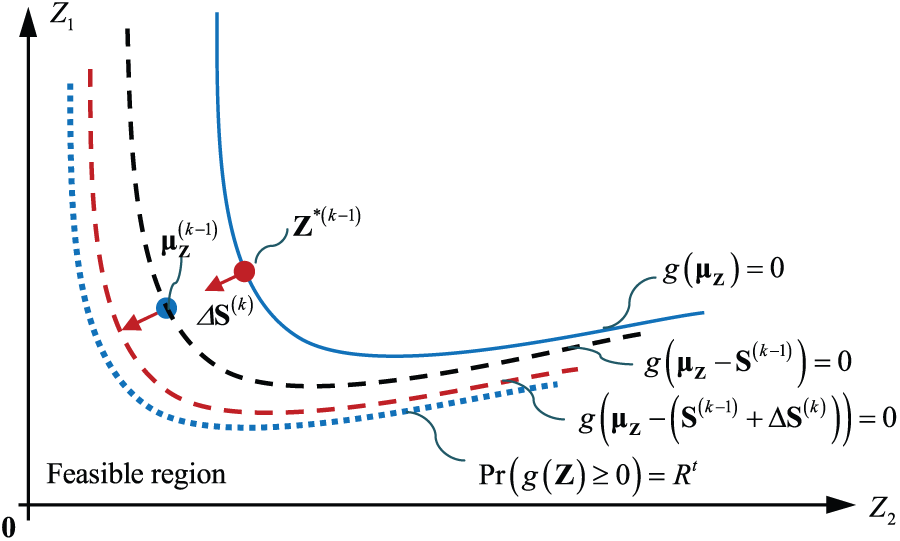
The calculation for the increment of shifting vector.
where the subscript i denotes the ith component of the vector;
After the above equivalent process, the updated deterministic optimization problem as equation (7) is also formulated. The current solution
The computational procedure
As shown in Figure 3, the proposed approach is summarized as the following steps:
Step1: After analyzing the practical engineering problem, the RBDO model is formulated as equation (1).
Step2: Set the iteration step
Step3: Set
Step4: Calculate the reliability index
Step5: Calculate the increment
Step6: Formulate the optimization problem as equation (7) and solve it to get updated solution
Step7: Repeat Step 3 to Step 6 until the following conditions are achieved


The flowchart of the proposed approach.
where
It can be found that all of the above steps are carried out in the original space. Because there is no non-linear transformation for constraint functions, extra error will not be introduced into the reliability analysis compared to other FORM-based approach. It can be also found that the calculation of constraint functions is not necessary for the reliability analysis in all iterations except the second iteration. This can further improve efficiency. These characteristics can be exhibited by example analysis in the nest section.
Numerical examples and discussions
Three examples with different complexity are used to test the proposed approach, which include a standard test case, a structural design problem, and an application of laptop structural design. By comparing the results of SORA, the performance of proposed approach is investigated in terms of accuracy, efficiency, and convergence. To verify the accuracy of all results, the double-loop strategy is used to get reference solutions, in which the sequential quadratic programming 41 is employed to solve the design optimization in outer level, and the Monte-Carlo method 42 is adopted to conduct the reliability analysis in inner level. The number of constraint functional computation is counted to measure the efficiency of the methods. In addition, the same solution parameters and convergence tolerances are set for all methods to keep objective comparisons as possible.
A standard test case
The example is a widely used standard test case for RBDO methods18–25

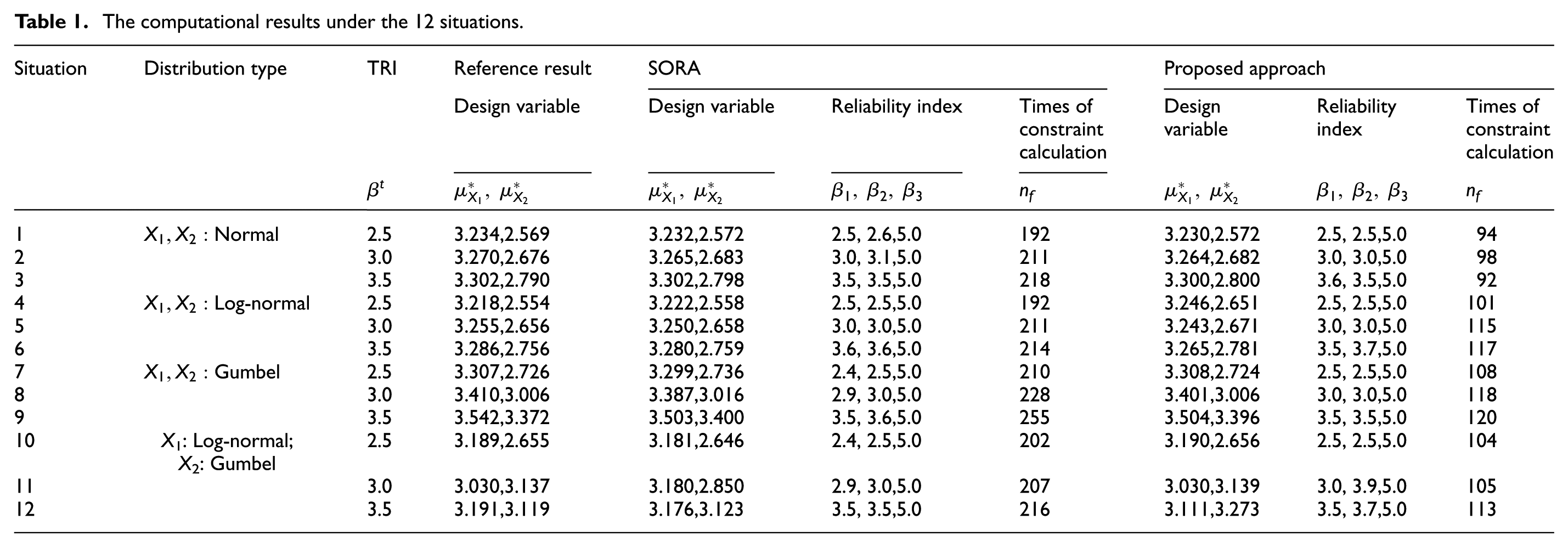
As mentioned above, the difference between the FORM-based methods12,13 and the proposed approach is that the former performs the reliability analysis after mapping the constraint functions into the standard normal space and the latter does it in the original space. To show the impact of this difference on the validity of the results, a variety of situations are considered in solving this problem. First, four distribution situations are set for the two random variables. In the Situations 1–3, their distribution is the same type which respectively is normal, log-normal, ands Gumbel. In the Situation 4,
All calculation results are listed in Table 1. The results show that the optimal design of proposed approach is very close to the reference result and meets the constraint reliability requirements under each situation; while the optimal design of SORA violates Constraint 1 under Situations 7, 8, 10, and 11. In order to analyze the reason, Figure 4 shows the curves of Constraint 1 transformed into the standard normal space under Situations 1, 7, and 10, namely Curve_0, Curve_1, and Curve_2 respectively. Because
The computational results under the 12 situations.
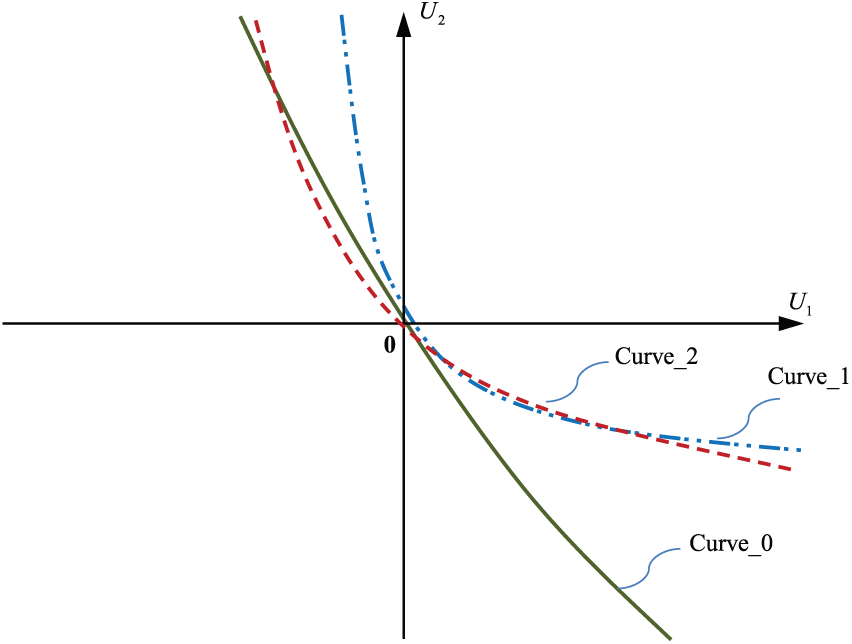
Constraint function curve in the standard normal space.
A structural design problem for a roof truss
Figure 5 shows a structural design problem for a roof truss.
43
The top boom and compression members are concrete, and the bottom boom is steel. Their cross-sectional areas are

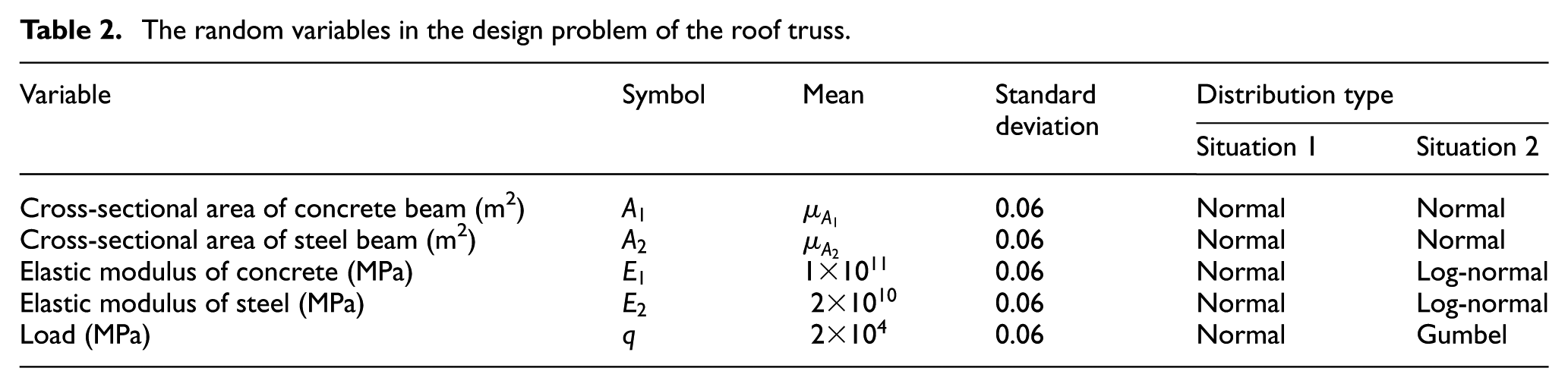
As listed in Table 2, two situations are considered for the distribution type of random variables. The SORA-SPA method and proposed approach are used to solve equation (19) and the same initial design
The random variables in the design problem of the roof truss.
The computational results in the design problem of the roof truss.

SORA-SPA: sequential optimization and reliability assessment—saddle point approximation.

A structural design problem for a roof truss. 36
An application of laptop structural design
A laptop has become an essential tool for many people due to its portability and rich functionality. In order to enhance the market competitiveness, a laptop is designed to be thinner structurally and more powerful functionally. The issue of heat dissipation is always a challenge in the structural design of laptop. Moreover, the user’s settings directly determine the function of the laptop. Therefore, it is significant for a designer to fully consider the uncertainties involved in the working conditions of the laptop. 44
As shown in Figure 6, the structural design problem of a 13-inch laptop is considered based on heat dissipation. The laptop adopts the forced air cooling unit which combining two centrifugal fans with a heat pipe. The heat of key components on the mainboard, such as the central processing unit (CPU) and the graphics processing unit (GPU), is conducted to the heat sink through the heat pipe. Centrifugal fans drive air to enter the laptop from the inlets on sides and pass through the heat sink to take away the heat. In addition, the heat of the mainboard can also be conducted into the ambient through the bracket and cover. In the practical problem, the thickness of the fans, bracket, and cover can be considered as the three design variables, namely
The random variables in the design problem of the laptop.

CPU: central processing unit.

Here, the constraint functions is based on the FEM, which consists of 35,511 eight-node hexahedral elements and 108,612 four-node tetrahedron elements. The FEM under Case 1 or Case 2 is obtained by setting corresponding boundary condition as shown in Figure 7. To achieve parameterization, the second-order polynomial response surfaces of

To test the accuracy of the response surfaces, the comparison between the results of each response surface and corresponding FEM is carried out at six points which are randomly selected in the design space. The results are listed in Table 5. The maximal error of the response surfaces does not exceed 5%. Usually, it is acceptable for such engineering problems.
Accuracy test of the response surfaces in the design problem of the laptop.

FEM: finite element model.

The structural drawing of the laptop.

The FEMs of the laptop.
To better investigate the practicability of proposed approach, the target reliability index
The computational results in the design problem of the laptop.
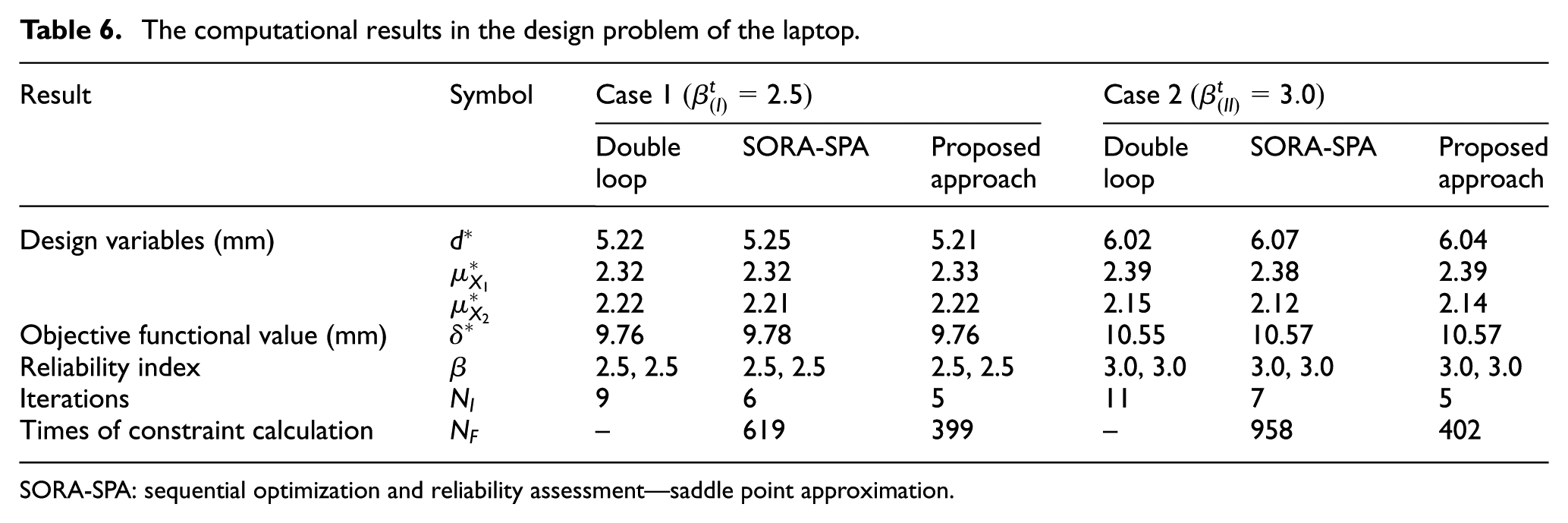
SORA-SPA: sequential optimization and reliability assessment—saddle point approximation.
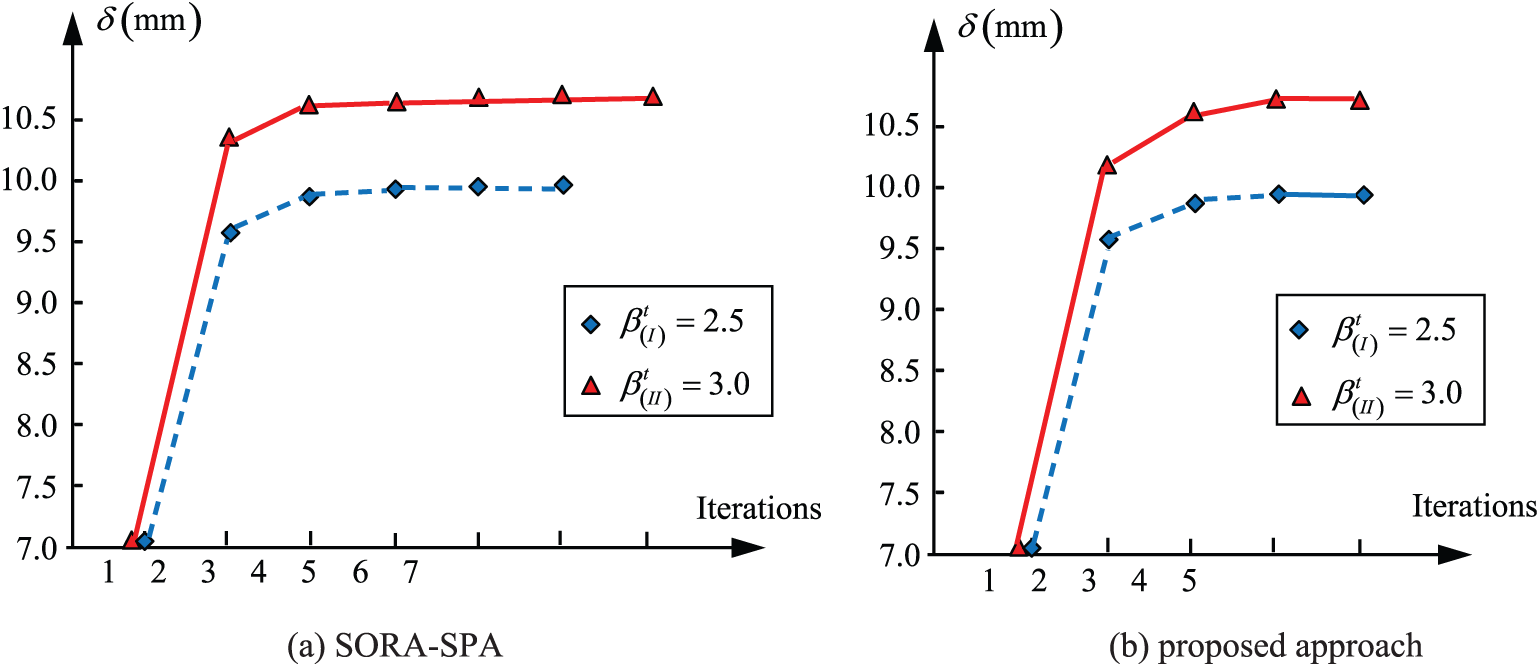
The iterative process for the design problem of the laptop.
Conclusion
In this article, a decoupling approach of RBDO is developed which exhibits a good performance in terms of accuracy and efficiency. This approach is particularly applicable when the non-normal-to-normal transformation increases the non-linearity of probabilistic constraints. The good accuracy is achieved by conducting the constraint reliability analysis in the original space to avoid the error from the non-linear transformation. The high efficiency is obtained by proposing the approximate technology to reduce the calculation times of the constraint function. The convergence is ensured by introducing the concept of increment to drive the equivalent constraint boundary to gradually approximate the probabilistic constraint boundary. The validity and practicability of this approach are demonstrated by two numerical examples and the design application for a laptop. Also, it seems promising to extend the approach to deal with some other important problems in the future, such as system reliability design and multidisciplinary reliability design.
Footnotes
Handling Editor: Michal Kuciej
Declaration of conflicting interests
The author(s) declared no potential conflicts of interest with respect to the research, authorship, and/or publication of this article.
Funding
The author(s) disclosed receipt of the following financial support for the research, authorship, and/or publication of this article: This study was supported by the Major Program of National Natural Science Foundation of China (grant no.: 51490662), the Natural Science Foundation of Hunan Province of China (grant no.: 2017JJ2012), and the Educational Commission of Hunan Province of China (grant no.: 17A036, 17C0044).
