




Abstract
This paper is aimed at proposing a new approach to Reliability-based Design Optimization (RBDO) and applying it to cushioning packaging design with a highly nonlinear system. The problem is formulated as an RBDO problem, which is included a minimizing cost function and probabilistic constraints. Here, the thickness of the cushion material is dealt with uncertainty and uncontrolled parameters. The traditional reliability index approach (RIA) has evolved as a powerful tool to solve the RBDO problem; however, due to its convergence problem, the modified reliability index approach (MRIA) is proposed. Although the MRIA method solves the problems of the traditional RIA, it inherits the low efficiency of searching for the most probability point (MPP). Thus, we developed a novel RIA based on MRIA to improve the efficiency and robustness during the RBDO process. The innovation active set strategy is developed in reliability assessment, which is a strict inequality to determine whether the current constraint is active or inactive. An application example is presented, and the results are compared with MRIA to assess cost-effectiveness and efficiency. Results indicate the proposed method is feasible to solve the uncertainty problem of packaging materials in the processing process and is also an efficient RBDO method.
Introduction
During handling and transportation, a lot of goods are damaged due to various uncontrolled uncertainties, including cushion material properties, drop height, and storage temperature.1–3 Therefore, many methods have been well developed and widely applied to protect the product from the risk of damage.
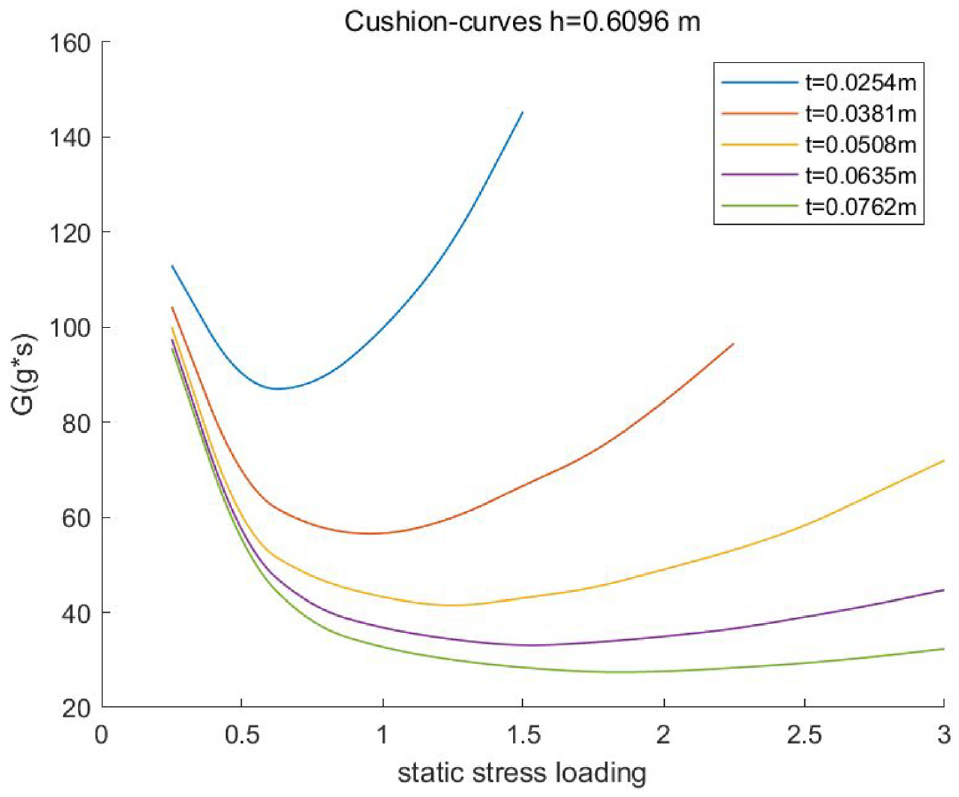
One of the most well-known ways to protect products from damage is to provide a more reasonable packaging based on the cushion curves of a certain material, which is established by ASTM D 1596. 4 The simple cushion curves are depicted in Figure 1, which provide a lot of information, including the G-value (the fragility of the product) vs statics stress, the drop heights (h), and the thickness of the cushion (t). However, it takes a lot of experimental cost and time to generate all the curve information, and the cushion designed in this way is often over-designed. Although it protects the products in the circulation environment, it is at the cost of a lot of materials. Those drawbacks prompted many researchers to establish a simplified cushion-curve method based on the stress–strain curve of the material.5,6 However, this simplified method of establishing the cushion curves is performed well for closed-cell cushion materials and has certain limitations for open-cell packaging materials.7,8 Moreover, the stress–strain characteristics of packaging materials are not willing to be provided by the manufacturer.
A simple cushion-curves.
Another way to protect the product from damage is to make the impact peak acceleration of the product from vibration less than the allowable G-value. Generally, the drop model of the packaging system, like a single-degree-of-freedom or two-degree-of-freedom spring system, 9 is abstracted to assess the damage to the product. Besides, the Transport Packaging Laboratory of Kobe University has conducted a large number of various drop tests and simulations 10 to predict whether the product is damaged or not based on the comparison of the measured impact acceleration with the G-value of the product. Recently, Ge et al. 11 and Ge and Rice 12 have been developed a new non-linear Kelvin foam. After studying its cushioning properties, it can be regarded as a new type of packaging protection material in the future. Although many efforts have been made to protect products from being destroyed, the uncertainties in the transportation process are still one of the great challenges faced by designers. Every year, the product damage and commercial value caused by uncertainties in the circulation environment and is highly due to uncontrolled manufacturing parameters of the cushion are still immeasurable. Therefore, the uncertainties deserve special attention, especially the uncontrolled manufacturing parameters of the cushion.
To date, reliability-based design optimization (RBDO) has been derived as a dominant model to consider uncertainties and is widely utilized in various engineering fields.13–15 RBDO model integrates uncertainty parameters into optimization problems with probability constraints to seek more reliable engineering design and save materials at the same time.16,17 Traditionally, two different approaches, which mainly include the reliability index approach (RIA) 18 and the performance measure approach (PMA) 19 are widely utilized for assessing the probabilistic constraints in RBDO. RIA is developed focused on the concept of the first-order second moment (FORM), 20 which is widely applied to solve RBDO problems. Conceição António 21 proposed a gradient algorithm for RIA, based on the Hasofer-Lind method, 22 and then applied it to the RBDO problem of composite laminates. Tu et al. 23 emphasized that RIA has the disadvantages of convergence problems and numerical singularities. which promotes PMA as a more efficient and robust choice to wisely deal with RBDO problems.24,25 Ting Lin et al. 26 proposed the modified reliability index approach (MRIA) to overcome the disadvantage of RIA by a new definition of reliability index. Although MRIA could converge the optimal solution efficiently and stably in assessing the active probabilistic constraints, it also inherits the low efficiency of searching for the most probability point (MPP); hence, the hybrid reliability method is presented. 27 das Neves Carneiro and António 28 developed a prominent reliability method based on the RIA by introducing the genetic algorithm (GA’s)29,30 with elite strategy into the reliability assessment process to improve the efficiency and convergence of RIA. Although these approaches have been presented to enhance the efficiency of evaluating the failure probability of RIA, the computational cost is still huge in the process of solving the RBDO problem.
In general, the above methods are mainly divided into two strategies, the double-loop strategy (DLS),26,31 the single-loop strategy (SLS), 32 followed by the decouple-loop strategy,33,34 and the hybrid loop strategy35,36 are carried out based on the two strategies. Compared with the DLS and the SLS, the former is simpler and more stable, although DLS has a nested nature. In general, those strategies for assessing probability constraints lead to performing first-order or second-order approximate expansion at the MPP, that is, the first-order reliability method (FORM)37,38 and the second-order reliability method (SORM),39,40 to convert probability constraints into deterministic constraints. The FORM has been widely used in RBDO procedures due to its simplicity and efficiency. Besides, another method of probability assessment is Monte Carlo simulations (MCS),41–43 which is regarded as a robust reliability analysis and often is applied as an auxiliary tool to verify the accuracy of the optimal solution. Nevertheless, if the performance function has a highly nonlinear system, MCS may need excessively time-consuming computational efforts because it requires many sample data, especially in cases with highly nonlinear RBDO problems. Therefore, the FORM approaches based on DLS exhibited a good performance both efficient and robust to assess the failure probability in RBDO.
After an in-depth study, the enhanced modified reliability index method (EMRIA) is proposed to improve the efficiency of MRIA based on the innovation active set and applied to deal with the uncertainty based on cushion thickness in cushioning packaging design. EMRIA can not only improve the accuracy and efficiency in the process of evaluating the failure probability but also provide an optimal and reliable design for cushion packaging design. In the remainder of this paper, a brief reliability methods review is given in Section “Existing relevant reliability index.” In Section “Construct the search region of MPP,” the innovation active set is defined. After that, the details of EMRIA are presented in Section “EMRIA in RBDO.” An application is carried out to demonstrate the superiority and efficiency of the suggested method in Section “Application,” followed by conclusions in the next section. Final section states the further study.
Existing relevant reliability index
The classical RBDO mathematical model is 19

where
Reliability index approach
The system failure probability,

where
Thus, the reliability index

where

Graphical description of
Equation (3) is a sub-optimization to solve MPP and the corresponding reliability index. In equation (3), the reliability index obtained is all positive. If the design point falls within the failure region, then the currently defined reliability index is invalid and will not converge to obtain a true MPP, here, the convergence problem will occur.
Modified reliability index approach
Li et al.
35
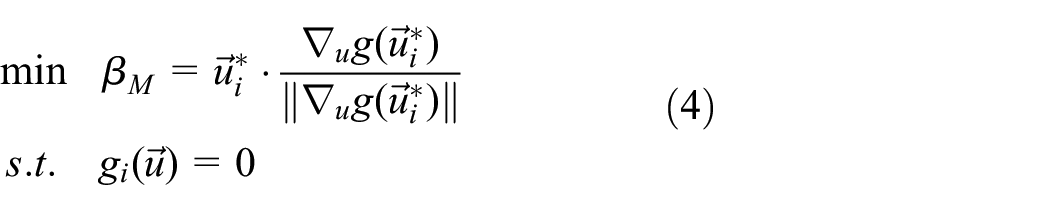
proposed a modified reliability index expression to solve the convergence problems of RIA,
where
This definition takes full advantage of the property that the collinear relationship between vector
Construct the search region of MPP
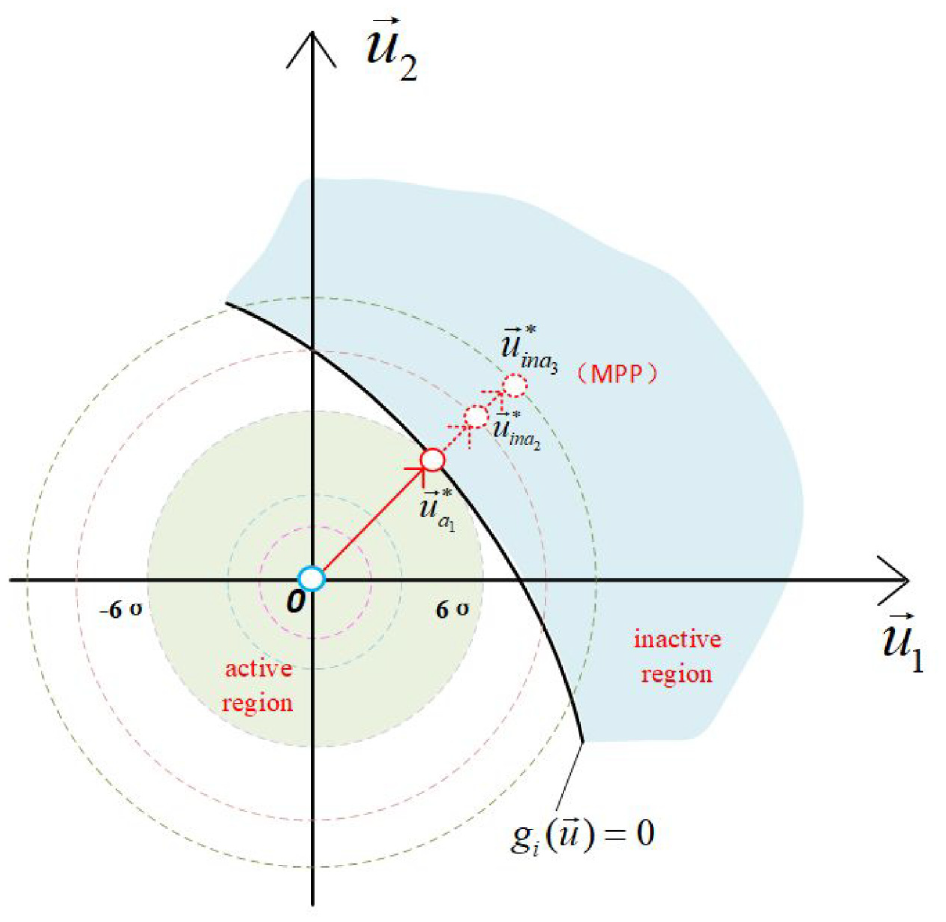
In this section, the EMRIA is presented, which inherits the robustness of the MRIA while improving the search efficiency of the MPP at the same time.
Firstly, the innovative active set (

where
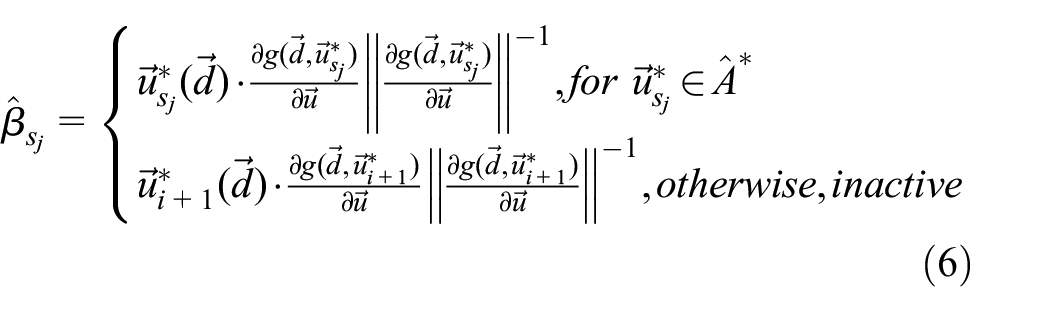
In which
The positional of MPP.
It is worth mentioning that the design and quality of “6-sigma” products have been recognized by the global market because of their high reliability and confidence level.44,45 The “6-sigma” design level is equivalent to a 99.9999998% confidence level, which is significantly more reliable than the 3-sigma design (99.73%). Therefore, we adopt a “6-sigma” design level to assess the reliability of the system.
EMRIA in RBDO
The proposed EMRIA in this paper solves the RBDO problem in equation (1), which mainly adopts DLS. In this section, we will introduce the functions of the inner loop and the outer loop in detail.
FORM for constraint conversion
As mentioned before, a sub-optimization iteration will be executed in the inner loop, which is utilized to solve the MPP

The PDF in
Then, the sub-optimization scheme is normally expressed as:

where

where

where

where
DLS combining the EMRIA
In the outer loop,

where

Combining equations (12), (10, and (6), the optimized iterative scheme of the outer loop is:

where
In the beginning, the initial values,
Application
To demonstrate the ability of the proposed method in RBDO, a practical problem is discussed here. Comparing the convergence results of EMRIA with that of both MRIA and RIA. Among them, function evaluations (FEs) are used as a prominent indicator to evaluate the efficiency of both methods in the entire solution process.
A drop packaging system
A package is depicted in Figure 5, where the product and cushioning materials are idealized as a nonlinear mass-spring system with a stiffness coefficient,

Graphic of a packaged product.
The dropping process of a system is built with the nonlinear mass-spring system, as shown in Figure 6. Here,
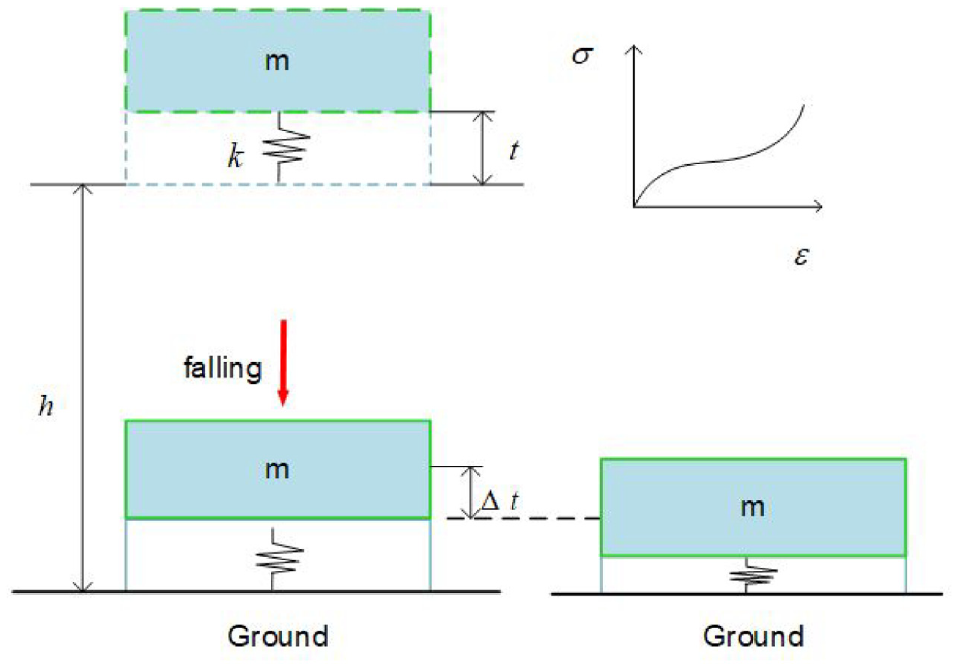
The process of collision between the model and the ground.
In this study, closed-cell foam is used as cushion material in the presented analysis due to its good cushioning property. The relationship between stress and strain is fitted by Matlab and the data from Instron 5566 static compressor, as shown in Figure 7, where the cushion material is placed between two parallel plates. The fitting analytical formula is:

where

Instron 5566.
During the impact, we assume the impact energy is consumed by the cushioning material (without energy loss), which makes the cushion material has maximum deformation. Thus, apply the energy balance as: 48

where
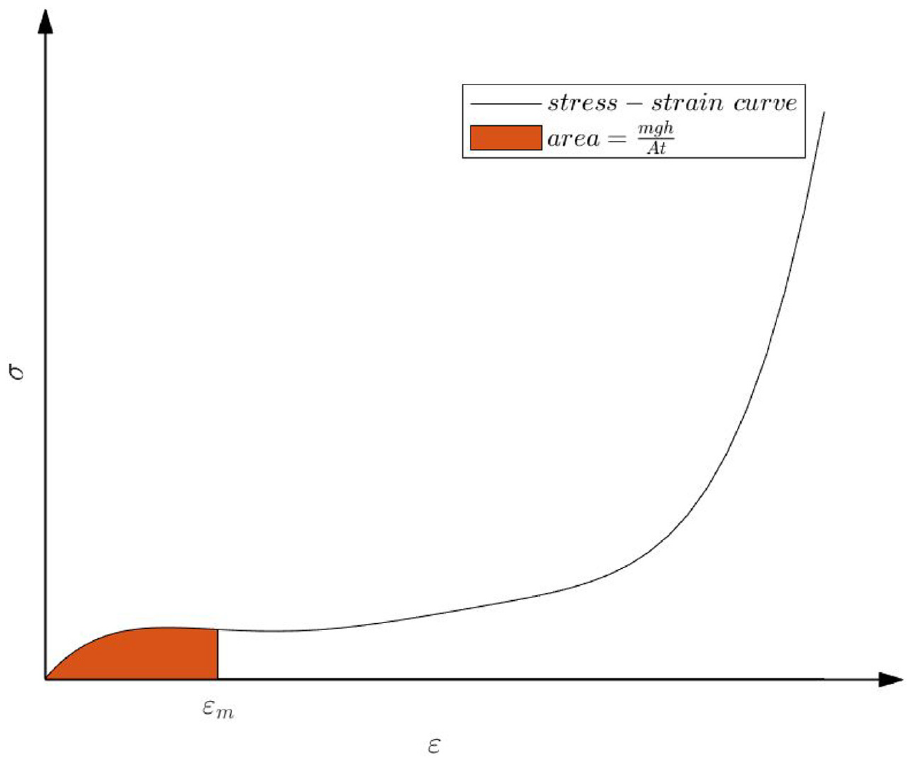
Dynamic stress–strain curve.
Thus, impact acceleration is achieved:

It is worth emphasizing that the maximum impact acceleration is compared with the fragility value of the product to assess the damaged possibility of a shock to the product. 49 The fragility value is the critical acceleration of product damage.
Formulated RBDO
A packaged product with a mass (
Assuming the random variable follows a normal distribution
Design parameters.

The RBDO model contains two highly nonlinear performance functions. One constraint is that the maximum impact acceleration generated during the impact should be less than the G-value of 110 g. The second is that the maximum strain of the cushion cannot exceed the given 0.2. In these two failure modes, the failure probability of the system shall not exceed the target of 3%. In addition, the iteration convergence criterion is set to 10−6. RBDO model is constructed as:

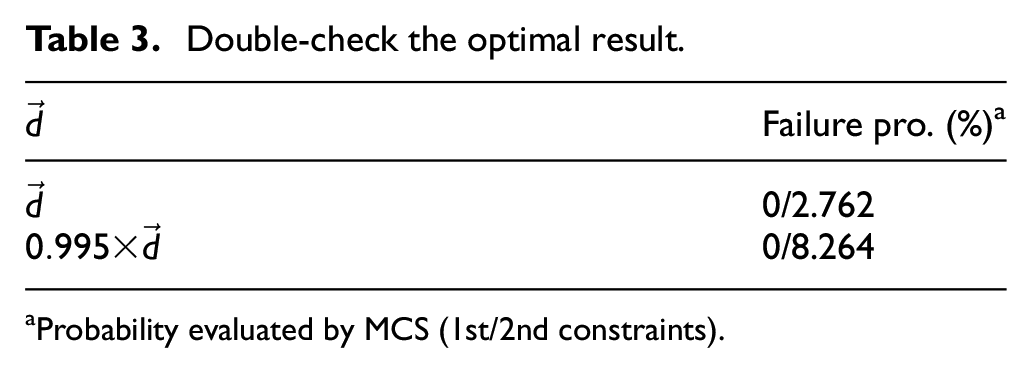
The results of RIA, MRIA, and EMRIA are tabulated in Table 2 for this RBDO problem. From Table 2, all approaches presented the same optimal design point as 0.0365. Meanwhile, the minimum objective function or cost function obtained is also the same as [2.5526e-4] under the same initial setting. However, the converged results obtained by the proposed EMRIA method require 4 iterations (Iter.) and 158 function evaluations (FEs), followed by the MRIA method with 17 iterations (Iter.) and 264 function evaluations (FEs), and finally, RIA 35 iterations (Iter.) and 423 FEs required. It is obvious to conclude that the proposed EMRIA is more efficient and faster than MRIA in the whole solution process. Figure 9 presents the iteration history of both methods in this problem. In addition, the failure probability (Failure Pro.%) of two constraints is evaluated by MCS at the optimal solution based on 106 samples. The outcome results are 0/2.762%, which is almost identical to the allowable failure probability of 3%. It also exhibited the constraint of
Comparative results in MRIA and EMRIA.

Probability evaluated by MCS (1st/2nd constraints).

Iteration history of design variable for the different methods.
In Table 3, the design variable (optimal solution) is reduced by 0.5% which causes the failure probability of the system by nearly 10%. It shows that the obtained result is the optimal and correct solution. Therefore, analysis based on the above results, EMRIA could find the correct optimal solution and show good efficiency and accuracy.
Double-check the optimal result.
Probability evaluated by MCS (1st/2nd constraints).
Conclusion
A novel reliability analysis method of cushioning packaging design named enhanced modified reliability index method (EMRIA) is proposed based on MRIA. The problem is formulated as an RBDO model. The key step of MRIA is to construct the region for MPP search stably and robustly in the inner loop using an innovative active set strategy. This strategy is a strict inequality, which is used to determine whether the current constraint is active or inactive. The active constraint will go into the outer loop to complete structural optimization design analysis, while inactive ones will be discarded. This process is continued to iterate until it stably converges to the optimal solution.
An example of cushioning packaging design was studied. The thickness of the cushion is an uncertain and random parameter, which is related to the manufacturing of the cushion. The results show that EMRIA could converge the same optimal solution as both RIA and MRIA but has higher computational efficiency than RIA and MRIA. In addition, the optimal solution is verified by MCS based on 106 samples, which shows an agreement with the target reliability. The studied cases prove that the developed method not only has the capacity to solve the uncertainty in the cushioning packaging design but also has a better performance than MRIA, in such of efficiency, stability, and accuracy.
Further work
In this work, we demonstrated that the proposed EMRIA has the following advantages:
The proposed EMRIA can be applied to solve the RBDO problems in practical engineering, which can achieve a balance between cost and quality.
The proposed EMRIA is suitable for testing highly nonlinear systems and performs well.
The proposed EMRIA has a prominent characteristic in both efficiency and stability in comparison with MRIA.
The disadvantage of the proposed method is that the conclusion is not robust. A small disturbance of the design variables will cause a greater failure probability of the system. In Table 3, the design variable (optimal solution) is reduced by 0.5%, the Failure Pro.% is close to 10%. It can only show that the obtained result is the optimal and correct solution but not robust. In response to this important issue, we are currently investigating further.
The future work of this paper is as follows,
The research will focus on large and complex engineering field designs of RBDO with multiple design variables and constraints to test the proposed method.
The research will further explore the efficiency of the proposed method compared with the other reliability method-based RIA and PMA.
The research will further verify whether the proposed EMRIA applies to other cushioning materials such as open-cell cushion materials.
Footnotes
Handling Editor: Chenhui Liang
Declaration of conflicting interests
The author(s) declared no potential conflicts of interest with respect to the research, authorship, and/or publication of this article.
Funding
The author(s) disclosed receipt of the following financial support for the research, authorship, and/or publication of this article: The author gratefully acknowledges the support from the National Natural Science Foundation of China [grant number 51679056]. The author thanks the Packaging Laboratory of Rutgers, The State University of New Jersey.

Data availability statement
Data will be made available on reasonable request.