




Abstract
As a common nature gas measuring tool, ultrasonic flow meter is more and more put into use. Therefore, the accuracy of measurement is what we concern the most. The performance of ultrasonic flow meter is closely related to fluid state which flows through it. This article identified the evaluation method of rectification effect of gasotron and its implementation steps. It proposed an assessing index Lmin based on dichotomy. Computational fluid dynamics method is used to simulate the model of an upstream straight pipe section with a header and plate gasotron, which obtained the assessing index Lmin in five different transmission conditions. Finally, the feasibility of the gasotron is validated against comparing indication errors in different installation conditions: with a header, benchmark, with a header and gasotron.
Keywords
Introduction
Based on the working principle of ultrasonic flow meter, its calculating model is supposed to be used in ideal flow field to remain valid, so the accuracy of ultrasonic flow meter is affected by the profile of flow field state. 1 For certain complex spaces, the performance of ultrasonic flow meter will decline, where there are installation restrictions or the pipe has a blocking component and cannot contain enough straight pipe to render the flow into ideal state. 2 To ensure that the flow fully develop into steady state before reaching ultrasonic flow meter, there usually are some installation requirements for the length of the upstream straight pipe of the meter. For place with space restriction, we have to shorten the length of the pipe or add a gasotron to make offset. Mattingly and other scholars tested the velocity distribution, turbulence intensity, and swirl angle of single-bend pipe and double-bend pipe in different planes. In addition, the needed straight length between the single-bend pipe and the double-bend pipe was studied, which was used to eliminate the non-planar double-bend swirl angle. 3 Morrow et al. 4 proposed that besides the velocity distribution of flow field through the flow meter was supposed to fully developed, the turbulent flow structure also should be close to the fully developed flow; otherwise, the fluid will be unstable and will re-develop into a non-uniform flow. Therefore, to ensure the measurement accuracy of the throttling flow meter, the flow field distribution needs to achieve no-distortion flow state. EM Laws pointed out that each flow-distortion factor has a good or bad influence on orifice flow meters compared to the no-vortex full development flow. As a consequence, when more than one influencing factor occurs at the same time, sometimes, the orifice flow meter’s discharge coefficient decreases. 5 In terms of the asymmetry of velocity distribution, vortex, and turbulent structure, the effect of each flow-distortion factor on flow meter measurement has been studied by many scholars. For example, Morrison tested the influence of different inflow velocity distributions on the outflow coefficient Cd of the orifice flow meter. It was found that the pressure drops as the flange connection increases with the increase in the momentum in the wall area, as the result of the increase in the pressure gradient across the orifice plate near the wall area. And, with the increase in the momentum in the wall area, the outflow coefficient Cd decreases. The plate with β = 0.75 is more sensitive to the variation of inflow velocity than β = 0.5.6,7 In addition, the influence of vortex on the axial pressure distribution of orifice flow meters has been studied. 8 Vortex are generated using a vortex generator. 9 Lee 10 simulated the plate and tubular gasotron working on the pipe with diffused section by computational fluid dynamics (CFD), which validated the practicability of gasotron. Qu 11 analyzed the flow velocity profile of pipe with non-plane dual bend and half-open valve, respectively, and mounted four types of rectifier comparing to the non-gasotron one by particle image velocimetry (PIV). Liu and Huang 12 proposed an evaluating method for the effect of rectifier based on water flow model. Based on three well-known British laboratory tests, Smith determined the optimal installation position of the Sprankle, Zanker, and other tube bundle rectifiers upstream of orifice flow meters with 100 mm diameter and 250 mm diameter. Under this two flow meter sizes, the optimal position of the tube bundle rectifier is 10–15 times the tube diameter. 13 JA Brennan et al. 14 studied the influence of several typical rectifiers and their mounting locations on the accuracy of flow rate measurements. laser Doppler velocimetry (LDV) equipment, laser Doppler anemometry (LDA), and PIV technology have been used to measure the flow velocity distribution after the rectifier.15–19 EE Essel et al. 20 used the PIV to obtain the flow field of the water after passing the rectifier in the slim pipe. Laws summarized the research on flow rectifiers, to ISO 5167, which mainly includes tube bundle, Sprankle, and Zanker flow rectifiers. Plate gasotron mostly is used at upstream of ultrasonic flow meter. This study adopted 19-hole plate gastron. 21 As we can see, the study for evaluating rectifying effect of rectifier generally is about liquid flow and differential pressure or orifice flow meter. The previous research mainly discussed the parameters affecting the ultrasonic flow meter and the gasotron. The purpose of this study is to identify the calculation steps of assessing index Lmin for rectification effect of the gasotron by dichotomy. It calculated the Lmin for gas pipe with a header and plate gasotron numerical modeling in different transmission conditions based on CFD method. On comparing benchmark date, indication errors performed consistency well, which validated the feasibility to mounting gasotron when there is spatial limitation. In summary, this study intends to propose a set of system rectifier performance evaluation methods to optimize the performance of ultrasonic flow meters and verify its feasibility based on CFD.
Methods
Mathematic model
The standard k-ε model is often used for isotropic uniform turbulent flow, such as circular pipe. It obtains the solution of k and ε by solving the k-ε two-equation model,22–25 then calculates the turbulent viscosity using the solutions of k and ε, and finally obtains the solution of the Reynolds stress by the Boussinesq assumption. In 1972, Launder and Spalding introduced a turbulent dissipative rate ε equation based on the turbulent kinetic energy k equation and developed the k-ε two-equation model, as described below:
k equation
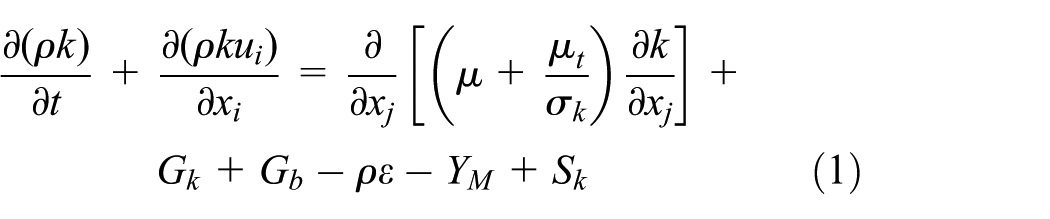
where Gk is turbulent kinetic energy induced by average speed gradient, and Gb is turbulent kinetic energy induced by buoyancy effect. β is thermal expansion coefficient. Ym is the effect of compressible turbulent pulsating expansion on the total dissipation rate. σk is the Prandtl number corresponding to kinetic energy. The default value in FLUENT is 1.0:
ε equation

where C1ε, C2ε, and C3ε are empirical constants. The default values in FLUENT are 1.44, 1.92, and 0.09, respectively.
Gasotron effect evaluation
To evaluate the rectifying effect of the gasotron on the fluid flow state, a method to estimate the stability of the flow velocity in the cross section of the pipeline is proposed. The simulation values in the cross section are compared with the theoretical calculation values.
Select a cross section of the pipeline, then determine the stability of the selected cross section based on its flow velocity profile. As shown Figure 1, to r1 = r, r2 = 2r, r3 = 3r, r4 = 4r, and r5 = 5r radius concentric pipe cross section for each, where r = 0.2R, mark the simulating flow velocity of point each concentric circle intersecting with its own two mutually perpendicular diameters and the center of the circle as ui, where i = 0, 1, 2, …, 20.

Velocity sampling point in pipe cross section.
Define ei as difference value between ui and vi, where vi is theoretical calculation speed. vin is the boundary speed in simulation. If for all i = 0, 1, 2, …, 20, the following formulas are satisfied, it can be determined that the medium velocity field on the cross section is in a stable state; otherwise, the cross section is considered to be a non-stable flow velocity cross section


To quantify the rectification effect of the gasotron, an evaluation index Lmin was introduced. The physical meaning of the index is the length of the straight pipe required to render the distortion flow into stable flow state after rectifying by the gasotron.26–29
Basing on the stability estimation above, in the calculation of the rectification evaluation index L, the basic idea dichotomy is adopted. As shown in equations (5) and (6), by n times calculations, to identify whether the velocity of the cross section Ln is stable, for Ln satisfying equation (6) is supposed to be required result Lmin


The implementation is as follows:
Step 1. First of all, the section of the gasotron downstream length L1 is arbitrarily selected to estimate the stability of the flow velocity. According to the simulation results, the velocity values of each point on the cross section of the pipe are obtained. The stability of the flow velocity at the cross section of L1 is determined by equations (3) and (4). Then, find a cross section through which the flow velocity distribution is stable.
Step 2. Select the cross section of the gasotron downstream length L2 = 0.5 L1, repeat evaluation method of step 1 to find a cross section through which the flow velocity distribution is unstable.
Step 3. Select the cross section of the gasotron downstream length L3 = L2 + 0.5(L1 – L2), repeat evaluation method of step 1 to find a cross section through which the flow velocity distribution is stable and judge whether|L3–L2| satisfies for equation (6); if it does, end the calculation and take L3 as Lmin, if not, select the cross section of the gasotron downstream length L4 = L3 + (L2 – L3) and repeat the step above until finding a stable one and stratify equation (6).
Case study
Modeling
According to previous research, the header type DN300×2600 (P = 6.93 MPa) is selected to model for its high distortion to flow. Since plate gasotron is the widely used upstream ultrasonic flow meter, its modeling is employed in this study. As shown in Figure 2, the geometry model is set up by Pro/E. The origin of coordinates is at the intersection of the axis of the cross section of the header with the axis of the inlet straight section. The pipeline length from the entrance to the header (L3) is set to three times the diameter (3D) of itself and the length from the header to the gasotron (L1) is 6D. The metering length is 4D (i.e. length of the ultrasonic flow meter), and the distance between gasotron and the ultrasonic flow meter is 16D. The diameter of the metering pipe is DN150.
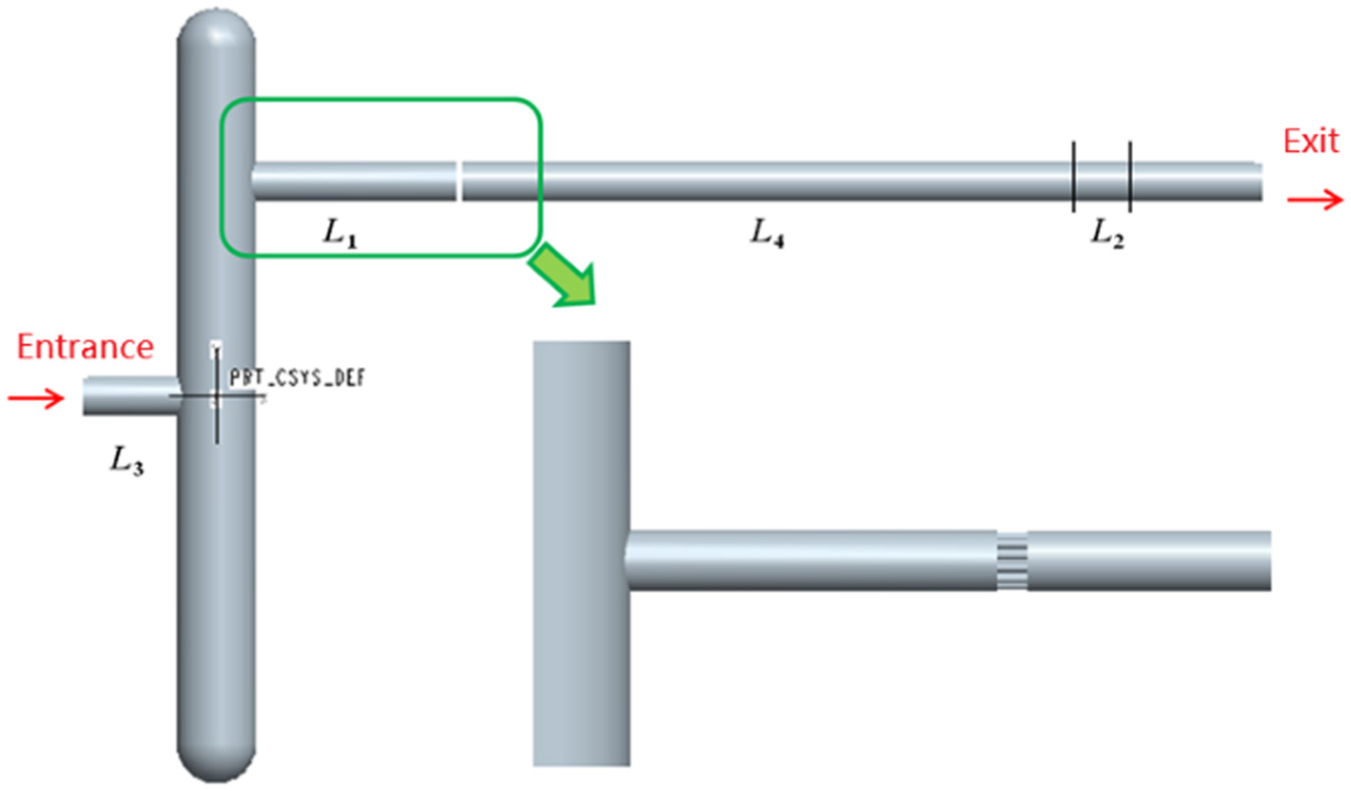
Geometry model of header and gasotron on metering segment.
The three-dimensional model was imported into ANSYS-ICEM to be meshed. The grid model is shown in Figure 3, with 624,255 grids totally for the calculation.

Grid model of gasotron on metering segment.
The distribution of the internal gas flow field with different transmission flows Q and the length L of the downstream straight pipe section is analyzed. The header is DN300×2600 header, and the diameter of downstream pipe is DN150; three sets of simulating scenario results for comparative analysis: benchmark, header and 30D straight pipe, header and 19-hole plate gasotron, respectively.
Boundary conditions
The inlet boundary condition is “Velocity-inlet,” the exit boundary condition is “outflow,” and the wall boundary condition is default and “no slip” is employed. The operating temperature is 12°C, and the operating pressure is set as 0.8 MPa. The gas density is 0.68 kg/m3, and viscosity is 1.603 × 10⁻⁵ m2/s. The velocity of sound is 340.3 m/s. Table 1 shows the boundary conditions and flow velocity stability estimating value (i.e. Δv) in five different transmission conditions as follows.
Boundary conditions and flow velocity stability estimating value.

Results and discussion
The theoretical velocity of the sampling point in the cross section can be obtained (Figure 1), as shown in Table 2.
Theoretical velocity of the sampling point.

The XY profile global velocity cloud around the gasotron (red area in Figure 4) in five transmission conditions are shown as below.
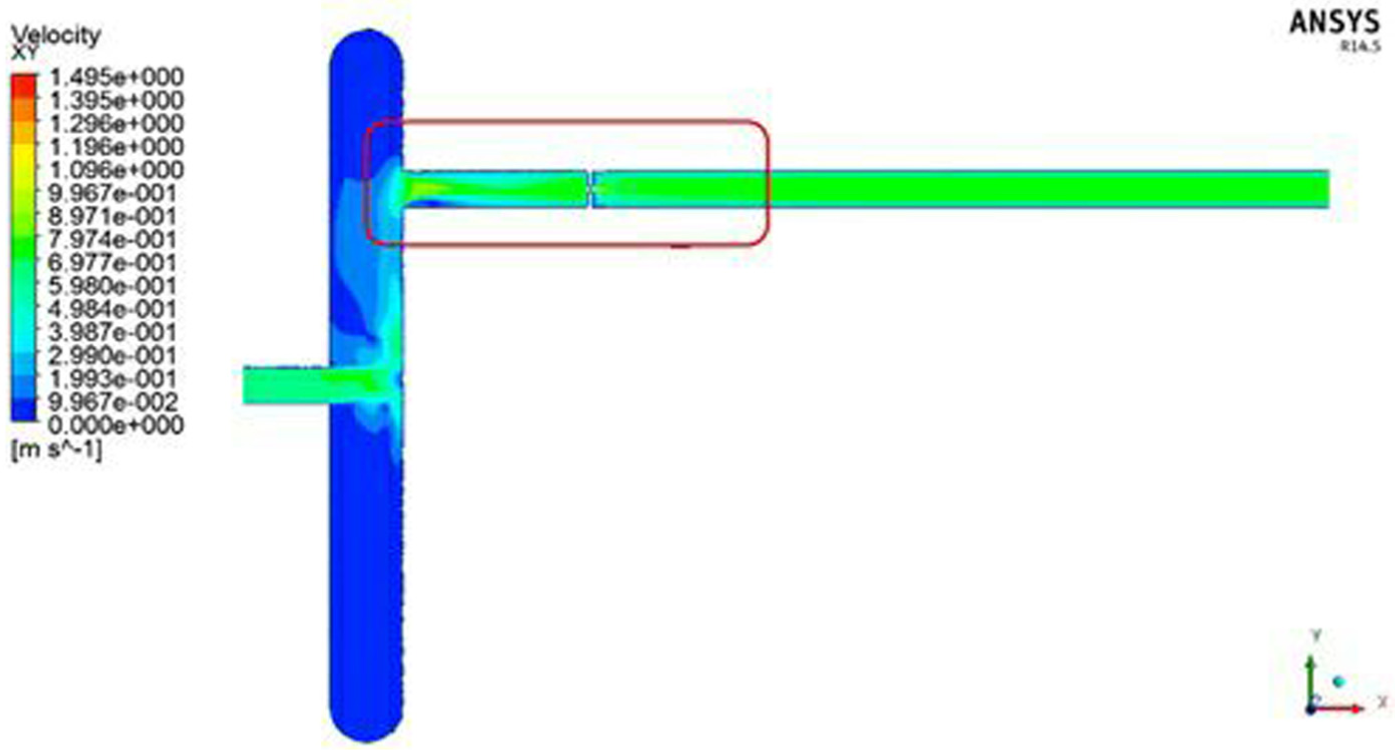
Contours of the XY velocity (Q = 39.71 m3/h).
Figure 5 indicates qualitatively that vortex and asymmetric flow distribution as a result of distortion by header developing into stable flow state soon after rectified by gasotron. It represents the XY profile global velocity cloud when the flow is 39.71, 215.71, 558.86, 875.73, and 2131.91 m3/h, respectively.

Contours of the XY velocity with different flow rates: (a) Q = 39.71 m3/h, (b) Q = 215.68 m3/h, (c) Q = 558.86 m3/h, (d) Q = 875.73 m3/h, and (e) Q = 2131.91 m3/h.
Figure 6 shows the velocity distributions across the cross section of different downstream lengths when the flow rate is 875.73 m3/h.

Velocity distributions across the cross section of different downstream lengths (Q = 875.73 m3/h).
It can be seen that the flow velocity profile represents relatively uniform concentric circles distribution at L = 10D. Read the simulating velocity ui at each sample point marked in Figure 1. According to Table 2 and Figure 6, for each i = 0∼20, equation (3) is established, where Δv = 0.2Vin = 2.754 m/s. It does not satisfy ∣Ln–Ln–1∣ ≤ 0.5. Therefore, select L2 = 0.5 L1 and repeat the steps before. If the velocity of cross section at L = 5D is unstable, then increase the L. We can obtain Ln = 6.719D and Ln – 1 = 6.563D satisfying above requirements. Therefore L = 6.719D can be determined as Lmin when Q = 875 .73 m3/h. The rectifying effect of rest of other four transmission conditions can be figured out by above steps, as shown in Table 3.
Lmin in five transmission conditions.
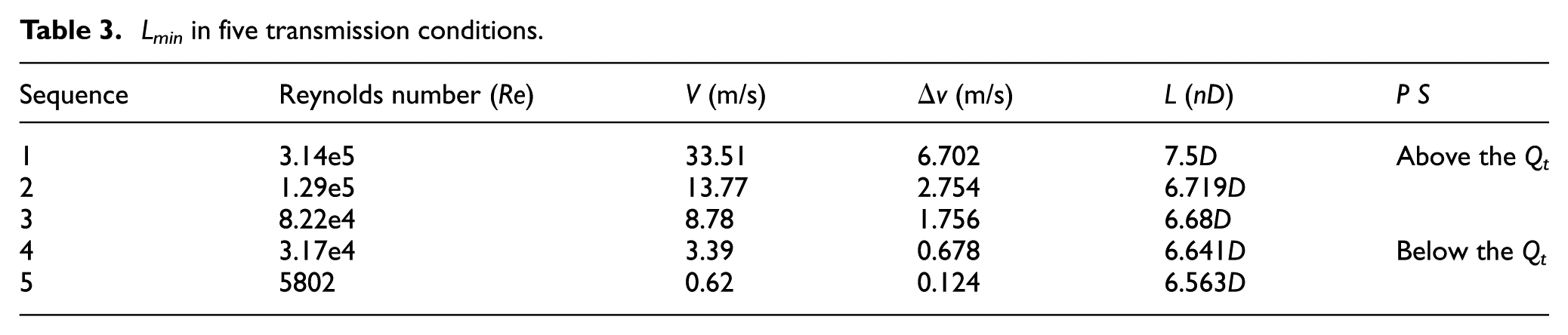
It indicated that the installation of the flow meter at the downstream L = 8D of the gasotron can ensure the flow field of the gas downstream header and gasotron stable when the ultrasonic flow meter working in five groups of transmission conditions, while the required straight pipe length is 27D for stability of flow state and indication errors with no gasotron at the pipe with header.
According to simulating results in three installation conditions, indication errors can be obtained. As previous study shows that when there is a header upstream located on pipeline, 27D straight pipe section at upstream of pipeline is supposed to be ensured to render the gas flow into uniform stable state.30,31 Therefore, Figure 7 shows the indication errors in header with 27D straight pipeline, benchmark, and header and gasotron with 8D straight pipeline, such three installation conditions.

The trends of indication errors in different installation conditions.
In benchmark, gas enters the measuring pipe section, of which diameter is DN150, through the header, the length of straight pipeline at upstream of ultrasonic flow meter is 160D, a plate gasotron is installed at 10D upstream of ultrasonic flow meter, and the downstream length of gasotron is 20D. The ultrasonic flow meter adopted for measurement is Daniel SeniorSonic™, which flange with measuring pipe section. As we can see when the gas flow state reaches a steady state, the indication errors range of the flow value on each cross section is 0.32%–1.47%. When there is a header and gasotron on the pipeline, the trends of indication errors and its values are basically similar. The offset range is between 0.03% and 0.2%. The detail information is shown in Table 4; when the flow rate is below Qt, the simulation errors of case 1 exceeds ±1%, which does not meet the minimum performance requirements of the ultrasonic flow meter. In the other two installation conditions, the errors below the Qt is within ±1%, the mean values are 0.75% and 0.82%, while the indication errors above the Qt are both within ±0.5%, the mean values were 0.32% and 0.39%, respectively. It means the installation of gasotron at D > 8D upstream the ultrasonic flow meter could improve the metering accuracy well.
Indication errors in different installation conditions.

According to JJG 1030-2009 “Ultrasonic Flowmeter” verification regulations, since the installation of gasotron at D > 8D upstream of the ultrasonic flow meter, the flow state has been restored to the performance range that the flow meter can compensate. 2
Conclusion
This study systematically identified the evaluation method of rectification effect of gasotron and its implementation steps. The CFD method was used to simulate the geometric model of the header and plate gasotron in the upstream straight section of the flow meter and obtained quantitatively the Lmin in different transmission conditions. When length of downstream gasotron straight pipeline L > 8D, the flow fields can all reach stable state at given transmission flow rate. Comparing indication errors in three different installation conditions—pipeline with header, benchmark, and pipeline with header and gasotron—on which when there is a header and gasotron upstream of the ultrasonic flow meter, the changing range of indication error basically being accordance with ones in benchmark, within 0.03%–0.2%, while the other two conditions the indication error both within ±0.5%, all satisfy the relevant standards stipulated ultrasonic flow meter minimum performance requirements. The feasibility of gasotron was validated.
Footnotes
Handling Editor: Hongfang Lu
Declaration of conflicting interests
The author(s) declared no potential conflicts of interest with respect to the research, authorship, and/or publication of this article.
Funding
The author(s) received no financial support for the research, authorship, and/or publication of this article.
