



Abstract
In this study, a stochastic user equilibrium model on the modified random regret minimization is proposed by incorporating the asymmetric preference for gains and losses to describe its effects on the regret degree of travelers. Travelers are considered to be capable of perceiving the gains and losses of attributes separately when comparing between the alternatives. Compared to the stochastic user equilibrium model on the random regret minimization model, the potential difference of emotion experienced induced by the loss and gain in the equal size is jointly caused by the taste parameter and loss aversion of travelers in the proposed model. And travelers always tend to use the routes with the minimum perceived regret in the travel decision processes. In addition, the variational inequality problem of the stochastic user equilibrium model on the modified random regret minimization model is given, and the characteristics of its solution are discussed. A route-based solution algorithm is used to resolve the problem. Numerical results given by a three-route network show that the loss aversion produces a great impact on travelers’ choice decisions and the model can more flexibly capture the choice behavior than the existing models.
Keywords
Introduction
In transportation system, uncertainty is unavoidable and plays an essential role in travel choice decision. So, reliability-based network equilibrium problems in a stochastic network have recently attracted more and more attention.1,2 The variations of the supply and demand in a transportation network are primary sources of uncertainty. On the supply side, the roadway capacity can be degraded because of traffic incidents, weather conditions, traffic management and control, work zones, and so on. On the demand side, traffic demand is constantly changing over time because of special events, traffic policy, travel information, and so on. Both supply and demand variations will result in stochastic route travel time. Empirical studies also indicated that travel time uncertainty was one of the three most important factors influencing route choice considerations for commuters.3–5
Within the framework of user equilibrium (UE) model, travelers in the network are assumed to be perfectly rational and choose routes to minimize their travel costs or generalized travel costs. This decision-making mechanism is widely used in traffic network modeling but has been criticized for ignoring travelers’ preference differences and cognitive limitations.6–8 Daganzo and Sheffi 9 developed the stochastic user equilibrium (SUE) model with travelers’ perception errors. Subsequently, prospect theory (PT), 10 cumulative prospect theory (CPT), 11 and regret theory (RT)12,13 have been successively introduced to describe travelers’ choice behavior more precisely. For example, Xu et al. 14 extended the travel time budget (TTB) model to bounded rationality by introducing CPT and proposed the prospect-based user equilibrium (PUE) model.
The random regret minimization (RRM) is based on RT, a new behavior decision prediction approach, which is seen as the alternative of the random utility maximization (RUM) model.15,16 In the regret function of RRM model, two max operators are adopted to determine the regret of considered alternative through comparing it with other alternatives for different attributes. However, some derived difficulties are incurred due to the presence of two max operators. Subsequently, the new RRM model was developed by replacing one max operator with a summation, and another one with a Logsum formulation. 17 These changes make the likelihood function become smooth and estimable. Moreover, the Logsum-approach results in a continuous and monotonic increasing function with respect to attribute difference. The new RRM model has been seen as the classical RRM model, and the scale features of its regret function were discussed in van Cranenburgh et al. 18 Henceforth, the mentioned RRM model in this article refers to the classical RRM model. The RRM model assumes that travelers are always inclined to choose the alternatives with the least anticipated regret. It can be easily estimable using many conventional discrete choice software packages due to its characteristics of multinomial nested logit (MNL) choice probabilities. Recently, the RRM model has been extensively applied to explain the choice behavior of decision makers in different contexts, such as route choice, the automobile fuel choice, and the consumer choice.19–24
In general, the TTB model is widely used to model travelers’ choice behavior under risk. 25 And the TTB consists of the expected travel time and an excess budget ensuring on-time arrival. However, TTB model only considers the reliability aspect and ignores the unreliability impact. For the purpose of incorporating both these aspects simultaneously, Chen and Zhou 26 proposed a new traffic equilibrium model based on the definition of TTB, which is named the mean-excess traffic equilibrium (METE) model. Subsequently, Chen et al. 27 further extended the METE model by introducing travelers’ perception errors and developed the stochastic mean-excess traffic equilibrium (SMETE) model. More recently, multi-objective equilibrium problems have been intensively studied and discussed.28–31 These studies revealed that the generalized cost or linear combination methods may miss some efficient routes that are not at extreme points. In particular, Wang et al. 29 proposed the UE condition with double objectives in a stochastic network, in which no traveler can improve any one of both without deteriorating the other target by unilaterally changing routes.
Note that the TTB model still belongs to the framework of linear-additive RUM principle criticized widely. Meanwhile, as Sun et al. 30 pointed out, the TTB is not actual travel time but the longest time travelers can endure for a trip, and the expected travel time is the time that travelers hope to spend in traffic. One possibility is that travelers tend to minimize their expected travel time and unreliability simultaneously. More specifically, the expected travel time and travel risk can be considered separately, and travelers prefer to choose the routes with the least and most reliable travel times. The RRM model provides an opportunity to make travelers perceive the changes of attribute performance on the considered route when choosing between alternatives. The outcomes of changes are incorporated into the attribute-level regret function to reflect the emotion experienced of travelers. Then, travelers make relevant decisions to minimize the negative emotion, namely, the regret.
Though the difference between the regret and rejoice induced by the loss and gain with same size exists in the RRM model, it is only caused by the taste parameter. 18 The taste parameter in the model reflects travelers’ decision characteristics in both aspects: one is the importance of the relevant attributes and the other is the relative significance of the regret and rejoices. That is, the difference is determinate when the taste parameter adopts a fixed value. Moreover, the difference disappears when the taste parameter is a smaller value. However, as we know, travelers are commonly loss averse, which implies that travelers are more sensitive to losses than gains.32–34 More specifically, even though travelers have the uniform preference for the regret and rejoice, the difference between the regret and rejoice induced by the loss and gain with same size may still exist due to loss aversion. Hence, we infer that the loss aversion may be ignored so that result in the disappearance of the difference under a smaller taste parameter in the RRM model.
This article aims to fill in such a literature gap by incorporating the loss aversion of travelers to develop a modified random regret minimization (MRRM) model. In the MRRM model, the difference between the regret and rejoice induced by the loss and gain with same size stems from two aspects: one is the taste parameter reflecting the relative significance of the regret and rejoice and the other is the loss aversion of travelers. In addition, the variational inequality (VI) problem of the proposed MRRM-SUE model is given and the method of successive average (MSA) 35 is adopted to address this problem. The comparisons between the RRM-SUE and the MRRM-SUE models are conducted in an example network.
The other parts of this article are organized as follows. The following section provides the restatements with respect to TTB and RRM models and develops logit-based equilibrium models. In section “A new route choice model,” a new regret-based SUE model considering the loss aversion of travelers is proposed, and its equivalent VI problem is formulated and resolved using the MSA algorithm. An example network is adopted in section “Numerical example” to reveal the performance of the MRRM-SUE model and compare it with other models. Section “Conclusion” provides the conclusions of this article.
TTB-SUE and RRM-SUE models
Consider a stochastic network
Throughout this article, the link travel time in the transportation network is expressed as follows

where


where


The TTB-SUE model
Lo et al.
25
proposed the TTB model for degradable transport network. A route’s TTB consists of the expected travel time and an excess budget ensuring on-time arrival. Within the framework of TTB model, travelers can endure a longer budget time to make themselves arrive on time within a predefined confidence level

where

Obviously, formula (7) can be rearranged as

Let

Under the SUE condition, none of travelers can improve his perceived travel cost by unilaterally switching routes. In the TTB-SUE model, the travelers’ route choice follows the RUM principle and travelers tend to choose the routes with the least perceived TTB. The perceived budget

where

where
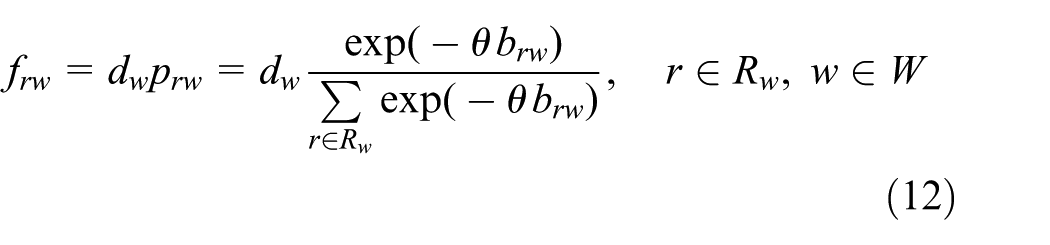
Apparently, the equilibrium flow pattern determined by the TTB-SUE model depends not only on the considered route TTB but also on other alternative TTB.
The RRM-SUE model
The RRM model is a relatively new discrete choice approach. The model postulates that people prefer to choose the alternatives with the least anticipated regret when choosing between alternatives. Meanwhile, it also can capture semi-compensatory choice behavior of decision makers.
The regret function is the center of the RRM model. It can be determined by equation (13), which was first proposed by Chorus 17 to smoothen binary regret proposed by Chorus et al. 15 which utilized two max operators

where
In the RRM model, the difference between the regret and rejoice induced by the loss and gain with same size is only caused by the taste parameter. The study by Van Cranenburgh et al. 18 can be referred for detailed description. Moreover, the difference disappears when the taste parameter is a smaller value. However, to the best of our knowledge, travelers have the characteristics of loss aversion in the decision-making processes. That is to say, travelers’ preference is asymmetric when facing a loss and an equivalent gain. More specifically, even though the regret and rejoice are of equal importance for travelers, the difference between the regret and rejoice induced by the loss and gain with same size may still exist due to loss aversion. In this regard, we intend to develop a new regret-based route choice model by introducing travelers’ asymmetric preference for gains and losses in the following section.
In the RRM-SUE model, travelers are more inclined to minimize their perceived regret. The perceived regret

where


It is observed that the equilibrium flow pattern in the RRM-SUE model not only depends on the considered route’s performance but also is affected by the performance differences between the considered route and other competitive alternatives in the choice set.
A new route choice model
The attribute-level binary utility function with asymmetric preference
In order to incorporate the loss aversion into the RRM model, an attribute-level binary utility function considering gain-loss asymmetric preference is proposed in this subsection. Let
Assumption 1:
Assumption 1 implies that the binary utility function only depends on the difference between the considered alternative
Assumption 2:
Assumption 2 indicates that the binary utility function belongs to attribute-level utility function. Travelers have to make a trade-off between alternatives for different attributes. Meanwhile, it also implies that the attribute differences on different attributes will be perceived separately.
Assumption 3:
Assumption 3 is imposed to describe travelers’ asymmetric preference on potential gains and losses. Travelers are assumed to be much more sensitive to potential loss than gain with equal size.
The MRRM-SUE model
Through comparing the considered alternative and other alternatives, the binary regret can be determined by perceiving the regret caused by losses or the rejoice incurred by gains in terms of a special attribute. Different from the regret function of the RRM model, travelers’ loss aversion is incorporated into regret to develop a new binary regret function

where
To illustrate the relationship between the new regret function and attribute difference and reveal the difference of both binary regret functions, the shapes of both functions with equal taste parameter
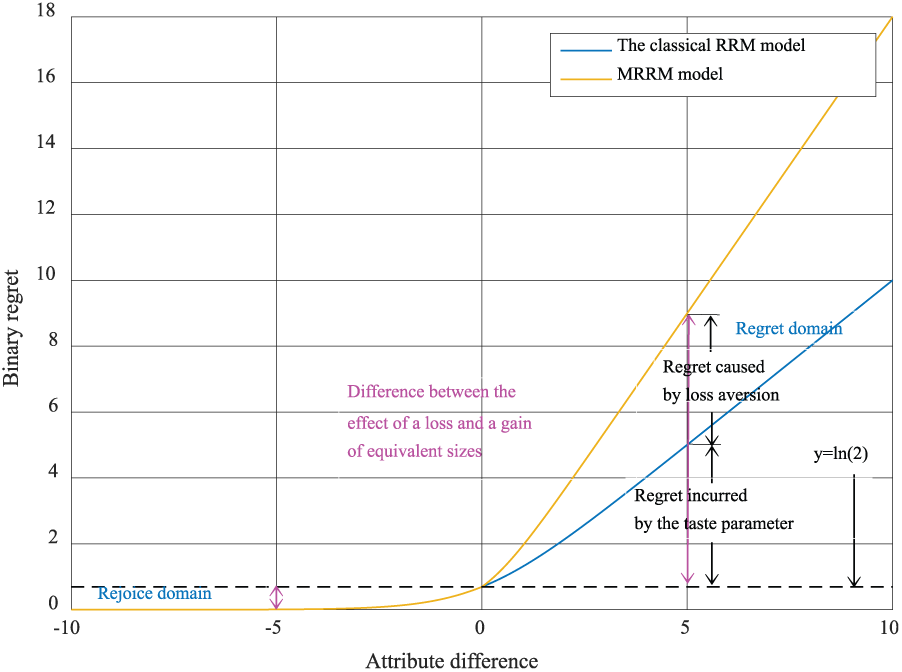
The regret function of MRRM model.
In order to further analyze the effects of the taste parameter on the regret function of the MRRM model, the taste parameter with different sizes is adopted in Figure 2(a)–(d). And the other parameters are
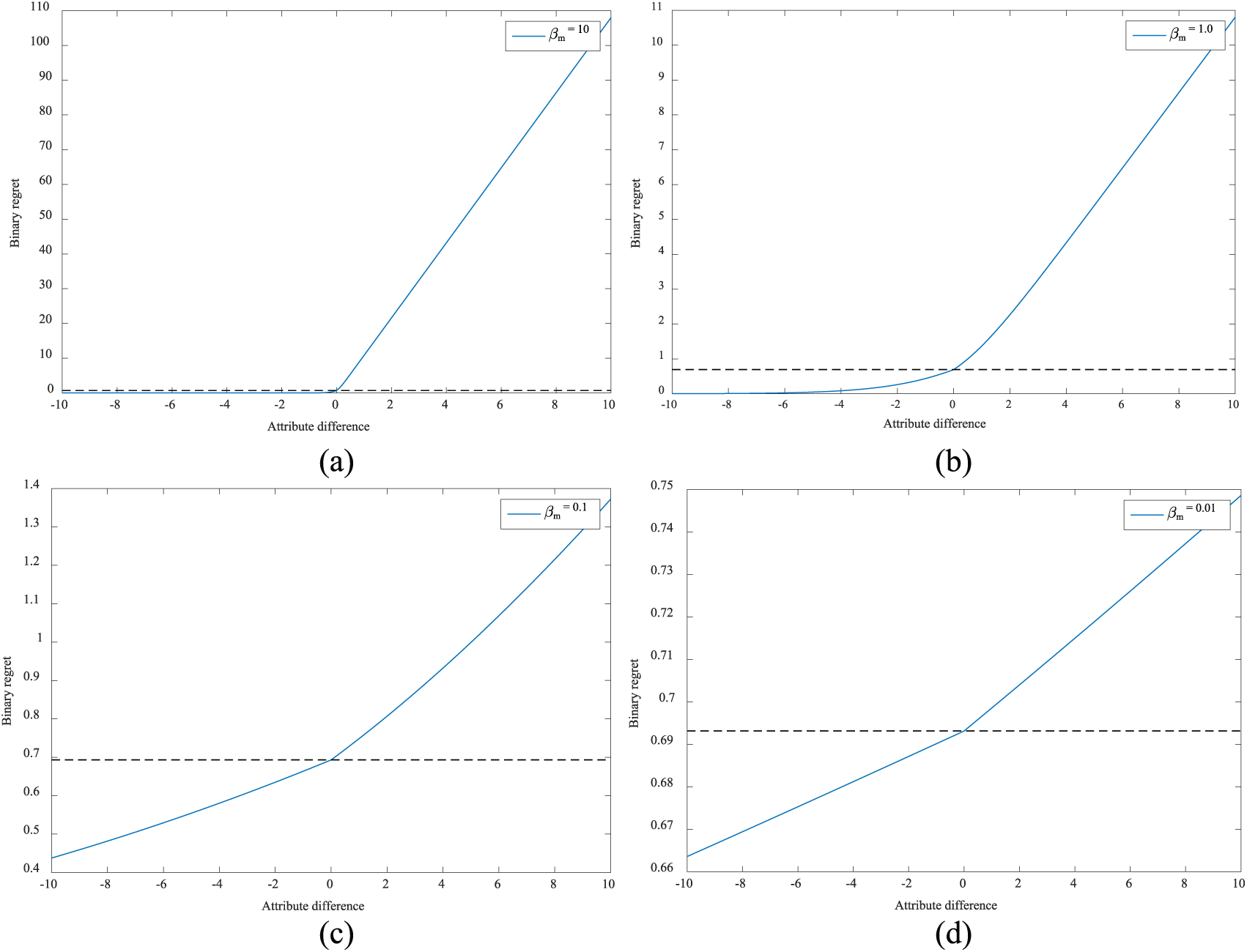
Shapes of the regret function with different sizes of taste parameter.
In comparison with TTB-SUE and RRM-SUE models, the MRRM-SUE model with travelers’ loss aversion is developed in this article, which assumes that travelers tend to minimize the considered route’s perceived regret. The perceived regret

where the systematic regret


Thus, the equilibrium route flows of MRRM-SUE model not only rely on the attribute difference between the considered route and other alternatives but also are affected by travelers’ loss aversion and relative importance of the regret and rejoice.
The equivalent VI formulation
The MRRM-SUE problem can be described as the VI problem as follows

where

Theorem 1. The VI problem (21) is equivalent to the equilibrium condition of MRRM-SUE model.
Proof: According to the Karush–Kuhn–Tucker (KKT) conditions of equation (21), we can derive equations (23) and (24)


where

Combine equations (24) and (25), we have

Then substitute equation (26) into equation (23), the equilibrium condition (16) of MRRM-SUE model can be obtained. So, the proposed VI formulation is equivalent to the equilibrium condition of MRRM-SUE model.
Theorem 2. There exists at least one solution for the proposed equivalent VI problem.
Proof: According to equation (22), the feasible set
Solution algorithm
The MSA algorithm is employed to resolve the proposed equilibrium problem in this article. And the algorithm steps are expressed as follows:
Step 1. Initialization. For given OD demand
Step 2. Calculation. Calculate the attribute-level binary utility function

Step 3. Checking the convergence. If the iteration counter
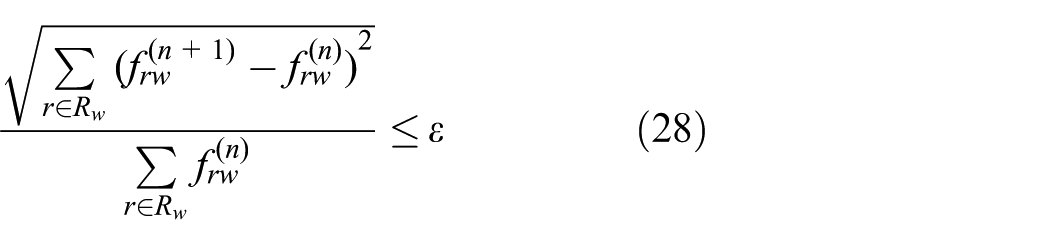
Otherwise, make
Numerical example
This section provides a numerical example with three-route transportation network to demonstrate and validate the MRRM-SUE model. Also, the sensitivity analysis is implemented to describe the effects of parameter variations on travelers’ choice behavior.
A three-route example
To illustrate the proposed model, a simple three-route network is used and the network characteristics are the same with 10. The parameters of link travel time function in equation (1) are
In the numerical example, travelers are assumed to be homogeneous with the desired on-time arrival probability of 98% in the TTB-SUE model. This article assumes that link travel times are independent from each other. And the corresponding route travel times follow the normal distributions. Thus,
The equilibrium route flow patterns of different SUE modes are shown in Table 1 and Figures 3–5. From those, it can be seen that three SUE models give various results. Below, we further analyze the differences of these SUE models. First, the assignment results of TTB-SUE model in Figure 3 indicate that the TTBs of three routes are almost identical in the equilibrium state. However, as discussed above, the TTB is not actual travel time but the longest time travelers can endure for a trip, and the expected travel time is the time that travelers hope to spend in traffic. Moreover, the TTB adopts a linear combination form about two attributes in the stochastic network, which is still within the framework of RUM principle criticized widely.
Equilibrium route flows of different SUE models.

TTB: travel time budget; SUE: stochastic user equilibrium; RRM: random regret minimization; MRRM: modified random regret minimization.

Route TTBs of different SUE models.

Route mean travel times of different SUE models.

SDs of route travel time of different SUE models.
Because of the different decision-making mechanisms, the RRM-SUE and MRRM-SUE models give different equilibrium results relative to the TTB-SUE model. In order to illustrate the differences of the RRM-SUE and MRRM-SUE models, all attribute performances in the equilibrium state are depicted in Figures 4 and 5. Compared to the RRM-SUE model, the MRRM-SUE model incorporates the effects of travelers’ loss aversion. Moreover, travelers are assumed to be much more sensitive for the loss of reliability than that of the expected travel time in the numerical example. So, the equilibrium results given by two regret-based SUE models are different. And the standard deviations of route travel times in Figure 5 distributed more uniformly in the MRRM-SUE model than those in the RRM-SUE model. In addition, all SUE models give the non-dominated route flow assignment results for the mean travel time and reliability. From Figures 5 and 6, the TTB, mean travel time, and reliability of three routes can be easily discovered.

Change in probability of using route 1 for different
Sensitivity analysis
As mentioned above, the equilibrium results of the RRM-SUE model are mainly affected by the taste parameter
First, the RRM-SUE and MRRM-SUE models are, respectively, executed with the dispersion parameter
Figure 7 plots the changes in the choice probability on route 1 when the taste parameter

Change in probability of using route 1 for different
In the analysis above, the taste parameters about different attributes are assumed to be identical. In the following, the joint effects of both taste parameters on route choice behavior are examined and shown in Figure 8. Other associated parameters are
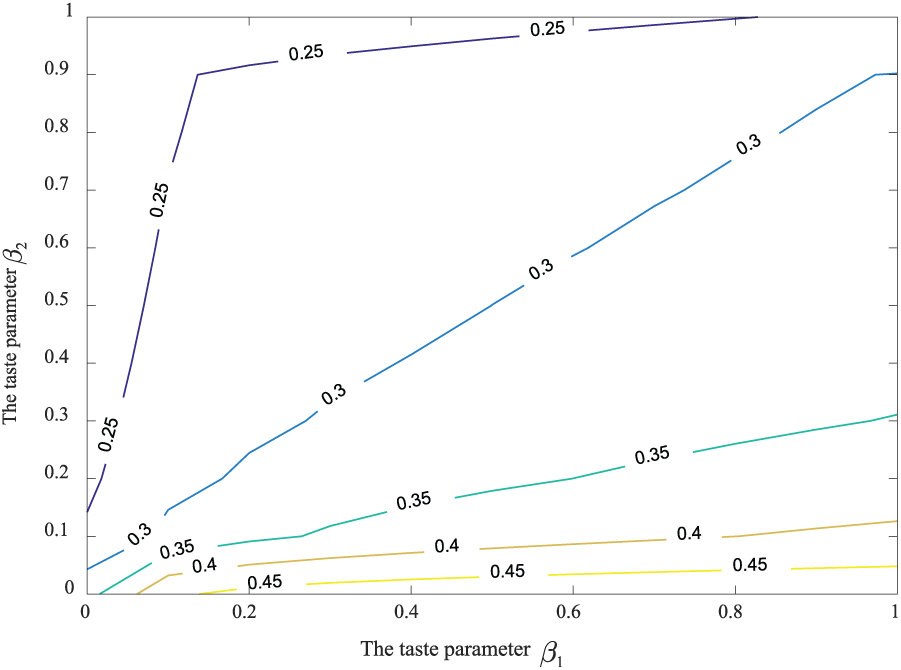
The joint effects of the taste parameters for different attributes.
Conclusion
In this article, a new logit-based SUE model, MRRM-SUE model, is developed by incorporating the features of loss aversion of travelers. In this model, travelers tend to minimize the anticipated regret in the travel decision processes. In addition, the equivalent VI problem of the MRRM-SUE model is given and the characteristics of the solution are discussed. And a route-based solution algorithm, MSA method, is applied to resolve the relevant problem. In order to demonstrate the proposed model and compare it with other models, a three-route example network is used to represent the differences of different SUE results. It can be concluded that travelers’ loss aversion indeed has a great impact on route choice behavior. In particular, the MRRM-SUE model can reduce to the RRM-SUE model under a certain condition. The model proposed in this article appears more flexible in estimating travelers’ route choice behavior than other models.
It also should be noted that some parameters are used to present its equilibrium results in the MRRM-SUE model. Although the sensitivity analysis can flexibly describe travelers’ route choice behavior, the calibrations of these parameters are still worthy and meaningful for further research efforts to achieve more realistic flow pattern. Moreover, the day-to-day learning process of travelers is not concluded in the proposed model. It is also significant to further extend the MRRM-SUE model by incorporating the learning and adaption mechanism to day-to-day route choice behavior.
Footnotes
Handling Editor: Crinela Pislaru
Declaration of conflicting interests
The author(s) declared no potential conflicts of interest with respect to the research, authorship, and/or publication of this article.
Funding
The author(s) disclosed receipt of the following financial support for the research, authorship, and/or publication of this article: Financial supports provided by the National Natural Science Foundation of China (No. 51338008 and No. 51378036) are acknowledged.
