



Abstract
A mathematical programming method for sensitivity analysis of the link-capacitated stochastic user equilibrium model is presented in this article. By the sensitivity matrices, the changes in the network flows can be easily obtained, while some links reach the capacity limits. By link-based stochastic user equilibrium model with link capacity constraints, it is possible to formulate an efficient algorithm for the sensitivity analysis. Two numerical examples are provided for demonstrating the correctness and implementability of the method finally. Since the link capacity is one of the constraints of the model, the method presented here can also be used for the basic model with other constraints.
Keywords
Introduction
Sensitivity analysis is to analyze the output variables of the model with the change of the input variables. It is important for traffic network equilibrium problems. Knowledge of how sensitive a conclusion is to changes in the network can help to identify which link need to pay more attention. And the information from the sensitivity analysis can also be applied to a variety of control problems, design, and optimal pricing in traffic networks.1,2
Tobin and Friesz 3 demonstrated the uniqueness properties of a restricted formulation of the deterministic user equilibrium (DUE), and variational inequality method was developed for sensitivity analysis of DUE. Clark and Watling 4 presented the mathematical programming method for sensitivity analysis of Probit-based stochastic user equilibrium (SUE) model. Then, in 2001, Ying and Miyagi 5 conducted the study on sensitivity analysis of Logit-based SUE model, and the method is developed from a dual formulation of the SUE analysis, and it is more simple and more likely to be accepted relative to the variational inequality method.
Wardrop 6 proposed user equilibrium (UE) assignment principle, and the following UE models are too sensitive to traffic cost. SUE assignment was proposed by Daganzo and Sheffi; 7 Fisk’s 8 model is a general model that unifies Wardropian equilibrium and the concept of the stochastic assignment, and the result of the SUE is more reasonable than UE. Considering in real world, link flow stops increasing when reaching the capacity, and Bell 9 did study about Fisk’s model with queues. In this article, we present a mathematical programming method for sensitivity analysis of link-based SUE model with link capacity constraints. 10 For the basic SUE model avoiding the path enumeration and benefit from it, more efficient algorithm can be developed for SUE assignment. 11
The second section of this article provides a concise review of the link-based SUE model with link capacity constraints. The sensitivity analysis method is formulated in the third section. In the fourth section, we provide two numerical examples for demonstrating the correctness and implementability of the method in detail. Finally, some concluding remarks are summarized in the fifth section.
Link-capacitated SUE model
Let a transportation network G = [N, A], where N and A denote the sets of nodes and links. O and D are the sets of origins and destinations, and we give positive demands
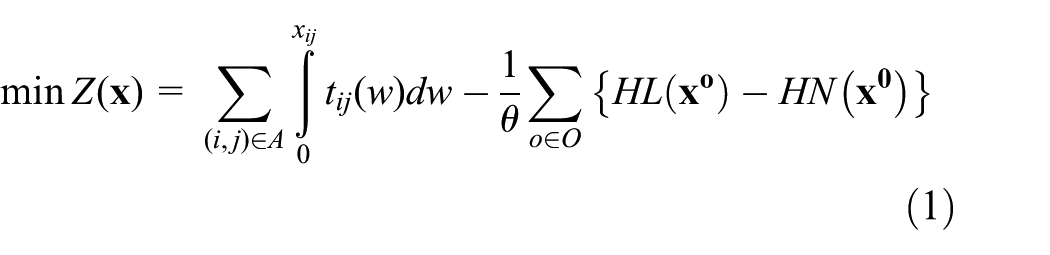
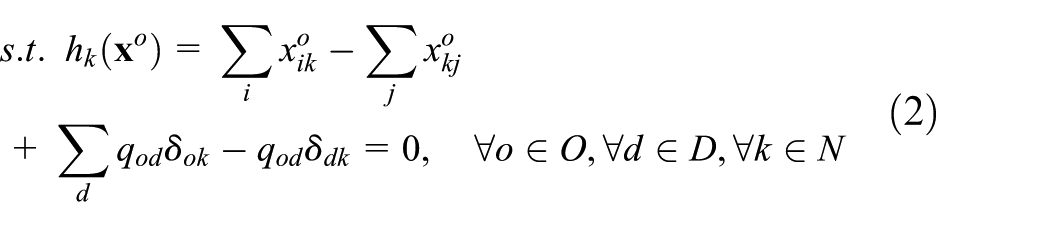
According to the Logit-type SUE assignment, Akamatsu decomposed the entropy function into link variables, and Ji built the capacitated SUE model as follows10,11



where we define functions


Equation (5) was added to the basic link-based SUE model to limit the increase in the link flows unreality. The equivalent and uniqueness of the model above was proved by Ji et al., 10 and an effective algorithm for the assignment with constraints was also proposed, so it will not be repeated in this article.
Sensitivity matrices deduced
Let

From the Kuhn–Tucker conditions, and due to the work by Fiacco, 12 we define the functions as follows


When we get the optimum solution, we obtain

In equation (11), the “diag” denotes a diagonal matrix with corresponding diagonal entries. We give matrices


According to equations (11)–(13), we obtain

A first-order approximation of the solution can be obtained as follows

where
According to equations (1), (6), (7), and (8), we obtain the core elements of the

where
Considering the Kuhn–Tucker conditions, the function


Thus

where
Let


We obtain the core elements of the


According to the model, the value of equation (22) is zero. Therefore, the rest can be computed efficiently.
The link-based SUE model represents the SUE assignment as an optimization problem with only link variables; benefit from it, Lee et al.
13
developed an efficient algorithm. It gave the CPU times needed by the conventional and modified method for Sioux Falls network; in the case of
An outline of the procedure for the sensitivity analysis is as follows:
Step 1. (Initialization) Compute the SUE by the linearization method. 13
Step 2. (Checking the constraints) If the results satisfied, stop and obtain
Step 3. Compute the matrices
Step 4. Compute equation (14) or (19). If
According to equation (15), we can obtain new assignment results quickly, while some links are closed because of the flows reaching the capacity.
Numerical examples
Example 1. Illustrate our method
It is a network with five nodes and six links which Ying and Miyagi 5 used, as shown in Figure 1. The link cost functions are as follows

where


Network of Example 1.
The traffic demand is

According to our method, link constraints are added to the basic model, and we give the constraints

For there is one origin in the network, we can obtain

The Hessian matrix is

For
According to equations (2) and (5),

Then, according to equations (22) and (23), the matrix
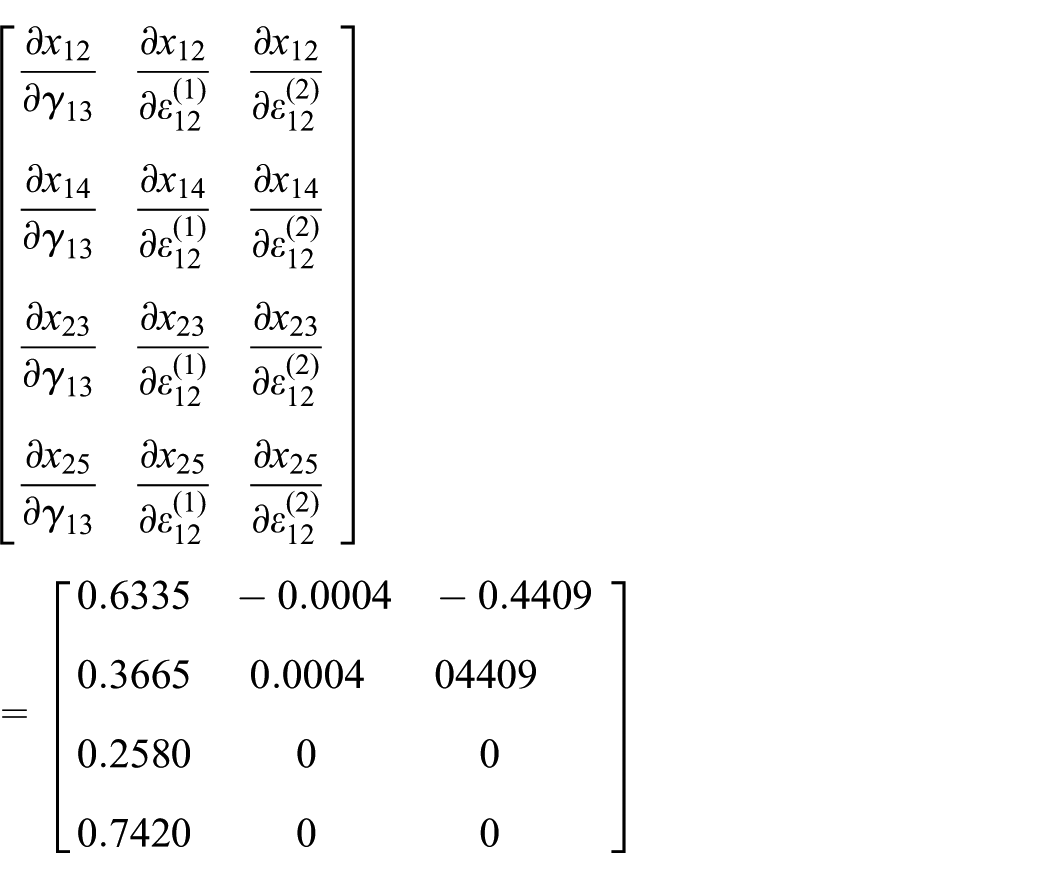
This matrix agrees with that computed by Ying and Miyagi. Pay attention, when
In order to illustrate the method comprehensively, we closed the link (1, 2), and in the model, the constraint for

Table 1 shows comparisons of estimated flows by our method with the actual solutions recomputed by the algorithm for capacitated SUE model, and the error between them is very small up to maximum 0.0005.
Traffic flows with small perturbations in Example 1.

Example 2. A toy-size network example
Solutions of the link-based SUE model are

Network of Example 2.
The link cost functions are of the BPR forms as equation (21), and the unperturbed parameters are assumed to be as in Table 2. Set

Network parameters in Example 2.

Perturbations of parameters are as follows

We can get the initial solutions by the efficiency algorithm and ALM. 13 Comparing the estimated flows with what obtained by the algorithm, the errors are small to the flow changes. The “estimation error” equals the actual flows minus the estimated flows.
Because the traffic flows of link (07, 08), link (05, 09), link (07, 11), and link (10, 11) reach the capacity limits, they would not increase by ALM. The same results are derived by the sensitivity analysis method, which verifies the proposed method. To save space, we give the results perturbed simultaneously by a set of parameter uncertainties in Table 3, and good results can be obtained by separate parameter uncertainty.
Traffic flows with a set of small perturbations in Example 2.

In practice, when roads are closed for heavy traffic, neither the origin-based flows nor the traffic flows would be changed. When the flows are checked, new constraints can be joined to the model, such as
Conclusion
This article has presented the method for sensitivity analysis of Logit-type SUE assignment model with link capacity constraints. By the method, we can estimate changes in traffic flows quickly and accurately when some roads closed for heavy traffic. Benefit from the link-based basic model, the algorithm for our analysis can be efficient. Since the link capacity is one of the constraints of the model, the method presented here can also be used for the basic model adding other constraints.
Footnotes
Academic Editor: Xiaobei Jiang
Declaration of conflicting interests
The author(s) declared no potential conflicts of interest with respect to the research, authorship, and/or publication of this article.
Funding
The author(s) received no financial support for the research, authorship, and/or publication of this article.