



Abstract
This article proposes two strategies for time-dependent probabilistic fatigue analysis considering stochastic loadings and strength degradation based on the failure transformation and multi-dimensional kernel density estimation method. The time-dependent safety margin function is first established to describe the limit state of the time-dependent failure probability for mechatronics equipment with stochastic loadings and strength degradation. Considering the effective safety margin points and the corresponding number of the load cycles, two strategies for transforming the time-dependent failure probability calculation to the static reliability calculation are then proposed. Multi-dimensional kernel density estimation method is finally employed to build the probability density functions and the reliability is estimated based on the probability density functions. An engineering case of a filtering gear reducer is presented to validate the effectiveness of the proposed methods both in computational efficiency and accuracy.
Keywords
Introduction
The fatigue is crucial to mechatronic products’ lifetime and it may cause catastrophic consequences. In order to guarantee the safety and reliability of equipment during service operation, it is essential to assess and predict the fatigue reliability of mechanical structures accurately, which can contribute to make maintenance strategies and health management plans, with maximizing the use of equipment and improving economic benefits. 1 During the past decades, a number of researchers have sought to calculate the fatigue reliability of mechanical products based on probabilistic methods. These methods can be grossly divided into three categories: fatigue life–based reliability analysis method,2–4 fatigue damage cumulative–based reliability analysis method,2,5–16 and residual strength degradation–based reliability analysis method.17–20 According to crack propagation theory or fatigue cumulative damage theory, the fatigue life–based reliability analysis method considers the fatigue life as the control parameter to estimate fatigue reliability. This method is straightforward to implement reliability analysis under static loading, but it is too complicated to gain probability distribution of the fatigue life under random loadings. Based on deterministic fatigue cumulative damage theory, the statistics and probability theory are introduced to describe uncertainty during the process of damage development, and many effective reliability analysis methods have been developed. For instance, Raju et al. 4 and Tanaka et al. 6 proposed a statistic Miner rule based on traditional Miner rule under the few conditions and assumptions. Wirsching 2 and Martindale and Wirsching 7 proposed a fatigue reliability model based on Miner rule by assuming that instantaneous accumulative damage and critical damage are random variables. Based on the integration of the probabilistic S-N model, Miner rule, and probability density transformation technology, Rathod et al. 13 and Wang et al. 14 established probabilistic damage accumulating model to handle fatigue reliability analysis and optimum design. The fatigue damage cumulative–based reliability analysis method has many advantages such as building model effectively, little statistical information, and consistent basic trends of failure process. However, the key problem for the method is to determine the statistical parameters for the accumulated damage and the critical damage. The residual strength degradation–based reliability analysis method accounts for the residual strength degradation as a control parameter. If the residual strength degradation is greater than additional load, the product will be safe; otherwise, the product will be failed. This method reveals degradation law of failure process, which, however, requires plenty of experimental data to estimate the trajectory of strength degradation.
The fatigue reliability is actually time-dependent due to the fact that loading generally exhibits time-varying characteristics, and the fatigue process is a dynamic process. 21 Many methods for time-dependent reliability analysis have been developed, for example, outcrossing rate method,22–25 extreme value distribution,26,27 sampling approaches,28–31 and other methods.32–34 Cumulative fatigue damage and residual strength degradation–based reliability analysis methods have considered time-varying loading and strength degradation. However, in the existing methods of fatigue reliability analysis, their limitations are also very obvious. The former may be limited by the statistical characteristic parameters of the accumulated damage and the critical damage; the latter relies too heavily on plenty of experimental data. Therefore, security margin is selected as the control parameter to handle fatigue reliability analysis considering stochastic loadings and strength degradation as a new approach. Besides, the time-dependent property of fatigue reliability is also included.
In order to estimate the time-dependent fatigue reliability efficiently and overcome the limitations in most of the current methods, following contributions in threefolds are made: (1) time-dependent security margin model based on time-dependent strength degradation model is built; (2) two transformation strategies are constructed to transform the time-dependent failure probability problem into static one; and (3) multi-dimensional kernel density estimation (KDE) method is employed to establish the time-dependent probabilistic fatigue analysis model.
This article is organized as follows. The time-dependent strength degradation model is built in section “The time-dependent residual strength model.” Section “The proposed probabilistic fatigue analysis method” illustrates the details of the proposed time-dependent probabilistic fatigue analysis strategies. The effectiveness of the proposed method is testified in section “Case study.” Finally, conclusions are drawn in section “Conclusion.”
The time-dependent residual strength model
Residual strength is defined as the ability that a product or material can still resist external forces or loads in the use of a period of time. The typical expression of the residual strength model is defined as 17

where

where

For structures and components, considering the uncertainty from manufacturing, materials performance, and working environment, the initial fatigue strength should be regarded as a random variable.35,36 Meanwhile, the external forces or loads

where
The proposed probabilistic fatigue analysis method
In this section, detailed procedure for time-dependent probabilistic fatigue analysis strategies considering stochastic loadings and strength degradation is introduced. In the procedure, a safety margin function is first introduced based on the stress–strength interference theory; security margin sequence and the corresponding number of the loading cycles are then obtained by using simulation method. By combining the security margin sequence and the corresponding number of the loading cycles, probability density functions (PDFs) of probabilistic fatigue can be obtained. Finally, time-dependent fatigue failure probability can be estimated. For a clear illustration, the flowchart of the proposed method is provided in Figure 1.
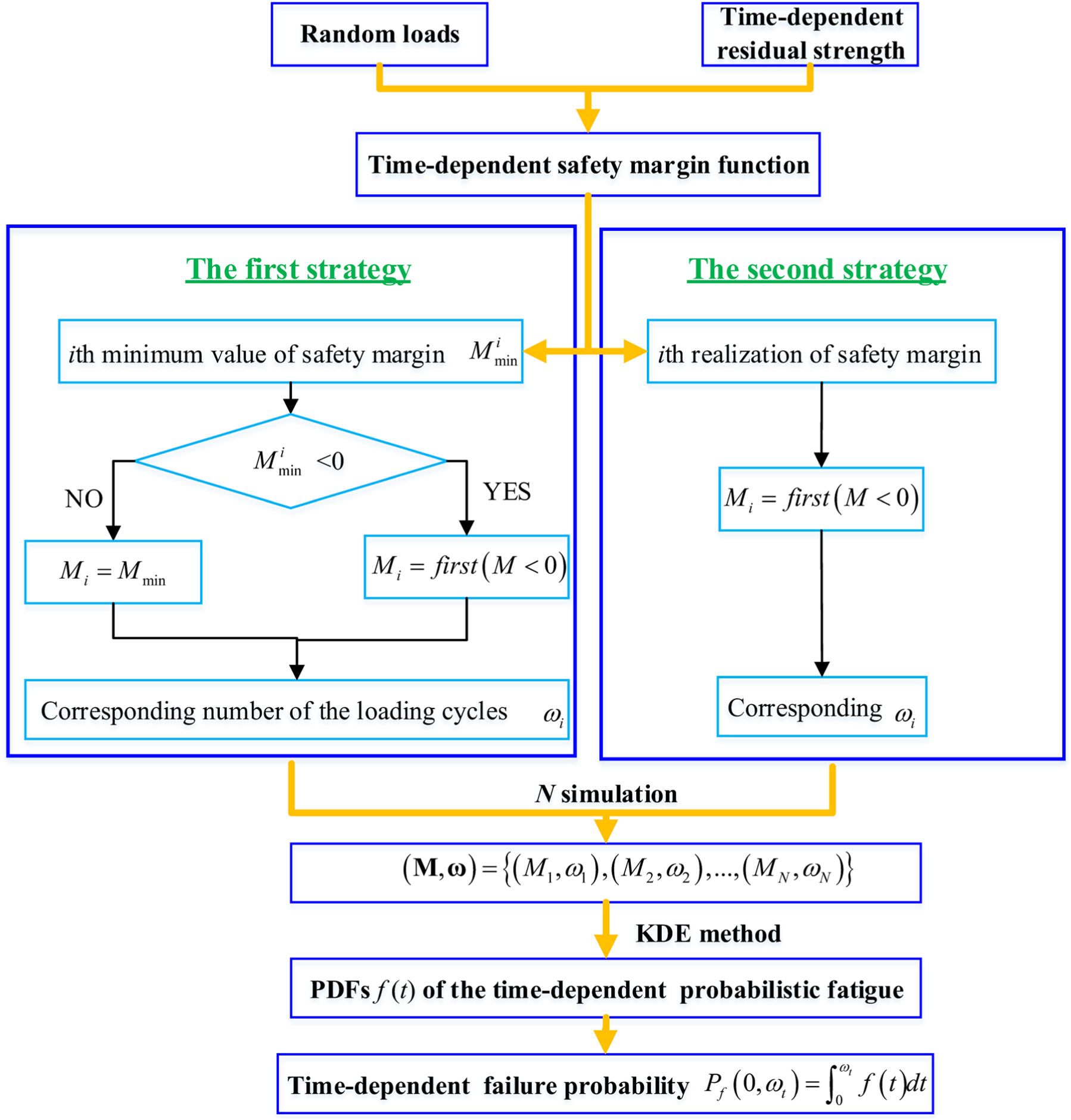
Flowchart of the proposed method.
On the basis of stress–strength interference theory, the time-dependent safety margin function is established as

According to the definition of the time-dependent reliability, the time-dependent probabilistic fatigue at the given number of the loading cycles

Because the loads and residual strength are time-varying and statistically dependent, the existing stress–strength reliability analysis method cannot obtain the accurate solution. 37 Therefore, a sampling-based method based on KDE method 38 is proposed to calculate the time-dependent probabilistic fatigue.
Transformed models for time-dependent probabilistic fatigue
As one realization of the stochastic process representing the time-dependent safety margin function,
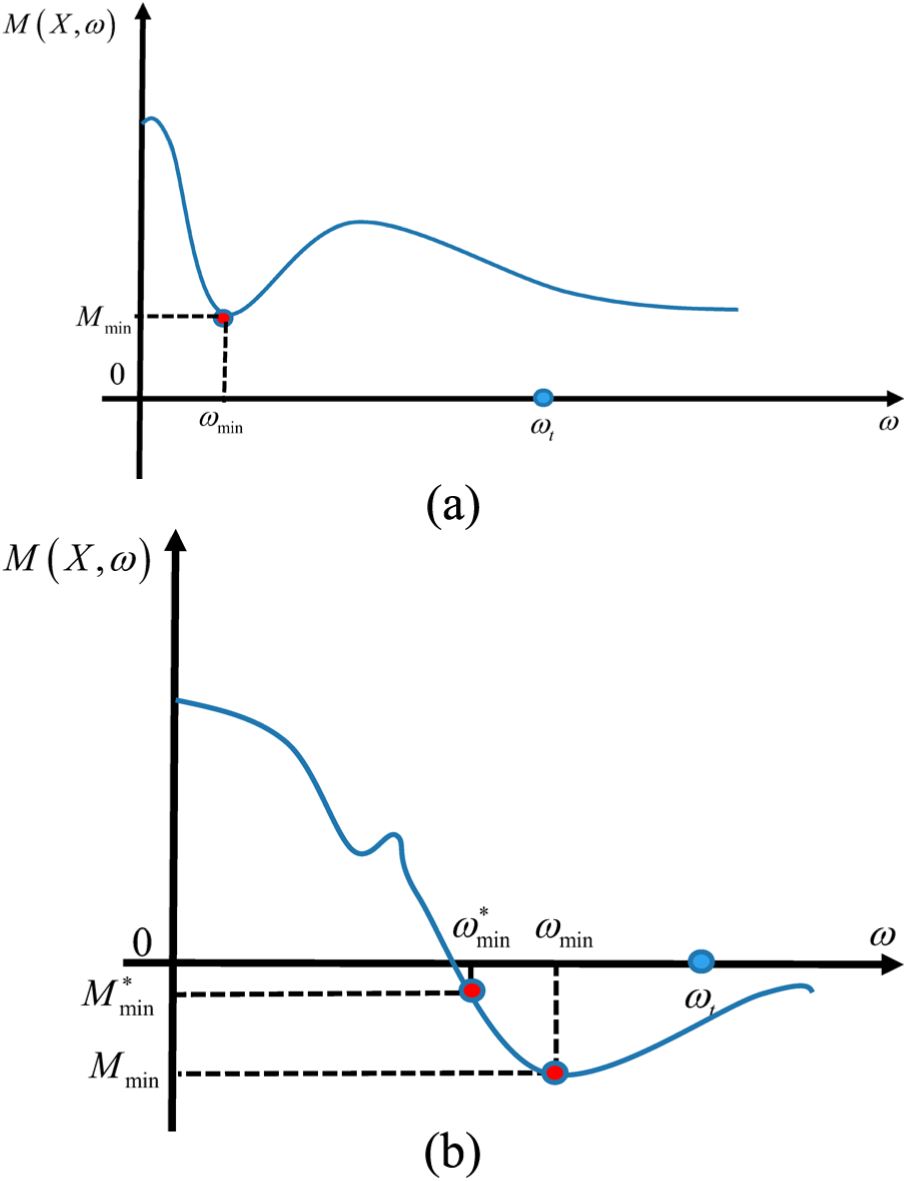
The geometrical relationship between
According to the definition of the time-dependent reliability, at the given number of the loading cycles

If the joint PDF

When all

where
The above discussions show that the time-dependent probabilistic fatigue can be estimated only when the joint PDF
Establishment of
and
based on the KDE method
KDE method as a sampling-based method was originally proposed by Rosenblatt
39
and Parzen.
40
In statistics, KDE is a non-parametric technique to estimate the PDF with given data sets, which can make the mean integrated square error between the true density and the estimated density be minimal. In order to obtain the balance between computational efficiency and accuracy, KDE is employed to estimate the PDF
Step 1. N trajectories are simulated. Input samples vectors
Step 2. Determinate the minimum value of each trajectory. For the
Step 3. Replace and update
After getting the vectors

where
The bandwidth of the kernel function is important to predict accuracy and the optimal value of


where d is the dimension of the joint PDF, here

when
Step 1. N trajectories are simulated. Like Step 1 of
Step 2. Select
After getting the vector

where

where

Above discussion shows that the major idea to construct the PDFs of the two strategies is to select the appropriate samples which control the failure of the structure. In this article, two methods are proposed to obtain the samples which control the structure failure and construct two types of PDF for different times of loading. When the failure of the fewer times of loading is considered, the joint PDF
Case study
In this section, the filtering gear reducer is employed to illustrate the proposed methods. The principle diagram of a filtering gear reducer is shown in Figure 3.

The principle diagram of filtering reducer.
A filtering gear reducer is mainly composed of the following parts: the power input eccentric shaft H, split dual external gears (gear 1 and gear 3), fixed internal gear (gear 2), and the power output gear (gear 4). The transition principle of a filtering reducer could be summarized as follows. First, the motor drives the eccentric shaft and the first-stage eccentric reducer mechanism is composed of the eccentric shaft, split dual external gears, and fixed internal gear to filter out the high-frequency wave of the rotation of the motor. Second, the second-stage filtering planetary drive mechanism with small teeth difference consists of split dual external gears and the power output gear to filter out the high-frequency wave of split dual external gears for driving the actuating mechanism in a slow speed. The tooth surface contact stress is expressed as

where
Detailed information for the computing coefficients.

Information of the random variables for T, b, and d.

According to the definition of time-dependent residual strength, the residual strength of the duplex gear 1 is

where
The time-dependent safety margin function of the duplex gear 1 could be provided as

For the duplex gear 1, the simulated samples shows that all margin functions are less than 0, when the number of load cycles is greater than
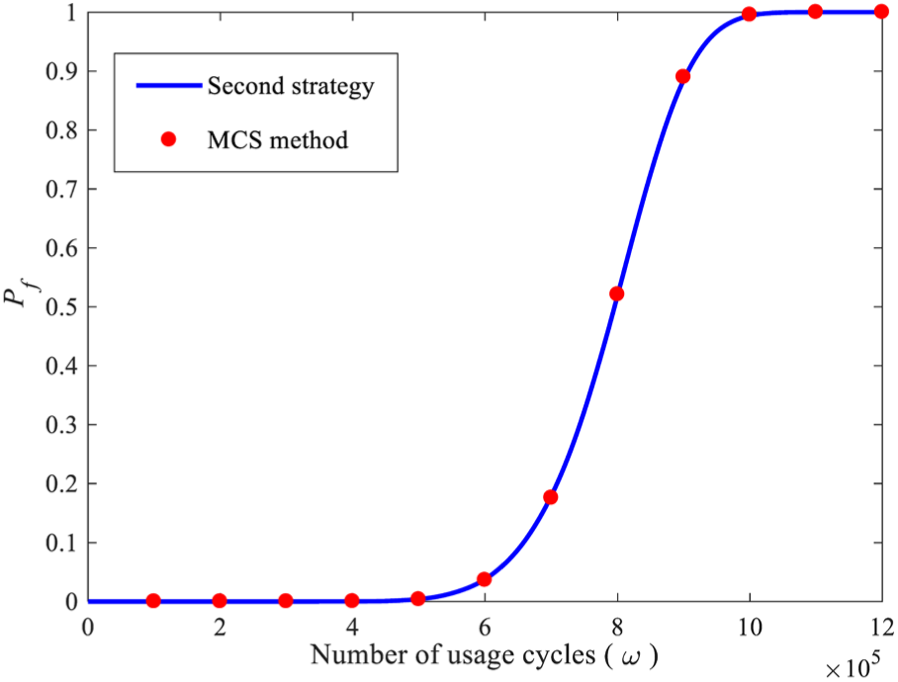
Failure probability for gear 1 on the entire life cycle.
However, in engineering practices, acquisition of experimental data for the entire life cycle is usually expensive; therefore, it is intended to focus more on the changing trend of the failure probability for the smaller number of the load cycle. Therefore, the first strategy shows superiority in the application of failure probability analysis. In order to verify calculation accuracy of the first strategy, Figure 5 gives the failure probability results for the times of load from 0 to

Failure probability for gear 1 from 0 to
Error between the proposed methods and the MCS method for gear 1.

Using the same procedure, the time-dependent failure probability curves for duplex gear 3 with two proposed strategies are given in Figures 6 and 7, where the times of load are
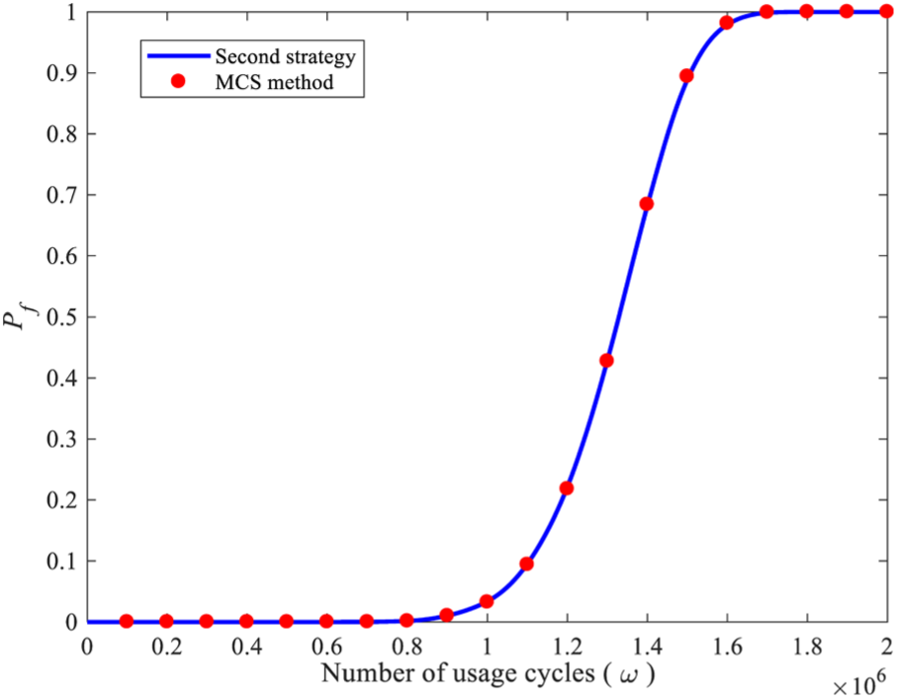
Failure probability for gear 3 on the entire life cycle.

Failure probability for gear 3 from 0 to
Error between the proposed methods and the MCS method for the gear 3.

In this engineering case, 105 samples are employed for the MCS method at every number of the load cycles, for example,
Conclusion
In this article, two methods of time-dependent probabilistic analysis are proposed for dynamic uncertain structures with stochastic loadings and strength degradation by transforming the time-dependent failure probability to the time-independent ones. Based on the stochastic loading and the strength degradation, the time-dependent residual strength model is constructed. According to the stochastic stress–strength interference theory, the time-dependent safety margin function, namely, the limit state function of the time-dependent failure probability, is established. The simulation method is employed to find the effective safety margin points and the corresponding number of the load cycles which controls the structural failure. Then, two strategies are presented on the basis of the size of the number of load cycles. KDE method is finally used to build the PDF of the two strategies, respectively. A filtering gear reducer is used as an example to illustrate and validate the computational accuracy and efficiency of the proposed method. The results show that the computational efficiency of the proposed method is improved under the precondition of assuring precision. In addition, the two proposed strategies can be extended to deal with the time-dependent reliability for complicated dynamic uncertain structures, where the inputs are described by a stochastic process. The stochastic processes can be decomposed into the random variable by discretization of random processes method, and then, the proposed methods can be used.
Footnotes
Handling Editor: Guian Qian
Declaration of conflicting interests
The author(s) declared no potential conflicts of interest with respect to the research, authorship, and/or publication of this article.
Funding
The author(s) disclosed receipt of the following financial support for the research, authorship, and/or publication of this article: This work was supported by the National Natural Science Foundation of China under the Contract No. 11472075.
