



Abstract
In this study, an enhanced genetic algorithm is proposed to solve multi-objective design and optimization problems in practical engineering. In the given approach, designers choose available design results from the given samples first. These samples are re-ordered according to their mutual relationships. After that, designers choose an exact ratio of conformity as available field. Furthermore, more weight information can be obtained through finding the minimum value of the norm of unconformity and satisfactory samples. These samples can be used to reflect the preference chosen for Pareto design solutions. A structure design problem of speed increaser used in wind turbine generator systems is solved to show the application of the given design strategy.
Keywords
Introduction
With the development of complex engineering systems, many engineering design problems are treated as multi-objective design optimization problems (MDOP). In practical engineering, it is not easy to get the theoretically optimal design results for MDOPs.1–5 Consequently, the satisfactory results are selected, rather than the theoretically optimal ones. There are many approaches have been given to solve MDOPs using the satisficing theory.6–9 In these approaches, the satisfaction degrees of different objectives are introduced. It is essential to choose a balance to calculate and decide the best options by designers. Two types of methods which are termed as preference-based and generating methods are usually used to calculate multi-criterion formulations. Satisficing sets of Pareto design solutions can be obtained by the above approaches.10–15 However, it is not easy to deal with the multi-dimension of balances among several objectives if many objectives are involved. The preference-based methods can change an MDOP into its corresponding one-objective optimization problem.16–20 Then, we can find a Pareto solution set. Furthermore, the weight factors can also be adjusted by designers during the whole MDOP process. The weighted summation method is used widely in practical engineering for MDOP because of its comparability.21–26
It should be noted that the value of objective satisfaction degree can be represented by weight coefficients. But it is not easy to choose exact and appropriate weight generally. It is because that they are mainly based on the knowledge and experiences of designers. To tackle this challenge, many different weight approaches are given. Using fixed-weight method, for example, weight coefficients can be fixed during the calculation of genetic algorithm (GA). However, using this approach, appropriate numbers of weight should be preset by designers. Many works have been done to develop the fixed-weight method. Murata et al. 27 developed a random-weight method which can assign samples to Pareto frontier fairly. Zheng et al. 28 introduced an adaptive weight method which can utilize population information to arrange their values. However, it is not easy to embody designer preference completely in GA using above methods. At the start of the design process, it is hard to choose relatively better preference between two objectives. The analyses of optimal results after generations in GA are essential. Furthermore, the values of weights are also should be modified interactively, which can keep GA evolving along the preferred directions of designer. An enhanced GA method is introduced and utilized to solve this problem.29–32 However, another difficulty is shown in this situation. The exact definition of the upper and lower bounds cannot be given by the binary relationship of preference components.
In practical engineering, Pareto results should be distributed evenly on design frontier to ensure that designers can trade-off solutions on the frontier effectively. In this study, an enhanced GA model is proposed to calculate individual samples during the process of GA. The proposed method constructs an available design area for nonlinear design and optimization problems.
The rest of this article is scheduled as follows. First, multi-criterion satisficing design problems are shown in section “Multi-criterion satisficing design problems.” In section “PWGA for multi-criterion satisficing design,” the Lp-norm concept and the mutual relationship between selected samples are given. Then, the progress of enhanced preference-weight genetic algorithm (PWGA) is proposed in section “The design process of GA.” Furthermore, a speed increaser design example is also provided to illustrate the application of given approach in section “Example.” Section “Conclusion” gives the conclusion.
Multi-criterion satisficing design problems
Denote a vector of design variables and parameters as

Furthermore, denote its corresponding quality criterion set as

where

where

where

Thus, the multi-criterion satisficing problem can be changed as follows

where
Here, equation (6) is formulated as the overall satisfaction function. Its weights can be used in multi-criterion design and optimization in GA.
PWGA for multi-criterion satisficing design
Because of designer’s knowledge, the preference relationships among samples are different in GA generally. In this study, the following symbols, which are listed in Table 1, are utilized to denote the mutual relationships of individual samples.
The symbols used to show binary relationships.

In Table 1,

Giving

where
The purpose of equation (8) is to obtain the optimal Lp-norm of
In the beginning of optimization in equation (8), the original weight coefficients are set based on designer’s arbitrarily. Then, the populations can be added gradually during the following several generations of evolution. The value of weights is adjusted in the iterations of interactive optimization until satisficing individuals can be found.
The design process of GA
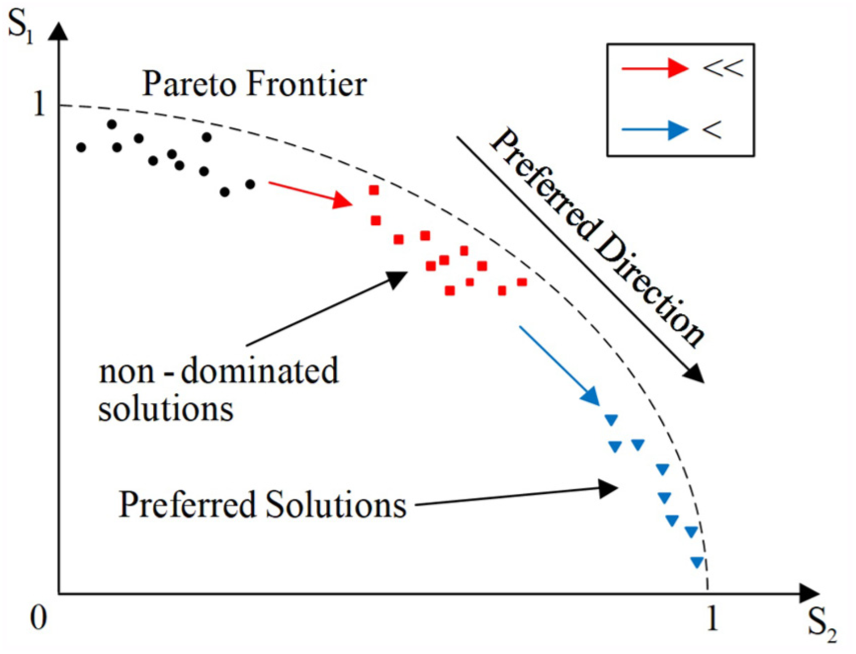
In this study, we introduce weigh approach into Pareto GA and proposed an interactive PWGA to search whole Pareto solutions set as widely as possible. The major advantage of the proposed method is that the satisfaction degree of samples can move along preferred directions during the optimization. Meanwhile, the optimal weight coefficients are utilized in this design process to make sure Pareto design results can be obtained directly. The research process of interactive PWGA is illustrated in Figure 1.
The research process of interactive PWGA.
The detailed strategy of the proposed PWGA method is shown as follows:
Step 1. Initiate the original samples.
Step 2. Select the samples by designer according to binary relationship in equation (7). Utilize the mutation and crossover. Apply the Pareto strategy to obtain the evenly distributed samples.
Step 3. During the optimization, choose several samples of different satisficing degree based on designer. Then, solve the optimization problem in equation (8) and obtain the optimal weights.
Step 4. Choose new samples and send them to the current sample set. If no new samples can be found by designer, the algorithm converges. Otherwise, turn to step 2.

The flowchart of interactive PWGA.
Example
The speed increaser is one of the most important parts in wind turbine generator systems (WTGS). Its basic function is to transfer torque to electric generator and the related components. In the design and manufacturing process, there are many factors which may ultimately impact the performance of speed increaser. For the good performance of speed increaser, the proposed multi-objective design optimization strategy is utilized to deal with the design problem of the speed increase. Here, the speed increaser adopts a two-stage parallel shaft to connect with a planetary transmission structure, which is shown in Figure 3.

The structure diagram of speed increaser.
The standard NGW-type planetary rotating wheel train is used in the low-speed stage. 1 represents the sun gear in the planetary gear train and 2 represents the planetary gear in the planetary gear train. In this problem, three identical planetary gears are evenly distributed along the circumference. 3 represents a fixed ring gear in a planetary gear train. H represents a planetary carrier (input end) in a planetary gear train. Both an intermediate gear and a high-speed gear adopt a helical gear drive. 4 and 5 represent an intermediate-size gear as shown in Figure 3. 6 and 7 represent the high-speed gear size. Because the helical gear increases the total contact area of the gear pair as compared with the spur gear, the carrying capacity of the gearbox can be increased. Also, the stability of the output shaft end of the gearbox will be increased. Consequently, the sudden loading and unloading along the tooth width direction can be avoided. At the same time, the axial force is generated along the axial method. So, the tapered roller bearings are used in the gearbox to bear the axial force generated by helical gears.
The purpose of this design problem is to minimize the weight of the speed increaser and maximize the transpiration efficiency. The mathematic model of the design problem and the detailed information can be found in Chen and Zhu 33 and Zhao et al. 34 In this problem, there are 14 design variables and 40 constraints. The design solutions are shown in Table 2.
The design solutions of the example.

Conclusion
In this study, an enhanced PWGA method is proposed and utilized to solve MDOPs. The evolution preference can be adjusted and controlled during optimization process based on the arrangement information of samples. It can ensure that the solutions of MDOP employ the preferred and non-dominated performance. Furthermore, it is helpful for designers to take a tradeoff. Furthermore, the man–machine interactive strategy is utilized with sample evolution. In this way, not only the designer preference information can be added but also the Pareto solutions can be found by seeking along the designer satisfaction preference. A speed increaser design example is utilized here to illustrate the effectiveness of the given method.
Footnotes
Handling Editor: José Correia
Declaration of conflicting interests
The author(s) declared no potential conflicts of interest with respect to the research, authorship, and/or publication of this article.
Funding
The author(s) disclosed receipt of the following financial support for the research, authorship, and/or publication of this article: This research is partially supported by the National Natural Science Foundation of China (Grant No. 51505067), the China Postdoctoral Science Foundation (Grant Nos 2016M602687 and 2018T100970), and the Natural Science Foundation of Guangdong Province, China (Grant No. 611228787036).
