




Abstract
Remaining useful life prediction is a critical issue to fault diagnosis and health management of power-shift steering transmission. Power-shift steering transmission wear, which leads to the increase of wear particles and severe wear afterwards, is a slow degradation process, which can be monitored by oil spectral analysis, but the actual degree of the power-shift steering transmission degradation is often difficult to evaluate. The main purpose of this article is to provide a more accurate remaining useful life prediction methodology for power-shift steering transmission compared to relying solely on an individual spectral oil data. Our methodology includes multiple degradation data fusion, degradation index construction, degradation modelling and remaining useful life estimation procedures. First, the robust kernel principal component analysis is used to reduce the data dimension, and the state space model is utilized to construct the wear degradation index. Then, the Wiener process–based degradation model is established based on the constructed degradation index, and the explicit formulas for several important quantities for remaining useful life estimation such as the probability density function and cumulative distribution function are derived. Finally, a case study is presented to demonstrate the applicability of the proposed methodology. The results show that the proposed remaining useful life prediction methodology can objectively describe the power-shift steering transmission degradation law, and the predicted remaining useful life has been extended as 65 Mh (38.2%) compared with specified maintenance interval. This will reduce the maintenance times of power-shift steering transmission life cycle and finally save the maintenance costs.
Keywords
Introduction
The wear degradation and failure, which is the primary failure mode of power-shift steering transmission (PSST), will result in high costs and safety problem. Therefore, the PSST should be monitored regularly, and the maintenance should be implemented based on the operation condition to avoid the unscheduled maintenance. Currently, prognostics and health management (PHM) technology, which can improve reliability and safety of the equipment that has high-reliability requirements, has attracted a great deal of attention in research and plays a key role in industries. And, the key issue among PHM is remaining useful life (RUL) prediction that provides the foundation for condition-based maintenance (CBM) strategy. 1
In PSST, metal particles that produced from different friction couplings are mixed in lubrication oil uniformly, and its amount can be used to evaluate the wear condition. 2 The particle amount in PSST is not directly observable and can only be indirectly assessed via oil-based condition monitoring (CM) technique, which has been proven to be widely applicable to the mechanical transmission system with oil lubrication. The oil spectral analysis is always performed at discrete epochs to obtain CM data that can be used to assess oil contamination and wear particles in transmission. 3 Thus, the spectral oil data from CM are utilized for degradation modelling, reliability analysis and RUL prediction of PSST.
For many years, numerous researches have been carried out to model the wear degradation evolution and its association with oil analysis. Using the data from oil spectral analysis, Zhang et al. 4 have predicted the RUL of PSST based on multi-output least squares support vector regression (LS-SVR) method. Du et al. 5 have built the healthy state monitoring model of lubrication oil based on hidden Markov model (HMM), and the real-time monitoring of mechanical transmission system has been realized. Liu et al. 6 have been established the degradation failure model based on Wiener process. Comprehensive review on the application of different approaches in degradation modelling and RUL prediction can be acquired in Si et al., 7 and references therein. However, the main limitation of these typical studies is that the developed models deal with a single element data (see, for example, Fe4 and Cu6) from oil spectral analysis, and no studies considered multiple element data. PSST wear mechanism is numerous and complex, 8 it is hard to represent the PSST degradation degree only considering a single element data set. As a result, considering only one element will lead to the inaccuracy of the degradation estimation and RUL prediction. Therefore, a degradation index must be constructed to characterize the wear degradation degree of PSST through the fusion of multiple element data from oil spectral analysis that can be used for degradation modelling and RUL prediction.
The remainder of this article is structured as follows: section ‘Degradation index construction’ describes the degradation index construction method that includes the robust kernel principal component analysis (KPCA)-based data dimension reduction procedure and the state space model-based index construction procedure. Section ‘Degradation model and RUL estimation’ illustrates some of the key elements related to the degradation model, including failure mechanism of the PSST, RUL definition and estimation, and an explicit flowchart of the proposed method is presented. Section ‘Experiment research’ applies the proposed method to construct the degradation index and demonstrates the improved performance for RUL prediction based on the oil spectral data from PSST. Section ‘Conclusion’ provides the conclusions of this work.
Degradation index construction
In this section, we develop a degradation index construction method for fusing multiple degradation data from spectrometric oil analysis to characterize the underlying degradation process accurately and carry out the prognostic analysis precisely. The method includes the degradation data dimension reduction procedure and the degradation index construction procedure.
Fusion of multiple degradation data
Let us assume that the element concentration data set from oil spectral analysis is described as

where
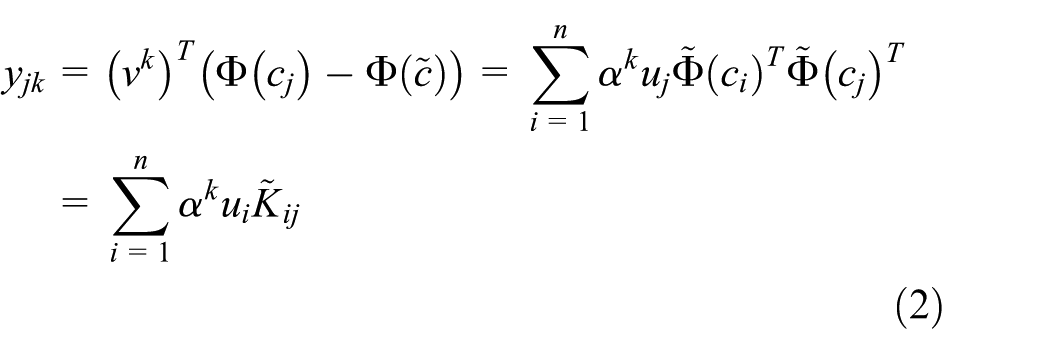
Robust KPCA is a renewed form of KPCA using robust analysis based on fuzzy membership that can decrease the adverse effects of outliers and the nonlinearity among CM data. 9 It maintains most information of the origin CM data using a smaller cluster of uncorrelated variables called principal components (PCs). The robust KPCA algorithm works as follows:
Initializing the membership
Set
If
Calculating the projection value from CM data
5. Finally, evaluating sample

where
After the above steps, the eigenvalue, contribution rate and accumulating contribution rate of components will be obtained. And, the main information of element concentration data is represented by the selected PCs. It is worth noting that more details about the robust KPCA algorithm can be acquired from Heo et al. 10
Construction of wear degradation index
The PSST performance condition is separated into three states: health, alarm and failure.
5
The feature matrix of PC matrix has different state subspaces between health state and alarm state.
11
Therefore, we used the main angle of basis vector between subspace of health state
Using the main angle numerical calculation method based on the singular value decomposition of basis vector inner product matrix proposed by Hamm and Lee, 12 the inner product matrix of the basis vector is given by

where
Decomposing the singular value of inner product matrix, the eigenvalues

where
The main angle vector can be written as

where
Degradation model and RUL estimation
In this section, we briefly explain the PSST failure mechanism, the degradation process, the RUL definition and the estimation process that can be used to evaluate the improved performance of the proposed methodology when used for RUL prediction.
Failure mechanism
The PSST starts working in a healthy state and is subject to degradation index from oil spectral analysis at regular sampling times providing wear degradation information for maintenance decision-making. Due to the random influence of the internal operation condition and external environment, stochastic models are commonly used to model the degradation process and its association with the CM process. Among these models, Wiener process model has been widely used to model the degradation process for its useful mathematical properties and clear concept. 13 Therefore, we assume that the PSST degradation process is represented by Wiener process, and the degradation model is given by

where the degradation process
RUL definition
Let us assume that when the degradation process

where
Let

We see that the RUL of PSST defined above considers the stochastic of degradation and realizes the real-time RUL estimation by updating the observation process when new degradation index is obtained.
RUL estimation
We then estimate the RUL of PSST based on the degradation model, the RUL definition and the degradation index. According to the Markov property of Wiener process, the PSST’s degradation track after time

On this basis, if time

According to the stochastic process theory, the FHT of Weiner process conforms to inverse Gauss distribution.
13
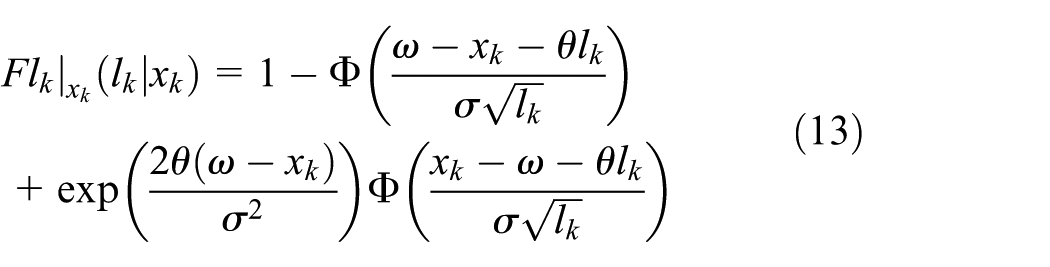
Therefore, the RUL of PSST at time


Flowchart of the methodology
The flowchart of our proposed RUL prediction methodology for PSST is shown in Figure 1. Recall that the PSST is monitored under regular oil spectral analysis, numerous elements concentration will be obtained. The information redundancy of multiple element concentration data makes it hard for PSST wear degradation modelling. Thus, the robust KPCA is used to reduce the oil spectral data dimension, and the values of PCs will be obtained, which represents the main information of element concentration data. Then, the degradation index that can be used for degradation modelling and RUL prediction is constructed based on the state space model and the obtained PCs. Finally, using the constructed degradation index, the Wiener process–based degradation model is established, and value of RUL and the related PDF for the PSST will be obtained.

Flowchart of the RUL prediction methodology for PSST.
Experiment research
In this section, we present a numerical example using real CM data from three reliability tests of PSST to illustrate the entire construction and prediction procedure. All of the PSST units are tested under multi-gear, varying load and multi-speed cyclic operation. The oil samples were collected every 5 h during the operational life of each PSST unit. The criteria of sample collection are listed in Table 1, and see Liu et al. 6 for detailed sampling principals.
Criterion of sample acquiring.

Degradation index construction
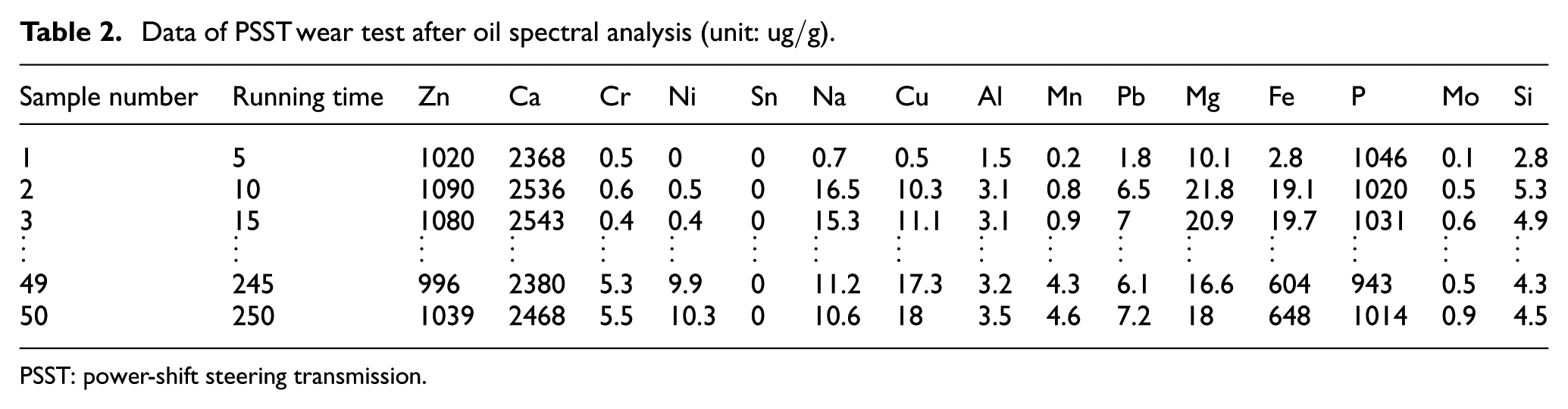
During the operational life of each PSST unit, oil spectral analysis was carried out in time using MOA II (atomic emission spectroscopy), which provides the concentrations in parts per thousand of 21 elements. A preliminary analysis indicated that it is sufficient to consider 15 out of 21 elements for PSST degradation modelling and lubrication oil, and we call them wear degradation indicator elements. 14 The oil spectrometric data for one of three PSSTs are shown in Table 2.
Data of PSST wear test after oil spectral analysis (unit:
PSST: power-shift steering transmission.
The spectrometric data of wear test for PSST have a large number of variables with each variable having a great amount of test data. Hence, it is hard to directly apply the spectrometric data set to wear degradation model and RUL prediction of PSST. Thus, we reduced the dimension of oil spectrometric data by robust KPCA. Table 3 illustrates the calculated eigenvalues, contribution rates and accumulating contribution rates for principal component analysis (PCA) and robust KPCA. Without loss of generality, all degradation data will be normalized before the analysis.
Comparison between PCA and KPCA.

PCA: principal component analysis; KPCA: kernel principal component analysis.
It clearly shows that the robust KPCA reduces the dataset dimension more effectively than the PCA for fewer quantities of PCs and higher contributing rate. The accumulating contribution rate of the first three PCs in robust KPCA is 99.77%.
Then, we construct the wear degradation index by state space model based on the PCs of robust KPCA. The PSST wear degradation index at each sampling times is shown in Table 4.
Degradation index of PSST.

PSST: power-shift steering transmission.
Parameter estimation
Using the degradation index of other two sets, we estimated the degradation parameter
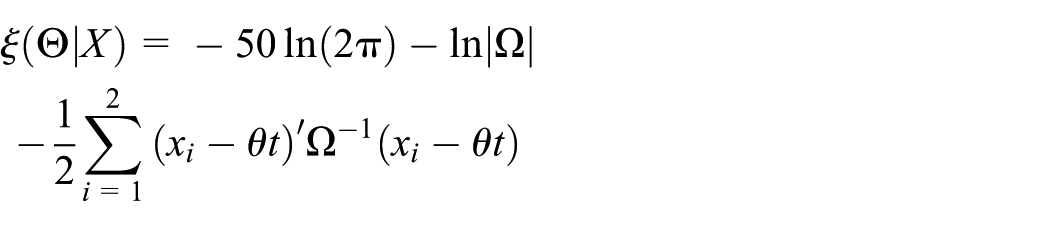
Let us further assume that the degradation model’s parameter vector
where
It is easy to obtain the maximum likelihood estimation
RUL prediction of PSST
The maintenance threshold of PSST based on wear degradation index is
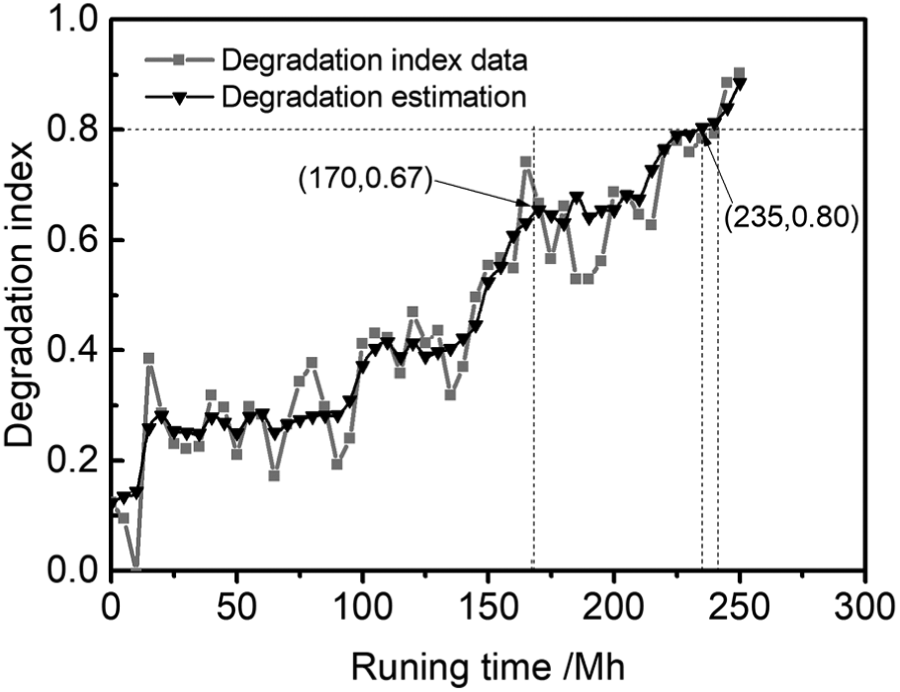
Degradation estimation for PSST using degradation index.
It is clear that the FHT of wear degradation index is 235 Mh, which represents the PSST degradation failure period. Compared with the previously specified maintenance interval, the FHT is extended by 65 Mh. By analysis, the specified maintenance interval is formulated based on the similarity with other similar PSST that without considering the otherness of internal operation condition, external environment, and so on. However, the developed method in this article considers the individual difference of PSST unit and random influence of environment, which ensures the estimation accuracy of PSST wear degradation state. The extension of maintenance interval will effectively reduce the maintenance time of PSST life cycle and finally reduce the maintenance cost. 17
Next, utilizing formula (12), the PDF of predicted RUL of PSST was calculated at several monitor moments, which characterizes the uncertainty of the predicted RUL. The PDF curves are provided in Figure 3.

Predicted PDF for PSST.
In order to evaluate the accuracy of RUL prediction, we calculated the relative error between predicted RUL and real RUL. Table 5 shows the predicted RUL at different quantiles of PSST life, as well as the relative errors.
Mean RULs and relative errors.

RUL: remaining useful life.
As shown in Table 5, RUL prediction shows lower relative error, and the relative error decreases when the PSST operates from health state to failure state. The relative error is less than 10% (5.63%) when the PSST running to half of the PSST life, which indicates that our RUL prediction methodology can accurately predict the maintenance time and finally enhance the reliability and safety of the PSST.
In order to evaluate the performance of the proposed methodology, we calculated the root mean square error (RMSE) 18 between predicted RUL and actual RUL. We consider two cases for this comparison: (1) the methodology proposed in this article based on the fusion of multiple oil spectra and (2) the methodology in Liu et al. 6 based on each selected degradation data. A small RMSE represents a better prediction of the RUL with less absolute error and thus leads to a better CBM strategy with fewer stock costs.
Table 6 summarizes the RMSE for all selected degradation data in Liu et al. 6 and the degradation index proposed in our article, respectively. Based on Table 6, we find that our proposed methodology can provide the smallest RMSE compared with using each degradation data. Thus, our methodology can provide a more accurate prediction of the RUL, which provides a useful reference for the rational formulation of the CBM strategy for the PSST.
Comparison of RMSE between the predicted and actual RUL.

RMSE: root mean square error; RUL: remaining useful life.
Conclusion
Aimed at predicting the RUL of PSST under multiple spectral oil data, we have developed a new KPCA-based data fusion method and a state space model for wear degradation index construction subject to CM. And, we also have applied a degradation modelling and RUL estimation method based on FHT of the stochastic process to predict the RUL of PSST using the constructed wear degradation index. Detailed results are as follows:
The wear degradation index construction procedure is based on the main angle of basis vector from subspace between health state and alarm state. The index value ranges from 0 to 1 along with the performance condition changes from health state to the failure state, which can accurately characterize the PSST degradation degree.
The stochastic process follows Wiener process. The formulas of RUL, PDF and CDF based on available CM information have been derived in explicit forms as functions. They can be updated dynamically with monitor time, which is very efficient for practical application.
Test results have been presented, which validate the effectiveness of the methodology developed in this article for wear degradation index construction, degradation modelling and RUL prediction. It has been found that the developed methodology can objectively describe the performance degradation law.
As the results show, the maintenance time predicted by the developed method is 235 Mh, which is longer than 65 Mh compared with specified maintenance interval. And, the extension of maintenance interval will effectively reduce the maintenance time of PSST’s life cycle and finally save the maintenance costs.
Overall, the methodology described in this article can be used to predict the maintenance interval based on multiple spectral oil data, which can help engineers to implement CBM programme effectively. Using the methodology, maintenance management is expected to reduce the cost and also to improve the reliability of the transmission system.
Footnotes
Handling Editor: Dong Wang
Declaration of conflicting interests
The author(s) declared no potential conflicts of interest with respect to the research, authorship and/or publication of this article.
Funding
The author(s) disclosed receipt of the following financial support for the research, authorship and/or publication of this article: This work was supported by the National Science Foundation of China under grant no. 51475044.
