



Abstract
Some equipment of special types can be stored for a very long time. During storage, the equipment can be affected by temperature, humidity, mechanical stress, and so on, and the study on their storage reliability is very significant. Many theories and methods are proposed for storage reliability assessment in the literature, but few are applied into practice or verified by the actual conditions of the engineering project. Besides, the performance degradation of the equipment with a long storage time is not evident, the performance degradation model is hard to build. Thus, in this article, a storage reliability assessment method under periodical inspection for the equipment with a long storage time is studied. In the method, the storage reliability curves of “repaired as good as new” and “degenerated after repaired” are constructed to describe the different states of the stored equipment after periodical inspection, the environmental factor is used to deal with the data coming from accelerated life tests, and the study is based on an engineering project, thus the effectiveness can be verified.
Keywords
Introduction
There is some equipment of special types and they can be stored for a very long time. During storage, the equipment can be affected by many kinds of environmental factors such as temperature, humidity, and mechanical stress. The main failure mechanism during storage includes oxidation, aging, mildew, sealing failures, and other slow chemical or physical processes.1,2 Storage reliability assessment can help find out the root causes of storage failure, eliminate the hidden faults, and provide a technical support for storage management, and thus it deserves much attention.3–5
The reliability of the stored equipment gradually declines under the influence of various environmental stresses. For example, solder joints of electronic components are oxidized, mechanical components may be corroded or rusted, rubber parts will be aging, and fatigue cracks will grow.6–8 These are the main reasons for performance degradation and reliability reduction of the stored equipment. 5 Most storage reliability assessment methods construct storage reliability models by analyzing the failure mechanism and performance parameter degradation based on the probability theory,2,9 but these models may fail when the degradation is not evident. Also, some storage reliability models are studied on basis of conducting storage reliability tests which need rich sample and sufficient data.10,11 As the research continues, new methods and theories are introduced into storage reliability assessment, such as the neural network, 12 Bayesian statistics,13–15 fuzzy theory, 16 interval analysis, 17 and multi-information fusion analysis theory 18 are introduced, and these methods are verified much more suitable for the storage and small-sample systems under multi-source stresses. However, the aforementioned methods are a little more complex and their models contain many unknown parameters which are difficult to be accepted by engineering applications. Thus, their applications are restricted. By considering the actual conditions of an engineering project, this article aims to propose a storage reliability assessment method under periodical inspection for the equipment with a long storage time.
The remainder of this article is organized as follows. The section “Storage reliability assessment under periodical inspection” gives key storage reliability indexes and storage reliability models under inspection period. In the section “Storage reliability assessment of an electronic equipment,” after a brief introduction to the project, the storage reliability assessment framework is constructed. Following the framework, the storage reliability model as well as its parameter estimation are studied under a data collection of 12 samples. Moreover, storage reliability indexes in life cycle are assessed at the end of this section. Finally, the conclusion and future studies are summarized in the “Conclusion” section.
Storage reliability assessment under periodical inspection
Several key storage reliability indexes
Storage reliability is to study the ability of the stored equipment to keep its required functions under stated storage conditions for a specified period of time or a time interval. According to the definition of storage reliability, three primary storage reliability indexes, namely, storage life

where

where
Several key storage reliability indexes
The storage reliability of the stored equipment gradually declines under the influence of various environmental stresses. Oxidation, corrosion, aging, and so on are the main reasons for performance degradation and reliability deterioration of the stored equipment. 5 In practical application, the stored equipment mostly adopts regular inspection approach to control their reliability and safety. Thus, studies on storage reliability change rules and the construction of storage reliability models under the inspection period for the stored equipment are the essential issues. 19
In general, the storage life of the stored equipment obeys exponential distributions.3–5 After the inspection, some equipment can be restored as good as new while some degenerate to a certain extent. Obviously, if the states of the stored equipment are different after being repaired, then the characters of their storage reliability curve are various. Based on different states, storage reliability curves can be described as the state of “repaired as good as new” and “degenerated after repaired,” and characteristic curves under two states are shown in Figures 1 and 2, where

The characteristic curve of storage reliability under the state of “repaired as good as new.”
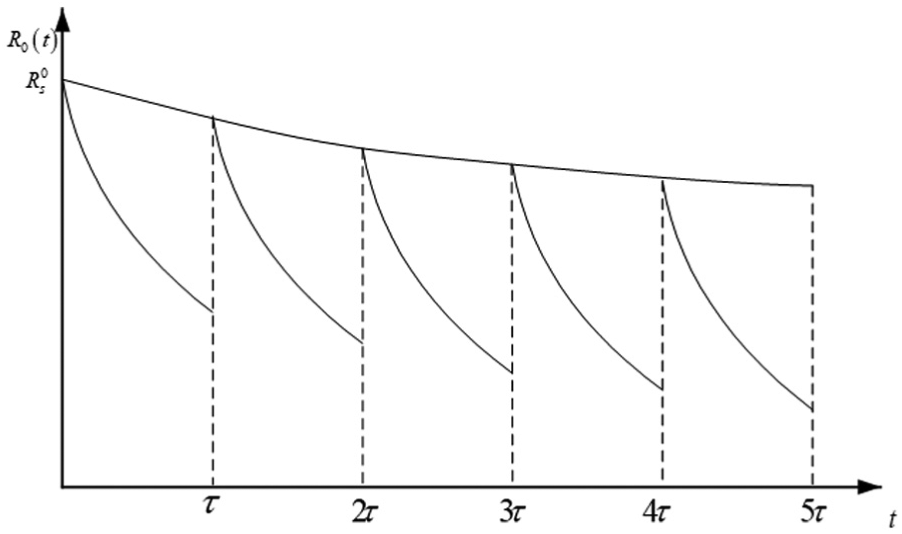
The characteristic curve of storage reliability under the state of “degenerated after repaired.”
For these two states, storage reliability models can be constructed as follows.


where

where

where

For the non-renewal part, its components have degraded but have not reached such an extent as to be repaired or replaced. If

Thus, the storage reliability of the whole system can be computed by

where
Storage reliability assessment of an electronic equipment
The purpose of the project is to assess electronic equipment which will be periodically inspected every 2 years. The main design requirements of this electronic equipment are that the initial reliability is not less than
The process of storage reliability assessment is shown in Figure 3.

Storage reliability assessment framework.
Storage lifetime data for 12 samples
In this project, 12 test samples produced on 30 January 2013 are chosen for tests, and storage reliability tests are subsequently conducted. In general, the electronic equipment is featured with extremely high reliability and it will be stored for a significantly long time. The existing approaches to obtain storage lifetime data can be divided into field storage tests and accelerated storage tests. 20 Field storage tests are time-consuming and they are difficult to be managed. Moreover, the storage reliability of the electronic equipment is very few in the storage period of more than a dozen years. Thus, field storage tests are inapplicable for the electronic equipment. Since the sample quantity is extremely small (only 12 samples can be used) and the cost of production is very expensive, it is impossible to conduct a large amount of experiments. According to the actual situation, here we take the idea of accelerated life tests and increase the environmental stress for samples. Besides, some reliability lifetime data are also obtained in a short period.
The detailed situations of storage lifetime tests and key time nodes are introduced as follows.
Twelve samples chosen for tests are produced on 30 January 2013 and their initial reliability
After being stored for 1 year, the first storage lifetime test is conducted from 1 February to 10 February 2014. In this test, two environmental stresses, namely temperature and humidity, are considered, and thus the humid heat test is conducted. Eight samples are taken to do the humid heat test and the remaining four samples are stored as usual. In the humid heat test, all eight samples experienced 10 cycles in total with every 24 h as a cycle. The samples are detected at the end of every cycle. The test condition is 120°C, 95% RH, where RH means the relative humidity. The result of this test is that one of the eight samples failed after the fifth cycle and the failed one does not take part in the remaining tests.
After conducting the humid heat test, the failed sample will be repaired and the failed components will be replaced. This sample will not be used in the remaining tests and the remaining seven samples are stored in the warehouse again.
The second storage reliability test is conducted from 10 April to 20 April 2015. The test process is the same as the first one but there is an adjustment of environmental stresses. Then, eight samples are chosen to undergo the humid heat test and the rest four samples are stored as usual. The test condition is 150°C, 105% RH. All eight samples experienced 10 cycles in total with every 24 h as a cycle. The samples are inspected at the end of every cycle. The result of this test shows that one of eight samples failed after the fifth cycle.
Storage lifetime data related to these 12 samples can be summarized in Table 1, where
Storage lifetime data for 12 samples.

RH: relative humidity.
Storage reliability modeling for electronic equipment
In each test, only the failed part is replaced and the reliability of this part cannot return to its initial reliability degree. Thus, the storage reliability assessment model for this type of electronic equipment should be constructed by Model II. In this article, parameter estimation of the storage reliability assessment model is based on processed data of humid heat tests. Furthermore, lifetime data coming from the humid heat tests will be conversed to lifetime data under the normal storage state via an environmental factor, which will be introduced in the next subsection.
Environmental factor estimation under exponential distributions
The environmental factor

where
Interval evaluation of environmental factor

Here,
Reliability lifetime data conversion based on environmental factors
For the electronic equipment, the confidence coefficient is expressed as


Similarly, the interval evaluation of the environmental factor


The storage reliability model for the electronic equipment
If the reliability lifetime data are transferred from a much more adverse circumstance to a normal environment, the lower confidence limits of environmental factors should be used.24–26 Thus, the electronic equipment storage reliability under the normal storage conditions can be computed by

where
The storage reliability assessment model for these 12 samples can be constructed by Model II, that is

According to life test data II, the reliability of these samples under the condition 120°C, 95% RH is

Thus, the reliability of this type of electronic equipment after stored for 1 year is

According to equations (15)–(17), we have

According to data III, on 30 January 2015, these 11 samples are inspected and failed components are replaced. On 10 April 2015, the humidity test concerning 8 samples is conducted again and 1 of 8 samples fails after the fifth cycle. Thus, the reliability point estimation for these samples can be obtained by

According to equation (15), we can obtain that

Taking equation (18) and equation (20) into equation (15), we can obtain that

and the reliability lifetime can be calculated by

Storage reliability assessment for the electronic equipment
According to the requirements made by a customer, this type of the electronic equipment should be stored for 10.5 years with the storage reliability of more than 0.96 under
Storage reliability assessment
As analyzed above, the storage reliability of this electronic equipment can be computed by

From Figure 2, it can be concluded that the minimum reliability appears at the end of every inspection period and thus, the storage reliability can be estimated by computing the storage reliability at the end of each inspection period. The results are shown in Table 3.
Storage reliability before the inspection.
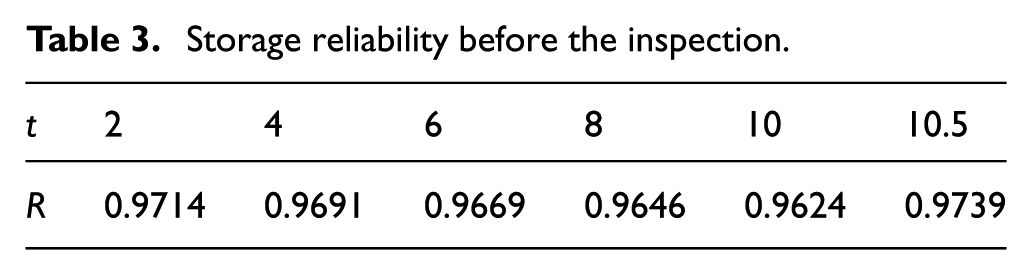
It can be seen that the storage reliability at the end of every inspection period as well as 10.5 years is more than 0.96, that is to say, the storage reliability of the electronic equipment satisfies the requirement.
Storage reliability lifetime assessment
Assume that

For the electronic equipment, the storage reliability should not be less than 0.96 in 10.5 years, that is
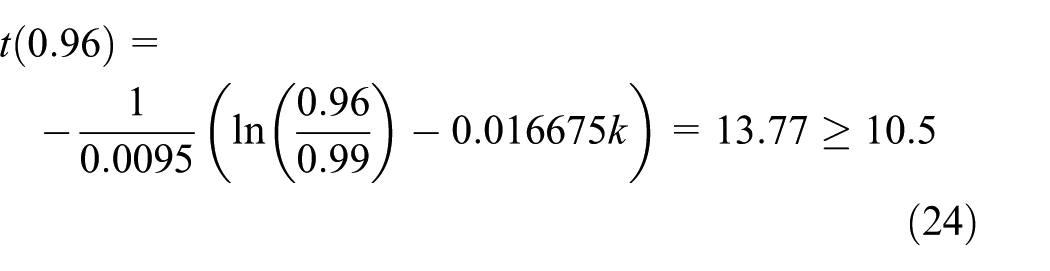
Thus, the storage lifetime of the electronic equipment satisfies the requirement.
Conclusion
Many theories and methods have been developed for storage reliability assessment in the literature, but few are put into practice or verified by engineering examples. Thus, this article proposed a storage reliability assessment method under periodical inspection for the equipment with a long storage time. Moreover, this article gave a detailed procedure description of storage reliability tests, test data processing, model selecting, model construction, parameter estimation, and so on. In the future, the optimization model for the best periodic time of inspection will be studied, because excessive inspection will increase life cycle costs while overlong periodic time of inspection violates the original intention of periodical inspection.
Footnotes
Handling Editor: José Correia
Declaration of conflicting interests
The author(s) declared no potential conflicts of interest with respect to the research, authorship, and/or publication of this article.
Funding
The author(s) disclosed receipt of the following financial support for the research, authorship, and/or publication of this article: This research was partially supported by the National Natural Science Foundation of China (51575116), the Innovative Academic Team Project of Guangzhou Education System (1201610013), the Science and Technology Planning Project of Guangdong Province (2017A010102014, 2016A010102022), the Science and Technology Planning Project of Guangzhou Municipal Government (201707010293), and the Innovative Team Project of Guangdong Universities (2017KCXTD025).
