




Abstract
In view of the defects of borehole collapse, inhibition of gas desorption and migration of gas existing in hydraulic fracturing and other hydraulic permeability–increasing measures for soft coal seams with low-permeability technology is proposed for coal breakage by a high-pressure abrasive gas jet for relieving pressure and increasing permeability. The comparative analysis of gas jet flow field structure between convergent nozzle and Laval nozzle has been given by numerical simulation. For Laval nozzle, the expansion wave and compression wave alternate and move forward steadily in gas jet and vanish when potential core length reaches maximum. So, the Laval nozzle can form more stable flow filed structure of gas jet and avoid shock wave in gas jet. Furthermore, a high-speed camera is adopted to analyze the jet structure and verify the conclusion of numerical simulation. Based on thermodynamic theory, this article calculates and analyzes the critical local sound velocity and pressure generated from the stress wave during the process of coal breakage by the gas jet. Furthermore, experimental coal breakage by a high-pressure abrasive gas jet is carried out. The high-pressure abrasive gas jet impacts the coal body as a quasi-static load and a dynamic load and forms corrosion pits on the surface of the coal body. Penetrating cracks are formed within the coal in the pattern of the loaded stress wave which leads to coal breakage. The effects of porosity and permeability on the propagation of the stress wave in coal are analyzed by establishing the dispersion equation for the spread of the stress wave in coal. The results show that porosity has a significant effect on wave velocity and that the attenuation of the stress wave is intensified with an increase in porosity. Moreover, the stress wave attenuation is more obvious at high frequency. The effect of permeability on the wave velocity is not significant at low frequencies. In contrast, at high frequency and relatively low permeability, the wave velocity increases with the permeability, and the attenuation of the wave velocity initially increases and then decreases. When the permeability is greater than 10−11 m2, the wave velocity is not affected by the permeability. However, the stress wave is not attenuated.
Introduction
Methane is an important source of clean energy, but the mining technology of coal-bed methane determines its utilization level. In China, more than 15 billion m3 of coal-bed methane requires the process of underground mining. However, as the depth of the coal bed increases, the permeability of the coal bed worsens. Moreover, there is enhanced difficulty in the mining of deep coal-bed methane, and the mining efficiency is reduced. Therefore, scholars have proposed various technologies for hydraulic pressure relief and strengthening of the coal body during coal-bed methane mining. These technologies include water jet cutting, 1 hydraulic punching, 2 and hydraulic fracturing.3–5 However, the above-mentioned technologies frequently result in borehole collapse when applied to soft coal seams and fail to achieve the desired favorable effect on mining.6,7 In addition, the existence of water in a coal body has a negative effect on methane desorption and seepage. 8 The adoption of gas to power the pressure relief of a coal seam can avoid the disadvantages of hydraulic stress measurement. The methods utilizing gas include liquid carbon dioxide phase transformation breakage technology 9 and supercritical carbon dioxide jet coal petrography breakage technology. 10 Nonetheless, due to the complexity of preparation and implementation of underground processes using liquid carbon dioxide, the popularization and application of the above-mentioned technologies in underground coal mines are restricted. There are two basic conditions to utilize gas to power coal seam pressure relief. First, the gas must be continuously supplied. Second, the gas must reach a state at which coal breakage occurs. The development and application of a high-pressure abrasive air jet provides an idea for coal breakage through the air jet. It is widely utilized in glass and metal cutting, drilling, and burring by virtue of its strong impact property.11–13
In this study, coal is broken using a high-pressure abrasive air jet to improve the permeability of a coal seam High-pressure air is produced directly by an air compressor in the underground coal mine, which avoids the shortcomings of hydraulic stress measurement and liquid carbon dioxide coal breakage. In existing abrasive erosion mechanisms adopted up until now, the pressure and flow are relatively low. The pressure is lower than 2 MPa, the flow is less than 100 L/min, and the erosion depth is shallow. In other words, the existing abrasive erosion mechanisms are all based on low pressure and flow. Another issue is that in the past a convergent nozzle has been adopted. The velocity of the outlet of such a nozzle is at either subsonic or sonic speed, and cannot reach supersonic velocity. Therefore, it is not conducive to the erosion breakage of coal body. The pressure of a high-pressure gas jet needs to be increased to achieve a better erosion effect. The de Laval nozzle is utilized to cause the outlet velocity of the nozzle to reach supersonic speed. However, when the gas pressure is higher than 16 MPa, the temperature and concentration of the jet flow will dramatically change, which significantly affects the acceleration of abrasive particles and thus the erosion mechanism.
According to water jet theory, when a jet acts on a coal body, the breakage of the coal body appears as the formation of erosion pits and the expansion of the macro cracks. The former results from the propagation and reflection of jet impact energy within the coal body in the form of an elastic stress wave14,15 The degree of breakage of the coal is determined by the intensity of the stress wave and the attenuation law of the stress wave in coal as well as the characteristics of the coal body. Lu et al. 16 indicated that the buckling failure of the coal body was mainly caused by the tensile stress of the jet impact stress wave. However, they ignored the influence of holes and the fracture of the coal and rock mass on the propagation of the stress wave.17,18 Ju et al. 19 proved that porosity significantly affected the propagation characteristics of the stress wave. Under the same strain rate, the reflected wave amplitude and wave crest were enhanced with increasing porosity, while the transmission amplitude was decreased. In addition, the energy dissipation rate increased linearly with the porosity. Tang et al. 20 verified that the properties of the elastic wave were influenced by two parameters, namely the fracture density as well as longitudinal and shear waves. The fracture shape did not exert a great influence on the dispersion and attenuation of elastic waves.
In summary, coal breakage by a high-pressure abrasive air jet mainly depends on the impact load. Buckling failure occurs in a coal body under the effect of the tensile stress of the stress wave. The propagation characteristics of a stress wave in jet impact are affected by the multi-pore structure of the coal body. Therefore, based on the experimental analysis of the characteristics of impact on a coal body by a high-pressure air jet, this article establishes a propagation model of a jet impact stress wave in a coal mass on the basis of Biot theory to analyze the propagation rule of the stress wave in a coal body and the influence of the porosity of the coal body on stress wave propagation.
Experimental coal breakage by a high-pressure abrasive air jet
Flow field structure of the high-pressure air jet
Impact force and range both depend on flow field structure of the air jet. More optimal flow field structure of air jet has more efficient energy conversion and better coal breakage effect when energy input of gas is the same. As a critical factor for air jet structure, the nozzle structure of convergence is used most presently. Compressed air accelerates in contraction section and up to sound velocity in cylindrical section of convergence nozzle. And it will continue to accelerate because of air expansion at the nozzle outlet. But the expansion is out of control because of lack of divergent section of nozzle, which leads to the flow field structure of air jet not being optimal. On the other hand, the flow field of Laval nozzle is better because the expansion is controllable by means of designing reasonable length and angle of expansion section. For contrastive analysis flow field of air jet between convergence nozzle and Laval nozzle, numerical simulation by FLUENT has been done. For gas phase flow field, gas phase continuity equation is

Gas phase Navier–Stokes equation is
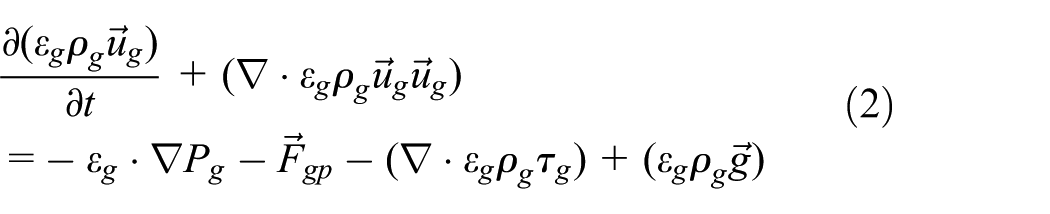
where
The RNG k–ε turbulence model used in this article can simulate, among others, the high Reynolds number flow of jets. The gas is assumed as an ideal gas. The governing equations for the RNG k–ε turbulence model are


where

where
Laval nozzle’s type is 3 Ma, as shown in Figure 1. Convergence nozzle has the same parameters with convergence and throat section of Laval nozzle.21,22 Inlet boundary is pressure inlet, and the pressure is 25 MPa. From the results of numerical simulation as shown in Figure 2, it can be concluded that the flow field structure of Laval nozzle is more stable and the potential core is longer. Expansion wave and compression wave alternate and move forward till the end of potential core when air jet flow out from Laval nozzle. However, expansion wave will superpose and turn to shock wave after reflection in air jet of convergence nozzle. Beyond the shock wave, the velocity of air jet decreases drastically in potential core. The length of potential core of convergence nozzle is much shorter than Laval nozzle. Therefore, Laval nozzle transfers more impact kinetic energy than convergence nozzle and is much more benefit for coal breakage.

Structure of Laval nozzle.

Flow field structure of air jet in convergence nozzle and Laval nozzle.
To verify flow field structure of Laval nozzle gained by numerical simulation, experiment of flow field structure shoot by high-speed camera is conducted. The experimental apparatus was mainly composed of a high-pressure air compressor (with a maximum pressure of 40 MPa and a maximum air intake of 2 m3/min), gas storage tank, abrasive tank, high-pressure pipe, test rig, and a measurement system. The test rig was mainly utilized to fix the positions of the nozzle and coal samples, as well as to install the pressure and temperature sensors. The measurement system was composed of the pressure gauge installed in the pipeline, flow meter, and thermometer as well as a temperature and pressure data acquisition system utilized in measuring jet flow.
The system apparatus was connected as shown in Figures 3 and 4. In addition, a high-speed camera (Phantom Miro M310) was utilized to record the jet flow to determine the structure of the jet flow field. Water was added to the abrasive tank to produce tracer particles to clearly photograph the structure of the jet flow field.

Schematic diagram of the connection of the high-pressure abrasive gas coal breakage system.

High-pressure abrasive air jet coal breakage system device.
The inlet pressure of Laval nozzle is 25 MPa, the results of experiment are highly consistent with numerical simulation, as shown in Figure 5. So, Laval nozzle transfers more impact kinetic energy than convergence nozzle and is much more benefit for coal breakage. And the Laval is the best choice for coal breakage in the article.

High-pressure air jet flow field structure.
Experimental parameters
Coal sample parameters
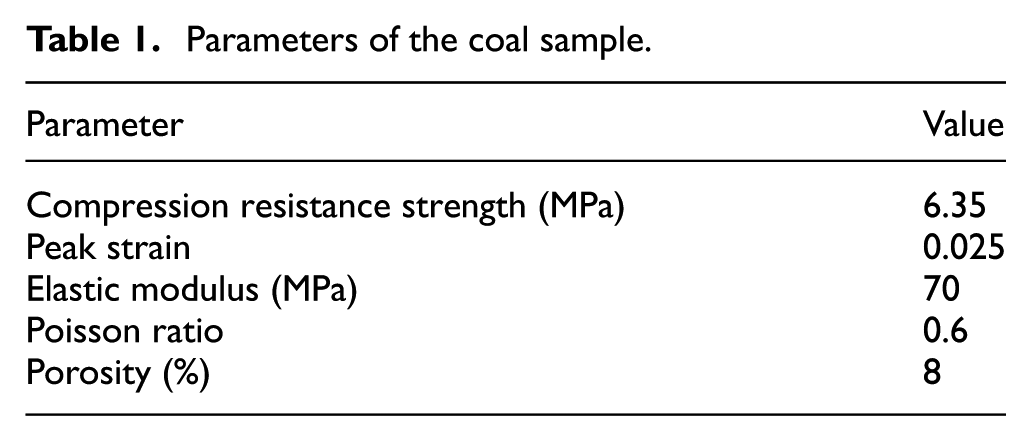
The erosive coal briquettes were collected in the Jiulisha coal mine. An MTS815 rock mechanics testing system was utilized to measure the mechanical properties of the coal samples. An ASAP2010 specific surface distribution measuring instrument manufactured by Micromeritics Instrument Corporation was used to measure the porosity of the coal body. The specific parameters are shown in Table 1. To study the propagation law of the stress wave in the process of jet impact, the length of the coal samples was lengthened, and the size was
Parameters of the coal sample.
Jet flow parameters
The impact load of the abrasive air jet is the main cause of the breakage of the coal body. The magnitude of the impact load of abrasive and gas is determined by the jet velocity, which is decided by the structure of the nozzle and the inlet pressure. The principle of coal breakage by the jet impact stress wave is that the impact zone is in an absolutely pressurized state under the action of a strong compression wave caused by the impulsive load of the abrasive and gas. The pressure on the contact surface is reduced from the peak pressure to the stagnation pressure until the next outward radial flow of jet flow. Due to the sharp drop in pressure, the compression wave forms a strong radial force after being reflected. When the tensile stress exceeds the fracture strength of the coal body, cracks will be generated. To sum up, the jet velocity and longitudinal wave velocity are the key factors for rock breakage. The relationship among cut depth, jet velocity, and longitudinal wave velocity is

where C is the sonic velocity of water, V0 is the jet velocity, dc is the hole diameter of the rock mass impacted by the jet, and k is a coefficient related to the characteristics of the rock mass and impact distance.
Daniel believed that the effect of the jet velocity on the stress wave was quite significant. 23 When the water jet velocity was lower than 850 m/s, there was no obvious stress wave on a granite sample. The results of the research by Liu et al. 18 indicated that water sandstone was eroded by a water jet flow with a water jet velocity of 400–600 m/s, and the stress wave effect appeared. The compressive strength of a coal body is much lower than the tensile strength of rock. Si et al. 24 utilized a water jet velocity of 350 m/s to impact a coal body, and an obvious stress wave effect was presented. The sonic speed of water is much higher than that of air. According to equation (1), the velocity of the stress wave effect generated from air jet impingement on coal is lower than that of water jet impingement. Based on thermodynamics theory, if the velocity of the gas is greater than the local sonic speed, the de Laval nozzle should be adopted. The critical outlet velocity of the jet is

where v is the outlet velocity of the jet (m/s), P0 is the stagnation pressure of compressed air (Pa),
The breakage of coal by high-pressure gas is related not only to the jet expansion but also to the local sonic velocity. The stagnation pressure is set at 10 MPa. The air compression process is assumed to be an isothermal process, and the gas temperature is at room temperature of 298 K. The injection process of high-pressure gas is a one-dimensional (1D) isentropic motion. According to the following equation, it can be calculated that the outlet temperature of the nozzle is 77 K

where T is the outlet temperature of the nozzle (K), and
The local sonic velocity can be expressed as

where a is the local sonic velocity (m/s), R = 8314/M0 is gas constant (J/K mol), and M0 is the molecular weight of the gas.
According to equation (8), the local sonic velocity is calculated to be 176 m/s, and the outlet velocity of the nozzle is 203 m/s. That is, when the pressure is 10 MPa, the outlet velocity of the nozzle is greater than local sonic velocity, which satisfies the condition for the generation of an obvious stress wave after the abrasive air jet flow impacts the coal body.
The abrasive material selected in this experiment is 120-mesh carborundum, at a mass concentration of 20%. As for the premixed abrasive jet, the acceleration of the abrasive material is determined by the velocity of the jet flow. The acceleration phase of the abrasive material occurs mainly within the nozzle with acceleration to the constant speed of the free jet. For a de Laval nozzle, the key to acceleration of the abrasive material lies in the length of the nozzle throat and the expansion section. When the velocity of the gas within the throat section reaches sonic velocity, this is the critical stage for the acceleration of the abrasive material. A reasonable throat length can make the abrasive material accelerate to the sonic velocity. In the expansion section, the jet velocity is greater than the sonic velocity, and the abrasive material could be further accelerated. Through a comparative analysis in the experiment, it is found that the #1 nozzle is more conducive to the acceleration of the abrasive material.
Analysis of experimental results
When the abrasive air jet flow impacts the coal body, there are two forms in which macroscopic rock mass failure occurs. One is the formation of erosion pits normal to the surface of coal body, and the other is the breakage of the rock mass caused by the expansion of macro cracks in the coal body. In addition, the jet energy is converted to radiation energy and the kinetic energy of coal debris. The high-speed jet flow is loaded to the surface of the coal body instantaneously. The compressive stress exerted by the jet flow on the coal body is greater than its compressive strength, which leads to the appearance of shear breakage within the impact area. Erosion pits are formed on the surface of the coal body. At this point, the diameter of the erosion pits is equal to that of the jet flow. After the formation of the erosion pits, the jet flow is rejected on the surface of the erosion pits, and forms the wall jet, which produces a strong shear force and further breaks the coal body. The radius of the erosion pit is increased and the erosion depth in gradually enhanced (shown in Figure 5). The erosion time in this experiment is 6 s, and the depth of erosion in the #1 coal sample is 48 mm and 44 mm in the #2 coal sample.
The high-speed jet flow forms the erosion pits on the surface of coal body. Meanwhile, the dynamic impact load is transmitted in the form of a stress wave in the coal. Continuous jet flows form stable sources of the waves that are applied to the coal surface. The particles at the wave front are compressed. Before the arrival of the next wave front, the particles are subjected to tensile stress. When the tensile stress exceeds the tensile strength of the coal body, the cracks will be generated. The stress wave is reflected after propagating to the crack surface. The cyclic load is exerted on the crack surface to enhance its area. As shown in Figure 6, the #1 and #2 coal samples present macroscopic cracks in front of the erosion pits. The cracks penetrate the coal body, and the expansion of these macroscopic cracks eventually leads to the breakage of the coal body.

Breakage forms of the coal body under high-pressure abrasive air jet flow: (a) macroscopic crack growth and form of erosion pits in the #1 coal sample and (b) macroscopic crack growth and form of erosion pits in the #2 coal sample.
The existence of secondary and primary cracks reduces the amplitude of the transmitted wave, the energy of which is dissipated while passing the cracks and the intensity of the stress wave is decreased. A contrast experiment was carried out to determine the effect of porosity and crack rate on stress wave propagation in the coal body. Coal gangue samples were collected in the same coal seam. The uniaxial compressive strength of the coal gangue samples was 44 MPa, and the porosity was 4%. The erosion experiment was carried out with the same jet parameters. The breakage form after erosion is shown in Figure 7. The appearance of the macroscopic crack in the samples led to breakage. Therefore, the same breakage form occurred in the coal body. However, there was a difference in that two macroscopic cracks appeared in the samples. The reason for this is that the porosity of the coal gangue sample was lower than that of the coal sample, and the attenuation of its stress wave is slower. When the stress wave was propagated to the far end of the sample, the energy could still form penetrating cracks in the coal body, which led to the breakage of the coal.

Breakage forms of coal gangues under high-pressure abrasive air jet flow.
The experimental results showed that when the high-pressure air jet flow impacted the coal body, it was applied to the coal body as both a static and dynamic load, and the erosion pits were formed on the surface of coal body. Furthermore, the penetrating cracks were formed within the coal body in the pattern of the stress wave load, which led to the breakage of the coal body. The porosity of the coal body not only affects the propagation of the stress wave but also forms the breakage modes of the coal body. Therefore, it is necessary to carry out a theoretical study on the effects of porosity on the propagation rules of the stress wave
The propagation rule of a stress wave in a coal body
Dispersion equation of a stress wave in a coal body
Coal bodies possess a multiple-pore structure. The original coal body is a type of fluid–solid coupling medium. When the jet flow impacts the coal body, its dynamic response is more complex than that of an ideal single-phase elastic medium. Therefore, it is of practical significance to study the propagation of a stress wave in coal by utilizing a two-phase medium model compared with a single-phase elastic medium. Under the effect of the impact of the jet flow, the stress wave is propagated in the coal body in the form of a spherical wave. Various studies on the propagation of spherical waves in a single-phase medium have been carried out. However, the effect of fluid–solid coupling should be considered for the propagation of a spherical wave in a coal body.
The physical power of the coal body is neglected. Using spherical coordinates

where
The effective stress in the coal body is

where
Combining equation (9) with equation (10), the stress wave propagation equation expressed by effective stress could be obtained

The equilibrium equations and constitutive relation of the fluid in the coal body are


where,
The effective stress–strain relation is

Combined with equations (11)–(14), the stress wave equation in displacement vector form could be obtained

where

The divergence is taken on the two sides of the wave equation, and equation (17) is obtained

where

where
As a high-pressure abrasive air jet impacts a coal body, the impact load is transmitted into the rock in the form of longitudinal waves. Equation (17) contains the propagation characteristics of a longitudinal wave in a coal body. Due to the pore characteristics of the coal body, the propagation of the longitudinal wave in the coal body exists in two forms, namely a fast longitudinal wave and a slow longitudinal wave. Because there is a great difference between the velocities of the two types of waves, the shear failure for the coal due to the slow wave is not obvious. As a result, equation (17) can be solved under the given relevant characteristics of the fast longitudinal wave. According to the non-zero condition, the dispersion equation for the P wave is

where lp is the wave vector of the P wave and

According to equation (19), the wave vector value lp of the fast wave and its phase velocity, attenuation, and attenuation characteristics could be calculated


where Re and Im represent the real and imaginary parts of the complex number, respectively.
Propagation characteristics of an elastic wave in a coal body
According to the dispersion equation of a stress wave the stress wave propagation in a coal body is closely related to the porosity and permeability. Therefore, a numerical analysis method is utilized to solve the dispersion equation. Related parameters of the coal body are listed in Table 2.
Parameters of the coal body.

kp = 10−10 m2, and
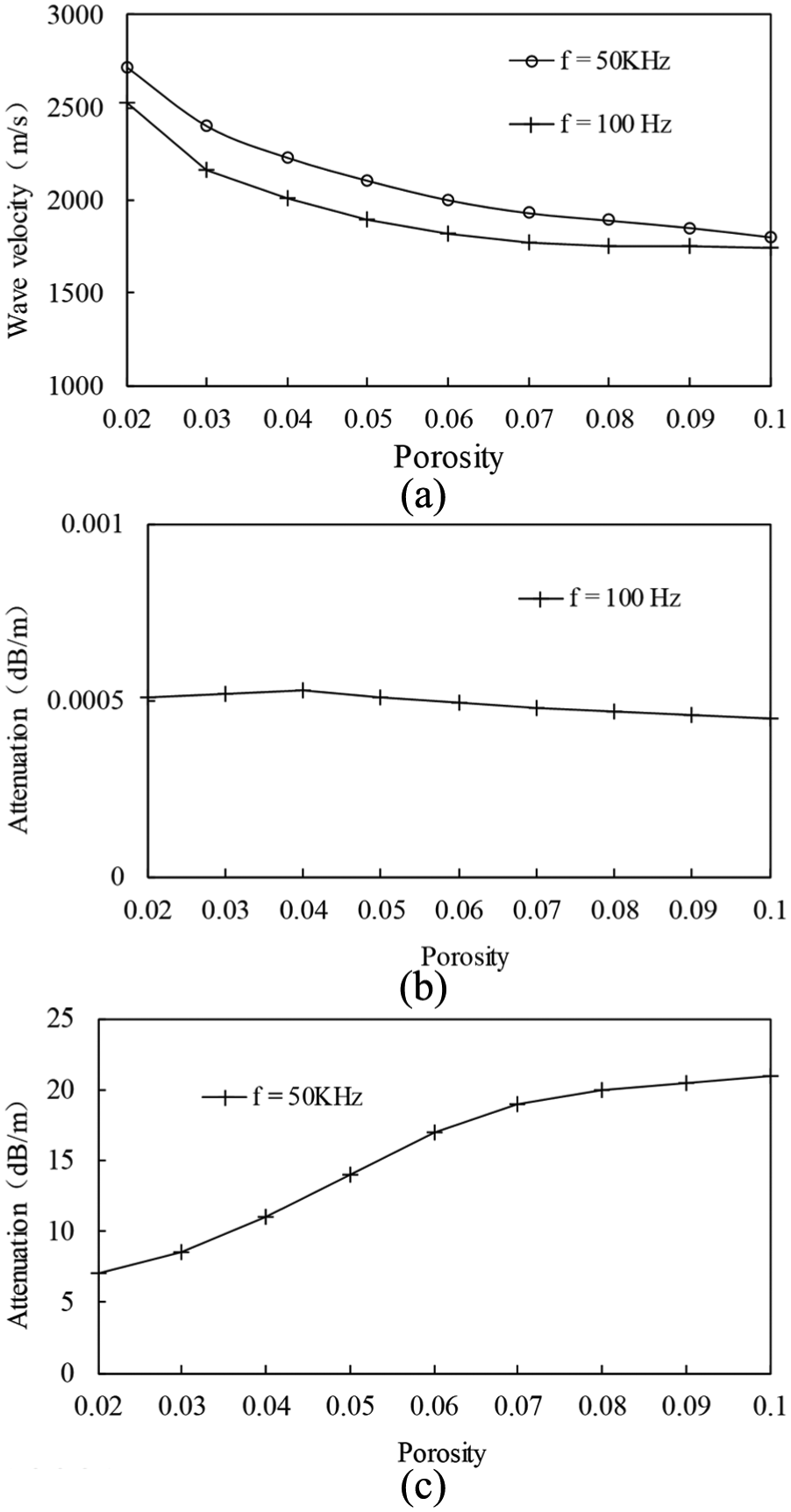
The effect of porosity on wave velocity and attenuation.
Porosity has a significant effect on the wave velocity, which is consistent with the research results of Ju Y et al. 19 The porosity is directly proportional to the pore interface of wave impedance, which leads to multiple reflections and superpositions of the stress wave. As a result, the amplitude and crest of the reflection wave are increased. In the meantime, due to the decrease in the coal matrix, the solid medium bearing stress wave decreases and so does the transmission of stress wave. The reduction in the transmission wave reduces the propagation velocity of the stress wave. With the increase in the porosity, the dissipation of the energy of the stress wave is enhanced. Furthermore, due to the formation of pores and cracks in the coal body, the dissipation is gradually increased. In other words, the attenuation of the stress wave shows an increasing trend with the enhancement of porosity. The superposition of the stress wave is more rapid and frequent at high frequency. Compared with low frequency, the change in attenuation of the stress wave is more obvious at high frequency.
Due to the relative motion between the pore fluid and the solid skeleton generated from the pore permeability of the coal body as shown in Figure 9, the longitudinal wave is affected to a certain extent. The porosity of coal is 0.03, and the coefficient of viscosity of the pore fluid is 10−4. The range of variation of permeability is from 1 × 10⁻¹³ to 1 × 10⁻¹⁰. The high frequency is 50 kHz, and low frequency is 100 Hz. The calculation results show that the velocity of the fast wave has little effect on the permeability at low frequency. Furthermore, the attenuation of wave velocity first increases and then decreases. When the permeability is greater than 10−11, the wave velocity is not affected by permeability. In contrast, the stress wave is not attenuated.
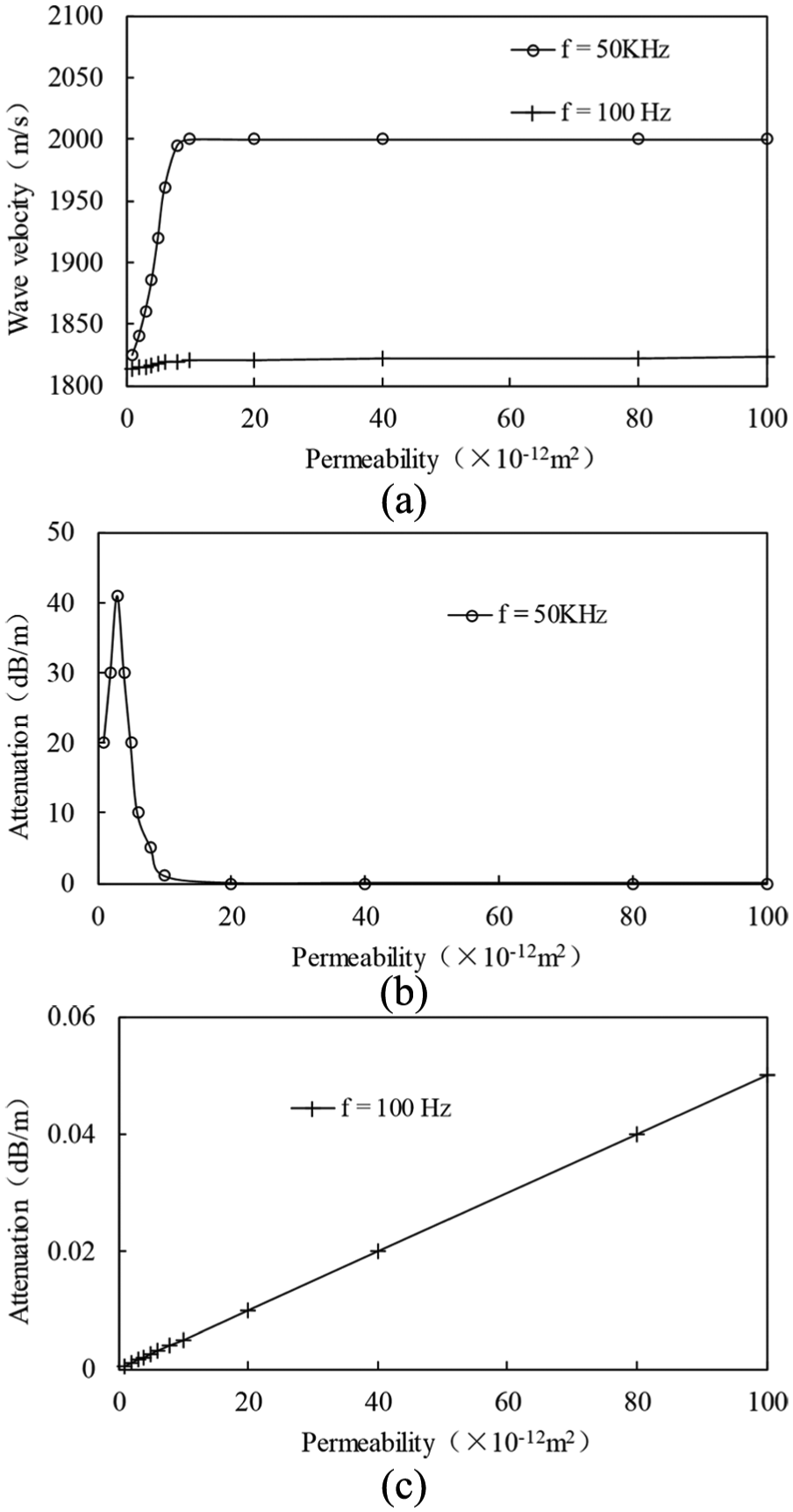
The effect of permeability on the wave velocity and its attenuation.
Conclusion
The high-pressure abrasive (carborundum) air jet can realize the breakage of a coal body, which provides a new method for gas mining in a low-permeability coal seam.
When utilizing a de Laval nozzle, the outlet velocity of the nozzle can reach supersonic speed. Furthermore, the jet flow possesses a typical pulse structure. The formation of the pulse structure is beneficial to the erosion and breakage of the coal body.
A high-pressure air jet uses its impact load as the main form of coal breakage. The impact load is propagated in the form of a stress wave in the coal body. When the impact pressure of the jet flow is 10 MPa, the outlet velocity of the nozzle is greater than the local sonic speed. Due to the action of the stress wave, coal bodies form penetrating cracks, which leads to the breakage of the coal. Furthermore, corrosion pits are formed on the surface of the coal body. By comparing the erosion effects of a coal sample and coal gangue, it is concluded that the porosity has an important influence on the propagation and attenuation of the stress wave.
Based on the establishment of the dispersion equation for the stress wave in a coal body, it is concluded that the stress wave velocity and its attenuation are related to the porosity and permeability of the coal body. Increasing porosity leads to an increase in the attenuation trend of the wave velocity. The higher the frequency, the more obvious this trend will be. Permeability has a certain effect on the wave velocity and its attenuation. However, when the permeability is greater than 10−11 m2, the wave velocity will not be affected by the permeability. In contrast, the stress wave is not attenuated.
Footnotes
Handling Editor: Wensu Chen
Declaration of conflicting interests
The author(s) declared no potential conflicts of interest with respect to the research, authorship, and/or publication of this article.
Funding
The author(s) disclosed receipt of the following financial support for the research, authorship, and/or publication of this article: This paper was jointly funded by the National Key Research and Development Program of China, (grant no.: 2017YFC0804207), the National Science Foundation of China (grant nos.: 51704096, U1704129), the Science Research Funds for the Universities of Henan Province (grant no.: J2018-4), the Scientific Research Foundation of State Key Laboratory of Coal Mine Disaster Dynamics and Control (grant no.: 2011DA105287—FW201601), and the Scientific Research Foundation of State Key Laboratory Cultivation Base for Gas Geology and Gas Control (grant no.: WS2017A02).
