




Abstract
The noise source of hybrid electric vehicle is varied, which makes the frequency band from low-frequency to high-frequency distribution. Using a single material to control the hybrid electric vehicle interior noise to improve the performance of vehicle, noise, vibration, and harshness performance is limited. In this article, the composite noise reduction materials which have the function of damping and acoustic absorption are used to control the vehicle interior noise. First, the noise characteristics of the hybrid electric vehicle are analyzed. The distribution of the hybrid electric vehicle interior noise is obtained. Then, the sound-absorbing properties of polyester-polypropylene bi-component fiber are analyzed. The low-frequency noise reduction principle of butyl rubber damping material is also analyzed. Finally, the noise reduction materials consisting of polyester-polypropylene and butyl rubber are added to the hybrid electric vehicle roof and floor. After improving material, the hybrid electric vehicle interior noise is test. As the result, the car driver’s right ear A-weighting sound pressure levels have been greatly improved. The low-frequency noise below 400 Hz reduced 1.5 dB(A), and the high-frequency noise above 400 Hz reduced 5.2 dB(A). The total noise reduction reached 3.3 dB(A) near the driver’s right ear, which significantly improve the noise, vibration, and harshness performance of hybrid electric vehicle.
Introduction
Relative to traditional internal combustion engine vehicle (ICEV), hybrid electric vehicle (HEV) adds motor, dynamic coupling mechanism, and battery pack. HEV has relatively complex structure and its working state changes a lot. Thus, the noise and vibration characteristics also change. Except low-frequency noise generated by original engine, there is 400- to 2000-Hz high-frequency noise generated by the motor. Within such frequency range, human ear has very high sensitivity, so strong noise feeling may be caused. Even harsh howling sound is caused. 1 Therefore, it is especially important to reduce noise in HEV and improve noise, vibration, and harshness (NVH) performance of HEV.
There are three types of noise control of HEV: noise source control, receiver’s side control, and transmission path control. Noise source control is the most direct vehicle noise reduction technology. Busch et al. 2 decreased the engine combustion noise through controlling solenoid energizing dwell. Veit et al. 3 refined the turbocharger noise to reduce the interior noise. But noise source control technology is restricted by the technology of component manufacturers, and the improvement space is limited. Receiver’s side control technology is an active noise control (ANC), which is a method for reducing unwanted sound by the addition of a second sound specifically designed to cancel the first. Zuo et al. 4 established an ANC model to reduce the noise of blower in fuel cell vehicle. Kim et al. 5 used active sound design technique to control interior sound due to power train. But the application of ANC in automobiles has been limited due to the complex noise environment. The noise transmission path control method is easy to operate and widely used in automobile noise reduction. Using the acoustic absorption materials to reduce noise and improve NVH performance belongs to transmission path control method. In order to reduce medium–high-frequency noise in HEV, acoustic materials of fiber, foamed, and polyurethane types are adopted at relevant part for acoustic encapsulation. 6 Mineral wool and other cellular materials are used to encapsulate side body and ceiling of HEV so as to effectively control medium–high-frequency noise in HEV. 7 Cummer et al. 8 effectively broke through technical bottlenecks in passive control of low-frequency vibration noise through local resonance phonon crystal structure and achieved the special effect of controlling large wavelength low-frequency mechanical wave through subwavelength micro-structure. Parikh’s research uses sound-absorbing materials such as polypropylene to floor coverings to reduce noise inside the vehicle. By stacking an underpad and a floor covering together, noise inside the vehicle was significantly reduced. 9 Saha provided an overview of noise control materials that are used in heavy trucks and buses. He also provided some examples of different noise control material applications. 10 Polce et al. 11 focused on the acoustic performance of damping material, sound-absorption material, and acoustic effect of the related parts, the influence of material type, and application position difference on NVH performance of vehicle body. Varghese et al. 12 outlined a unique method to optimize noise treatment materials and its effective placement to suit performance, weight, and cost.
But these researches mainly focus on the application of an acoustic material. In fact, HEV has a wide noise spectrum characteristic. In order to compare the spectral characteristics of HEV and ICEV, we selected an HEV and an ICEV with same engine capacity and placed a microphone in the engine compartment, respectively, as shown in Figure 1.

Microphones in engine compartments of HEV and ICEV: microphone in (a) HEV and (b) ICEV.
The two vehicles were driven on a good road at the speed of 60 km/h. The engine speeds were 1300 r/min. At this moment, the HEV was in the operation condition of hybrid driving, and the ICEV transmission was shift at sixth gear. Then, the noise data were collected with the Supervisory Control and Data Acquisition System (SCADAS) of LMS company. After data processing, the noise spectrums in engine compartments of HEV and ICEV are shown in Figure 2.

Noise spectrums in engine compartments of HEV and ICEV.
It can be seen from Figure 2 that A-weighting sound pressure levels (SPLs) of HEV and ICEV are very similar in low-frequency region. But in high-frequency region, HEV’s A-weighting SPL is significantly higher than ICEV. Therefore, the HEV noise control is limited with only one kind of acoustic material. It is very necessary to apply multiple acoustic materials to reduce noise in HEV.
The rest of this article is organized as follows. In section “Materials and methods,” four tasks are executed. First, the sources of noise in HEV are analyzed. Second, the HEV noise testing is conducted to gain characteristics of interior noise of HEV. Third, acoustic performance of polyester-polypropylene (PET-PP) bi-component fiber and butyl rubber materials is researched. Fourth, the noise reduction materials, such as PET-PP and butyl rubber, are selected to control the HEV interior noise. In section “Results and discussion,” the testing results of HEV interior noise before and after noise control are analyzed and discussed. In section “Conclusion,” some conclusions are provided.
Materials and methods
Outline of the sources of noise in HEV and preliminary test
Outline of the sources of noise in HEV
Compared with traditional vehicle, the structure of HEV changes greatly as follows:
Power system added—except the engine, large-capacity power battery is added.
Drive axle changed significantly—the drive axle turns into drive axle assembly which is composed of dynamic coupling device, motor MG1, and motor MG2 from transmission.
Structural arrangement changed—the engine and drive axle assembly are arranged at the front end of HEV, and large-capacity power battery is arranged at the rear of HEV, which leads to the change in vehicle body weight distribution.
Structural diagram of HEV is shown in Figure 3. The noise sources of HEV mainly come from the engine, dynamic coupling mechanism, MG1, MG2, frequency converter assembly, and power battery. The noise sources present diversification and complexity.

Structural diagram of HEV.
Preliminary test
To gain characteristics of noise sources of HEV, HEV noise testing is conducted according to Economic Commission for Europe (ECE) R51 Uniform Provisions Concerning the Approval of Motor Vehicles Having at Least Four Wheels with Regard to Their Noise Emissions proposed by ECE in 2000. 13
The four-channel SQuadriga portable sound analyzer is used to record the driver’s binaural noise and noise samples of co-pilot position and passengers at the rear seats. The layout of the sensors is shown in Figure 4.

Sensors’ layout: microphones at (a) driver’s side, (b) the rear seat, and (c) co-pilot side.
Testing conditions are as follows: speed 60 km/h, combined drive of engine, MG1, and MG2. After data collection and analysis, noise spectrums under such working conditions are shown in Figure 5.
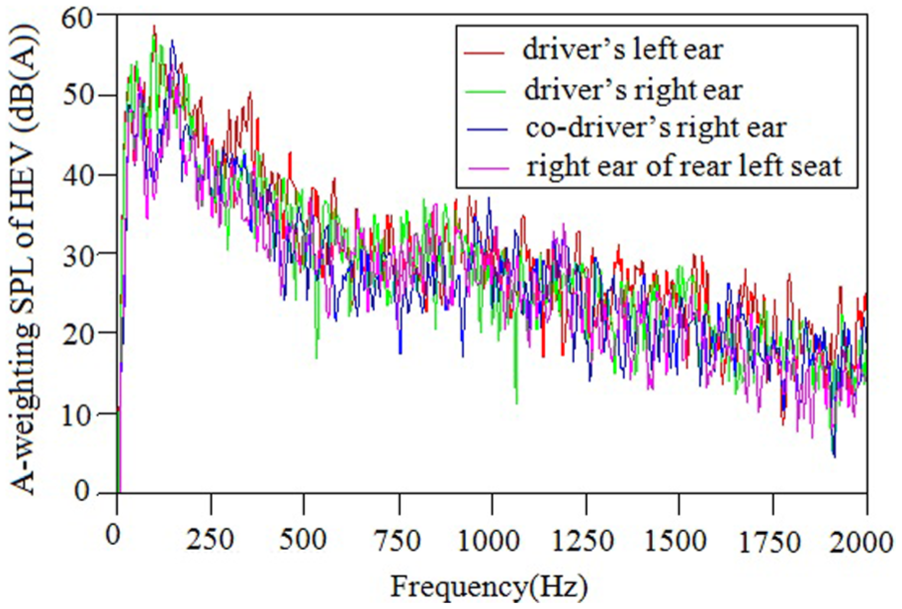
Interior noise spectrums of HEV.
It can be seen from Figure 5 that A-weighting SPL of driver’s both ears, co-pilot’s right ear, and right ear of passenger in the rear seat of driver distinguishes little. The noise in HEV basically maintains below 2000 Hz and mainly appears at 99, 353, and 938 Hz. The noise amplitudes of driver’s left ear are 58.76, 50.33, and 37.18 dB(A), respectively.
Acoustic performance of material
Acoustic absorption performance test of acoustic material
B&K Model 4206 is applied as the test instrument, and the test is conducted according to ASTM E1050. The test samples are disk-type samples with the diameter of 100 and 30 mm, respectively. The test sample with the diameter of 100 mm is used to test acoustic absorption curve of material for low-frequency noise. The test sample with the diameter of 30 mm is applied to test acoustic absorption curve of material for high-frequency noise. The full frequency band of material is fitted by two curves.
Acoustic absorption performance of fibers with different areal density
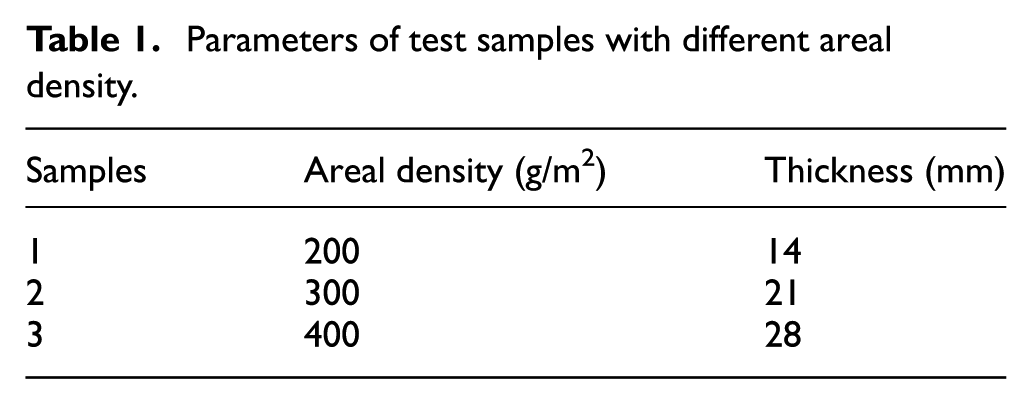
To study acoustic absorption performance of PET-PP fiber materials with different areal density, three kinds of materials with different areal density and thickness are chosen for test, as shown in Table 1.
Parameters of test samples with different areal density.
The acoustic absorption coefficients of three kinds of materials after the test are shown in Figure 6.
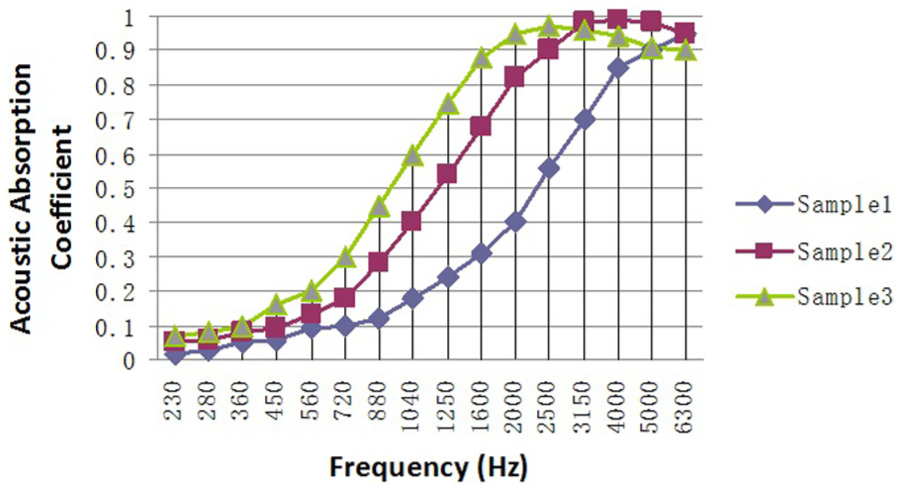
Acoustic absorption curve of PET-PP fiber materials with different areal density.
According to the test results in Figure 6, the change curve of acoustic absorption coefficient of PET-PP fiber materials with the frequency has the consistent change trend with common porous acoustic materials. 14 Acoustic absorption coefficient of materials gradually rises with the increase in the frequency. The material has good absorption function for medium–high frequency and especially the acoustic wave above 1500 Hz. Besides, as areal density of material increases, the general acoustic absorption performance of material is enhanced. However, the coefficient of PET-PP fiber materials with the areal density of 300 and 400 g/m2 drops at above 2500 Hz.
Acoustic absorption performance test of different types of fibers
PET-PP fiber materials with different areal density and thickness, single PET fiber material, and regenerated fiber material are chosen to test acoustic absorption performance. Four types of test samples are shown in Table 2.
Parameters of different types of fiber samples.

PET-PP: polyester-polypropylene.
Acoustic absorption coefficients of different materials are gained through the test, as shown in Figure 7.

Acoustic absorption coefficients of different fiber materials.
It can be seen from Figure 7 that acoustic absorption coefficient of PET-PP fibers with the same areal density rises with the increase in the thickness of materials under the same frequency. Because the increase in the thickness enhances the obstruction for acoustic wave to penetrate the materials, and the materials increase consumption of acoustic wave ability, acoustic absorption performance of materials strengthens. In addition, the comparison of acoustic absorption curves of PET-PP fiber, PET fiber, and regenerated fiber shows that PET-PP fiber has stronger acoustic absorption effect under small areal density. Acoustic absorption coefficient of PET-PP material with the areal density of 200 g/m2 is higher than that of PET fiber with the areal density of 350 g/m2 and regenerated fiber with the areal density of 400 g/m2 under 200–6300 Hz frequency band. The acoustic absorption curves of PET fiber with the areal density of 350 g/m2 and regenerated fiber with the areal density of 400 g/m2 are basically close, but the acoustic absorption effect of PET fiber is slightly better than that of regenerated fiber. Therefore, if PET-PP fiber material is used in HEV, it will not only guarantee a good acoustic absorption effect but also contribute to light weight of acoustic trim.
Acoustic absorption performance test after thermal aging of fibers
In order to study acoustic absorption performance of PET-PP fiber material after thermal aging, PET-PP material with the areal density of 200 g/m2 and thickness of 28 mm is chosen to carry out acoustic absorption test under the conditions of normal temperature and 65°C for 2 h, respectively. The test results are shown in Figure 8.

Acoustic absorption coefficient curves of fiber before and after thermal aging.
It can be seen from Figure 8 that acoustic absorption performance of PET-PP fiber material slightly declines after thermalization under 65°C. This is because molecular structure of material changes after the material is heated, which influences consumption of acoustic wave energy. But for the declining numerical value, acoustic absorption performance change of material changes little.
Butyl rubber damping material
Butyl rubber is a kind of line-type gel-free elastic copolymer. It is a synthetic rubber, a copolymer of isobutylene with isoprene. The abbreviation IIR stands for isobutylene isoprene rubber. Its molecular structure is as follows.

There is a short double bond in the molecular structure of butyl rubber. Distribution density of methyl on the side chain is large and shows special wormlike molecular motion form in the glass transition zone. Hence, it has excellent damping capacity. 15 The density of butyl rubber damping material is 920 kg/m3, and the Poisson ratio is 0.4. The elastic modulus and loss factors of the butyl rubber were tested under 20°C of room temperature by the dynamic mechanical analysis (DMA) of Metravib company (France) according to ISO 6721 Plastics—Determination of Dynamic Mechanical Properties. Elasticity modulus and loss factor of material are shown in Figure 9. It can be seen from Figure 9 that elasticity modulus and loss factor of butyl rubber change with the frequency.

Elastic modulus and loss factor of butyl rubber.
Interior noise control and results analysis
Noise reduction material selection scheme
It is found from analysis of acoustic performance of materials that PET-PP material has good acoustic absorption performance, so PET-PP composite material is chosen to reduce noise. Meanwhile, in view of acoustic interior decoration, areal density of PET-PP material is 200 g/m2, and its thickness is 28 mm. Acoustic absorption effect of PET-PP material at low-frequency zone is not good. Low-frequency noise on HEV is caused by body structure vibration to a large extent, except the engine. The use of damping material can restrain steel plate vibration so as to reduce low-frequency noise caused by vibration. As analyzed above, butyl rubber damping material has good damping performance, so butyl rubber is chosen as the low-frequency noise reduction material of HEV. According to simulation analysis, PET-PP and butyl rubber materials which are pasted on the roof and floor of vehicle can reduce the noise well. The installation technology is as follows: first paste a layer of IIR on the roof and the floor and then paste PET-PP porous acoustic absorption material. The schematic diagram of composite noise reduction material is shown in Figure 10.

Schematic diagram of noise reduction material.
Realization of vehicle noise reduction
Take noise control in HEV with the noise reduction material pavement scheme in Figure 10 according to above analysis. After tearing down the original trim material on the vehicle roof, apply IIR and PET-PP successively to complete the acoustic packaging on the vehicle roof, as shown in Figure 11, and then pack the vehicle floor with acoustic material with same method.

Applying noise reduction materials on HEV roof.
Results and discussion
Results
To more objectively compare noise level of HEV before and after noise control with noise reduction material, interior noise test is conducted with the same method under the same working conditions with the trial experiment after noise reduction material is encapsulated in the vehicle. After experiment, two spectrums of the noise at the driver’s right ear before and after optimizing were obtained, as shown in Figure 12

Comparison of A-weighting SPL of driver’s right ear before and after the use of noise reduction material.
With the Test.Lab software of LMS company, the different values of overall (OA) level, which also were the different values of root mean square (RMS) of the two frequency spectrum curves below 400 Hz and above 400 Hz in Figure 12, were calculated, respectively.
According to the calculated results, composite noise reduction material which is synthesized by PET-PP and IIR can reduce 1.5 dB(A) noise for low-frequency noise below 400 Hz and can reduce 5.2 dB(A) noise for high-frequency noise above 400 Hz, and the total noise reduction reaches 3.3 dB(A) near the driver’s right ear.
A-weighting SPLs of the other three points before and after the use of noise reduction materials are shown in Figures 13–15.

Comparison of A-weighting SPL of driver’s left ear before and after the use of noise reduction material.

Comparison of A-weighting SPL of co-pilot’s right ear before and after the use of noise reduction material.

Comparison of A-weighting SPL of right ear of passenger in the rear left seat before and after the use of noise reduction material.
The experimental result shows that the composite noise reduction material has excellent performance and significantly reduces interior noise level. The test results also showed that the noise reduction effect in the front occupants is better than that in the rear ones. The main reason was that the high-frequency noise was mainly reduced by the noise reduction material PET-PP. The PET-PP was mainly laid on the car roof and floor. The microphone on the both ears of the passenger in the front seat was located in the center of the carriage and the center of the noise reduction material parcel, so the noise reduction effect was obvious. However, the microphone in the back row was located on the rear of the carriage and close to the rear windshield and was located on the edge of the noise reduction material parcel, so the high-frequency noise reduction effect was bad. Therefore, the noise reduction materials are applicable to noise reduction in HEV.
Discussions
This article mainly focuses on the study of using sound reduction materials which have the function of damping and acoustic absorption to control the interior noise in HEV. After analyzing the properties of acoustic materials that include PET-PP and IIR, the HEV sound reduction method is carried out. As the noise test results indicate, the A-weighting SPLs have been greatly improved in HEV.
Currently, a great deal of researches pay close attention to the acoustic materials’ properties and using them to reduce the interior noise in cars, which are described in section “Introduction.” These results are very similar to our results and indicate that the sound reduction materials, such as PET, natural fiber composite, and nonwoven material, can reduce the interior noise and improve the NVH performance in car. An argument just like the suggestion pointed out by our article is given that the effect of noise reduction is limited if only using one kind of sound material in car, especially in HEV. The use of a variety of acoustic materials to control HEV interior noise can effectively reduce the noise from low frequency to high frequency which improves the NVH performance.
Of course, the use of composite materials to effectively reduce the noise inside the car also caused some problems. This will lead to greater economic costs. The vehicle mass loading will be increased. At the same time, this puts forward higher requirements to the processing technology. However, as a commonly used chemical, PET, PP, and IIR are cheap. After using these noise reduction materials, the cost of the car has increased by about US$100. Compared to a US$30,000 car, the cost has increased by only 0.3%. The surface density of PET-PP material is 200 g/m2, and the volume density of IIR is 920 kg/m3. So the weight of the car will be increased by about 24 kg when the area of the roof and floor using noise reduction materials is 5 m 2 . The mass loading of original car is about 1500 kg, so the refined car weight is increased by only 1.6%. The laying of noise reduction material is mainly based on paste, and its processing technology is relatively simple and easy to implement. It is suitable for popularization of automobile noise reduction technology.
This article has many contributions and advantages. It illuminated how to analyze the properties of acoustic materials. It also presented a method for using acoustic materials to reduce the interior noise of HEV based on experiment. The principle of this method is clear and is simple to carry out. So it can be used widely and can provide a useful tool for noise reduction in HEV. From the perspective of practice, the method proposed here is of important value for improving NVH performance of HEV.
Of course, there are still some aspects that need to be improved. The noise reduction effect of the acoustic material on the HEV is verified only under the most commonly used hybrid working condition, and other conditions, such as pure electric working condition and regenerative braking condition, are not considered. Considering that the influence of temperature on the acoustic performance of materials was small and the test conditions were limited, the noise reduction effect of the material after thermal aging was not tested in the article. These are also the main issues requiring in-depth study in the future.
Conclusion
PET-PP composite noise reduction material has excellent acoustic performance. Compared with common fiber, it has better acoustic stability. Such material can significantly reduce interior high-frequency noise of HEV. In addition, the experiment results showed that the noise reduction effect in high frequency for the front occupants is better than that for the rear ones.
Butyl rubber owns favorable damping performance. After the material is pasted on the roof and the floor of HEV, steel plate vibration can be effectively restrained so as to reduce low-frequency noise which results from vibration.
The composite noise reduction material which is synthesized by PET-PP and IIR is used to encapsulate HEV, which has good noise reduction effect from low frequency to high frequency. For low-frequency noise, 1.5 dB(A) noise can be reduced; for high-frequency noise, 5.2 dB(A) noise can be reduced. The total reduction amount of noise reaches 3.3 dB(A).
Footnotes
Handling Editor: ZW Zhong
Declaration of conflicting interests
The author(s) declared no potential conflicts of interest with respect to the research, authorship, and/or publication of this article.
Funding
The author(s) disclosed receipt of the following financial support for the research, authorship, and/or publication of this article: This work was financially supported by National Natural Science Foundation of China (51575238) and Postdoctoral Foundation of Jiangsu Province (1601064C).