




Abstract
The influence of geometrical parameters of the short grooves on the hydrodynamic lubrication is studied in this article. Based on Reynolds equation and Jakobsson–Floberg–Olsson cavitation theory, an analytical model is developed to investigate the hydrodynamic lubrication of the short grooves. The study employs a multigrid method to calculate the distribution of hydrodynamic pressure and the average pressure of textured surfaces. The results indicate that the interactions between neighboring short micro-grooves and the end effect on the hydrodynamic pressure should be considered in the process of numerical simulation. There exist the optimum values of horizontal spacing and short micro-groove depth to maximize the hydrodynamic pressure. The average film pressure decreases with the increase in the vertical spacing, but it increases alongside the short groove width. The increase rate of the average pressure declines gradually as the short groove length grows. Therefore, hydrodynamic lubrication performance can be improved by optimizing the geometrical parameters of the short grooves according to operating conditions.
Introduction
Surface texturing has been proved to be an effective way to improve tribological performance in a wide range of mechanical components for many years. However, it still presents challenges to engineers to select an optimal surface texture for a specific application. In addition, researches on the lubrication and anti-friction mechanism of surface texture remain a difficult task to scholars and engineers.1,2
For the reasonable exploitation and application of surface texture, it is important to investigate the characteristics and variation of the tribological behavior and the surface texture geometrical parameters in modern surface engineering. It can greatly improve the tribological performance of mechanical component by optimizing geometrical parameters, shapes, and distribution of surface texture. 3 Etsion 4 indicated that dimples can be textured by laser surface texturing on the contact surfaces of various lubricated applications. The tribological performance will be significantly enhanced by optimizing the geometrical parameters of surface texture, such as the geometrical shape, orientation, size, depth, area density, and textured area of the dimple.5–9
Meanwhile, grooves can also influence the tribological performance of the friction pairs.10,11 However, the role of grooves in the change of tribological behavior of the friction pairs has always been controversial due to its geometrical character. Based on the principle of the hydrodynamic lubrication,12–15 the maximum load carrying capacity can be obtained by the grooves that are perpendicular to the sliding direction. Conversely, the grooves can scarcely generate hydrodynamic lubrication when they are parallel to the sliding direction. Besides, the geometrical parameters of the grooves also have significant influences on the hydrodynamic lubrication, such as width, depth, and spacing. The experimental investigation showed that the grooves parallel to the sliding direction can expand the hydrodynamic lubrication regime for preserving the oil film effect.16,17 But the grooves perpendicular to the sliding direction do not expand the hydrodynamic lubrication regime for the sake of side leakage of the lubricating oil, so the tribological performance in this case is poor. Therefore, it can be concluded that the orientation angle of the groove is an important influence factor in the tribological behavior of textured surfaces. Further studies showed that the merits of perpendicular and parallel orientation of the grooves may swap under different contact conditions. 18 Moreover, the textured area and geometrical shapes of the groove also have important effects on the hydrodynamic lubrication of the textured surfaces.19–21 In conclusion, the tribological performance of textured surfaces can be improved by optimizing the geometrical parameters of micro-grooves according to the operating conditions.
Recently, Zhu et al. 21 developed a model-based virtual texturing approach to study the distribution patterns of surface texture on the hydrodynamic lubrication. The results showed that the short grooves perpendicular to the motion direction may be among the best lubricating effects. Subsequently, Ali et al. 22 presented experimental and numerical investigations on the effects of short micro-grooves perpendicular to the sliding direction on the tribological performance in elastohydrodynamic lubrication point contacts. They demonstrated that the short grooves can act as powerful oil reservoirs and significantly enhance the hydrodynamic lubrication when they are shorter than the diameter of Hertzian contact. It is true that each short groove serves as a truly closed and independent texture unit when it is entirely covered in the contact zone, thus preventing side leakage of the lubricating oil. Consequently, the short groove can significantly promote the tribological performance of the friction pairs. Unfortunately, there are few systematical and theoretical investigations on the effects of the geometrical parameters of the short groove on the hydrodynamic lubrication.
This work is conducted to investigate the effect of the geometrical parameters of the short grooves on hydrodynamic lubrication for infinitely long textured sliders under a given set of operating parameters. Geometrical parameters such as the short groove width, depth, length, and spacing are studied using the numerical simulation method.
Analytical model
A cross section of a surface-textured parallel infinitely long slider is shown in Figure 1. The lower slider is fixed and textured with short grooves, and the cross section of each short groove is assumed to be a parabolic line. Each short groove is marked with width


A cross section of a surface-textured parallel slider.
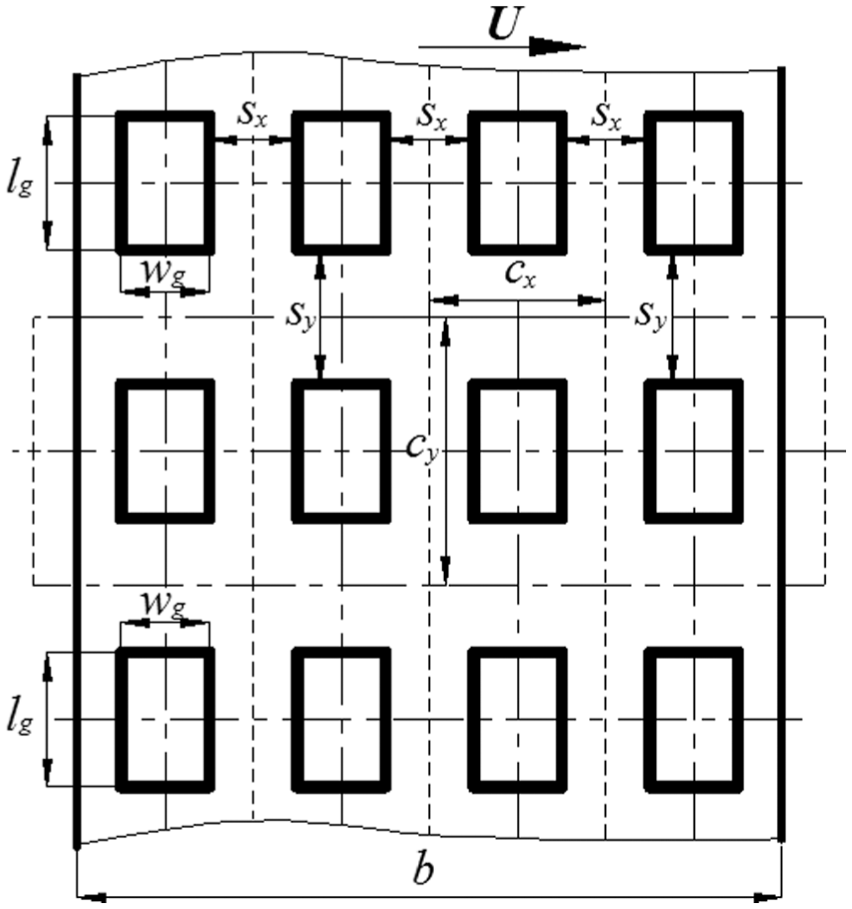
Geometrical distribution of a textured surface with short grooves.
As shown in Figure 2, the short groove distribution can be regarded as thousands of lists with a cycle of cy perpendicular to the sliding direction. In this article, the slider is supposed to be infinitely long and perpendicular to the sliding direction. So, the end effects in this direction can be neglected, and consequently, the pressure distribution in the textured surface can be assumed to be the periodical arrays with a cycle cy. Furthermore, because of the symmetry of the short grooves and the sliding direction, the pressure distribution is also symmetric in a list. Hence, it is sufficient to consider that half a short groove list represents the complete film pressure distribution, as shown in Figure 3. And, the boundary conditions of the half a short groove list will be given in the following form

where

Half a short grooves list.
The lubricant is a Newtonian fluid with a constant viscosity η, and the flow is considered laminar. Therefore, the generalized Reynolds equation for the hydrodynamic pressure can be written in the following form

where h and p are the local film thickness and pressure, respectively; ρ is the lubricant density; x and y are the horizontal and vertical Cartesian coordinates, respectively.
Based on the main fundamental principle of the Jakobsson–Floberg–Olsson (JFO) cavitation theory,23,24 the fluid film will rupture and cavitation occurs when the fluid local pressure falls below the cavitation pressure. There is a mixture of both liquid and vapor or gas in the cavitation region. The mixture will pass through the cavitation zone, and with the increase in the pressure, the mixture will “switch” back to the full-film at the end of the cavitation zone. The fractional-film content (θ = ρc/ρ) is applied to Reynolds equation, and a “universal” partial differential equation (PDE) that covers both the full-film and cavitation regions can be proposed for simplification, generalization, and improvement in dealing with the cavitation algorithm. However, in order to make the resulting PDE consistent with the uniform pressure assumption within the cavitation region, a switch function for g is introduced by Elrod, 25 as shown in the following function

Therefore, the resulting universal PDE can be given as follows

where
And, the pressure can be calculated from the fractional-film content θ as the following function shows

The film thickness at a specific point of the textured slider in the half a short groove list can be shown in the following form
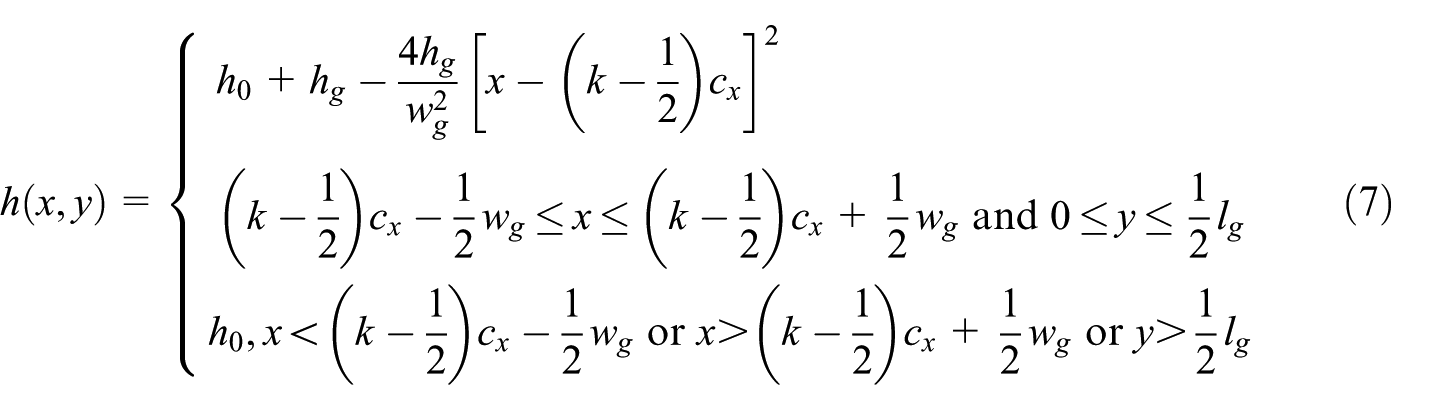
where k is the groove serial number, k = 1, 2, 3, …, Ng. Ng is the number of short groove in a list.
The average film pressure, pav, between the sliders can be written in the following equation

A set of dimensionless variables are defined to facilitate the numerical simulation, as shown in the following form

where hr and lr are the reference values along the directions of film thickness and groove width, respectively.
Therefore, the dimensionless form of equation (5) can be transformed into the following form

where
And, the dimensionless form of equation (7) can be transformed into the following form

where
The dimensionless boundary equation (2) can be transformed into the following form
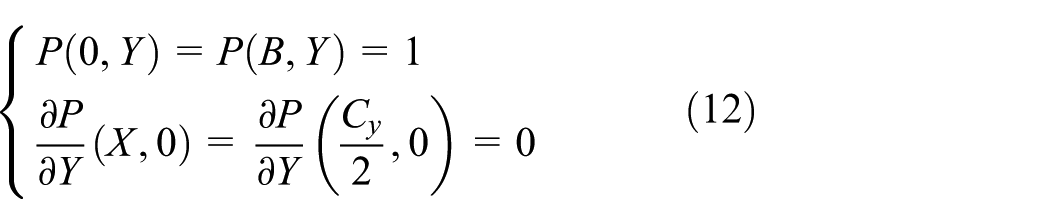
where B is the dimensionless slider width,
The dimensionless average film pressure, Pav, can be written in the following equation.

Numerical method
The finite difference method is used to discretize equation (10), and the form of difference equation is the same as Fesanghary and Khonsari’s. 26 And, the difference equation of equation (10) is given in the following form

Subsequently, the governing equations are solved by the multigrid method using the uniform grid in the computational field. In this case, the approximate solution of the governing equations is obtained by Gauss–Seidel iteration with the pressure relaxation factor

A multigrid V-cycle for M = 3.
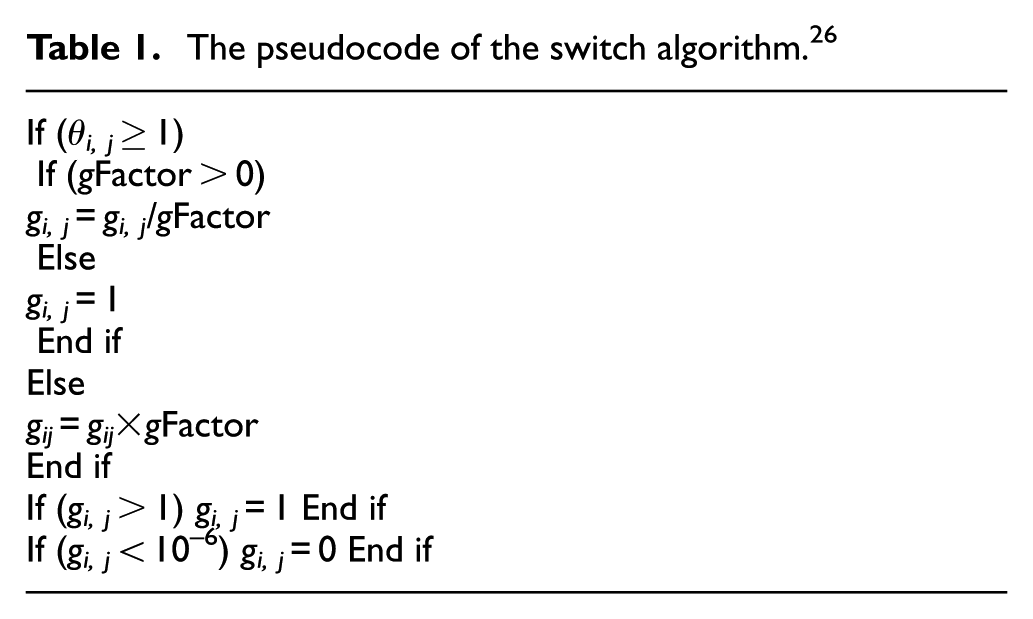
In this article, the switch function in the Elrod cavitation algorithm, which was proposed by Fesanghary and Khonsari, 26 is applied to deal with cavitation zone, and the operation procedure as shown in Table 1. When the value of θi,j is greater than or equal to 1, gi,j is increased by dividing the current value by a constant gFactor, which is equal to 0.8.
The pseudocode of the switch algorithm. 26
In general, the results are transferred from the fine grid to the coarse grid between adjacent grids called restriction to the coarse grid, whereas the opposite is called interpolation of correction. The process of restriction to the coarse grid is achieved through the restriction operator, which is denoted by

Then, the results of the coarse grid k − 1, Pk – 1, can be obtained by the all-weighted restriction operator from the fine grid k, Pk, as shown in equation (16)

Besides, the process of interpolation of correction is achieved through the prolongation operator which is denoted by

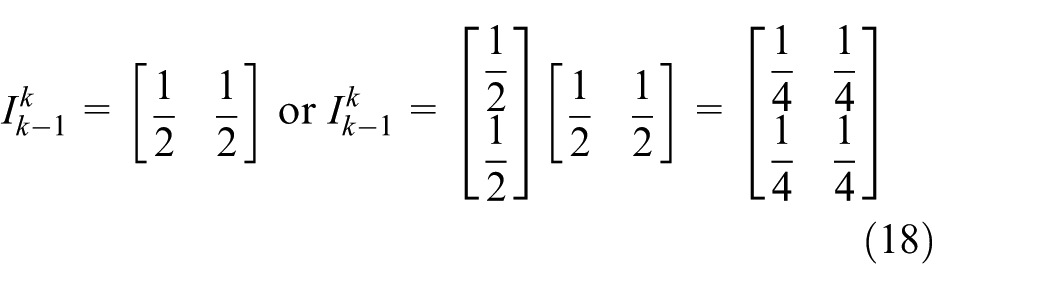
And, the weighted operator has two forms according to the location of the nodes between adjacent grids, as shown in equation (18).
Then, the results of the coarse grid k, Pk, can be obtained by the mapping operator from the fine grid k − 1, Pk – 1, as shown in equation (19)

An equal distance multigrid method is applied to solve the hydrodynamic lubrication of this article. That is, both the dimensionless mesh-sizes of the finest mesh,


The convergence of the film pressure is assumed to be calculated average values of pressure changes between two V-cycles. Generally, the program is considered to reach the convergence precision when the value of the convergence of the film pressure falls below the user-defined tolerance value ε. The converging condition is confirmed by the following equation

where P(i, j) denotes the pressure value at the point (i, j), n is the number of nodes in the x-axis direction, m is the number of nodes in the y-axis direction, and
Validation of the present numerical method
In order to verify the viability and effectiveness of the present numerical method, this article takes the analytical solutions and the present numerical solutions of the typical infinitely long inclined slider as examples. The infinitely long inclined slider is shown in Figure 5. The upper slider is stationary, and the lower slider moves at a certain speed U. The inlet and outlet film thickness are denoted by h1 and h0, respectively. And, the ratio of outlet to inlet film thickness is denoted by K(h1/h0).

Inclined slider.
The analytical solution of load carrying capacity per unit length is denoted by the following equation 28

where W is the load carrying capacity, l is the slider length perpendicular to the slider direction, b is the slider length along the sliding direction and equal to 10 mm in this, and please refer to other parameters’ value from Table 2. The optimum value of K that maximizes the load carrying capacity per unit length is 2.2. Therefore, the maximum load carrying capacity per unit length is about 0.84 MPa m.
The reference parameters for this study.
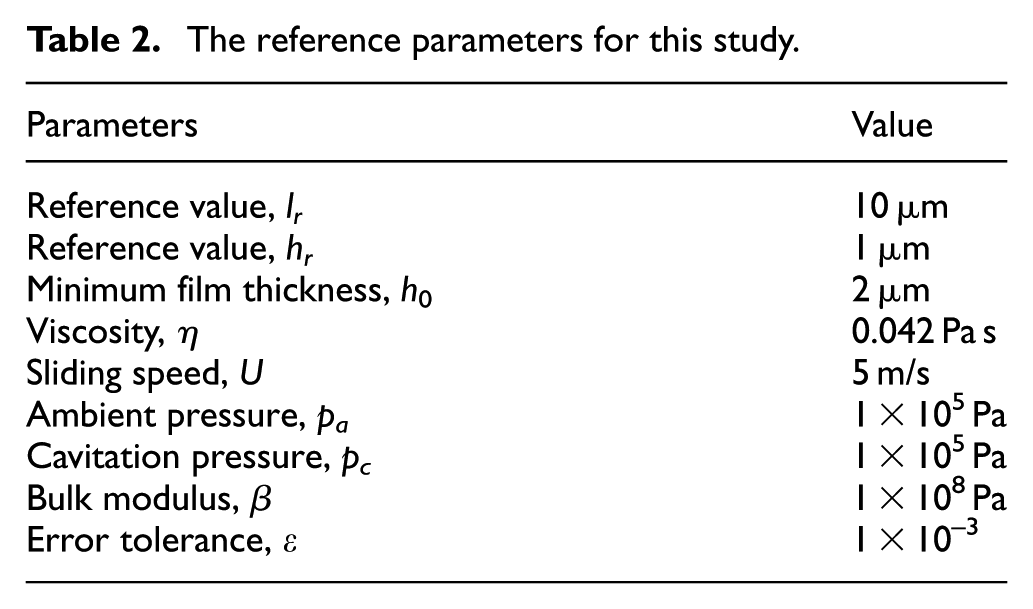
Figures 6 and 7 show the numerical solutions of the present method. As can be seen from Figures 6 and 7, the optimum value of K that maximizes the load carrying capacity is 2.2 and the maximum load carrying capacity per unit length is about 0.51 MPa m. As can be seen, the results of the optimum values of K are consistent, but the maximum load carrying capacity per unit length of the present numerical solutions is less than the analytical solutions. Through comparison between the analytical solutions and the numerical solutions of the present method, it can be concluded that the present numerical solutions have certain validity and application value.

The distributions of film thickness and pressure of inclined slider for the case of K = 2.2.

Load carrying capacity per unit length, W/l, versus ratio of outlet to inlet film thickness K.
Results and discussion
To investigate the influence of the short grooves on the hydrodynamic lubrication of the textured infinitely long slider, a systematic simulation analysis is performed. The reference parameters for this study are given in Table 2.
Figure 8 shows typical dimensionless film pressure distribution over the unit list with different number of short grooves. Figure 8(a) shows the pressure distribution for Ng = 1; it is noted that the pressure distribution has almost no change in the inlet zone while varies dramatically in the short micro-groove. The film pressure is rapidly increasing from about the right of the left edge of the short micro-groove when reaching its maximum value at the right edge of the short groove, then the pressure drops sharply to the end. Figure 8(b)–(d) shows the pressure distribution for Ng = 3, Ng = 5, and Ng = 7; clearly, the pressure distribution is significantly affected by its neighboring short grooves. Besides, the end effects of boundary along the horizontal direction have affected the maximum film pressure at the starting and ending areas of the short grooves. Furthermore, the interaction between neighboring short grooves and the end effects declines with the number of short grooves. So, the interaction between neighboring short grooves and the end effects should be considered in the process of calculating the pressure distribution. Similar results were obtained by Ronen et al. 29 in the numerical simulation of hydrodynamic lubrication of micro-dimples.

Dimensionless film pressure distribution of a list for different numbers of short grooves: (a) Ng = 1 (Wg = 4, Lg = 20, Hg = 2, Sx = 24, Sy = 2); (b) Ng = 3 (Wg = 4, Lg = 20, Hg = 2, Sx = 24, Sy = 2); (c) Ng = 5 (Wg = 4, Lg = 20, Hg = 2, Sx = 24, Sy = 2); and (d) Ng = 7 (Wg = 4, Lg = 20, Hg = 2, Sx = 24, Sy = 2).
Figure 9 displays the effect of dimensionless horizontal spacing, Sx, on the dimensionless average pressure for various short groove numbers, Ng. As can be seen the influence of the number of short grooves diminishes when Ng increases at any given value of horizontal spacing. And, this may well indicate the influence of the number of short grooves on the film distribution pressure as shown in Figure 8. Furthermore, it is observed from Figure 9 that the rate of addition in the dimensionless average pressure is very small when above five short grooves. Therefore, Ng = 5 may be a good choice for the purpose of saving computing time and ensuring computation precision. Besides, another interesting phenomenon is that there is an optimal value of horizontal spacing to maximize the dimensionless average pressure, but it is not entirely obvious. The horizontal spacing has a distinct influence on the load carrying capacity when Sx is still relatively small, which diminishes with the increase in the Sx. When Sx > 10, it has a fairly small influence on the load carrying capacity.

Dimensionless average pressure, Pav, versus horizontal spacing, Sx, for various short groove numbers, Ng (Wg = 4, Lg = 20, Hg = 2, Sy = 2).
Figure 10 illustrates the effect of dimensionless horizontal spacing, Sx, on the dimensionless average pressure for various short groove widths, Wg. Clearly, the influence of horizontal spacing on the dimensionless average pressure and the optimal value of horizontal spacing get bigger with the increase in the short groove width. In addition, the dimensionless average pressure grows linearly as the short groove width rises. The above results are likely due to the fact that the wider groove forms the larger convergence area.

Dimensionless average pressure, Pav, versus horizontal spacing, Sx, for various short groove widths, Wg (Lg = 20, Hg = 2, Sy = 2, Ng = 5).
Figure 11 demonstrates the effect of dimensionless vertical spacing, Sy, on the dimensionless average pressure for various dimensionless horizontal spacing, Sx. Obviously, the dimensionless average pressure decreases with the increase in the vertical spacing, which is chiefly because the interaction between neighboring short grooves and coupling effect diminish with the increase in the vertical spacing. Besides, the vertical spacing does not affect the optimal value of horizontal spacing.

Dimensionless average pressure, Pav, versus vertical spacing, Sy, for various horizontal spacing, Sx (Wg = 4, Lg = 20, Hg = 2,
Figure 12 shows the effect of dimensionless short groove depth, Hg, on the dimensionless average pressure for various dimensionless minimum film thicknesses, H0. With the increase in the short groove depth, the dimensionless average pressure first increases and then decreases at any given value of H0. This phenomenon indicates that there is an optimal value of short groove depth to maximize the dimensionless average pressure, which means that there might be an optimum depth for the short groove to obtain the optimum converging wedge for generating hydrodynamic lubrication. On top of that, it is clear that the minimum film thickness has a significant effect on the dimensionless average pressure. And, the optimum value of short groove depth grows as the minimum film thickness increases, which indicates that the optimum value of short groove depth should be decided by the load carrying capacity in the design of the short groove.
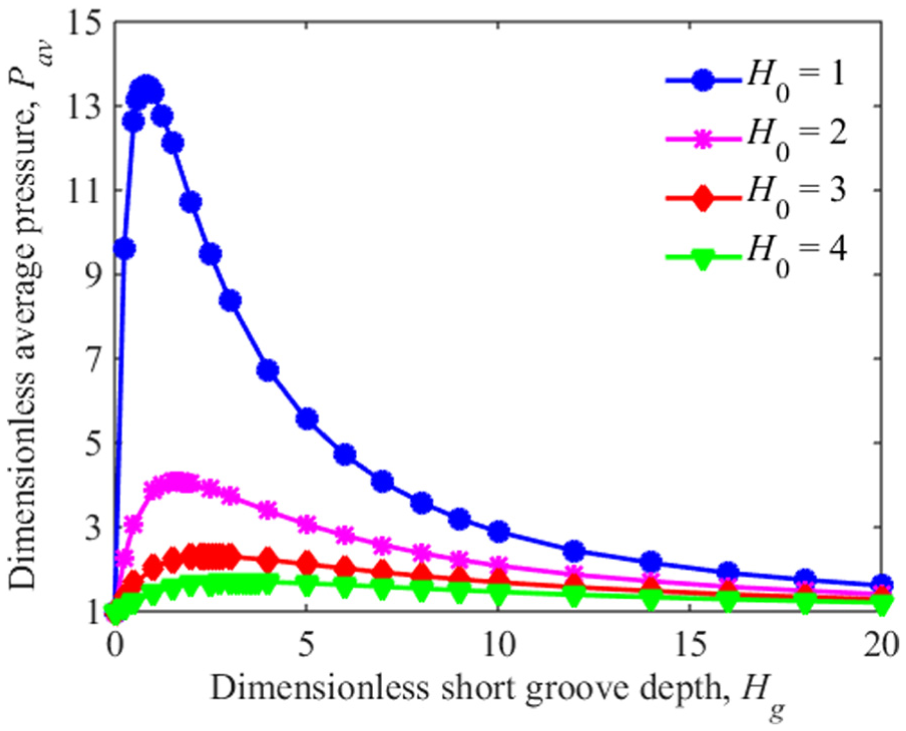
Dimensionless average pressure, Pav, versus short groove depth, Hg, for various minimum film thicknesses, H0 (Wg = 4, Lg = 20, Sx = 24, Sy = 2, Ng = 5).
Figure 13 presents the effect of dimensionless short groove length, Lg, on the dimensionless average pressure for various dimensionless horizontal spacing, Sx. It can be seen from Figure 13 that the dimensionless average pressure increases alongside the short groove length; however, the increase rate of the dimensionless average pressure declines gradually. Especially, when the dimensionless short groove is above 24, it has very little influence on the dimensionless average pressure, which is possibly because the interaction between short grooves is very little for longer short grooves in the vertical direction. Moreover, the short groove length does not affect the optimal value of horizontal spacing.

Dimensionless average pressure, Pav, versus short groove length, Lg, for various horizontal spacing, Sx (Wg = 4, Lg = 20, Hg = 2, Sx = 24, Sy = 2, Ng = 5).
Conclusion
A hydrodynamic lubrication model of textured infinitely long sliders was developed to study the effect of geometrical parameters of the short micro-groove on the hydrodynamic pressure. The influence of geometrical parameters of short groove was analyzed to maximize the hydrodynamic lubrication, and the average film pressure was chosen as the valuation criteria. The results showed that the interactions between neighboring short micro-grooves and the end effect on the hydrodynamic pressure are significant, and they should not be neglected in the process of numerical simulation. There are the optimum values of horizontal spacing and micro-groove depth to maximize the average film pressure. The average film pressure decreases with the increase in the vertical spacing, but it increases alongside the short micro-groove width. The average pressure rises as the short groove length grows; however, the increase rate of the average pressure reduces gradually.
Footnotes
Appendix
Handling Editor: Michal Kuciej
Declaration of conflicting interests
The author(s) declared no potential conflicts of interest with respect to the research, authorship, and/or publication of this article.
Funding
The author(s) disclosed receipt of the following financial support for the research, authorship, and/or publication of this article: This work was supported by the National Natural Science Foundation of China (grant nos 51305168, 51375211, and 51375213), the Natural Science Foundation of Jiangsu Province (grant no. BK20130524), the Innovation Program of Ordinary University Graduate Students of Jiangsu Province (KYLX_1015), and the Research Foundation for Advanced Talents of Jiangsu University (grant no. 13JDG090).
