



Abstract
Three-degree-of-freedom coupled system of vehicle, beam, and smooth-and-discontinuous absorber is constructed to detect the application of smooth-and-discontinuous absorber in vibration reduction of beam subjected to an infinite series of moving vehicles. Smooth-and-discontinuous absorber can be linear absorber or nonlinear one depending on the value of the smoothness parameter. The moving vehicles are simplified as an infinite series of moving spring masses. The amplitude–frequency response functions of the system are obtained using a series of elliptic integrals of the first and second kind. Furthermore, power flow approach is used to detect the effectiveness of smooth-and-discontinuous absorber with parameter variation. The results show that smooth-and-discontinuous absorber can adapt itself to effectively reduce the vibration energy of beam subjected to an infinite series of moving spring masses, which broaden the application of smooth-and-discontinuous absorber in engineering.
Keywords
Introduction
It is well known that the vibrations of beam bridge caused by moving loads will decrease the strength and stability of bridge structure. 1 However, the safety of vehicles will be affected by the excessive vibration of beam bridge. In fact, the dynamics of the vehicle–bridge system become more and more complex with the ever-increasing flow of high-powered heavy vehicles traveling at higher and higher traffic speeds. Therefore, the investigations on vibration and control of beam bridges subjected to moving loads have been of great significance in engineering.2–11 The effects of interaction between the vehicle and the bridge pavement were investigated in Chatterjee et al. 6 An analytical approach was presented to solve the problem of vehicle–bridge dynamic interaction taking into account both flexural and torsional mode shapes in Marchesiello et al. 7 The effects of separation between the moving vehicle and bridge were investigated in Cheng and Au. 8 The dynamic response and the resonance curve of the bridge were obtained using the mode analyzing method and Runge–Kutta method in Chen et al. 9 The vibration of a beam excited by an elastic body with conformal contact was studied in Ouyang and Mottershead. 10 Using the numerical–analytic approach, the equation of motion of the beam and the moving body were established separately and a reattachment condition of the moving oscillator to the beam after separation was proposed in Stancioiu et al. 11 However, these results were limited in vibration of the beams subjected to a moving load.
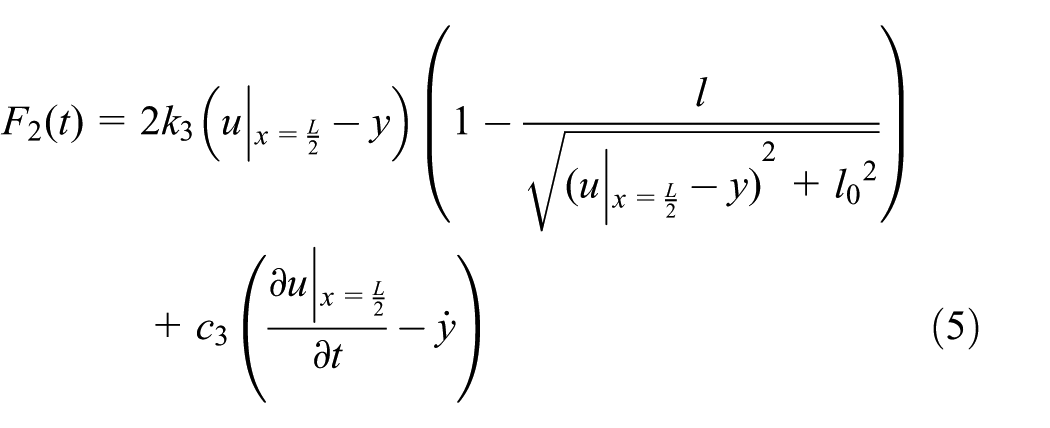
In fact, there are very few papers on the vibration of beams subjected to an infinite series of moving loads.12,13 Traditionally, theoretical investigations of beam vibration due to moving loads were focused on dynamic response of beam subjected to a moving load. But, the vibration of a beam subjected to an infinite series of moving loads is composed of not only linear superposition of dynamic response caused by a moving load but also the nonlinear dynamic characteristics. Hence, bifurcation and chaos should be detected. The problem of repetitive moving loads was classified as a linear beam subjected to an infinite series of moving loads with constant velocity, which repeated at regular time intervals. 12 Moreover, nonlinear stiffness of dynamic vibration absorber can lead to complex dynamics such as quasi-periodic, chaotic, and sub-harmonic responses. The mid-span deflection of the nonlinear beam under traveling vehicles through the bridge successively had rich dynamic behaviors, which may lead to the potential hazard of the bridge. 13 Therefore, how to eliminate bridge vibrations under an infinite series of moving loads becomes a challenging task.
In engineering, dynamic vibration absorbers were applied in order to control vibration. A semi-active vibration absorber with piece-wise linear elastic components was studied in Qian and Hu. 14 The energy pumping with a strong nonlinear attachment was detected and its advantages were analyzed in comparison with classical tuned mass damper (TMD) in Gourdon et al. 15 The optimization of parameters for four semi-active DVAs was presented in Shen et al. 16 In practice, all kinds of moving loads can lead to the different external excitation frequency. Frequency often shifts from one mode to another in the beam subjected to moving loads. Hence, we are encouraged to find a versatile dynamic damper which leads itself to linear dynamic damper or nonlinear one in order to meet vibration control demands. It happened to be coincided with the characteristics of smooth-and-discontinuous (SD) oscillator whose natural frequency can be changed depended on the value of the smoothness parameter.17–19 Based on SD oscillator, we constructed SD absorber and used it to reduce the vibration of the 2-degree-of-freedom coupled system of vehicle and bridge in Tian et al. 20 In this article, we focus on the 3-degree-of-freedom coupled system in which moving vehicles are simplified as moving spring masses and the effectiveness of SD absorber with parameter variation in this case.
This article is organized as follows. In the next section, the vehicle–bridge–SD absorber coupled system is constructed, in which the axial force and an infinite series of moving loads are considered. The response curves of vehicle–bridge are derived analytically in section “Dynamic analysis of vehicle-bridge system.” SD absorber is proposed for eliminating undesired vibrations of a beam in section “Vehicle–bridge–SD absorber dynamic interactions,” and coupling effects between the vehicle–bridge system and SD absorber are analyzed. Furthermore, the efficiency of vibration reduction is detected by use of the power flow approach in section “Optimization for SD absorber.”
Vehicle–bridge–SD absorber coupled system
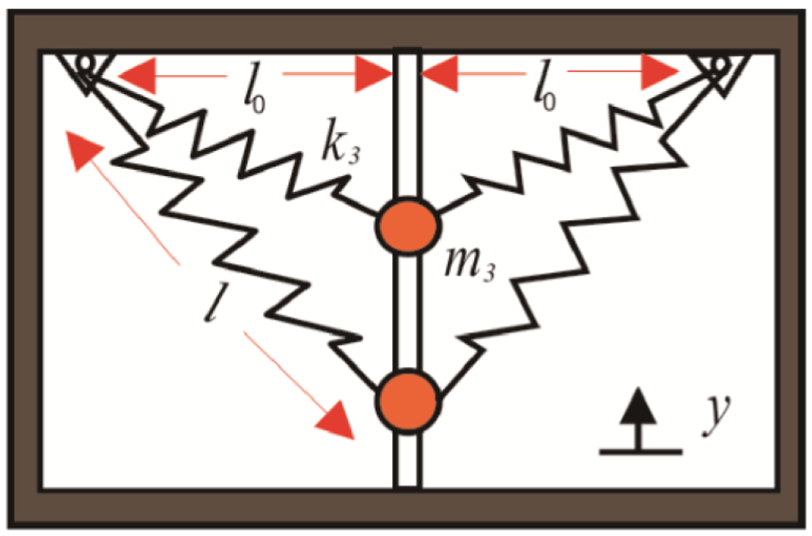
In a complicated real system, frequency often shifts from one mode to another, which
involves a versatile dynamic absorber which can lead itself to linear dynamic dampers or
nonlinear one to meet reduction demands. As is given in Tian et al.,
20
SD oscillator is an
example of a conservative system whose natural frequency can be changed depending on the
parameter
SD absorber.
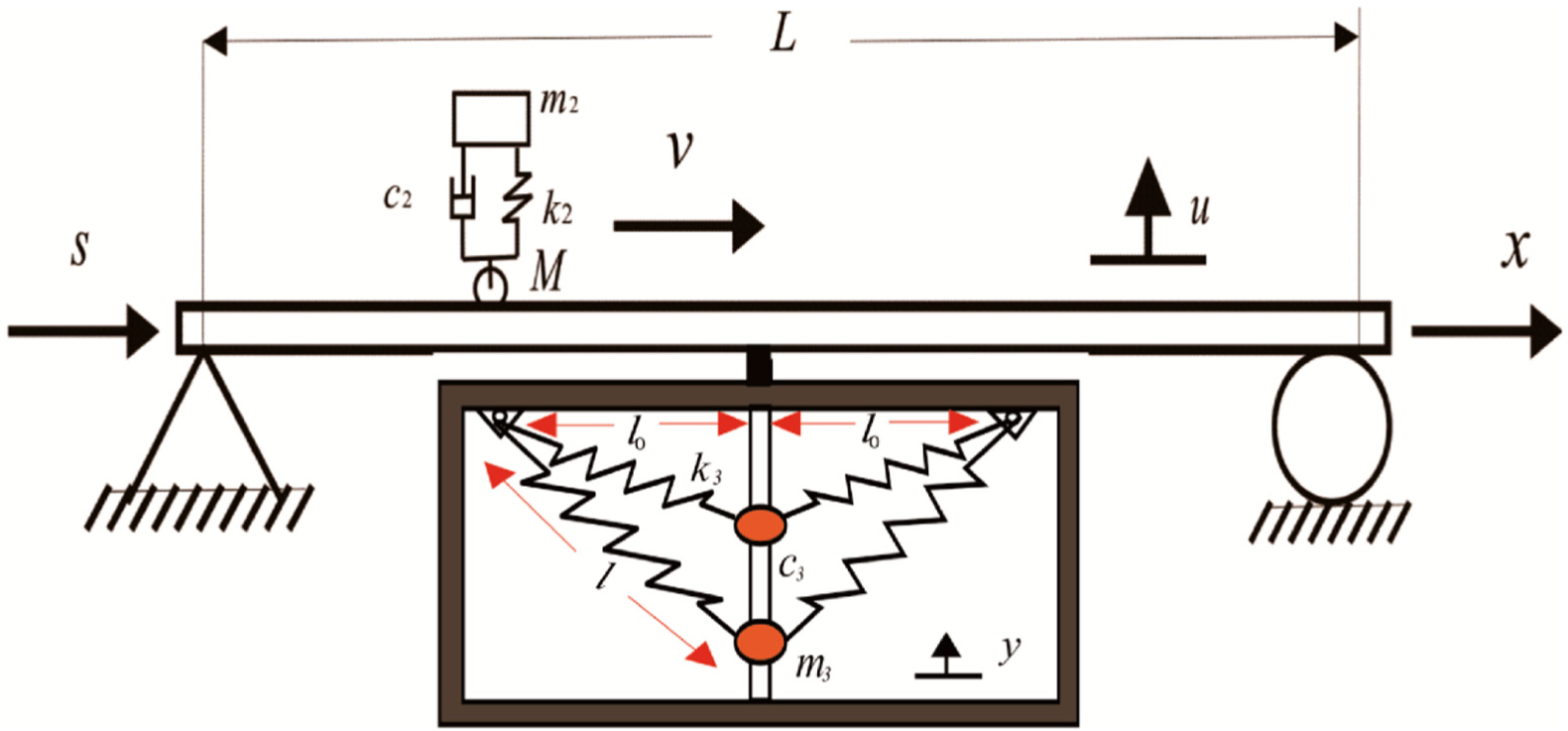
The vehicles, passing through the beam bridge successively, are simplified as a moving
spring mass system with the constant speed v at time

where



Vehicle–bridge–SD absorber model.
Moreover, EI,
Our attention is focused on the effectiveness of SD absorber in this article. Therefore, only the first vibration mode of beam is interested. Let

Furthermore, multiplying the first equation of equation (1) and integrating over

where


Notice


Therefore, we can obtain

Let

Equation (12) can be written as

In the following, we will analyze the dynamical characteristics of the coupled system without SD absorber.
Dynamic analysis of vehicle–bridge system
The motion equation of the coupled system without SD absorber can be mathematically modeled by

Let

we have

In order to discuss the amplitude–frequency response function of system equation (15), we will use the average method and let

we can obtain

which leads to

By solving equation (20), the amplitude–frequency response curves of system equation (15) shown in Figures 3–5 are obtained and the influence of speed and other various parameters is examined as follows.
Figure 3 shows the amplitudes
of beam via the speeds v of moving spring–mass under different damping
coefficients. Other parameters are chosen as
Figure 4 illustrates the
amplitudes of beam with the speeds under different wheel masses. The wheel masses are
The changes in the amplitude with the speed and different mass of the suspension are
shown in Figure 5. The
oscillator masses are

Influence of v and damping coefficient on the amplitude.

Influence of v and wheel mass on the amplitude.

Influence of v and mass of the suspension on the amplitude.
As a consequence of the above, the results indicate that the mid-span deflection of the beam subjected to an infinite sequence of regularly spaced concentrated moving loads has rich dynamic behaviors, which may lead to the potential hazard of beam. Hence, we will propose SD absorber for eliminating undesired vibrations of the beam.
Vehicle–bridge–SD absorber dynamic interactions
In order to reveal the efficiency of SD absorber, theoretical analysis and numerical simulations are carried out to investigate the maximum amplitude for the vehicle–bridge–SD absorber coupled system.
Let

From equations (16) and (21), equation (14) can be rewritten as

In order to discuss the amplitude–frequency response function of system equation (22), we will use the average method and assume

Using equations (18) and (23) and the average method, we have the amplitude–frequency response function of 3-degree-of-freedom coupled system as follows

where
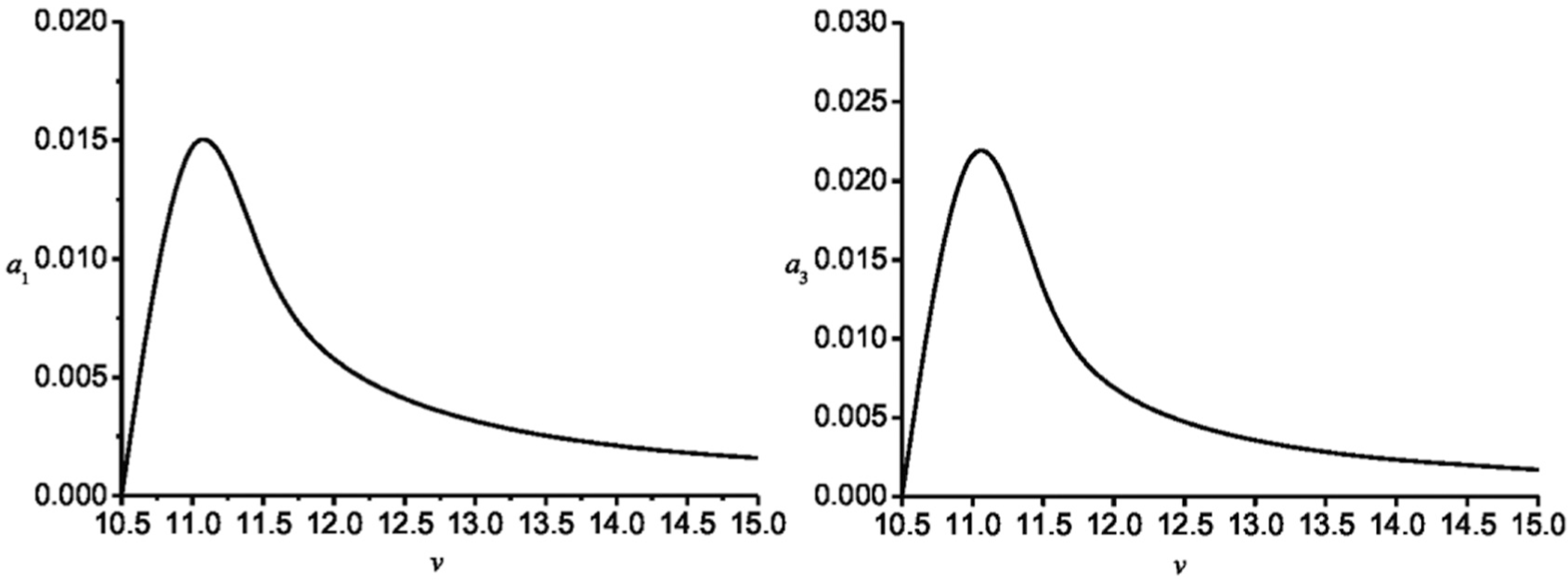
Figure 6 shows the effects of the
speed on the amplitudes of beam and SD absorber, where
Influence of v on
Optimization for SD absorber
In this section, the power flow approach22–27 is used to detect the efficiency of vibration reduction of SD absorber. The portion of the input energy dissipated by the viscous damper and the kinetic energy of SD absorber is computed, which shows the effect of SD absorber.
Calculation of power flow
Let

From equations
(6) and (13) and

Hence, the instantaneous input power flow density

caused by the moving spring mass and the axial force, that is

Thus, the time-averaged input power flow
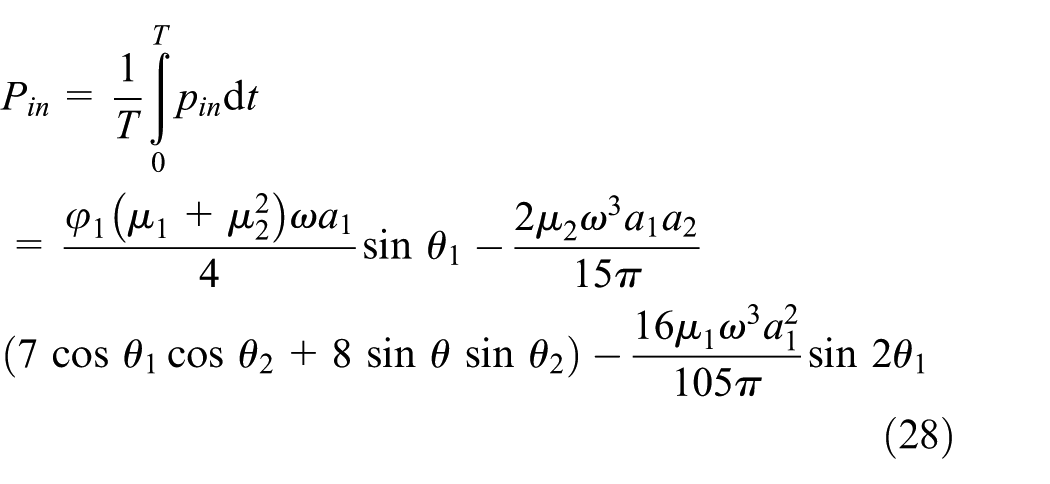
where
The instantaneous and time-averaged dissipated power flow absorbed by SD absorber can be written as

and

Efficiency of SD absorber
We introduce

as the efficiency parameter of vibration reduction. The input power is converted into
dissipative energy as much as possible to minimize the vibration of the bridge when
Figure 7 shows the effect of the
wheel mass M on

Influence of M on
Figure 8 shows the effect of the
ratio

Influence of the ratio
As shown in Figure 8, the mass
ratio
Figure 9 shows the joint effects
of the smooth parameter

Influence of
In Figure 10, the effects of the
smooth parameter and the mass ratio on

Influence of
The coupling effects of the smooth parameter and the speed on

Influence of
In conclusion, the smooth curves in Figures 8–11 reveal that SD absorber can be used to control the complex vibrations of the
coupled vehicle–bridge system.
25
The natural frequency of SD absorber can be changed depending on the
values of the smooth parameter
Conclusion
The 3-degree-of-freedom vehicle–bridge–SD absorber–coupled system was constructed and the
application of SD absorber in the vibration reduction of beam was discussed. The moving
vehicles are simplified as an infinite series of moving spring masses. By use of a series of
elliptic integrals of the first and second kind, the amplitude–frequency response functions
of the coupled system were obtained. The influence of different parameters on
Footnotes
Acknowledgements
The authors would like to thank National Natural Science Foundation of China (Grant Nos 11372196, 11002093, and 11472180), Natural Science Foundation for Outstanding Young Researcher in Hebei Province of China (No. A2017210177), Natural Science Foundation for Breeding Outstanding Young Researcher in Hebei Province of China (No. A2015210097), Natural Science Youth Foundation in Hebei Province of China (No. A2015421006), the Youth Foundation of Hebei Educational of Committee Grant (No. QN2014041), the New Century Talent Foundation of Ministry of Education (NCET-13-0913), and the Key Project of Education Department in Hebei Province of China (No. ZD2016151).
Handling Editor: Fakher Chaari
Declaration of conflicting interests
The author(s) declared no potential conflicts of interest with respect to the research, authorship, and/or publication of this article.
Funding
The author(s) received no financial support for the research, authorship, and/or publication of this article.