




Abstract
With the advent of Industry 4.0, maintenance strategy faces new demands to avoid the hysteresis of the conventional passive maintenance mode and the non-feasibility of the periodic preventive maintenance model. In view of the inherent polymorphism of manufacturing systems and with the objective of maximizing benefits, a novel cost-oriented predictive maintenance based on mission reliability state for manufacturing systems is proposed. First, the cyber-physical system is adopted to organize and analyze big data in the operational process of manufacturing systems in terms of predictive analytics in cyber manufacturing environment. Second, a new connotation of mission reliability is defined based on the big operational data to comprehensively characterize the dynamic state of the equipment health states and the qualified degree of the production task. Third, the predictive maintenance mode based on mission reliability state is quantified by the comprehensive cost, and the relationship between mission reliability and cost is established. Thereafter, cost-oriented dynamic predictive maintenance strategy is proposed. Finally, a case study on the maintenance decision-making problem of a cylinder head manufacturing system is presented. The final result shows that the comprehensive cost can be further reduced by the proposed method relative to the traditional periodic preventive maintenance strategy.
Keywords
Introduction
With the rapid development of information technology and computing science and the integration of advanced analytics into cyber manufacturing today, many production activities are facing new opportunities and challenges.1–3 Proper maintenance strategies are drawing increasing attention and facing new challenges as important methods in improving the reliability and availability of manufacturing systems in order to ensure the timely delivery of high-quality products to customers.4,5 In many cases, maintenance costs can reach 15%–70% of the total production cost or even exceed the annual net profit. 6 Thus, an appropriate and optimized maintenance strategy is required in production management to maintain or to restore the system into a state in which the equipment can complete the required production tasks with minimal costs.7,8
Numerous studies have been conducted in the past decades to improve the scientific nature of maintenance strategies. During the early stage, corrective maintenance policy is usually applied in the manufacturing industry with the sole purpose of repairing the components to restore the system back to its running state. Corrective maintenance is only implemented after failure occurs; thus, it tends to cause a lag in maintenance activities9,10 and serious damages to the people and the environment because of the unexpected faults. 5 Sharma et al. 11 suggested that corrective maintenance can be considered as an acceptable strategy only in cases of large profit margins.
Once aware of corrective maintenance mode’s deficiencies, the idea of maintenance has been transferred to another level where maintenance prevents failure—preventive maintenance. In this maintenance mode, actions are carried out on a planned, periodic schedule to keep the system in a state of working condition based on historical data and expert experience. 12 Most of these studies are conducted for the simple system (i.e. binary-state systems).13,14 With the evidently increasing size and complexity, manufacturing systems showed obvious polymorphism, and binary-state systems are deemed unsuitable for describing the dynamic performance of manufacturing systems. 15 In addition, many scholars developed a periodic preventive maintenance strategy to reduce costs. In this maintenance mode, a unit is preventively maintained at fixed time intervals. 16 This maintenance mode does not consider the dynamic state of the system; this often leads to over or less maintenance that causes unnecessary waste or unproductive in the manufacturing process, respectively. 5 Therefore, this kind of maintenance policy is difficult to apply in practical production.
An increasing number of scholars have realized that manufacturing systems are multi-state 3 and proposed a new method called predictive maintenance strategy, also referred to as condition-based maintenance strategy. Zhou et al. 17 considered the system as subject to degradation that required continuous and meticulous monitoring, and they proposed a reliability-oriented predictive maintenance method based on the continuous monitoring system. Curcurù et al. 18 adopted a stochastic model combined with a Bayesian approach for the degradation process and proposed a calculation method of the maintenance time that minimizes the total maintenance cost. Shey et al. 19 assumed that the system deterioration follows a non-homogeneous continuous-time Markov process, and they developed a long-term average cost function for each major, minor, and imperfect repair. Yang et al. 20 thought that the degraded state of the system depends on the number of products produced, and they proposed a joint transformation for lifetime and product quantity over maintenance levels. Deloux et al. 21 used statistical process control to monitor the stress covariate; they proposed the predictive maintenance strategy and combined it with statistical process control and condition-based maintenance. In addition, a number of scholars from the perspectives of the system engineering integrated maintenance strategy and other production plans were designed to achieve system optimization.22,23
Ensuring the completion of production tasks should be the primary maintenance objective for manufacturing systems. However, handling different production tasks in various production cycles is possible even with the same manufacturing system. Therefore, the polymorphism of manufacturing systems is reflected in equipment performance and dynamic production scheduling. Current predictive maintenance strategy studies for multi-state manufacturing systems remain basic reliability-oriented; 24 only a few studies have integrated manufactured product quality into maintenance policy decision-making.23,25 However, these indicators still fail to reflect the actual production state of manufacturing systems; thus, these studies have limited practical applications. The rapid development of information technology and computing science and the integration of advanced analytics into cyber manufacturing provide a new possibility for altering the maintenance method.26,27 Under the cyber manufacturing background, a large amount of operational data can be timely collected. Fully using these data to predict current and future safety and health states and creating a scientific and reasonable maintenance strategy has become the international hotspot in the reliability engineering and system safety field.
The above-mentioned literature reviews show a wide gap between academic and industrial applications. In detail, assumptions incompatible with the actual industrial demands limit possible conditions or occurrences, as mentioned previously, suppose that the manufacturing system is a binary-state system. The lack of a systematic consideration of the production tasks may lead to ineffective maintenance policy decision-making, as indicated in previous discussions that concern only the age or failure of the equipment. Although immense efforts have been forwarded, several inadequacies have been uncovered in the recent review; for example, the system polymorphism was caused by the dynamic production scheduling among others. Fortunately, a major improvement is provided by making up for the traditional method’s deficiencies especially from the big data collection process and the transformation of big data into meaningful information through the cyber-physical system (CPS) development. On this basis, a predictive maintenance decision-making method was proposed in this article based on mission reliability state for cyber manufacturing systems. Comparing to previous related studies in the frame of maintenance strategy for a manufacturing system, physical multi-station and functional multi-state are fully taken into account in this article, and the main contributions are as follows:
The connotation of predictive maintenance in the context of cyber manufacturing from the conceptual level, and a practical index of integrated production tasks, equipment performance and product quality is proposed for improved visibility and comprehensiveness, and its modeling method is given.
Based on the multi-state characteristics of equipment performance, a quantitative relationship between the equipment performance in a multi-state form and the failure rate considering the impact of maintenance activities is established.
A predictive maintenance decision-making method based on the mission reliability state is proposed, and an optimization method for multi-station manufacturing systems is proposed with the minimum comprehensive cost as the criterion based on the task demand transfer in the manufacturing system.
The rest of the article is organized as follows. Section “Predictive maintenance connotation and foundation in cyber manufacturing” expounds the connotation of predictive maintenance for manufacturing systems under the background of cyber manufacturing. Section “Predictive maintenance strategy based on mission reliability state” presents the predictive maintenance strategy based on the mission reliability state. Section “Cost-oriented dynamic predictive maintenance strategy optimization” proposes the cost-oriented predictive maintenance optimization method. Section “Case study” reports a case study of an automotive cylinder head manufacturing system to verify the effectiveness of the proposed method. Finally, section “Conclusion” draws the conclusions.
Assumptions
In developing the predictive maintenance strategy of a multi-station manufacturing system, some assumptions are addressed as follows:
Each machine is a physically independent entity, and the probability that a unit of input is output as a finished product is independent.
A perfectly reliable inspection station exists after each machine. Only qualified products can enter the next station, and defective products can only be reworked once.
Predictive maintenance restores the equipment performance to somewhere between as good as new and as bad as old, and corrective maintenance only restores the equipment back to the operating condition without affecting the performance.
The proportion of each failure mode of the equipment is constant, and the maintenance duration of each failure mode is independent of the equipment performance degradation level. Thus, the proportional relationship between parameters px (x = 1, 2, 3, …, M) is constant.
The duration of predictive maintenance activity is compensated by overtime, so it is not considered the effect of occupation of production time due to predictive maintenance activities on the mission reliability.
Predictive maintenance connotation and foundation in cyber manufacturing
Predictive maintenance in cyber manufacturing
Currently, many factories still perform reactive maintenance on their equipment based on equipment condition monitoring because traditional process monitoring systems can detect failures only when they occur. This process is expensive because of extensive unplanned downtime and damage to machineries. In addition, preventive maintenance has a large blind spot. In order to change the situation, the biggest challenge for the manufacturing industry is to improve the transparency and predictability of the polymorphism of the manufacturing system’s operating status. To achieve transparency and predictability, the manufacturing industry should transform itself into cyber manufacturing, a systematic methodology that translates big data from manufacturing into predictive and prescriptive operations to achieve resilient performance. The advent of the “Internet-of-Things” and “Smart, Cyber-Physical Systems” ideologies has helped establish cyber manufacturing. 1 Cyber manufacturing aims to enable personnel to comprehend potential relationships and to make informed decisions by integrating industrial big data and smart analytics. Cyber manufacturing evidently provides the transformation platform from solving visible problems to removing invisible issues. 28 Furthermore, it provides the new demand and connotation of maintenance actions.
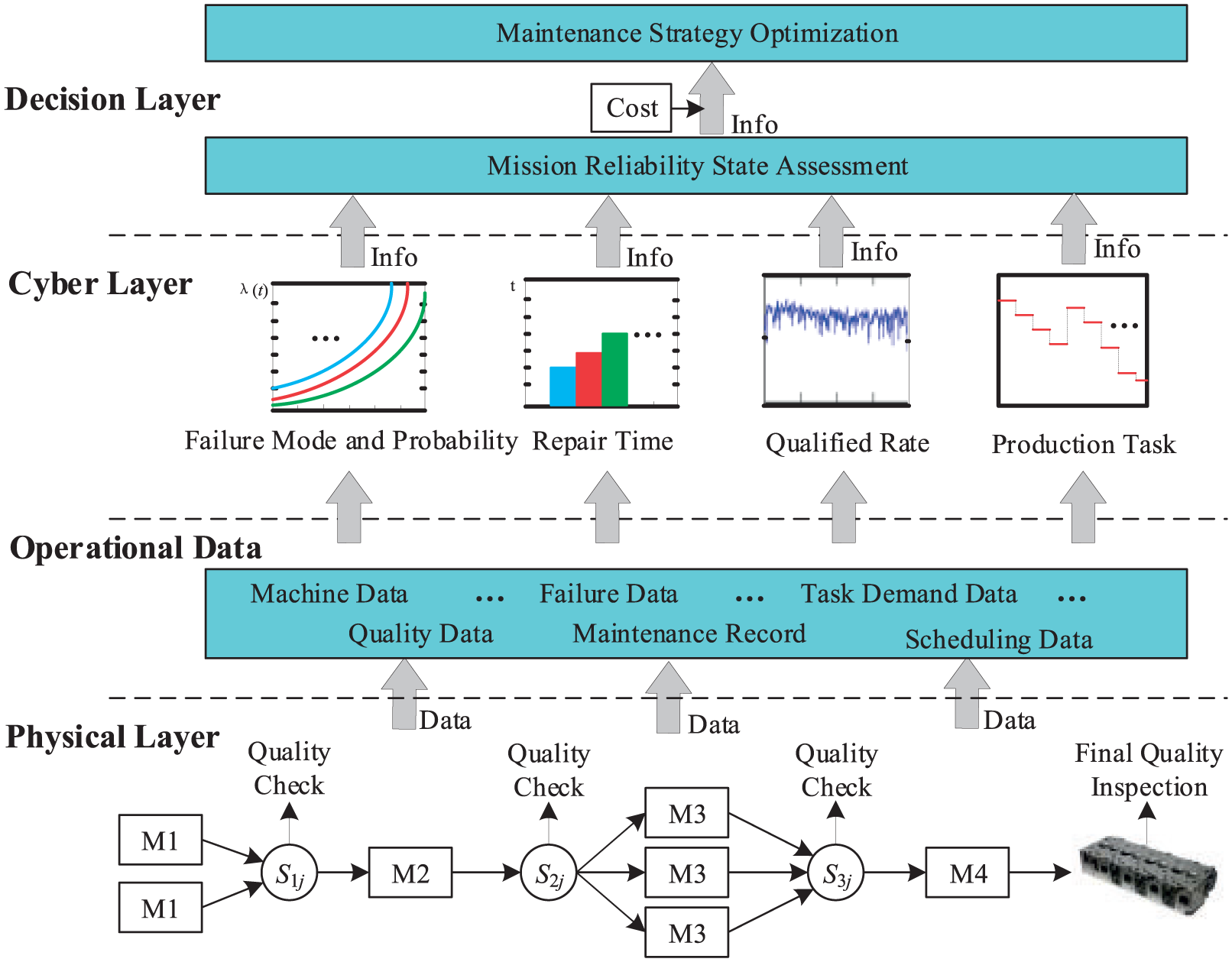
Figure 1 shows that predictive maintenance is a condition-based maintenance method based on the accurate prediction of an equipment operating condition; it aims to prevent failure and to retain the operational condition of the system. Cyber manufacturing provides the basic environment to accurately predict the operation state of the equipment and then serves as the reference basis to develop a predictive maintenance strategy.

Schematic view of the predictive maintenance in a cyber manufacturing environment.
For manufacturing systems, the strategies of production operation and maintenance should be developed and optimized by analyzing massive data and by combining them with an effective model. These data include the inherent information, such as equipment reliability, equipment capacity, and system structure, as well as a number of dynamic change information, such as the dynamic production task demands, equipment failure rates, and manufacturing pass rates. In the context of cyber manufacturing, massive data are easily acquired through advanced sensing and cloud storage technologies. The effective performance parameters can be extracted through various data processing platforms before the prediction model can be established. The future values of these parameters can be predicted in particular periods by analyzing the massive data. The core of cyber manufacturing is the construction of a calculation tool to predict the changing trends of performance parameters. Once the prediction model is established, the significance of the massive data can be reflected. The extraction of effective information from a large number of parameters to establish a comprehensive index called mission reliability state is key in predictive maintenance. The index enables manufacturing operations to successfully integrate with the functional objectives so that it can fully reflect the polymorphism of the manufacturing system. Moreover, the enterprise can take advantage of cyber manufacturing to maintain profits by making appropriate dynamic predictive maintenance plans based on the mission reliability state of manufacturing systems, thereby injecting resilience into manufacturing systems.
Mission reliability connotation
Production and maintenance strategies should be developed and optimized by analyzing big data and by combining them with an effective model. The extraction of meaningful information to establish the mathematical model for providing a good decision support for the operation and maintenance of the manufacturing system is a new topic and idea for these big data in the cyber manufacturing era.
For multi-state manufacturing systems, the functional objective is to fulfill the dynamic production task demand. Therefore, mission reliability can be defined as the ability of the system to meet the production task demand, which can be quantified by the probability of the manufacturing system to complete the production task under specified task profiles (conditions) and within the specified time. 28 This can be described by the following equation

where

where
According to the connotation of mission reliability, the accurate quantification of
Schematic view of mission reliability.
Big operational data can be obtained in the production process. The relevant data are extracted according to the mission reliability connotation, including the failure, maintenance, product quality inspection, and scheduling data. The mechanism can be expressed as follows.
Various failure modes appear in the equipment operation process. Different failure modes correspond to various maintenance measures and produce different downtimes. A certain interval is set, and the failure modes are classified according to the length of the shutdown caused by these failures. Thereafter, combined with the cumulative probability of the occurrence of various failure modes, the distribution probability of processing capacity in this state can be calculated, as shown in Table 1. With the aging and wear of equipment, the cumulative risk of each failure mode shows a growing trend, and the distribution of processing capacity exhibits a corresponding dynamic change.
Sample for cumulative probability distribution of processing capacity under certain state.

According to the production task plan, productivity demand (d) can be
determined. Thereafter, minimum workload

where r is a binary coefficient. If the rework process exists in the
current equipment, then r = 1; otherwise, r = 0.
Predictive maintenance strategy based on mission reliability state
The primary maintenance objective for production equipment is ensuring the realization of the functional goals of the system. Manufacturing system operation aims to accomplish a number of production tasks. However, the performance and production scheduling in the current manufacturing environment have shown a dynamic nature and have evolved into the polymorphism of manufacturing systems. Mission reliability of manufacturing systems integrates the performance of equipment and the requirements of production tasks and then it reveals the nature of the manufacturing system polymorphism. Therefore, degradation models of parameters related to the mission reliability state are studied first in this section and then the dynamic predictive maintenance mechanism based on the mission reliability state is developed to address the inherent polymorphism of manufacturing systems.
Deterioration parameter models
The production equipment is subject to a continuous operation-dependent degradation, which leads to an increasing failure rate and a decreasing qualified rate. According to the connotation of mission reliability of manufacturing systems, the state of the production equipment can be characterized by the following four parameters.
A discrete random variable, tk, represents the cumulative running time from the last implementation of predictive maintenance to the next time. Its value is related to the predictive maintenance threshold and the degradation rate of equipment performance.
A piecewise continuous variable,

where
A constant,

We consider that the proportion of qualified items produced at time t in
the kth predictive maintenance cycle,

where
In addition, the expected qualified rate

Dynamic predictive maintenance strategies
Decision making of the multi-station manufacturing system
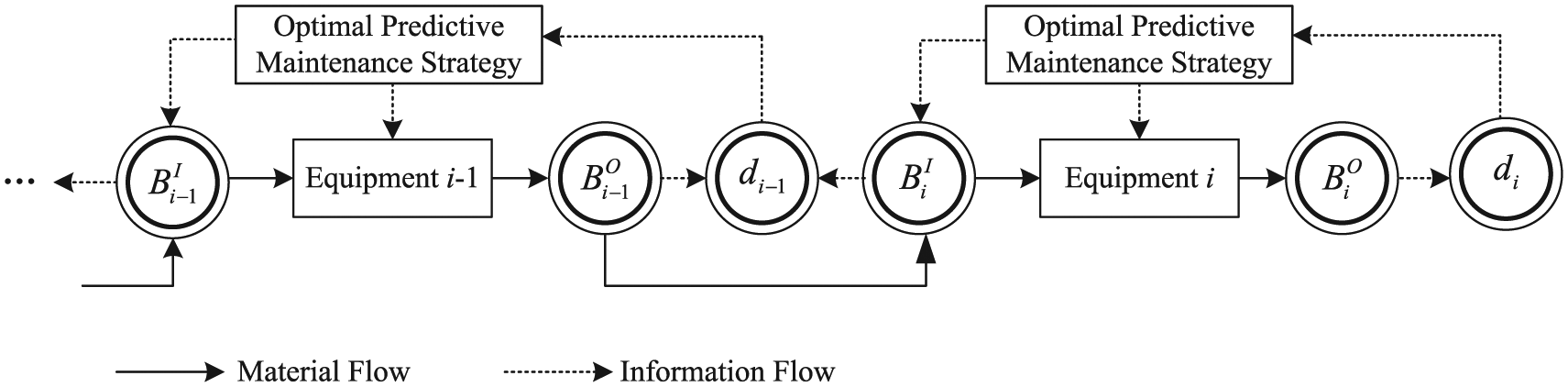
The manufacturing system is generally composed of several production equipments called the multi-station manufacturing system. For multi-station manufacturing systems, the dynamic predictive maintenance strategy decision-making can be conducted from back to front according to the system structure, as shown in Figure 3.
Schematic diagram of decision-making in multi-station manufacturing systems.
In detail, when given a production task required to produce D units qualified products in the planning horizon T, the total production tasks required to be decomposed to achieve the production task per unit time

Equation (8)
is evidently the output demand of the last equipment. According to this production task,
the predictive maintenance strategy optimization for the last equipment can be carried
out. Once the optimal predictive maintenance strategy is determined, the minimum
workload
Dynamic predictive maintenance strategy for a single equipment
At any time t, the production equipment stays in one of the two macro states: “operating” or “failure.” Corrective maintenance is required when the equipment fails. From a microscopic point of view, the probability of unexpected shutdowns caused by an operating process failure reflects the deteriorating state of the equipment. Thus, the microstate can be described by the distribution probability of processing capacity. Furthermore, it is defined as its cumulative probability distribution from the last predictive maintenance to the current time point.
Although predictive maintenance actions are committed to solving the problem of equipment performance degradation, creating a predictive maintenance strategy depending only on the equipment performance status is unscientific. In view of the polymorphism of manufacturing systems, a predictive maintenance strategy based on mission reliability state is proposed, as illustrated in Figure 4.

Schematic diagram of predictive maintenance based on mission reliability state.
As shown in Figure 4, the solid line is the material flow, which describes the actual machining process, whereas the dashed line is the information flow, which represents information transmission when the production state is modeled. Two possible maintenance actions that can be performed during the maintenance break are considered in this study, namely, corrective and predictive maintenance.
Minimal repair is performed in the corrective maintenance action. This repair primarily restores the equipment back to the operating condition from sudden breakdown with a simple approach as soon as possible. The failure rate and the distribution function are unchanged after minimal repair.
Predictive maintenance refers taking actively predictive maintenance actions on the equipment. This repair mainly addresses the performance degradation of the equipment. Therefore, it can reduce the failure rate but cannot return the equipment to an as-good-as-new condition.
A very suitable function for the parameterization of failure rate function is the
Weibull distribution because of its adaptability.
29
Consider the initial failure rate
function in as-good-as-new condition is

The predictive maintenance strategy based on the mission reliability state fully uses
the superiority of the mission reliability index in describing the dynamic production
status of the equipment. Its objective is to determine the most suitable condition for
implementing the predictive maintenance to achieve the maximum profit. The mission
reliability threshold value for performing predictive maintenance is

where
Thereafter, the expected unavailability of the equipment in the k + 1th predictive maintenance cycle (i.e. the time interval between the kth and k + 1th predictive maintenance) can be expressed as follows

where
According to the cumulative probability distribution of the equipment processing capacity shown in Table 1, the unavailability can also be expressed as follows

Equations
(10)–(12) derived the following conclusion: when given a mission reliability
threshold
Ensuring functional objectives is the primary maintenance objective in actual production. Maintenance should provide the right reliability, availability, and efficiency in accordance with task demand requirements. However, mission reliability threshold determination is not random or dependent on experience. Giving an economic value to the results of the predictive maintenance strategy is necessary. Thus, formulating predictive maintenance strategy is a cost-oriented objective optimization problem.
Cost-oriented dynamic predictive maintenance strategy optimization
Modeling of related costs
For manufacturing systems, the main concern of the producers is reducing the cumulative
production cost throughout the planning horizon under the condition that the manufacturing
system can ensure the intended production activity purpose. Mission reliability is
obtained to characterize the production status of the equipment. Therefore, based on the
predictive maintenance mechanism shown in Figure 4, five kinds of costs arising in the planning horizon T
are mainly considered in this study, including a corrective maintenance cost

The optimal predictive maintenance strategy for this production task stage can be obtained by minimizing the cumulative comprehensive cost.
1. Corrective maintenance cost.
The corrective maintenance costs for various failure modes are actually different.
Therefore, an expected minimum repair cost (cc), which can be
derived from the historical maintenance information, is defined for computation.
Thereafter, the corrective maintenance cost

where E is the number of predictive maintenance cycles in planning
horizon T.

2. Predictive maintenance cost
Equipment performance cannot be restored to the initial state of the prior predictive
maintenance cycle after a predictive maintenance activity because of aging and other
reasons. This finding is consistent with equation (4). Therefore, assuming that each
predictive maintenance activity is the same is feasible; thus, the cost for every single
predictive maintenance is constant. In this instance, the cumulative predictive
maintenance cost

where
3. Production capacity loss cost
Usually, equipment failures always result in production capacity loss. According to the
probability distribution of processing capacity state, the production capacity loss cost

where
4. Indirect loss cost
In reality, production tasks that cannot be completed on time negatively affect customer
satisfaction, which indirectly brings economic losses to the enterprise such as a late
penalty or reduced orders caused by diminished corporate reputation and other factors. The
size of this kind of loss is related to the importance of the task. Expected indirect
economic losses can be denoted by

where
5. Product quality loss cost
Quality loss

where
Optimization of a predictive maintenance strategy
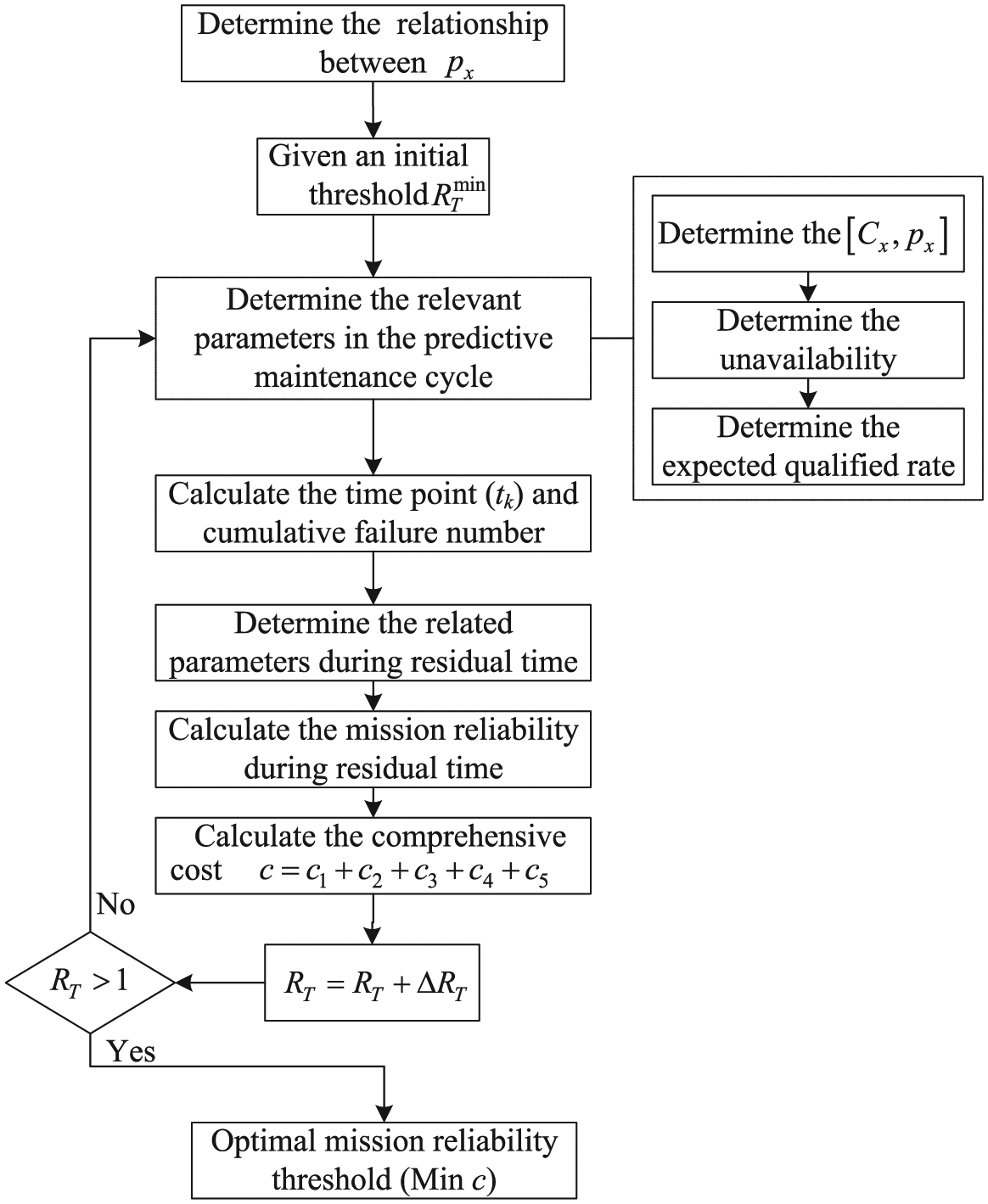
Given the complexity of obtaining an analytical solution for the optimal mission reliability threshold, an iterative numerical optimization procedure for single equipment is developed, as shown in Figure 5. Before optimization, the basic operational data of the equipment should be collected first.
Predictive maintenance strategy optimization procedure.
As shown in Figure 5, the details of the steps are illustrated as follows:
Step 1. Determine the proportional relationship between parameters px (x = 1, 2, 3, …, M) based on the failure and maintenance data.
Step 2. Assign an initial value
Step 3. Determine the cumulative probability distribution of
processing capacity
Step 4. Compute the unavailability. Given
Step 5. Derive the expected qualified rate based on equations (8) and (11).
Step 6. Determine the predictive maintenance schedule. The corresponding dynamic maintenance time point (tk) is calculated based on equation (9) and Step 4 result. Then, the cumulative failure number in each predictive maintenance cycle is obtained.
Step 7. Calculate the residual time based on equation (15)
and compute the cumulative failure number during this time. Thereafter, the
unavailability is obtained by equation (11). Finally, according to
the fixed proportion relationship between
Step 8. Calculate the expected qualified rate and minimum workload during the residual time based on equations (3) and (7). Thereafter, mission reliability during the residual time can be obtained based on equation (2).
Step 9. Compute the comprehensive cost based on equations (14)–(19).
Step 10. Use
Step 11. Check whether the optimization procedure should be
terminated. If
Step 12. Determine the optimal mission reliability threshold, wherein the mission reliability threshold corresponds to the minimal comprehensive cost.
Case study
Background
An engine cylinder head is one of the most important engine parts of the engine. Its role is to ensure the ventilation, cooling, and lubrication of the engine and to ascertain that all kinds of auxiliary systems, components, and engine are properly assembled. The increasing requirements of complex function and high precision led to the multiple production equipment contained in the manufacturing system. The main production equipment is shown in Figure 6. Accordingly, high accuracy requirements and complex manufacturing processes make the reasonable maintenance of the cylinder head manufacturing system become an important basis to ensure production task completion. However, the preventive maintenance strategy, which is often used by the enterprise, is not very good at balancing the relation between the production and the maintenance tasks. The improved production technology (i.e. cyber manufacturing) is an unprecedented opportunity for the evolution of maintenance strategy. In the cyber manufacturing context, big operational data can be acquired to predict equipment production state in a manufacturing system. With the increasingly vigorous competition pressure of the market, a perfect predictive maintenance strategy based on the predicted results of production state and a reduced production cost are some of the most effective means of enhancing the product competitiveness of a famous engine manufacturer in China.

Manufacturing system overview.
With the help of the manufacturing and quality experts from the engine provider, the pipe hole processing was identified as a key quality characteristic of the cylinder head. The processing equipment of the pipe hole is a special machine (a6). Therefore, special machine (a6) is taken as an example to verify the effectiveness of the predictive maintenance strategy proposed in this study.
Numerical example
Consider that the failure rate of the special machine obeys the Weibull distribution,
which is widely adopted to fit the failure rate function of large mechanical-electric
facilities.
30
Therefore, the failure rate can be expressed as
Collect basic data from the production management department. The values of relevant parameters are obtained based on a maximum likelihood method, as shown in Table 2.
Parameter values of the case.

The failure modes of the equipment are analyzed and then the processing capacity interval
is set as

The optimization is processed based on simulation. The assumed search ranges are
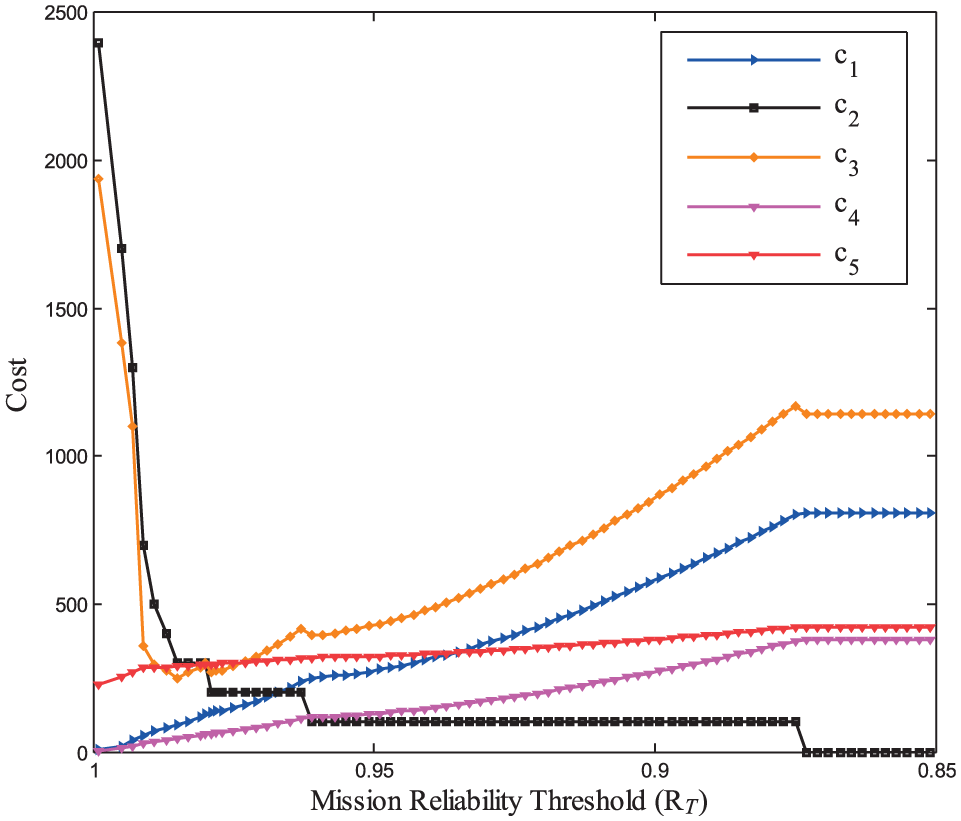
Figure 7 shows the variation trend of the five cost types when taking different mission reliability thresholds. With the reduced mission reliability threshold, the cumulative failure number of the equipment increases, the qualified rate of work-in-process decreases, and the task completion probability diminishes. Thus, the corrective maintenance costs c1, indirect losses c4, and product quality loss c5 gradually increase. In addition, predictive maintenance cost c2 and production capacity loss c3 gradually decrease because of the reduced number of predictive maintenance activities.
c1,c2,c3,c4,
and c5 against
Combined with five kinds of costs, the local data for the optimization process are shown in Table 3. Figure 8 shows the variation trend of the comprehensive cost with the mission reliability threshold from 1 to 0.85.
Local results of the optimization process.


Comprehensive cost (c) against
The relationship curve with the mission reliability threshold in interval (0.85, 1.00) is shown in Figure 8. With the reduced mission reliability threshold, the overall trend initially decreases and then increases. When the mission reliability threshold is set excessively high, excessive predictive maintenance activity results in a high comprehensive cost. With the reduced mission reliability threshold, the comprehensive cost gradually decreases, and the lowest point of the comprehensive cost appears at about 0.98. Thereafter, comprehensive cost increases again because the predictive maintenance is untimely implemented, which affects the production activities.
The optimization results are shown as follows: when the mission reliability threshold of predictive maintenance is set to 0.979, the comprehensive cost is at its lowest (c = 947.60). In this case, two predictive maintenance activities are performed in the planning horizon (i.e. t1 = 61.24; t2 = 50.86).
Performance analysis
In verifying the effectiveness and advancement of the dynamic predictive maintenance method of manufacturing systems based on mission reliability state, a comparative study of the proposed method and the periodic maintenance method, as well as the dynamic predictive maintenance based on equipment degradation (i.e. basic reliability), is conducted. It should be noted that in the decision-making of periodic maintenance and dynamic predictive maintenance based on equipment degradation, this article mainly draws on the main decision-making ideas of these methods under the assumptions of this article, and the main purpose is to verify the mission reliability as a scientific indicator of decision-making.
First, the periodic preventive maintenance method is used to obtain the optimal maintenance time interval, as the name suggests, maintenance activities will be carried out after a constant time interval, in other words, when the running time of the equipment reached its threshold in this mode. 16 In order to facilitate the comparative study, the corresponding mission reliability is considered, and the comprehensive cost is still the sum of these five types of costs. The periodic preventive maintenance model is compared with the dynamic predictive maintenance model from different points.
Based on the special machine case, the variation curve of comprehensive cost with time threshold is obtained, as shown in Figure 9. Optimization and comparison results are shown in Table 4.
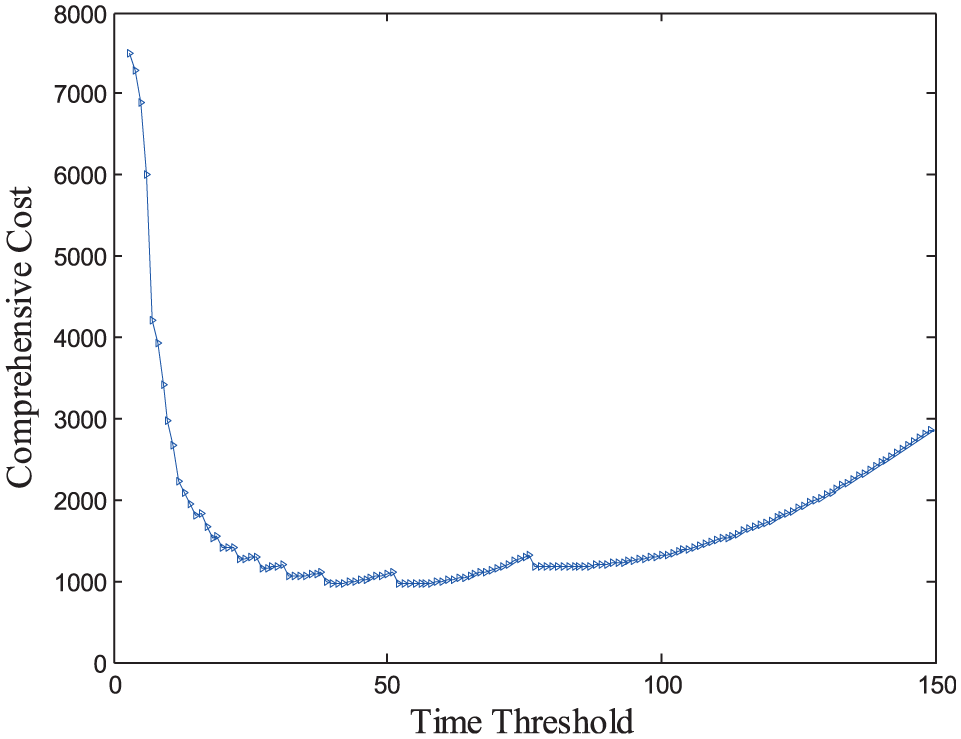
Comprehensive cost (c) against time threshold.
Comparison of the proposed method and the periodic preventive maintenance mode.

Table 4 shows that one more predictive maintenance activity is scheduled under the periodic preventive maintenance strategy. This finding means that the predictive maintenance is scheduled more frequently under the periodic preventive maintenance. The predictive maintenance cycle under the dynamic predictive maintenance strategy is dynamic and gradually reduced because the predictive maintenance cannot restore the equipment as new. The optimal minimum cost under periodic preventive and dynamic maintenance strategies are 976.58 and 947.60, respectively. This finding implies that the production task can result in high profits when the dynamic predictive maintenance strategy is applied.
Thereafter, the dynamic predictive maintenance based on mission reliability is compared with the dynamic predictive maintenance based on equipment degradation. 17 The equipment degradation state is represented by the cumulative failure number of equipment. The variation curve of the comprehensive cost with the cumulative failure number threshold is obtained, as shown in Figure 10. The optimization and comparison results are shown in Table 5. The corresponding comprehensive cost under the dynamic predictive maintenance strategy based on equipment degradation is calculated by considering the mission reliability state and product quality state under this condition.

Comprehensive cost against cumulative failure number threshold.
Comparison of dynamic predictive maintenance driven by mission reliability and by equipment degradation.

Table 5 shows that the dynamic predictive maintenance strategy based on the equipment degradation results in a waste of 11.88. It is interesting that the results obtained by both the strategies are to implement two predictive maintenance activities. This finding means that the dynamic predictive maintenance based on equipment degradation is advanced to the periodic preventive maintenance. However, benefit from taking the production state as the center, the dynamic predictive maintenance based on mission reliability brings more savings in corrective maintenance, processing capacity, as well as quality and indirect losses, which consequently decrease comprehensive cost.
The two comparative studies above show that when the dynamic predictive maintenance strategy based on mission reliability is applied to the manufacturing system, predictive maintenance can be scheduled more effectively and scientifically. The dynamic predictive maintenance strategy based on mission reliability achieves better economic performance than the conventional periodic preventive maintenance strategy and dynamic predictive maintenance based on equipment degradation.
Conclusion
In this study, a novel approach for developing a dynamic predictive maintenance strategy based on the mission reliability of multi-state manufacturing systems has been presented in the context of cyber manufacturing. Cyber manufacturing provides a big data environment for the development of predictive maintenance strategy and the extraction of meaningful information from big data for the accurate prediction of the dynamic change of production state. In accurately characterizing the polymorphism of manufacturing systems, mission reliability is put forward based on the equipment degradation state and production task demands. The development mechanism and process of the predictive maintenance strategy for multi-station manufacturing systems based on mission reliability are presented as well. The predictive maintenance is performed when mission reliability reaches its threshold. The optimal predictive maintenance strategy is obtained by minimizing the comprehensive cost, including corrective and predictive maintenance costs, as well as production capacity loss, indirect loss, and quality loss. In comparing this mode with the conventional maintenance mode for manufacturing systems, the advantages can be summarized as follows:
First, mission reliability fully reflects the production states of manufacturing systems from the system perspective, and the maintenance strategy driven by mission reliability state is more valid.
Second, the dynamic predictive maintenance mode fully uses the advantages of cyber manufacturing in data based on the understanding of multi-state manufacturing systems and effectively makes up for the deficiency of the periodic preventive maintenance mode.
Third, the predictive maintenance optimization strategy of multi-station manufacturing systems is presented from the reverse transmission perspective of the production task demand.
The dynamic predictive maintenance strategy of multi-state manufacturing system is a popular and challenging topic. A number of issues are suggested below for future research:
Integrating other types of costs during optimization, such as personnel costs;
Replacing the product qualified rate with the degree of product quality and incorporating quality improvement into the decision-making basis;
Extending the mission reliability connotation by understanding the polymorphism of manufacturing systems further.
Footnotes
Handling Editor: Davood Younesian
Declaration of conflicting interests
The author(s) declared no potential conflicts of interest with respect to the research, authorship, and/or publication of this article.
Funding
The author(s) disclosed receipt of the following financial support for the research, authorship, and/or publication of this article: This study was supported by Grant 61473017 from the National Natural Science Foundation of China and a general project (No. 6140002050116HK01001) funded by the National Defense Pre-Research Foundation of China.
