




Abstract
This article is concerned with the problem of resilient asynchronous H∞ static output feedback control for discrete-time Markov jump linear systems. By Finsler’s Lemma, and with the help of two sets of slack variables, the product terms of system matrices and Lyapunov matrices are decoupled. Resilient asynchronous controller is designed to improve the robustness of the controller and overcome the drawback that the controller cannot get the information of the system’s mode. The controller that makes sure the closed-loop system is stochastically stable and with prescribed H∞ performance is designed. The bilinear matrix inequalities are given as the sufficient conditions for the controller design, which can be solved using linear matrix inequalities along with line search. This control strategy can be used in many practical application fields, such as robot control, aircraft, and traffic control.
Introduction
In practice, because of the impact of external environment, internal failure, the communication delay such as considered in Lu et al., 1 the noise such as considered in Lu et al., 2 and other reasons, most of the subjects to be described are dynamic and time-variant. Markov jump linear systems (MJLSs) 3 are hybrid systems to describe the dynamic subjects. Markov chain determines the different modes in the MJLSs. The values of the Markov chain constitute a finite set. Due to the above-mentioned characteristics, a lot of application4,5 and research6–10 about MJLSs have been done in the past few decades. In Zhang et al., 4 MJLSs apply to model the neural network systems. Economic systems are described by MJLSs in Zhao and Zhang. 6 The controller in form of observer based is designed for MJLSs in Zhao and Zhang. 6 The problem of stability for MJLSs is solved in Costa and Fragoso. 7 The observability and detectability of MJSs is studied in Tan and Zhang. 8 In Wu et al., 9 the filtering problem for MJSs is considered. The character of Markov not only used in the MJLSs but also used in other process such as in Ma and Jia. 10
The operating principle of H∞ controller is that designing a controller for the given system and making sure the interconnection between system and controller is internally stable. So, the H∞ norm can be used in the condition when the worst disturbance put on the controlled output. 11 The H∞ control theory has been applied to many control systems, and it plays an important role in this area. This theory can be used to analyze and solve the problems in the worst situation. Correspondingly, the theory can not only be devoted to constitute-time system but also be used to solve the problem of discrete-time linear system. 12 Based on the mentioned reasons, the H∞ control has been used in many areas.13–15 The Lyapunov functions are necessary part in the H∞ control; however, it is not only used in H∞ control it also has lot of applications such as in literatures,16,17 and it is used in adaptive control for a kind of nonlinear systems.
Lot of the advanced control strategies have been put into application.18–21 However, the feedback control is still one of the most important control strategies. State feedback control such as Zhang et al. 22 and output feedback control are important parts of the problem of feedback control. In Gabriel et al., 12 the problem of state feedback control for MJLSs is studied. The problem of dynamic output feedback control is researched in Zhu et al. 23 Distributed output feedback control is considered in Wang and Zhang. 24 The state and output feedback control are both considered in Yan et al. 25 In Liu et al., 26 adaptive control is designed for feedback systems. Compared with other output feedback control forms, static output feedback control can be put into practical use with low cost, so static output feedback is very useful and more realistic. Static output feedback control problem has been extensively investigated in the past decades.27–31 However, for many existing works of static output feedback control, they assume that the controller can get access to the mode of the system. 29 The influence of environment that can affect the controller is not considered by Che et al. 31 So, to the limit of the author’s knowledge, there still are a lot of work to do in the research of resilient asynchronous control in form of static output feedback for MJLSs.
Motivated by the above observations, the resilient asynchronous H∞ static output feedback control problem for discrete-time MJLSs is studied in this article. Resilient asynchronous controller is designed to improve the robustness of the controller and make sure that the controller can work in the different mode from the system. By Finsler’s Lemma, and with the help of two sets of slack variables, the interconnection of system matrices and Lyapunov matrices is decoupled. The controller that makes sure the closed-loop system is stochastically stable and with prescribed H∞ performance is designed. The sufficient condition for the controller design is given in the form of bilinear matrix inequalities (BMIs), which can be solved using linear matrix inequalities along with line search. Nowdays, robot plays an important role in industrial production and our daily lives. So, the research of robot has attracted lots of interests.32–34
The control strategy is based on the static output feedback control, and through analyzing the static output data, the systems are controlled. It is known that the static output feedback is more cheaper and reliable to put into application. Meanwhile, the designed controller do not need to work in the mode which is synchronous with the system mode, so it has a wider range of adaptability than normal controller. The designed controller is also resilient, that is to say, it has a stronger robustness. In spirit of the application of advanced control strategy to robot system35–38 and the mentioned reasons, the controller designed in this article can be used in many actual situations, such as robot control, aircraft such as considered in Gai et al., 39 and traffic control.
This article is organized as follows. The discrete-time MJLSs and the resilient asynchronous H∞ static output feedback controller is formulated, and several essential definitions and lemmas are given in section “Preliminaries and problem formulation.” Based on these lemmas and definitions, the controller designed for the closed-loop system not only makes sure the system has a prescribe H∞ performance index but also is stochastically stable in section “Main result.” In section “Numerical example,” numerical example is given. The conclusion of this article is given in section “Conclusion.”
Notation: In this article, we use commonly used notations. Given two matrices
Preliminaries and problem formulation
On a probability space

where

With considering generality, we suggest that

Remark 1
We can tell that for given

The following resilient asynchronous controller is presented

where


Substituting equation (4) into equation (1), we can obtain the closed-loop system as

where for any

To obtain the main objective, the following definitions are given.
Definition 1
When

Definition 2
With a known scalar

The following lemmas will be used to obtain the main objective.
Lemma 1
Schur complement. For a given symmetry matrix

where
Lemma 2
For matrices
If and only if we can find a scalar

Lemma 3
Finsler’s Lemma: If there exist
Main result
Theorem
With a known scalars

such that the inequality

holds for all

The controller gains in equation (5) can be obtained as

Proof
Using Schur complement in equation (9), the inequality is equivalent to

According to Lemma 1, equation (10) is equivalent to

Based on the inequalities (9) and (12), the following inequality holds
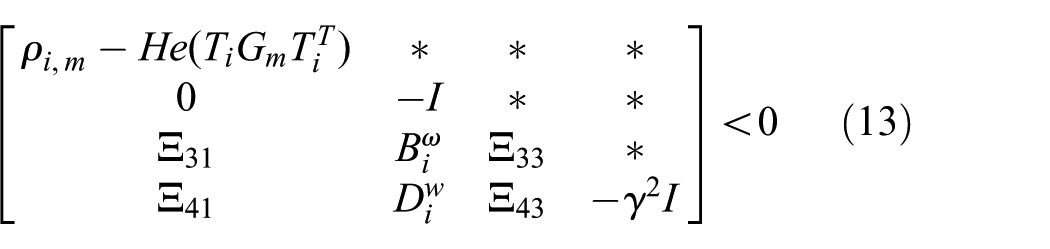
where




We can have the following equalities from equations (2), (8), and (10)

It is easy to know that equation (14) is equivalent to the following equality from equations (5), (7), and (18)

Based on equations (2), (8), and (10), we obtain
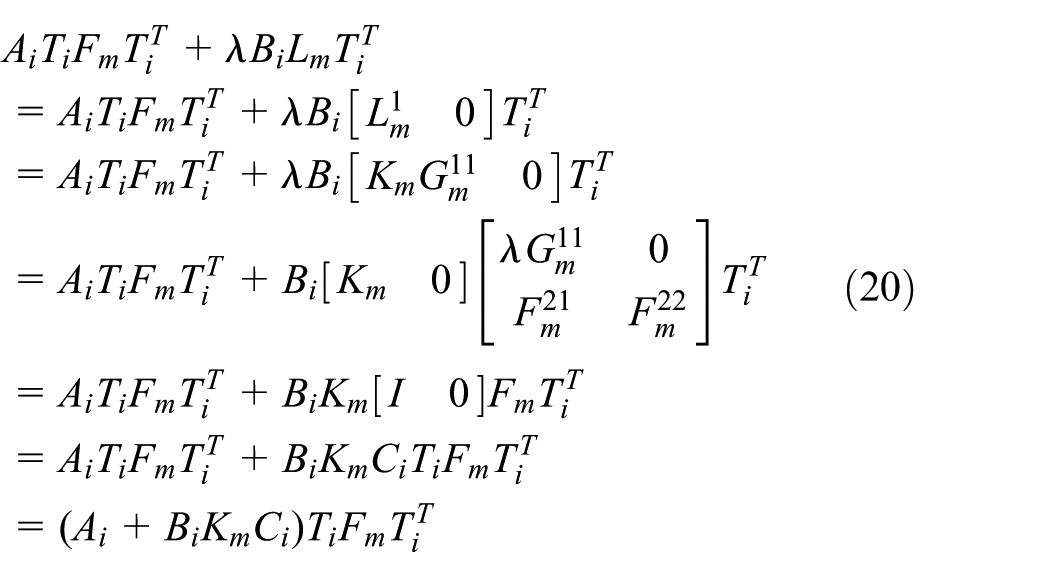
We can know that equation (16) is equivalent to equation (21) based on equations (5), (7), and (20)

From equations (2), (8), and (10), the following equality holds

Which is equivalent to the following equality based on equations (5), (7), and (22)

Similarly, from equations (2), (8), and (10), the following equality holds

Based on equations (5), (7), and (24), equation (24) is equivalent to the following equality

Substituting equations (19), (21), (23), and (25) into equation (13), we can have

We can have the Lyapunov function as

where
The conditional probability is computed as follows
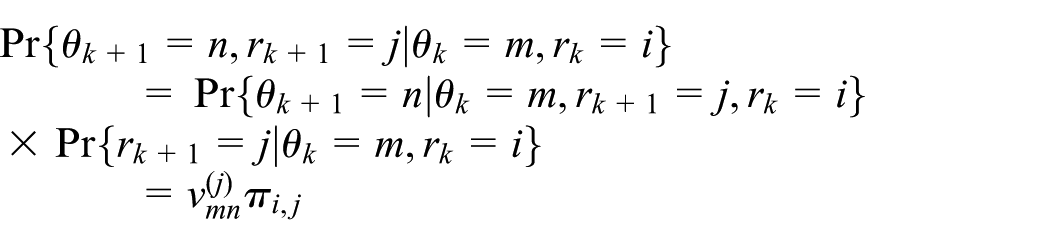
Then for

where

Pre- and post-multiplying

and its transpose to equation (26), then we can have

From equation (29), it is easy to obtain

which can be rewritten as
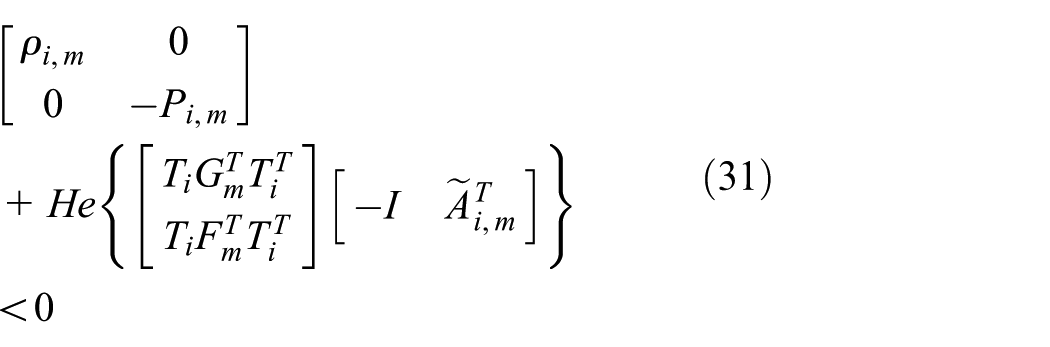
When

which is equivalent to

Based on equations (31) and (32), using Finsler’s lemma, we can have

which is equivalent to

Using equations (27) and (33), we have that

It shows that

Hence, according to Definition 1, system (6) is stochastically stable.
Moreover, from equation (29), it can be seen that

which is equivalent to

From equation (37), we have

which means
From equation (26), we can see it also is equivalent to

where
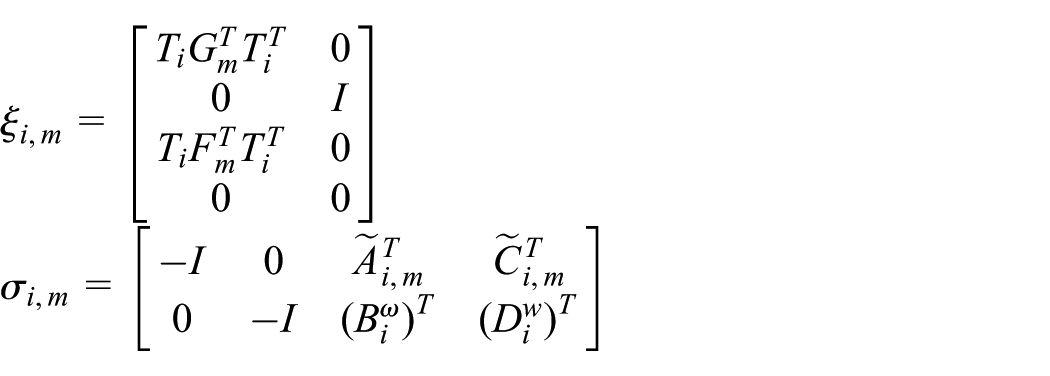
Consider the dual system of equation (6), when

which can be rewritten as

where

From equations (39) and (41), by Finsler’s lemma, we can obtain

Equation (42) is equivalent to

From equations (27) and (43), we can have

Then, we have
According to definition 2, system (6) is said to not only have a prescribed H∞ performance index but also is stochastically stable.
Thus, the proof is completed.
Remark 2
The BMIs in the Theorem have the characters of non-convexity. Due to its non-convexity, it is difficult to solve in the math. Although using the linear matrix inequalities (LMIs) solver and line search, we can get the suboptimal results of the problem in the following form. The method has been used in Zhong et al. 41 The method can also be used to solve the nonlinear problem such as. 42
Problem

where
Numerical example
In this section, we will have some numerical example to ensure the Theorem. Consider the discrete-time MJLSs (equation (1)) with two modes given as follows
Mode 1

Mode 2

According to equation
(3) and with the

Next, the TPs

and the TPs of Markov chains

Solving the problem by giving

The suboptimal H∞ performance
So, let

Given the initial state of the system as follows

Figure 2 shows the jumping of
Markov chains. The actual controller gains are

The jumping conditions of the Markov chains.

The trajectory of the controlled output.

The trajectories of the system states.
Conclusion
Resilient asynchronous H∞ static output feedback control for a set of discrete-time MJLSs has been designed and makes sure the system not only has a prescribed H∞ performance index but also is stochastically stable. By Finsler’s lemma, and with the help of two sets of slack variables, the interconnection between Lyapunov matrices and system matrices is decoupled. The BMIs are proposed as the sufficient conditions for the design of controller, which can be solved using LMIs along with line search. The designed controller improves the robustness of the closed-loop systems and is able to work when the jump between the system mode and the control mode is asynchronous. In the fields of robot control and aircraft and traffic control, the control strategy proposed in this article can be used.
Footnotes
Handling Editor: Chenguang Yang
Declaration of conflicting interests
The author(s) declared no potential conflicts of interest with respect to the research, authorship, and/or publication of this article.
Funding
The author(s) disclosed receipt of the following financial support for the research, authorship, and/or publication of this article: This article is supported by the National Nature Science Foundation of China (61773245, 61503224, 61473177, and 61273197), China Postdoctoral Science Foundation (2015M582115 and 2016T90640), SDUST Public visiting scholar, Taishan Scholarship Construction Engineering, and Construction Engineering and Postgraduate Science and Technology Innovation Project of Shandong University of Science and Technology (SDKDYC170233).