




Abstract
Diesel-piloted natural gas has been considered one of the most promising methods of using natural gas in a compression–ignition engine with few modifications, as this approach benefits from a high thermal efficiency resulting from a high compression ratio. This study experimentally investigated the impact of the natural gas substitution rate on the characteristics of combustion and emissions. Tests were performed under full-load operating conditions at a fixed speed of 1200 r/min with optimized injection timing, and the substitution rate of natural gas was varied with the fixed total fuel energy for different analyses. The in-cylinder pressure, pressure rise rate, heat release rate, cyclic variation of the maximum cylinder pressure (Pmax) and emissions of HC, CO, NOx, and smoke were analyzed. The results indicate that Pmax and the maximum pressure rise rate initially increase and then decrease as the substitution rate of natural gas increases, whereas the heat release rate and standard deviation of Pmax increase. Moreover, HC and CO increase as the substitution rate of natural gas increases, whereas NOx and smoke emissions exhibit a trade-off trend.
Introduction
With increasing concerns regarding environmental pollution and energy shortages, many countries have enacted increasingly stringent controls on vehicular emissions and fuel economy.1–5 To meet these requirements, the dual-fuel combustion concept was applied in high compression ratio internal combustion engines while maintaining the same thermal efficiency as the conventional diesel engine.6,7 Diesel-piloted natural gas (NG) engines have been proposed as a promising method to simultaneously reduce the emissions of particulate matter (PM) and nitrogen oxides (NOx) in engines with high compression ratios.2,8,9 Additionally, in a diesel-piloted NG dual-fuel engine, premixed NG is injected into the cylinder and piloted by a small quantity of diesel injected into the cylinder directly before the top dead center (TDC) of the compression stroke.10,11
In recent years, an increasing number of studies have been conducted regarding the functions of different parameters on performance and combustion, as well as the exhaust emissions of diesel-piloted NG engines. Papagiannakis et al.12,13 found that the maximum explosion pressure in a dual-fuel engine was smaller than the corresponding value of a pure diesel engine and concluded that the diesel-piloted NG mode could lower the emissions of PM and NOx simultaneously. Liu and colleagues14,15 evaluated the influences of the amount of pilot diesel on the pollution emissions of an engine fueled with diesel and NG under the condition of optimized injection timing. The experimental results suggested that the PM and NOx emissions were dramatically reduced in the dual-fuel mode, whereas the PM emissions increased as the quantity of pilot diesel increased. The aforementioned studies have shown that the diesel-piloted NG engine has the capacity to lower PM and NOx emissions while maintaining the same level of thermal efficiency as a diesel engine. However, the diesel-piloted NG engine still present some disadvantages, such as the high emissions of hydrocarbons (HC) and carbon monoxide (CO) under low loads that result from incomplete combustion and high cyclic variations due to unstable combustion at high loads.6,12 Various strategies, such as exhaust gas recirculation (EGR),16,17 throttle technology, 18 pilot injection timing,3,19,20 and the pilot fuel quantity,12,14,21,22 are used to overcome these obstacles. Incomplete combustion is the primarily cause of an over-lean air/NG mixture in the cylinder at low loads. Although gaseous fuel improves engine performance and reduces CO2 emissions, these parameters continue to be inferior to the respective values observed in diesel mode. However, the high substitution rate of NG (SRNG), which leads to a high cyclic variation of combustion under low-speed conditions, even at high loads, is often not considered, and few studies have focused on the combustion and emissions of diesel-piloted NG engines under full-load conditions.
In this study, a dual-fuel engine modified from a diesel engine was used to investigate the combustion and emission characteristics under full-load and 1200 r/min speed conditions, which is the lowest speed for the engine output at the maximum torque under the condition of optimized injection timing. Moreover, the impacts of the NG substitution rate on the in-cylinder pressure, pressure rise rate (PRR), heat release rate (HRR), cyclic variation of the maximum pressure, and CO, HC, NOx, and smoke emissions were investigated.
Test equipment and method
Experimental engine
The test engine is a six-cylinder, turbocharged, common rail engine fueled with pure diesel, which was manufactured by YUCHAI POWER in China. The engine specifications are shown in Table 1.
Engine specifications.
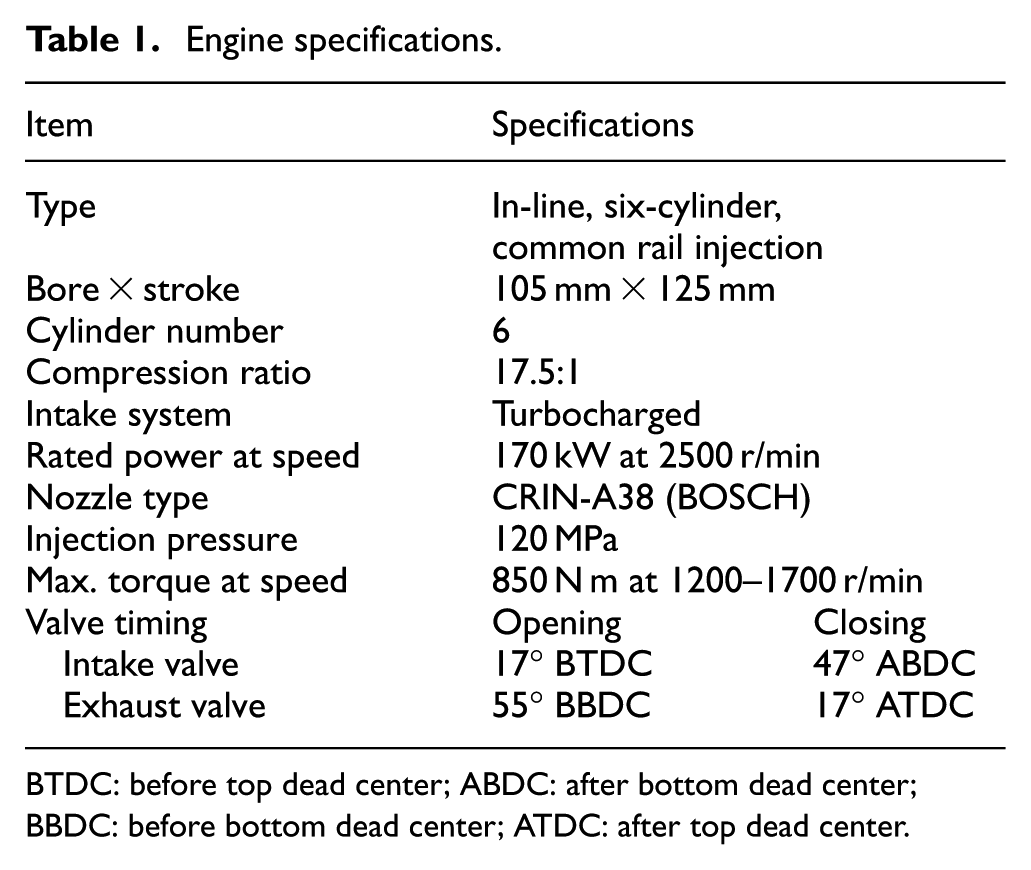
BTDC: before top dead center; ABDC: after bottom dead center; BBDC: before bottom dead center; ATDC: after top dead center.
Fuel supply system
To achieve combustion of diesel-piloted NG, a NG port injection system was equipped on the original diesel engine. The diesel-piloted NG engine and NG fueling system are shown in Figure 1. A dual-fuel electrical control unit (ECU) was coordinated with the primitive ECU. The signals collected from the engine, such as speed, temperature, and inlet pressure, were used by both of these ECUs. Diesel was injected directly into the cylinder by a diesel injector, and NG was injected into the inlet manifold by an NG injector after being adjusted to a lower pressure by the regulator. Furthermore, when the engine worked in the diesel-piloted NG mode, the dual-fuel ECU controlled both the gas and diesel injection events independently, and the injection signal of the primitive ECU was bypassed. More information about the diesel-piloted NG engine can be found in the studies by Zhang and colleagues.23,24

Schematic diagram of the bench control system.
Equipment layout and data collection
The dual-fuel engine was matched with an eddy current dynamometer. The parameters, such as torque, speed, pressure, and coolant temperature, as well as the pressure and temperature of the lubricating oil, were stored by the bench control system. The in-cylinder pressure was measured by a pressure sensor (Kistler 6052A) in conjunction with a charge amplifier (Kistler 5091). All data were recorded in the memory space of the combustion analyzer (Kibox 2893A) for the analysis of combustion characteristics. For fuel metering, an FCS3 flow meter and an HLQZ-Z-60 Roots gas flow meter were employed to measure the consumption of diesel and NG, respectively. The HC, CO, and NOx emissions were obtained using an AVL DIGAS 4000 exhaust analyzer, and the smoke optical absorption coefficient was measured using an AVL Dismoke 4000 smoke meter, as shown in Figure 1.
Experimental process and conditions
Before the experiment, the experimental engine was warmed up in pure diesel mode until the temperatures of the coolant and lubricating oil reached approximately 80°C ± 1°C and 65°C ± 1°C, respectively. The laboratory temperature was set at 23°C ± 1°C by the air conditioning system. Experiments were performed on a dual-fuel engine modified from an electronically controlled common rail diesel engine. The engine speed was kept constant at 1200 r/min with 100% load, and the injection timing of the pilot diesel was adjusted to the maximum power point. To investigate the influence of the SRNG on the combustion performance and emissions, the test engine was run in diesel mode first to test the combustion and emissions of the original engine. Then, the test engine was switched to dual-fuel mode, and the SRNG was set to 0 (pure diesel), 21.1%, 53.6%, 73%, and 95.6%. The corresponding injection quantities of pilot diesel and NG per cycle are provided in Table 2.
Test conditions.
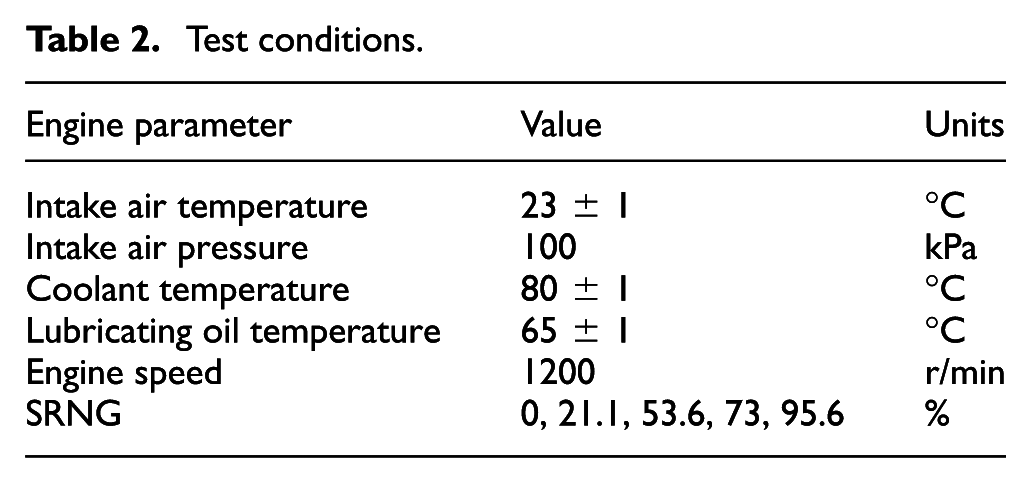
The SRNG in this article is defined as the ratio of NG energy to the sum of NG and diesel energy, which was calculated by the following equation

where
The total excess air coefficient

where
In addition, the HRR was calculated using the average in-cylinder pressure of 100 continuous operating cycles according to equation (3), which is based on the first law of thermodynamics

where
Results and discussion
Total excess air coefficient of the dual-fuel mode and injection timing
Figure 2 illustrates the total excess air coefficient (λT) and injection timing of the pilot diesel under different SRNGs. The λT decreases as the SRNG increases, and the injection timing of the pilot diesel initially advances and then retards. The λT decreases because part of the volume of the cylinder is taken up by the increase in gaseous NG in the dual-fuel mode, as this part of the cylinder is filled with fresh air in the original diesel mode. 14 The variation in the pilot fuel injection timing can be explained by this action 25 in which under low-SRNG conditions, the combustion of the NG/air mixture is poor and unsteady and the injection timing of diesel advances to improve the power characteristics of the dual-fuel engine. However, the injection timing should be retarded to increase the ignition energy due to the small amount of pilot diesel used under high-SRNG conditions.
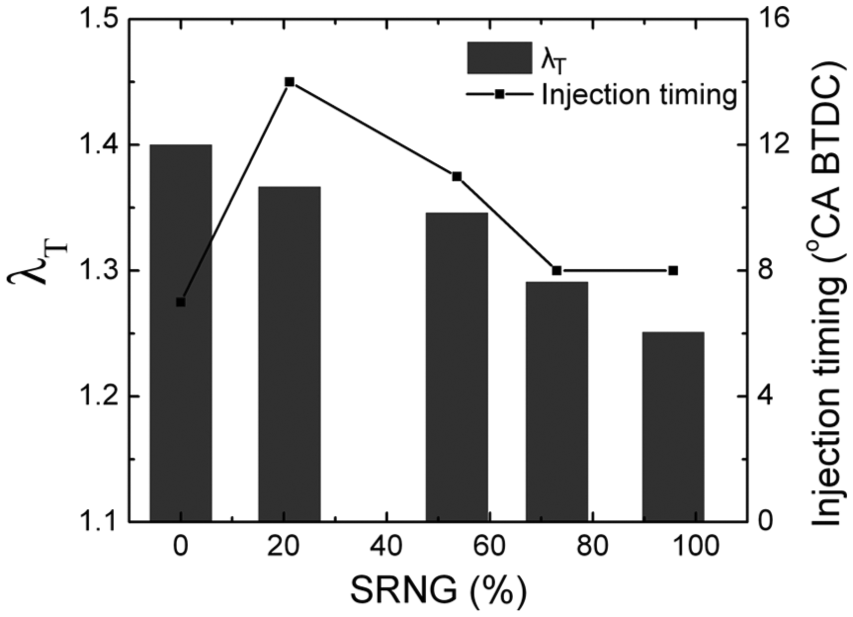
The λT and injection timing under different SRNGs.
Effects of the SRNG on combustion performance
The in-cylinder pressure and HRR under different SRNG conditions
Figure 3 presents the impacts of the SRNG on the in-cylinder pressure and HRR under optimized injection timing at full load. The maximum cylinder pressure initially increases and then decreases with increasing SRNG, which is mainly due to the progressive weakening of the diffusion combustion of diesel and the gradually increasing role of the flame spread combustion of the premixed NG/air mixture in dual-fuel mode. Moreover, the curves of HRR become sharper, while the crank angle corresponding to the peak value of HRR is retarded under dual-fuel mode. Accordingly, this trend may also be caused by the increased burning rate of the homogeneous mixture from the increased concentration of NG, which is fired by a multi-point ignition source. Additionally, compared with the original diesel engine, both the in-cylinder pressure and HRR are higher during the burning process but lower in the compression stroke. This result could be explained by the fact that a greater cylinder volume is taken up by the NG as the SRNG increases, and as a result, less fresh air is involved in the combustion process (as shown in Figure 2, λT decreases as the SRNG increases). The power of the exhaust is reduced, and the pressure of the turbocharger is lowered, leading to a lower pressure in the dual-fuel mode than in the original diesel mode during the compression stroke. Furthermore, in the beginning of the combustion phase of the dual-fuel mode, the diesel was compressed to combustion and piloted the NG/air mixture; then, both the diffusive combustion of diesel and the premixed flame propagation combustion of NG co-existed in the cylinder. Hence, the cylinder pressure of the dual-fuel mode was higher than that of the pure diesel mode. Moreover, at an SRNG above 70%, the main function of diesel is to act as a pilot for the NG/air mixture in the combustion chamber and to release less energy. The combustion of NG, which has a lower burning rate, plays an important role in the cylinder, which may be the main cause for the retarded timing of the HRR peak value.

The in-cylinder pressure and HRR with varying SRNG levels.
PRR and in-cylinder temperature under different SRNG levels
Figure 4 compares the PRR and in-cylinder temperature in pure diesel and dual-fuel modes with varying SRNG levels under optimized injection timing. The PRR of the dual-fuel mode is larger than the PRR of the pure diesel mode, and the PRR initially increases and then decreases as the SRNG increases. This trend can be explained as follows: as the SRNG increases, an evolution from diesel diffusive combustion occurs toward the premixed NG flame propagation combustion, which plays a vital role in combustion and might be the main reason for this phenomenon. With a moderate SRNG, the simultaneous combustion of diesel and NG leads to the maximum rate of pressure increase. Retarding the injection timing of pilot diesel to achieve the optimal power of the dual-fuel engine delays the timing of the peak cylinder pressure when the piston is far away from the TDC, resulting in a low rate of pressure increase. Finally, the burning rate of NG is slower than that of diesel, which increases the gap between them. We can conclude from Figure 4 that the in-cylinder temperature of a dual-fuel engine is generally higher than that of the original engine; as the SRNG increases, the temperature of the dual-fuel mode shows a rising trend. Note that the decrease in temperature for a value of 73% for the SRNG may be due to the retardation of the pilot fuel injection timing.
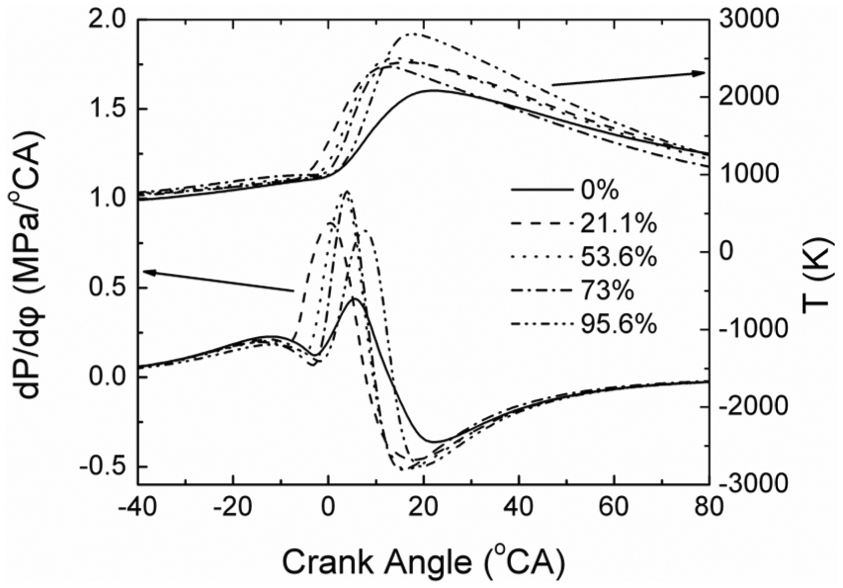
PRR and in-cylinder temperature under different SRNG levels.
Effects of the SRNG on the cyclic variations of Pmax
Figure 5 compares the influences of the SRNG on the average and standard deviation of Pmax. As shown in Figure 5, both the average and standard deviation values of Pmax in the diesel-piloted NG mode are higher than those of pure diesel mode. As the SRNG increases, the average Pmax decreases, whereas the standard deviation increases.

Average (
Figure 6 displays the cyclic distribution of Pmax under different SRNG levels. As illustrated in Figure 6, the cyclic distribution of Pmax in dual-fuel mode is more disperse than the corresponding value in pure diesel mode. As the SRNG increases, the dispersion of the cyclic distribution of Pmax increases. The results in Figures 5 and 6 are mainly due to the evolution of combustion between diesel and NG. The regular combustion of diesel depends on the injection rate, whereas the burning rate of the homogeneous mixture is controlled by the concentrations of NG in the mixture and the pilot quantity. Additionally, abnormal combustion, such as knock, due to the retardation of the injection time may lead to high cyclic variation in the dual-fuel engine.

Cyclic distribution of Pmax.
In summary, under full-load conditions, the in-cylinder pressure, PRR, and HRR of dual-fuel mode are higher than their corresponding values in original diesel mode. As the SRNG increases, both the in-cylinder pressure and PRR increase initially and then decrease, whereas the HRR, standard deviation of Pmax, and dispersion of the cyclic distribution increase. Additionally, the average value of Pmax decreases. Consequently, a slight reduction in the SRNG is a promising method for achieving less combustion noise (rate of pressure increase) and fewer cyclic variations in a diesel-piloted NG dual-fuel engine.
Effects of the SRNG on exhaust emissions
HC/CO
Incomplete combustion resulted from a lack of oxygen, and a sudden decrease in temperature below 1450 K could lead to increased CO formation. 26 The HC emissions are primarily generated by incomplete combustion, which is caused by a lack of oxygen and lower combustion rates in dual-fuel mode, and HC can be generated from the mixture that is compressed into the cylinder crevices during the compression stroke and at the beginning of the power stroke. 27 In general, the emissions of CO and HC from dual-fuel engines are considerably larger than those from pure diesel mode.23,28
Figure 7 illustrates the emissions of CO and HC under varying SRNG levels with optimum injection timing at full load. Both the emission levels of CO and HC in the diesel-piloted NG mode were higher than those in the pure diesel mode, and these levels increased with increasing SRNG. The main reason for this trend is that extensive flame extinction zones exist in the NG/air mixture far away from the injection spray zones under low-SRNG conditions; thus, the CO and HC emissions originate from the incomplete combustion of NG. When operating under high-SRNG conditions, the combustion around the spray zones is improved due to the rich mixture; however, the amount of NG, which is compressed into the cylinder crevices during the compression stroke and at the beginning of the power stroke, is significantly increased, resulting in an increase in HC emissions. Meanwhile, the reduction of pilot fuel, which decreases the ignition energy, may result in an increase in the amounts of HC and CO, possibly because the local temperature decreases as the ignition energy decreases during expansion, which may lead to an incomplete combustion mixture. In addition, the emission of CO can also result from cold wall quenching.

CO and HC emission characteristics.
Smoke and NOx
Figure 8 displays the effects of the SRNG on NOx and smoke emissions at full load with optimum injection timing. The formation of NOx is favored by the abundant oxygen level, the highest temperature in the cylinder resulting from combustion, and the long reaction time.27,29 In addition, as the main component of NG, methane has no carbon–carbon bonds and a low carbon-to-hydrogen ratio (1:4). The smoke emissions of dual-fuel engine are lower than those of the pure diesel engine and decrease with increasing SRNG; however, NOx emissions exhibit an opposite trend. This result is not consistent with the results reported by some other researchers30,31 because they found that the homogeneous combustion of NG/air mixtures generated fewer NOx and PM emissions. 32 In this study, the reduction of smoke emissions may be due to the decreasing trend in diffusion combustion and the increase in premixed flame spreading combustion resulting from the high SRNG. Additionally, the high combustion temperature and slow reaction time of methane increase NOx emissions. It is important to note that the smoke decreases rapidly, while NOx increases slowly as the SRNG increases. Moreover, an SRNG of approximately 70% may be a good choice for the reduction of both smoke and NOx emissions in diesel-piloted NG dual-fuel engines.

NOx and smoke (K) under different SRNG levels.
Conclusion
This research investigated the effect of the SRNG on the combustion and emissions of a turbocharged diesel-piloted NG engine with optimum injection timing under full-load conditions. The following conclusions could be drawn from the following results:
With an increase in the SRNG, the maximum cylinder pressure and PRR initially increase and then decrease, whereas the peak HRR increases. Compared to those of the original diesel engine, both the in-cylinder pressure and HRR under dual-fuel mode are higher in the burning process and lower in the compression stroke of the dual-fuel engine.
The cycle variation and standard deviation of Pmax are higher in the dual-fuel engine than in the original engine. The average Pmax decreases as the SRNG increases, whereas the standard deviation and dispersion of the cyclic distribution increase.
The HC and CO emissions under dual-fuel mode are higher than those under pure diesel mode, whereas NOx and smoke emissions exhibit a trade-off trend. The varying rates of these emissions differ as the SRNG increases.
Considering the power characteristics, combustion noise, cyclic variations, and emissions, an SRNG of approximately 70% would be ideal based on the results of this study.
Footnotes
Handling Editor: Oronzio Manca
Declaration of conflicting interests
The author(s) declared no potential conflicts of interest with respect to the research, authorship, and/or publication of this article.
Funding
The author(s) disclosed receipt of the following financial support for the research, authorship, and/or publication of this article: This research is supported by the National Natural Science Foundation of China (No. 51675262 and No. 51608221), and assistance was received from the Science and Technology Bureau of Huai’an (HAS2015015 and HAG201603).