




Abstract
Due to the raising economy development of Shenzhen, environmental problems brought by road transport have become more serious. Promoting liquefied natural gas vehicle in the road freight is a key to reduce emissions, change the direction for road freight development, and build a resource-saving society. This article studies the application of liquefied natural gas vehicle in Shenzhen in-depth through official data sets, field investigation, expert consultation, and so on. Economic benefit analysis shows that liquefied natural gas vehicle has the advantage of saving considerable fuel costs for enterprises. Moreover, the Monte-Carlo method is used to evaluate the economic benefits considering a lot of factors. The economic analysis shows that the liquefied natural gas vehicle is more affordable than the diesel vehicle. Finally, the current issues of liquefied natural gas vehicles on the promotion are discussed and some advices are proposed to improve air quality and reduce emissions.
Introduction
Due to the raising economy development of Shenzhen, the number of vehicles increases rapidly, which results in traffic congestion, as well as air pollution. By the end of 2015, there were over 3.2 million vehicles in Shenzhen. In the past 5 years, the annual growth rate was about 16%. In other words, there are about 500 vehicles per kilometer road length, and this vehicle density ranks number one in China. Previous studies showed that the road transport is one of the largest energy consumption and pollution emission industries.1–3 According to the China Vehicle Emission Control Annual Report 2015 published by the Ministry of Environmental Protection, the particulate matter (PM) and nitrogen oxide (NOX) exhausted by freight vehicles were significantly higher than those of passenger vehicles. Heavy-duty vehicle is the major contributor, whose PM and NOX emissions account for 52% and 61% of the total vehicle emissions, respectively. 4 In addition, the research from Peking University Shenzhen Graduate School shows that vehicle emission is the primary source of local PM, and 52% of them are from diesel heavy-duty trucks. 5
As a result, the transformation of the road freight mode and the promotion of energy-efficient, low-emission transportation have become the inevitable choice of Shenzhen for sustainable development, resource-saving, and environmental protection. In September 2013, the State Council issued the Air Pollution Prevention and Control Plan, which proposes to strengthen the mobile source emission control and vigorously promote new fuel-efficient vehicles. 6 After few days, the Shenzhen Municipal Government issues the Shenzhen Atmospheric Environmental Quality Improvement Plan and guarantees to promote 35,000 vehicles using cleaner energy by the end of 2016, which includes medium and heavy-duty liquefied natural gas (LNG) trucks or electric trucks. 7 If the goal comes true, it will be the largest cleaner fuel promotion program in road freight all around the world.
This article is divided into the following parts. The concept of LNG is introduced in section “Concept of LNG,” including its concept, supply safety, and fueling station. The section “Alternative fuel for road freight” explains that LNG is an ideal alternative fuel for road freight from different aspects. Subsequently, in section “Economic benefit of LNG vehicles,” the economic benefit is discussed from the aspect of freight enterprises, using the Monte-Carlo simulation, considering the uncertainties of fuels and its price, use intensity, and so on. The problems that obstruct LNG vehicle promotion are analyzed in section “Problems of LNG vehicles promotion.” Finally, the study is concluded in section “Conclusion and prospects.”
Concept of LNG
LNG is a natural gas (predominantly methane, CH4) that has been converted to liquid form for ease of storage or transport. 8 After being liquefied, it takes up about 1/600 the volume of natural gas in the gaseous state and about 45% the weight of water in equal volume. As a cleaner energy, natural gas is increasingly favored. LNG is proposed to be the prior choice of alternative fuels in many countries, for example, United States, Canada, Europe, and China.9–12 As a result, the ratio of natural gas in energy supply increases rapidly. While compressed natural gas (CNG) is just suitable for light-duty vehicles, LNG can be used in road transport, 13 such as heavy-duty trucks and buses. In China, CNG buses and LNG buses were introduced into the bus fleet in Beijing in 1999 and 2012, respectively.14,15 After that, more and more cities in China have swift some diesel buses to LNG buses, for example, Guangzhou, Xiamen, and Shenzhen. Heavy-duty vehicle, whose total mass is 14 tons or more, is the main object of promoting LNG vehicles in Shenzhen road freight. 7 Different from light-duty vehicle using diverse fuel (e.g. gasoline, diesel, CNG, and electric), heavy-duty vehicle uses diesel or LNG because the fuel’s energy density must be high enough to meet its power requirement. There are three main types of LNG heavy-duty vehicles in Shenzhen, namely, container tractors, engineering dump trucks, and engineering mixers.
LNG supply safety
The main sources of LNG supplied to Shenzhen include foreign imports and provincial imports. The former is mainly from Australia, Malaysia, and so on. The latter is the Second West-East Gas Pipeline Project, supplying natural gas of about 40 billion m3/year for Shenzhen. Natural gas is transported through pipeline in gaseous state, so it needs complex liquefaction process involving removal of certain components, for example, dust, acid gases, helium, and water. Besides, a small amount of LNG is transported to Shenzhen by cargo transport containers from Inner Mongolia, Xinjiang, and other gas fields. In addition, the contract of Russia’s gas project was signed. A diversity of LNG source markets appear.
Shenzhen has the largest number and the biggest LNG terminals in China. After all of the terminals have become fully operational, the supply capacity of LNG will greatly exceed 11 million tons/year, accounting for around 55% of that in Guangdong province. Along with picking up LNG at adjacent cities, LNG supply is totally guaranteed.
LNG fueling stations
The number of LNG fueling stations is still not enough in Shenzhen. Besides, the layout of LNG fueling stations is unreasonable. China National Offshore Oil Corporation (CNOOC) Shenzhen Gas Co., Ltd is one of the largest automotive LNG suppliers. By the end of 2015, it had built 17 LNG fueling stations distributed at 6 districts, 16 such as Nanshan, Baoan, Longgang, Yantian, Guangming, and Longhua (Figure 1). At present, nine of them have been put into use. Their clients include buses, coaches, container tractors, dump trucks, and engineering mixers. It just takes 3 min to refill a gas tank of LNG vehicle, which is shorter than refilling diesel to a diesel vehicle due to the high pressure of gas dispenser.

Distribution of LNG stations of CNOOC Shenzhen Gas Co., Ltd.
There are four types of LNG fueling stations: (1) skid-mounted fueling station—it is more flexible, less land-using, easily operated, and lower energy consumption. (2) Standard fueling station—since its storage volume is relatively large, it is mainly built at a field with a large demand of heavy-duty trucks or coaches. In general, it can supply LNG 30,000–50,000 m3/day. (3) LNG/L-CNG fueling station—its comprehensive performance is relatively good, for it can supply not only LNG but also CNG. (4) Movable skid-mounted fueling station—it is used under high mobility or urgent situation.
The typical LNG fueling stations of CNOOC Shenzhen Gas Co., Ltd are introduced as follows:
Zhongshan Park LNG fueling station (Figure 2)—the first domestic standard fueling station which costed about 8 million Renminbi (RMB), was built in 2007, and started operations in 2009. There are four gas dispensers and two 50-m3 tanks in it. At present, it serves roughly 110 vehicles/day. When the station operates at full capacity, it can fuel 800 vehicles/day.
Yantian Port 1, 2, 3 LNG fueling station—the company cooperates with Yantian Port and has built three stations in the port area serving LNG container tractors. Station 1, which comprised two gas dispensers and two tanks with total 60-m3 volume, is the biggest. With regard to stations 2 and 3 (Figure 3), there is only one dispenser and one 30-m3 tank, which can meet the demand of 100 container tractors.
Songping skid-mounted fueling station—the machine and technology used in this station is the achievement of “863” Plan Project (Figure 4). It is easily moved according to the market demand. Because of less land usage, it only has one gas dispenser and one 30-m3 tank. Therefore, its fueling ability is just about a quarter of the standard fueling station.

Zhongshan Park LNG fueling station.

Yantian 3 LNG fueling station.

Songping skid-mounted fueling station.
Alternative fuel for road freight
In recent years, LNG vehicle is covering all major heavy-duty vehicle types gradually. For road freight enterprises, there is enough vehicle supply to satisfy the needs of business requirements. In the following part, LNG vehicles with diesel vehicles will be compared from four different aspects. It can be concluded that LNG is the perfect alternative fuel for road freight.
Vehicle power performance
While the horsepower of LNG engine is almost the same with diesel engine in the same tonnage heavy-duty vehicle, LNG engine is more stable under idle operation. The maximum torque of LNG engine is slightly smaller than diesel engine, and the rotational speed of LNG engine under the maximum torque is higher than diesel engine. In other words, the instantaneous acceleration of LNG vehicle is a little worser. When at cruising stage, there is no significant difference between them, such as threshold horsepower and maximum speed.17,18
Vehicle cruising ability
The fuel used by LNG vehicle needs to be stored in low-temperature and heat-insulation tank. The temperature in the tank would rise and some boil-off gas could cause high pressure when vehicles are parked. Although some boil-off gas would leak from the tank in order to keep the pressure, the volume of boil-off gas of high-intensity heavy-duty vehicles is pretty small. Based on practical enterprises investigation, an LNG heavy-duty vehicle with two 450-L tanks can run 800–1000 km after fully refilled. In the same condition, a diesel heavy-duty vehicle with a 450-L tank can run 900–1200 km, slightly higher than that of an LNG truck.
Fuel safety
When LNG leaks into air, it would gasify immediately and diffuse upward subsequently since the density of natural gas is smaller than air. As a result, it is not easy for natural gas to accumulate. In addition, the ignition point of natural gas is about 230°C higher than gasoline and 450°C than diesel. Therefore, LNG is safer than diesel.
Longer engine service life
Cylinder liner, piston, piston ring of engine wearing and tearing, and diesel could penetrate into crankcase through the gap between piston and rim of cylinder and dilute lubrication oil, causing further wear and tear. As for LNG engine, it injects gaseous natural gas into the engine for combustion, which would not dilute lubrication oil. 19 Therefore, the service life of LNG engine is longer.
Application of LNG vehicles
Heavy-duty vehicles
There were about 76,000 heavy-duty vehicles in Shenzhen by the end of 2015, which can be classified as follows: (1) Container tractor—there are about 29,000 container tractors in Shenzhen, including 1000 only worked inside the port, while others are long-haul container tractors mainly served for Pearl River Delta. (2) Engineering mixer—there are about 3800 in Shenzhen, and the majority of them are heavy concrete tank mixer. (3) Engineering dump truck—there are about 4600 distributed in Shenzhen. (4) Other ordinary truck—there are about 38,600 ordinary trucks belonging to freight enterprises. Specific ratios for various types of vehicles are shown in Figure 5.

Classification of heavy-duty vehicles in Shenzhen city.
Application of LNG heavy-duty vehicles
In Shenzhen, the first LNG vehicle was introduced in 2009. LNG vehicles were massively promoted 2 years later; the main automobile brands include Sinotruk, Shaanxi Auto, and C&C Trucks. Almost all LNG vehicles are heavy-duty vehicles, costing around 350,000 RMB/vehicle.
The performance of LNG heavy-duty vehicles is obtained after interviewing and investigating some enterprises and ports using LNG vehicles. It is clear that LNG heavy-duty vehicles are superior to conventional diesel vehicles in terms of economical view. There were about 1000 LNG heavy-duty vehicles used in Shenzhen by the end of 2014, and the number of each type of LNG heavy-duty vehicle is shown in Figure 6. These vehicles can be classified as follows:
Container tractor—whose number is about 700. Among them, 400 internal container tractors are used inside the port and 300 tractors are long-haul container tractors. Since LNG fueling stations in the port are easy to access, the LNG vehicles can be refilled efficiently and quickly. Besides, 20%–30% of fuel cost can be saved. Accordingly LNG container tractors have been applied excellently inside the port. At present, about 1000 diesel container tractors in four ports in Shenzhen are planned to be upgraded to LNG tractors, and few diesel tractors will be kept for emergency situation.
Engineering mixer—whose number is about 200. According to the feedbacks from enterprises, the effect of LNG engineering mixers is quite satisfied. Sometimes, LNG vehicles’ refilling often results in unloaded mileage, which would reduce the benefit. Some enterprises build fueling stations inside the mixing station, providing convenient service and reducing the cost of the fuel.
Engineering dump truck—whose number is about 100. The effect of LNG engineering dump truck is modest. These vehicles can be divided into two categories due to the difference in goods they carry. The first carries sand, running between bulk wharf and mixing station. The economical performance is very good due to the convenience of fueling. The second one carries redundant soil, running between the building sites. The lack of fueling station along transit lines obstructs its promotion.
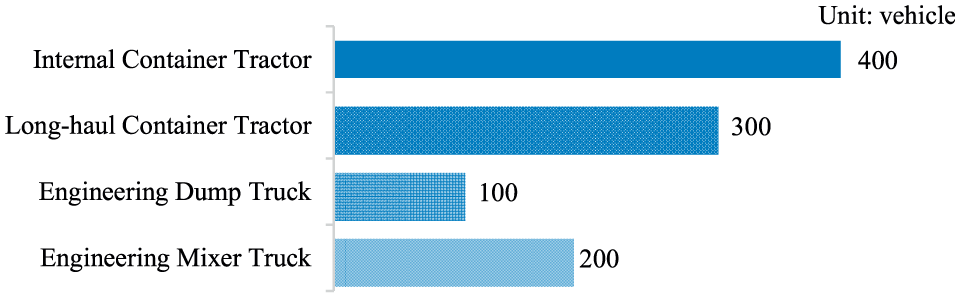
Number of LNG heavy-duty vehicles in Shenzhen city.
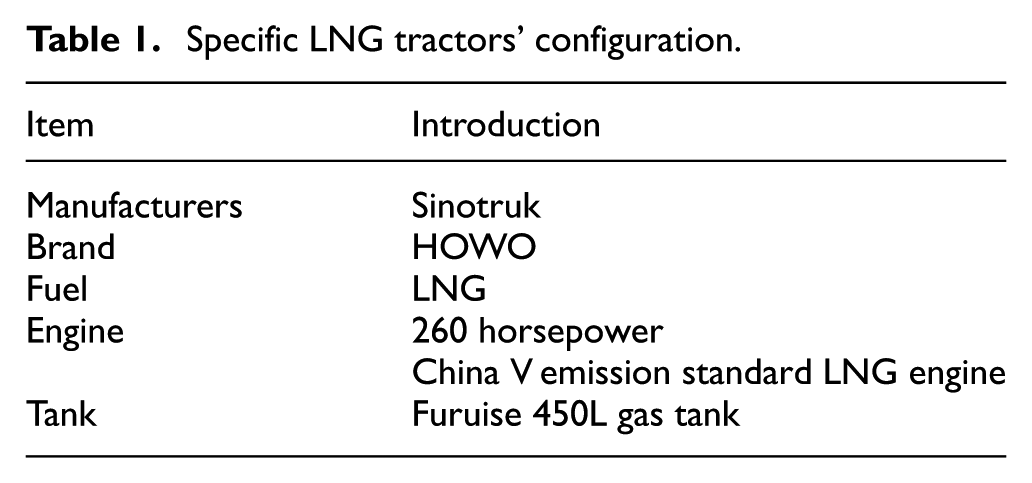
Hercules Transportation Ltd is selected as a typical and representative example of freight enterprises for replacing original diesel truck by LNG truck. Hercules Transportation Ltd, which was founded in 2000, mainly undertakes the business of logistics including port logistics, intercity transportation, and inter-provincial transportation. It owns 561 heavy-duty vehicles and more than 600 drivers currently. In March 2014, the company purchased 50 LNG container tractors. After 6 months, it purchased other 99 LNG tractors. These tractors’ configuration and parameters are shown in Table 1. The cost of one tractor was 320,000 RMB, while diesel tractor in the same configuration is 290,000 RMB, cheaper about 10%. At present, the use intensity of LNG tractors is the same with diesel tractors. Basically, tractors work 18 h each day and 6 days each week. Sometimes, it operates all days each week. The general mileage of a tractor is 7000–8000 km/month, and even 10,000 km/month when in busy time. The reasons of preferentially purchasing LNG tractors are as follows: (1) with the emission standard becoming stricter, the exhaust after-treatment cost of diesel vehicles would be more expensive and (2) the support of policies, such as financial support and port operating license.
Specific LNG tractors’ configuration.
Policy for promoting LNG vehicle
The Shenzhen government takes a series of steps to promote the application of cleaner energy. Among them, LNG heavy-duty vehicles are highly emphasized and vigorously promoted. All levels of the government introduce relevant subsidy measures. The maximum cumulative subsidy is up to 40,000 RMB/vehicle, which means subsidizing about half of the purchase price difference and increasing the enterprise’s enthusiasm of purchasing.
Specific subsidy measures are as follows:
1. Subsidies at the national level
To guide the use of gas-fueled vehicles, the Ministry of Finance and the Ministry of Transport issue “Special Financial Funds Management for Energy Conservation and Emission Reduction of Transportation,” which announces that each LNG vehicle meeting the requirements will be refunded 10,000 RMB.
2. Subsidies at Shenzhen municipal level
In February 2015, the Shenzhen Municipal Development and Reform Commission decided to refund 20,000 RMB to each qualified LNG vehicle to encourage the promotion.
3. District government subsidies
Some district governments of Shenzhen also take measures to encourage using LNG vehicles. For example, Yantian District’s government would reward 10,000 RMB for each LNG truck bought before 2016.
Economic benefit of LNG vehicles
Container tractor, dump truck, and engineering mixer truck are typical vehicle types in the road freight of Shenzhen. Therefore, these three types are taken as the example to analyze economic benefit of LNG vehicles.
The baseline
There are few diesel heavy-duty vehicles meeting the China V emission standard in Shenzhen till 2015. In this article, LNG trucks and diesel trucks with the same horsepower and configuration meeting the China IV emission standard are compared together. We investigated their purchasing cost, vehicle maintenance, and fuel consumption rate through a variety of methods, for example, official data sets, field investigation, and expert consultation. Official data sources mainly include Shenzhen Statistical Yearbook, Shenzhen Port, and Freight Management Bureau statistical reports. Field surveys were conducted among freight enterprises, ports, and market dealers, including vehicle parameters and operating information. These data are used to calculate the annual cost of each vehicle. The calculation formula is as follows


The cost of heavy-duty vehicles mainly consists of purchase cost and operational cost. The main factors affecting the purchasing cost between LNG vehicle and diesel vehicle are engine type, gas tank (or tank), and fuel supply system. Vehicle operating cost mainly includes the following: (1) regular maintenance and unscheduled repair costs and labor costs and (2) fuel cost, which is the sum of vehicle use intensity fuel consumption rate and fuel prices. As operating features vary according to types of heavy-duty vehicle, different indicators should be used to calculate the use intensity. For container tractors and engineering dump trucks, vehicle kilometers traveled (VKT) is the most appropriate indicator. As for engineering mixer trucks, operational time per year is the most appropriate indicator. This is because the engine not only makes the vehicle running but also keeps the mixer tank rotating in order to maintain the concrete’s liquid state during the transportation process. In other words, the engine runs and emits pollutants all the time. In Table 2, the relevant data are used to analyze the economic benefits.
Analysis of economic benefit.

As shown in the Table 2, the annual cost of LNG vehicle is less than that of diesel vehicle. Since the oil price is relatively cheap at the time when our research started, which means the economic advantage of LNG is weak and economic benefit analysis is conservative. In the long term, the price of diesel will still rise, so there is a good prospect for LNG vehicles’ development. If we assume a one-time payment in each vehicle purchasing and only consider its operating costs in vehicle’s service life, the breakeven charts of the three types of heavy-duty vehicles are shown in Figure 7. According to the figure, it is obviously shown that LNG truck is more affordable than diesel truck. Accordingly, all three types can make up the difference of purchasing costs within 1/3 period of vehicles’ service life. In a word, LNG vehicle has the advantage of saving considerable costs.
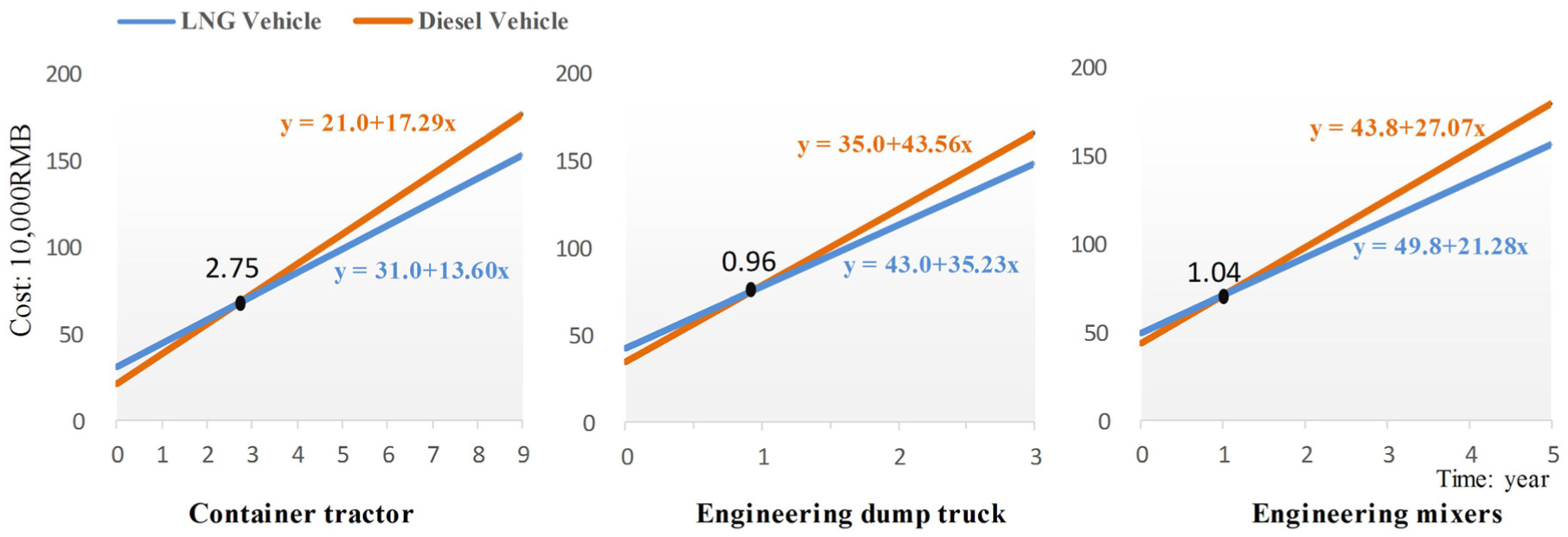
Breakeven chart of LNG and diesel heavy-duty vehicles.
Monte-Carlo analysis
As the economic benefits are influenced by a number of factors, most of them are non-determined factors. Therefore, the benefits are studied further by Monte-Carlo method with the assistance of the Crystal Ball software. Few factors were considered during the simulation process such as subsidies, vehicle type, fuel price, use intensity, and fuel consumption rate. Monte-Carlo experiment can obtain and display a collection of simulation outputs for a stochastic model or for a model with stochastically varied parameters.
Annual cost per vehicle
The annual cost of three types of heavy-duty vehicles is shown in Table 3. The result shows that while annual cost is affected by fuel price to a greater extent, LNG vehicles always perform better economically. The annual cost per LNG vehicle is 11%–22% lower than that of diesel one. For container tractors, cost savings of 19,270 RMB can be achieved per vehicle each year in median level by switching diesel to LNG. With a huge use intensity, the average service life of engineering dump trucks and engineering mixers is shorter. For dump trucks, replacing diesel with LNG can achieve 50,880 RMB of cost savings in median level per vehicle each year. LNG engineering mixers can save 47,419 RMB in median level per vehicle each year compared with diesel fuel.
Statistical characteristic of annual cost of three types of vehicles (unit: RMB).

First Qu. represents the first quartile, and Third Qu. represents the third quartile; benefits is the difference ratio of annual cost between LNG vehicle and diesel vehicle.
Cost tradeoff evaluation
Monte-Carlo simulation method is also used in breakeven year analysis, considering two scenarios. The first scenario is without subsidies from government, while the second scenario is with the maximum subsidies, namely, 40,000 RMB each vehicle. The breakeven year of three types of heavy-duty vehicles with subsidies and without subsidies is shown in Table 4 and Figure 8.
Statistical characteristic of breakeven year of three types of vehicles with subsidies and without subsidies (unit: year).
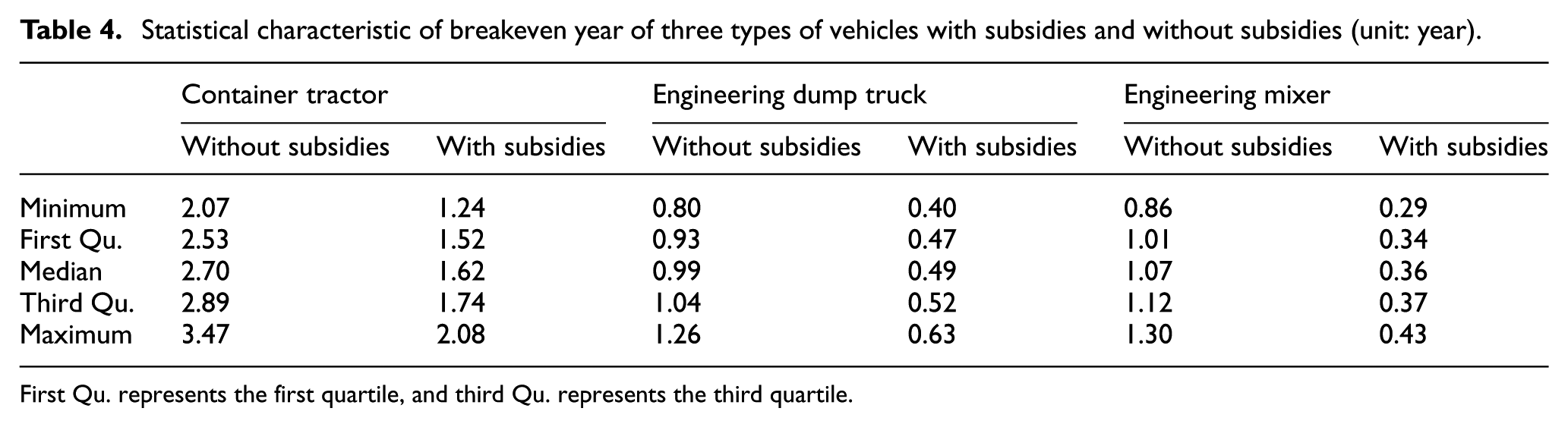
First Qu. represents the first quartile, and third Qu. represents the third quartile.

Breakeven year of three types HDTs with subsidies and without subsidies.
Compared with the scenario without subsidies, the breakeven year and uncertainties due to various risks can be reduced by a large extent with the help of subsidies. In terms of container tractors, the difference of purchase cost can be recovered by 1.62 years approximately in median level under the with-subsidies scenario, and 1.08 years lower than that without subsidies. In comparison with diesel dump truck, an LNG dump truck can recover the cost difference within 0.49 year in median level with the help of subsidies, which was half of that without subsidies. As for LNG engineering mixers, it would be 0.36 year to recover the cost difference with subsidies and 1.07 years without subsidies.
Thus, LNG vehicle has the advantage of saving considerable amount of fuel costs. The above analysis shows that the LNG vehicle is more affordable than the diesel vehicle even during the period of fuel price fluctuation. Accordingly, all three types of vehicles can recover the gap of purchase costs in 1/3 period of vehicles’ service life without subsidies. With the subsidies available, the economic benefits would be even more significant and the gap of purchase costs can be recovered in 1/6 period of vehicles’ service life. Therefore, LNG vehicle is more efficient than the conventional diesel vehicle from the economic perspective.
Problems of LNG vehicles’ promotion
Planning and construction of LNG fueling stations need to be improved
The planning and construction of LNG fueling station should be promoted in the following two aspects:
There is much space to develop the planning and layout of LNG fueling station. According to the domestic and foreign development experience, the planning and layout of stations are important for the development of LNG vehicle. However, the construction of station involves planning, land, public security, fire fighting, and many other government agencies. That means there will be a long and complex process before getting all of the approvals. Besides, it is also difficult to get the land for construction. Meanwhile, Shenzhen has not yet made the development plan of LNG fueling station, resulting in the lag of the planning.
There are some difficulties to conquer in extending normal fuel-filling station to LNG fueling station, mainly because the relevant departments did not set aside excess land in the planning and construction of the original station, and the standard of fueling station construction and operation needs to be further improved. Besides, the existing fueling stations have a conflict of interest with LNG fueling station. That means it is hard to balance them.
LNG vehicles’ technical support capability remains to be improved
Although LNG vehicles’ manufacturing technology has gradually matured, it still has some shortcomings compared to diesel vehicles, such as relatively poor stability of fuel supply system and high failure rate of components. Those are more likely to cause the uncertain attitude of the freight enterprises and may have a negative impact on the enterprises having purchased LNG vehicles.
Policy support needs to be more perfect
LNG’s application in the freight of Shenzhen is still in its infancy. And the advertisements of LNG vehicle are insufficient. Therefore, freight enterprises are unclear about its economic benefit, driving operation, maintenance, especially the cost difference between LNG vehicle and diesel vehicle, which causes many potential clients to adopt a wait-and-see attitude. In order to further promote, it urgently needs government policy support at early stage, especially financial support. At present, national, municipal, and district government have been offering subsidies to promote LNG vehicles. But the total amount of subsidies is not large enough and has much more restrictions.
Conclusion and prospects
In this article, the quantification of the economic benefits of LNG vehicles is conducted. The results show that LNG vehicles have the advantage of saving considerable fuel costs. All types of heavy-duty vehicles could make up the difference of purchase cost in the 1/3 period of vehicles’ service life without subsidies, even though LNG vehicle are more expensive than diesel vehicle. When the enterprises get the subsidies, the gap of purchase costs can be recovered in 1/6 period of vehicles’ service life. However, promotion of LNG vehicles in Shenzhen road freight can have significant benefits on the environment, such as reducing PM, NOX, and greenhouse gas emission. It also plays a significant role in Shenzhen atmospheric environmental quality improvement. LNG vehicle technical support capability remains to be improved, and the market penetration rate of LNG truck in heavy-duty vehicles is less than 2%.
In order to promote LNG vehicles in the freight, this article puts forward two policy recommendations: (1) construction of LNG fueling station needs to be improved and (2) subsidies for enterprises to purchase LNG vehicle need to be increased.
In conclusion, promoting LNG vehicle in Shenzhen freight will boost energy-saving and emission-reduction, preserve ecosystems, and protect the environment. The experience of Shenzhen will provide reference for other cities to promote LNG vehicles.
Footnotes
Academic Editor: Yongjun Shen
Declaration of conflicting interests
The author(s) declared no potential conflicts of interest with respect to the research, authorship, and/or publication of this article.
Funding
The author(s) disclosed receipt of the following financial support for the research, authorship, and/or publication of this article: This study was funded and supported by the Shenzhen Science and Technology Plan (grant no. JCYJ20140418181958475) and the Energy Foundation (grant no. G-1312-19692).