



Abstract
A wind tower can augment the performance of a vertical-axis wind turbine since it can increase the wind velocity as well as adjust the wind direction. However, it is very important to correctly determine the configuration of the wind tower because the wind tower can also interrupt the wind flow toward the wind turbine. Hence, a numerical analysis was conducted to investigate an effective wind tower configuration using computational fluid dynamics. For practical reasons, a numerical algorithm using a reduced computational domain was applied because the full three-dimensional computational fluid dynamics required huge amounts of computation time for a transient analysis. This method was validated using experimental results and was then applied to the computation of a wind tower with an installed vertical-axis wind turbine. Three wind tower design parameters were chosen for investigation: the inner radius, outer radius, and relative angle of the guide wall. When these parameters were correctly determined, the wind tower always increased the performance of the vertical-axis wind turbine in an omnidirectional wind. In addition, the maximum power coefficient was increased from 0.261 (without the wind tower) to 0.436.
Keywords
Introduction
Global demand for renewable energy will continue to increase due to the steady depletion of fossil fuels. Efforts to develop sources of energy to replace fossil fuels are being conducted in various fields, including solar, geothermal, ocean, waste heat, and wind power. To exploit wind power, wind energy is converted to mechanical energy by a wind turbine, and then, electrical energy is produced by rotating a generator with this mechanical energy. The attainable output power depends on the size of the wind turbines and wind velocity. Wind turbines are typically divided into horizontal-axis wind turbines (HAWT) and vertical-axis wind turbines (VAWTs) based on the rotational direction in relation to the wind direction.
VAWTs are widely used, even in urban settings, because they have several advantages, including low noise, a simple structure which does not need a yaw control device, and easy installation of the generator near the ground. However, their efficiency is degraded because they operate in a complex flow field of spreading trailing vortices which are detached from the preceding blade. The efficiency of a wind turbine greatly depends on how effectively a turbine blade can convert wind energy to mechanical energy. Therefore, considerable research1–3 has been conducted to develop a better blade which can efficiently convert wind energy at appropriate Reynolds numbers,4–6 corresponding to the wind velocity. This effort is necessary because many wind turbine airfoils were developed at approximately one-order higher Reynolds number for aircraft wings.
The blades of the VAWT operate vertically in relation to the wind direction. As a result, they do not need a yaw control, but their output power greatly depends on their relative position against the wind direction. This phenomenon is due to the variation in the angle of attack of the blade. If a better angle of attack can be formed, the performance of the wind turbine can be improved. For this purpose, guide vanes7–9 have been applied to adjust the flow direction and ensure that the blade maintains a better angle of attack. Experimental results 10 have shown that the power coefficient could be improved by 75% when the guide vane was set appropriately.
In order to access higher wind power, wind turbines can be installed at high elevations or at the edge of a building roof.11,12 If a diffuser is installed at the rear of the wind turbine, it augments the wind turbine’s output power13–15 by increasing the pressure difference between the fore and aft sections of the wind turbine. The increased pressure difference results in improved wind turbine performance. However, applying a diffuser to a VAWT is not easy because the diffuser needs a yaw control device. To address this issue, diffusers16,17 are typically installed around vertical wind turbines so that they can work without yaw control.
When diffusers are installed around a VAWT, they act as an omnidirectional guide vane and have improved the wind turbine power by 3.48 times at peak torque. 16 However, the improvement in VAWT performance provided by guide vanes cannot be simply predicted using the single streamtube model or multiple-streamtube model18,19 which were developed to evaluate the aerodynamic performance of VAWTs. Such prediction requires a computational study for various geometries of the guide vanes in an omnidirectional wind. A two-dimensional (2D) computational investigation was conducted, and the results showed that the power coefficient was increased by around 30%–35% when compared to stand-alone operation. 20
A review of previous research efforts to improve the performance of the VAWT reveals many feasible approaches. In this study, the wind tower shown in Figure 1 was adopted because it has several merits, including high elevation, an omnidirectional guide vane, and the installation of many wind turbines in a single tower. The wind tower has the potential to significantly improve the performance of the VAWT without using a yaw control device. However, the wind tower can also degrade the performance of the VAWT depending on its configuration because the wind flow could be blocked by the tower. Therefore, the configuration of the wind tower was investigated to determine the design parameters, so that the VAWT would always achieve best performance in an omnidirectional wind. In addition, a numerical method using a reduced computational domain was investigated as a practical tool to predict the performance of the VAWT installed within a wind tower.

View of a wind tower with installed VAWTs.
Numerical method
Computed results can differ depending on the size of the computational domain, the number of grid elements, the turbulence model, the first grid near wall, and so on. Hence, for computations involving the VAWT, studies have been conducted to determine an appropriate turbulence model21–24 because flow structures within the VAWT are complex. These studies showed better prediction results when the shear stress transport (SST) k–ω turbulence model was applied. However, to investigate the performance of the VAWT, the computation requires a transient analysis because the torque on a blade varies depending on its location during rotation.
For a VAWT having three blades, a 2D computation needs approximately 300,000 grids and more than 10 rotations to get a stable result in the transient analysis. This requires computational time of almost 24 h using a PC (4.0 GHz quad-core CPU). Even though the computational time greatly depends on the computational algorithm and the performance of the PC, it nonetheless requires a huge amount of computational time if the analysis is extended to a three-dimensional (3D) domain. For this reason, although some have been computed in three-dimensions,25,26 many computational studies have been conducted using a 2D domain.27–29
Depending on the computational domain, the computational algorithms can be classified as 2D, two and a half dimensional (2.5D), or 3D analyses. The 2.5D analysis uses the computational domain of only a part of the blade in the spanwise direction instead of the full blade. The computed result using the 2.5D analysis provided a better result than that using 2D analysis. 30 In this study, the 2.5D analysis was adopted as a practical method to investigate the performance of the VAWT, and then, this method was validated using experimental results from the literature.
CFX
31
was adopted for the numerical analysis, and the computational domain consisted of three domains: the core region, blade region, and outer region as shown in Figure 2. The core and blade regions rotate in the transient analysis, and they slide at the interface with the outer region. Before starting the transient analysis, a fully converged result was obtained for the steady-state. This result was used as an initial state in the transient analysis. For comparison with the experimental results, flow conditions in the experiment were applied to the boundaries of the computational domain. A high-resolution method was used for the discretization of convective terms, and the second-order backward Euler scheme was applied in the transient analysis. The SST model was adopted for turbulence analysis, and this was solved by the high-resolution scheme, which provides better accuracy in boundary layers on unstructured meshes. An automatic scheme was applied to the wall function, and the first grids on the blade were carefully treated so that they were located within the sublayer. In the transient analysis, the rotational angle in a time step was set to 1°, which was more restricted than the time step recommended by CFX. When the rotational angle in a time step was reduced to less than 1°, the difference between the computed results was insignificant.21,32 The maximum number of iterations per time step was set to 10 and the root-mean-square (RMS) residual target was set to

Computational domain and grids (reduced for better view).
Validation of numerical method
Among many experimental results, three experimental results32–34 were selected so that a numerical validation could be conducted with various solidities of VAWTs. Table 1 shows the specifications of the VAWT and the experimental facility.
Specification of VAWTs and experimental conditions.

VAWT: vertical-axis wind turbine.
Comparison with Castelli’s results
The VAWT used in the experiment
32
had a low solidity character. Since the 2.5D analysis was applied, the height

where

where
Grid independency was tested at the optimal tip speed ratio of

Variation in power coefficients depending on the grids: (a) number of elements and (b) non-dimensional distance.
Figure 4 shows the power coefficients computed with a coarse grid (grid-B), and a fine grid (grid-G) is shown in Figure 3. As expected, the peak power coefficient was larger than that in the experiment, and also the application of different grids resulted in different power coefficients. The computed optimal tip speed ratio was larger than that in experiment, and the power coefficients in the range of low tip speed ratio were less than those in the experiment. In this computation with two different grids, an interesting point was observed that the optimal tip speed ratio was obtained near the same point even though different power coefficients were obtained. The cause of this phenomenon will be described together with a comparison of other experimental results in section “Discussion of three comparison cases.” In order to compare these results with a 2D computational analysis, the computed results reported by Castelli 32 are illustrated in Figure 4.

Comparison of power coefficients with the experimental and computational results. 32
Comparison with Howell’s results
The VAWT in this experiment had a solidity of 0.5, and it was tested under velocities ranging from 3.16 to 5.45 m/s. In the computation, a velocity of 4.31 m/s was selected to compare with not only the experimental result but also the computed result reported by Howell et al.,
33
who performed a 2D computation. The first grid near the blade was determined to be less than

Comparison of power coefficients with the experimental and computational results. 33
Comparison with Takao’s results
In the experiment conducted by Takao et al.,
34
the VAWT had the largest solidity of 0.685. Figure 6 shows the computed results with the experimental results. Three different grids were applied to investigate their effect at the optimal speed ratio. The “grid-K” was a fine grid, but the “grid-M” was a coarse grid, in that its first grids were located in the log-region. For these three different grids, the optimal tip speed ratio for each was obtained near

Comparison of power coefficients obtained using different grids with the experimental result. 34
Discussion of three comparison cases
Table 2 shows the optimal tip speed ratio and the maximum power coefficient obtained using the 2.5D computation, compared with those measured in the three experiments. In addition, it shows the ratio of the computed value to the measured value. Since the 2.5D computation did not consider the loss generated by the arm struts and at the blade tip, it is natural that the computed results would be better than the experimental results. In the 2D computation conducted by Castelli et al. 32 and Howell et al., 33 the maximum power coefficients of 0.56 and 0.37 were obtained, respectively. Thus, the power coefficient ratios became 1.81 and 2.05, respectively; these are greater than 1.35 and 1.67 obtained in the 2.5D computation. Accordingly, it can be considered that the 2.5D computation is more accurate than the 2D computation because a finite computational domain along the spanwise direction was added in the 2.5D computation.
Comparison of the optimal tip speed ratio and the maximum power coefficient.

The solidity of the VAWT was the largest in Takao et al.’s 34 experiment. Hence, it can be predicted that the optimal tip speed ratio will be lower than those measured in the other two experiments.32,33 This prediction is clearly shown in not only the experimental results but also the computed results. However, the maximum power coefficient ratio shown in Table 2 was larger than those in other two experiments. This resulted from the low-power coefficient in the experiment. In Takao et al.’s 34 experiment, the size of the VAWT was bigger than that in Howell et al.’s 33 experiment, and moreover, the wind velocity was twice higher. The low-power coefficient could be caused by the larger solidity. In the computation, the maximum power coefficient computed based on Takao’s VAWT model was slightly larger than that computed with Howell’s model. Therefore, the 2.5D computation provides consistent results according to the experimental conditions. Thus, this computational method was applied to investigate an applicable wind tower configuration.
Comparison between a 2.5D and a 3D computation
In order to compare the 2.5D and the 3D computational results, the VAWT used in Takao et al.’s
34
experiment was adopted. Figure 7 shows streamlines, which were obtained using the 2.5D computation, in the center plane of the span. The computed results in the outer region are illustrated based on the stationary frame, but those in the blade and core region are illustrated based on the rotating frame, as shown in Figure 7(a). In addition, Figure 7(b) illustrates streamlines only in the stationary frame at the same blade location. In the 2.5D computation, the difference between the flow structures along the spanwise direction was insignificant because the computation was conducted as if the blade had an infinite length. The flow structure within the VAWT showed a strong vortex located near the azimuth angle of

Streamlines in the center plane of the computational domain in the 2.5D computation: (a) rotating frame and (b) stationary frame.
In the flow structures obtained using the 3D computation, a strong vortex also appeared in the center plane of the span, as shown in Figure 8(a). However, the strength of this vortex was gradually weakened as the plane moved toward the blade tip, as shown in Figure 8(b) and (c). In order to investigate the effect of the vortex within the VAWT, the torque in the blade was determined at the same tip speed ratio along the rotational direction.

Comparison of streamlines along the spanwise direction in the 3D computation: (a) at the center plane of the span, (b) at the plane of H*0.25 from the span center, and (c) at the plane of H*0.5 (blade tip).
Figure 9 shows the difference in torque coefficients obtained with the 2.5D computation and the 3D computation. In the 2.5D computation, the height of the computational domain was tested with three different lengths, which were 10%, 20%, and 50% of the blade span. The difference in the computed results was insignificant, as shown in Figure 9. Most of the positive torque was obtained in the range of 19° <

Comparison of torque coefficients obtained with various spanwise computational domains and 3D computation at
One of the important purposes of this study was to investigate the potential for predicting the performance of a VAWT using a reduced computational domain and a reduced number of grids. While the applied method cannot predict the true performance value of the VAWT, it could be a very useful tool for comparing relative value. For instance, when designing both a wind tower and a VAWT, there are many design variables that should be determined. These design variables can be optimized using an optimization technique, if the adopted numerical method provides consistent results for various operating conditions. Therefore, this 2.5D analysis can be applied to the design of a wind tower.
Wind tower and wind turbine
A wind tower was employed to improve the performance of a VAWT, as shown in Figure 1. VAWTs were installed at the center of the wind tower. Guide walls around the VAWT were installed to support each floor of the wind tower. These guide walls were utilized to not only change wind flow direction but also to provide access to more wind energy. This would allow the VAWT within the wind tower to operate at a better angle of attack as well as receive more wind energy. However, the effect of the guide wall greatly depends on the relative location of the guide wall with respect to the wind direction. Thus, it was necessary to investigate the correct guide wall configuration considering an omnidirectional wind.
Seven guide walls were employed as shown in the cross-sectional view of the wind tower, which is illustrated in Figure 10. The number of guide walls was determined based on an experiment. The experiment showed that a wind tower installing seven guide walls exhibited better VAWT performance than the others. A VAWT installed within the wind tower had five blades, and its solidity

Geometrical parameters within a wind tower.
If the inner radius
The outer radius
The computational grid, which is reduced for better view, is shown with the VAWT and guide walls in Figure 11. Total pressure was applied to the inlet boundary condition because this condition can be considered a natural phenomenon. In the computation, the applied total pressure was 40 Pa larger than the static pressure. At the exit, a static pressure was applied. The performances of the VAWTs were compared based on a design point operating at a tip speed ratio of

Grids in a horizontal plane (reduced for better view).
The relative angle parameter
When the wind blows parallel to a guide wall, the relative angle
Periodic averaged torque coefficient with various relative angles of guide wall.

Figure 12 shows the variation in torque coefficient

Variation in the torque coefficients along the rotational direction
The inner radius parameter
The output power of the VAWT is affected by the wind flow rate, wind pressure, wind velocity, wind direction, and so on. The inner radius of the guide wall can affect the wind direction and velocity on the rotating blades of the VAWT. For a fixed blade rotating radius
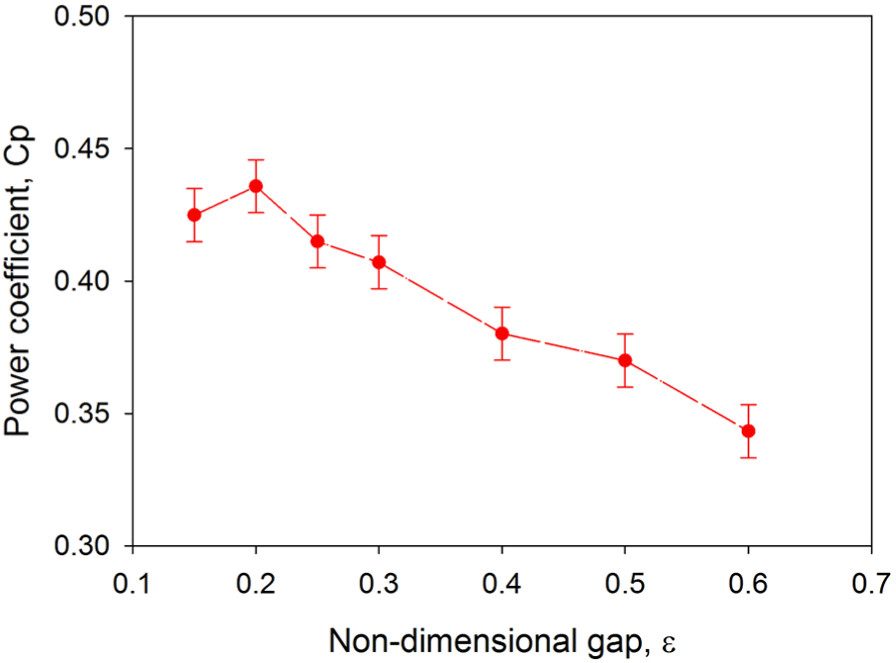
Comparison of the power coefficients obtained with various gaps
The best performance of the VAWT was obtained when the gap was set to

Comparison of the power coefficients obtained with various relative angles
Comparison of flow structures
Depending on the two design parameters (

Comparison of the streamlines and the relative static pressure contours at
Figure 15(c) shows the velocity vectors when a smaller torque was obtained with
The outer radius parameter
In an equal upstream flow condition, a larger wind tower cannot receive a higher wind flow rate unless the total pressure of the wind is increased. The more the outer radius of the wind tower is increased, the greater the static pressure is increased. The increased static pressure results in a low velocity at the inlet of the wind tower compared with the wind velocity in the far field. In the case of
Periodic averaged torque coefficient with various guide wall outer radii.

Conclusion
A numerical study was conducted to improve the performance of the VAWT using a wind tower. The appropriate number of guide walls was determined to be seven based on an experiment. A transient analysis with a reduced computational domain was adopted and was validated using experimental results from the literature. Three parameters of the guide wall were selected as the major design variables. The output powers of the VAWT obtained with the various parameters are compared, and the correct configuration of the wind tower was investigated. The performance of the VAWT was mainly improved by the diversion of wind passing the guide wall within the wind tower. When the wind tower was designed with a gap of
Footnotes
Handling Editor: Bo Yu
Declaration of conflicting interests
The author(s) declared no potential conflicts of interest with respect to the research, authorship, and/or publication of this article.
Funding
The author(s) disclosed receipt of the following financial support for the research, authorship, and/or publication of this article: This research was supported by “the renewable energy innovation project” of the Korea Institute of Energy Technology Evaluation and Planning (KETEP) that was granted financial resource from the Ministry of Trade, Industry & Energy, Republic of Korea. This financial support was gratefully acknowledged.