




Abstract
This work concerns the usage of the internal stiffness and damping nonlinearity for vibration suppression in a van der Pol–type mechanical self-excitation system. Changing the vertical or horizontal damping could limit the growth of the flow-induced instability. Applying harmonic balance method, the energy transfer for the self-excitation vibration is investigated through the limit circle. The steady amplitude of the limit circle is a key parameter that could be used to evaluate the effectiveness of the self-excitation oscillation suppressing. Increasing horizontal damping could reduce the rate of roll on for the steady amplitude curve of the limit circle, but the critical flow velocity for the limit circle occurring is minimally affected. Increasing vertical damping could increase the critical flow velocity, but the rate of the roll on is virtually unaffected when the parameters are properly chosen.
Keywords
Introduction
Self-excitation of a structure is a common nonlinear mechanism, which can be caused by steady wind flow 1 and dry friction 2 or artificially achieved by nonlinear feedback control.3,4 The action of the self-excitation oscillation is two-fold: one is to operate utilizing self-excitation mechanism for the highest energy efficiency. Some examples are atomic force microscopy,5,6 sensing,7–10 and energy harvesting. 11 The self-excitation systems presented in these literatures always consist of constant source of energy, oscillator, and control device supplying power to the vibrating system that modifies the flow of energy and directs the vibrating energy. 12 The other considered by researchers is that the self-excitation vibration of the structure needs to be suppressed to enhance the performance.13,14 This type of the self-excitation vibration has ultrasonic vibration of the tool in the process of cutting, oscillation of the rotating machineries, and flutter of the aerofoil. 1 The main objective of this contribution is that changing internal stiffness and damping nonlinearity suppresses the self-excitation vibration.
Appleton and van der Pol considered the self-sustained vibration of an electrical circuit involving a triode vacuum tube.15,16 van der Pol described an alternative version of the equation that included in his now famous paper. 15 The negative damping was of the linear viscous type, and the positive viscous damping was proportional to the product of the square of the displacement and the velocity. Self-excitation vibration is generated from the interaction between a negative near-equilibrium damping mechanism that destabilizes the static equilibrium of the system and a nonlinear damping operating far-from-equilibrium that limits the growth of the instability. As a result, the limit circle is obtained and the system is constrained to an autonomous vibration with the frequency very close to the natural frequency of the system. Van der Pol’s paper has attracted the attention of many researchers who have made countless attempts to deal with this equation analytically.17,18 Recently, modifications have been made to van der Pol’s original equation in terms of the relationship between the damping and stiffness forces to velocity and displacement, respectively.19–21 Krack et al. 22 developed a novel reduced model for the analysis of self-excitation vibration and demonstrated the applicability of the proposed overall methodology that complemented by generalized Fourier–Galerkin method and numerical continuation. Chen 1 studied crosswind fatigue analysis of flow-excited flexible structures around vortex lock-in speed where the nonlinear aerodynamic damping effect is significant. He also derived analytical solutions of circle number, fatigue damage, and the validated accuracy through comparison with rain-flow circle counting method. Malas and Chatterjee 3 proposed a nonlinear velocity feedback control method for generating artificial self-excitation vibration in a 2-degrees-of-freedom mechanical system. Kwaśniewki et al. 23 investigated the self-excitation acoustical system in elastic construction stress changing measurement.
Self-excitation vibration is usually undesirable. Literature on controlling the self-excitation vibration is vast.24–30 Malas and Chatterjee 4 proposed an acceleration feedback–based technique for the self-excitation vibration in a multi-degrees-of-freedom mechanical system. An adaptive control was proposed to keep the vibration amplitude at the desired level. Chatterjee 2 introduced a new method of controlling friction-driven self-excitation vibration. Das and Mallik 27 proposed proportional–derivative (PD) control via time-delayed velocity and displacement feedback for suppressing friction-induced self-excitation vibration. Chatterjee and Malas 28 reported stiffness-switching methods for generating artificial self-excitation vibration in a simple mechanical system. It was found that the on-off fashion can be effectively utilized for controlling self-excitation vibration in a simple mechanical system.
It is significant to suppress self-excitation vibration passively. An additional degree of freedom that couples the tangential force was provided by an inclined vibration absorber. Chatterjee et al. 24 investigated the usage of high-frequency tangential excitation in controlling self-excitation vibration. Dohnal 29 studied on a flow-induced self-excitation oscillation and presented stability analysis on vibration suppression employing variable stiffness and damping.
Recognizing the significance of the problem of control of self-excitation vibration in mechanical systems, this manuscript concerns a passive suppression method for self-excitation vibration. Self-excitation vibration suppression is achieved by internal stiffness and damping nonlinearities that are provided by appending horizontal springs and horizontal dampers, respectively.
Mechanical model
Figure 1 shows a lumped parameter model of flow-induced self-excitation system. The horizontal dampers and springs provide internal nonlinearities. The mass
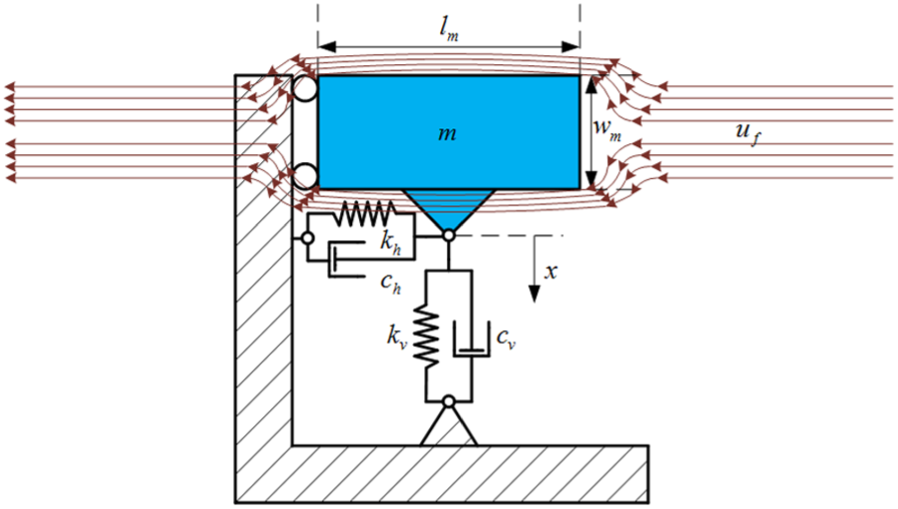
Schematic representation of a lumped parameter model of flow-induced self-excitation system that has both stiffness and damping nonlinearities.
The internal force matrix
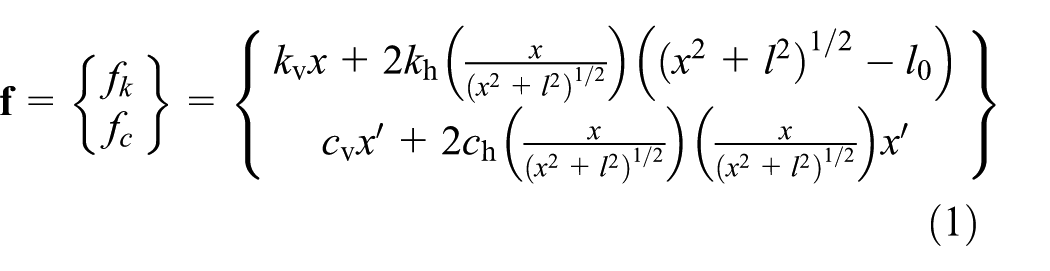
where
Bernoulli principle is applied. The external force induced by the flow can be obtained 1

where
The equivalent viscous damping, which is a commonly used concept in nonlinear systems, is exploited and this equivalence is based on the equal energy dissipation per cycle

The equations of the motion for the system as shown in Figure 1 can be written as

The damping type can be approximated to the type of the damping referred to by the Van der Pol, provided that the level of vibration is not too large.
Limit circle
Calculation of limit circle
Equation (4) can be written in non-dimensional form as

where
Harmonic balance method (HBM) is used. To improve the accuracy of the solution when relative low-order harmonic truncation is applied, the new time transformation is introduced 30

where
Derivation of equation (6) to

So, equation (5) has the form

where
Using HBM, the solution to equation (8) can be assumed as

Truncation order N is the parameter that determines the accuracy of the solutions. Substituting equation (9) into equation (8), the coefficients of
Figure 2(a) shows the third, fifth, and seventh truncation HBM solutions. The parameters are

The limit circle of the self-excitation system; the parameters are
Table 1 shows comparison of the solutions between analytical and numerical methods. The points A, B, C, and D on the limit circle are chosen. It is found that the deviation of the harmonic balance solution is decreased as the truncation order is increased. The seventh truncation harmonic balance solution is very accurate to 0.05%–0.6%.
Comparison of the solutions between analytical and numerical methods.

HBM: harmonic balance method.
Characteristics of limit circle
The mechanical energy of the self-excitation system is the sum of kinetic energy, and elastic potential energy can be written as

where
The energy acting by the damping force can be written as

The change in the mechanical energy of the self-excitation system
Figure 3 shows the three-dimensional (3D) plots of the energy for the self-excitation vibration through the limit circle. Red line shows that energy is being supplied by the damper, and the mechanical energy of the system is increased. The blue line shows the energy is being dissipated. The reason for this is that the nonlinear damping performs significantly far from the equilibrium point but minimal near the equilibrium point. The sign of the energy only depends on the displacement. The energy is negative, until to the extreme level, and then, the energy is positive, as the displacement response is increased. Analysis of the power input and output characteristics through the limit circle could provide the theoretical basis for controlling the size of the limit circle, so that the self-excitation vibration could be suppressed.

Normalized energy acting by damping for various non-dimensional velocity and non-dimensional displacement. The parameters are
Vibration suppression
This section concerns the suppression of self-excitation vibration by regulating internal stiffness and damping nonlinearities. The steady amplitude of the stable limit circle is a key parameter that could be used to evaluate the suppressing effectiveness. It could be achieved by root mean square (RMS) of the time response

Figure 4 illustrates the steady amplitude of the limit circle

Illustration of the steady amplitude
Conclusion
This article was concerned about the generation and suppression of flow-induced self-excitation vibrations in a type of spring-damper vertical mechanical system. Suppression of the self-excitation vibration was achieved by passive means. Internal stiffness and damping nonlinearities that coupled the vertical force were provided by appending horizontal springs and dampers. HBM was used for analysis of the limit circle of the system. The harmonic balance solutions with third, fifth, and seventh truncation were compared. The seventh truncation solution was also validated by numerical method. The energy transfer for the self-excitation vibration through the limit circle was analyzed. The amplitude of the limit circle was used to evaluate the effectiveness of the suppression of the self-excitation vibration, and the conclusions were as follows:
The rate of roll on for the steady amplitude curve of the limit circle was decreased as horizontal damping was increased, but critical velocity for the limit circle occurring was minimally affected.
The critical velocity was increased as the vertical damping was increased, but the rate of the roll on was unaffected.
Both the horizontal and vertical stiffness had minimal effect on the steady amplitude and critical velocity.
Footnotes
Acknowledgements
The authors of this article would like to acknowledge the help provided by Professor Michael J. Brennan from UNESP.
Handling Editor: Crinela Pislaru
Declaration of conflicting interests
The author(s) declared no potential conflicts of interest with respect to the research, authorship, and/or publication of this article.
Funding
The author(s) disclosed receipt of the following financial support for the research, authorship, and/or publication of this article: This work was supported by the State Key Program of National Natural Science of China (No.11232009) and National Natural Science Foundation of China (Nos 11502135 and 11572182).