




Abstract
In this paper, a passenger train with detailed cabin structural has been established based on the finite element method. Simulation results indicate that the train driver injury by the triangular impact pulse in US 49CFR is more seriously than those by the collision scenarios in EN15227. Besides that the driver seat position has a significant effect on the driver injury severity during a secondary impact. It is found that generally the head injury criterion (HIC15) is proportional with the longitudinal and vertical distance between the driver seat and control desk. And the leg injury criterion (TI) is inversely proportional with the longitudinal distance and proportional with the vertical distance. In terms of the chest injury criterion (V*C), it is more complicated, and its minimal value is about at the position of 0.43 m (longitudinal) and 0.15 m (vertical). Moreover, simulation results indicate that the train driver with arms lying on the control desk has a less injury severity than that with the arms dropping naturally, and equipping with the three-point belt is of significant benefit for the train driver to reduce the secondary impact against the control desk during a train collision accident.
Keywords
Introduction
With the continuous increase in train speed, railway vehicles are nowadays fast, convenient and smart. In spite of remarkable improvement in railway industry, a number of severe railway accidents still took place in recent years both in China and abroad, resulting in significant economic losses and serious casualties. Under this background, plenty of researches on train structural crashworthiness were carried out worldwide.1–4 The European standard EN 15227:2005 5 was first published in 2005, in which the railway vehicles should be fulfilled not only the static strength but also the structural crashworthiness. Besides that during a train collision accident, the occupants will be subject to different potentially harmful contacts (‘secondary impact 6 ’), such as the impact between occupant and interior or occupant and occupant. Due to this reason, some researches were also focused on the secondary impact between train interior and occupant.7–12 In terms of the train driver protection, airbags were considered as a solution to decrease the thoracic injuries imparted to the train driver in a rail collision. 13 Eames 14 optimised the driving cab design from the point of view of debris ingress. A biomechanical study of the train driver was comprehensively analysed in the research programme PROCAB.15,16 However, Hault-Dubrulle et al. 16 indicated that although there were some studies dealing with the protection of train driver, only few results can be found in the literature. Indeed, these research projects were often confidential, and data were not available. 16 Besides that the collision scenarios used to analyse the secondary impact between occupant and train interior are variable, some from the collision scenarios defined in EN 15227:2005 5 and some using the triangular impact pulse defined in US 49CFR. 17 The reasons using these different collision scenarios have not been clearly indicated and the occupant injuries subjected to these different collision scenarios have not been fully compared. Moreover, the previous researches on the secondary impact between train driver and control desk are mainly focused on decreasing the driver injury by optimisation of the control desk structure. The effect of some key factors, such as the driver sitting postures, driver seat position and equipping with three-point belt, have not been fully analysed. Due to this reason, in this article, the driver injuries subjected to the common collision scenarios are first analysed and compared. The most dangerous scenario is then selected for the further analysis by different driver sitting postures and driver seat positions. Besides that the effect of the three-point belt against the secondary impact between train driver and control desk is also analysed.
Modelling of train collisions
Finite element model of passenger train
The collided passenger train (electric multiple unit (EMU)) consists of three vehicles including two head vehicles with driver cabin and one in the middle (as shown in Figure 1(d)). The carbody is made of hollow aluminium with the type of 6005A, whose elastic modulus is 70 GPa, Poisson’s ratio 0.3, yield strength 215 MPa and density 2700 kg/m3. The front vehicle is 20.83-m long and 2.86-m wide. The on-board devices are simplified as mass particles and connected to the carbody according to the corresponding positions. The finite element model (FEM) model of the front vehicle in the software LS-DYNA with version 971 consists of 24 mass point elements, 1260 elastic elements, 3016 solid elements and 672,161 shell elements with 666,944 quadrilateral shell elements and 5217 triangular shell elements. The middle vehicle is 16.414-m long and 2.86-m wide. Since the middle vehicle is not the main deformation area during a low-speed collision accident, only the two ends are meshed with fine grids, as shown in Figure 1(b). In terms of the rear vehicle, the end part is also meshed with fine grids, and its rest parts are simply modelled as rigid bodies, as shown in Figure 1(c).

FEM model of passenger train: (a) front vehicle, (b) middle vehicle, (c) rear vehicle, and (d) train model.
FEM model of driver cab
Since the structure of control desk in the driver cab is very complex, it is simply modelled as shown in Figure 2(b). Usually this control desk is made from polyurethane fibre–reinforced plastics, whose elastic modulus is 17.5 GPa. 18 The driver seat is 0.42-m wide and 0.63-m long, with the backrest inclined at an angle of 8°, as shown in Figure 2(c). The seat and the backrest are made from a porous sponge material which is modelled by a compressible foam material, whose elastic modulus is 30.6 MPa, Poisson’s ratio 0.3, density 91 kg/m3 and damping factor 0.1. 19 Since the train drivers are usually males whose statures vary from 1.6 to 1.9 m, the Hybrid III 50th male dummy is adopted in the simulation, as shown in Figure 2(d).
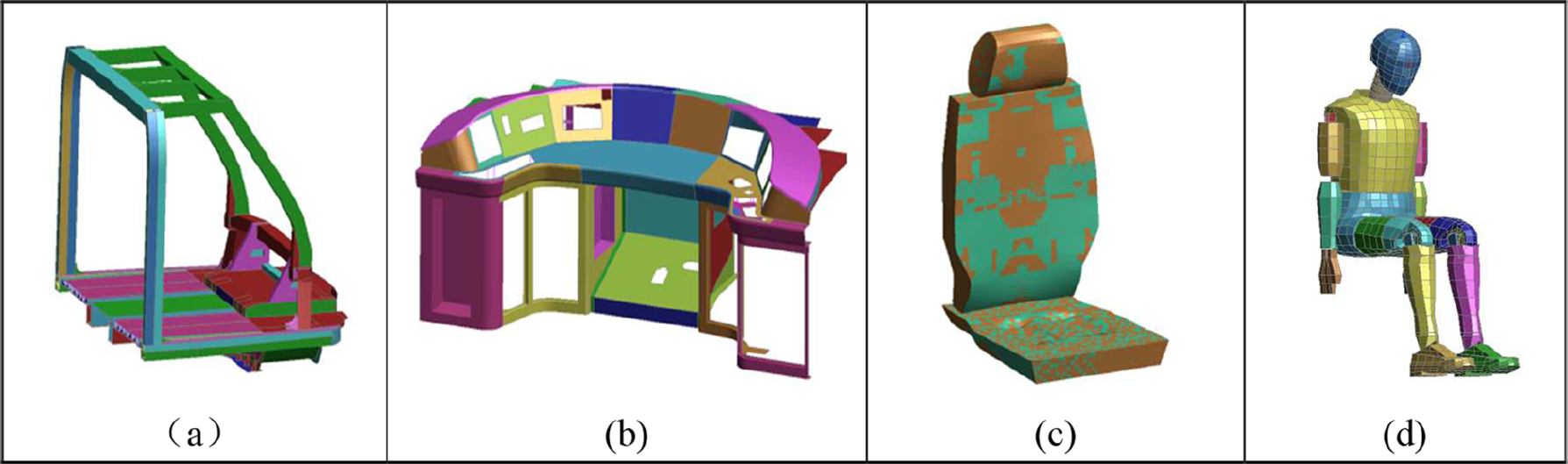
FEM model of driver cab: (a) driver cab, (b) control desk, (c) driver seat, and (d) driver dummy model.
Driver injury criteria
Since at present there is no Chinese standard for the occupant injury in the railway collision accident, some injury criteria from the British standard GM/RT2100:2012 20 is adopted and described as follows:
1. Head injury criteria
HIC15
The head injury criterion (HIC) shall not exceed a value of 500 over any time interval of 15 ms. The HIC shall be calculated using the following formula

3 ms(g)
The maximum acceleration of the head (3 ms(g)) shall not exceed 80g for more than 3 ms.
2. Upper chest (thorax) injury criteria
V*C
The viscous criterion (V*C) at any time shall not exceed 1.0 m/s. The V*C shall be calculated using the following formula

Combined thoracic index
The combined thoracic index (CTI) shall not exceed a value of 1.0. The CTI shall be calculated using the following formula

3. Leg injury criteria Tibial index
The tibial index (TI) shall not exceed a value of 1.3. The TI shall be calculated using the following formula

Collision scenarios for the driver secondary impact simulation
Collision scenarios in the different standards
In order to evaluate the driver injury severity in the secondary impact, the first step is to define a reasonable collision scenario. Due to this reason, several widely used collision scenarios are chosen and compared, for example, the collision scenarios defined in the standard EN 15227 and US 49CFR:
EN 15227 collision scenario 1 – head on impact of two identical trains at a speed of 36 km/h (Figure 3(a));
EN 15227 collision scenario 2 – impact between a train and a freight wagon of 80 t at a speed of 36 km/h (Figure 3(b));
EN 15227 collision scenario 3 – impact between a train and a lorry at a grade crossing at a speed of 110 km/h (Figure 3(c));
US 49CFR – the triangular impact pulse (Figure 3(d)).

Different collision scenarios: (a) two identical train collision, (b) collision between train and truck, (c) collision between train and obstacle, and (d) triangular impact pulse.
Driver injure criteria by different collision scenarios
According to the simulation results, it can be found that the kinematics of the driver dummy by different collision scenarios is essentially the same. Taking the triangular impact pulse, for example, (shown in Figure 4), at beginning t = 0, the driver dummy sits in the chair with two arms lying on the control desk and legs on the pedal. From t = 0 to 0.155 s, the driver dummy leans forwards to the control desk under the increased impact pulse. Besides that the dummy’s hands are in contact with the screens, and dummy’s chest is also in contact with the control desk. At t = 0.189 s, the dummy’s upper limb keeps leaning forwards, although the impact pulse decreases gradually. Meanwhile, the gravity of dummy moves upwards due to the supports from dummy’s legs and the dummy’s hip lifts up progressively. Finally, when the dummy leans forwards further, its head strikes the control desk and then rebounds back.
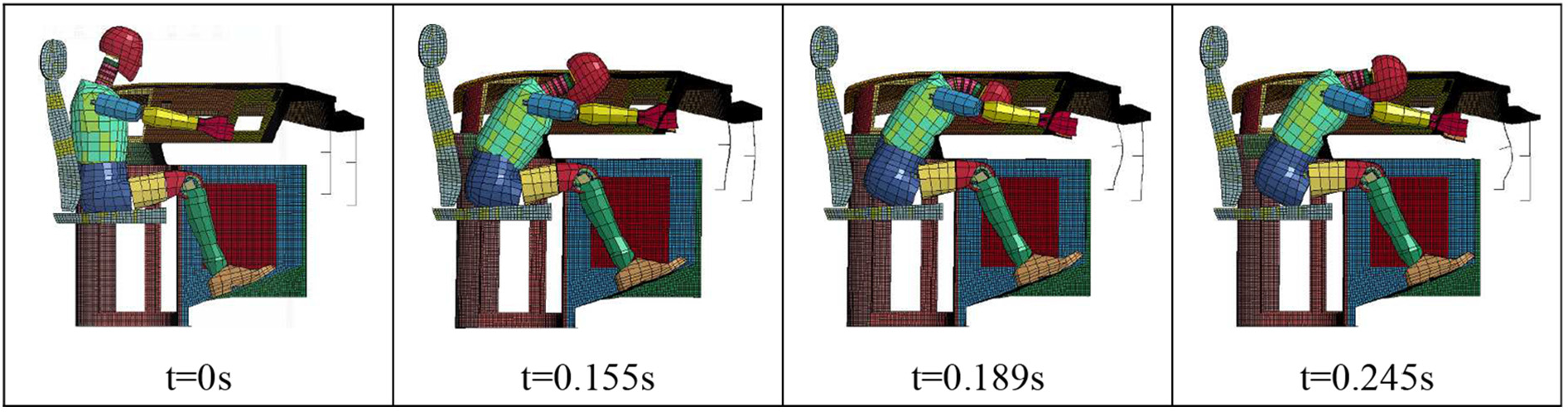
Time history of the driver dummy by the triangular impact pulse.
The injury severity of the driver dummy by different collision scenarios are evaluated and summarised in Table 1. It can be seen clearly that all the injury criteria are under the limits defined in the standard GM/RT2100. That means the driver is well protected by the existing structural design. Besides that the driver injury criteria subjected to the triangular impact pulses are larger than those by the collision scenarios defined in EN 15227. Due to this reason, the most serious collision scenario (triangular impact pulse) is proposed for the study on the driver secondary impact.
Driver injure criteria by different collision scenarios.
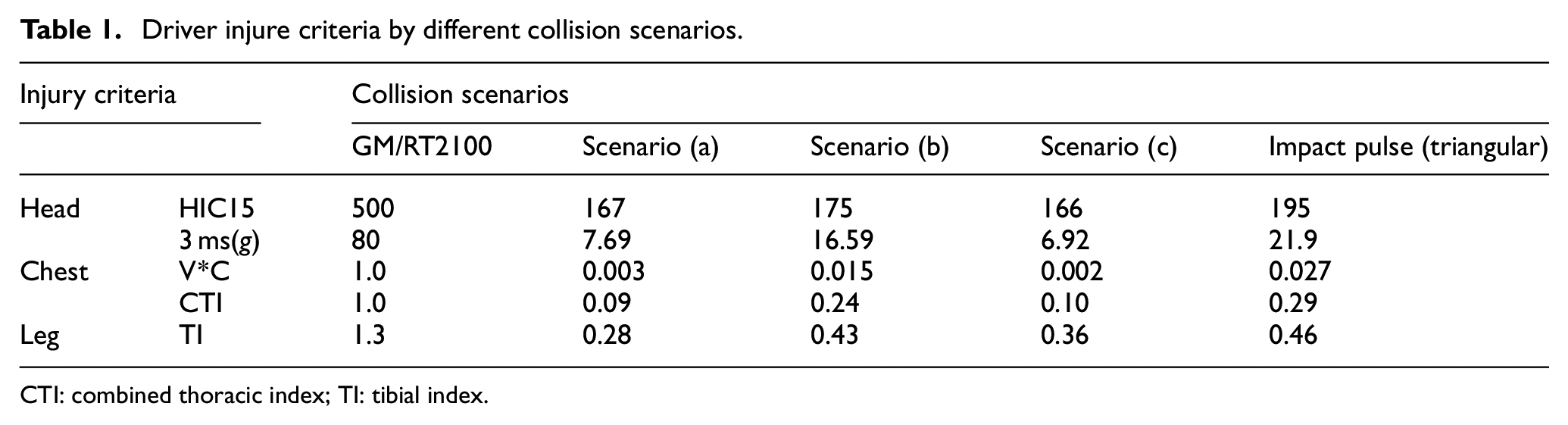
CTI: combined thoracic index; TI: tibial index.
Effect factors on the driver secondary impact
In this section, the triangular impact pulse is adopted for the further study on the driver injury severity during the secondary impact. Several effect factors are fully analysed, such as the driver sitting posture, driver seat position and the improvement by equipping with three-point belt (Figure 5).

Effect factors: (a) arms lying on the control desk, (b) arms drop naturally, (c) different seat position, and (d) with three-point belt.
Driver sitting posture
With the development of Chinese railway vehicles, nowadays there are two kinds of train control system. For the first one, the driver is required to hold the control handle all the time, as shown in Figure 6(a). In another case, the driver’s arms drop naturally (Figure 6(b)), since there is no need to hold the control handle all the time. Although the motions of driver dummy with different sitting postures are almost the same (Figure 6), from the comparison of injury criteria summarised in Table 2, it can be found that the driver dummy with the arms lying on the control desk has a less injury severity than that with the arms dropping naturally.

Time history of the driver dummy by different sitting postures: (a) arms lying on the control desk and (b) arms drop naturally.
Driver injury criteria by different sitting postures.
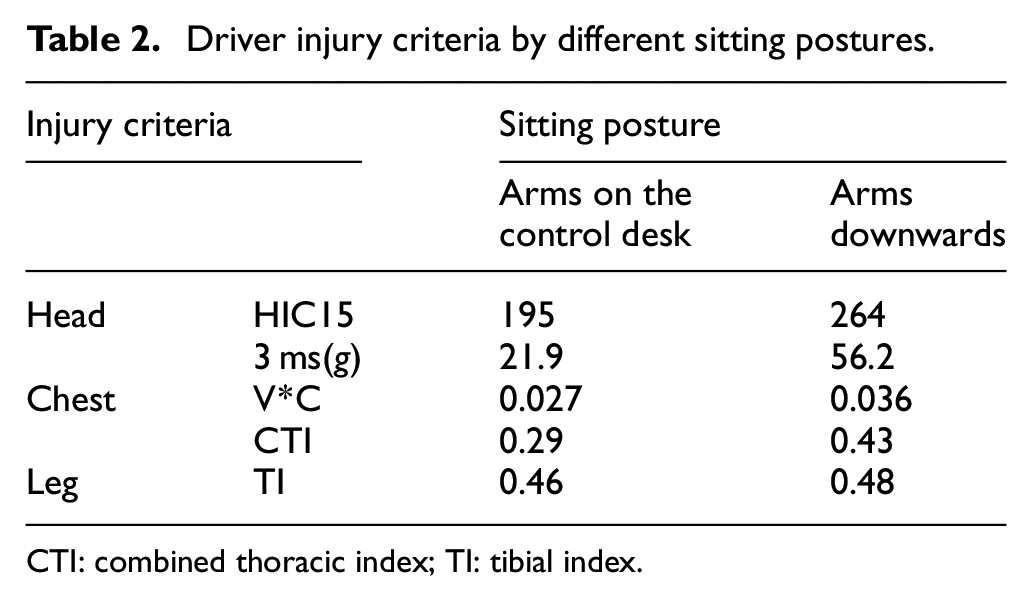
CTI: combined thoracic index; TI: tibial index.
Driver seat position
In order to comprehensively analyse the influence of the driver seat position on the driver injury severity during the secondary impact, three longitudinal distances (0.35, 0.4, 0.45 m) and three vertical distances (0.15, 0.2, 0.25 m) between the driver seat and control desk are chosen (Figure 5(c)). As a result, there are nine scenarios simulated in this section, namely, A(0.35, 0.15), B(0.4, 0.15), C(0.45, 0.15), D(0.35, 0.2), E(0.4, 0.2), F(0.45, 0.2), G(0.35, 0.25), H(0.4, 0.25), I(0.45, 0.25).
The motions of the driver dummy by different seat positions are shown in Figure 7. At the beginning, the acceleration of the impact pulse increases linearly, and the dummy leans forwards. At the time of 0.125 s, the chests of all the driver dummies are in contact with the control desk. At the time of 0.185 s, the heads of driver dummies in scenario G, H and I impact the control desk. And when the simulations run to the time of 0.23 s, the head forward movements in scenario A, B, C, D, E and F reach their maximum degree but without contact with the control desk. However, the dummy’s heads in scenario G, H and I rebound upwards after hitting the control desk.

Time history of the driver dummy by different driver seat positions.
The injury criteria of the driver dummy by different seat positions are summarised in Table 3. Based on these simulation results, the response surface (RS) method is adopted in the software MATLAB with version R2012a to construct polynomial approximations of the dummy injury criteria (HIC15, V*C and TI) with the two input variables



Driver injury criteria by different driver seat positions.
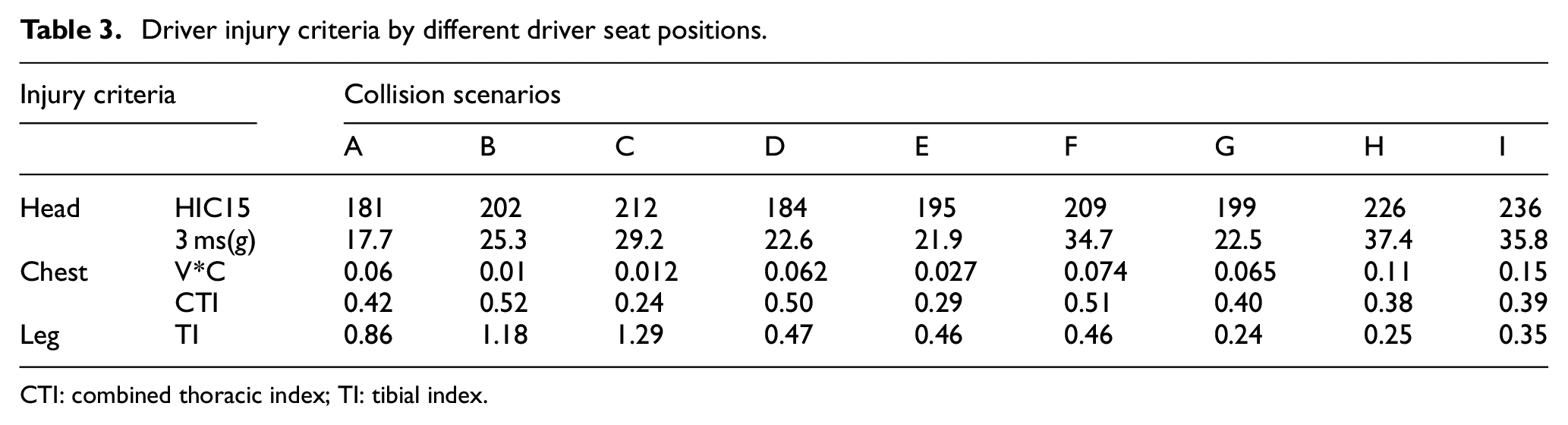
CTI: combined thoracic index; TI: tibial index.
In order to validate and check the accuracy of the constructed RS models, nine verification points are generated. Figure 8 shows the comparisons between the simulations and RS models. It can be seen that the results from the RS models are in a good correlation with the simulation results, and the high values of R2 also indicate that the RS models are reliable in predicting the driver injury criteria.

Comparison between RS models and simulation results (a) HIC, (b) V*C, and (c) TI.
According to the constructed RS models, the relationships between the driver injury criteria and driver seat position are shown in Figure 9. It can be found that the driver seat position has different effects on different injury criteria. Generally, the HIC15 criterion is proportional with the longitudinal and vertical distance between the driver seat and control desk; and the TI criterion is inversely proportional with the longitudinal distance and proportional with the vertical distance. In terms of the V*C criterion, it is more complicated, and its minimal value is about 0.006 at the position of (0.43, 0.15). Due to this reason, the driver seat position should be properly arranged according to the primarily protected organ of the train driver (head, chest or leg).

Relationships between the driver injury criteria and driver seat position: (a) HIC, (b) TI, and (c) V*C.
Three-point belt
Although the three-point belt has been successfully adopted in the passive safety of automobile industry, it is not equipped for the train driver at present. According to the simulation results in Figure 10, it can be observed that the three-point belt can successfully constrain the driver’s forward movement during a secondary impact. For example, at t = 0.189 s, the driver dummy leans forward under the effect of impact pulse. Meanwhile, the constraint force from the belt increases gradually. When the three-point belt extends to a certain degree, it will be locked and then prevents the driver dummy leaning forwards further. Due to this reason, the driver dummy’s head is well protected and doesn’t impact the control desk. The injury criteria shown in Table 4 also point out that the three-point belt is of significant benefit for the driver to reduce the secondary impact against the control desk during a train collision accident.
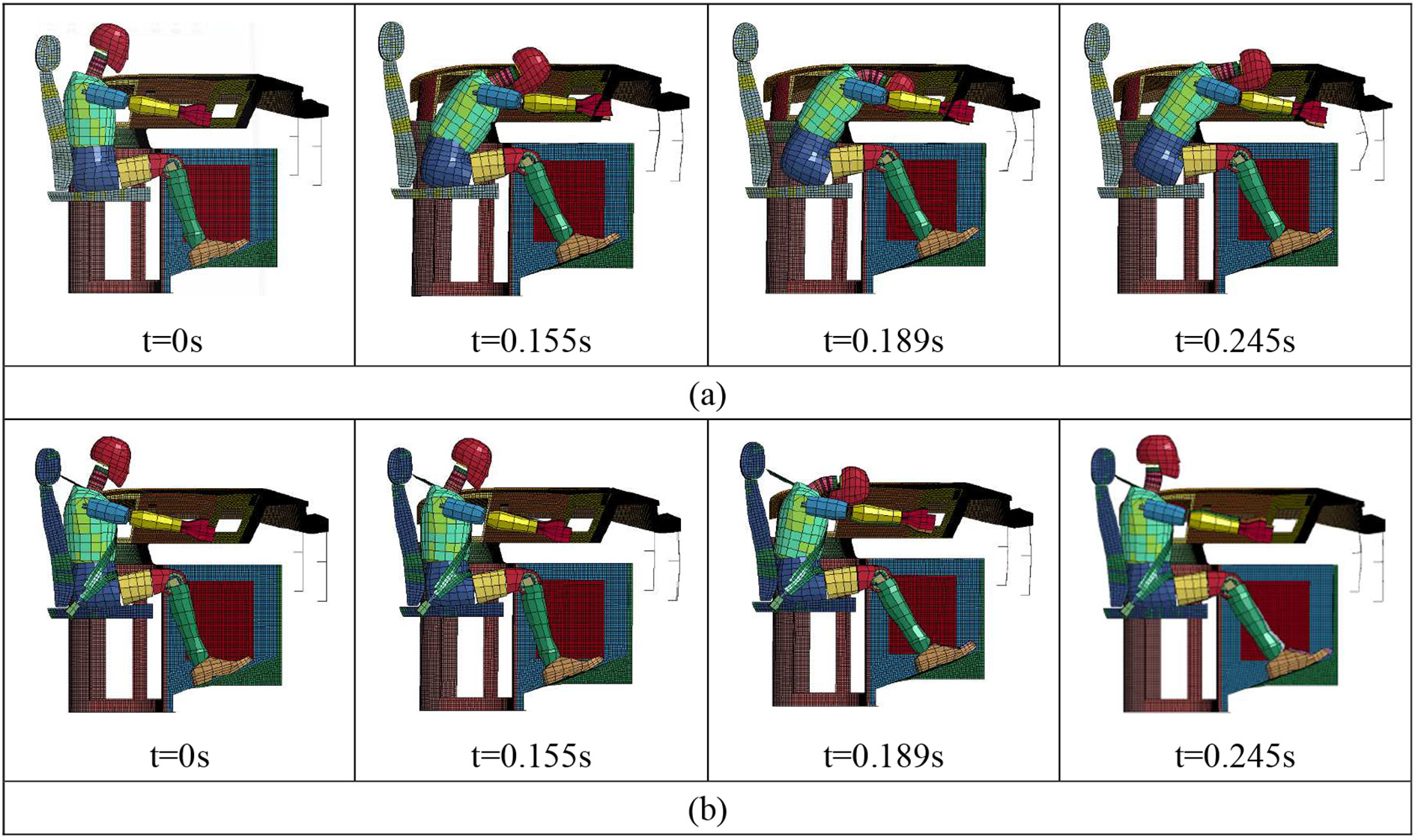
Time history of the driver dummy: (a) without three-point belt and (b) equipped with three-point belt.
Driver injury criteria by equipping with three-point belt.

CTI: combined thoracic index; TI: tibial index.
Conclusion
In this article, a passenger train with detailed cab structure has been established based on the finite element method. The secondary impact between train driver and control desk is fully analysed and several effect factors, such as the driver sitting postures, driver seat positions and equipping with the three-point belt, are comprehensively studied. The main conclusions are summarised as follows:
According to the comparison of the injury criteria by different collision scenarios, the train driver suffers the most serious injury by the triangular impact pulse defined in the standard US CFR49. Due to this reason, the triangular impact pulse is proposed for the research on the driver secondary impact.
The relationships between the driver injury criteria and driver seat position are represented based on the RS method. It is found that the driver seat position has a significant effect on the driver injury severity during a secondary impact. Generally, the HIC (HIC15) is proportional with the longitudinal and vertical distance between the driver seat and control desk. The leg injury criterion (TI) is inversely proportional with the longitudinal distance and proportional with the vertical distance. In terms of the chest injury criterion (V*C), it is more complicated, and its minimal value is about at the position of 0.43 m (longitudinal) and 0.15 m (vertical).
Research results also indicate that the train driver with arms lying on the control desk has less injury severity than that with the arms dropping naturally. Besides that equipping with the three-point belt is of significant benefit for the train driver to reduce the secondary impact against the control desk during a train collision accident.
As the main conclusions in this article are carried out by the theoretical analysis and dynamic simulation, some impact tests are suggested in the further investigations.
Footnotes
Handling Editor: Yangmin Li
Declaration of conflicting interests
The author(s) declared no potential conflicts of interest with respect to the research, authorship, and/or publication of this article.
Funding
The author(s) disclosed receipt of the following financial support for the research, authorship, and/or publication of this article: This work was supported by the National Key Technologies R&D Program (no. 2015BAG12B01-19), the Fundamental Research Funds for the Central Universities (no. kx0286020172695) and the Shanghai Pujiang Program (no. 16PJ1409500).