




Abstract
Tramp shipping transport is an important part of ocean transportation. However, facing the spot market with many uncertain conditions, it is not easy for fleet operators to plan vessel’s routes and schedule in the later period time, especially considering the situation that loading time window for a lot of cargoes has strong randomness. This article designed a linear programming model with chance constraints for the time window of loading cargo. Before the optimization, a survey for the waiting time of ships for berths is carried out in some of the ports with large export volume. Combined with the degree of acceptance how long ship owners can wait for the berth, the uncertain time window constraints can be transformed into deterministic constraints. The model is solved by column generation optimization technique. The model and algorithm are verified by a case of Panamax bulker fleet planning in real market. The results show that the model and the algorithm proposed in the article can well work on large-scale problem and can achieve good precision. Also, via sensitivity analysis, we provide decision makers good reference to balance profit and risks coming from randomness.
Introduction
With the development of the world economy and the increasing integration of the world, volume of international trade is increasing year by year. Bear the transport of goods between countries in the world, ocean shipping accounted for the absolute superiority of the number, about 90% 1 of the international trade goods shipped by ocean-going vessels. There are three main forms of international ocean transportation in the academic view: industrial transport, tramp shipping, and liner shipping. The statistical data show that tramp shipping, the cargo of which is in bulk liquid and dry bulk, always occupies the main market share. In the long term, the technical progress of tramp shipping and application of management decision technology have been lagged behind liner shipping. In order to improve the utilization ratio of ships and reduce the ballast running distance, it is necessary to optimize the planning of tramp shipping routes and schedule.
In tramp shipping, the ship owner or operator does not own the cargo but selects available cargoes to transport so as to maximize the profit. In some certain conditions, a ship owner or operator need to make a plan for a period like few months that at what sequence their ship to visit some specified cargoes with loading time windows. The position, hire, and loading time window of a cargo are known or part of above information is known in advance. We discuss the ship routing and scheduling problem in our article.
In the real market, with environmental condition changing time to time, there are many factors hard to know exactly which can affect the supply of cargoes. Although statistically speaking, there is a probability that there will be big volume cargo coming out in a relatively fixed active season, but it is still affected by uncertainties such as supply and demand in the trade market, transport market tonnage supplement, local political situation, and weather. The random loading time window in port is a regular uncertain condition which affects the result a lot for a ship planner to make decision. Without a fixed time window, it is not only uneasy to arrange when a ship is suitable to visit the cargo but also has chance to miss the later scheduled plan. That is why we think the study on the subject is quite important for ship planning work in real market. This article explored how to combine uncertain loading time window into fleet resources planning, which means how to get the ships’ routes and scheduling.
The contributions of this article are threefold. First, via waiting time for berth from some ports, we found that the ships’ waiting time fit some certain distributions in some ports. This finding can be well applied to solve chance-constrained programming model we introduced in the article. Second, most of the previous ship routing and scheduling problems are solved by heuristic algorithm which is not easy to find the exact best solution in reasonable time. In this article, we use column generation technique to solve a large-scale problem which can get exact best solution in reasonable time. Third, the uncertain loading time window is taken into account in the problem of ship’s routing and scheduling problem. This is a real situation which decision-makers usually to face in the area of ship planning. Our programming model provides a very practical reference for the shipping business enterprise.
The remaining of the article is organized as follows. Section “Literature review” introduces related works in the field of fleet routing and scheduling. The specific formulation of fleet routing and scheduling with constraints of chance is described in section “Fleet routing and scheduling problem based on constraints of chance,” while section “Algorithm” introduces the algorithm of the proposed model. Case study is fully described and solved in section “Case study” with sensitivity analysis and evaluation of algorithm. Finally, conclusions are drawn in section “Conclusion and future work” along with future work.
Literature review
In the field of fleet routing and scheduling research, how ships coordinate the demand for cargo transportation is an important issue in the transportation of industry and tramp vessels. One cargo is made up of the specified amount of the product to be extracted in the designated port, which is transported and unloaded at the designated unloading port. Because the exact time is important for loading,2,3 there is often a time window in port of loading. Due to berth resource scarcity properties during this period, ships must begin the process of loading of the goods as soon as possible. There may also be unloading time window.
The ship operator of a tramp vessel focuses on maximizing the profit. Unscheduled ship operation plan operations usually have a set of mandatory contract goods and will try to increase the ships’ availability for transportation. We focus on the tramp ship planning and ship scheduling problem, because this field contains the most general situation. Most of the corresponding industrial transportation problems are also similar. The details of the problem we discuss here are similar to those described by people like Desrosiers et al., 4 which include a multi-car collection and delivery problem. Korsvik and Fagerholt 5 offered a Tabu search heuristic algorithm, which is the opposite of the heuristics of people like Brønmo et al., 6 which allows for the infeasible solution window constraint on the capacity and time window of the ship. Tabu search heuristic is better than the local search heuristics model proposed by the people like Brønmo et al., 6 especially for larger and more constrained problems. In a recent paper, Malliappi et al. 7 proposed a variable neighborhood search heuristic algorithm for a same problem. They have changed their strength to the standard issue of land transportation, due to the lacking of realistic data in the physical market of tramp shipping. They compared their own neighborhood search heuristic algorithms with Brønmo et al. 6 and Korsvik et al.’s 5 Tabu search heuristic algorithm. The results show that the average variable neighborhood search has the best heuristic algorithms of them.
Jetlund and Karimi 8 studied a problem which is the choice of route selection and ship scheduling in bulk liquid chemicals in transportation areas of the Asia-Pacific region by a shipping operator. For their problem, the authors presented a mixed-integer linear programming (MILP) formulation using variable-length slots and proposed a heuristic decomposition algorithm that obtains the fleet schedule by repeatedly solving the base formulation for a single ship. The method has been got through the real case data test, which involved 10 oil tankers and 79 transport goods problems. The profit grew up 32.7% when compared with before experience assigned task.
In the most literature of tramp shipping, the cargo cannot exceed the loading capacity of the ships. By introducing decomposition plate load, the limit can be removed and the goods can be realized as partial shipments between several ships. This problem was learned by Andersson. 9 Hennig et al. 10 designed a general mathematical model to illustrate problem basis condition that cargo can be split. A feature of the problem is, compared to the previous discussion, that it has no predefined cargoes. Fagerholt 11 and Lindstad et al. 12 put forward the decision support system (DSS), and it is used for ship routing and scheduling optimization, in which many kinds of heuristic algorithms from Brønmo, Korsvik et al., Korsvik and Fagerholt are cooperated. The one important experience of system design emphasized the importance of DSS and user interaction, rather than focusing on the optimization algorithm.
For the larger size problem, DSS method become less effective. Therefore, Brønmo et al. 13 recommended the use of dynamic column generation scheme, according to the need to generate a feasible course of the ship. Because they have to discrete quantity of goods, the solutions must be changed to a certain extent. The problem last converted into heuristic column generation method. Column generation is an optimization algorithm for solving large-size linear programming problem. This theory was first presented in 1960 by Dantzig and Wolfe. 14 In 1961, Gilmore and Gomory 15 applied this method in cutting model problem. In 1984, the method was applied in a problem of vehicle routing problem (VRP) with time window. 16 Kobayashi and Kubo 17 studied an industrial oil tankers transport routes and scheduling problem in the practical market. And, Potthoff et al. 18 used the method for railway crew rescheduling problem. And, in recent years, this method is more and more taken to solve linear programming with exact solution.19–22
As for the ship route planning and scheduling problem, many pure or MILP models and their extensions are developed, which can refer to these literatures.23–31 Zeng and Yang 32 combined integer programming with heuristics. Cho and Perakis, 33 considering the fleet size, mixing, and delivery route assignment, presented integer linear programming models over a long-term planning horizon. Jaramillo and Perakis 34 proposed an integer linear programming model with two feasible models based on mixed linear-integer programming models. Fagerholt 35 worked a three-phase method by assuming weekly liner routes for this fleet deployment problem. Yang et al. 36 proposed a mixed-integer programming model based on investment of multimode according to the transport demand and routes under the fluctuant market conditions. A genetic algorithm was presented by Lin and Liu 37 based on the actual operating problems to determine ship allocation. Xie et al. 38 proposed an algorithm using both the linear programming formulation and dynamic programming techniques to get a better solution compared with using linear model only in others’ liner models.
Mostly, fixed shipment demand and direct shipping transportation without transshipment are in above-mentioned papers. But in shipping reality, the demand in future is quite uncertain, which brought another parts of the literature.39,40 Meng et al. 41 proposed a solution method which combined a dual decomposition with Lagrangian relaxation method to integrate the sample average approximation (SAA) method under uncertain demand. Yang et al. 42 established a mixed-integer programming model based on multiple influencing factors. In front of complicated future circumstance, Halvorsen-Weare et al. 43 put forward a solution algorithm and several robustness strategies with the uncertain problems.
Fleet routing and scheduling problem based on constraints of chance
Problem description
Problems are described as follows: a large dry bulk ship owner controls some of the ships around the world that need to plan routes in a certain future period. There are some cargoes with fixed information on the spot market to be chosen to transport. The information of loading and unloading ports, the loading time window, the expected voyage time, and hire income is known. There are also some cargoes with information of loading time window and hire unknown. The expected hire for these cargoes can be forecasted through experience and other market information. And, the ship owners will plan the routes for the ships they will put into the spot market based on the forecast results and other known information. Since whether berths are available for some cargoes is also random, it will take some time for the ships to wait after arriving at the loading port. The length of time to wait for the berthing varies with the time of arrival of the ship.
By sampling survey data in some ports which regularly have large volume of goods to export in seasonable time, we found there is a certain statistical regularity in the anchorage time. The waiting time for berths for ships’ interval to access the same port fits some probability distribution. We carried out surveys for waiting time for berths from some ports from which cargoes regularly come year by year, such as Jakarta in Indonesia, Goa in India, Paranagua in Brazil, Kwinana in Australia, New Orleans in the United States.
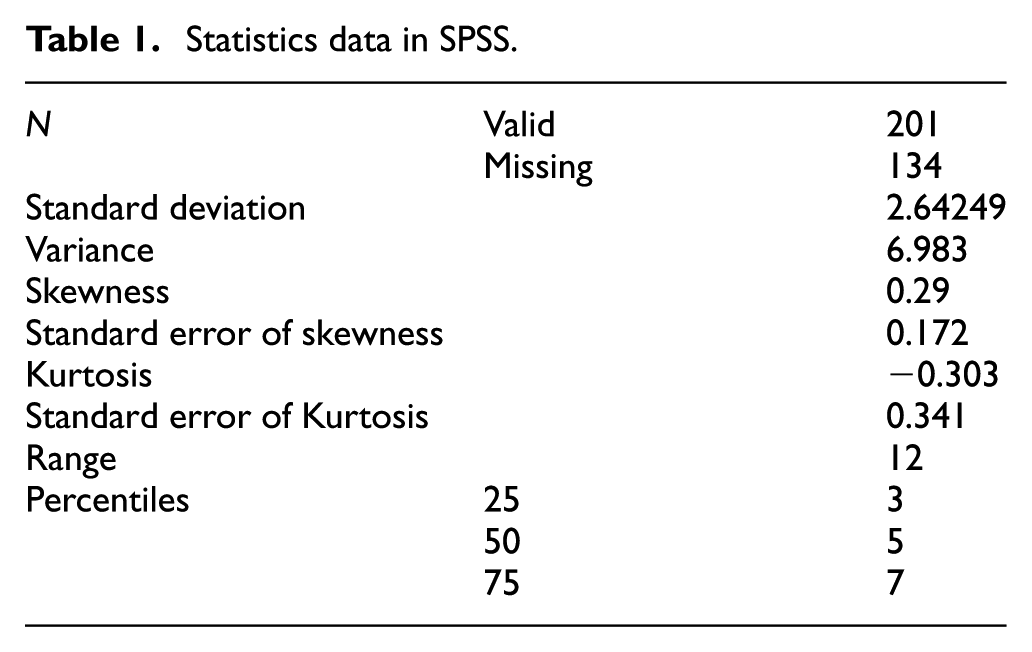
Take Jakarta as an example, we collected waiting time data of dry bulker arrived Jakarta from January to March in 2015. After times comparison, we found that when taking 6 h as time slice, the waiting time allows some known distribution and can pass hypothesis test. Figures 1 and 2 show berth time data and the hypothesis test by SPSS, respectively. From the data, we can concluded that from 1 January to 24 January, the waiting time for berth of ships arrived Jakarta is subject to a normal distribution of µ = 5.41 and σ = 2.64 (Tables 1 and 2).

Waiting time for berth of dry bulkers arrived in Jakarta from January to March in 2015.

Hypothesis test chart by SPSS.
Statistics data in SPSS.
One-sample Kolmogorov–Smirnov test.

Test distribution is normal.
Calculated from data.
Similar to the above process, we sampled statistics and analyzed the ship’s berth data for Goa in India, the US Bay Area, Paranagua in Brazil, Kwinana in Australia, and Yosu in Korea, total of five commonly used export ports. The statistics pattern will help us to deal with the uncertain loading time window in these ports.
Model formulation
Via the problem description, we can see for each ship there are a series of cargoes to visit in strict accordance with the loading time window. Thus, in practice, very few decision-makers will venture to arrange ships to visit cargoes that are likely to miss time windows. And those cargoes with random time window also add the risk that the ships to miss the later schedule after visiting them. In the model, we designed the loading time window of some cargoes to meet certain confidence in a certain area constraints. Then, use chance-constrained programming model to solve this problem. Before giving the established model, notations used in this article are listed as follows:
N: a collection of all nodes in the problem;
Q: the maximum days of waiting for berth which ship owner can accept;
S: a collection of actual starting points of all ships,
The following models are established

Subject to








This objective represents the maximum profit for all operating vessels throughout the operation period. The four sub-items represent the income of all shipments of goods, the variable costs of all shipments, the fixed costs of all vessels, and the additional costs if a vessel missed the time-window. Constraint (2) indicates that all ships arrive from the virtual point to the actual starting point of the ship. Constraint (3) means that all ships are accessible from the starting point and can only visit one cargo. Constraint (4) indicates that the total number of ships entering and leaving the ship is consistent. Constraint (5) means that all cargoes are accessed by up to one ship. Constraint (6) represents the number of constraints on the number of ships returned to the area. Constraint (7) indicates that the number of ships returning to the end of all areas is equal to the total number of ships. Constraint (8) and constraint (9) represent constraints on the time at which the ship arrives at port of loading of the cargo. Constraint (10) indicates that the least confidence level that a decision can accept their vessels’ longest waiting time. Constraint (11) indicates that each ship has a maximum number of points that have randomness. Constraints (12) and (13) indicate that the paddock time is not random and the cargo load time window is constrained. Constraint (14) represents the ship’s total operating time constraint on any r-path. Constraint (15) indicates that the decision variable is 0 or 1; the decision variable is 1 when the cargo ships are accessed; otherwise, 0.
The opportunity constraint
Algorithm
To solve the problem, first we transform the original model into set partitioning problem (SPP) model. Then, the solution steps are as follows:
Step 1. For the conditional probability constraint, with the known sampling data, we can determine its probability density function and parameters.
Step 2. The conditional probability constraint is transformed into a deterministic constraint according to the calibrated probability density function.
Step 3. For the inability to fit the data, we inquire the known statistical data according to the conditional probability constraint directly, and the conditional probability constraint is transformed into the deterministic constraint by the statistical experience.
Step 4. Construct the initial set of columns to form the initial restricted main problem (RMP). 44
Step 5. Solve the RMP, get the corresponding dual problem.
Step 6. Solve the sub-problem, using the interpolation method to obtain the initial feasible solution.
Step 7. Get the path r to improve the subjective problem.
Step 8. Cycle the above steps until the main problem can no longer be improved to get the optimal solution.
Combined with the above process, the problem can be solved.
Case study
Case description and results
In this section, we choose a practical case to calculate and discuss the verification results of the planning model and algorithm proposed in this article for large-scale practical problems. Taking the Panamax dry bulk fleet of a large state-owned ocean-going shipping company in China as an example, the article uses the mathematical model established above to study the market situation in the future for a period of time and will focus on how to plan the routes and schedule of the fleet in order to make the whole fleet achieve maximum profit during the planning period.
A large shipping company is mainly engaged in dry bulk ocean shipping business. The company manages a fleet of more than 100 vessels including cape size, Panamax, and handy size. There are a total of 22 own and hired ships operating in Panamax fleet. In this case, we select Panamax fleet operations as an example for analysis. In all 22 ships, 5 of them are in a state of long-time charter, and the remaining 17 ship contains 12 ships which need to return to Shanghai, China, for repair or inspection or to be return to the head owner when current charter party expired within a year (in calculation, we take the shortest operation time constraints for 300 days, the longest run time constraints for 360 days). These vessels cannot be in a long-time charter for more than 1 year. The position and age of each ship are introduced in Table 3. We assume that the hires of candidate cargo are known or can be predicted. The distance matrix of all points is shown in Table 4. Some of the cargoes have random idle time at loading port with which the probability distribution is known.
Vessels’ position and age.

Distance matrix of all points (unit: days).

Assume that the ship owner is expected to put the ship into three strategic operations:
Strategy 1. A 1-year time charter or sign contract of cargoes with duration period about 1 year.
Strategy 2. A 6 months time charter or sign contract of cargoes with duration period about 6 months.
Strategy 3. Spot market operation; wait for a number of months before making later decisions.
Finally, owners decide that two ships will be put into the strategy 1, 5 ships (Vessels 11–15) in strategy 2, and 10 ships (Vessels 1–10) in strategy 3. For vessel 16 and vessel 17 which will be put into strategy 1, the 1-year daily hire is US$7250. For ships that put into Strategy 2, the actual 2 ships, vessel 14 and vessel 15, will carry out 6 months period with US$8250 as hire. Vessels 11–13 will sign a period of about 4–6 months of cargoes contract. And vessels 1–10 will be put into strategy 3, which is our focus to discuss how to plan their route and scheduling to visit cargoes.
The next step is to carry out the route planning and scheduling plan according to the known information on the market for vessel 1–10. For 10 ships on the spot market, it is divided into two stages to optimize, the first phase of the planning period is 135–195 days, taking into account the total operating time of the ships 280–360 days, and the implementation of one cargo duration of 30–100 days or so, so the first phase of the planning period span is relatively wide. Otherwise, it is difficult to get a higher profitability of the solution. When the first planning period is about to end, the Atlantic Ocean and the Pacific Ocean should have at least three vessels in their area to ensure the balance of the ship’s configuration in the world. At this stage, we take the penalty factor as 0.8 to express the cost for missing the loading time window. For a cargo with a random loading time window, the maximum waiting time for the ship to accept the ship is 10 days and the confidence level is 70%. The information on the cargo of the 10 vessels is shown in Appendix 1. After calculation, there are four orders in the cargoes which have random loading time window not in accordance with the owner’s acceptable waiting time and are excluded from the candidate options.
The cargoes that fit the time probability constraints will be added directly to the candidate set for optimization. After the optimization path is obtained, the random number generator set will generate random waiting day’s number. After adding number of waiting days, if any of the loading time windows of later cargoes is missed, then the punishment factor is set to be active.
After the end of the first stage planning period, the investment strategy is redesigned for the 15 ships of strategy 2 and strategy 3. The calculation shows seven ships should be put into strategy 2 and eight ships into strategy 3. Vessels 11–15 in strategy 2 originally added vessel 2 and vessel 10 will be chartered out basis their balance about 6 months. The hire is US$6500. The remaining eight ships that are put into in strategy 3 are required to carry out the remaining time under the operating restriction. And the ships will return to the virtual endpoint in Shanghai after the operation is completed. The ship owner can accept the maximum waiting time for 10 days as well, the confidence level of 70% (Table 5).
Optimal routes of calculation.

Indicates that the ship missed the time window of the cargo; (): the number inside indicates the random numbers that are generated by the specified distribution.
The total calculated optimal routes in two stages are shown in Table 5. From the table, we can see that average daily profit for one vessel is US$5329. Total 46 cargoes are selected to visit. Eleven cargoes with random loading time window out of total 90 suitable candidates are selected to visit. Among the 11 cargoes, only 2 countered the situation that cause vessel to miss their later cargo plan.
Sensitivity analysis
Risk and opportunity in the market always exist at the same time, and decision-makers with different business styles may make different choices in the same market situation. In this article,
We change the value of
The profits in four scenarios are shown in Figure 3. Through comparative analysis, we have a random cargo summary of the following characteristics.

Average profit of one vessel for four different scenarios.
When the maximum waiting time is 10 days and the confidence level is 90%, the fleet average daily profit is the maximum. In this case, the fleet can choose a large scale of cargoes. In these three constraints, there is no case where the randomness of the waiting time causes the delay of the following tray. In this case study, we have given that if idle time subsequent cargo delay happens to randomness, then delayed cargo income can only be calculated at 80% and 20% of their income for alternative ships and penalty cost of replacement goods. These costs vary in practices and make a big difference, so taking different parameters of penalty coefficient may have different effects on the results.
We set the same largest accept idle time for all cargoes. But in the actual market, idle time has many differences in different ports, from only 1 or 2 days to 1 month or longer in busy season. Therefore, the general situation is that policymakers have different idle time limits for different cargoes.
Overall, different policymakers have different preferences for risk, and the longer time the ship in ports and a berth, the higher the need of material supply and ship maintenance cost. Therefore, decision-makers need to figure out suitable decision based on their operating conditions and the judgment for the follow-up market.
Conclusion and future work
To improve the decision-making quality of ocean shipping enterprises in the fleet routing and scheduling area, especially for the large-scale nonlinear programming problems in practice, this article designed a linear programming model with chance constraints for the loading time window. In this article, the ship berth time survey is carried out for some of the ports with large export volume. Combined with the degree of acceptance of the owner for the berth waiting time, the uncertain time window constraints can be transformed into deterministic constraints. The model is solved using the improved shortest path algorithm combined with the column generation optimization technique, which breaks the limitation of the heuristic methods. In this article, the application of the algorithm shows the strength of finding satisfied path in time and space transportation network.
Combining with the randomness of ship waiting time in practical problems, the model is with constraint of chance, which focuses on investigating and analyzing the characteristic of ships’ berth waiting time in some ports and in particular seasons. We focus on fleet routing and scheduling optimization problem in the field of the fleet planning practice considering the randomness of the ship’s idle time in ports.
The article also has some deficiencies to be improved, limited by the algorithm design and accuracy of algorithm. In the follow-up study, the author will focus on the following discussion to make the model conform to the actual market situation. The target function will be varied. The target function will be set by technical indexes such as ship idle time and ballasted ratio. The ship will be not homogeneous. Ships are divided by age, holding cost, deadweight ton, and seaworthiness cargo.
Footnotes
Appendix
Relevant information of vessels and 94 cargoes.

| Position/loading port | Discharging port | Ready date/layday | Canceling day | Distribution | Duration (days) | Hire (USD) | |
|---|---|---|---|---|---|---|---|
| Vessel 1 | Dalian | 1 | |||||
| Vessel 2 | Shanghai | 5 | |||||
| Vessel 3 | Yokohama | 12 | |||||
| Vessel 4 | Singapore | 7 | |||||
| Vessel 5 | Chennai | 22 | |||||
| Vessel 6 | Durban | 18 | |||||
| Vessel 7 | Cape Passero | 6 | |||||
| Vessel 8 | Houston | 11 | |||||
| Vessel 9 | Santos | 27 | |||||
| Vessel 10 | New Orleans | 20 | |||||
| Cargo 1 | Tianjin | Xiamen | 2 | 5 | 12 | 10,000 | |
| Cargo 2 | Longkou | Lagos | 2 | 5 | 150 | 8200 | |
| Cargo 3 | Vanino | Shanghai | 85 | 90 | 15 | 11,500 | |
| Cargo 4 | Seattle | Busan | 22 | 30 | 55 | 16,000 | |
| Cargo 5 | Qinhuangdao | Lake Charles | 22 | 30 | 95 | 8000 | |
| Cargo 6 | Samarinda | Guangzhou | 80 | 87 | 20 | 12,000 | |
| Cargo 7 a | Jakarta | Inchon | 301 | 324 | Normal (1.4, 0.6) | 25 | 11,000 |
| Cargo 8 | Gladestone | Busan | 300 | 307 | 25 | 12,000 | |
| Cargo 9 | Newcastle | Yingkou | 299 | 304 | 40 | 18,000 | |
| Cargo 10 | Bunbury | Chittagong | 299 | 304 | 50 | 14,000 | |
| Cargo 11 a | Kwinana | Shibushi | 220 | 239 | Normal (3.3, 1.2) | 45 | 13,500 |
| Cargo 12 | Surabaya | Beihai | 220 | 225 | 30 | 11,500 | |
| Cargo 13 a | Port Kelang | Kosichang | 185 | 199 | Normal (5.2, 2.6) | 20 | 11,000 |
| Cargo 14 | Kosichang | Kaohsiung | 160 | 170 | 25 | 11,000 | |
| Cargo 15 | Kuantan | Bayuquan | 150 | 160 | 35 | 12,000 | |
| Cargo 16 | Bintulu | Goa | 9 | 14 | 40 | 15,000 | |
| Cargo 17 | Geraldton | Kandla | 265 | 275 | 45 | 13,800 | |
| Cargo 18 | Goa | Lianyungang | 245 | 255 | 35 | 10,500 | |
| Cargo 19 | Haldia | Ningbo | 140 | 147 | 35 | 10,000 | |
| Cargo 20 | Tianjin | Genoa | 154 | 159 | 105 | 10,000 | |
| Cargo 21 | Inchon | Istanbul | 135 | 145 | 140 | 8500 | |
| Cargo 22 | Shanghai | Rotterdam | 102 | 107 | 105 | 8200 | |
| Cargo 23 a | Yosu | Owendo | 311 | 335 | Poisson (2.6) | 140 | 8500 |
| Cargo 24 | Longkou | Manzanillo | 105 | 110 | 85 | 10,500 | |
| Cargo 25 | Surabaya | Goa | 41 | 45 | 25 | 15,000 | |
| Cargo 26 | Gove | Cebu | 205 | 211 | 20 | 12,000 | |
| Cargo 27 | Durban | Jebel Ali | 80 | 90 | 40 | 14,000 | |
| Cargo 28 | Jubail | Mumbai | 99 | 104 | 20 | 10,000 | |
| Cargo 29 | SW Pass | Haldia | 70 | 80 | 110 | 34,000 | |
| Cargo 30 | Amsterdam | Ningbo | 205 | 210 | 85 | 21,000 | |
| Cargo 31 | Poti | Mesaieed | 40 | 50 | 70 | 28,000 | |
| Cargo 32 | Santos | Dalian | 270 | 280 | 85 | 31,000 | |
| Cargo 33 | Santos | Bandar Abbas | 165 | 175 | 85 | 26,000 | |
| Cargo 34 | Puerto Cabello | Algiers | 200 | 205 | 40 | 20,500 | |
| Cargo 35 | Los Angeles | Beilun | 305 | 315 | 45 | 16,500 | |
| Cargo 36 | Newcastle | Masinloc | 215 | 225 | 35 | 13,200 | |
| Cargo 37 | Tanjung Bara | Qinzhou | 20 | 30 | 25 | 11,500 | |
| Cargo 38 | Narvik | Lake Charles | 10 | 20 | 40 | 12,000 | |
| Cargo 39 | Paranagua | Cebu | 1 | 10 | 100 | 28,000 | |
| Cargo 40 | Santos | Qingdao | 88 | 98 | 110 | 30,000 | |
| Cargo 41 | Newport News | Mumbai | 30 | 40 | 125 | 24,000 | |
| Cargo 42 | Norfolk | Vizag | 20 | 30 | 120 | 28,000 | |
| Cargo 43 | SW Pass | Busan | 20 | 30 | 105 | 29,000 | |
| Cargo 44 | Murmansk | Damietta | 90 | 100 | 35 | 13,000 | |
| Cargo 45 | Saint Petersburg | Haldia | 100 | 110 | 110 | 26,000 | |
| Cargo 46 | Riga | Naples | 110 | 120 | 40 | 15,000 | |
| Cargo 47 | Narvik | Dakar | 120 | 130 | 50 | 18,000 | |
| Cargo 48 | Liverpool | Conakry | 130 | 140 | 40 | 17,000 | |
| Cargo 49 a | Paranagua | Tema | 242 | 267 | Normal (21.3, 7.7) | 40 | 22,000 |
| Cargo 50 a | SW Pass | Shanghai | 293 | 310 | Normal (8.5, 5.2) | 60 | 30,000 |
| Cargo 51 a | SW Pass | Gamba | 10 | 28 | Normal (4.2, 2.1) | 60 | 24,000 |
| Cargo 52 | SW Pass | Port Said | 175 | 195 | 80 | 16,000 | |
| Cargo 53 a | SW Pass | Tianjin | 265 | 287 | Normal (7.7, 4.2) | 75 | 34,000 |
| Cargo 54 | SW Pass | Kosichang | 150 | 160 | 110 | 31,000 | |
| Cargo 55 | SW Pass | Jebel Ali | 160 | 170 | 95 | 36,000 | |
| Cargo 56 a | Paranagua | Lagos | 17 | 40 | Normal (18.6, 6.4) | 80 | 21,000 |
| Cargo 57 | Paranagua | Lome | 180 | 190 | 85 | 22,000 | |
| Cargo 58 | Paranagua | Chittagong | 30 | 40 | 110 | 28,000 | |
| Cargo 59 a | Paranagua | Doha | 275 | 299 | Normal (23.6, 8.5) | 55 | 38,000 |
| Cargo 60 | Santos | Durban | 190 | 200 | 60 | 24,000 | |
| Cargo 61 | Santos | Shimizu | 20 | 30 | 125 | 30,000 | |
| Cargo 62 | Santos | Haiphong | 200 | 210 | 120 | 32,000 | |
| Cargo 63 | Santos | Fangcheng | 210 | 220 | 115 | 31,000 | |
| Cargo 64 | Santos | Inchon | 220 | 230 | 125 | 33,000 | |
| Cargo 65 | Dampier | Kandla | 115 | 122 | 55 | 14,500 | |
| Cargo 66 a | Kwinana | Karachi | 30 | 47 | Normal (2.2, 1.8) | 65 | 15,000 |
| Cargo 67 | Port Lincoln | Fangcheng | 230 | 240 | 60 | 14,000 | |
| Cargo 68 | Adelaide | Yingkou | 155 | 165 | 75 | 14,000 | |
| Cargo 69 | Dampier | Kosichang | 240 | 250 | 45 | 13,500 | |
| Cargo 70 | Tianjin | Cebu | 250 | 260 | 20 | 9500 | |
| Cargo 71 | Qinhuangdao | Kaohsiung | 260 | 270 | 15 | 10,000 | |
| Cargo 72 | Longkou | Poti | 237 | 244 | 65 | 9200 | |
| Cargo 73 | Yantai | Lagos | 270 | 280 | 110 | 6000 | |
| Cargo 74 | Shanghai | Tema | 175 | 185 | 115 | 7800 | |
| Cargo 75 | Dangjin | Douala | 280 | 290 | 110 | 8500 | |
| Cargo 76 a | Yosu | Lome | 282 | 300 | Poisson (4.7) | 105 | 9000 |
| Cargo 77 a | Yosu | Houston | 97 | 114 | Poisson (3.8) | 75 | 7500 |
| Cargo 78 | Dangjin | Lake Charles | 300 | 310 | 100 | 7500 | |
| Cargo 79 | Inchon | Los Angeles | 310 | 320 | 80 | 9000 | |
| Cargo 80 | Busan | Veracruz | 175 | 180 | 100 | 7500 | |
| Cargo 81 a | Goa | Port Kelang | 92 | 135 | Manual statistic | 20 | 9500 |
| Cargo 82 | Mumbai | Xiamen | 120 | 125 | 25 | 10,500 | |
| Cargo 83 a | Goa | Lianyungang | 175 | 188 | Manual statistic | 30 | 11,200 |
| Cargo 84 | Goa | Bayuquan | 65 | 70 | 30 | 11,000 | |
| Cargo 85 | Goa | Shenzhen | 52 | 57 | 25 | 10,500 | |
| Cargo 86 | Vizag | Guangzhou | 35 | 45 | 25 | 10,500 | |
| Cargo 87 | Vizag | Shibushi | 143 | 148 | 30 | 10,500 | |
| Cargo 88 | Haldia | Busan | 55 | 67 | 30 | 11,000 | |
| Cargo 89 | Doha | Nantong | 245 | 252 | 30 | 10,500 | |
| Cargo 90 | Inchon | Singapore | 5 | 10 | 35 | 9500 | |
| Cargo 91 | Yuzhny | Nantong | 265 | 270 | 85 | 17,000 | |
| Cargo 92 | Surigao | Yantai | 251 | 256 | 35 | 11,500 | |
| Cargo 93 | Constanta | Lianyungang | 300 | 307 | 50 | 20,000 | |
| Cargo 94 | Jubail | Tianjin | 315 | 320 | 35 | 10,200 |
Cargoes which have uncertain loading time window.
Handling Editor: Gang Chen
Declaration of conflicting interests
The author(s) declared no potential conflicts of interest with respect to the research, authorship, and/or publication of this article.
Funding
The author(s) disclosed receipt of the following financial support for the research, authorship, and/or publication of this article: This research was supported by Higher Education Development Fund (for Collaborative Innovation Center) of Liaoning Province, China (grant no. 20110116401), Liaoning Excellent Talents in University (LR2015008), and the Fundamental Research Funds for the Central Universities (YWF-16-BJ-J-40 and DUT16YQ104).