




Abstract
This article proposes a new model to address the design problem of a sustainable regional logistics network with uncertainty in future logistics demand. In the proposed model, the future logistics demand is assumed to be a random variable with a given probability distribution. A set of chance constraints with regard to logistics service capacity and environmental impacts is incorporated to consider the sustainability of logistics network design. The proposed model is formulated as a two-stage robust optimization problem. The first-stage problem before the realization of future logistics demand aims to minimize a risk-averse objective by determining the optimal location and size of logistics parks with CO2 emission taxes consideration. The second stage after the uncertain logistics demand has been determined is a scenario-based stochastic logistics service route choices equilibrium problem. A heuristic solution algorithm, which is a combination of penalty function method, genetic algorithm, and Gauss–Seidel decomposition approach, is developed to solve the proposed model. An illustrative example is given to show the application of the proposed model and solution algorithm. The findings show that total social welfare of the logistics system depends very much on the level of uncertainty in future logistics demand, capital budget for logistics parks, and confidence levels of the chance constraints.
Keywords
Introduction
There is a wide consensus that freight transportation is a major contributor to climate change and global warming is due to various pollution emissions. Freight transportation is largely driven by fossil fuel combustion, mostly diesel fuel, resulting in emissions of greenhouse gases (GHG), such as carbon dioxide (CO2), nitrogen oxide (NOx), sulfur oxide (SOx), particulate matters, and air toxics. 1 It is estimated that freight transport accounts for around 10% of energy-related carbon emissions. 2
Therefore, it is clearly an urgent need for effective measures and policies to combat further environmental damage due to increased vehicular pollution emissions and to develop sustainable, low-carbon regional logistics systems.
Logistics network design is an important component of regional logistics system. It is normally viewed as a strategy planning problem, involving logistics facility planning and sustainable logistics management policy-making. To determine the optimal number and size of logistics parks is a core task of logistics facility planning, while the sustainable logistics management policy mostly refers to CO2 emission taxes.3,4
A logistics park, which is also referred to as “logistics village” in Germany, “distribution park” in Japan, and “logistics platform” in Spain, is a specially important component of the regional logistics network. A logistics park implies a spatial concentration area for grouping various activities, such as transportation, distribution, warehousing, commercial trade, and other related services (such as maintenance and repair). It is also an intersection of different transport modes and an interface between local traffic and long-distance traffic. 5
Logistics parks play an important role in promoting logistics efficiency, decreasing the logistics operation cost, as well as environmental effects (e.g. reducing CO2 emissions and air pollution) due to economics of scale with logistics clusters.6,7 Economy of scale regarding the construction of logistics parks refers to the phenomenon that the average construction cost per unit area for a logistics park decreases with the increase in the size of the logistics park.8–10 Meanwhile, the economies of scale regarding the operation of logistics parks refer to the phenomenon that average operating cost per unit of shipment decreases with the increase in the size of the logistics park due to the clustering and synergetic effects among the different logistics service providers.11,12 However, it would lead to lower utilization rate of logistics facilities and higher logistics operation cost due to less considering logistics choice behavior and logistics parks collaboration configures. 13
Meanwhile, the sustainable regional logistics network design will face the below two challenges. The total volume and structure of logistics demand retain both change due to population aggregation and industrial reconstruction. And the higher energy consumption and lower efficiency on city logistics have always take place due to the lack of system integration and less consideration of economics of scale economy on logistics system. Therefore, it is vital for authorities to optimize logistics network design so as to build a sustainable logistics network with low-carbon and higher logistics operator efficiency.
An important task of regional logistics network design is to determine the optimal location and size of different logistics terminals (especially logistic parks) and the corresponding configure patterns. 14 Among the configure patterns of regional logistics network design, the configure pattern based on hub-and-spoke structure is applied widely. 15 Soysal et al. 16 presented a network model of wagonload traffic, which aimed to determine the hub location and size considering total cost and efficiency of the network system. Vieira et al. 17 investigated a hub location problem from the perspective of network design, jointly considering the transportation cost and travel time, and proposed a mixed-integer programming formulation. Crainic et al. 18 addressed a two-tiered freight distribution system in a big city, aiming to determine the optimal locations of logistics facilities.
The classic network design model based on hub-and-spoke can well describe the economics of scale by transportation consolidation, but there exists deficient in characterizing the interactive decision relationship among different shareholders. Harker and Friesz 19 reviewed the major modeling techniques that had been applied in analyzing intercity freight network equilibrium, and pointed out the shortcomings of the spatial price equilibrium models. Taniguchi et al. 20 proposed a bi-level model to determine the optimal size and location of public logistics terminals and solved the model using queuing theory and nonlinear programming techniques. Catalano and Migliore 21 presented an optimal model on design of logistic terminals based on Stackelberg game, which aimed to determine the optimal location pattern and public share in investments. The finding shows that the transhipment and consolidation services should be concentrated at few terminals to exploit fully economies of scale at the expense of the average travel time to reach the logistic platforms.
The research mentioned above has primarily been concentrating on problems of a static, deterministic nature. However, the regional logistics network planning involves a longer time span range from 5 to 20 years depending on the construction project, in which the logistics demand often preserves some uncertainty due to the change in regional economic and industrial structure. 22 Optimal solutions for a deterministic problem may turn out to have poor quality or even lose feasibility as a result of uncertain factors. 23
Therefore, uncertainty (particularly, uncertain demands) in logistics network design is one of the most challenging issues. Stochastic optimization and robust optimization are the two main paradigms for dealing with uncertainty in mathematical programming models. Stochastic optimization relies on the distribution of the uncertain parameters while robust optimization is a distribution-free approach aiming to find the worst case scenario with respect to a predefined uncertainty set.24,25
Lium et al. 26 presented an optimization model of stochastic service network design, which is an extension of the classic multi-period service network design model by introducing stochastic demand in the form of a scenario tree. A mixed-integer programming model was developed with the objective of minimizing the expected cost over all scenarios. Hoff et al. 27 is the continuation of Lium et al., 26 with the primary aim of developing efficient approaches that can solve large real-sized instances. A variable neighborhood search (VNS)-based approach was proposed. Yang and Chen 28 investigated a two-stage stochastic model for the air freight network design problems with uncertain demand. The top-level decision variables of this problem include the number and location of air freight hubs, while the second stage consists of decisions of flight routes and flows. Ukkusuri and Patil 29 developed a multi-period network design problem considering both demand uncertainty and demand elasticity and presented a bi-level stochastic mathematical programming with complementarily constraints. The finding shows that under demand uncertainty, there are potential benefits of introducing flexibility in investment decisions.
Plastria 30 considered the problem of expanding arc capacities in a network subject to demand and travel time uncertainty and proposed a robust optimization model that is insensitive to this uncertainty. MT Melo et al. 31 addressed the robust optimization model based on scenario-based stochastic mixed-integer programs for infrastructure network under stochastic arc disruption and gave a cutting-plane algorithm and several heuristic approaches for solving the optimal models. Mittal et al. 32 addressed the optimal inland-empty-container depot locations under stochastic demand, presenting a two-stage stochastic analysis model. Chen and Fan 33 presented a stochastic programming model to cope with uncertainty brought by cellulosic ethanol technology evolvement in transportation fuel portfolio design problems. De Rosa et al. 34 studied a new robust formulation for strategic location and capacity planning considering potential company acquisitions under uncertainty. They found that robust model achieves superior results to the deterministic configurations in exhaustive computational tests. For comprehensive surveys on robust optimization, the readers are referred to Gabrel et al. 35 and Kamruzzaman and Hine. 36 Mohammadi et al. 37 addressed the sustainable hub location problem with uncertain data, in which two new environmental-based cost functions accounting for air and noise pollution of vehicles are incorporated. And a mixed stochastic programming model is proposed and the solution based on simulated annealing (SA) and an imperialist competitive algorithm (ICA) is developed to solve real-sized instances.
It indicates that the existing related studies mainly focused on minimizing transportation cost or time, and little attention has been paid to logistics demand uncertainty and environment-related costs. In view of the above, this article proposes a new model for addressing the design problem of green regional logistics network. The proposed model explicitly considers the effects of logistics demand uncertainty in future and CO2 emissions of transport modes. It is formulated as a two-stage optimization problem with a set of chance constraints for the consideration of logistics system sustainability. The first stage of the proposed model, which is referred to as the “here-and-now” stage, occurs before the actual logistics demand is realized. The performance of the transportation system, the total logistics system welfare, is a random variable which depends on the actual logistics demand in future. The traditional expectation models may lead to a large variation for different logistics demand scenarios.38–40 In this article, a robust risk-averse objective function is thus introduced to compensate the shortcomings of the expectation models. The second stage of the proposed model, which is referred to as the “wait-and-see” stage, occurs after a logistics demand scenario has been determined. It describes a scenario-based stochastic logistics service routing choice equilibrium.
The main contributions of this article are as follows. First, a two-stage optimization model is developed to investigate the problem of optimizing location and size of logistics park considering CO2 emissions and uncertainty of logistics demand in future. The proposed model aims to maximize a robust risk-averse objective function subject to a set of chance constraints taking into account the sustainability of logistics system. The logistics service route choices of logistics users are analyzed and formulated as an equivalent mathematical programming model. Second, the proposed model explicitly considers the effects of logistics demand uncertainty, in which the logistics demand is assumed to be a random variable following a certain probability distribution. Third, a heuristic solution algorithm that is a combination of penalty function method, genetic algorithm (GA), and Gauss–Seidel decomposition approach is developed to solve the proposed model. Fourth, the solutions for different types of models, including deterministic model, expectation model, and robust model, are compared. The effects of the capital budget for logistics park, the coefficient of variation (CV) of total logistics demand, risk-averse parameter, and confidence levels of sustainable chance constraints are also investigated for giving some insightful findings.
The remainder of this article is organized as follows. Section “Basic considerations” describes basic components of the model, including the regional logistics network representation and model assumptions. Section “Model formulation” presents the model formulation and section “Solution algorithm” describes the solution algorithm. Section “Illustrative numerical example” presents a numerical example for illustration of the model applications. Section “Conclusion and further studies” concludes the article.
Basic considerations
Network representation
In order to model the regional logistics services, Figure 1(a)–(d) show the logistics demand network, logistics service network, service route, and physical logistics network, respectively. In Figure 1(a), there are different types of logistics demands (such as industrial, commercial, and agricultural logistics) between a given logistics origin–destination (OD) pair. These demands are served by the logistics service network, as shown in Figure 1(b) and (c).

Network representation of the regional logistics system: (a) logistics user demand network Gd = (Nd, Ad ), (b) logistics service network Gs = (Ns, As ), (c) logistics service route, and (d) logistics physical network Gp = (Np, Ap ).
Let
The logistics physical network, as shown in Figure 1(d), is composed of a set of logistics nodes (logistics parks, distribution centers, or freight terminals) and a set of logistics links or arcs which represent physical links, such as road segments, rail tracks, river segments, or sea lines. We denote a logistics physical network as
In order to facilitate the construction of the model, we introduce a virtual arc to represent a logistics transfer activity (i.e. change of transportation mode). For example, Figure 2 represents a logistics service from node A to B, via transferring from railway to highway at transfer node H. In this article, for presentation purpose, we denote

Representation of virtual transfer arc.
Assumptions
To facilitate the presentation of the essential ideas without loss of generality, the following basic assumptions are made in this article.
A1. The planning period is assumed to be 1 week. The model proposed in this article is thus mainly used for strategic planning and/or policy evaluation purposes.
A2. In the regional logistics system, the locations of logistics parks and CO2 emission taxes are determined by the logistics authority.
A3. Logistics users make their logistics service route choices based on their own perceptions of the service disutility. The disutility of logistics service is measured by service time and monetary cost. The latter consists of logistics fare and CO2 emission taxes for using this service.
A4. An elastic demand function is used to capture the responses of logistics users to the disutility of logistics service.
A5. The logistics users can use a single (pure) mode or a combination of several modes (called combined mode). The single/pure mode includes heavy goods vehicle (HGV), light goods vehicle (LGV), railway, or waterway.
Model formulation
As shown in Figure 3, the robust sustainable logistics network design can be formulated as a two-stage decision process. In the first stage, the location and size of logistics parks are optimized before realization of the future logistics demand, while in the second stage, logistics users make their logistics service choices once the uncertain logistics demand is determined. In the following, we present the formulation of the two-stage decision process in the proposed model.
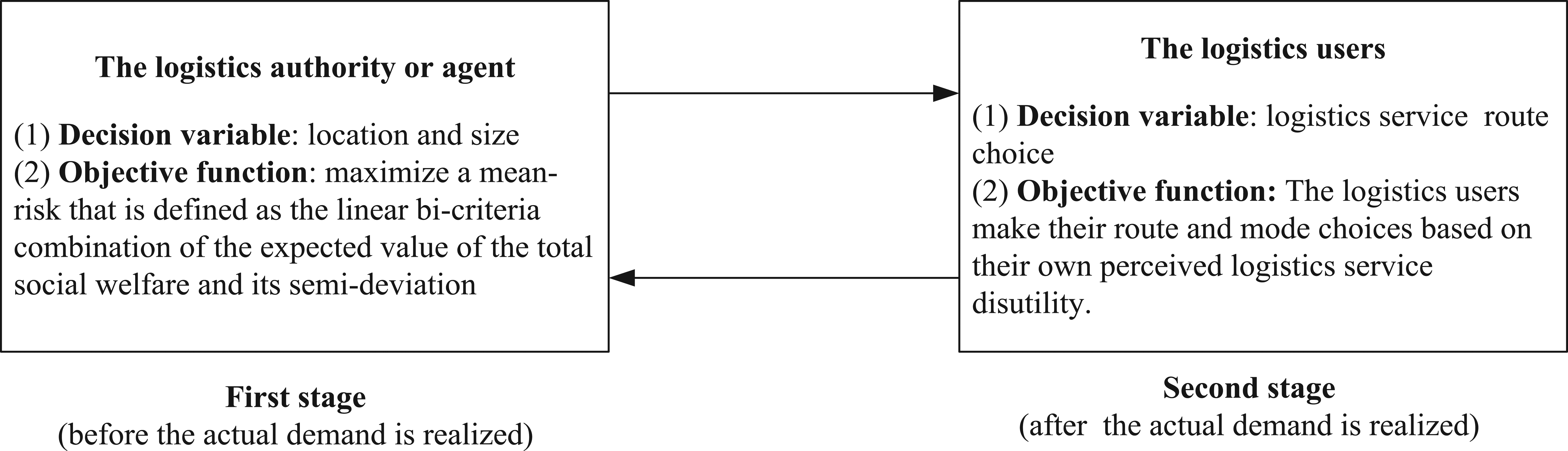
Framework of the two-stage decision model.
Scenario-based stochastic Logistics users’ service choice equilibrium
According to A3, the logistics users’ disutility consists of the logistics service time, transportation cost, and CO2 emission taxes (if any), which can be expressed as

where
The transportation cost and service time on a route can be expressed as the sum of the transportation costs and service times on all the transport arcs and transfer arcs (i.e. transfer nodes) along that route, including transfer cost and time, which are, respectively, expressed as


Considering the difference in the attributes of different transportation modes, the logistics service time on arc a for different modes should be estimated by different functions, as shown in equation (4). For the transportation mode of HGV or LGV, the Bureau of Public Roads (BPR) US type function can be used to estimate the service time.13,41 For railway or waterway, the average transport service time and departure interval time should be considered, that is

where
The CO2 emission taxes on route r between OD pair w can be expressed as the sum of the emission taxes on all the arcs along that route, that is

According to A3, the logistics service mode/route choices can be calculated by a logit-based stochastic user equilibrium (SUE) under logistics demand scenario. The flow

where the parameter
In order to capture the logistics users’ responses to logistics service disutility, an elastic travel demand function is introduced. It is assumed that the total resultant demand

In this article, we adopt the following demand function

where

According to the theory of equilibrium network flow, the following constraints should be satisfied44,46



where, equation (10) is the modal demand conservation constraint. Equation (11) is the route flow conservation constraint for the pure mode or combined mode. Equation (12) shows the relationship between the route flow and arc flow in the network. Equation (13) shows the relationship between the route flow and virtual arc flow (i.e. transferring flow) in the network. Equation (14) shows the non-negativity constraints for the route flows and OD pairs flow, respectively.
The network equilibrium for a multimodal logistics network with elastic demand with uncertain logistics demand can be defined as follows.
Definition 1
A network flow pattern
Equivalent variational inequality model
The multimodal logistics network equilibrium conditions can be formulated as an equivalent variational inequality (VI) model.
Proposition 1
A flow pattern in a multimodal regional logistics network with elastic demand and uncertain logistics demand reaches the SUE state if and only if it satisfies the following VI condition





where
Robust design problem for the sustainable regional logistics networks design
As stated in section “Introduction,” the traditional expectation model may lead to a large variation in the logistics system performance for different logistics demand scenarios. In order to hedge against the instability of the model solution due to the future logistics demand uncertainty, a robust risk-averse objective function and some chance constraints are introduced as follows.
Chance constraints
Chance constraint of link capacity.
Since the future logistics demand in the regional logistics system is a random variable, the flow over logistics arcs, which depends on the actual logistics demand, is also stochastic. Let


From equation (12), the arc flow can be expressed as the sum of the flows of logistics service routes traversing that arc (i.e.

The chance constraint of the arc capacity requires that the flow on each arc does not exceed the capacity of that arc with a certain probability or confidence level

The above equation can be further written as

where
2. Chance constraint of environmental tolerance.
Environmental sustainability, as an important component of sustainable urban development, requires that the vehicular emissions on each arc of the network do not exceed a given threshold with a certain confidence level. Let

where
Obviously, the amount of CO2 emissions over arc


From equation (26), the amount of CO2 emissions on an arc is a linear function of the flow on that arc. Thus, it also follows a normal distribution, that is

The chance constraint of the environmental tolerance can then be obtained as

where
Model formulation of the robust regional logistics design problem
We define the total social welfare under scenario


where
The objective function (31) includes three components: the first bracket represents consumer surplus (denoted as CS), whereas the sum of the second term (i.e. the revenue at logistics nodes) and the third term (i.e. the revenue of logistics services on arcs) is the producer surplus.
The total social welfare of logistics system, defined in equation (31), is a random variable, and its expected value E(Z) can be expressed as

We now introduce the semi-deviation as a measure of solution robustness, as in Ahmed 51 and Santoso et al., 52 which is defined as

where
The semi-deviation, but not the variance (or standard deviation), is used as an indicator for the risk measure because variance is a symmetric statistic and gives equal weight to deviations above and below the mean without addressing the risks associated with extreme outcomes,39,53,54 and because mean-variance does not preserve the convexity of the objective function. 51 The semi-deviation risk measure defined in equation (37) overcomes these shortcomings.
In view of the above, the robust risk-averse regional logistics network design model can be formulated as given below

Subject to


where
Solution algorithm
In this section, the sample average approximation (SAA) scheme is used to approximate the robust optimization problem (37)–(42). The penalty function method is embedded by GA which is developed to solve the approximate problem.
SAA-based scheme
In the SAA-based scheme, we generate a sample of size

Subject to





where
Penalty function approach embedded by a GA
Note that there are side constraints (44)–(45) in the approximate problem (38)–(42). These side constraints can be incorporated into the objective function (43) using the penalty function approach, that is

where

Accordingly, models (38)–(42) can further be written as

where
The above model can then be solved using the GA based on penalty function approach. The step-by-step procedure of the GA in conjunction with the penalty function approach is given as follows.
Solving the logistics authority robust risk-averse decision problem—first-stage problem (Algorithm 1).
Step 0. Initialization. Generate a sample of size N for logistics demand OD1 and OD2, that is, N logistics demand scenarios
Step 1. Outer loop operation (solve the first-stage problem—logistics authority decision loop). Using GA to solve the first-stage problem (58).
Step 2. GA initialization. (a) Set the GA parameters: the probability of crossover (Pc) and the probability of mutation (Pm). (b) Set a stopping tolerance (c) Set n = 0, and create the initial population popn
=
Step 3. Inner loop operation (solve the second-stage problem—logistics service route flow assignment).
For each logistics demand scenario
Step 4. Compute the objective function value
Step 5. Calculate the fitness value of
For each
Step 6. Sort the individual
Step 7. Implement selection, crossover, and mutation
Implement selection, crossover, and mutation according to
Step 8. Termination check for the outer loop operation.
If
Step 9. Output the optimal result.
The flow chart of Algorithm 1 is shown in Figure 4(a).
2. Solving the logistics service routing choice equilibrium problem by the Gauss–Seidel decomposition approach—second-stage problem (Algorithm 2).
Step 1. Initialization. Set iteration index n = 1. Let
Step 2. Calculating the disutility. Calculate the disutility of all logistics service routes
Step 3. Calculating logistics demand. Calculate the resultant demand for each OD pair w based on equation (8).
Step 4. Computing the logistics service demand, mode share, and transfer flows. Use equations (8), (10), (11), and (13) to compute
Step 5. Logit-based SUE assignment. Conduct logit-based SUE assignment to get auxiliary arc flow
Step 6. Method of successive average. Let
Step 7. Convergence check. Define
Step 8. Set n = n + 1. Compute all arc transport costs and route transport costs on the basis of current arc flows, then go to Step 2.
Step 9. Output the resultant demand and corresponding network flow pattern
The flow chart of Algorithm 2 is shown in Figure 4(b).

Flow chart of (a) Algorithm 1 and (b) Algorithm 2.
Key elements design of GA
In this section, we explain three key elements of the GA: the coding, selection, crossover, and mutation methods.
Coding method
The chromosome of the individual in the GA is made up of two parts as shown in Figure 5.

Chromosome of the GA.
Part 1 represents whether the candidate logistics park is open, the value is 1 when the candidate logistics park is open and 0 otherwise. As shown in Part 2, if the candidate logistics park is open, which size can been used a random positive real number r in
Selection method
The selection process is applied with the method of spinning the roulette wheel selection operator. We can adopt the so-called rank-based evaluation function as follows

We mention that i = 1 means the best individual, while
The selection process is based on spinning the roulette wheel pop_size times, each time selecting a single chromosome for a new population in the following way:
Step 1. Calculate the cumulative probability

Step 2. Generate a random real number
Step 3. Select the ith chromosome
Step 4. Repeat Steps 2 and 3 pop_size times and obtain pop_size copies of chromosomes.
Crossover and mutation method
Crossover operator.
We implement a crossover operation for the two parts of the chromosome. The two-point crossover method is adopted for Part 1. The crossover operation of Part 2 is a convex combination of two corresponding parents. For each pair of parents (vectors


where
We give a simple example as follows, which consists of six candidate logistics parks as shown in Figure 6. Let V1 and V2 denote the chromosomes of parent1 and parent2 respectively. And Let C1 and C2 denote the corresponding chromosomes of the child1 and child2 after crossover operator respectively. The parameters of crossover operation of Part 2 are set to

Representation of the crossover operation.
It is possible that the crossover operation produces certain “problem chromosomes,” which describes an unfeasible logistics park design scheme. For example, it is to obtain a problem chromosome as shown in Figure 6(b). Here, the value of
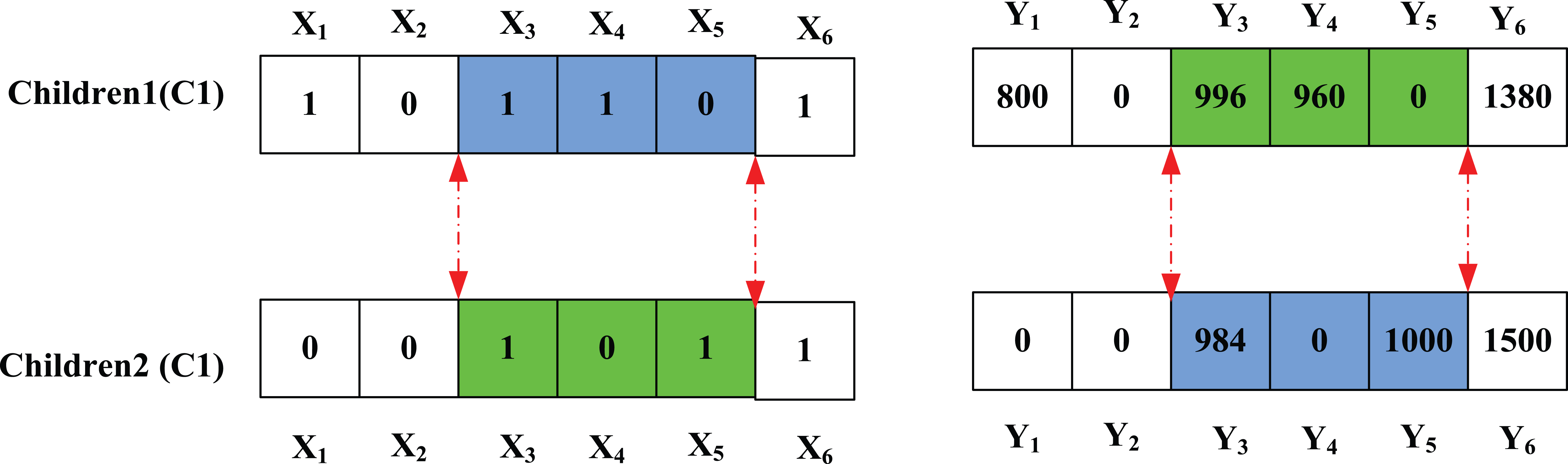
Children chromosome after correcting.
Mutation operator.
Generating a random real number r in [0, 1], we select the given chromosome for mutation.
If r < Pm. Let a parent for mutation

Representation of the mutation operation.
Illustrative numerical example
To facilitate the presentation of the essential ideas and contributions of this article, the proposed model and the solution algorithm are applied to a simple logistics service network. In this section, the solutions for different types of optimization models are compared to show the importance of the consideration of logistics demand uncertainty and risk for low-carbon logistics network design. Sensitivity analysis to some key model parameters, such as the CV of total logistics demand, risk-averse parameter, and confidence levels of chance constraints, is also carried out for providing some insightful findings.
Problem setting
In the following, a numerical example is used to illustrate the applications of the proposed model and solution algorithm. The example regional logistics network is shown in Figure 9. It consists of two logistics demand OD pairs, that is, OD pair 1 (1 → 8) and OD pair 2 (1 → 7), 8 nodes and 15 links which are denoted by arc i (i = 1, 2, 3, …, 15). In this figure, nodes 3, 4, and 5 are assumed to be three candidate logistics parks.

Original logistics service network.
Figures 9 and 10 show the original and modified logistics service networks, respectively. For some links, different vehicle types are available, and one link that is served by different vehicle types can thus be expanded as different links. For example, link 1 in the original logistics service network (i.e. Figure 9) can be expanded as arcs 1 and 16, as shown in the modified logistics service network (i.e. Figure 10). The basic data for the logistics service network are given in Table 1.

Modified logistics service network.
Basic input data for the logistics service network.

HGV: heavy goods vehicle; LGV: light goods vehicle.
Suppose that the logistics OD pair 1 (from node 1 to node 8) serves agricultural goods, in which potential demand follows a normal distribution
Transfer time and cost at the general logistics nodes.
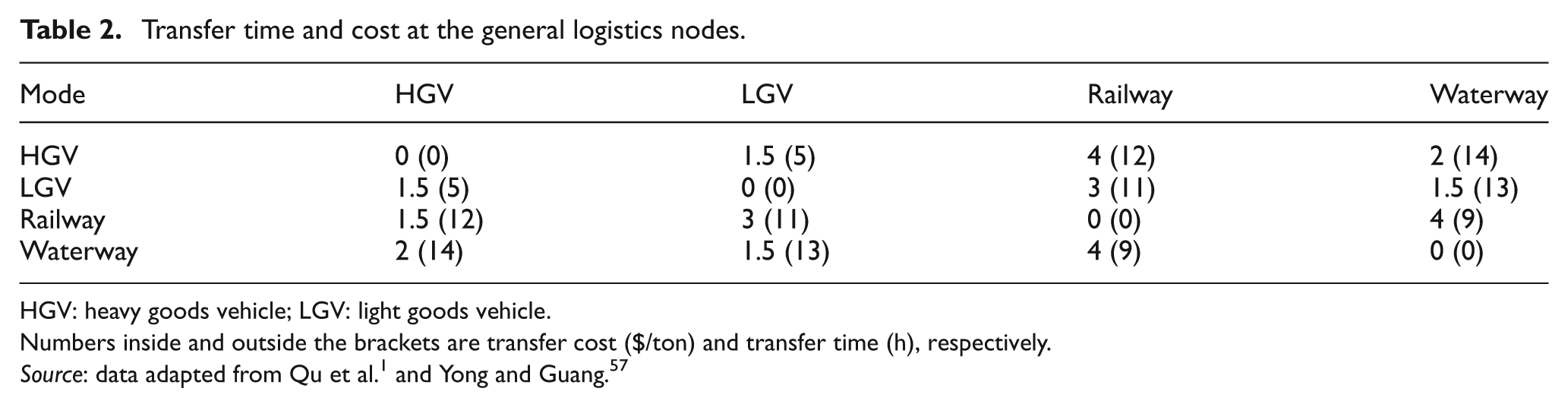
HGV: heavy goods vehicle; LGV: light goods vehicle.
Numbers inside and outside the brackets are transfer cost ($/ton) and transfer time (h), respectively.
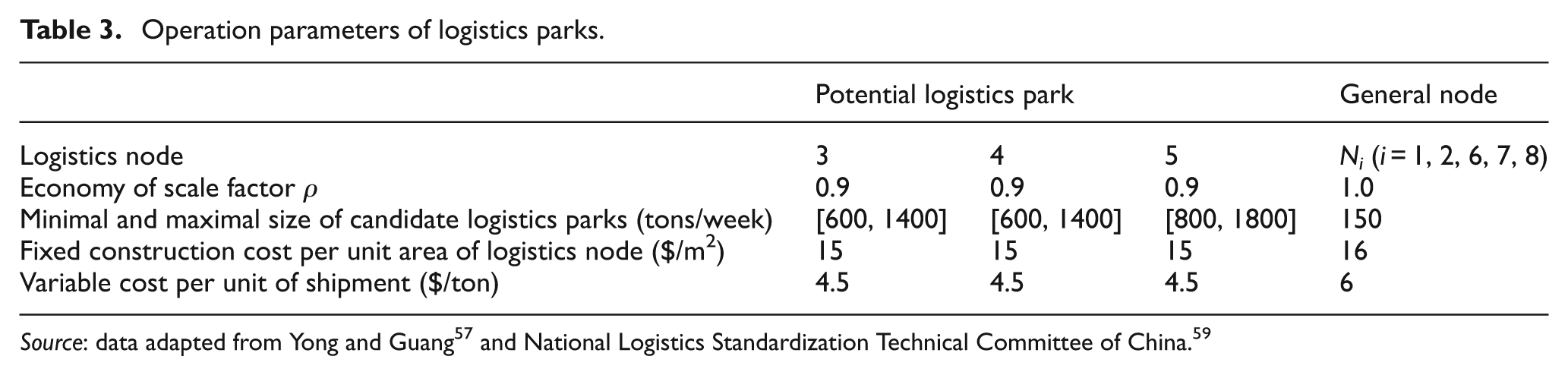
Operation parameters of logistics parks.
Numerical results and discussions
Applying the proposed model and solution algorithm to the example network, the results are summarized as follows.
We first investigate the performance and convergence of the proposed solution algorithms. The proposed solution algorithm was coded in Microsoft Visual C++ 6 and run on a laptop Dell N5040 with an Intel Pentium 2.13-GHz CPU and 4.00 GB RAM. And the iterative process for the reference case takes about 1978.44 s of CPU time. Figure 11 shows the convergent of situations of GA method for solving the first-stage problem. It shows that the value of the total social welfare increases quickly with the number of iterations and then tends to stabilize after about 50 iterations.

Convergence of genetic algorithm (GA).
Table 4 indicates the optimal solutions and associated system performances for three different models, including the robust model, expectation model, and deterministic model. The expectation model refers to optimize the exact value of the objective without considering the risk of variation of logistics demand, which means the risk-averse parameter
Comparison of solutions of the robust, expectation, and deterministic models.

It shows that the expected total social welfare of the robust model is the lowest (2,198,322 $/week), that of the deterministic model is the highest (2,221,212 $/week), and that of the expectation model is in between (2,194,686 $/week). This means that ignoring the effects of the demand uncertainty may lead to an overestimation of the expected total social welfare.
Figure 12 depicts the expected total social welfare for different budget levels for the robust model and the expectation model when the CV of logistics demand uncertainty is fixed at 0.1 and the confidence levels of all the chance constraints are fixed at 95%. It can be seen that the total social welfare quickly increases for low-budget levels for these two models, and then tends to stabilize when the budget level reaches 17,000$ (i.e. the critical level). This is because the budget constraint becomes inactive (or unbinding) after the critical level. In addition, for a given budget level, the expected total social welfare under the expected model is always higher than that under the robust model, and the difference between them enlarges with the budget level before reaching the critical level.

Expected total social welfare against budget levels for robust and expectation models.
To examine the effects of the logistics demand uncertainty and risk measure, as shown in Figure 13, we can find that for a fixed value of risk-averse parameter, for example,
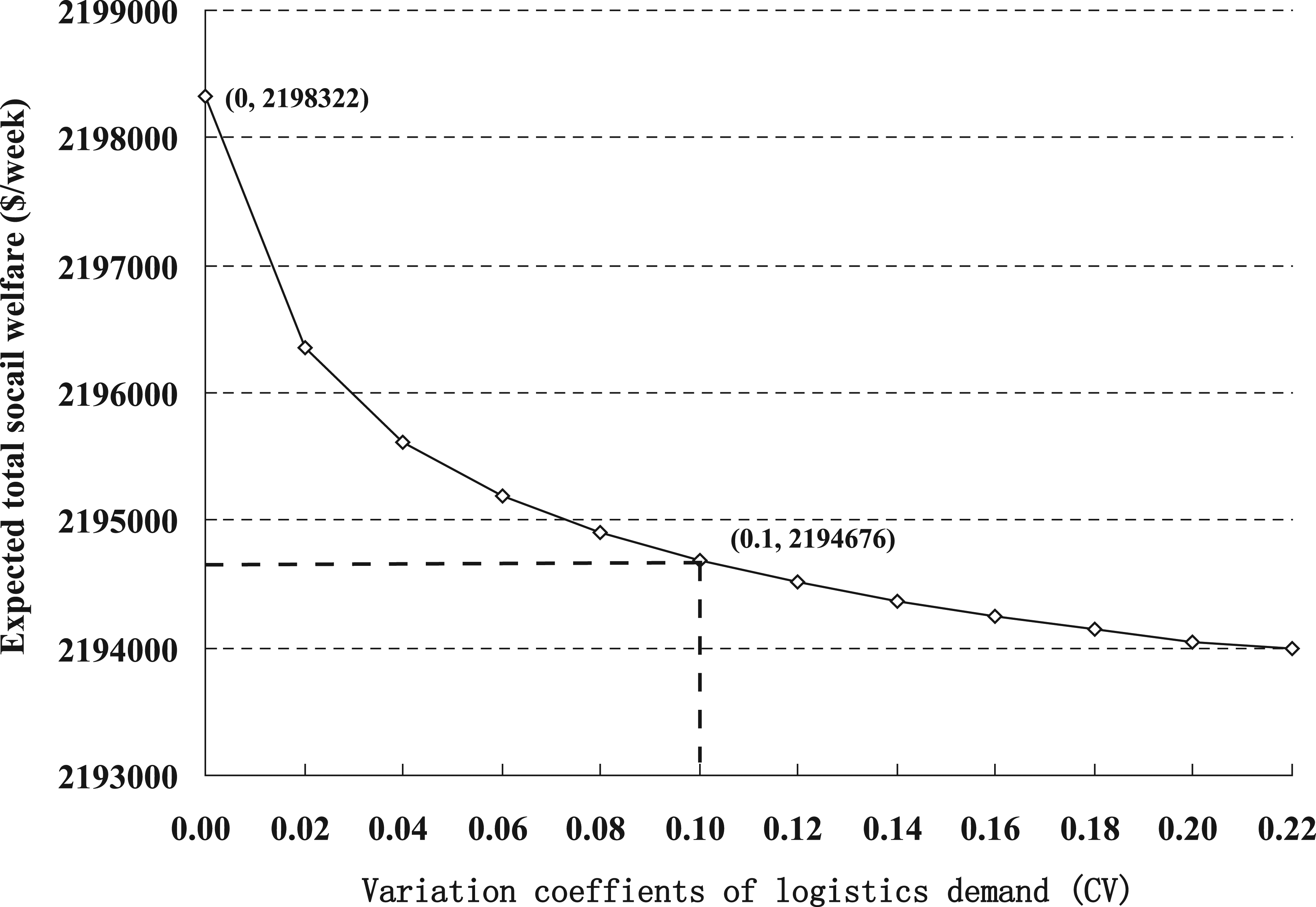
Expected total social welfare against variation confident parameter (CV).
Figure 14 shows the expected total social welfare for different values of risk-averse parameter λ. It can be observed that for a fixed CV (e.g. CV = 0.1), as the risk-averse parameter increases from 0 (i.e. expectation model) to 15 (i.e. robust model), the expected total social welfare decreases from 2,198,322 to 2,194,433 $/week. This means that a lager value leads to more robust system performance but a lower expected total social welfare, and vice versa. Therefore, ignoring the risk term may lead to an overestimation of the expected total social welfare. In a robust region green logistics network design, a trade-off should be made between the expected system performance and its risk.

Expected total social welfare against risk-averse parameter (λ).
Finally, we examine the effects of the confidence levels of various chance constraints as shown in Figure 15. Three cases are considered, namely, Case 1: changing the confidence levels of all the chance constraints; Case 2: changing the confidence level of the link capacity chance constraint only (equation (25)); and Case 3: changing the confidence level of the environmental capacity chance constraint only (equation (30)).
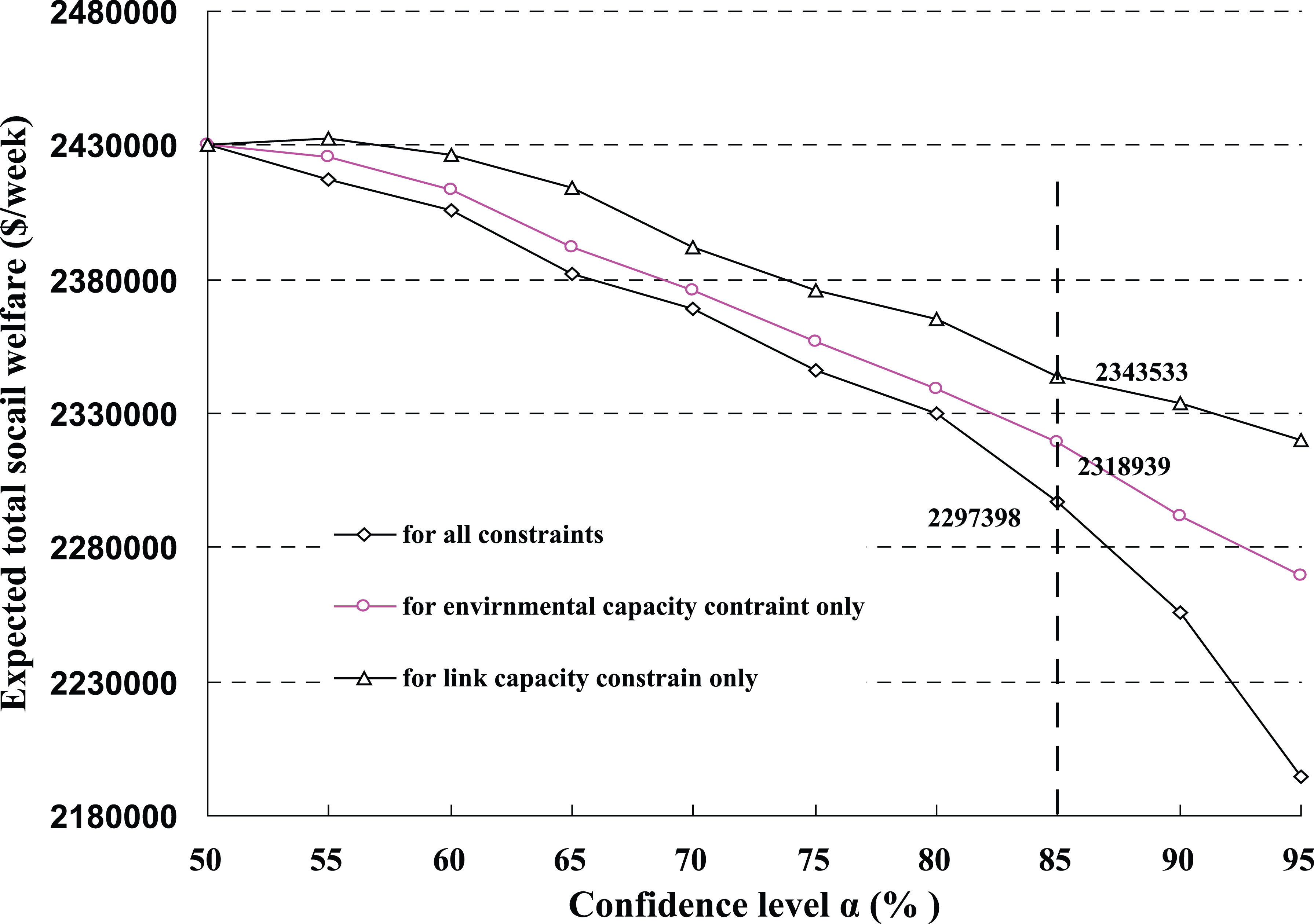
Total social welfare against confidence levels of various constraints.
It can be noted in Figure 15 that the total social welfare decreases with the confidence levels due to a trade-off between the total social welfare and the system stability (or robustness). For Case 1, when the confidence levels of all the chance constraints increase from 50% to 95%, the value of objective function (equation (43)) decreases from 2,429,999 to 2,194,676 $/week. In order to identify the impacts of different chance constraints, we change the confidence level of one chance constraint only and fix those of other constraints at the level of 50%. It can be seen that the environmental (or link capacity) chance constraint can generate the largest (or smallest) effect on the value of objective function. It is thus important to incorporate the effects of environmental factors into the regional logistics network.
Conclusion and further studies
This article proposed a novel model for sustainable regional logistics network design. In the proposed model, the effects of the uncertainty of future logistics demand and the environmental sustainability were considered for optimization of location and size of logistics park simultaneously.
The proposed model was formulated as a two-stage robust optimization problem with various chance constraints, in which the first stage aims to maximize a robust risk-averse objective function so as to create a robust and sustainable regional logistics network, while the second stage is a scenario-based stochastic logistics service route choice equilibrium problem. A penalty function approach embedded by a GA and a decomposition approach were developed to solve the proposed model. Numerical example was given to illustrate the properties of the proposed model and solution algorithm. The proposed model can serve as a useful tool for designing a sustainable and robust green logistics system.
It should be pointed out that although the numerical results that are presented in this article can be explained logically, case studies on large and realistic logistics networks are necessary to further justify the findings of this article and the performance of the proposed model. The research directions for future studies may also focus on an extension of the proposed model to logistics network design with the pricing issue for a combined transportation mode in a multimodal logistics network and the multi-period investment problem in a logistics network.
Footnotes
Appendix 1
Appendix 2
Acknowledgements
The authors would like to thank the editors and anonymous referees for their helpful comments and constructive suggestions on an earlier version of the manuscript.
Academic Editor: Xiaobei Jiang
Declaration of conflicting interests
The author(s) declared no potential conflicts of interest with respect to the research, authorship, and/or publication of this article.
Funding
The author(s) disclosed receipt of the following financial support for the research, authorship, and/or publication of this article: The work that is described in this paper was supported by grants from Graduate student teaching reform project of Central South University (No. 2014JGB36), Teacher Foundation of Central South University (No. 2013JSJJ0015) and Foundation of Central South Forestry University of Science and Technology.