




Abstract
The hydraulic pipeline is subject to the aero-engine base excitation and the pump fluid pulsation which can always damage the pipeline through overload to fatigue. So, the health monitoring technique of hydraulic pipeline is essential for the maintenance of the aero-engine. In this article, the Kalman filter combined with fiber Bragg grating method is proposed to detect the location faults of the hydraulic pipeline system. In this method, the description of state equations for the hydraulic pipeline vibration signals are presented based on autoregressive model. Then, a practical strategy detection method is proposed to investigate the vibration signals of hydraulic pipeline based on the Kalman filter technique. Finally, the clamp loosening and the collision faults of the hydraulic pipeline are conducted as an example to validate the proposed approach. The obtained results show that the present technique is convenient and efficient to detect the location faults of hydraulic pipeline where the fiber Bragg grating sensors are fixed, which can serve as an effective guidance for the health monitoring of hydraulic pipeline in aero-engine.
Introduction
The aero-engine hydraulic pipeline system connected with the high-pressure pump, valve, and actuators is the one of the most important component in the aircraft. The landing gear, flap, and wheel brakes of the aircraft are operated by hydraulic pipeline system which consists of the pipelines, joints, clamps, valve, and actuators. The pipeline is subject to aero-engine base vibration and pump fluid fluctuation which can always induce faults such as collision between pipelines and the clamps loosening. Moreover, these faults could damage the pipeline system easily and threaten to the aircraft’s safety.1,2 Therefore, the effective method for detecting the location faults efficiently and accurately is strongly recommended for aero-engine hydraulic pipeline system.
The vibration signals of the pipeline included much information which could be used to diagnose and predict different working states of the pipeline system. 3 The vibration signals also showed different time varying and periodic pulsation characteristics.4–6 High-frequency resonance analysis methods, such as envelope, 7 bicoherence, 8 and other frequency analysis methods were proposed to analyze the vibration signals and defect localized faults. Several time-frequency methods had been applied to distinguish these vibration signals for fault location, such as wavelet analysis,9–11 neural network,12,13 and hidden Markov modeling (HMM).14,15 The hydraulic pipeline vibration signals were nonlinear and often non-stationary duo to various working states of the aero-engine. 16 So, some nonlinear analysis methods were proposed to deal with the complex vibration signals. 17 A two-stage Kalman filter method was proposed for state and disturbance estimation combining a robust and optimal algorithm. 18 In addition, the combination of an extended Kalman filter with a hybrid automation technique was proposed to deal with a sensorless control.19,20 One of the challenges for dealing with the state estimation and fault prediction is the nonlinear and non-stationary characteristics of vibration signals. Recently, autoregressive (AR) model was proposed to estimate the nonlinear vibration signals, in which the AR model coefficient reflected different operation conditions. 21 The priori estimates were used to obtain a real-time estimate combined with the measurement signals, and Kalman filter technique could describe the transform progress of states through the state equation.
For the hydraulic pipeline with long distance, it is essential to acquire multi-point vibration signals for detecting the potential faults. The traditional piezoelectric accelerometers are suffering from electromagnetic interference and complex wirings challenges. Fortunately, the fiber Bragg grating (FBG) is a kind of optical sensor with advantages of lightweight, small volume, one line with multiple points, distributed measurement, electromagnetic interference resistance and so on. The FBG technology has been widely applied in many industry fields, such as bridge monitoring 22 composites material, 23 sea bed level, 24 and wind turbine blades. 25 To the author’s best knowledge, there is almost no literature reporting on FBG sensor for detecting and locating the fault of the aero-engine hydraulic pipeline system. Therefore, Kalman filter combined with FBG technique may serve as a potential method to analyze the vibration signals of the aero-engine hydraulic pipeline under various types of fault.
In this article, the fault diagnosis and location for the aero-engine hydraulic pipeline system is investigated. The Kalman filter combined with FBG technique are proposed to detect and locate the faults in pipeline system. The real-time experiments of collision between pipelines and the clamp loosening faults are conducted as an example to verify the proposed method. Some new results for detecting and locating the faults are illustrated based on Kalman filter technique.
Description of the AR model and Kalman filter
The low-dimensional AR model for the pipeline vibration signals is established, then the Kalman filter technique is applied to estimate the state of the pipeline system.
The AR model
The AR process of order

where

where
The general solution of equation (2) can be written as

where
State-space equations
The state-space model is available to predict the system’s working conditions. The model of the state space can be written as


where


Some basic principles of Kalman filter
The Kalman filter technique is applied to estimate state and predict the behavior of the system. The estimation of the state is adjusted after each new observation, in which a new estimation of the state after each observation and variance–covariance matrix is given for estimating the state. The first step in the Kalman filter procedure is an estimation of the state based on the previous state

The variance–covariance matrix is

where

where

The variance–covariance matrix can be written as

where

The matrix

It is proved that the minimum mean square estimate of
Predict the working states of the pipeline system
The Kalman filter has been considered as an efficient method to estimate the states of the dynamic system from real-time measurements. It can be utilized for health monitoring of aero-engine hydraulic pipeline system. The Kalman filter technique employs recursive estimator meaning, which the estimated state from the previous time step and the current measurement are calculated for the current state. The measurement of the hydraulic pipeline response is used to determine the state errors by Kalman filter method. The AR model is established for the healthy vibration signal, then Kalman filter is then obtained based on present AR model. The value

Flowchart of Kalman filtering technique.
Experimental setup
The FBG is a kind of optical sensor with advantages of lightweight, small volume, one line with multiple points, distributed measurement, electromagnetic interference resistance, etc. These characteristics of the FBG sensor could be utilized in aero-engine hydraulic pipeline system for measuring the vibration signals and the health monitoring.
The FBG test system consists of the FBG sensors, FBG demodulation module, dynamic analyzer, and computer. The main part of system is FBG demodulation module, the model number is PXIe-4844 of National Instruments. The vibration signals of pipeline system is detected by the FBG sensors. Wide band optical is generated by the FBG demodulation module and the reflected optical is scanned, then the optical signals are converted to electrical signals and processed by dynamic analyzer. The vibration response is detected by accelerometer, and the response signals are digitalized and processed by PXIe-4499 of National Instruments.
Two pipelines with same geometrical and material are connected through joints, which are fixed by clamps on the panel. The panel with pipeline is fixed on the shaker table. The random excitation of frequency is ranging from 30 to 3000 Hz, and the power spectral density (PSD) is 0.0001 g2 Hz−1. The schematic diagram of experimental setup is shown as Figure 2.

Schematic diagram of experimental setup.
As shown in Figure 3, four FBG sensors are distributed along the pipeline to detect the different working states of the hydraulic pipeline system. Four clamps are at the location of the
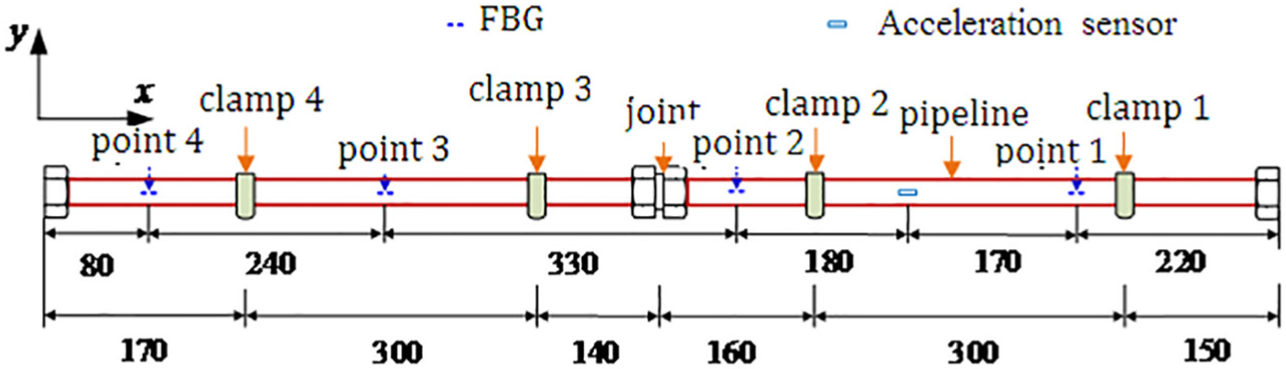
The arrangement of the sensors in hydraulic pipeline system.
Results and discussion
The estimation value of various working states of the aero-engine hydraulic pipeline system can be obtained from equation (11). The vibration signals

The state-space equations of the pipeline vibration signals can be calculated according to equations (8) and (9), and the state matrix
Clamp loosening of pipeline system
The No. 2 clamp in the test system is chosen as an example to verify the effectiveness of the proposed method. In the test process, the clamp loosening and breaking down could be considered as faults for pipeline system under random vibration excitation. The FBG sensors are distributed along the pipeline to detect the working states of the pipeline system. The picture of clamp loosening and clamp breaking down faults are shown as Figure 4. No. 2 clamp becomes loosening at
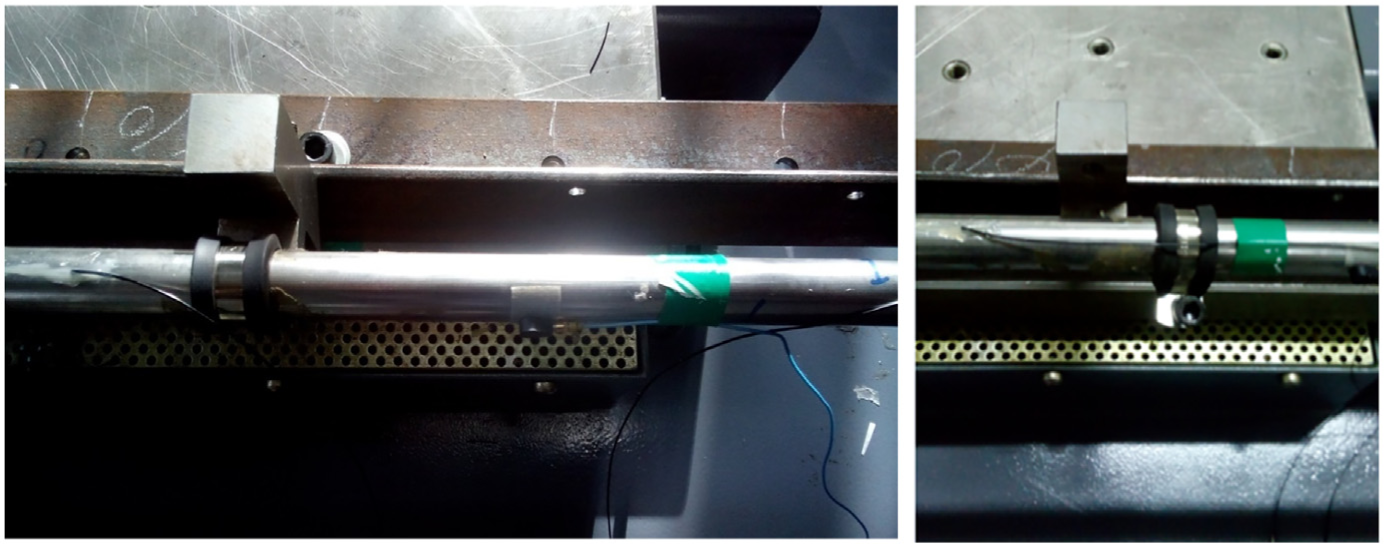
Picture of two types clamp failure: (a) clamp loosening and (b) clamp break down.

Vibration signals measured by FBG.

Vibration signals measured by accelerator.
From Figures 5 and 6, it can be seen that the measuring point at No. 2 clamp can detect vibration fault signals easily by FBG sensor while the acceleration sensor is not sensitive to locate the loosening position. When No. 2 clamp becomes loosening, vibration fault signals can be detected by the four FBG sensors. It can be seen that the vibration amplitude at measuring point 2 is higher than other points when clamp becomes loosening.
Figure 7 shows the vibration and the update signals of Kalman filter, and Figure 8 shows the update error and the estimate error when the fault of No. 2 clamp occurs. No. 2 clamp becomes loosening at
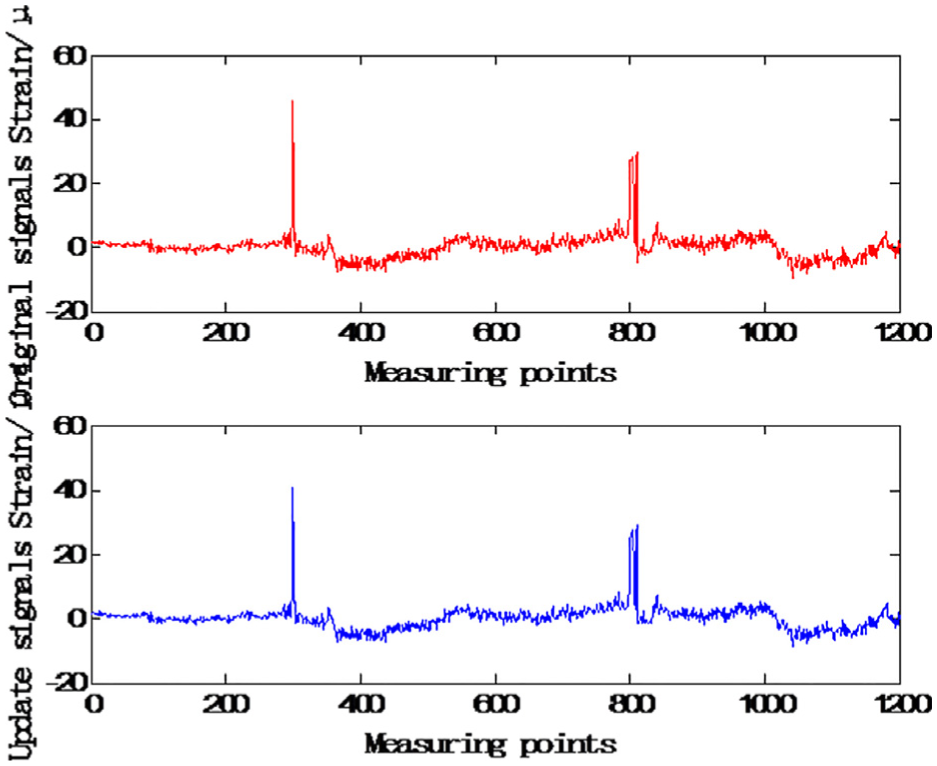
Vibration and update signals.
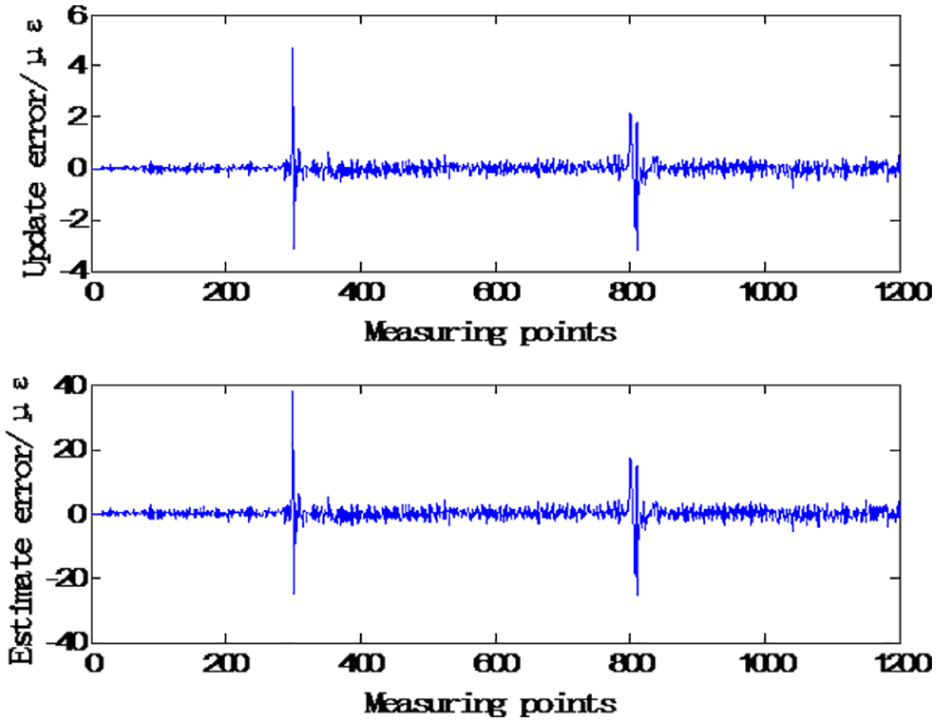
Update error and the estimate error.
Body collision of the pipeline system
The FBG sensors are arranged along the pipeline to detect the working states of pipeline as shown in Figure 3. The different points of the pipeline body are knocked at time

Measured by FBG.

Measured by acceleration sensors.

Kalman filter of vibration signals of measurement at point 1: (a) vibration and update signals and (b) update error and the estimate error.
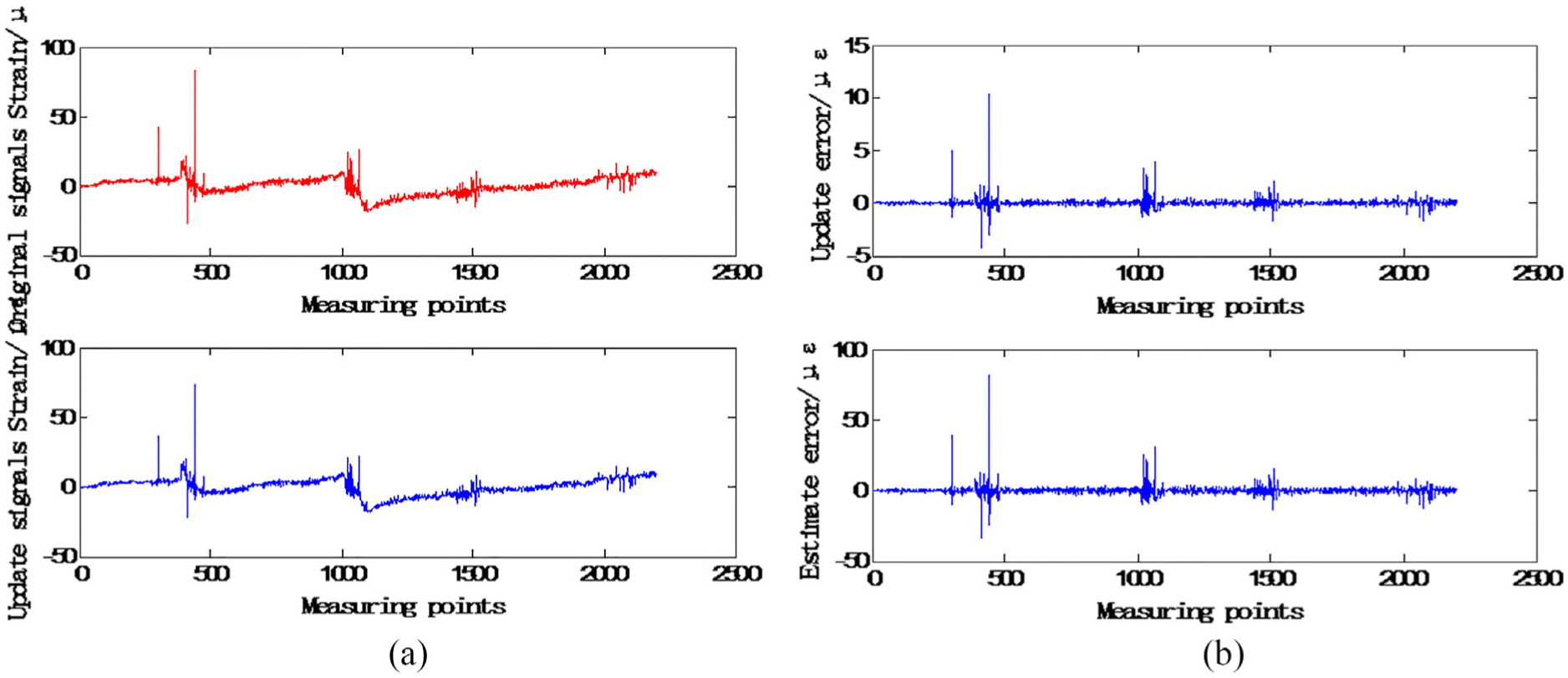
Kalman filter of vibration signals of measurement at point 2: (a) vibration and update signals and (b) update error and the estimate error.

Kalman filter of vibration signals of measurement at point 3: (a) vibration and update signals and (b) update error and the estimate error.
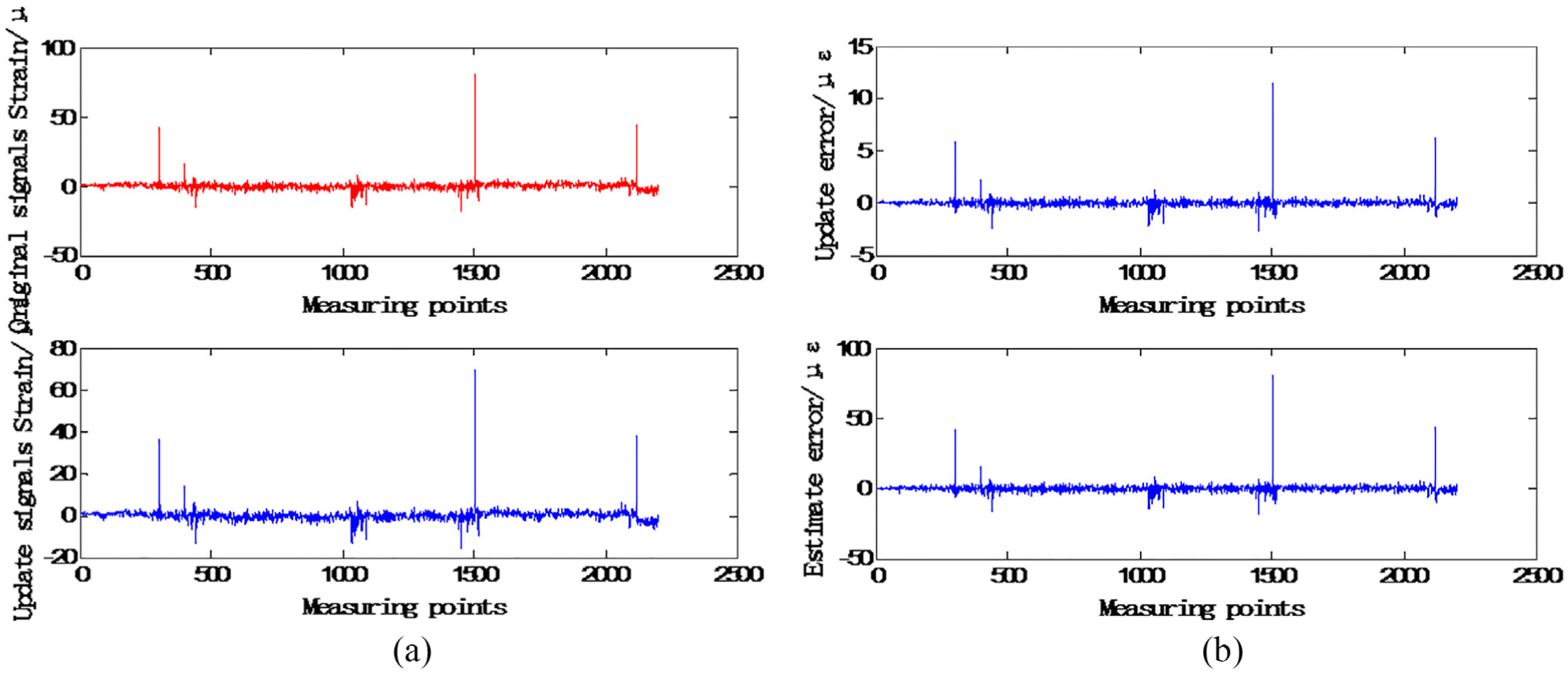
Kalman filter of vibration signals of measurement at point 4: (a) vibration and update signals and (b) update error and the estimate error.
From Figures 11–14, it can be seen that the vibration response amplitude of point 1 still keeps high level when the pipeline is knocked at point 2. However, the vibration response decreases when the pipeline is knocked at point 3. Therefore, the point 2 can be selected as a unique point to obtain much more changes in vibration signals when fault is occurred. The similar behavior can be observed for point 3.
When the pipeline body is knocked, the diverged changes may be hidden in the time-domain signals, which are difficult to be identified by the original data directly. Fortunately, the test and prediction can be carried through the change of the update error and the estimate error with Kalman filter technique. The fault points can be detected by the update error and the estimate error, and the Kalman filter method has strong sense ability to detect the fault points with sufficient accuracy where the FBG sensors are fixed.
It can be inferred from the above discussion that Kalman filter combined with FBG technique is useful to detect the faults of the aero-engine hydraulic pipeline system. The gradual changing process of the faults and the location of fault points can be detected by this technique easily, which can serve as an effective guidance for the maintenance and health monitoring of hydraulic pipeline in the aero-engine.
Conclusion
In this article, the Kalman filter combined with FBG method is proposed to detect the faults in the aero-engine hydraulic pipeline system. The present technique turns out to be convenient and efficient to deal with the fault diagnosis and location of hydraulic pipeline. Some conclusions are obtained as follows.
The fault vibration signals of hydraulic pipeline can be detected easily by FBG sensors with high precision while the acceleration sensor is not sensitive to locate the loosening position. FBG sensors with its unique advantages such as little external mass to pipeline and high capability of anti-electromagnetism compared with the piezoelectric accelerometer, can be applied to detect the faults of hydraulic pipeline where the FBG sensors are fixed.
The fault points can be detected by the update error and the estimate error. Results show that Kalman filter method has strong sense ability to detect the fault points with sufficient accuracy. Moreover, the gradual changing process of the faults can be detected by this technique easily. Therefore, Kalman filter is useful to detect the fault where the FBG sensors are fixed in the aero-engine hydraulic pipeline system, which can serve a potentially effective method for the maintenance and health monitoring of aircraft.
Footnotes
Handling Editor: Jose Antonio Tenreiro Machado
Declaration of conflicting interests
The author(s) declared no potential conflicts of interest with respect to the research, authorship, and/or publication of this article.
Funding
The author(s) received no financial support for the research, authorship, and/or publication of this article.