




Abstract
An interval element-free Galerkin method was proposed to solve some issues in structural design and analysis of structural parameters that have errors or uncertainties caused by manufacture, installation, measurement, or computation. Based on the interval mathematics and perturbation theory, we deduced interval element-free Galerkin method equilibrium equations using the element-free Galerkin method and solved them using the parameter perturbation of interval number. A bar under uniform load, a bi-material cantilever beam subjected to uniform stress, and collinear double edged cracked plate subjected to uniform tensile stress, including uncertainty parameters, were analyzed. Numerical simulations show that interval element-free Galerkin method is accurate and effective in solving the uncertainty problems.
Introduction
Due to different reasons, real engineering structures always have some inevitable uncertainties, such as loads, physical and geometric parameters, boundary conditions, and system failure conditions.1–5 Many calculation methods have been implemented to solve the uncertainty in solid mechanics,6–8 structural mechanics,9,10 fluid mechanics,11,12 and fluid–structure interaction,13,14 including stochastic finite element method (FEM),15–18 fuzzy FEM,19–21 and interval parameter perturbation method.22–26 The stochastic FEM requires the statistic characteristics of uncertainty parameters, while the fuzzy FEM is very slow. In comparison, the interval analysis can quantificationally inspect the influence of uncertainty parameters without knowing their probability distribution and is very effective for small-range uncertainty problems. The interval parameter perturbation method, proposed by Wang and Qiu, 27 has been widely applied in the structural response analysis due to its simplicity and efficiency. Wang and Qiu28,29 developed the interval and subinterval perturbation methods to solve the heat convection–diffusion problem with uncertain-but-bounded parameters. A collocation method was proposed further in the article by Wang et al. 30 to analyze the heat convection–diffusion problems with interval input parameters. Compared with previous interval approaches, the computational cost of the interval parameter perturbation method is smaller, and the convergence condition which is related to the ranges of interval parameters is more easily guaranteed.
Before each computation, FEMs should generate and maintain meshes of sufficient quality, which leads to a big amount of data preparations and requires complicated pre- and post-processes.31–33 The meshes might suffer from severe distortion in metal stamping forming, high velocity impact and explosion, dynamic crack propagation, fluid–solid coupling, and other problems that involve the extreme large deformation, largely reducing the precision. As these defects of FEMs, the upsurge of researching element-free method34–38 has begun since 1990s in the field of international computational mechanics.
The element-free method has many advantages such as strong anti-distortion ability, high precision, convenient post-process, elimination of volume self-locking, and quick convergence. This method has been developed fast and applied to solve problems about elastoplasticity, 39 buckling, 40 heat conduction, 41 elastodynamic, 42 large deformation, 43 and micromechanical study on the electro-elastic behavior. 44 However, its application on research about the uncertainty problems is rare, 45 and especially, there is no research about the uncertainty problem of simulating the cracked structure. Ma et al. 46 used the interval element-free method just to evaluate the bending defection range of plates on Winkler foundation. Interval element-free method needs to be further developed.
In the present study, we proposed the interval element-free Galerkin method (IEFGM) based on the investigation of the interval mathematics and element-free Galerkin method. This method only requires the node information, without demand for any element connectivity, and resolves the interval equilibrium formula using the interval number decomposing method. We also deduced the interval J-integration formula in detail. Finally, to verify the accuracy of IEFGM, we analyzed the issues of a bar under uniform load, a bi-material cantilever beam, and a collinear double edged cracked finite square plate under uniform tension with uncertainty parameters.
Moving least square approximation
Using the values of several unrelated nodes, moving least square (MLS) can achieve a fitting function that is smooth and has connective derivatives. Considering the uncertainty of material characteristics and loads, EFGM approximates the field function using an MLS-generated smoothing function. The function

where
In a two-dimensional space, a linear basis and a quadratic basis are respectively


Because of the singularity of

or the complete expansion basis

where
Coefficient vector

where n is the number of the nodes corresponding to the weighted function
In order to minimize the error, we aim to minimize

where




Hence, we have

Substituting equation (12) into equation (1), we have

where


The t-distribution weight function is

where
Discrete scheme
MLS has no interpolation, so we use the penalty function as the natural boundary condition. Utilizing the theory of minimum potential energy, we get the Galerkin discrete form of the elastic body equilibrium governing equation as follows

where
and

is the stiffness matrix with

where

where
and

where


where
While a varies in the aI,

Equations (20) and (23) can be written as


Equation (26) is exactly the static force interval element-free problem, which generally aims to determine the displacement set

The interval form of

where


Since the uncertainty parameter a varies in small range, we have

where
Ignoring the high-order items, we have the Taylor expansions at


where
From the interval element-free governing equation, we have

Since the decomposed form of the interval is unique, we have


Substituting
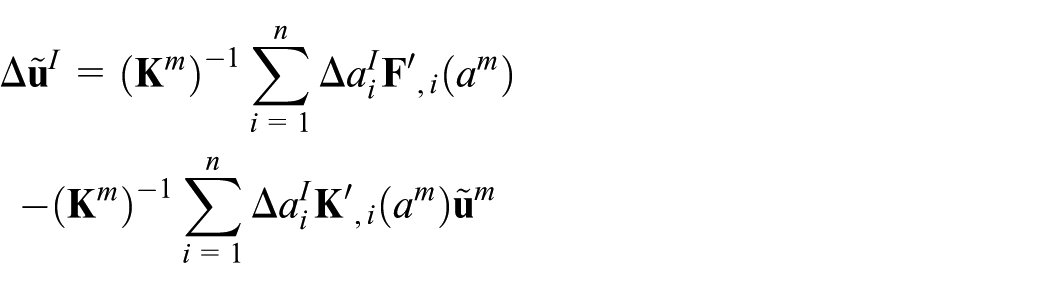

The upper and lower bounds of the structural static displacement are

where
Because

Interval J-integration theory
J-integration, proposed independently by Rice in 1968, was found to be the first translation integration of the energy momentum tensor.
49
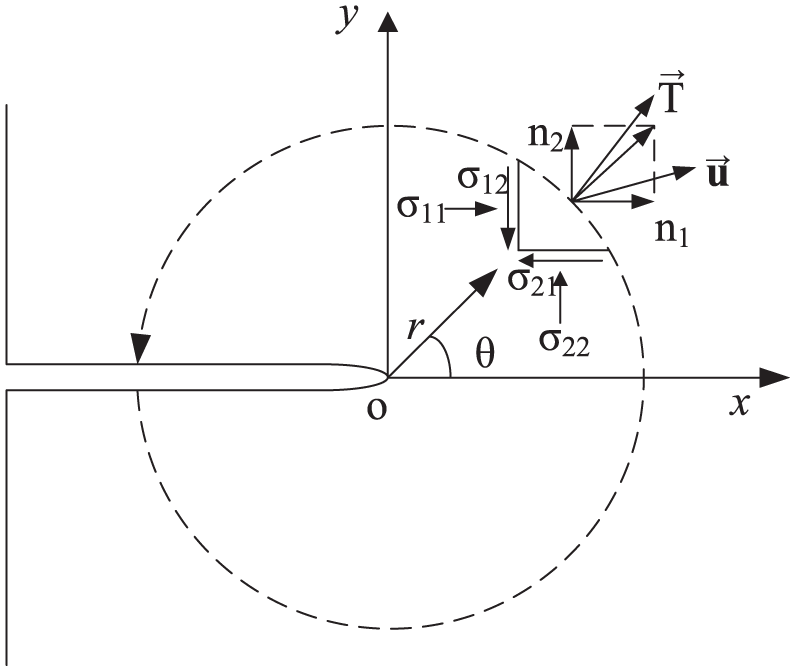
As shown on the two-dimensional cracked body in Figure 1, we choose an arbitrary smooth closed curve

where
Ignoring the higher-order item and from the Taylor expansion at


A rectangular closed curve was used to compute the J-integration (Figure 2). Due to the symmetry around the x-axis, we have




Rectangular closed curve.
Under the situation of linear elasticity, when the passion ratio


Numerical calculation
Bar under linearly distributed load
One end of the bar was fixed, the other was free, with the linear load P(x) = x applied. The bar parameters including length L = 1.0, cross-sectional area A = 1.0, and elastic modulus Em = 1000, ΔE = 100 (Figure 3). Single Gaussian point and 11 equidistant nodes were used at scale = 2.1 (Figure 4). The example is only used to verify the correctness of IEFGM.
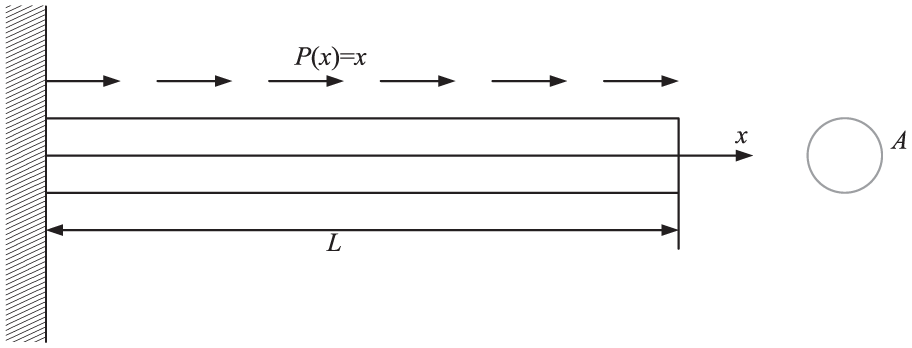
Unit-length bar under linearly distributed load: geometric model.

Node distribution at unit length bar (11 nodes).
Figure 5 shows the displacements at the upper boundary
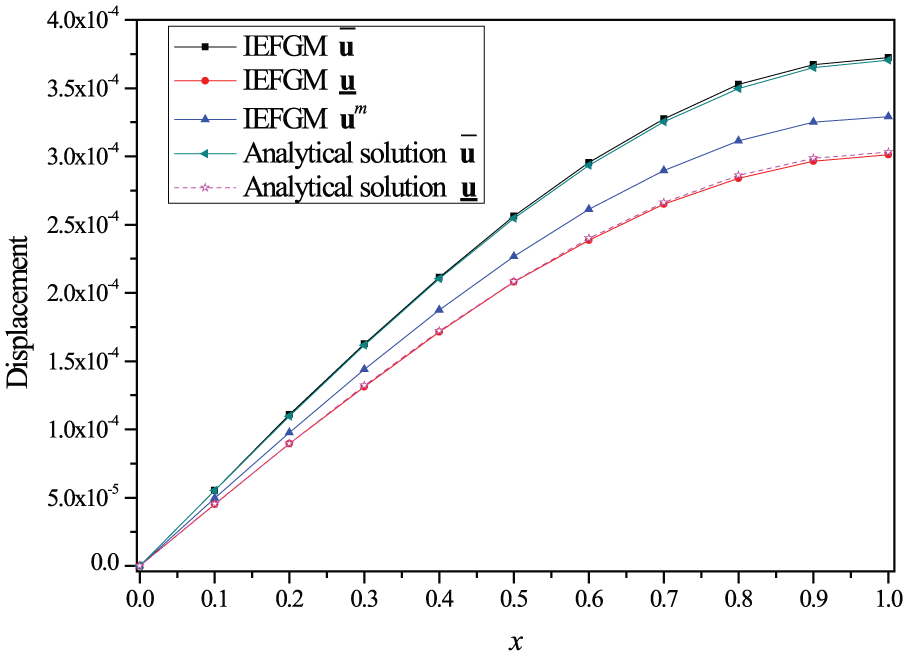
Displacement distribution interval of a one-dimensional bar.

Stress distribution interval of a one-dimensional bar.
Bi-material cantilever beam
As shown in Figure 7, a bi-material cantilever beam was imposed at the upper part with even-distributed load

Cantilever beam under uniform load distribution.

Node distribution.
Table 1 lists displacement and stress by IEFGM and the Monte Carlo method (MCM) with 10,000 samples along height and at x = 50 mm. At y = 0 mm,
Displacement and stress along the height and at x = 50 mm.

IEFGM: interval element-free Galerkin method; MCM: Monte Carlo method.
A collinear double edged cracked finite square plate
Figure 9 shows a collinear double edged cracked finite square plate subjected to uniform tension stress PI on both up and down boundaries. The crack length is a = 5 m and l = 20 m. Poisson’s ratio µ = 0.3. The elastic module EI and the load PI are the interval variables, with mean values Pm = 1.0 MPa, Em = 1000 MPa, and deviations ΔP = 0.1 MPa, ΔE = 100 MPa. It is supposed to be a plane strain problem. Due to the bidirectional symmetry, we only used a quarter of the model in the up-left part. As shown in Figure 10, the symmetrical boundary conditions were applied on the right and bottom sides. Totally, 472 nodes were arranged on the plate, with the refined nodes on the crack tip. An area surrounded by Q1Q2Q3Q4 (length c = 4.0 m, width b = 2.0 m) was selected to solve the
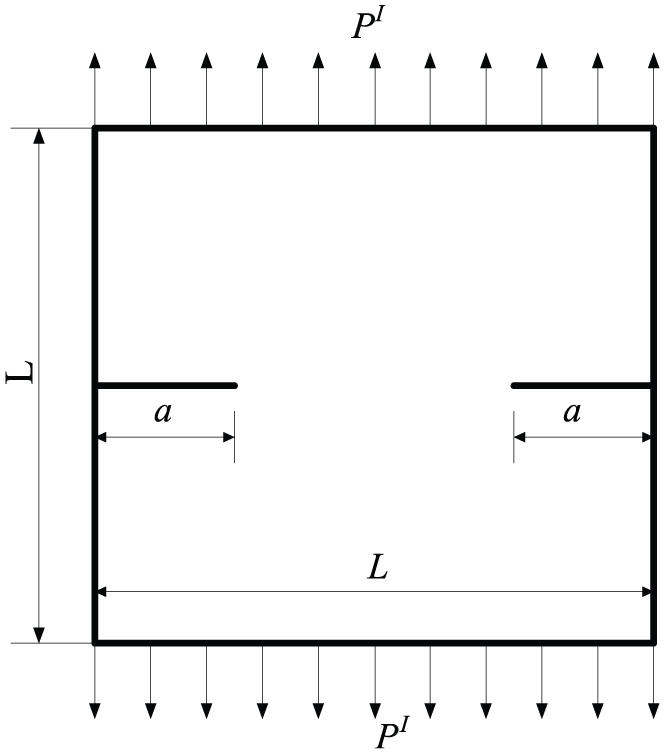
Double-edged cracked plate under mode I loading.
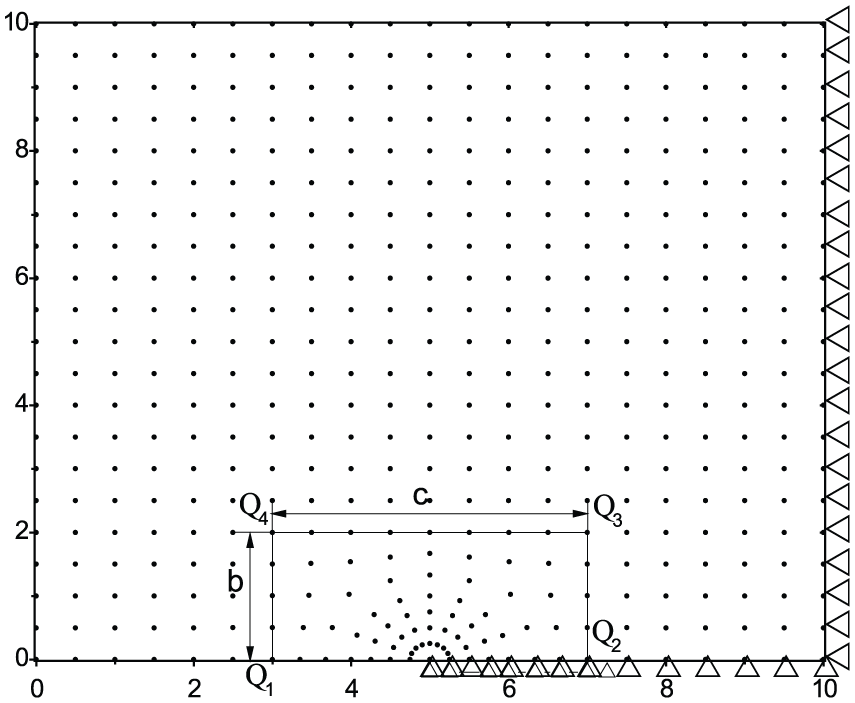
Lay-outs of nodes, boundary conditions and the J-integration domain.
The interval of the stress intensity factor is

Stress interval ahead of the crack tip.
Conclusion
We proposed the IEFGM after investigating interval mathematics and combining with the inner product space and element-free Galerkin method. The IEFGM only needs the node information, without requirement for element connectivity. The interval number decomposition was used to solve the interval equilibrium equations. The interval J-integration formula was deduced in detail. Several numerical calculations examples including a bar under uniform load, a bi-material cantilever beam subjected to uniform stress, and collinear double edged cracked plate subjected to uniform tensile stress, including uncertainty parameters all show that IEFGM is accurate and effective in solving uncertainty problems.
Footnotes
Handling Editor: Kai Bao
Declaration of conflicting interests
The author(s) declared no potential conflicts of interest with respect to the research, authorship, and/or publication of this article.
Funding
The author(s) disclosed receipt of the following financial support for the research, authorship, and/or publication of this article: This work was financially supported by the National Natural Science Foundation of China (grant no. 11502092), Jilin Provincial Department of Science and Technology Fund Project (grant no. 20160520064JH, 20170101043JC), supported by the Fundamental Research Funds for the Central Universities.