The general shallow wave equation can be used to describe the fluid motion which own uniform density and nearly uniform speed. In fact, these problems we face in nature do not satisfy these conditions, for example, the motion system of nonlinear rotation fluid governed by the frictional dissipation as well as the atmosphere system with greater viscosity. In these conditions, we need to amend the general shallow wave equation and consider the dissipative and viscous effect. In this article, starting from the shallow wave equation with dissipative and viscous effects in the horizontal direction, by virtue of plane approximation and quasi-geostrophic approximation of large-scale motion, we derive the dissipative Petviashvili equation to describe the two-dimensional Rossby waves. Based on the ansatz function method, we obtain the exact analytical solutions of dissipative Petviashvili equation and discuss the influence of dissipation on the two-dimensional Rossby waves.
As is well known, the basic equations describing the motion of two-layer barotropic fluid is the following nondimensional shallow water wave equations1
where express the wind speed in the x and y direction, respectively; t denotes time; g is the gravitational acceleration; H and h represent the average and perturbation height of fluid, respectively; and f is the Coriolis parameter. Equation (1) includes two kinds of waves, that is, inertial-gravity waves and Rossby waves. These two kinds of waves reflect the motion of fluid under the influence of gravity and rotation in the rotation earth, so they have important meaning for fluid dynamics.
For convenience, people commonly use the following potential vorticity equation1 instead of the above shallow water wave equations
where is called as relative vorticity and is called as absolute vorticity. From equation (2), it is easy to find that the potential vorticity
is conserved without other effects. Meanwhile, we note that because f is constant, with the increasing of the free surface height h, the absolute relative vorticity also increases to remain potential vorticity conserved; if h remains constant, the stretching of planetary vorticity f can produce the relative vorticity . Because of the simplicity, the potential vorticity equation (2) can be used widely to deal with many problems and is regarded as a powerful theoretical tool in the field of atmosphere and ocean.
But in the spit of the above-mentioned advantage, we also find that equation (2) contains three variables , in fact, it is still difficult to get analytical solutions. With the development of theory, for the large-scale motion in the mid-latitude atmosphere and ocean, the quasi-geostrophic potential vorticity equation is also derived and becomes an important theoretical basis for understanding the dynamics of atmosphere and ocean. On the basis of quasi-geostrophic potential vorticity equation, after a series of reduction, the authors in Zhao and Liu2 derived the Petviashvili equation as an ageostrophic extension of the barotropic quasi-geostrophic potential vorticity equation. Furthermore, the analytical solutions of Petviashvili equation were also given by employing the extension Jacobi elliptic function method.3
We need emphasis that the dissipative and viscous effects are neglected in Zhao and Liu.2 Since 1960s, many authors discussed the nonlinear wave motion in the middle-low atmosphere,4–9 as we know, the atmosphere and ocean are both nonlinear rotation fluid dynamics systems driven by external forcing and governed by frictional dissipation. So frictional dissipation, external forcing, nonlinear advection, rotating field, as well as gravity field constitute the basic features of atmosphere and ocean motion. In fact, Lindzen10 found that the breaking of gravity wave can produce wave damping in the middle atmosphere; furthermore, Holton and Wehrbein11 pointed that the breaking of gravity wave can supply most frictional dissipation for stratosphere and middle atmosphere and describe the dissipation process using Rayleigh friction parameterization; Hirst12 also employed Rayleigh friction to research large-scale pattern. The research of Fedorov13 indicated that the dynamics behavior of upper atmosphere is decided by nonlinear and molecule viscous loss, the Rayleigh friction increases with the rising of altitude and the viscous friction increases with the rising of temperature in middle atmosphere. Except the bottom of stratosphere, the order of magnitudes of Rayleigh friction coefficient and viscous friction coefficient are both . In some conditions, the difference between the nonlinear term and dissipative term is very small, so the dissipation common cannot be omitted.
In this article, starting from the shallow water wave equations with viscous and friction dissipation, the dissipative potential vorticity equation will be derived and conserved state will be analyzed; meanwhile, the dissipative Petviashvili equation will be also derived to describe two-dimensional Rossby waves. By observation, we can find that the extension Jacobi elliptic function is invalid to solve the dissipative Petviashvili equation. Here, we will use the ansatz method to seek the exact analytical solutions of dissipative Petviashvili equation. The plan of the article is as follows. In section “Derivation of dissipative Petviashvili equation,” we will derive the dissipative potential vorticity equation and dissipative Petviashvili equation and analyze the conserved state; the qualitative analysis on the dissipative Petviashvili equation will be placed in section “The qualitative analysis of dissipative Petviashvili equation.” Section “The analytical solutions of dissipative Petviashvili equation” will be devoted to derive the exact analytical solutions of dissipative Petviashvili equation by ansatz method, and different conditions will be discussed and some shock wave and solitary wave solutions will be given. Finally, some conclusions will be placed in section “Conclusion.”
Derivation of dissipative Petviashvili equation
For the shallow water model, the motion equations including viscous and friction dissipation can be written as14
where denotes viscous effect and is a kind of internal friction caused by the viscosity of air molecules, and is called as viscosity coefficient of molecules motion. The influence of internal friction on the airflow can be expressed with Reynolds number Re, and Re is the ratio of advection term and internal friction term, express friction dissipation, and is Rayleigh friction coefficient. Rayleigh friction parameterization can describe damping dissipation function in the process of motion. The model reflects that the vertical scale is much less than the level scale and quasi static equilibrium, and Coriolis force and pressure gradient force are the main acting forces in large-scale atmosphere motion, especially the viscous and friction dissipation effects are considered.
The difference between atmosphere and other fluids motion manifest as the vorticity characteristic. No matter small-scale or large-scale systems, many real atmospheric phenomena observed by scientists all show vorticity characteristic. Vorticity is a vector and suitable to describe the feature of the vortex vector. In order to reflect the vector feature and variation of vorticity, it is necessary to derive the governing equation of vorticity variation.
Taking the partial derivative of the first equation in equation (4) on variable y and the second equation on variable x and carrying out subtraction for the two obtained equations can lead to
Let and make use of the plan approximate, then equation (5) can be reduced to
then we have
By analyzing equation (7), we can find that the first term on the right side expresses the horizontal divergence. When divergence happens, the horizontal divergence is positive, the local relative vorticity decreases; when convergence happens, the horizontal divergence is negative, the local relative vorticity increases. The second term on the right side of equation (7) denotes effect, , advection effect of geostrophic vorticity. When the fluid moves toward north, the local relative vorticity decreases; on the contrary, the local relative vorticity increases. Based on equation (7), by analysis, we can find that the viscosity and friction dissipation result in variation of local relative vorticity in two different directions. Furthermore, equation (7) can be rewritten as
which shows that the variation of the absolute vorticity is caused by divergence and two kinds of dissipations. When the divergence and dissipation are absent, the absolute vorticity is conserved; when the divergence is absent and the dissipation is present, we have
From equation (9), we can find that the influence of viscosity and friction on the absolute vorticity is opposite, and the viscosity causes the absolute vorticity increase and the friction makes it decrease.
The vorticity equation is derived from the level motion equation, and it has more advantage than motion equation in the area of forecasting the variation of large-scale motion. Because the large-scale motion is quasi-geostrophic, the local variation terms and are less an order than other terms, such as Coriolis force term and pressure gradient force term. As a prediction equation, it is difficult to obtain the value of and accurately. While, for the vorticity equation, the local variation term , advection term, geostrophy variation term, and divergence term are of the same order, it can be calculated accurately. So the vorticity equation (9) is usually applied instead of the shallow water motion equation (4).
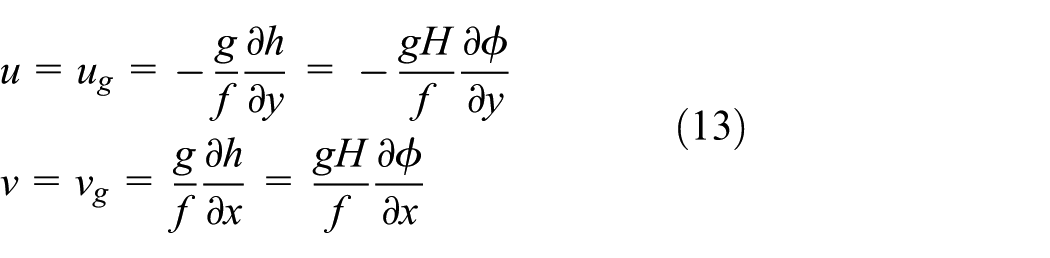
where is the Rossby radius of deformation, and are the two-dimensional Laplace and Jacobian operators, respectively. In the derivation process of equation (14), the following assumptions are used
The above assumptions are valid only when . As is well known, the condition is valid with high accuracy for the large-scale quasi-geostrophic motion. Let’s define as the characteristic length scale of x and y and as the characteristic scale of time t, then equation (14) can be turned into the following nondimensional form
Because
we have
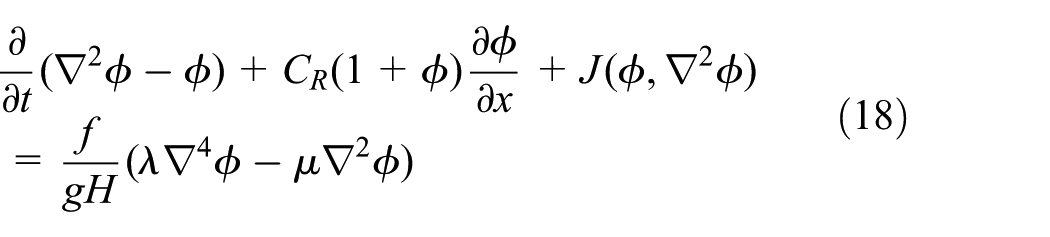
where is the nondimensional phase speed of the linear Rossby waves. Equation (18) is a partial differential equation including a scalar nonlinear term and a vector nonlinear term as well as dissipation terms. When the dissipation is absent, equation (18) deduces to Petviashvili equation, so we call equation (18) dissipative Petviashvili equation.
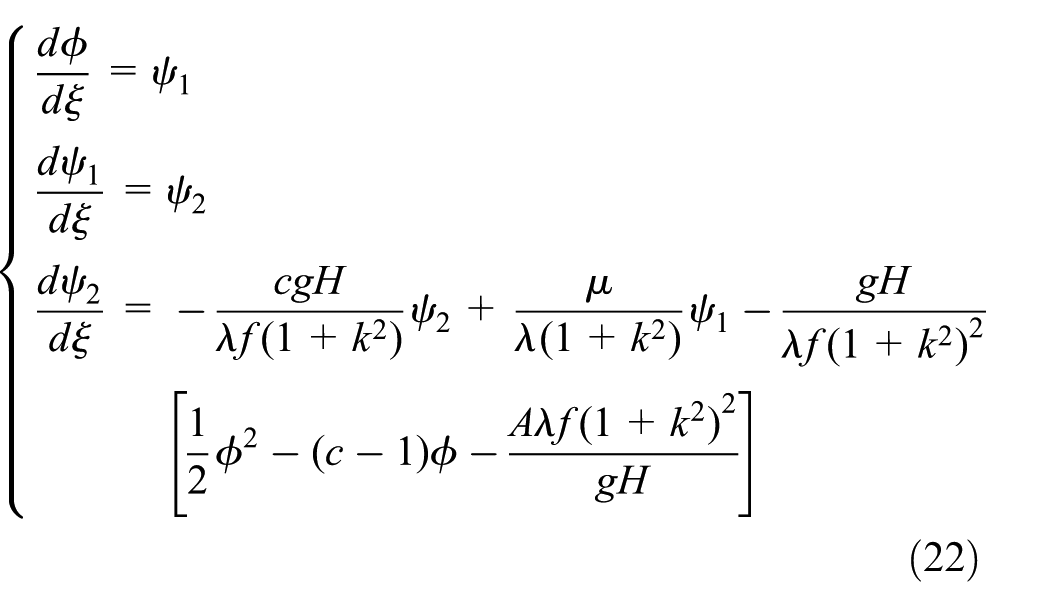
The qualitative analysis of dissipative Petviashvili equation
when , the first equation of (26) has a real root and two conjugate imaginary roots, P is focus point or saddle-focus point; when , the first equations of (26) have three real roots, P is nodal point or saddle-node point. In a similar way, when , the two equations of (26) have a real root and two conjugate imaginary roots, Q is focus point or saddle-focus point; when , the two equations of (26) have three real roots, Q is nodal point or saddle-node point.
The analytical solutions of dissipative Petviashvili equation
In order to obtain the exact analytical solutions of equation (18), taking
For equation (30), when and are both zero, that is, and are both zero, by balancing the highest order derivative term and nonlinear term, the authors have obtained the exact analytical solutions based on the extension Jacobi elliptic function method,2 Backlund transformations,15 Binary Bell polynomial,16 Rational function,17 and so on.18–20 But when the viscous and friction dissipation are present, the extension Jacobi elliptic function method is invalid, so here we adopt the ansatz function method.21–23 Assuming
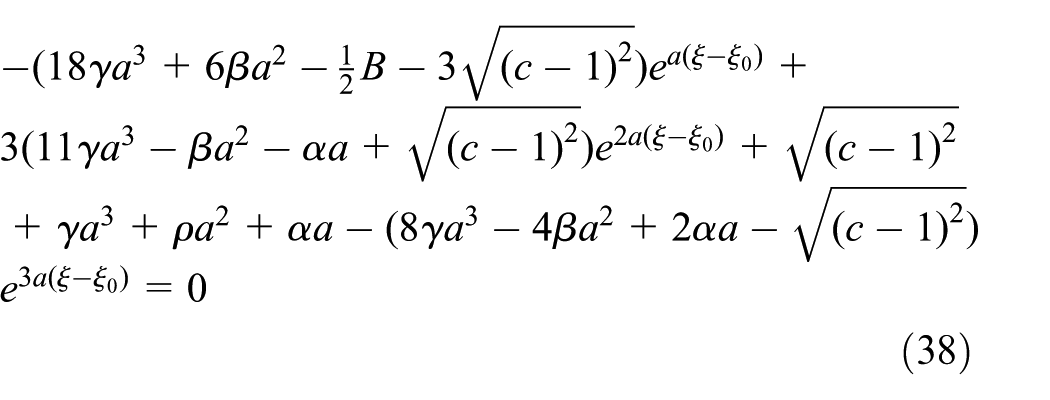
where are all undetermined constants and is regarded as integration constant. Substituting equation (31) into equation (30), we have
then we can obtain an exact analytical solution of dissipative Petviashvili equation
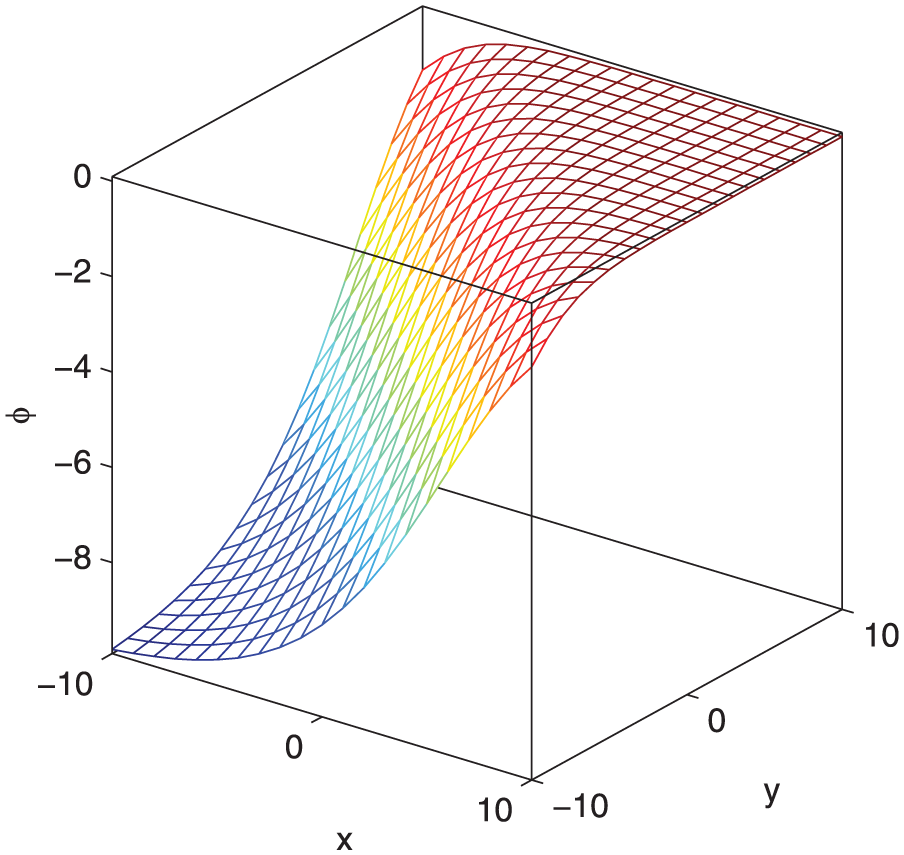
From equation (36), we can find that when and when . So the explicit traveling wave solution (36) is a shock wave solution of dissipative Petviashvili equation. Furthermore, and , so the shock wave solution is saddle-saddle heteroclinic orbit of linking the two saddle points P and Q.
Introducing , as well as the integration constant into equation (36), we obtain
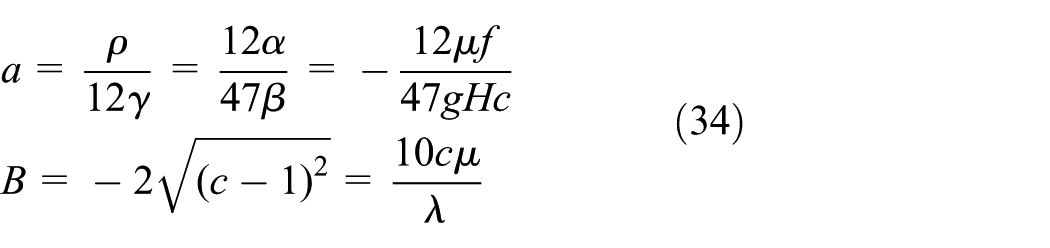
For the large-scale motion, these parameters in equation (37) have the following scale and numerical value.
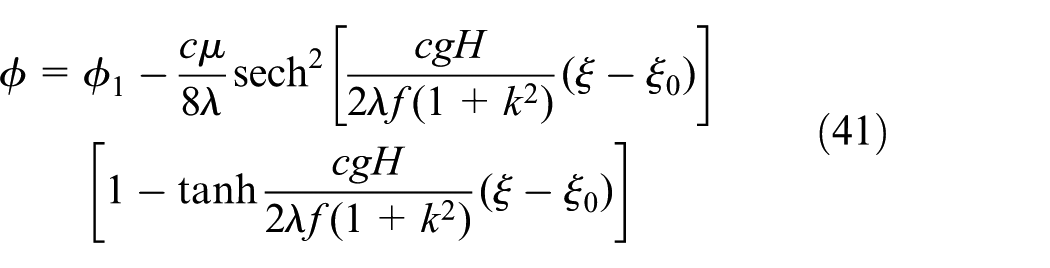
then we can obtain the other one exact analytical solution of dissipative Petviashvili equation
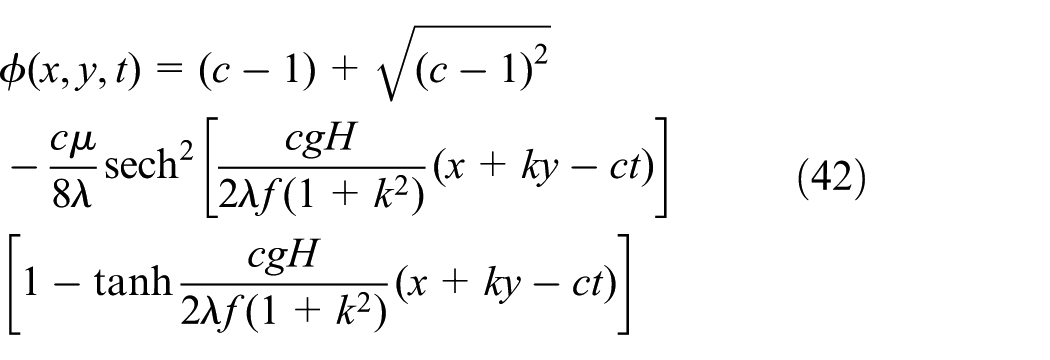
From equation (41), we can find that when . So the explicit traveling wave solution (41) is a solitary wave solution of dissipative Petviashvili equation. Furthermore, and , so the solitary wave solution is a homoclinic orbit of starting from the saddle point P and returning to the saddle point P.
Introducing and as well as the integration constant into equation (41), we obtain
In this article, starting from the shallow wave equation with dissipative and viscous effects in the horizontal direction, the vorticity equation with friction dissipation and viscous effect is first derived. By analyzing the vorticity equation, we can find that the influence of viscosity and friction on the absolute vorticity is opposite, and the viscosity causes the absolute vorticity increase and the friction makes it decrease. Furthermore, by virtue of plane approximation and quasi-geostrophic approximation of large-scale motion, the dissipative Petviashvili equation to describe the two-dimensional Rossby waves is also derived. Based on the ansatz function method, we obtain a shock wave solution and a solitary wave solution of dissipative Petviashvili equation. The results show that the shock wave solution is saddle-saddle heteroclinic orbit of linking the two saddle points P and Q and the solitary wave solution is a homoclinic orbit of starting from the saddle point P and returning to the saddle point P.
Footnotes
Handling Editor: Roslinda Nazar
Declaration of conflicting interests
The author(s) declared no potential conflicts of interest with respect to the research, authorship, and/or publication of this article.
Funding
The author(s) disclosed receipt of the following financial support for the research, authorship, and/or publication of this article: This work was supported by National Natural Science Foundation of China (Nos 41576023 and 11701334), China Postdoctoral Science Foundation funded project (2017M610436), Open Fund of the Key Laboratory of Meteorological Disaster of Ministry of Education (Nanjing University of Information Science and Technology) (No. KLME1507), Open Fund of the Key Laboratory of Ocean Circulation and Waves, Chinese Academy of Sciences (No. KLOCAW1401), and Young Teachers Support Program of SDUST (No. BJ162).
References
1.
PedloskyJ.Geophysical fluid dynamics. New York: Springer, 1979.
2.
ZhaoQLiuSS.Application of Jacobi elliptic functions in the atmospheric and oceanic dynamics: studies on the two-dimensional nonlinear Rossby waves. Chin J Geophys2006; 49: 965–970 (in Chinese).
3.
LiuSKFuZTLiuSDet al. Jacobi elliptic function expansion method and periodic wave solutions of nonlinear wave equations. Phys Lett A2001; 289: 69–74.
4.
RhinesPB.Waves and turbulence on a beta-plane. J Fluid Mech1975; 69: 417–443.
5.
Longuet-HigginesMSGillAE.Resonance interactions between planetary waves. Proc Roy Soc A1967; 299: 120–144.
LuoDH.A theory of blocking formation in the atmosphere. Sci China Ser B1990; 33: 69–79.
8.
TanBKBoydJP.Dynamics of the Flierl-Petviashvili monopoles in a barotropic model with topographic forcing. Wave Motion1997; 26: 239–251.
9.
YangHWXuZHYangDZet al. ZK-Burgers equation for three-dimensional Rossby solitary waves and its solutions as well as chirp effect. Adv Diff Equ2016; 2016: 167.
HoltonJRWehrbeinWM.Estimates of the stratospheric residual circulation using the downward control principle. Chin J Geophys1993; 98: 10465–10479 (in Chinese).
12.
HirstAC.Unstable and damped equatorial modes in simple coupled ocean-atmosphere models. J Atmos Sci1986; 43: 606–632.
13.
FedorovYI.Charged particle acceleration in the front of the shock wave bounding supersonic solar wind. Kin Phys Cele2014; 30: 109–125.
14.
BreschDFernández-NietoEDGladysNRet al. Numerical validation of a bilayer viscous model for Shallow Water equations. Comput Model Eign Sci2009; 43: 27–71.
15.
WangYHChenY.Bäcklund transformations and solutions of a generalized Kadomtsev-Petviashvili equation. Commun Theor Phys2012; 57: 217–222.
16.
WangYHChenY.Binary Bell polynomial manipulations on the integrability of a generalized (2+1)-dimensional Korteweg-de Vries equation. J Math Anal Appl2013; 400: 624–634.
17.
LüXMaWXKhaliqueCM.Solitary waves with the Madelung fluid description: a generalized derivative nonlinear Schrödinger equation. Commun Nonlinear Sci2016; 31: 40–46.
18.
MaWXYouYC.Solving the Kortewegde-Vries equation by its bilinear form: Wronskian solutions. T Am Math Soc2005; 357: 1753–1778.
19.
ZhangLJKhaliqueCM.Traveling wave solutions and infinite-dimensional linear spaces of multiwave solutions to Jimbo-Miwa equation. Abs Appl Anal2014; 2014: 963852.
BiwasA.1-Soliton solution of the generalized Zakharov-Kuznetsov equation with nonlinear dispersion and time-dependent coefficients. Phys Lett A2009; 373: 2931–2934.
22.
BiwasAEssaidZ.Solitary wave solution of the Zakharov-Kuznetsov equation in plasmas with power law nonlinearity. Nonlin Anal Real World Appl2010; 11: 3272–3274.
23.
KrishnanEVBiwasA.Solutions to the Zakharov-Kuznetsov equation with higher order nonlinearity by mapping and ansatz methods. Phys Wave Phenom2010; 18: 256–261.