A forced KdV equation including the special topography effect is derived to describe nonlinear long wave and solitary eddy based on the quasi-geostrophic potential vorticity model. We obtain the theoretical solution of the equation and the concrete form of stream function through perturbation theory and multi-scale analysis methods. It is found that the joint effect of weak shear basic flow and topography can change the cyclone and anticyclone structure of eddy, and in the meantime topographic structure affects the East-West propagation direction of solitary wave. Finally, according to the interaction between nonlinear long wave and topography by pseudo spectral numerical method, the topographic height is related to the amplitude, wavelength and wave velocity of the excited wave train, and the topography affects not only the spatial structure of wave, but also the amplitude of wave.
In the past few decades, many scholars have explored various spatiotemporal waves in geophysical fluids. Nonlinear Rossby waves have occupied an important place in the atmosphere and ocean.1–6 In particular, much attention has been paid to the Rossby solitary wave. Subsequently, some scholars continue to study the propagation characteristics of solitary wave and get some important conclusions. For example, the solitary waves have been investigated in the mid-atmosphere where the African easterly waves were propagated.7 The importance of nonlinear wave was also researched in oceanography. During winter the Kuroshio tends to cross Luzon Strait, and some nonlinear internal waves in the deep basin of the South China Sea have been evaluated for their generation and evolution. Park and Farmer8 and Zhang et al.9 discussed the propagation of the coherent structure of the nonlinear barotropic interaction of two-layer fluids in geophysics. Moreover, some forcing factors such as topography are very important in large scale motion, so the influences of topography on Rossby solitary wave also attract more attention. Solitary Rossby waves induced by linear topography in barotropic fluids with a shear flow are studied.10 The large-scale topographic effect even would affect global atmosphere circulation.11,12 The evolution of the amplitude of the nonlinear Rossby wave under the effect of topography and dissipation satisfies the inhomogeneous Benjamin-Davis-Ono-Burgers (BDO-Burgers) equation.13 What’s more, Yang et al.14 and Wang et al15 derived some new equations governing the behavior of Rossby solitary waves with the effect of topography, and discussed the changes of nonlinear long wave amplitude and waveform with numerical method. Zhang et al.16 investigated the dynamics of nonlinear Rossby waves in zonally varying background current under generalized beta approximation, and the spatial-temporal slowly varying topography, which represented an unstable mechanism for the evolution of Rossby solitary waves, was a factor in linear growth or decay.
At the same time, the Korteweg-de-Vries (KdV) equation bears solitary wave solutions, and it ensures the existence of Rossby solitary waves. Song et al.17 have defined the domain in the shallow water -plane model where the necessary and sufficient conditions for the existence of the KdV-type solitary Rossby wave are satisfied. Further, isolated eddy models in geophysics were discussed to explain isolated, nonlinear atmospheric, oceanic, and planetary phenomena.18,19 Das20 derived a modified-KdV (mKdV) equation for such problem. What’s more, Redekopp and Weidman21 obtained KdV and mKdV models in two-layer fluid, and gave the conditions for the formation of shear flow and Rossby solitary wave. Boyd22,23 derived KdV and mKdV equations describing equatorial Rossby solitary waves from the original hydrodynamic equations. Benney24 and Yamagata25 first derived the nonlinear equation to describe the large-scale nonlinear modulated wave train in the middle and high latitude atmosphere.
The study of the exact solutions to nonlinear equations is of great importance. For a long time, there is no unified solution for the nonlinear evolutions because of their complex and changeable non-linearity. In the solitary wave models community, the important problem is to obtain the exact solution of the isolated wave model through various solution methods, and to analyze the features of the isolated wave during the propagation process on the basis of the exact solution. To date, many fundamental properties of the equation have been studied from the equation itself, including the Hamiltonian structure,26 and Borel-measurable Markov jump systems.27 A great deal of work has been carried out by many mathematicians and physicists on nonlinear equations, and they have found a variety of complex solution methods, such as sine-cosine method,28-expansion method,29 Darboux transformation method,30 Jacobi elliptic function expansion method,31,32 Bäcklund transformation method,33,34 and so on.
Further, combined ZK-mZK equation is derived to reflect the propagation of Rossby waves on the plane which is more appropriate for the real ocean and atmosphere than the dimensional models.35 Recently, a few new kinds of nonlinear equations, such as higher order nonlinear Schrödinger equation, mZK equation and KdV-ILW-Burgers equation were derived.36–38 Most results indicated that all the above models can describe the characteristics of solitary waves to a certain extent. In the specific research process, we need to deduce the optimal model according to the actual application background and parameter characteristics.
Theoretical analysis and methods
In this section, starting from the quasi-geostrophic potential vorticity equation, we derive a mKdV model equation for the spatial-temporal evolution of nonlinear Rossby wave with effects of topography. We derive the asymptotic solution of meridional structure. Combining low-order meridional structure and high-order amplitude mode, the vortex structures of cyclones and anticyclones are given according to the stream function.
Mathematical model and boundary conditions
Based on the quasi-geostrophic barotropic model in the paper,39 it is given the vorticity equation including the topography.
where is the stream function, , is the planetary vorticity with its meridional gradient , is the local Coriolis parameter, is the two-dimensional Laplace operator, is the topography effect. Dimensional analysis of a series of elements,
Derivation the nonlinear Rossby wave and the mechanism of solution
The basic flow is zonal flow, and the whole flow function is
where is the zonal background flow, is wave speed, is the perturbed one, is a small parameter to measure the strength of nonlinearity. If , it becomes a weakly nonlinear problem. Substituting equation (6) into equation (4), we get
To find the asymptotic solution of the weakly nonlinear problem (), we introduce slowly varying coordinates
We assume that the meridional direction is the main part and the zonal disturbance for the topographic effect,
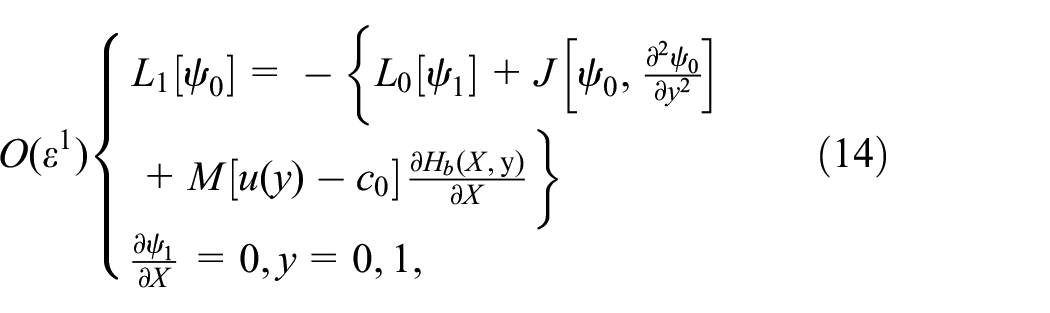
We substitute equations (8), (9) into equation (7), and classify them according to the small parameter ,
where The perturbation stream function is expanded by small parameter perturbation as follows,
For the velocity , this is a variable coefficient problem, and it is difficult to derive an analytical solution generally. This order has no dispersion effect. In order to determine amplitude , it is also necessary to solve the higher-order problem.
here
Let be the solution of a separable variable in the form of . According to equation (5), we can derive
According to equations (13), (15)–(17), the singularity elimination condition can be obtained
Namely
Finally, we get
where
The right end of equation (20) contains a non-homogeneous term, and we will discuss this model numerically later. If there is no forced term , equation (20) degenerates into
as a standard KdV equation.
We derive the exact solution in progressive wave form of equation (26). Let , , and represents the velocity of progressive wave in slow variable space. Finally, we can find the exact solution.
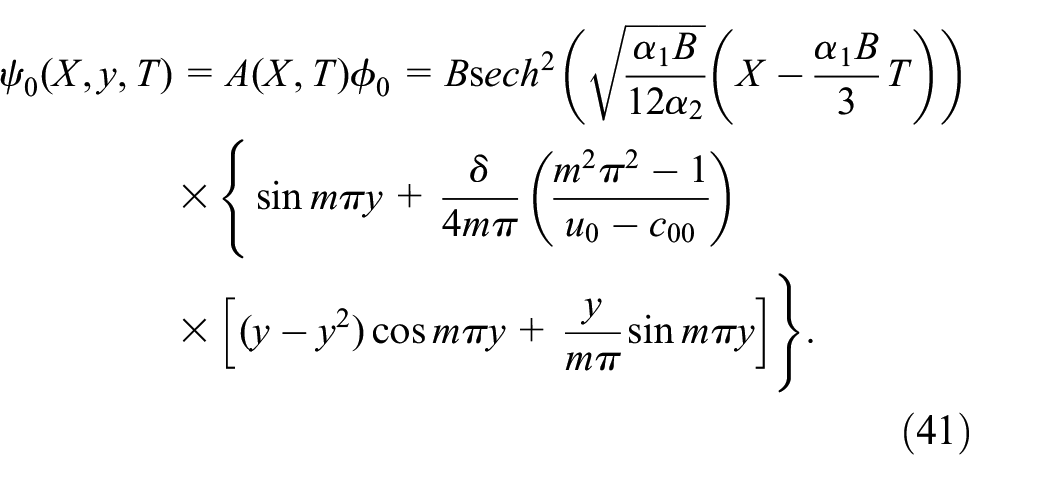
where represents the amplitude of the solitary wave, is the velocity of progressive wave, and is the width of the waves, the values of and are related to topographic effect, meridional structure, -effect and other factors in equations (14), (15). It can be seen clearly that the condition for the existence of solitary waves is
If , there are crest solitary waves. Otherwise, if , only trough solitary waves exist. It can also be seen from equation (28) that the symbols of variable and variable are the same. In the case of isolated Rossby waves in this paper, it is easy to see from equation (22) that when the shear of the background flow is not too strong, and , so . At this point, we focus on the influence of topography on wave propagation direction
, , so , , finally , it indicates that the isolated Rossby wave propagates westward.
is downhill terrain with large slope, so , , , and , finally , therefore, the propagation direction of isolated Rossby wave changes to eastward due to the effect of topography.
Approximate solution of meridional structure
The weak shear flow and topography are given: , , , is a constant. The eigenvalue problem of equation (13) is considered to be a variable coefficient problem, so we set
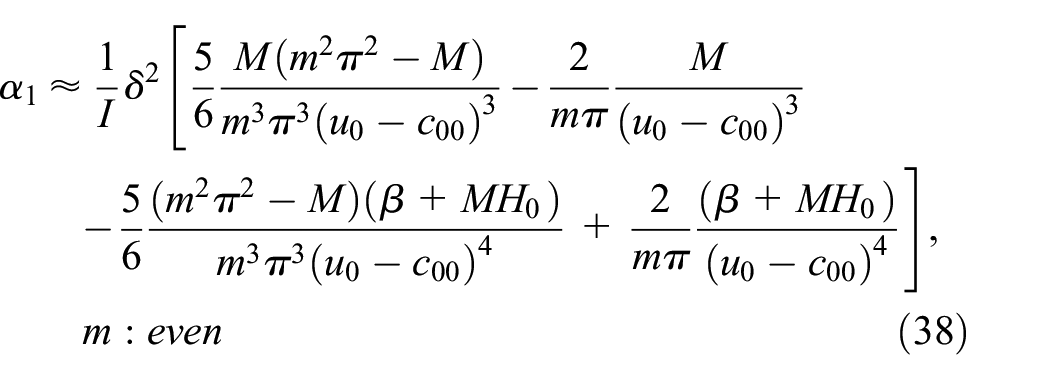
Now we continue to calculate the coefficients in equation (26). According to the asymptotic solution equation (35), we can obtain the approximate expressions for ,
The isolated vortex structure based on the influence of topography (only the case the meridional wave number )
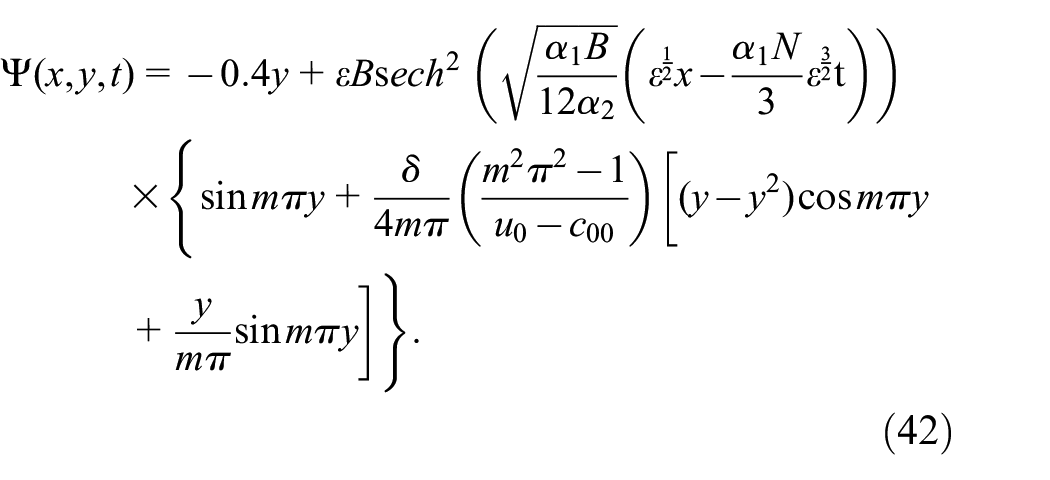
In oceanic large-scale fluid motion, with a latitude of , let , considering the correlation coefficient of given base flow and equation (14), at the same time, We discuss topography parameters separately (1): , after calculation , (2): , through similar calculations, . For , , we get
We calculate the value of the stream function according to the given parameters. Figure 1(a) and (b) show Vortex structure for stream function . Under the combined action of weak shear basic flow and topography, the vortex on the north side is a cyclone in Figure 1(a), and the corresponding anticyclone ring is on the south side with dense contours at the center of symmetry. Due to the change of topographic state, the vortex on the north side in Figure 1(b) is an anticyclone, and the corresponding cyclone ring on the south side. This symmetrical isolated vortex extremely with a long lifetime cycle is the nonlinear steepness caused by the interaction of finite amplitude vortex and background basic flow shear, which maintains the energy dispersion of disturbance and can explain the phenomenon of Gulf Stream vortex in the ocean from the mechanism.
Vortex structure for stream function: (a) and (b) .
If there is no zonal flow shear and topographic effect in the derivation results of the higher-order model, the coefficient in equation (20), and the disappearance of nonlinear term makes it impossible to excite solitary waves. In addition, it can be obtained that even if there is no zonal shear, the topographic effect can ensure the generation of nonlinear effect. In large-scale atmospheric motion, this theory can explain the phenomenon of atmospheric blocking well, which confirms the type and the lifetime according to the parameters.
Results and discussion
In this section, we consider the non-homogeneous term at the right end of the forced KdV model, which is affected by the topography. Through the pseudo spectral numerical method, we simulate and obtain the variation waterfall plots of the waves forced by different topographic effects.
Numerical method
To approximate equation (20) numerically, we discretize the spatial dimension in it, and find out the numerical solution based on the Pseudo-spectral method.40 Combined with the discrete Fourier transform, we use the fourth-order Runge Kutta method to improve the accuracy (see Appendix A).
The effects of topography
In oceanic large-scale fluid motion, with a latitude of , let , , , regarding the correlation coefficient of given base flow and equation (14).
For the case , (meridional wave number )
Let , , and the coefficients in the equation (20) be , , , or , , and we provide the initial condition . Figures 2 and 3 show the numerical results. Figure 2(a) and (b) show that the wave excited by the topography is a steady trough solitary wave in the topography forcing area. Its amplitude increases with time slightly at the beginning. A modulated elliptic cosine wave train is generated downstream, and no wave is generated upstream (). Figure 3(a) and (b) reflect the characteristics of solitary waves excited by topography clearly (). The upward convex topography grows a steady crest solitary wave in the forced region, and a similar modulated wave train is generated downstream. Comparing Figures 2 and 3, the main effect of the increase of topography height on the generated fluctuation is to increase the amplitude of steady soliton and downstream modulated wave train greatly in the terrain forcing area. The higher the topography, the shorter the excited modulated elliptic cosine wavelength.
The wave excited by the topography: (a) H0=5, h0= - 0.5, T=20 and (b) T=0 to 20.
The wave excited by the topography: (a) H0=5, h0=0.7, T=20 and (b) T=0 to 20.
For the case , (meridional wave number )
Let , , and the coefficients , in the equation (20) are , , , or , . We provide the initial condition , and Figure 4(a) and (b) show the numerical results. For , other parameters remain unchanged, and we get . The results show that the solitary wave propagates downstream excited by the topography, but the modulated cosine wave train propagates upstream, which is in the opposite direction to Figures 2 and 3. In addition, the trough solitary wave amplitude excited downstream gradually increases and tends toward stability in Figure 4(a), while crest solitary waves appear in the topographic forcing area, and the amplitude increases with time obviously. It can be seen from Figure 4(b) that two separately propagating crest solitary waves are excited downstream, and the downstream amplitude is larger with the change of time. Comparing Figure 4(a) with Figure 4(b), the higher of the topography, the shorter the wavelength of the excited upstream modulation wave train and the faster with propagation speed.
The wave excited by the topography in weak shear flow: (a) h0= - 0.5 and (b) h0=0.7.
The wave excited between mobile solitary waves and topography forcing effect
We only take , , , , , , and the initial conditions of equation (20) is given . Figure 5(a) and (b) show the evolution law of the wave with time after the interaction between the mobile solitary wave and the topography. Under the interaction between the initial trough solitary wave and the Gaussian terrain, the trough solitary wave is excited near the right side of the terrain, and the amplitude increases with time. A more complex wave train is growing in this area, and an elliptical cosine wave train with small amplitude is generated downstream of the forced area. Under the interaction of moving solitary waves, the amplitude gradually increases and tends toward stability. Elliptic cosine dissipative wave train will be generated upstream of the topographic area gradually, and the amplitude of topographic excited solitary wave will decrease with the time.
The wave excited by mobile solitary waves and topography: (a) T=0, T=5, T=15 and (b) T=0 to T=15.
Conclusion
This paper derives a forced KdV equation with topography based on the quasi-geostrophic barotropic model by the multiple scale method, and the influence of topographic action on the positive and negative parameters of KdV equation is discussed. Further, we discuss the cyclone and anticyclone structures represented by the stream function. Finally, the propagation law of wave under topographic forcing is numerically simulated by the pseudo-spectral method.
In the forced solitary wave model, the topographic parameters are related to the coefficients of nonlinear term and dispersion term in the model. Therefore, different topographic parameters may excite trough and peak solitary waves. In addition, the change of topographic parameters will change the vortex structure corresponding to the stream function.
The relationship between the change of topography variable of and the coefficient of forced KdV equation has an effect on the numerical solution of whole model. So, the topography affects not only the spatial structure of wave, but also the amplitude of wave. For the meridional wave number , the weak shear flow and topographic forcing will excite the solitary wave and modulate cosine wave train, and the topographic height is related to the amplitude, wavelength and wave velocity of the excited wave train.
We have discussed the effects of several types of topographic forcing on wave train propagation, but don’t verify the Gulf Stream vortex in the actual ocean area. In addition, in the fluctuating meridional structure , the parameters of the model will change, and the vortex structure represented by the stream function will also be different, but ignoring the question in this paper. We will conduct in-depth research on the above problems in the further work.
Footnotes
Appendix A
We divide the interval into evenly spaced grid points defined by , for , the discrete Fourier transform is , let
the inverse discrete Fourier transform can be expressed as
further
, . Finally, the fourth-order Runge Kutta method for time ,
Let
Handling Editor: Chenhui Liang
Declaration of conflicting interests
The author(s) declared no potential conflicts of interest with respect to the research, authorship, and/or publication of this article.
Funding
The author(s) disclosed receipt of the following financial support for the research, authorship, and/or publication of this article: This project was supported by Funded by Key Laboratory of Ministry of Education for Coastal Disaster and Protection, Hohai University (Grant No. 202201), the National Natural Science Foundation of China (Grant No. 41806104; 41906008).
Shi-kuoLBen-kuiT. Rossby waves with the change of β. Appl Math Mech1992; 13: 39–49.
2.
JianSLian-GuiY. Modified KdV equation for solitary Rossby waves with β effect in barotropic fluids. Chin Phys B2009; 18: 2873–2877.
3.
MizutaG. Rossby wave radiation from an eastward jet and its recirculations. J Mar Res2009; 67: 185–212.
4.
LiYYuZChenY, et al. Two-dimensional fractional algebraic internal solitary waves model and its solution. Adv Mech Eng2019; 11: 1–9.
5.
YangYSongJ. On the generalized eigenvalue problem of Rossby waves vertical velocity under the condition of zonal mean flow and topography. Appl Math Lett2021; 121: 107485.
6.
ZhangPXuZLiQ, et al. The evolution of mode-2 internal solitary waves modulated by background shear currents. Nonlinear Process Geophys2018; 25: 441–455.
7.
LenouoANkankam KamgaFYepdjuoE. Weak interaction in the African easterly jet. Ann Geophys2005; 23: 1637–1643.
8.
ParkJHFarmerD. Effects of Kuroshio intrusions on nonlinear internal waves in the South China Sea during winter. J Geophys Res2013; 118: 7081–7094.
9.
ZhangJZhangRYangL, et al. Coherent structures of nonlinear barotropic-baroclinic interaction in unequal depth two-layer model. Appl Math Comput2021; 408: 126347.
10.
YangLDaCSongJ, et al. Rossby waves with linear topography in barotropic fluids. Chin J Oceanol Limnol2008; 26: 334–338.
11.
LuoD. Topographically forced Rossby wave instability and the development of blocking in the atmosphere. Adv Atmos Sci1990; 7: 433–440.
12.
LuoD. A barotropic envelope Rossby soliton model for block–eddy interaction. Part I: effect of topography. J Atmos Sci2005; 62: 5–21.
13.
UchimotoKKubokawaA. Form drag caused by topographically forced waves in a barotropic β channel: effect of higher mode resonance. J Oceanogr2005; 61: 197–211.
14.
YangHYangDShiY, et al. Interaction of algebraic Rossby solitary waves with topography and atmospheric blocking. Dyn Atmos Oceans2015; 71: 21–34.
15.
WangJZhangRYangL. A Gardner evolution equation for topographic Rossby waves and its mechanical analysis. Appl Math Comput2020; 385: 125426.
16.
ZhangRYangLLiuQ, et al. Dynamics of nonlinear Rossby waves in zonally varying flow with spatial-temporal varying topography. Appl Math Comput2019; 346: 666–679.
BenneyDJ. Large amplitude Rossby waves. Stud Appl Math1979; 60: 1–10.
25.
YamagataT. The stability, modulation and long wave resonance of a planetary wave in a rotating, two-layer fluid on a channel beta-Planet. J Meteorol Soc Jpn1980; 58: 160–171.
26.
XuXX. An integrable coupling hierarchy of the Mkdv_integrable systems, its Hamiltonian structure and corresponding nonisospectral integrable hierarchy. Appl Math Comput2010; 216: 344–353.
27.
MaHWangY. Full Information H2 control of Borel-measurable Markov jump systems with multiplicative noises. Mathematics2021; 10: 37–13.
LiuXTianLWuY. Application of G′G. Appl Math Comput2010; 217: 1376–1384.
30.
ZhaoQLLiXYLiuFS. Two integrable lattice hierarchies and their respective Darboux transformations. Appl Math Comput2013; 219: 5693–5705.
31.
ParkesEJDuffyBRAbbottPC. The Jacobi elliptic-function method for finding periodic-wave solutions to nonlinear evolution equations. Phys Lett A2002; 295: 280–286.
32.
ZhaoQLiuSK. Application of Jacobi elliptic functions in the atmospheric and oceanic dynamics: studies on two-dimensional nonlinear Rossby waves. Chin J Geophys Chin Ed2006; 49: 965–973.
33.
ZedanHAAladrousEShapllS. Exact solutions for a perturbed nonlinear Schrödinger equation by using Bäcklund transformations. Nonlinear Dyn2013; 74: 1145–1151.
34.
MaWXStramppW. Bilinear forms and Bäcklund transformations of the perturbation systems. Phys Lett A2005; 341: 441–449.
35.
ZhaoBJWangRYSunWJ, et al. Combined ZK-mZK equation for Rossby solitary waves with complete Coriolis force and its conservation laws as well as exact solutions. Adv Differ Equ2018; 2018: 42.
36.
LuCFuCYangH. Time-fractional generalized Boussinesq equation for Rossby solitary waves with dissipation effect in stratified fluid and conservation laws as well as exact solutions. Appl Math Comput2018; 327: 104–116.
37.
YangHYinBZhongB, et al. Rossby solitary waves generated by wavy bottom in stratified fluids. Adv Mech Eng2013; 5: 1–10.
38.
YuDZhangZGDongHH, et al. Bäcklund transformation, infinite number of conservation laws and fission properties of an integro-differential model for ocean internal solitary waves. Commun Theor Phys2021; 73: 035005.
39.
PedloskyJ. Geophysical Fluid Dynamics. 2nd ed.New York, NY: Springer-Verlag, 1987.
40.
FornbergB. A practical guide to pseudo-spectral method. Cambridge: Cambridge University Press, 1996.