




Abstract
Using the magnetic fluids containing polymer additives as the lubricant with couple stress, this article first develops the lubrication model of the journal bearing considering the couple interaction between its squeeze dynamic effect and its rotating effect. The effects of the squeeze dynamic effect of journal bearing, magnetic fluids’ cohesion force, and magnetic fluids’ couple stress on the lubrication performance of journal bearing (the load-carrying capacity (S) and its attitude angle (ψ), the friction coefficient (Cf(R/c)), and the side leakage (Q)) has also been studied. The results above show that the maximum dimensionless film pressure (Pmax) along the bearing centerline increases as the increase of the squeeze dynamical effect parameter (q), magnetic fluids’ cohesion force coefficient (γ), and magnetic fluids’ couple stress parameter (L*); ψ decreases as the increase of q, the decrease of γ, and the increase of L*; S increases as the increase of q, γ, and L*; Cf(R/c) decreases as the increase of q, γ, and L*; Q decreases as the decrease of q, the increase of γ, and the increase of L*.
Keywords
Introduction
The mechanical properties in the viscous base liquids of magnetic fluids by mixing micro-solid particles suspension are usually different from the Newtonian fluids. The major reason is the presence of couple stress, which makes the stress tensor that is non-symmetric. For example, the electric fluids, blood, and lubrication oil with adding micro-high additives are all called as the classic couple stress fluids.1,2
Due to magnetic fluids having the similar physical and chemical properties of couple stress fluids,3,4 the article mainly investigated the lubrication performance of journal bearing lubricated by magnetic fluids with couple stress properties based on the magnetic fluids’ cohesion force and the squeeze dynamic effect combined with the rotating effect of the journal bearing.
Nowadays, the research on the lubrication effect of the journal bearing lubricated by the magnetic fluids (including magnetic Newtonian fluids and the magnetic couple stress fluids), which mainly considered the rotation effect of magnetic fluids’ journal bearing (journal bearing using the magnetic fluids as the lubricant). For example, on the magnetic fluids with Newtonian characteristics as a lubricant, Tipei 5 found that the load-carrying capacity of magnetic bearing and its active region increases as the increasing of the applied magnetic field parameters; Chang et al. 6 found that the rectified magnetic parameters of permanent magnets could decrease the attitude angle of the load-carrying capacity and the side leakage of the bearing, especially obvious on the medium and high eccentricity ratio (ε ≥ 0.5) of the bearing. Magnetic fluids as a lubricant could improve the dynamic stiffness and damping coefficients of the herringbone-grooved journal bearing, which could also make it work more stable. 7 On the magnetic fluids with couple stress characteristics as a lubricant, few works were mentioned. Das 8 pointed out that the increasing of magnetic fluids’ cohesion force coefficients and couple stress parameters could increase the maximum load-carrying capacity of journal bearing and decrease its coefficient with the incompressible, electrical, magnetic, couple stress fluids as a lubricant under the application of uniform magnetic field. Nada and Osman 3 analyzed the lubrication effect of magnetic fluids by regarding it as non-Newtonian fluids, and they found that the increasing of couple stress parameters on the particle size could increase the oil-film pressure of the bearing and its load-carrying capacity, along with the decreasing friction coefficient. Meanwhile, the increase in applied magnetic parameters could also increase the oil-film pressure of the bearing and its load-carrying capacity. There have been some other studies on the pure squeeze film effects of journal bearing lubricated by non-magentic fluids with couple stress such as Lin et al. 9 compared the squeeze film behavior of couple stress fluids with that of Newtonian lubricants by theoretical analysis. 10 Mokhiamer et al. 11 took the account of the elastic deformation of the liner into the lubrication effect of journal bearing lubricated by a fluid with couple stress.
According to the research above, it has been got that the application of the magnetic fluids’ journal bearing was mainly studied on the steady-state effect of the journal bearing rotating effect. However, the value of bearing load and its direction is variable in practice, which could vary the angular rotation speed (ωb) of bearing and the angular rotation speed (ωj) of journal. Therefore, the lubrication performance of the rotating effect of journal bearing or the squeeze effect of journal bearing alone is incomplete, and the effects of circumvolving in the circumferential direction and squeeze film behavior in the axial direction are considered simultaneously in this article, which is deficient in other research on the magnetic fluids’ journal bearing. Based on this, the lubrication performance of the journal bearing lubricated by magnetic fluids with couple stress based on the coupling effect between magnetic fluids’ cohesion force of journal bearing and its squeeze dynamic effect will be studied in this article.
The Reynolds equations of magnetic fluids’ journal bearing on the lubrication performance have been developed based on Stokes 12 micro-continuum theory, along with the couple effect of the journal bearing rotating effect and its oil-film squeeze dynamic effect. Based on this, the influence of magnetic field with axial symmetric gradient distribution on the magnetic lubrication oil-film pressure and its lubrication performance have been analyzed. The couple relationship of the influence above with the squeeze dynamical effect parameter (q) of journal bearing, magnetic fluids’ cohesion coefficient (γ), and magnetic fluids’ couple stress parameters (L*) have been also been discussed in the article. This is helpful to the optimum design basis of the magnetic fluids’ journal bearing for its lubrication performance.
Theoretical analysis
Model basis
The physical model of magnetic fluids’ journal bearing is stated in Figure 1. B is the width of the bearing, Rj is the radius of bearing journal, Rb is the inner radius of bearing; ε = e/c, where c = Rb–Rj, e is eccentricity distance, and ε is eccentricity ratio. The rectangular coordinates (x, y, z) is linked to the bearing with the cylindrical coordinates (r, θ, z). The coordinate origin locates at the half-width of the bearing and at the overlap of the bearing center.
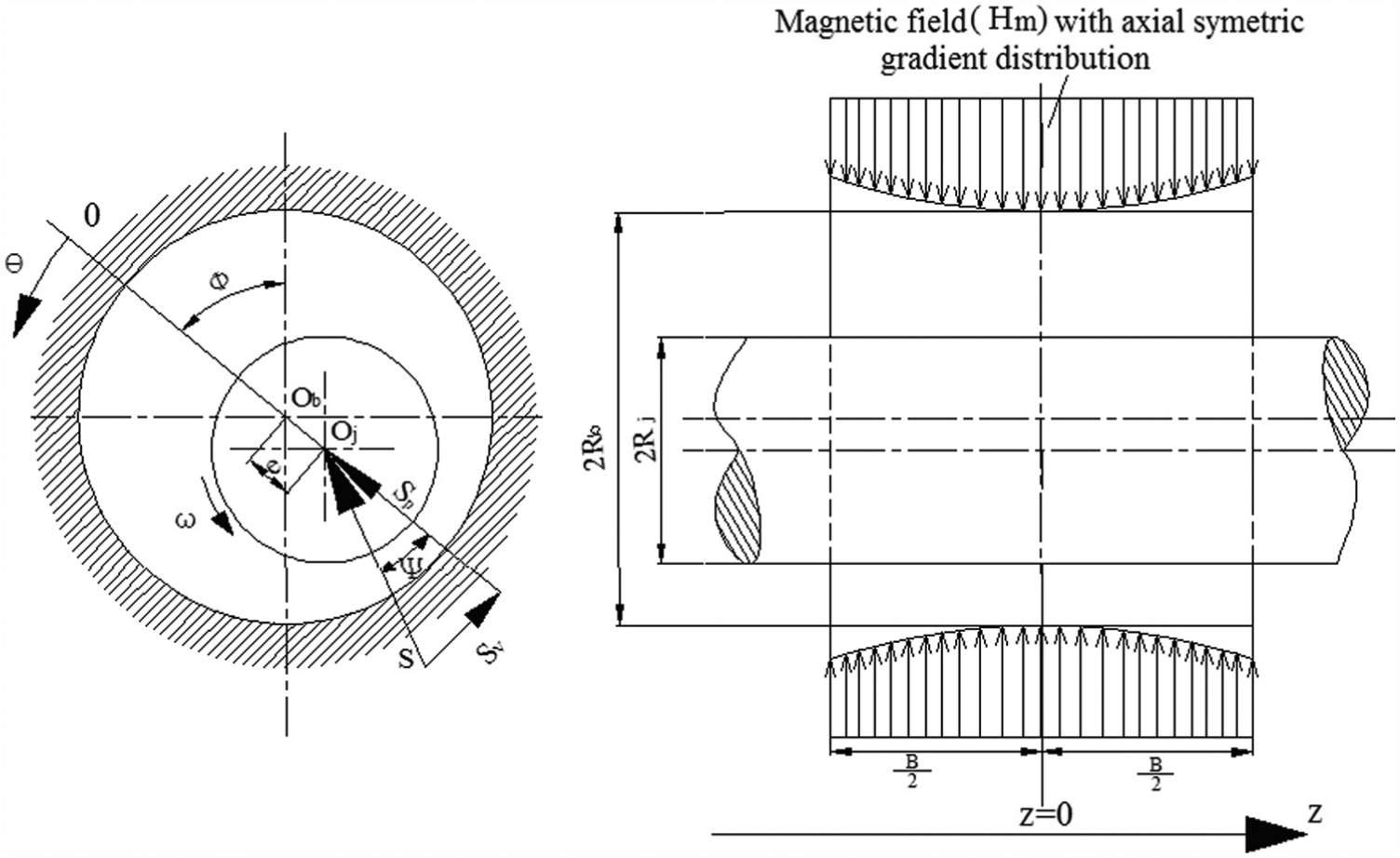
Magnetic fluids’ journal bearing and its magnetic field with axial symmetric gradient distribution (arrows show the direction of the magnetic field and its strength).
Modeling theory
Based on the Stokes 12 micro-continuum theory and Rosensweig et al.’s 13 theoretical research, the momentum and continuity equations of magnetic fluids considering the couple stress in the bearing are derived as follows
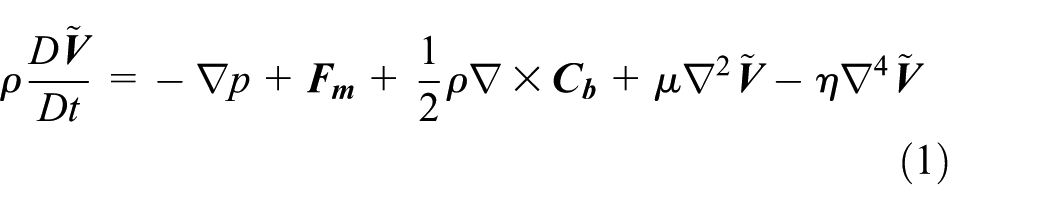

where the vectors

where

Considering isothermal conditions and linear behavior of the magnetic fluids,
It is assumed that the body moments are neglected, the fluid inertia is small, and the fluid film is thin compared with the journal radius; the curvature of the fluid film is neglected at the application of hydrodynamic lubrication. Equations (1) and (2) reduce to


The boundary conditions at the bearing surface are


The boundary conditions at journal surface are given as


where
Equations (5b) and (6b) mean that the tangential component of couple stress tensor along the solid boundary equals to zero. 11
Integrating equations (3a) and (3c) subject to the boundary conditions of equations 5(a), 5(b), 6(a), and 6(b), the fluid velocities in the bearing can be obtained as follows
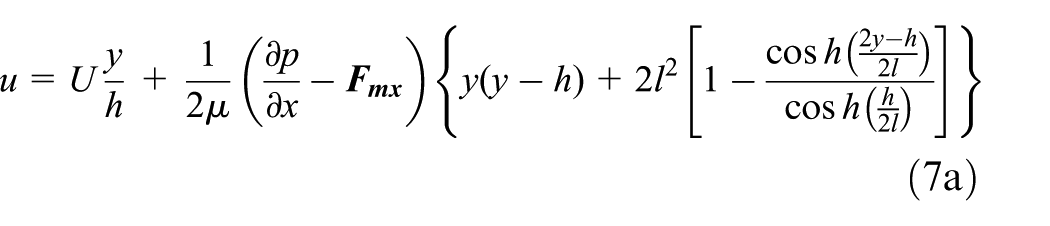

where
Substituting equations (7a) and (7b) into equation (4) and integrating with respect to the oil-film thickness y based on the boundary conditions (5a) and (6a), the generalized Reynolds equation (8) for the lubrication performance of magnetic fluids’ journal bearing considering the couple interaction among the squeeze effect, the rotating effect, and the cohesion force of magnetic fluids’ oil film can be derived as follows

where

where
Equation (8) is a modified Reynolds equation, which can be given in dimensionless form of equation (10) using
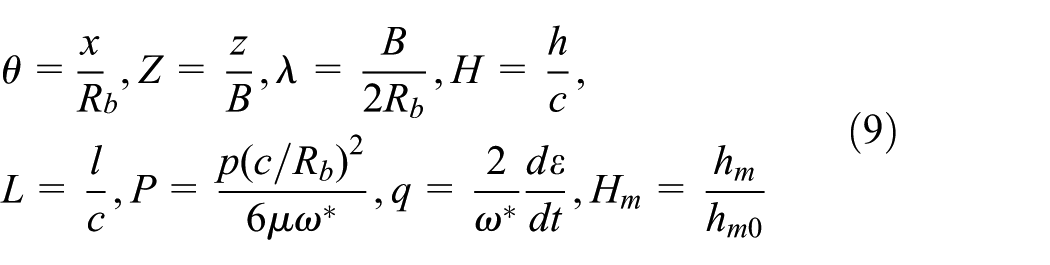
where
Thus, equation (8) becomes

where

where the four terms in the right of equation (10) represents the four effects of magnetic fluids’ journal bearing and its load-carrying oil film:
Combining the right first term of equation (10) and its right second term together
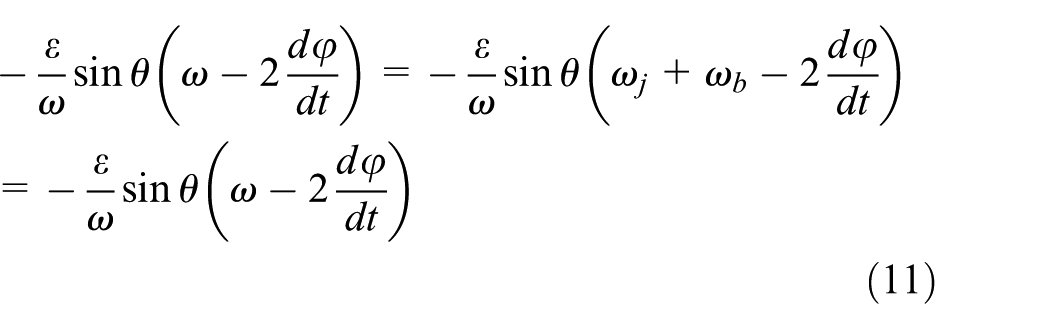
Using
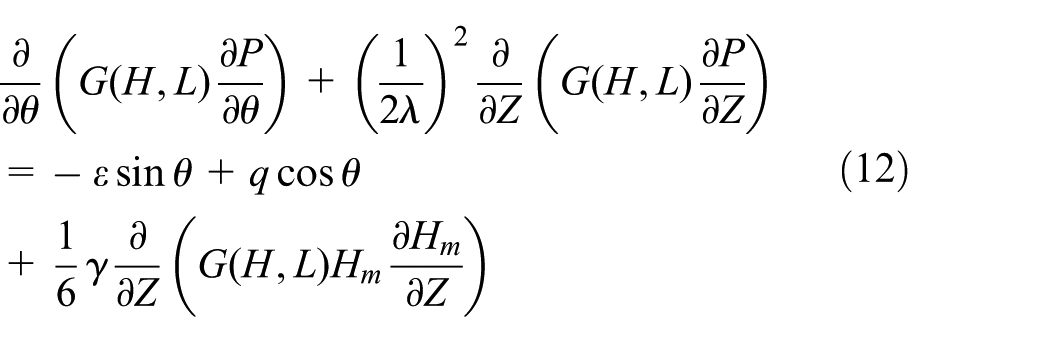
where the right first term and second term of equation (10) are the rotation effect caused by
The magnetic field is the symmetric gradient distribution along the axial direction from the middle section to the two ends of bearing in the following equation (13)

Then, the dimensionless form (equation (14)) of equation above is given as

where the magnetic field distribution,
Magnetic field distribution parameter β determines the distribution gradient of the magnetic field. In order to obtain the supporting magnetic fluids’ cohesion force and the positive resultant load-carrying capacity in this study, the negative gradient magnetic field
The relationship between the magnetic term

The effect of parameter (β) on the induced magnetic term
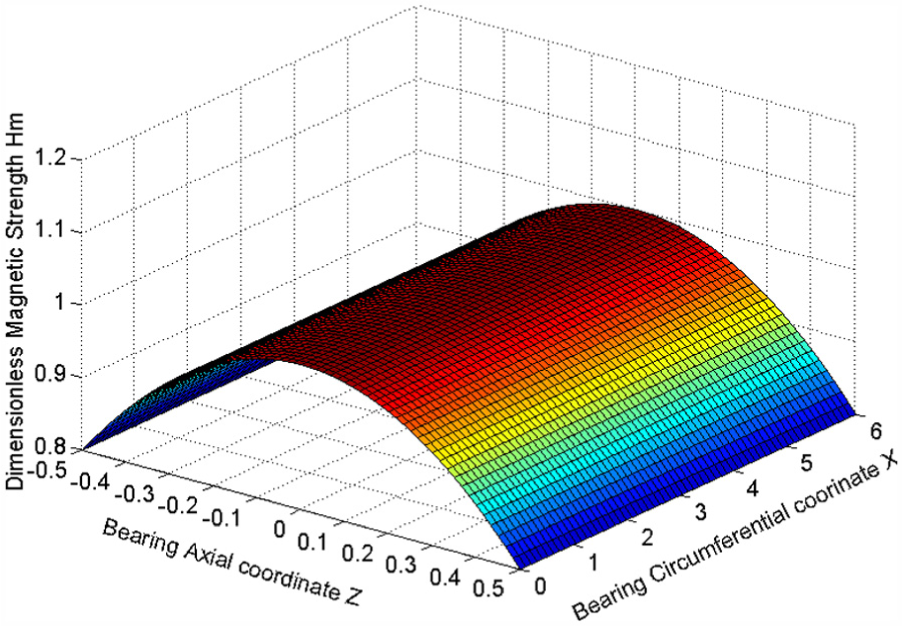
The designed magnetic field profile along the axial direction with β = 0.8.
The boundary conditions for the film pressure are

where
Lubrication performance analysis of the bearing
Load-carrying capacity
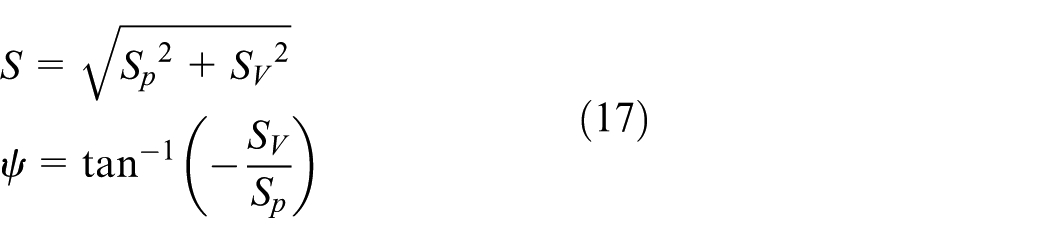
The parallel component (Sp) of the load-carrying capacity (S) along the offline OjOb and its vertical component (Sv) (shown in Figure 1) in dimensionless form are calculated by integrating the magnetic film pressure acting on the journal surface

Thus, the dimensionless magnetic load-carrying capacity (S) and its attitude angle
Friction coefficient
The shear stress 11 along the journal surface is

Substituting equation (7a) into equation (18)

The dimensionless friction force can be obtained by integrating the shear stress around the journal surface and written as

The friction coefficient of journal bearing based on equations (17) and (20) can be obtained as follows

Side leakage flow
The side leakage flow

Then, the dimensionless side leakage

where
Numerical analysis
Equation (12) was solved numerically using a finite difference scheme (template shown in Figure 4). The field of solution is divided into 128 intervals in the circumferential direction and 60 intervals across the bearing axial direction (length direction). Consequently, each intersection of these dividing lines is to give a mesh size of 129 × 61 points. Applying the central difference approximation for derivatives, equation (12) becomes

where

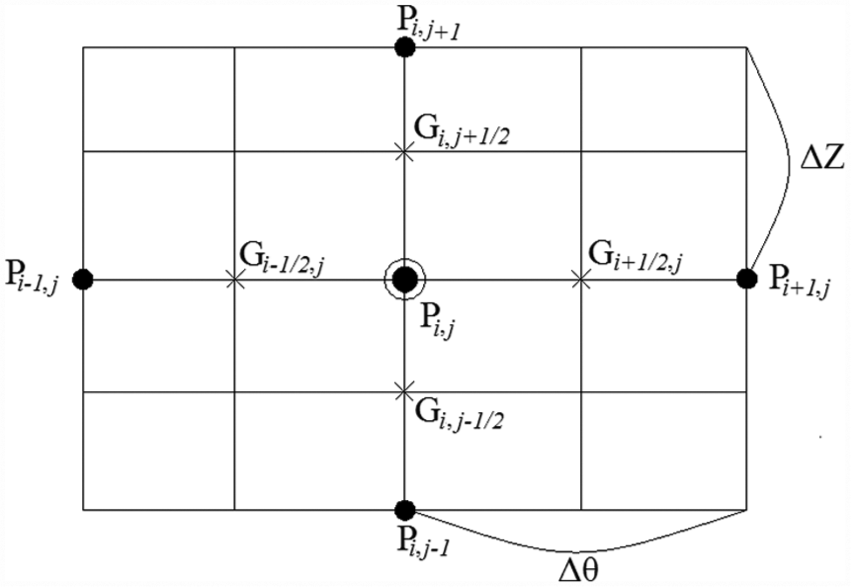
Difference meshed grid.

Results and discussion
From the solutions to the equations above, the lubrication performance of magnetic fluids’ journal bearing with couple stress can be examined. The magnetic fluids’ cohesion force coefficient (γ), magnetic fluids’ couple stress parameter (L*), and bearing construction parameters as well as operating parameters of the bearing are listed in Table 1 and used in the discussion.
Parameter values for discussion.

From Figure 5, it shows that the maximum dimensionless film pressure clearly increases as γ increases, and the pressure value for magnetic fluids’ journal bearing with magnetic fluids’ cohesion force is higher than that for magnetic fluids’ journal bearing with no magnetic fluids’ cohesion force (γ = 0.0) by about 7.1%, 18%, and 40.3% for γ = 0.05, γ = 0.1, and γ = 0.2, respectively.
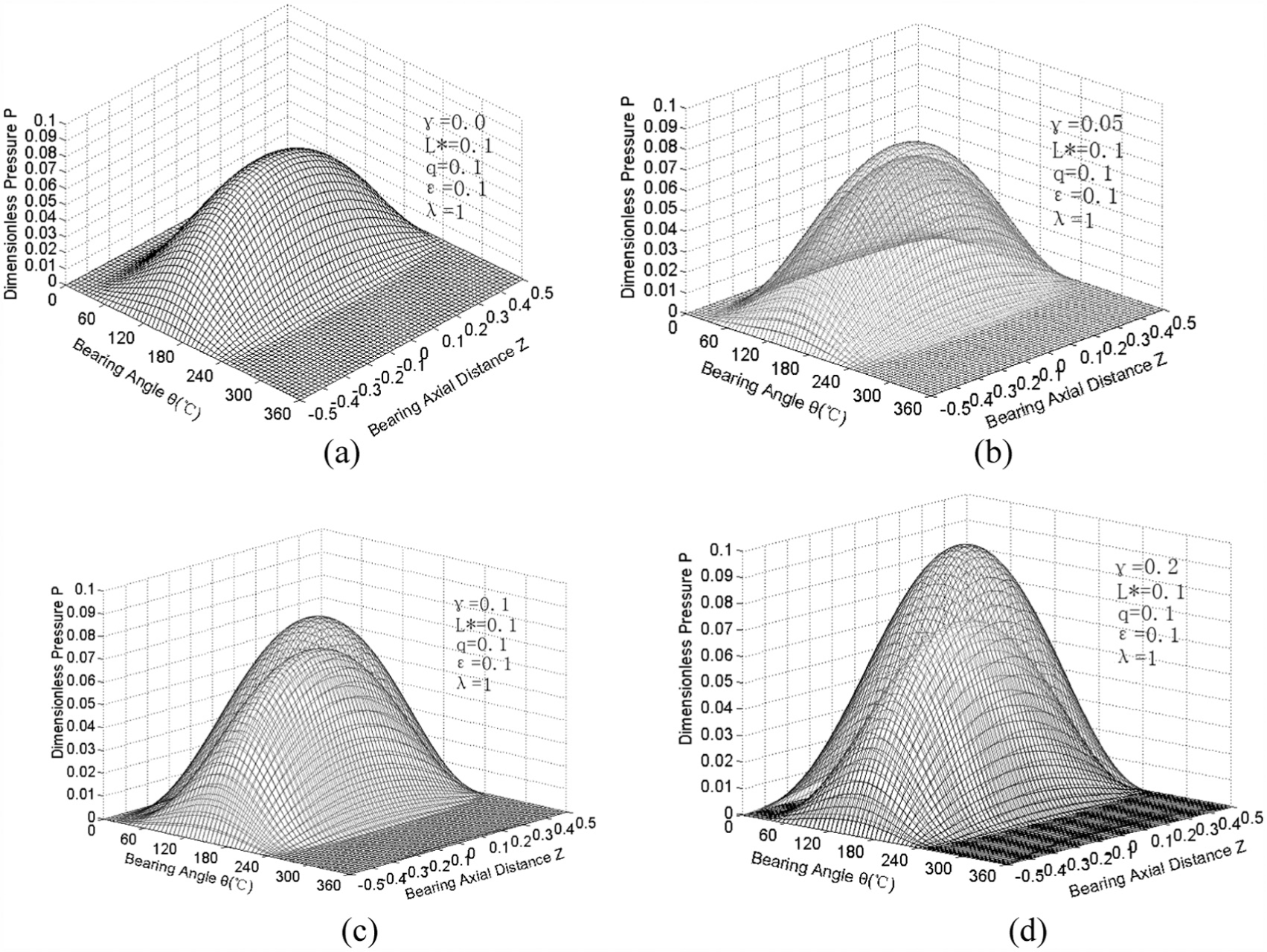
Effects of magnetic fluids’ cohesion force coefficient γ on the film pressure distribution: (a) γ = 0.0, (b) γ = 0.05, (c) γ = 0.1, and (d) γ = 0.2 (calculating conditions: γ = 0.0–0.2, squeeze dynamic effect parameter q = 0.1, couple stress parameter L* = 0.1, eccentricity ratio ε = 0.1, the ratio of width to diameter of bearing λ = 1.0, and magnetic field distribution parameter β = 0.8).
From Figure 6, there is a gradual decrease in the size of the cavitation region as γ increases. Especially in Figure 6(d), where γ = 0.2, a narrow limited region is formed between two active regions: the left active region is extended from conventional active region, and the right of it is caused by the pure magnetic effect.

Effects of magnetic fluids’ cohesion force coefficient γ on the active region boundary shape for different γ (A, C denotes active region and cavitation region, respectively): (a) γ = 0.0, (b) γ = 0.05, (c) γ = 0.1, and (d) γ = 0.2 (calculating conditions: γ = 0.0–0.2, q = 0.1, L* = 0.1, ε = 0.1, λ = 1.0, and β = 0.8).
From Figure 7(a), it can be seen that the values of maximum dimensionless centerline pressure increases clearly with the increase in squeeze dynamic effect parameter (q) by a ratio of about 2 times at q = 0.1 and 10 times at q = 1.0 than for q = 0.0, which results from the increase of hydrodynamic force caused by increasing q. From Figure 7(b), it can be seen that the values of maximum dimensionless centerline pressure increase with the increasing of L* for magnetic fluids’ journal bearing by a ratio of about 1.5 times at L* = 0.2 and 2 times at L* = 0.4 than for L* = 0.0, which results from the increase of hydrodynamic force caused by increasing L*. It also shows that the maximum centerline pressure of magnetic fluids’ journal bearing with cohesion force (γ = 0.2) increase obviously than those of magnetic fluids’ journal bearing without cohesion force (γ = 0.0) in Figure 7.
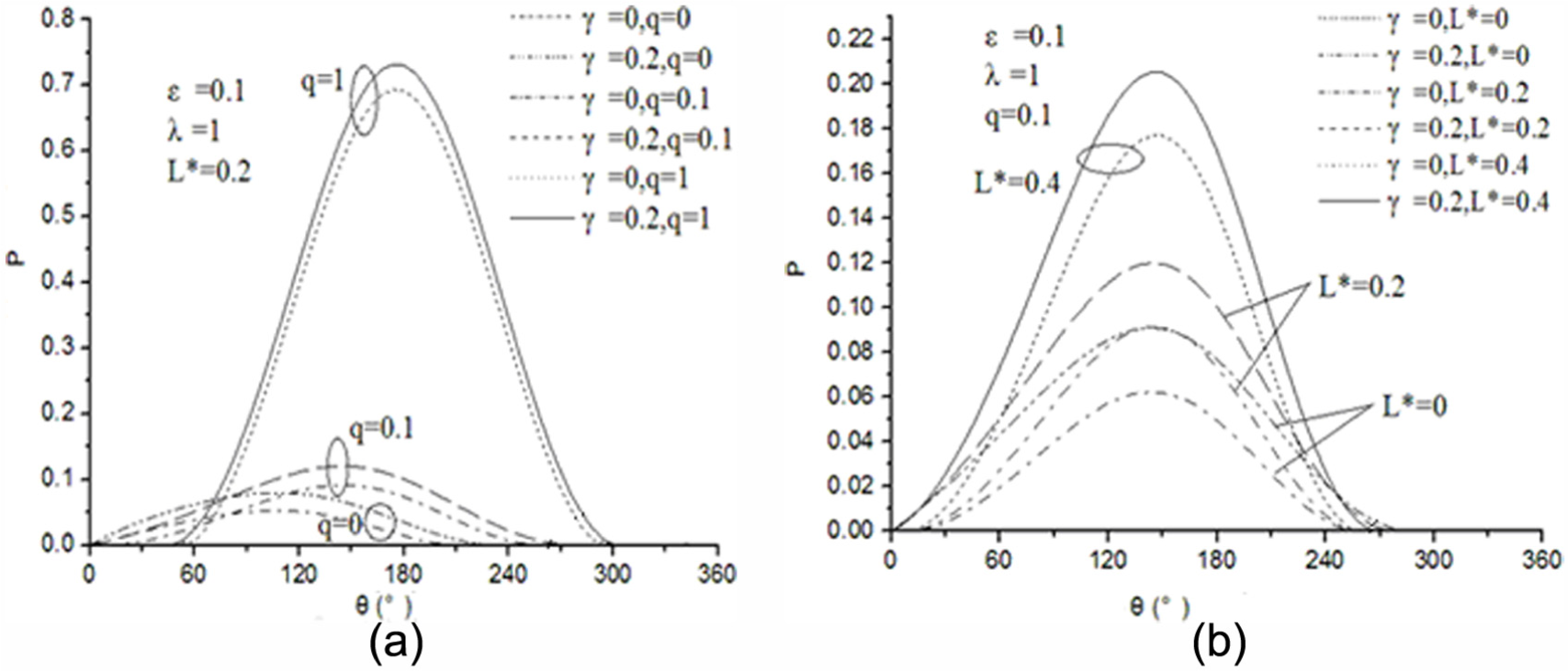
Dimensionless centerline pressure distribution (P) along the circumferential direction for q and L*: (a) the effect of γ and q when L* = 0.2 and (b) the effect of γ and L* when q = 0.1 (calculating conditions: γ = 0.0, 0.2, ε = 0.1, λ = 1.0, and β = 0.8).
The effect of γ and q on its lubricating performance (ψ, W, Cf(R/c), and Q) of magnetic fluids’ journal bearing with/without couple stress are studied as follows.
In Figure 8, it can be seen that the attitude angle (ψ) first increases and then decreases as the increase of ε for different γ, L* with the constant of q = 0.1, 0.5, and 1.0. According to equations (12) and (16), at low eccentricity ratio (ε = 0.1–0.3), the increasing reason of ψ mainly results from the couple effects of the squeeze dynamic effect
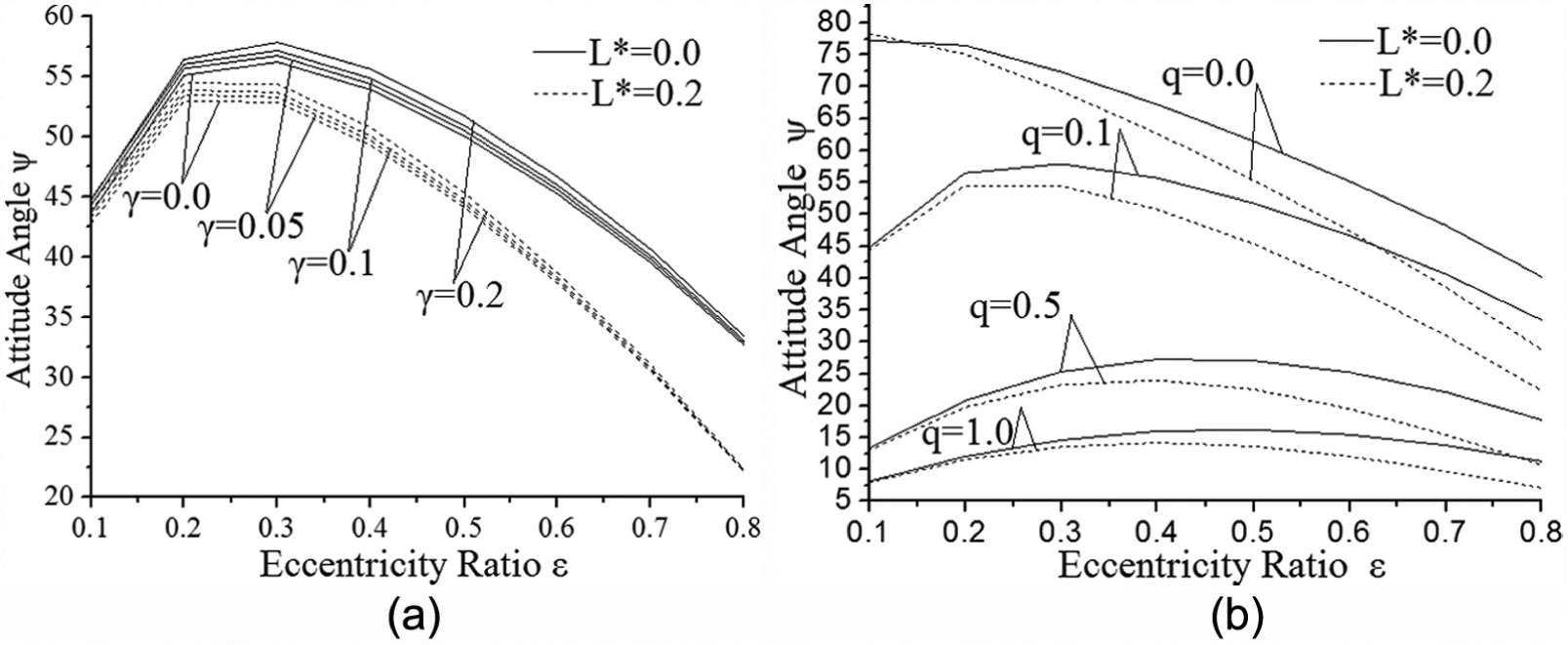
The effect of γ and q on the attitude angle (ψ) versus eccentricity ratio (ε): (a) the effect of γ when q = 0.1 and (b) the effect of q when γ = 0.2 (calculating conditions: L* = 0.0, 0.2, ε = 0.1–0.8, λ = 1.0, and β = 0.8).
From Figure 9(a), it is clear that the dimensionless load-carrying capacity (S) of magnetic fluids’ journal bearing with cohesion force (γ ≠ 0) leads to a slight increase compared with magnetic fluids’ journal bearing without cohesion force (γ = 0), as magnetic fluids’ cohesion force coefficient (γ) increase, which is mainly caused by the smaller cavitation region of magnetic field action especially at low value of ε where the hydrodynamic effect is small. At the higher value of ε, the hydrodynamic effect is dominant and the magnetic effect can be neglected. From Figure 9(b), it can be seen that the S of magnetic fluids’ journal bearing with squeeze dynamic effect (q ≠ 0) increase clearly than those of magnetic fluids’ journal bearing without squeeze dynamic effect (q = 0) as q increases especially at high value of ε. It is also shown that the S of journal bearing lubricated by magnetic fluids with couple stress (L* = 0.2) is obviously greater than those of journal bearing lubricated by magnetic fluids without couple stress (L* = 0) in Figure 9, which can be deduced that the magnetic fluids with couple stress (L* = 0.2) as a lubricant can improve the load-carrying capacity of magnetic fluids’ journal bearing with squeeze dynamic effect.

The effect of γ and q on the dimensionless load-carrying capacity (S) versus eccentricity ratio (ε): (a) the effect of γ when q = 0.1 and (b) the effect of q when γ = 0.2 (calculating conditions: L* = 0.0, 0.2, ε = 0.1–0.8, λ = 1.0, and β = 0.8).
Equation (20) shows that there is no significant effect of magnetic lubrication on the friction force. The increase in oil-film pressure by the magnetic effect does not greatly affect the pressure gradient

The effect of γ and q on the modified friction coefficient Cf(R/c) versus eccentricity ratio ε: (a) the effect of γ when q = 0.1 and (b) the effect of q when γ = 0.2 (calculating conditions: L* = 0.0, 0.2, ε = 0.1–0.8, λ = 1.0, and β = 0.8).
From Figure 10(a), it shows that the modified friction coefficient (Cf(R/c)) of magnetic fluids’ journal bearing with cohesion force (γ ≠ 0) clearly decreases compared with magnetic fluids’ journal bearing without cohesion force (γ = 0) as γ increases especially at low value of ε. The decreasing reason above results from the magnetic field effect of magnetic fluids’ cohesion force coefficients causing the increase in magnetic fluids’ oil-film load-carrying capacity, and the frictional force almost keeps constant according to equation (20). From Figure 10(b), it displays that the (Cf(R/c)) of magnetic fluids’ journal bearing with squeeze dynamic effect (q ≠ 0) decreases obviously than that of magnetic fluids’ journal bearing with squeeze dynamic effect (q = 0) as q increases especially at the low value of ε, which mainly results from the squeeze dynamic effect of q causing a larger increase in
Equation (23) shows that the side leakage of magnetic fluids’ journal bearing is determined as a resultant of two opposite effect. One is the pressure gradient
From Figure 11(a), the magnetic fluids’ journal bearing with cohesion force (γ ≠ 0) has a lower value of Q compared with magnetic fluids’ journal bearing without cohesion force (γ = 0) as γ increases especially at high value of ε, which results from the sealing magnetic fluids’ cohesion force of journal bearing. From Figure 11(b), the magnetic fluids’ journal bearing with squeeze dynamic effect (q ≠ 0) has a higher value of Q than those of magnetic fluids’ journal bearing without squeeze dynamic effect (q = 0) as q increases, which results from that the hydrodynamic effect increase as q increases. It also shows that there is a lower side leakage flow of journal bearing lubricated by magnetic fluids with couple stress (L* = 0.2) compared with journal bearing lubricated by magnetic fluids without couple stress (L* = 0) especially at high value of ε in Figure 11.

The effect of γ and q on the dimensionless side leakage flow (Q) versus eccentricity ratio (ε): (a) the effect of γ when q = 0.1 and (b) the effect of q when γ = 0.2 (calculating conditions: L* = 0.0, 0.2, ε = 0.1–0.8, λ = 1.0, and β = 0.8).
Conclusion
Considering the couple effect between the squeeze dynamic effect of magnetic fluids’ journal bearing and its rotation effect, a modeling theory of journal bearing lubricated by magnetic fluids with couple stress based on the magnetic fluids’ cohesion force and squeeze dynamic effect combined with the rotation effect has been developed to analyze its lubrication performance. The conclusions are as follows:
The maximum dimensionless film pressure
Attitude angle (ψ) decreases as the increasing of squeeze dynamic effect parameter (q), the decreasing of cohesion force coefficient (γ), and the increasing of coupe stress parameters (L*); the value of ψ first increases and then decreases as the increase in ε when the squeeze dynamic effect of q (≠ 0) exists.
The load-carrying capacity (S) of magnetic fluids’ oil film increases as the increasing of q, γ, and L*; the friction coefficient (Cf(R/c)) decreases as the increasing of q, γ, and L*; the side leakage (Q) decreases as the decreasing of q and the increasing of γ and L*.
It could be concluded from the above that the lubrication performance of magnetic fluids’ journal bearing with cohesion force are better than that of magnetic fluids’ journal bearing without cohesion force. The lubrication performance of magnetic fluids’ journal bearing with squeeze dynamic effect are better than that of magnetic fluids’ journal bearing without squeeze dynamic effect. The lubrication performance of journal bearing lubricated by magnetic fluids with couple stress are better than that of magnetic fluids without couple stress as a lubricant.
Footnotes
Appendix 1
Academic Editor: Crinela Pislaru
Declaration of conflicting interests
The author(s) declared no potential conflicts of interest with respect to the research, authorship, and/or publication of this article.
Funding
The author(s) disclosed receipt of the following financial support for the research, authorship, and/or publication of this article: This study was supported by Natural Science Foundation of JiangXi Province in China (ID: 20161BAB206119, 20161BAB216105), Science and Technology Project Founded by the Education Department of JiangXi Province in China (ID: GJJ151131), Open foundation of Jiangxi Province Key Laboratory of Precision Drive & Control (ID: PLPDC-KFKT-201609), and the National Natural Science Foundation of PR China (ID: 51765044).