



Abstract
In order to investigate the lubrication characteristics of journal bearings with the elasticity of liner affected by magnetic fluids, a theoretic computation model was developed based on magnetic fluids supporting force parameter (
Keywords
Introduction
Carrying the larger loading capacity of the magnetized journal bearings with a squeeze dynamic action such as in the internal combustion engine, the measure unit of oil-film thickness is usually expressed in micron, for the maximum oil-film pressure that is often bigger than the value of 10 MPa and the stiffness of the journal bearing (bearing block) is smaller due to its structure design limit.1,2 According to this analysis, the effects of the elastic deformation of working surface have a great importance in the pressure distribution of the oil film and its loading capacity. For example, some papers3,4 have reported that loading capacity of rigid journal bearing is bigger than that of journal bearing considering its materials elastic deformation. Meanwhile, the elastic deformation of the liner has also been considered about its lubrication influence on journal bearings, 5 authors mainly investigated that the elasticity effect of the liner reduces with increasing loading capacity and increases with increasing coefficient of friction. Usov 6 analyzed that a plane elastohydrodynamic problem for a radial sliding bearing with a thin liner under reciprocating motion under a constant load is considered, and he found that the film thickness and pressure distributions of journal bearing at various moments in time depend on the elastic deformation and the eccentricity motion. Patel et al. 7 found that the dimensionless pressure is greater when the width-diameter ratio of the bearing is slightly smaller. In addition, the increase of eccentricity expands the liquid film convergence area between the journal and the bearing, thus increasing the pressure again. Some studies8,9 have also explored the effects of texture and surface roughness on the lubrication and other properties of journal bearings. However, these papers above neglect the coupling effect among the relative characteristics parameters such as the squeeze dynamic action, couple stresses, the elastic deformation, and the extent of the elastic deformation about the impact on the couple stresses and other relative factors on the oil-film lubrication characteristics. The paper mainly shows that the lubrication characteristics of journal bearing with the elastic deformation of the liner and with a squeeze dynamic action based on magnetic fluids supporting force and its couple stress. Moreover, the elasticity extent of the liner on the effects of other characteristics parameters of oil-film lubrication characteristics is also discussed.
There are some papers discovered that magnetic fluids are non-Newtonian fluids10,11 with the solid magnetic nano-materials are analogical to the couple-stress fluids, which show the analogical mechanical properties. Up to now, few researches were mentioned about a lubricant with the magnetic couple-stress fluids under the applied magnetic field. Das 12 showed the maximum loading capacity of journal bearings increase with an increase in magnetic fluids supporting force parameters and couple-stress factors by using a non-compressible lubricant of electrical-magnetic, couple-stress fluids under the applied uniform magnetic field; Nada and Osman 13 analyzed the impact of magnetic fluids lubricant with considering it as non-Newtonian fluids, and pointed out that the increasing with the solid particle size concerning couple-stress factors can enhance the oil-film pressure of the bearing and its loading capacity and decrease the modified coefficient of friction. Moreover, the increasing of the applied magnetic field factors can also enhance the oil-film pressure of the bearing and its loading capacity. Hu and Xu 14 found that the lubrication characteristics of journal bearing with magnetic fluids supporting force and its couple stress can be obviously improved better than that of journal bearing with no magnetic fluids supporting force and its couple stress. However, the researches above have tended to mainly focus on the lubrication characteristics of journal bearing without the elasticity of the liner and the coupling effects among these characteristics parameters. However, the presence of the liner is helpful to protect the working life of journal bearing.5,6 Therefore, the study of magnetized journal bearing with the elastic deformation of the liner and its elasticity extent on the lubrication characteristics are necessarily discussed with the influence of squeeze oil-film action in axial taken into account together in the paper, which is few mentioned in other research on the journal bearing affected by magnetic fluids. Mokhiamer et al. 15 assumes that without considering the effect between own force and couple stress, the expressions of load, friction, and pressure center are deduced. The results show that the couple-stress factor have a significant impact on the bearing capacity, pressure distribution and friction coefficient in the journal bearing lubricated by stress-couple fluid.
The modified Reynolds formulas on the lubrication characteristics of journal bearing affected by magnetic fluids have been derived on the basis of Stokes micro-continuum theory,
16
considering the couple action between the rotating action of journal bearing and its oil-film squeeze dynamic action based on Hu and Xu’s theoretical research.
14
On the basis of this, the impact of the magnetic supporting oil-film pressure due to the symmetric gradient magnetic field in axial and its lubrication characteristics have been analyzed. The combined effect above among the elastic deformation coefficient (Ce) of the liner, the squeeze dynamic action parameter (q) of journal bearing, magnetic fluids supporting force parameter (
Theory
Modeling analysis
The physical model of journal bearings with the elastic or rigid liner affected by Magnetic fluids and considering its squeeze dynamic action are stated in Figure 1.

Journal bearings with the elastic/rigid liner affected by magnetic fluids and the axial symmetric gradient configuration of its magnetic field (arrows present the strength of the magnetic gradient field and its direction).
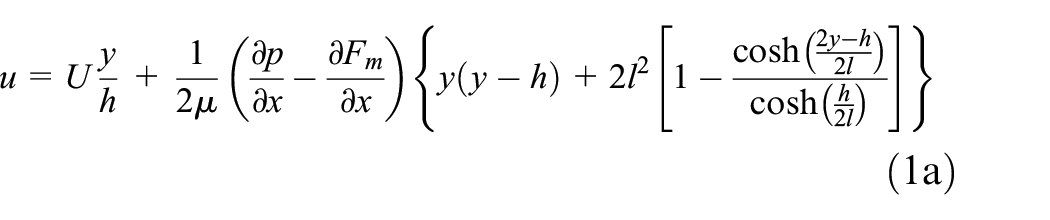
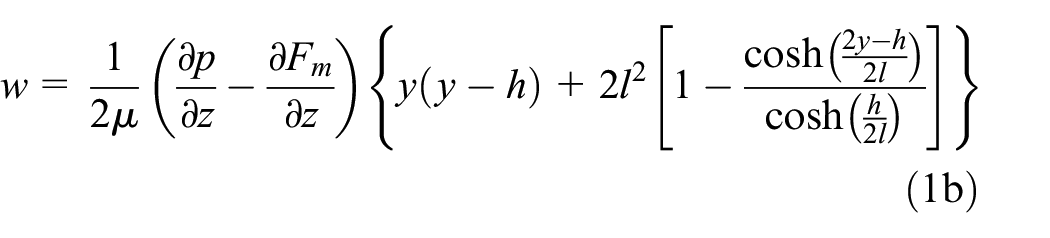
Considering the application of hydrodynamic lubrication, the magnetic fluids’ velocities
and
Where
Introducing the velocity components formulas of

Here
For obtaining dimensionless form, rewrite

Thus, formula (2) considering the elastic deformation of the liner becomes a dimensionless form:

Here
The oil-film pressure with boundary conditions can be expressed as:

Where
Characteristics of the bearing
Loading capacity
By integrating the oil-film pressure on the magnetic supporting journal bearing, the loading components can be acquired by

Thus, the dimensionless magnetic loading capacity (


Force of friction and its coefficient
The shear stress 17 on the moving journal surface is:

From equation (8a):

Thereafter, the force of friction is developed by integrating the formula (9):
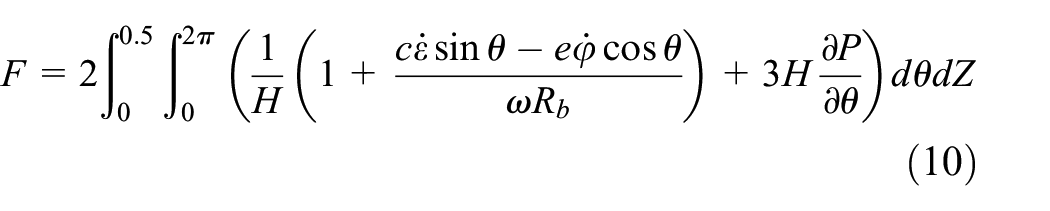
The modified coefficient of friction can be written as follows.

Side leakage
By integrating formula (1b), the side leakage flow of the journal bearing across its end segment can be acquired as follows.

Thereafter, the dimensional side leakage is obtained as:


Method of solution
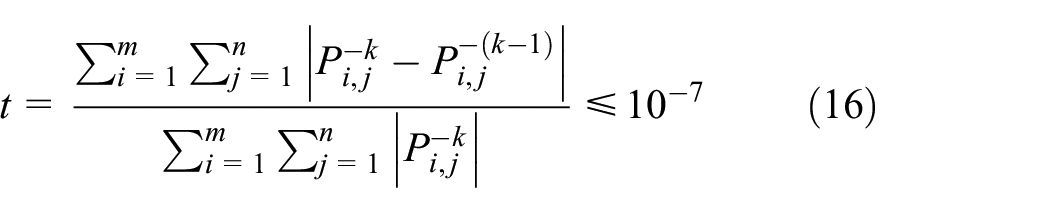
According to the finite difference scheme (seen as in Figure 2), the formula (4) can be solved numerically. The domain of solution is divided into the circumferential direction with


Difference meshed grid.
Where

Results and discussion
According to the solutions of the formulas above, the effects of magnetic fluids supporting force and couple stress on the lubrication characteristics of magnetized journal bearing with the elastic deformation of liner can be analyzed. The magnetic fluids supporting force parameter (
Parameters.
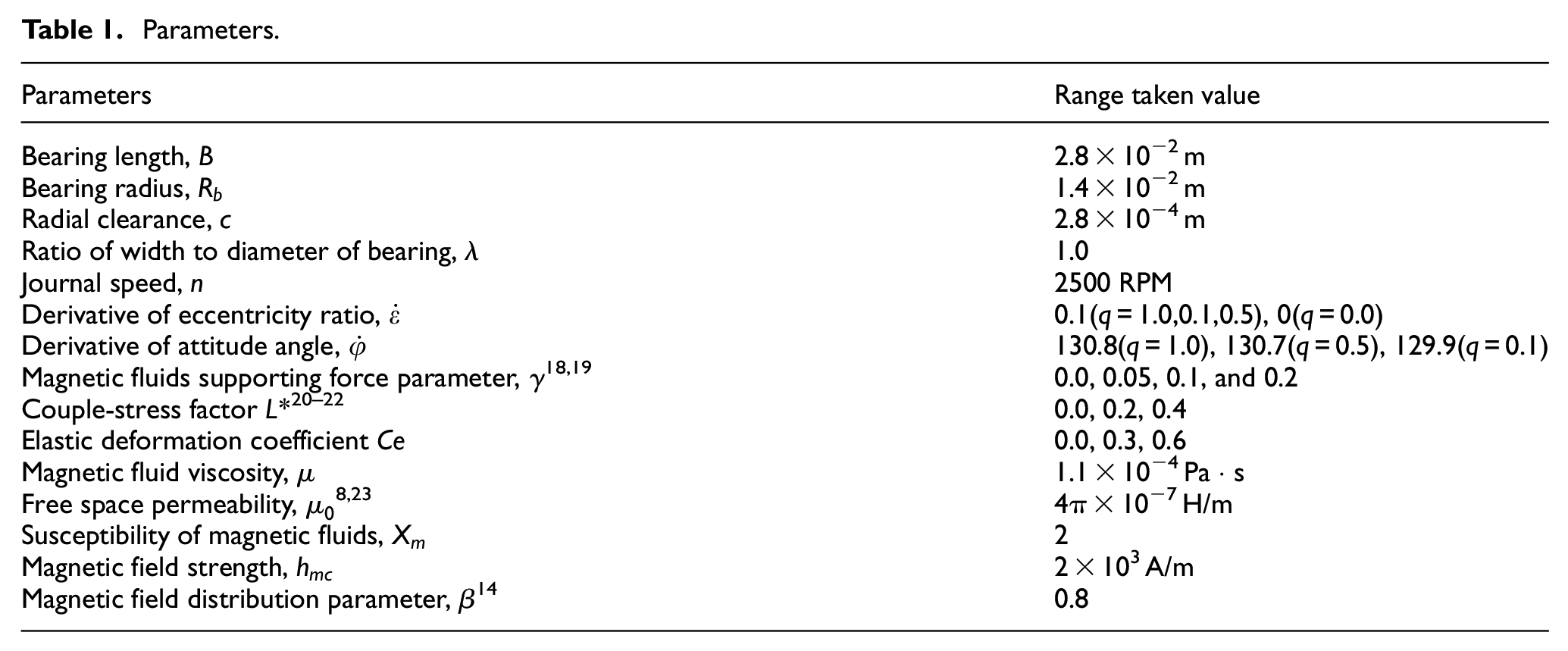
Figure 3 exhibits that the maximum dimensionless pressure peak (

Variation of oil-film pressure configuration with various γ (Calculating constants:
Figure 4 depicts that maximum dimensionless pressure peak (

Variation of dimensionless centerline pressure (P) at the direction of circumference with various L* (Calculating constants:
Figure 5 demonstrates that maximum dimensionless pressure peak (

Variation of dimensionless centerline pressure (P) at the direction of circumference with various Ce (Calculating constants:
In this paper, based on the rigid liner (Ce = 0.0) and the elastic liner (Ce = 0.6), the effects of different magnetic fluids supporting force parameter
Figure 6(a) shows that dimensionless loading capacity (S) of magnetized journal bearing affected by magnetic fluids and its supporting force (

Variation of dimensionless loading capacity (S) with eccentricity ratio (ε) for various
Figure 6 also illustrates that S of journal bearing affected by magnetic fluids with rigid liner (Ce = 0.0) is clearly higher than those of journal bearing affected by magnetic fluids with the elastic liner (Ce = 0.6) especially in the high ε, which can be inferred that journal bearings affected by magnetic fluids with the elastic liner (Ce = 0.6) weakens the increase of S.
Figure 7 shows that attitude angle (

Variation of attitude angle (
Figure 7(a) illustrates that magnetized journal bearing affected by magnetic fluids with supporting force has a lower ψ in comparison with that of journal bearing affected by magnetic fluids with no supporting force with increase in
Figure 8(a) illustrates that modified coefficient of friction (Cf (R/c)) of magnetized journal bearing affected by magnetic fluids with supporting force (

Variation of the modified coefficient of friction Cf (R/c) with eccentricity ratio ε for various
Figure 8(b) indicates that Cf (R/c) of magnetized journal bearing affected by magnetic fluids with couple stress (L* ≠ 0.0) decrease significantly than that of magnetized journal bearing affected by magnetic fluids with no couple stress (L* = 0.0) with increase in L* particularly in the low ε. The results above are mainly due to the increase of ε and L* leading to a significant increase of effective loading capacity, which leads to the decrease of Cf (R/c). Furthermore, the increase of
Figure 8 also exhibits that there exists a lower Cf (R/c) of magnetized journal bearing affected by magnetic fluids with the rigid liner (Ce = 0.0) in contrast to magnetized journal bearing affected by magnetic fluids with the elastic liner (Ce = 0.6) particularly in the low ε.
Figure 9 shows that dimensionless side leakage flow (Q) increases with increase in ε for various

Variation of dimensionless side leakage flow (Q) with eccentricity ratio (ε) for various
Figure 9(b) indicates that magnetized journal bearing affected by magnetic fluids with couple stress (L* ≠ 0.0) exists a lower Q than those of magnetized journal bearing affected by magnetic fluids without couple stress (L* = 0.0) with increase in L* particularly in the high ε, which caused by hydrodynamic effect increasing with increase in L*. In addition, Figure 9 also exhibits that there exists a lower Q of magnetized journal bearing with the elastic liner (Ce = 0.6) affected by magnetic fluids in contrast to magnetized journal bearing with the rigid liner (Ce = 0.0) affected by magnetic fluids particularly in the high ε.
The magnetized magnetic fluid journal bearing can meanwhile achieve lubrication and certain sealing effect. Continuous and stable lubrication can be effectively gotten through a small amount of magnetic fluid medium to reduce the side leakage flow.
Conclusion
The modified Reynolds formula of journal bearing with the elastic deformation of liner is derived by taking into account the presence of magnetic fluids supporting force and couple stress due to the existence of applied magnetic field and magnetic fluids as non-Newtonian lubricants filled with micro-additives. The following results are shown as.
This study reveals that maximum dimensionless pressure peak (
The loading capacity (S) increases with increase in
The existence of elastic deformation coefficient (Ce) weaken the effects of γ, L* on the increase of
It can be gotten that the lubrication characteristics of journal bearing with the rigid liner affected by magnetic fluids considering the effects of
Footnotes
Appendix
Handling Editor: Chenhui Liang
Declaration of conflicting interests
The author(s) declared no potential conflicts of interest with respect to the research, authorship, and/or publication of this article.
Funding
The author(s) disclosed receipt of the following financial support for the research, authorship, and/or publication of this article: This work was financially supported by Science and Technology Project Founded by the Education Department of JiangXi Province in China (ID: GJJ180960); National Natural Science Foundation of PR China for the financial support (ID: 51765044); The State Scholarship Found Project of China Scholarship Council in 2019(ID: 201908360023); Natural Science Foundation of JiangXi Province in China (ID: 20212BAB204038, 20161BAB216105).
