




Abstract
Tourism experience has great impact on the tourist satisfaction, and therefore, tourists pay more attention to the tourism experience utility of the tour. The present problem is how to plan the tour route to maximize tourism experience utility considering tourists’ preference of attraction, time, and cost budgets. The utility function for the tourism experience, consisting of utilities of tourism activities and travel, was proposed. An optimization model for tour route planning was established with the objective function of the tourism experience utility. Then, the computational method to obtain the optimal solution was given, and the feasibility of the method was validated by an example of a tourism transportation network. Finally, sensitivity analyses were conducted by varying the parameters of the tourism experience utility. The results showed that the tourists’ preference of attraction, degree of attention to travel time, and travel cost had great influence on the tour route planning. The tourists with high value of time tend to choose transportation mode with shorter travel times, and the tourism experience utility of the tourists with high value of time was higher than that of the tourists with low value of time.
Introduction
With improvement of living standards, tourism has become a new living fashion. The demand of tourism has shown diverse trends. Traditional tourism mode cannot well meet the needs of today’s tourists. More and more tourists pursue physical experiences and satisfactions during the tour. In order to improve tourism experience, tourists plan the tour routes before traveling to unfamiliar scenic cities. With their preference and limit in time and money, tourists usually search for data from travel books, personal travel blogs, or friends to arrange tour routes. 1 The tour route planning is a time-consuming task. It is difficult to find out the attractions worth of visiting and to figure out the schedules of the tour. Therefore, tour route planning model is used to build high-quality tour routes for tourists.
The tour route planning problem (TRPP) has been studied by some researchers in the literature. An early work on tour planning was introduced by Butt and Cavalier. 2 In this work, they proposed a greedy construction procedure for solving the multiple tour maximum collection problem with a duration constraint. Then, TRPP is commonly seen as a variant of the orienteering problem (OP). 3 Bérubé et al. 4 dealt with a bi-objective traveling salesman problem with profits (TSPP) and provided the first exact solutions for TSPP instances. Vansteenwegen et al.5,6 formulated TRPP as an integer programming problem. The goal of the problem was to provide a tour for tourist that maximizes profit within a time budget. However, the tourists’ preferences on the same attractions are diverse; the profit may be determined according to tourists’ preferences. 7 Abbaspour and Samadzadegan 8 discussed the itinerary planning based on tourists’ preferences and restrictions of attractions. The multimodal shortest path subroutine was designed to generate a tour route for a tourist. Another study has been carried out by Rodríguez et al. 9 They developed a tourist support system (TSS) which considered tourists’ conflicting objectives (e.g. distance traveled, activity costs, and activity utility), and a Tabu search procedure was given to solve the multi-objective problem. Brilhante et al. 10 presented TripBuilder which was a web tool helping tourists to build the personalized sightseeing tour. The point of interests (POIs) was chosen according to the profile of the tourist and the time budget of the tour. Then, the selected POIs were joined in an itinerary by a search algorithm addressing an instance of the traveling salesman problem. Other researchers have focused on tour route design for group members. Zhang and Xu 11 developed a corresponding model with multi-objective of group members. The itinerary could fulfill some constraints, such as the opening time of the attractions, tourists’ wishes, and the optimal travel time. Kinoshita and Yokokishizawa 12 presented a tour route planning support system for multiple group members. With the Kansei database, the system recommended a set of attractions considering the preferences of group members. Gavalas et al. 13 modeled the tourist trip design problem as the time-dependent team OP. Taking into account the time available for sightseeing, the attractions that match tourists’ preferences were selected, and travel times between attractions were calculated by the cluster-based heuristics. In summary, the target tour route should meet some criteria: variety of attractions, short travel time, and low tour cost.
The weakness of the previous research is that the attractions of the tour route were linked using a shortest path method. These work did not deal with the tourists’ preferences, and the time and cost budget at the same time. And tourists may encounter some constraints during the tour planning, such as arriving at some attractions at some specified time, how to travel from one location to another, and how much time or money needed to spend at each attraction. To address this issue, the tour route optimization model based on maximizing tourism experience utility is developed in this study. The solution to the model is proposed and validated by numerical examples. Finally, conclusions and future work are given in the last section.
Tour route planning model
Building the model
Take Figure 1 as a scenario. In a scenic city, there are different types of attractions—nature parks, historical monuments, leisure entertainments, shopping markets, and so on. According to the restrictions as mentioned in section “Introduction,” a tourist would plan a suitable tour route as shown in Figure 1(b).

Scenario of tour route planning: (a) tourism transportation network and (b) sketch of the tour route.
With the problem presented in the article and the scenario of tour route planning as show
in Figure 1, let
Tourism experience obtained from the tour is important for tourists. Tourists would be more satisfied with higher experience in the tour. In addition to tourism experience in the attraction, tourists would have experience during transportation. Utility means the user’s satisfaction to accept a service. Then, suppose the tourism experience utility consists of two parts, the utility associated with the travel and also that associated with tourism activities. The utility of the travel is assumed to have a linear function of the time and cost spent on transportation14–16

where
The utility of the tourism activity depends on tourists’ preference. The utility of the tourism activity is assumed to be correlated with the attributes of the attraction, the time, and cost spent on the tourism activity in the attraction. The utility of the tourism activity may be expressed as follows

where
Hence, the objective is to maximize the tourism experience utility within the tour time and cost budget. The TRPP can be formulated as equations (3)–(15)

Subject to










The objective function (3) maximizes the tourism experience utility of the tourist. Constraints (4) and (5) ensure that the tour route starts from node 1 and ends at node n. Constraint (6) implies that no attractions are visited more than once, and tourists could only choose one transportation mode among two nodes. Constraint (7) is the tour start time constraint. Constraints (8) and (9) calculate the departure time and the arrival time at each node. Constraints (10) and (11) guarantee that the time and cost budget of the tour are satisfied. Constraints (12) and (13) emphasize that each attraction is visited within its available visiting time interval. Constraints (14) and (15) define binary variables.
Solution algorithm
Because the TRPP is a combinatorial optimization problem, it is difficult to obtain the global optimal solution. 17 This article proposes a customized solution algorithm for the model, and it is described as follows:
Step 1. Initialize parameters—given tstart,
tend, C, the attributes of attractions and the properties of
each edge. Let k = 1,
Step 2. Processing the node—if
Step 3. Choose the transportation mode between
Step 4. Insert the nodes of CNL into the route after the current node, respectively—these new routes are regarded as the set of candidate routes, CR.
Step 5. Check the total time and cost—calculate the total time and
total cost of the route in CR, respectively. Delete the route
unsatisfied constraint (10) or (11). If
Step 6. Let k = k + 1—with maximum utility, choose the route from the CR. Update PATH(k + 1), LABEL(k + 1), MODE(k + 1) and AP(k + 1). Repeat steps 2–5.
Step 7. Stop the process and output PATH(k), MODE(k), AP(k).
Numerical example
Case description
An example graph shown in Figure 1(a) is given to evaluate the algorithm and the model. Figure 1(a) shows that node 0 is the source node and terminal node of the tour. There are six attractions in the tourism transportation network. Given the scenic city, the information about each attraction such as the level, ticket, opening, and closing time is collected from the city’s tourism website. In addition, the stay time for each attraction is estimated based on tourists’ travel histories of the attraction. The level of attraction, stay time for tourist activity, and tickets of six attractions are provided in Table 1.
Attribute parameters of attractions.
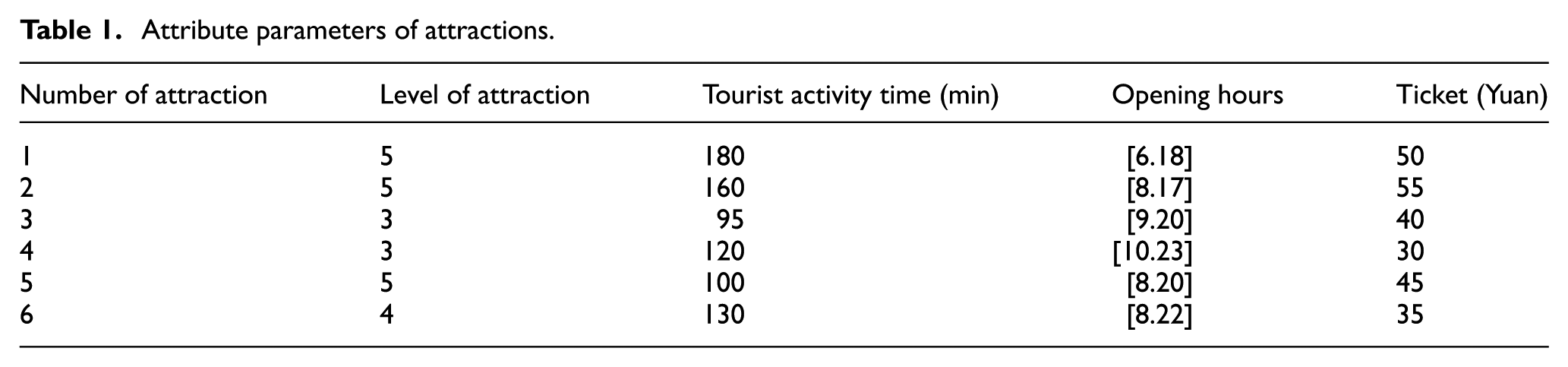
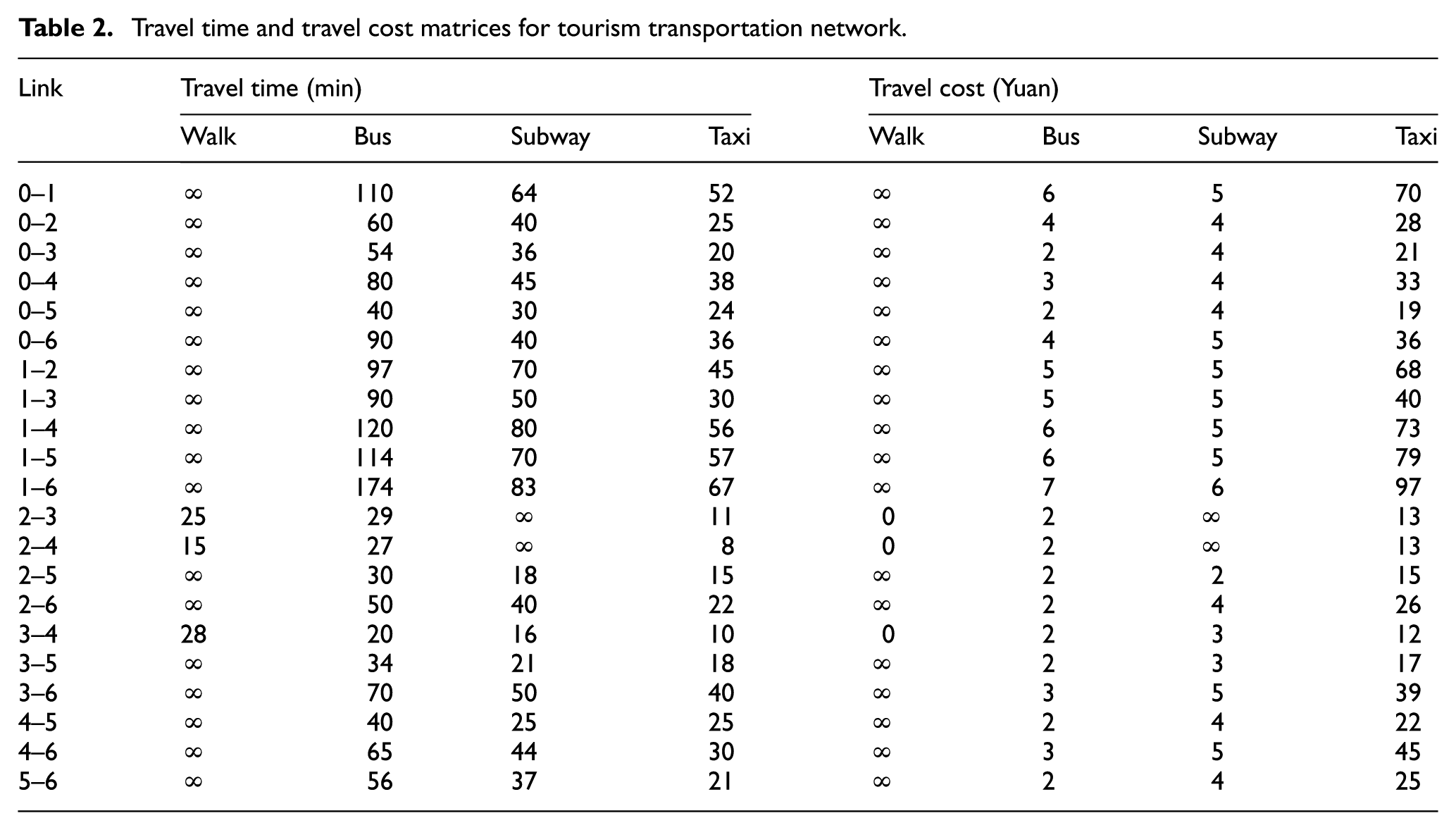
In the tourism transportation network, there are four transportation modes: walk, bus, subway, and taxi. Between node 3 and node 4, the transportation modes are walk, bus, subway, and taxi. The transportation modes of the links (2–3, 2–4) are walk, bus, taxi, and that of the other links are bus, subway, taxi. Moreover, the tour route planning should consider the travel time and travel cost needed to travel from one node to another. To simplify the calculation, the travel time and travel cost for each link are estimated by querying Baidu maps. The values of travel time and travel cost of different transportation modes for each link are given in Table 2.
Travel time and travel cost matrices for tourism transportation network.
Optimized results
In this section, an example is provided to illustrate the practicability of the model: a
tourist is going to visit some attractions departing at 8:30 and wants to return at 16:10
alone with the cost budget of 200 Yuan. Parameters in the proposed model are established
based on the previous literature.
18
So let τ = 1.0, φ = 0.1.
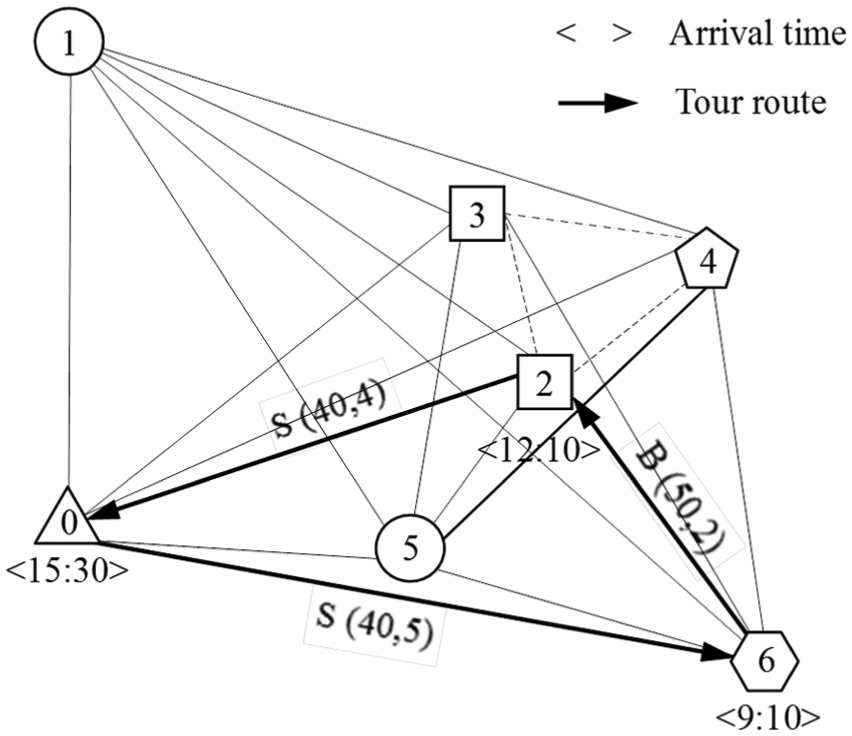
Schedule of the optimal tour route.
As shown in Figure 2, the optimal tour route consists of the attractions 2 and 6. Tourist could take the bus from the attraction 2 to 6, and the transportation modes for tourist traveling from starting point 0 to the attraction 6 and getting ending point from the attraction 2 are subway. The total cost of this tour is 101 Yuan. Tourist would take 420 min to the tour.
Parameters sensitivity analysis
To summarize, parameters
With parameters
Optimal tour routes with different parameters

Keeping the value of

Travel time and travel cost of the tour route related to parameters α and φ.

Tourism experience utility related to parameters α and φ.
Therefore, tourists with high value of time experience less disutility than tourists with
low value of time in travel. Similarly, low level of sensitivity to cost will lead to the
higher utility of the tourism activity for tourists with high value of time in
attractions. In summary, parameter
Conclusion
The tour route planning model based on maximizing the tourists’ tourism experience utility was proposed in the article. In this model, the time, cost, and the attribute of attractions were considered. The customized algorithm to solve the optimization problem was designed, and the model validity was verified through a numerical example. The experimental results show that tourists’ preference of attraction has an important effect on the tour route planning, and the attentions to the travel time and travel cost are positively correlated with the result of the tour route planning.
The aim of tour route planning is to design high-quality tour route for tourists. Apparently, the plan generally divides the tour route into two main parts: travel and tourism activity. And tourists may have different emphases for their tour routes. The above analysis shows that the tourists’ preference of attraction, transportation mode, attributes of attractions, time, and cost budget should be considered in the tour route planning. Only this way can provide a tour route to meet tourists’ demand.
In this article, tourism transportation network is constructed based on the constant travel time. In fact, traffic has dramatic impact on the travel time. It is important to refine the tourists’ transportation mode choice behavior in future research. Additionally, some popular attractions will be crowded during peak tour seasons. The overcrowding will affect the stay time and lead to a poor tourism experience for tourists. Therefore, how to introduce this factor into the tour route planning model should be discussed in the future.
Footnotes
Handling Editor: Francesco Massi
Declaration of conflicting interests
The author(s) declared no potential conflicts of interest with respect to the research, authorship, and/or publication of this article.
Funding
The author(s) disclosed receipt of the following financial support for the research, authorship, and/or publication of this article: This research was supported by the National Natural Science Foundation of China (grant nos 51338008 and 51308015).