




Abstract
The modular design can shrink production and management costs by quick procession of the specific needs of individual end users. This article presents a modular product design approach to product-oriented supply chain network. The proposed approach first builds a relationship matrix through the functional and structural interaction between the product components. Second, module suppliers are determined by the product module division via fuzzy clustering analysis of the relationship matrix. Third, for the determined suppliers, the supply chain costs and lead time are obtained, which can indicate the pros and cons of the supply network. Thus, proposed optimal product modules are verified through the supply network. A case on refrigerator parts modular is examined by the proposed method.
Introduction
With rapid development of global economy and the improvement of productivity, the focus on market competition has shifted from production and quality to personalized customization. Customers’ request for production development is increasingly demanding in terms of products diversification, condensed product lifecycle, and/or personalization. The double pressure from the peers and consumers urges firms to enhance profits by what they previously ignored like satisfaction of consumers’ demand for personalized products and shortening of delivery time. One effective way to such demands is sought through product development based on product supply network. The current competition among modern firms has turned into the competition among supply chains as firms transform the vertical integration of the independent operations of the traditional enterprise to horizontal complementary advantages between enterprises. Therefore, the rationale of modular product design should consider the structure and specifications of product supply chain network. The study considers that modular product design and supply chain have become hot areas in the field of design theory.
In the research of modular product design theory from aspects of supply networks, some scholars make a series of achievements on the relationship between modular product design and supply chain. Fisher pointed out that the performance of supply chain declined if the products mismatch the supply chain through empirical study. Fisher divided products into two categories: functional products and innovative products. Some scholars make contributions to the coordination of the product and supply chain based on the idea of concurrent engineering. 1 O Khan et al. by a case study on British fashion retailers, illustrated the collaboration of product design and supply chain can to improve the core competitiveness of enterprise. Furthermore, this kind of collaboration can augment flexibility and responsiveness of the supply chain. 2 Pero, through the literature review and the exploratory case study, developed a collaborative architecture, which was tested through multiple case studies. Basically, when collaboration was examined, the variety, modularity, and innovativeness of product were the main variables. When supply chain was taken into account, complexity of configuration, cooperation, and coordination were the other relevant variables. 3 Thiam-Soon Gan and Martin Grunow introduced a novel conceptual framework termed concurrent design attribute–trade-off pyramid (CDA-TOP), after some discussion on product design, supply chain design, and design trade-off methodologies. A classification method on the architecture for the synchronous design attributes and the interaction of product and supply chain is proposed. 4
Recently, studies focus on the application and implementation of three-dimensional concurrent engineering (3DCE) to embellish supply chain operation and business performance.5,6 Blackhurst developed a product chain decision model (PCDM) to describe supply chain operation, which simultaneously considers the related products’ design and manufacturing process design. 7 Zhang et al., by way of the weighted goal programming method to balance the potential conflicts in trades, proposed a quantitative 3DCE method. 8 Erika and James based on the theory of 3DCE, used the case study to explore the relationship between product, process, and supply chain decisions. The authors found that the changes in product design can change process and the scope and scale of supply chain. 9
Another stream of the collaboration mainly based on the ideas of concurrent engineering. Many scholars, following Fisher’s works, insisted two categories of products, namely, functional and innovative products, which is divided on the index score of the demand fluctuation, the predicting difficulty, change complexity, product innovation, and two types of supply chains, namely, efficiency and reaction types, which are divided according to the index score of the strategic goals, cooperation, flexible, reaction speed. X Ji et al. mainly discussed the problem on collaborative design of modular product and supply chain’s strategic configurations. They, from modular product degree’s factor in terms of depth and width, analyzed its benefits and impact on the supply chain. 4 C Hong suggested an integrated design method of green modular product and supply chain. He employed the green degree to indicate resource limits. 5 J Chen and Y Huang studied the interactive effect between product design and supply chain design, under the background of mass customization; and with the help of product modular design method, the model expression is presented to improve the product structure, and the objective optimization model is established to minimize the total supply chain cost. The mixed integer programming method was adopted to realize the simultaneous optimization design products and supply chain, and LINGO software is used to solve it. 6
From the above literature review, it is demonstrated that supply chain, as an organization network to realize the whole process of product delivery, has close relationship with product design. This indicates both product design and supply chain must be coordinated to realize the high performance of the supply chain operation. This article proposes a modular product design method based on the supply chain network. At first, we build modular structure of product. Then, based on the modular scheme, the modules will be dispatched corresponding to the three-level supply chain network. Finally, use cost and lead time of supply chain to evaluate and select modular solution.
Product module structure and supply chain
Product is an aggregate which the design unit such as a series of functional component, sub-functional component, assembly parts, and individual parts are got together according to certain rules. A product can be viewed as a physical organization that performs specified functions or provides services. Its components are functional segments that cooperate to accomplish these distinct purposes. Product architecture is the schema of these functional segments showing the physical building blocks and the ways in which they interact. The product architecture has broad implications on engineering design, process design, systems engineering, marketing, and organizational science perspectives. Product design is an engineering-based activity that realizes the customer requirements into functions of a new product. It is a creative integrated information processing, by which the product is shown in front of people through the lines, symbols, numbers, color, and so on, and also some sort of purpose, planning ideas, and methods of problem-solving of people through specific carrier are expressed in one form. 7 In 2000, the famous professors at the Massachusetts Institute of Technology, Ulrich and Eppinger, described that the product design structure is to match the product function with product components, and design structure matrix (DSM) is used to describe the relationship between components, according to the clustering module partition technology and the interaction requirement between the modules. In the rapid economic development and individual needs being becoming more common, mass customization has been one of the mainstream production modes. Mass customization is a kind of production mode that gathers the enterprise, customers, suppliers, employees, and environment as a whole. Mass customization emerged in the early 1990s with the objective of satisfying the individual customers through increased product variety. It emphasizes that the enterprise’s resources should be made full use under the guidance of system theory and the view of whole optimization point. In the support of the standard technology, modern design method, information technology, and advanced manufacturing technology, it is the feature of mass production of low cost, high quality, and high efficiency to provide customized products and services according to the personalized needs of customers. 8
Modular product design strategy is to achieve one of the most important technical means of mass customization. Modular product design is a design approach that subdivides a product into smaller parts, according to their functions, performance, specifications on the basis of functional analysis, called modules or skids, which can be independently created and then used in different systems. Module partition is the basis of the modular product, to the extent that a system’s components may be separated and recombined. Therefore, the method on module partition is a key to modular product design, which also influences on the product in the function, the structure, the production cost and time, and the maintenance.9,10 Modular products decompose the overall functionality of a product into sub-functions embodied in separate product modules. These modules are designed to be independent, standardized, and interchangeable. There are two main types of components in modular design: common and variant components. Common components serve as static and shared portions of the product architecture in product design, which enable reusability and save design efforts. Meanwhile, the goal of a variant component is to fulfill diverse and dynamic customer requirements within a given specific service level. Product variety can be realized by substitution of variant modules, which improves economies of scale in production. In addition, quality problems can be contained at the modular level, which eases maintenance and repair. Another advantage of modularity is that it enables concurrent design activities since it decouples a product into module development tasks to shorten product development time. In addition to component modularity, the standardization of the interface is necessary. Despite the advantages, there are potential drawbacks of modular product architecture, such as performance optimization.
A supply chain is a system of organizations, people, activities, information, and resources involved in moving a product or service from supplier to customer. 11 The supply chain council defines a supply chain as “every effort involved in producing and delivering a final product or service, from the supplier’s supplier to the customer’s customer.” Supply chain activities involve the transformation of natural resources, raw materials, and components into a finished product that is delivered to the end customer. Apparently, the supply chain is the functional network created among different companies producing, handling, and/or distributing a specific product. 12 The design of supply chain refers to the customer as the center and is used in a variety of new methods, new ideas, new thinking to build enterprise services and management system, to better meet customer demand. Supply chain design changed the way of the enterprise operation management mode—by shortening the lead time, reducing inventory, reducing cost, lean production, and enhancing communication efficiency of nodal enterprises of the supply chain—eventually improved the level of customer satisfaction, reduced costs, improved service efficiency, and promoted the comprehensive competitiveness of enterprises. From a strategic level, the supply chain design mainly includes three aspects: the choice of the whole supply chain node enterprise, network structure design, and the basic principles of design. Supply chain is a complex system, from raw materials procurement to finished goods delivered to customers. Enterprises need to select the appropriate node and coordinate with each other. At the same time, the design of supply chain need to follow the principle of combining top-down and bottom-up design, indirect principle, complementary principle, cooperative principle, innovative principle, strategic principle, and so on.
Up to 70% of product cost and 80% of product quality are decided during the design stage. 13 In the process of new product development, the design of supply chain should be considered during the product design process, which transforms potential market demands into product. The product design process is characterized as original and complex. However, the aim of the supply chain design is to determine the supply chain infrastructure such as factories, transport mode, warehouse, and distribution. The product design and the supply chain design were considered mutually independent in terms of their different aims. However, product design for supply chain management means building products that thrive in and enhance supply chain architecture. We classify the relationship between the product and the supply chain processes into the following three categories: dominant relation, parallel relation, and complementary relation. This article only considers the parallel relationship of modular product design and supply chain design, as shown in Figure 1, which indicates the corresponding relationships between modular design and the stages of the supply chain at all levels.

The relationship of modularity and supply chain.
Modular product based on the supply chain network
Modularity is the degree to which a system’s components may be separated and recombined. In this article, a modular design approach to product-oriented supply chain network is proposed. The flowchart of the method is shown in Figure 2,
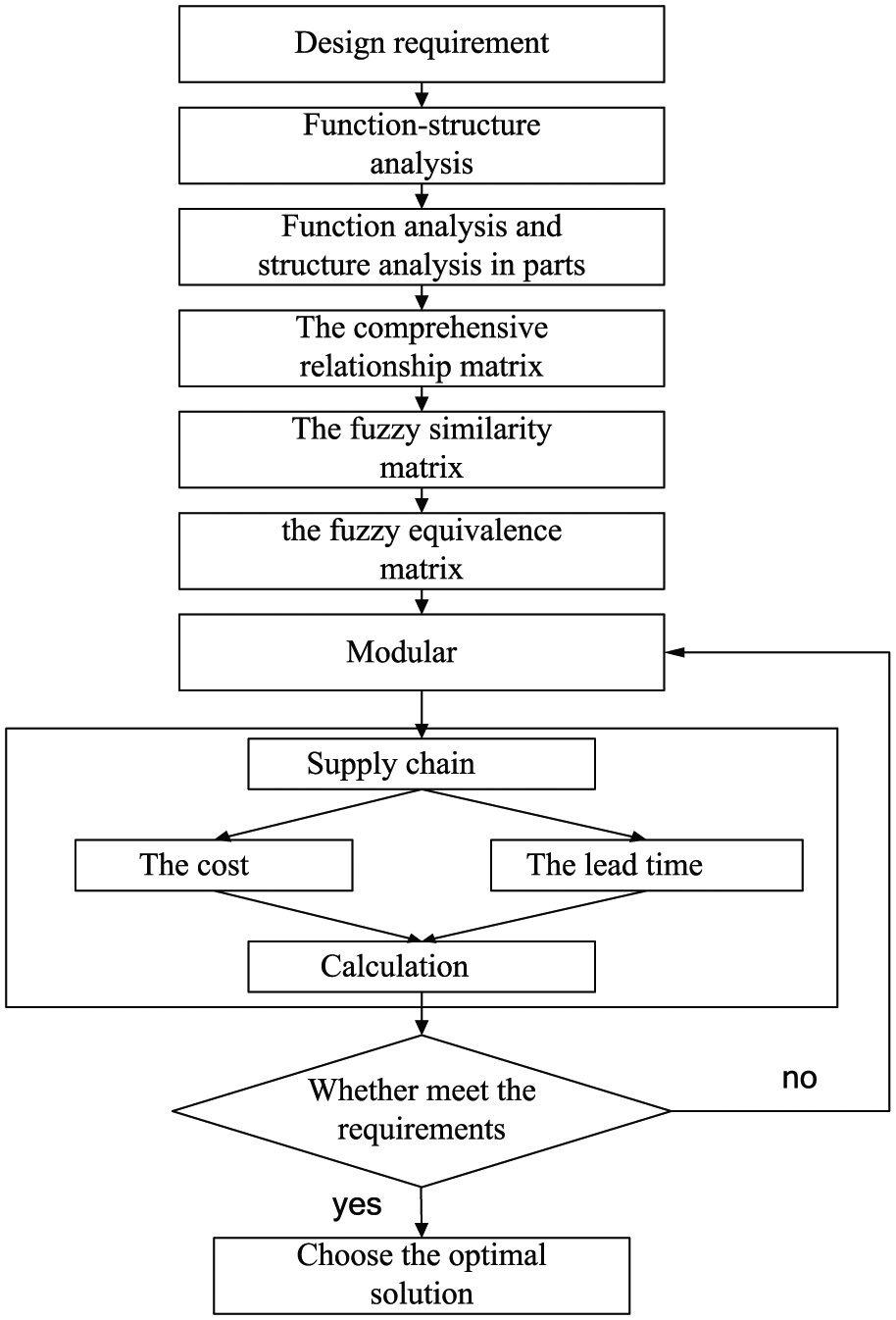
The flowchart of method.
The module partition based on the fuzzy clustering
As the key technology of modular product design, module partition has been the hotspot in research of engineering problems. At present, many scholars studied the method of module partition.
A modular system, which constitutes a modular product, can be characterized by functional partitioning into discrete scalable, reusable modules, rigorous use of well-defined modular interfaces, and making use of industry standards for interfaces.
In this article, we present a module partition method based on the fuzzy clustering algorithm which studies the degree of closeness and similarity relations between product components in terms of function and structure.
The relationship matrix between parts
The correlation of function
A module partition method can be examined by the correlation of parts’ function, by which parts to implement a common function would be assembled together to form module. Thus, the functions between modules are independent. The relationships are quantitatively described by 0–9 score, as shown in Table 1.
The functional relationship and quantitative values.

The functional relationship between parts is determined by the functional relation table, and the functional correlation matrix is as follows

The correlation of structure
A module partition method can be examined by the correlation of parts’ structure within the module, but the whole structure of the modules is independent. This is a fundamental principle of module partitioning, which can guarantee the integrity and independence of each module in structure. The relationships are quantitatively described by 0–9 score, as shown in Table 2.
The structural relationship and quantitative values.

The structural relationship between parts is determined by the structural relation table, and the structural correlation matrix is as follows

The parts’ incidence matrix would be established after definition of the relationship between the parts. As both function and structure scores would influence the relationship between the parts, a weighted average of the relationship to show the relevance of comprehensive matrix is defined as equation (1) shown


In equation (1), rpq represents the weighed relation value between the part p and the part q. F1 and F2 represent the relevance between the p and q in the functional matrix and the structural matrix, respectively. wf and ws represent the designed weight of function and structure, as shown in equation (2). The comprehensive relationship matrix is as shown in Table 3.
The comprehensive relationship matrix of the parts.

Fuzzy clustering method
In actual application, because the classification object’s data obtained are more complex and often not in [0, 1] interval, all the original data should be standardized. There are n objects to be classified, and each dimension feature xk has n raw data. They are assumed to be


Then, according to equation (5), the standardization values

The standardization values

The raw data obtained by the fuzzy similarity matrix are analyzed through the direct Euclidean distance, as shown in equation (7), where p and q, respectively, represent two parts. k represents the kth part. rpk represents the relevance between the p part and k part. m represents the matrix ranks. c is an arbitrary parameters, which makes rpq between 0 and 1

The matrix R is calculated by rpq, and the rpq value represents the value of each element in R. When pq is given the different values, it causes rpq to be different. Then, it causes each element in the matrix R to be different.
Theorem 1
The min-transitive closure t(R) of a fuzzy relation on a universe X with cardinality n is given by
The min-transitive closure of R is given by t(R) = R(n). Practically, one computes
After obtaining the fuzzy equivalence matrix, in this article, we use the direct selection method 15 to generate modular solution, according to which the division of the degree of refinement, assembling complexity to select different threshold λ.
The hierarchical model of supply chain based on product module structure
A simplified three-level (parts suppliers, module suppliers, final assembly enterprises) supply chain is employed for the case study on product structure and supply chain design. And the supplier capacity is infinite (a part only needs one supplier), as shown in Figure 1.
In this article, the modular structure is used to describe the product’s structure, and the modular structure can be represented by the structure matrix between the parts and modules, as shown in Table 4. R is a matrix in which the row and column are represented by m and n. m represents the number of modules that make up the product, and n represents the number of parts that make up the product. The number in the cell is 1, which indicates that the corresponding part of the row is in the corresponding module of the column. The number 0 indicates that the corresponding part of the row is not in the corresponding module of the column.
The structure matrix between the parts and modules.

The subscript index, decision variables, and parameters of the mathematical model are shown in Table 5.
The information of each variable in the supply chain model.
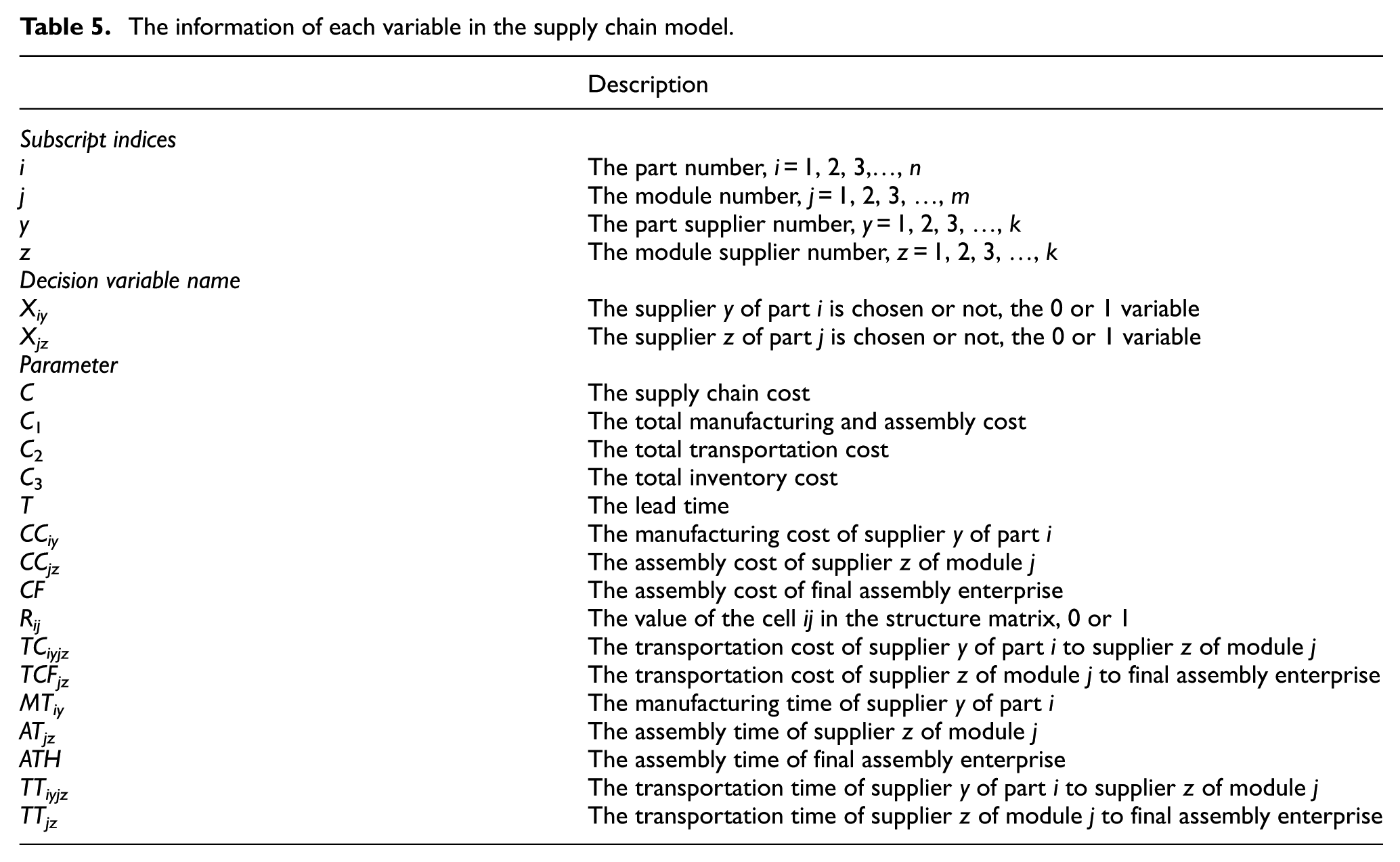
The supply chain cost is the total cost of a single product in supply chain, including total manufacturing and assembly cost (C1), total transportation cost (C2), and total inventory cost (C3) of the product at every stage of supply chain. The goal function of supply chain, cost C is: min C{production cost C1 + transportation costs C2 + inventory cost C3}. Production cost C1 is calculated by equation (8). If only one part is in module i, only manufacturing cost and final assembly enterprises’ assembly cost are considered

Production cost C1 is calculated by equation (8), where MCijz is the manufacturing cost of supplier z of part j in module i. ACis is the assembly cost of supplier s of module i. ACh is the assembly cost of final assembly enterprises h. If only one part is in module i, only manufacturing cost and final assembly enterprises’ assembly cost are considered.
The total transportation cost C2 is defined in equation (9). If only one part is in module i, the assembly part is directly transported into the final assembly enterprises

The total transportation cost C2 is defined in equation (9),where TCijz_is is the transportation cost of supplier z of part j in module i to supplier s of module i. TCis_h is the transportation cost of supplier s of module i to final assembly enterprises h. If only one part is in module i, the assembly part is directly transported into the final assembly enterprises.
From the production experience, inventory cost C3 is positively correlated with the production cost C1 and transportation cost C2. So the inventory cost C3 is calculated by equation (10)

A lead time is the latency between the initiation and execution of a working process. Lead time in the supply chain management realm is the time from the moment the customer places an order to the moment it is ready for delivery. In the absence of finished goods or intermediate (work in progress) inventory, it is the time it takes to actually manufacture the order without any inventory other than raw materials. The lead time of supply chain includes the manufacturing time of parts suppliers, the assembly time of module suppliers, the assembly time of final assembly enterprises, the transportation time of parts suppliers to module suppliers, the transportation time of module suppliers to final assembly enterprises. The objective function of the lead time in supply chain is shown in equation (11). If there is only one part in module i, the assembly part is directly transported into the final assembly enterprises

In equation (11) function, T is the lead time of supply chain. MTijz is the manufacturing time of supplier z of part j in module i. ATis is the assembly time of supplier s of module i. ATh is the assembly time of final assembly enterprises h. TTijz_is is the transportation cost of supplier z of part j in module i to supplier s of module i. TTis_h is the transportation cost of supplier s of module i to final assembly enterprises h. If there is only one part in module i, the assembly part is directly transported into the final assembly enterprises.
For the evaluation of modular scheme, the module ratio, the assembly difficulty ratio, the flexibility ratio of production, and other indicators can be employed. In this article, the total cost and lead time of supply chain, where each module or part has a supplier, are the goals for evaluation of the module structure, to determine the most suitable modules.
Case study
Refrigerator is an electrical equipment used frequently in daily life with basic function of food preservation. A refrigerator, studied in this article, includes 25 parts. The specific parts are shown in Table 6.
Refrigerator parts.

The manufacturing cost and time of parts suppliers and module suppliers are shown in Tables 7 and 8. The assembly cost of the final assembly enterprise is supposed to be 5 m yuan, the manufacturing time is supposed as 0.3 m days, where m is the number of modules in the product. Certainly, this article assumes that parts suppliers and module suppliers are independent without any functional or structural overlapping.
Parts supplier information.

Module supplier information.

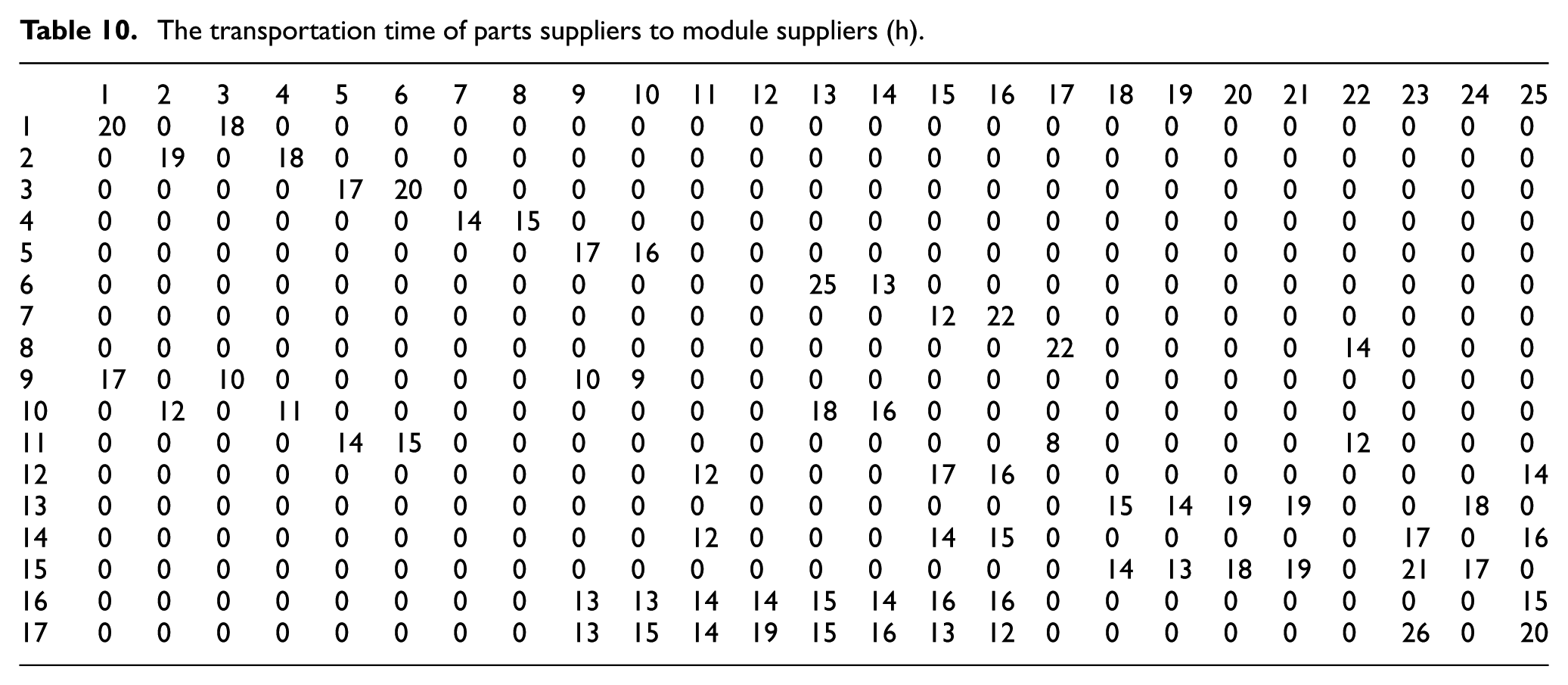
The transportation cost and time of parts suppliers to module suppliers are shown in Tables 9 and 10 where the row element represents the module suppliers, and column element represents the parts suppliers. (i, j) is a transportation cost or time of the supplier of j part to the supplier of i module.
The transportation cost of parts suppliers to module suppliers.

The transportation time of parts suppliers to module suppliers (h).
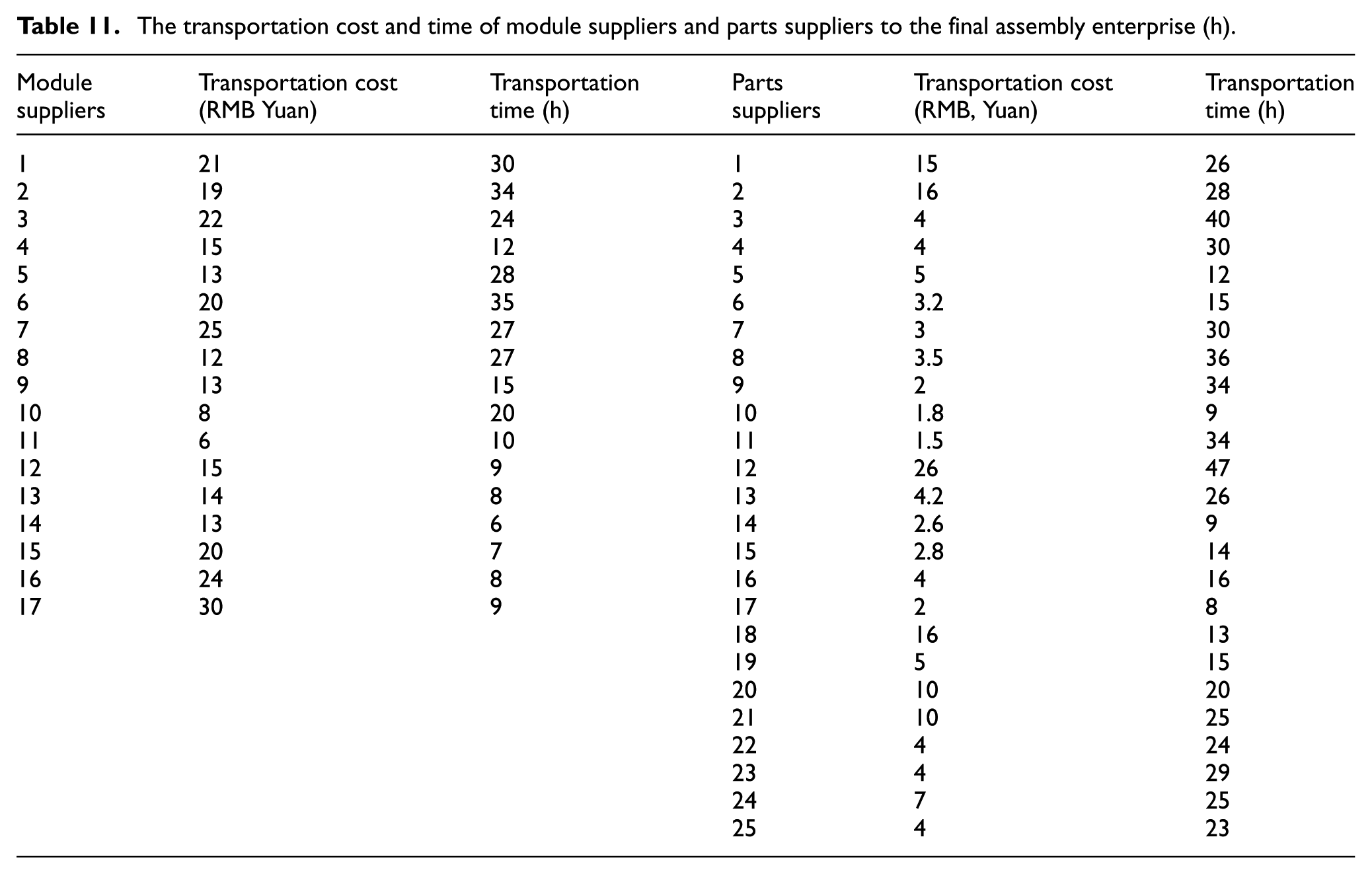
For those modules where there is only part inside, the part will be directly shipped from the part suppliers to final assembly. The transportation cost and time of each module suppliers and parts suppliers to the final assembly are shown in Table 11.
The transportation cost and time of module suppliers and parts suppliers to the final assembly enterprise (h).
The relation matrix synthetically illustrating the function–structure relation of parts is shown in Table 12. In this article, the weight of the correlation of function and the correlation of structure are designed as 0.5.
The comprehensive relationship matrix of the parts.

The fuzzy similarity matrix can be obtained by formula (7). The fuzzy equivalence matrix Rk is shown in Table 13 can be obtained by Theorem 1. The dynamic clustering result is shown in Figure 3.
The fuzzy equivalence matrix.

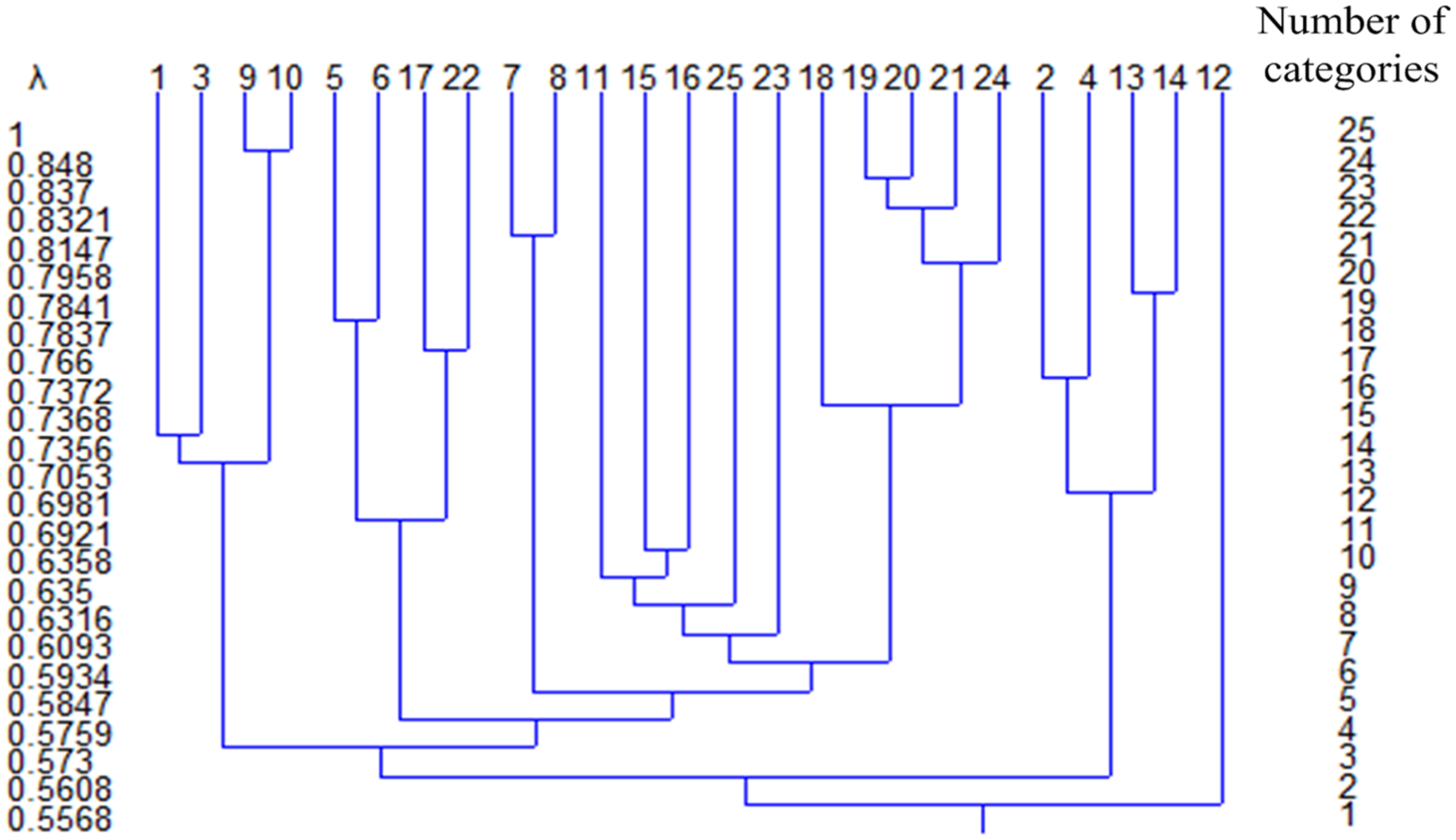
The dynamic clustering result.
The dynamic clustering result in Figure 3 shows that the modules {1, 3}, {9, 10}, {5, 6}, {17, 22}, {7, 8}, {18, 19, 20, 21, 24}, {2, 4}, {13, 14} are the stable sub-modules which can be aggregated into larger modules. When the value of λ is between 0 and 0.5568, the classification number of the module of 25 parts is one, which means the 25 parts can be aggregated into a module. When the value of λ is 0.5934, the parts of 11, 15, 16, 18, 19, 20, 21, 23, 24, 25 could be gathered into a class. The stability of the module is deteriorating, as the value of λ decreases. This means all the parts could be aggregated into a module, which apparently contradicts the aim of module partition. When the value of λ is 0.7356, the sub-modules are stable. Furthermore, as the value of λ increases, the number of the stable modules will decrease, which worsens the stability of the module. When the value of λ is 1, the classification number of the module of 25 parts is 25, which means that the 25 parts forms 25 modules with only one part. In other words, when the value of λ is 1, the 25 parts cannot be aggregated.
From the above analysis, the value of λ is appropriate to be selected between 0.5934 and 0.7356. The different values form the different schemes of modules. The supply chain’s cost and lead time of each scheme is calculated in Table 14 by the formula 2.4, 2.5, 2.6 (a = 0.5, b = 0.5), 2.7.
The result of the schemes.

Under the premise condition, there is no corresponding module suppliers of the module {11, 15, 16} in the scheme 6; therefore, the cost and lead time cannot be calculated and evaluated.
The average value of λ is 0.606, scheme 9: {1, 3, 9, 10}, {2, 4, 13, 14}, {5, 6, 17, 22}, {7, 8}, {11, 15, 16, 23, 25}, {12}, {18, 19, 20, 21, 24}, a total of 7 class, the same with scheme 8.
Table 14 shows that scheme 8 is the optimal solution with the total cost of 1902.6 yuan and the lead time of 78.88 days, which is the optimal compared with the other seven schemes.
Conclusion
Through the functional and structural correlation analysis of the product, the initial relationship matrix of all the parts between each other can be formulated. The module partition of the product is achieved by fuzzy clustering algorithm. Different value of λ can generate the corresponding modular scheme.
A simple three-level supply chain network diagram is employed to determine the optimal modular scheme in terms of the total cost and the lead time, which can be calculated by the supply chain network’s basic information. A mathematical programming model is suggested to minimize the cost and the lead time of the supply chain. Once the modular scheme is determined, the suppliers of the modular become definite. The cost and the lead time could be anticipated by the suppliers. Therefore, the optimal modular scheme is judged by the supply chain network’s performance.
A case study on the modular design of refrigerator verified the feasibility of the proposed method. On the whole, this article proposes a method on module partition based on the performance of the supply chain. Through this method, the supply chain network becomes efficient as the product development’s cost and time decrease greatly, which could enhance the market competitiveness of enterprises and gain more market share. The method can also help enterprises upgrade their existing products and supply chain network.
Footnotes
Handling Editor: Jianqiao Ye
Declaration of conflicting interests
The author(s) declared no potential conflicts of interest with respect to the research, authorship, and/or publication of this article.
Funding
The author(s) disclosed receipt of the following financial support for the research, authorship, and/or publication of this article: This work was supported in part by the National Science Foundation, China (grant nos 51175388 and 51475340). It was also supported in part by Hubei Science and Technology Support Program (grant no. 2014BAA097) and Wuhan Innovation Team Program of High-Tech Industry (grant no. 2016070204020160).