




Abstract
Secretion clearance is an important respiratory treatment for patients, who cannot cough out secretion spontaneously. Aiming at the disadvantages of existing secretion clearance technologies, in this article, we proposed two mechanical in-exsufflation secretion clearance systems (namely, pressure-controlled secretion clearance system and volume-controlled secretion clearance system) with a volume-controlled ear. To illustrate the dynamic characteristics of the two secretion clearance systems, a dimensionless mathematical model of the two secretion clearance systems was set up. After that the mathematical model was verified through experimental studies. To improve the efficiency and security of secretion clearance of the two secretion clearance systems, secretion clearance airflow dynamics of the two secretion clearance systems were studied and compared. Finally, influences of key parameters on the dynamic characteristics of the two secretion clearance systems are obtained. This article lays a foundation for the optimization of the two secretion clearance systems.
Keywords
Introduction
Mechanical ventilation, an important respiratory treatment, has been usually applied to assist patients who cannot breathe spontaneously in inhaling adequately.1–5 However, in the intensive care unit (ICU), on account of the application of an artificial airway and the use of drugs such as muscle relaxants and sedatives,6–9 patients with the aid of mechanical ventilation have difficulty in clearing secretion. In most cases, they cannot cough out secretions in artificial airway; hence, airways may be blocked by accumulation of secretions, which may put patients in lethal jeopardy in many ways. Initially, bacteria breeds easily in patients’ respiratory system with accumulation of secretions, which may bring about pulmonary infection.10–22 Furthermore, hypoventilation, respiratory failure, and other relevant diseases may be caused by secretion in airway.23–27 What is more, the most common disease is ventilator-associated pneumonia (VAP) in mechanical ventilation, whose incidence rate is about 68% and mortality rate is 50%–70%,28–32 respectively. Thus, to clear secretions in airways which are detrimental to patients, and make sure therapeutic effect of mechanical ventilation, it is of vitally significance to research secretion clearance methods.
Nowadays, some secretion clearance methods have gotten mature. For example, CoughAssist (Philips Respironics, Inc., Murrysville, PA), a representative mechanical in-exsufflation (MI-E) device, has been used clinically, but the patient cannot receive positive pressure.33,34 In-line inexsufflation (IL-IE) verified to reduce risk of VAP effectively is widely applied clinically.15–22,35–37 However, because of the device cannot connect with ventilator, persistent airway collapse may be caused by the IL-IE.38,39
In this article, aiming at the disadvantages of existing secretion clearance technologies, pressure-controlled secretion clearance (PCS) system and volume-controlled secretion clearance (VCS) system, two MI-E secretion clearance systems with a volume-controlled ventilation (VCV) function, had been proposed. Initially, according to the equivalent pneumatic system, a dimensionless mathematical model of the two secretion clearance system was set up, which is convenient and effective to study the dynamic characteristics in the secretion clearance system.
Furthermore, experimental studies on the secretion clearance system with a VCV function were carried out to verify the established dimensionless mathematical model. Based on experimental and simulation study on the secretion clearance system, its dynamic characteristics can be obtained and analyzed. Moreover, in order to compare the two MI-E secretion clearance systems in terms of safety and efficiency, comparison analysis between PCS system and VCS system had been obtained.
Finally, influences of key parameters on the dimensionless dynamic characteristics of the secretion clearance system are studied. Effective area of air intake of the lung (A*), volume flow of secretion clearance (
Mathematical model of secretion clearance system
Introduction of secretion clearance system with a VCV function
As shown in Figure 1, the pneumatic system used in the secretion clearance system is set up. Among them, compressor 1 and compressor 2 represent ventilator in mechanical ventilation circuit and secretion clearance circuit, respectively, and the respiratory tract and lung are represented by two variable volume containers whose air intakes are replaced by throttles. Solenoid valve 1 separates inspiration circuit and expiration circuit in ventilation mode, while solenoid valve 2 separates inspiration circuit and secretion clearance circuit in secretion clearance mode.
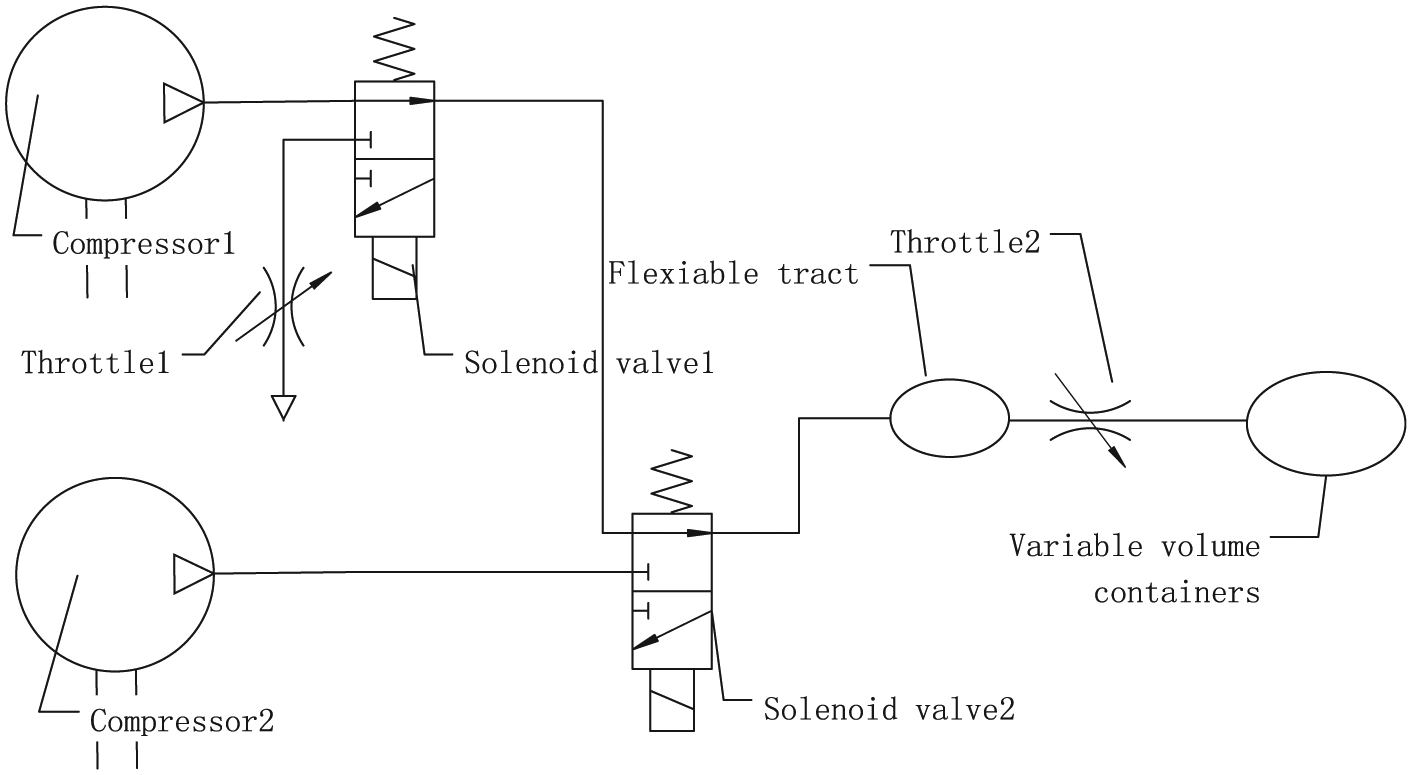
Simplified mechanical secretion clearance system.
In the ventilation mode, stable airflow is forced into the respiratory system by a positive pressure provided by the volume-controlled (VC) ventilator, which is represented by the air compressor 1. In the inspiration circuit, the air inflow depends on tidal volume of ventilator and the stable flow depends on inspiration time. In the expiration circuit, due to the elasticity of lung, air is expelled to the atmosphere through the exhalation valve 1.
In the secretion clearance mode, compressor 2 represents the exhalation valve. In the inspiration circuit, working process of secretion clearance mode is the same as that of mechanical ventilation mode. While secretions in the airway are cleared by a negative pressure provided by the ventilator in the secretion clearance circuit, which replaces the expiration circuit.
Modeling of secretion clearance system
In the secretion clearance system, its working process consists of the inspiration circuit, the expiration circuit, and the secretion clearance circuit. Therefore, equations of flow, pressure, and volume are necessary to set up mathematical model of secretion clearance system12,35,39
Pressure equation

Flow equation

Volume equation

In equations (1)–(3), p means pressure; R is a gas constant, which equals 287
Dimensionless model of secretion clearance system
The reference values and the dimensionless variables are presented in Table 1. The original mathematical secretion clearance model can be made dimensionless in the following section. So as to study the dynamic characteristics of secretion clearance system with a convenient and effective method, on the basis of discussion above, a dimensionless mathematical model of secretion clearance system is set up. Hence, according to the reference values in Table 1, the dynamic characteristics of the ventilation system can be calculated by checking reference values and dimensionless variables. Moreover, by means of the analysis of the dimensionless secretion clearance model, the influences of key parameters on the dynamic characteristics of the secretion clearance system can be obtained.
Reference values and dimensionless variables.

For the tidal volume (Vt) and maximum pressure (pmax) can be measured conveniently, the tidal mass (mt) can be calculated by the following equation 36

The maximum air mass flow exhaled from the lung, which is named as the maximum exhaled air mass flow (qmax), can be calculated as follows 37

Dimensionless equations of dynamics of air in the ventilator
In the inspiration circuit, the dimensionless mass flow equation of the secretion clearance system becomes

In the expiration circuit, the dimensionless volume flow or mass flow equation is

When the equivalent effective area of tract Ae is same as At, equation (7) can be rewritten as

And in the secretion clearance circuit, the dimensionless mass flow equation is


In equations (9) and (10), the atmosphere is replaced by a negative pressure
The dimensionless compliance of tract

Then, the dimensionless pressure in tract equation can be obtained as

Dimensionless equations in the lung
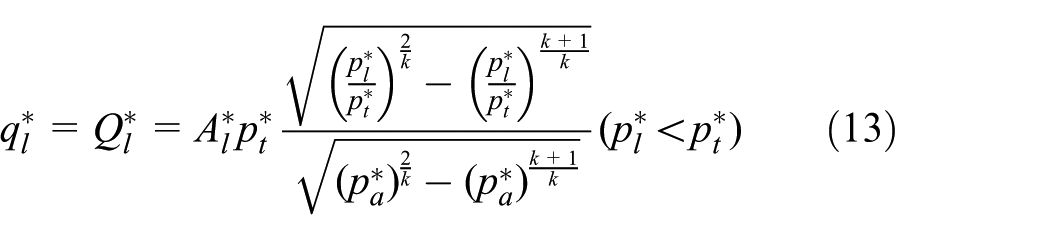
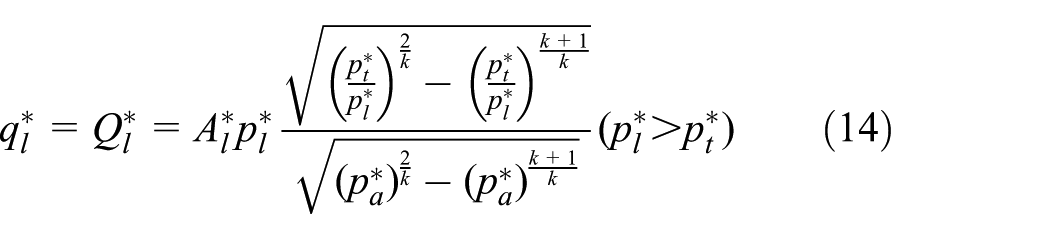
Respiratory track is regarded as throttles, the dimensionless equations of dynamics of air in lung can be obtained as follows


Experimental and simulation study
Experimental study
Because mechanical ventilation is a special case of secretion clearance system with a VCV function, experimental study of mechanical ventilation had been completed. As indicated in Figure 2, a detecting device used for clinical research to measure flow and pressure, a negative servo lung, and a VC ventilator are employed in studying dynamics of volume-controlled mechanical ventilated respiratory system. Stable volume airflow was output by the typical VC ventilator (TYCO PB840). Inspiration time, plateau time, and expiration time were set to 1.62, 0.4, and 2.67 s, respectively. In addition, tidal volume of respiratory system was set to 500 mL.
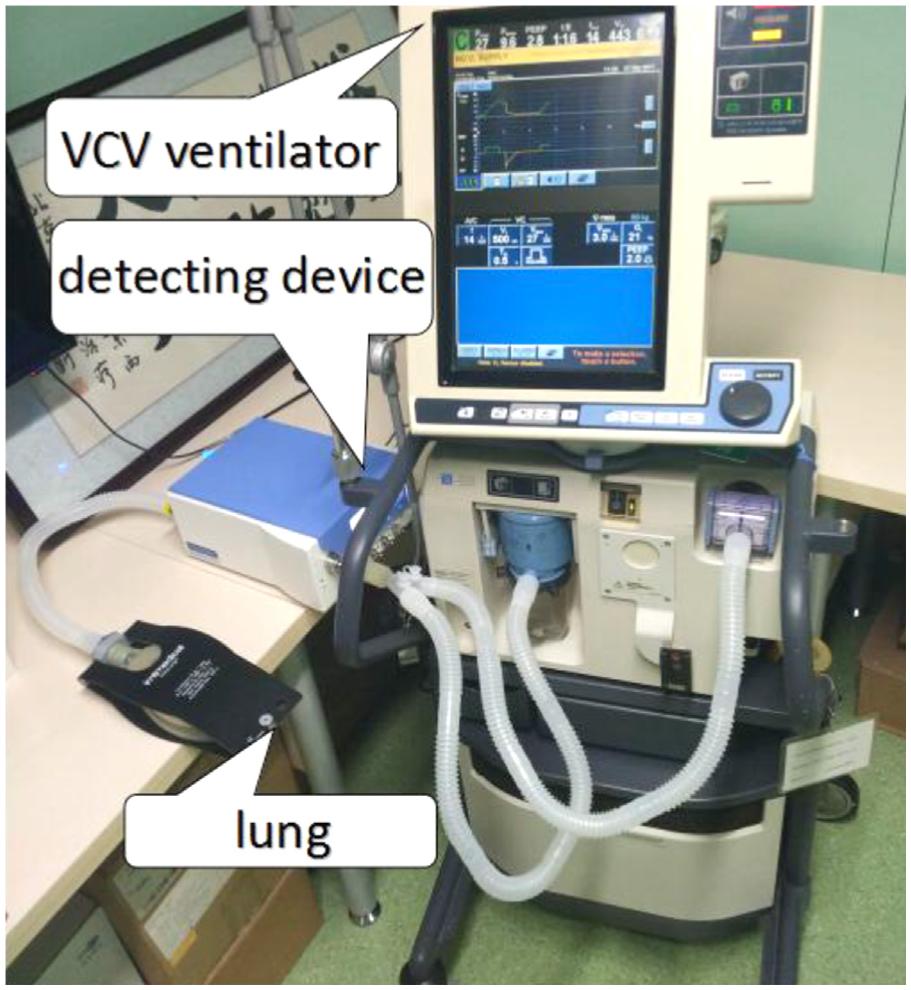
Experimental apparatus—VCV indicates volume-controlled ventilation.
Comparison of results from simulation and experiment
The dimensionless mathematical model coded in an S-function of MATLAB/Simulink simulates the mechanical ventilated respiratory system The experimental and the simulation results are shown in Figures 3 and 4, where experimental curves are illustrated by solid line and dotted line represents simulation one.

Dimensionless flow results in the tract.
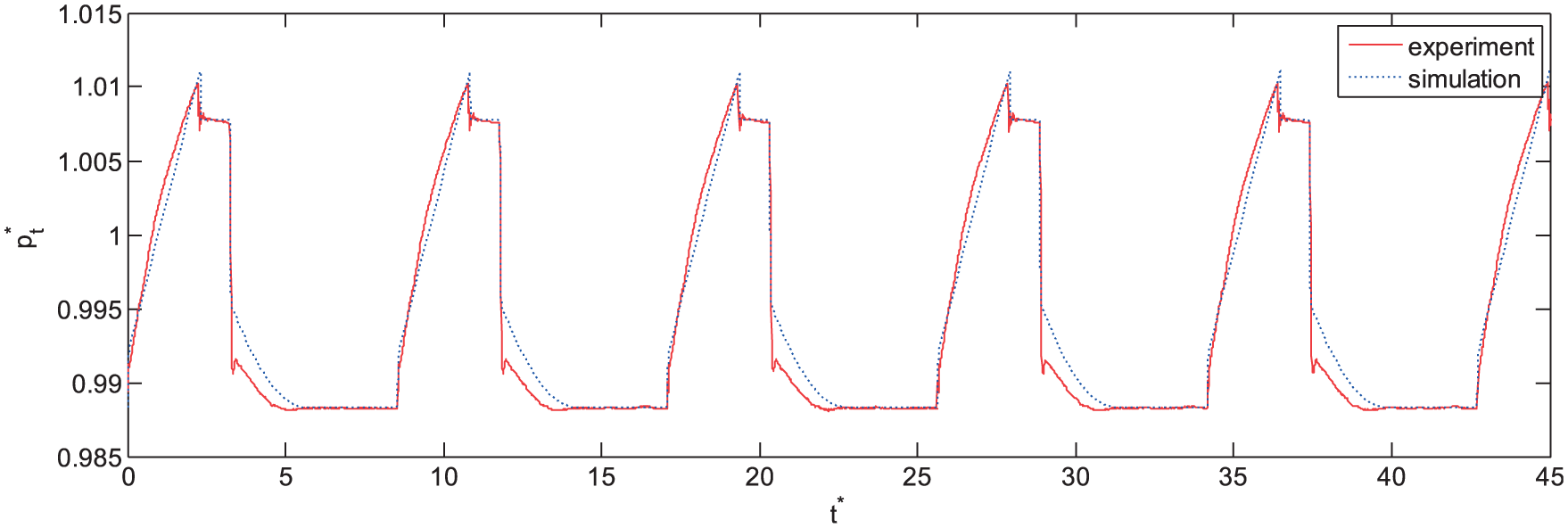
Dimensionless pressure results in the tract.
From Figures 3 and 4, it can be observed that experimental results and simulation results are identical approximately; hence, the dimensionless mathematical model can be used to study dimensionless dynamic characteristics of secretion clearance system.
As shown in Figure 3, at the beginning in the expiration circuit, because of the lag of the exhalation valve, peak volume flow in tract of simulation is slightly larger than experimental one. In addition, as shown in Figure 4, experimental pressure fluctuates at the beginning of the expiration time, because exhalation valve opens suddenly, which leads to a pressure fluctuation.
In the inspiration circuit, stable volume airflow is output by the typical VC ventilator and its pressure begins to rise rapidly at the beginning of the circuit. In the plateau circuit, the pressure in tract and lung reaches the peak pressure and the VC ventilator suspends to output airflow. In the expiration circuit, on account of huge pressure difference between atmosphere and respiratory system, the pressure in tract and lung drop rapidly; meanwhile, a peak expiration volume airflow is made.
Influence of key parameters of the PCS system with a VCV function
In the PCS system with a VCV function, dimensionless pressure of secretion clearance (
To study the dynamics of the dimensionless pressure in lung
Influence of dimensionless compliance on the dynamics in the PCS system
The impact of dimensionless

Dynamics of dimensionless pressure in lung with different

Dynamics of dimensionless pressure in tract with different

Dynamics of dimensionless volume flow of lung with different

Relationship between dimensionless compliance of lung and dimensionless peak pressure in tract.

Relationship between dimensionless compliance of lung and dimensionless peak pressure in lung.

Relationship between dimensionless compliance of lung and dimensionless peak volume flow of secretion clearance.

Relationship between dimensionless compliance of lung and dimensionless duration of secretion clearance.

Dynamics of dimensionless pressure in lung with different
Influence of dimensionless effective area parameters on the dynamics in the PCS system
The impact of dimensionless
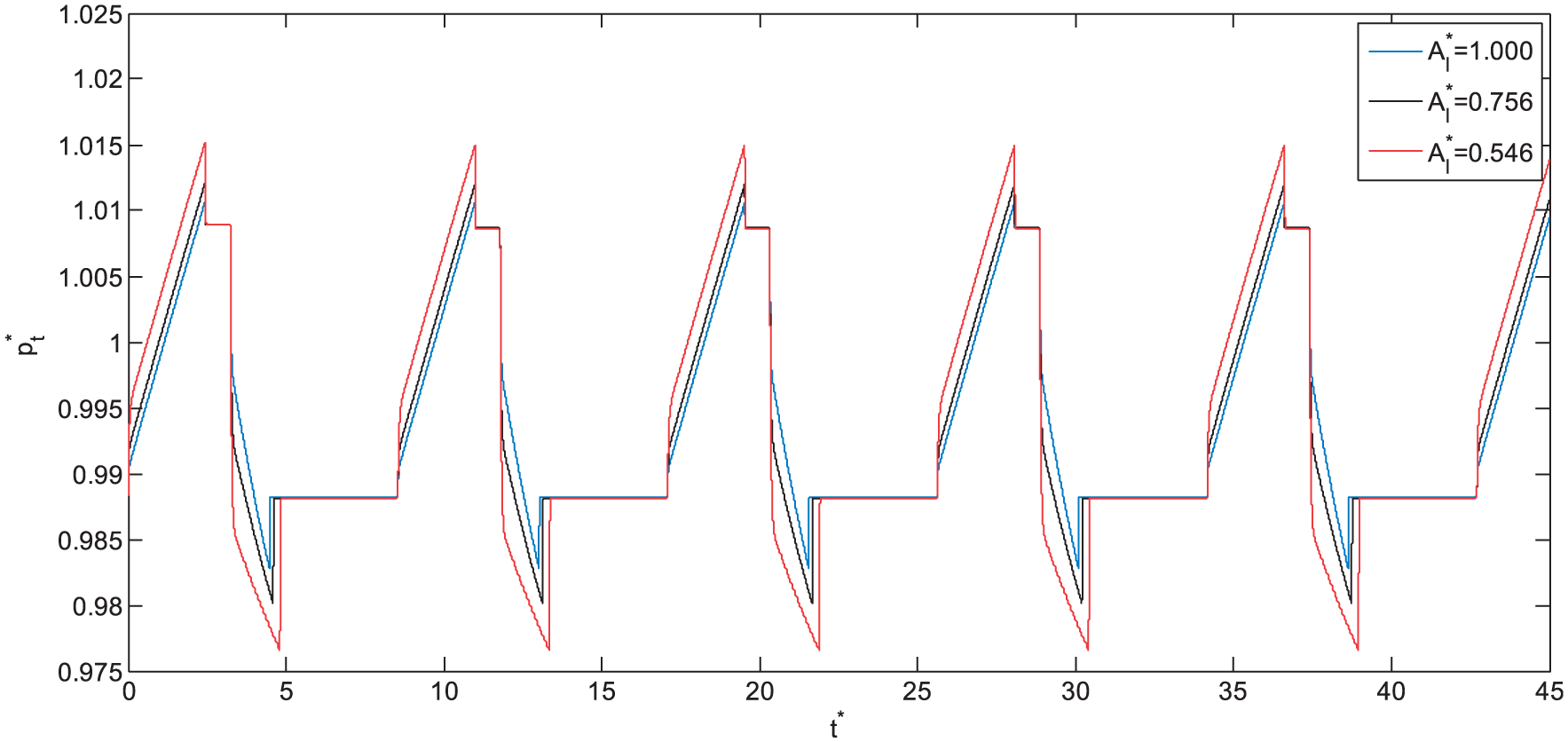
Dynamics of dimensionless pressure in tract with different

Dynamics of dimensionless volume flow of lung with different

Relationship between dimensionless effective area of lung and dimensionless peak pressure of tract.
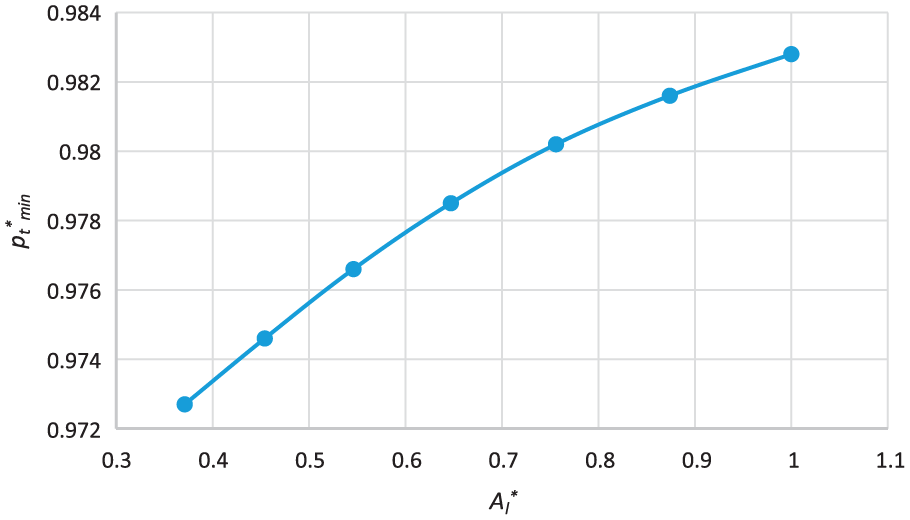
Relationship between dimensionless effective area of lung and dimensionless bottom pressure of tract.
Influence of dimensionless pressure of secretion clearance on the dynamics in the PCS system
The impact of dimensionless
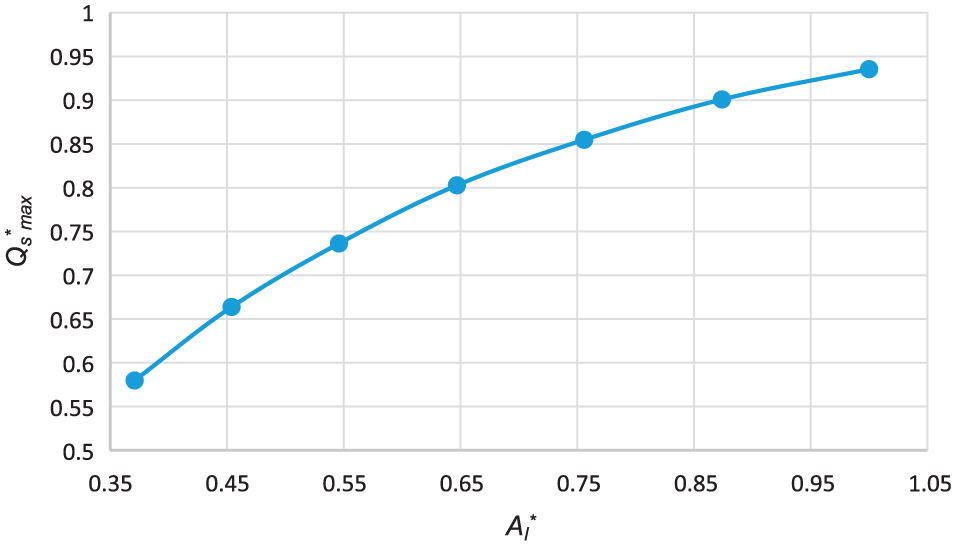
Relationship between dimensionless effective area of lung and dimensionless peak volume flow secretion clearance.
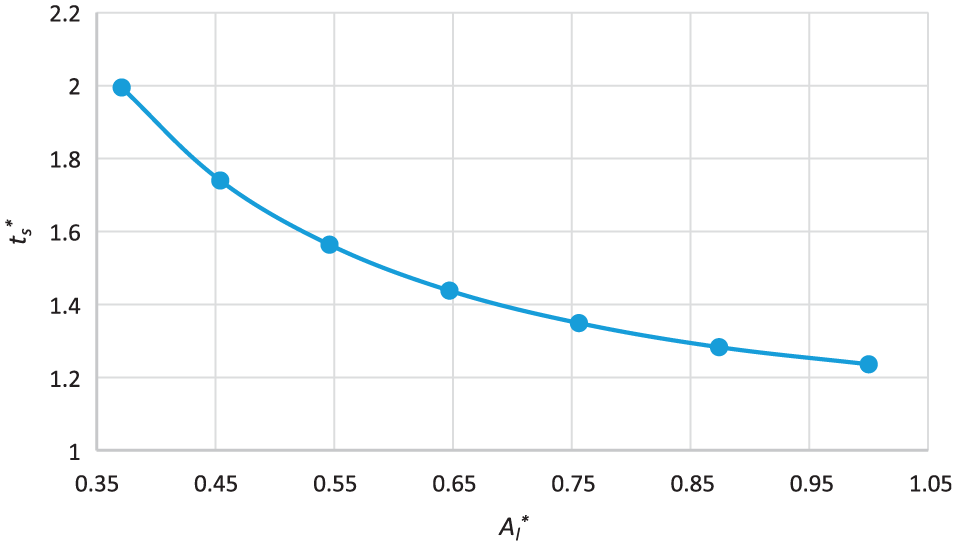
Relationship between dimensionless effective area of lung and dimensionless duration of secretion clearance.

Dynamics of dimensionless pressure in lung with different

Dynamics of dimensionless pressure in tract with different
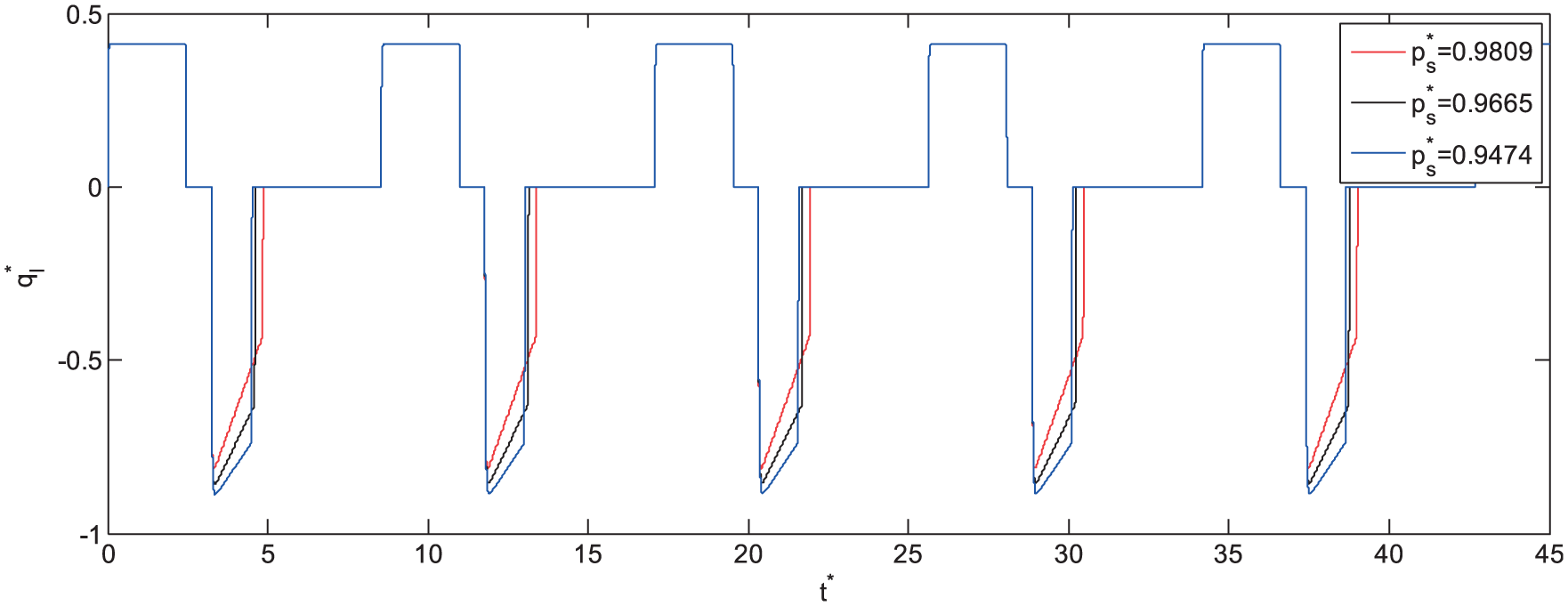
Dynamics of dimensionless volume flow of lung with different

Relationship between dimensionless pressure of secretion clearance and dimensionless bottom pressure in tract.
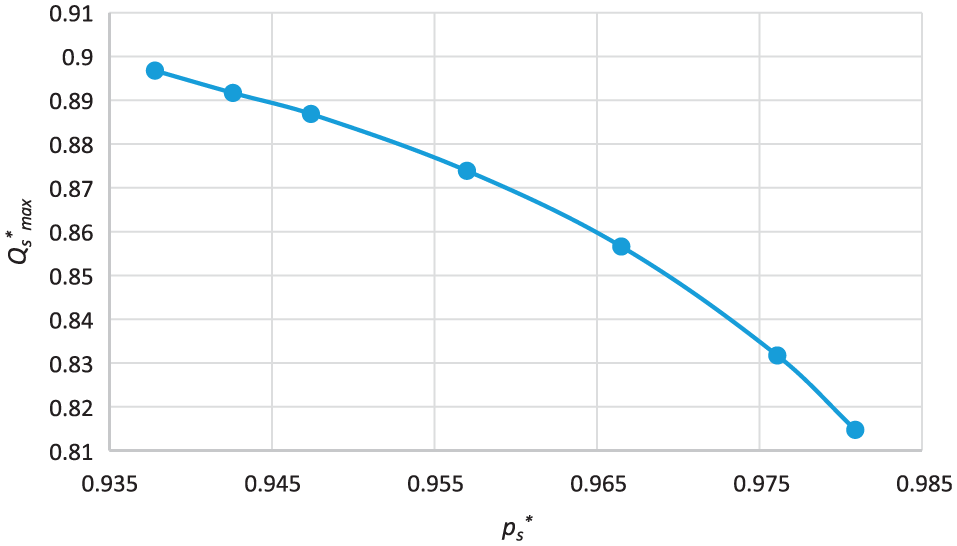
Relationship between dimensionless pressure of secretion clearance and dimensionless peak volume flow of secretion clearance.
Influence of key parameters of the VCS system with a VCV function
When the VC ventilator works in the VCS system, dimensionless volume flow of secretion clearance (
To study the dynamics of the dimensionless pressure in lung
Influence of dimensionless compliance on the dynamics in the VCS system
The influence of dimensionless
Influence of dimensionless effective area on the dynamics in the VCS system
The impact of dimensionless
Influence of dimensionless volume flow of secretion clearance on the dynamics in the VCS system
The influence of dimensionless
Comparison analysis in the PCS system and VCS system
In order to compare the two MI-E secretion clearance systems in terms of safety and efficiency, according to simulation in the PCS system and VCS system, comparison analysis of influence of the key parameters between PCS system and VCS system had been obtained.
Comparison analysis of compliance in the PCS and VCS
As shown in Figures 5, 6, 8, 9, and 24–27, both in the PCS system and in the VCS system, as dimensionless compliance of lung gets lower, pressure in lung and pressure in tract increases or decreases more rapidly; meanwhile, peak pressure becomes higher as well; moreover, at the end of the secretion clearance circuit, the bottom negative pressure in tract in the PCS system and VCS system remains unchanged. Hence, in the PCS system and VCS system, when tidal volume of ventilator keeps stable, decrease of dimensionless compliance of lung will bring about hyperventilation.
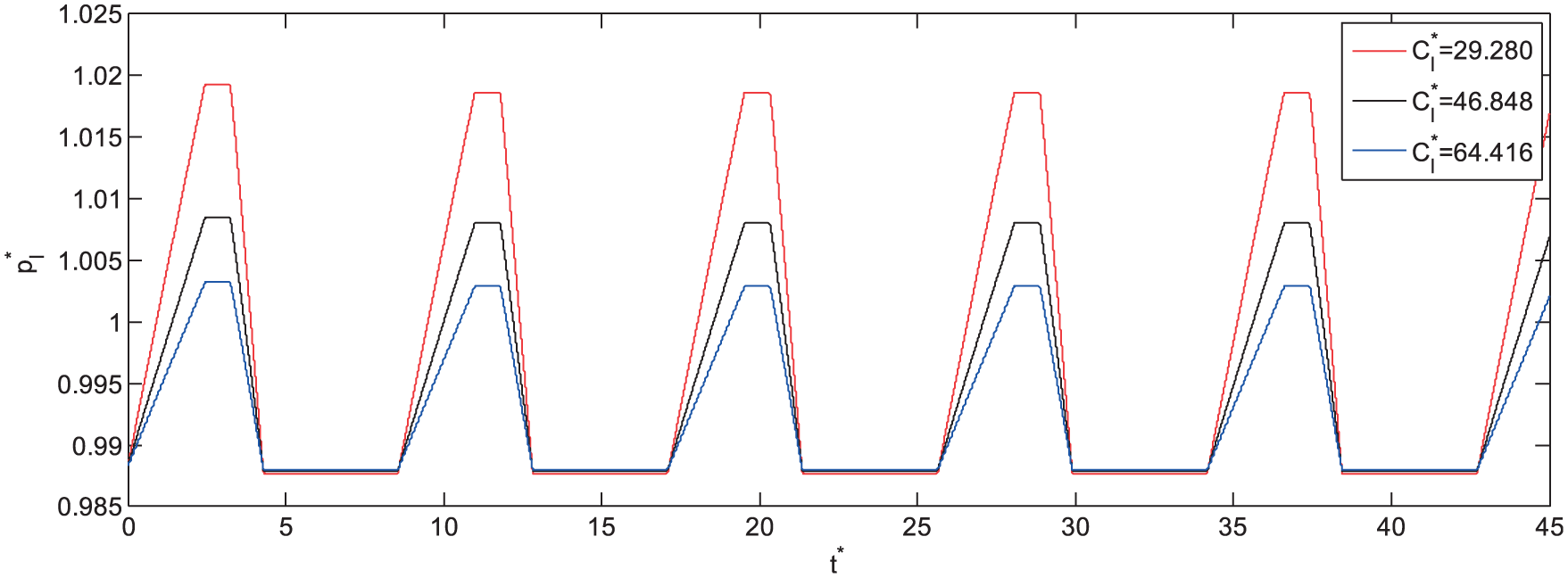
Dynamics of dimensionless pressure in lung with different

Dynamics of dimensionless pressure in tract with different
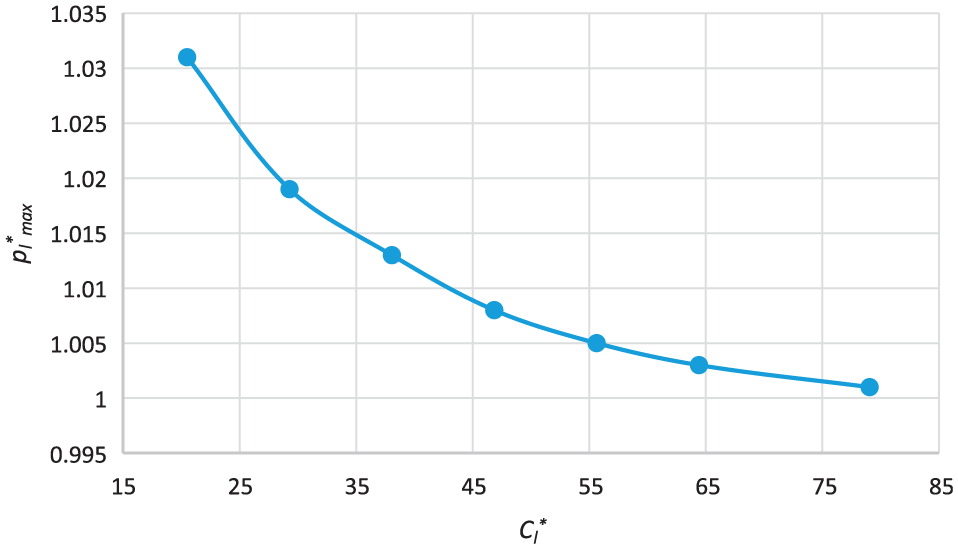
Relationship between dimensionless compliance of lung and dimensionless peak pressure in lung.

Relationship between dimensionless compliance of lung and dimensionless peak pressure in tract.
As shown in Figures 7, 10, 11, and 28, it can be obtained that peak volume flow of secretion clearance gets higher slightly and duration of secretion clearance gets shorter slightly with a lower compliance of lung in the PCS system, while in the VCS system, compliance of lung has an little impact on dynamics of secretion clearance airflow.
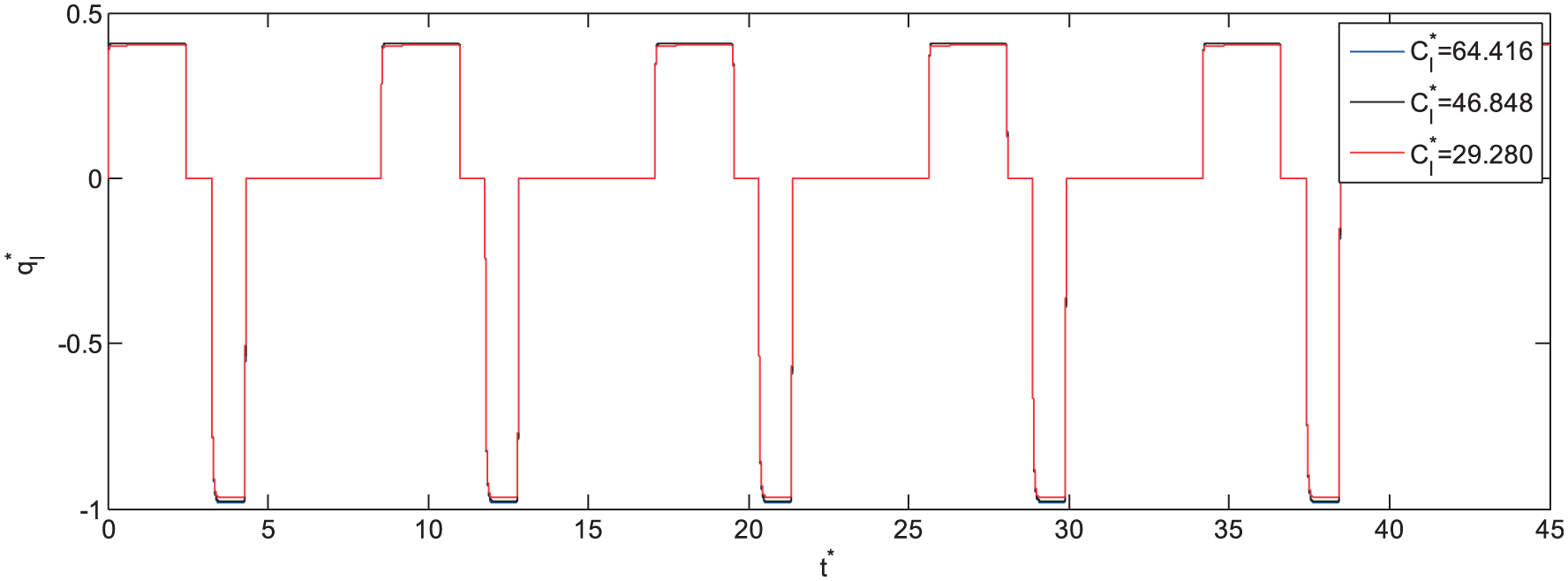
Dynamics of dimensionless volume flow of lung with different
Comparison analysis of effective area in the PCS system and VCS system
As shown in Figures 12 and 29, effective area of lung has an little impact on pressure in lung both in the PCS system and in the VCS system. As shown in Figures 13, 15, 16 and 30–32, when effective area of lung becomes lower, peak pressure in tract gets higher and bottom pressure gets lower; meanwhile, pressure in the plateau time keeps fixed. In addition, bottom pressure declines more rapidly in the VCS system than that in the PCS system; in the VCS system, a 42% decrease of dimensionless effective area (from 0.454 to 0.647) leads to a nearly 52% decrease of dimensionless negative bottom pressure in tract, while in the PCS system, a 42% decrease of dimensionless effective area (from 0.454 to 0.647) leads to a nearly 35% decrease of dimensionless negative bottom pressure in tract.

Dynamics of dimensionless pressure in lung with different

Dynamics of dimensionless pressure in tract with different

Relationship between dimensionless effective area of lung and dimensionless peak pressure of tract.

Relationship between dimensionless effective area of lung and dimensionless bottom pressure of tract.
As shown in Figures 14, 17, and 18, in the PCS system, when effective area becomes higher, peak volume flow of secretion clearance gets higher and duration of secretion clearance gets shorter, a 42% increase of dimensionless effective area (from 0.454 to 0.647) brings about a nearly 17% decrease of duration of secretion clearance. Therefore, efficiency of secretion clearance increases obviously with higher effective area. Inversely, as shown in Figure 33, in the VCS system, influence of effective area on secretion clearance airflow can be ignored.

Dynamics of dimensionless volume flow of lung with different
Comparison analysis between pressure of secretion clearance in the PCS system and volume flow of secretion clearance in the VCS system
To increase strength of secretion clearance, the negative pressure of secretion clearance in the PCS system can be reduced; similarly, volume flow of secretion clearance in the VCS system could be increased.
As shown in Figures 19 and 34, strength of secretion clearance has little impact on the pressure in lung both in the PCS system and in the VCS system. As shown in Figures 20, 22, 35, and 36, when strength of secretion clearance increases, negative bottom pressure in tract declines, a 25% decrease of dimensionless pressure of secretion clearance (from 0.9378 to 0.9474) in the PCS brings about a nearly 13% decrease of dimensionless bottom pressure in tract, while a 20% increase of dimensionless volume flow of secretion clearance (from 1.0 to 1.2) in the VCS system leads to a nearly 52% decrease of dimensionless bottom pressure in tract. It is obvious that strength of secretion clearance has more effect on bottom pressure in tract in the VCS system.

Dynamics of dimensionless pressure in lung with different
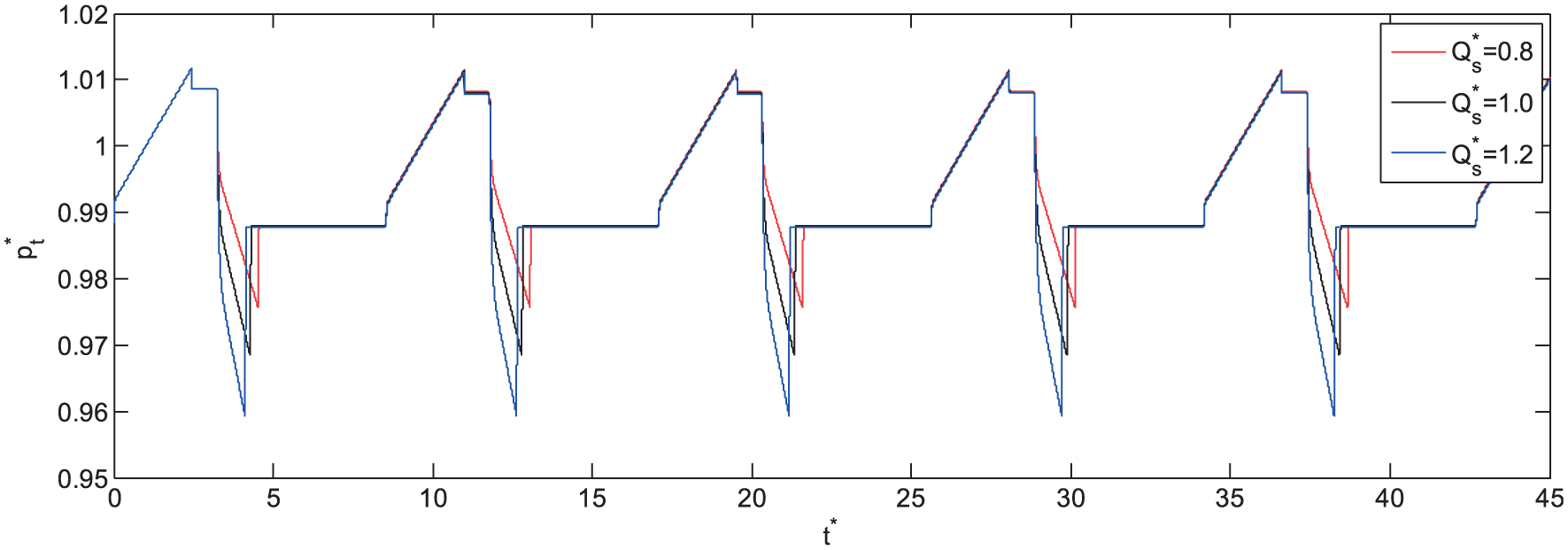
Dynamics of dimensionless pressure in tract with different

Relationship between dimensionless volume flow of secretion clearance and dimensionless bottom pressure in tract.
As can be seen from Figures 21, 23 and 37–40, strength of secretion clearance directly affects efficiency of secretion clearance. A 50% decrease of dimensionless pressure of secretion clearance (from 0.9570 to 0.9665) in the PCS system brings about a nearly 5% decrease of duration of secretion clearance, while a 20% increase of dimensionless volume flow of secretion clearance (from 1.0 to 1.2) in the VCS system leads to a nearly 16% decrease of dimensionless duration of secretion clearance. Therefore, secretion clearance in the VCS system is more efficiency with the same change of strength.

Relationship between dimensionless pressure of secretion clearance and dimensionless duration of secretion clearance.
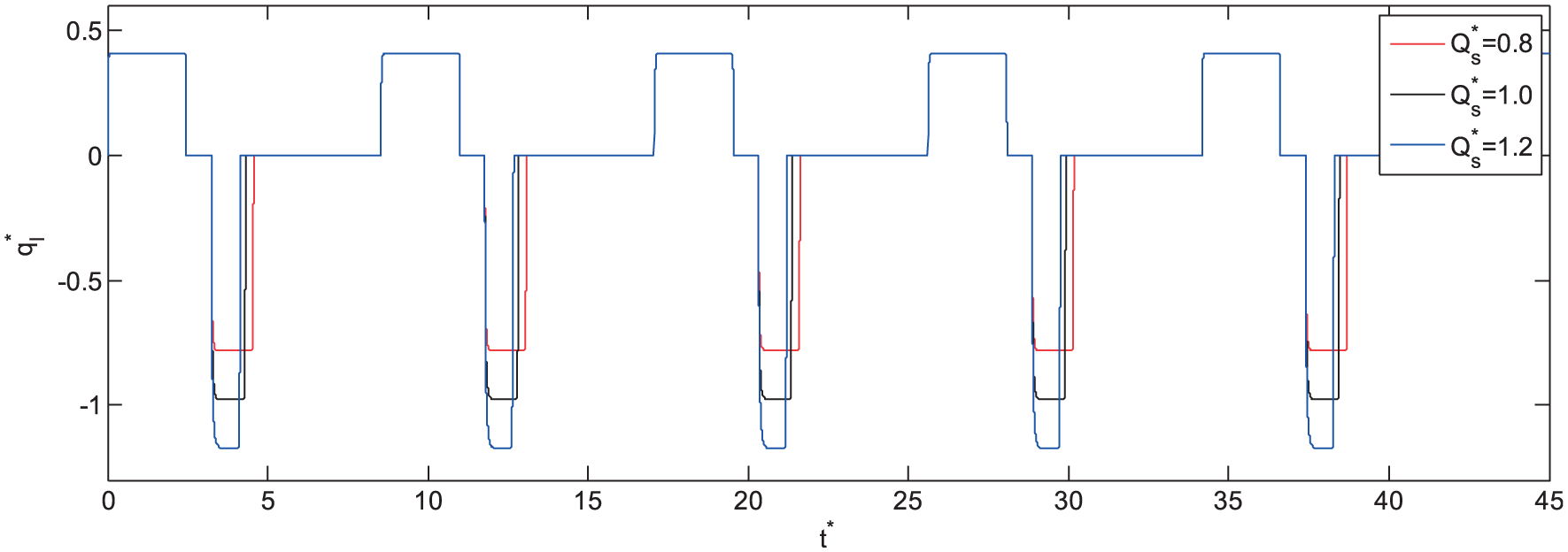
Dynamics of dimensionless volume flow of lung with different

Relationship between dimensionless volume flow of secretion clearance and dimensionless peak volume flow of secretion clearance.

Relationship between dimensionless volume flow of secretion clearance and dimensionless duration of secretion clearance.
Conclusion
This article aims to study dynamic characteristics of secretion clearance methods, and dimensionless mathematical model with a volume-controlled ventilator in the secretion clearance system has been built. In addition, comparison analysis of influence of the key parameters on dynamics in the PCS system and VCS system can be obtained:
The experimental and the simulation results are proved to be authentic and reliable, and the dimensionless mathematical model can be used in the study on the volume-control secretion clearance system.
Both in the PCS system and in the VCS system, when tidal volume of ventilator keeps stable, decrease of dimensionless compliance of lung will bring about hyperventilation.
In the PCS system, efficiency of secretion clearance increases slightly with a lower compliance of lung, while in the VCS system, compliance of lung has an little impact on dynamics of secretion clearance airflow.
Change of effective area of lung has more effect on negative bottom pressure in tract in the VCS system. In the VCS system, a 42% decrease of dimensionless effective area (from 0.454 to 0.647) leads to a nearly 52% decrease of dimensionless negative bottom pressure in tract, while in the PCS system, a 42% decrease of dimensionless effective area (from 0.454 to 0.647) leads to a nearly 35% decrease of dimensionless negative bottom pressure in tract.
In the PCS system, efficiency of secretion clearance increases obviously with higher effective area. Inversely, in the VCS system, influence of effective area on secretion clearance airflow can be ignored.
Both in the PCS system and VCS system, to avoid jeopardizing patients with a negative pressure in tract, when lung gets blocked, strength of secretion clearance should be decreased.
When strength of secretion clearance increases, efficiency of the VCS system is higher than that of the PCS system, however, the negative bottom pressure in tract is lower in the VCS system than that in the PCS system; hence, increase of strength of secretion clearance may cause a risk of respiratory tract of patients in the VCS system.
Footnotes
Handling Editor: Assunta Andreozzi
Declaration of conflicting interests
The author(s) declared no potential conflicts of interest with respect to the research, authorship, and/or publication of this article.
Funding
The author(s) disclosed receipt of the following financial support for the research, authorship, and/or publication of this article: The research is funded by Open Foundation of the State Key Laboratory of Fluid Power Transmission and Control.