




Abstract
Hydrostatic bearing is a key part that provides precision and long life to machine tools. It is one of the embodiments of tribology, mechanics, optimization method, and structural design in engineering practice. Articles about hydrostatic bearings since 1990 are collected in this review. Researching status is evaluated in two aspects: basic theory and typical application. This article presents a review of research articles related to introducing developments in hydrostatic bearings. Basic theory contains equations and analysis methods which include analytic, numerical, and experimental methods. Typical applications are based on rectangular oil pad, circular oil pad, and journal bearings. Moreover, this article focuses on the analysis of the relevant model, solution, and optimization and summarizes the hotspots and development directions.
Introduction
This review considers more than 400 articles published from 1990 to 2016. Among them, researches from the United States account for 25% which is leading the studies of hydrostatic bearings. Scholars from China, Japan, India, and France also make impressive contributions.
As Figure 1 shows, during that period, studies on hydrostatic systems never stopped and increased year by year. The increasing trend shows that both research method and application develop with time. In general, the trend line shows that the number of published articles about hydrostatic bearing grows about 1.01 per year and fluctuates every year. Around 30 articles came out in 2013 and only two researchers were published in 1990 (Figure 2).

Contribution of scholars from different countries.

Researches published between 1990 and 2016.
Hydrostatic bearings are important parts of machine tool for lubrication and supporting which are essential for a reliable moving performance. Formation of lubrication film is the key problem in bearing system analysis. 1 The load-carrying capacity is achieved by oil pads. The oil supply system injects oil into oil pockets, that is, the recess, whose depth is designed larger than the viscous boundary layer thickness of oil flow. So, there is no pressure loss when oil flows through the oil pocket. However, the film thickness at oil sealing edge is designed thinner than the viscous boundary layer thickness of oil flow. The viscous shear flow at the oil sealing edge can maintain the pressure in the oil pocket (Figure 3).

Oil flow in oil pad.
The design and analysis of hydrostatic bearings are highly associated with engineering applications. This review presents first the basic equation and its solution and then focuses on the application of different types of oil pads. Circular oil pads are usually used in thrust bearings, turntable, and slipper bearings. Rectangular oil pads are commonly used in guideways, slider bearings, and dampers. Journal bearings, conical, and spherical bearing are also introduced (Figure 4).
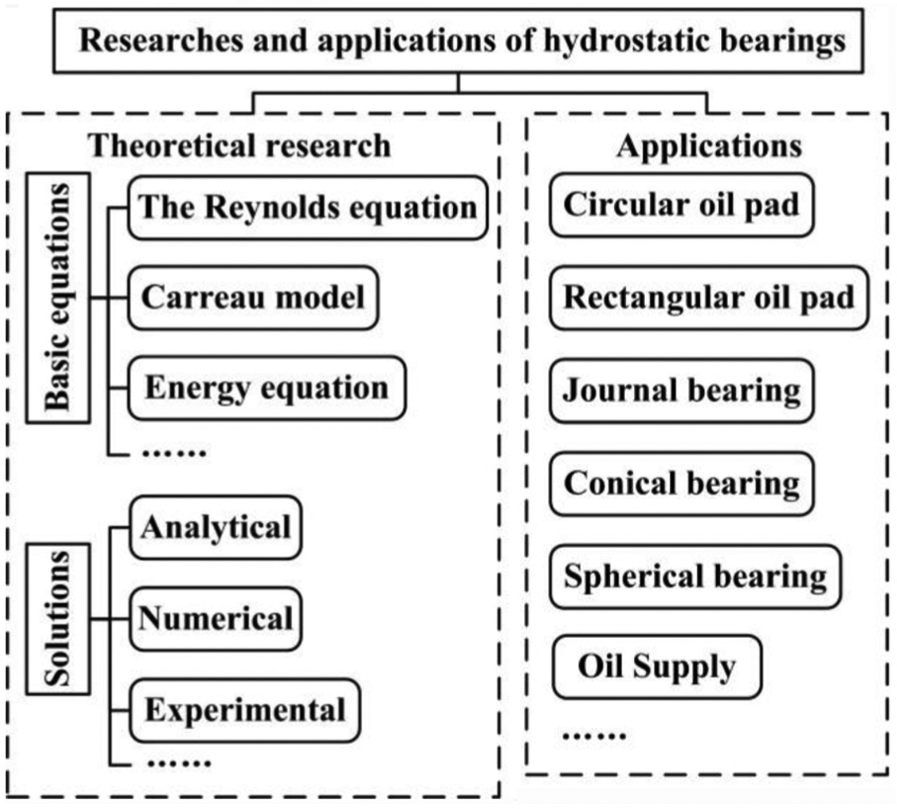
The review contents.
Theoretical researches
Basic equations for hydrostatic bearing
Studies about hydrostatic bearings belong to fluid mechanics. Theories of fluid dynamics can help researchers analyze hydrostatic systems. Equations describing fluid need to be modified because they are always complicated to solve.
The Reynolds equation provides a very practical model to describe the pressure distribution in thin film flow. The fluid energy equation provides thermal analysis for hydrostatic systems. Introducing different types of non-Newtonian fluid introduces more lubricants in hydrostatic bearing (Table 1).
Comparison of basic equations.
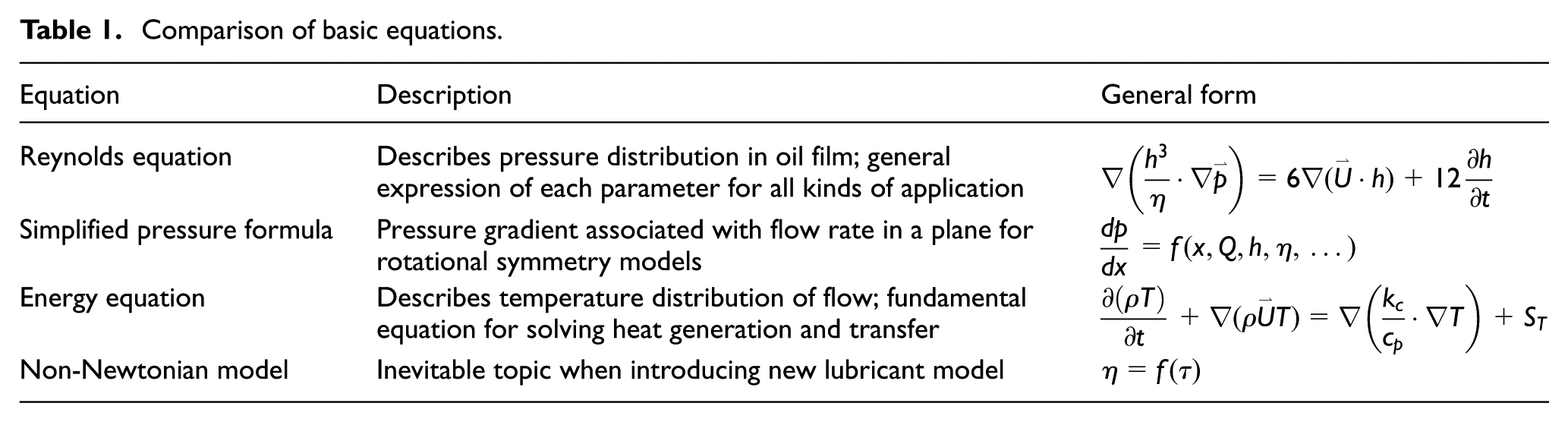
Reynolds equation 2 is a two-order partial differential equation describing oil pressure distribution in thin film that can be applied to calculate the pressure distribution in a journal bearing. The pressure variation in the thickness dimension is ignored because it is far smaller than other two dimensions. Then, the Reynolds equation is obtained 1

where p is the pressure, h is the film thickness, η is the viscosity, U is the surface velocity on x-coordinate, V is the surface velocity on y coordinate, and t is the time.
Since the Reynolds equation is usually difficult to be solved, it has been modified into different types to analyze the specific bearing model. Z Pang et al.3,4 proposed a dynamic transfer equation of a closed type of hydrostatic bearing to analyze its transient response and presented a simplified pressure formula for circular oil pad 3

M El Khlifi et al. 5 introduced a non-Newtonian fluid model into the Reynolds equation and combined fluid energy equation to research heat problem for hydrostatic bearing. The modified fluid energy equation for thin oil film is then proposed

where T is the temperature, u is the flow velocity on x-coordinate, v is the flow velocity on y–x-coordinate, w is the flow velocity on z-coordinate, kc is the heat transfer coefficient, ρ is the density, and cp is the specific heat capacity.
J Li and H Chen 6 gave an approximated expression of the roughness of bearing surface by rectangular groove and derived the results by solving the Reynolds equation. Both computational fluid dynamics (CFD) software simulation and numerical resolution are conducted. The comparison showed that two methods share similar results when surface roughness is 1%–10% of film thickness. E De la Guerra Ochoa et al. 7 introduced the Carreau model, a non-Newtonian fluid model, into the Reynolds equation to analyze the viscosity variation affections. The Carreau model is given by equation (4)

where η0 is the low shear viscosity, τ is the shear stress, G is the shear modulus, and n is the Carreau exponent which varies in the (0.2, 1) interval to describe non-Newtonian fluids.
Z Liu et al. 8 carried out the carrying performance of hydrostatic guideway, turntable, and journal bearing on machine tools. The Reynolds equation without viscosity variations is expressed in different coordinate systems for rectangular, circular, and journal bearings, respectively

In the study of a conical journal bearing, PG Khakse et al. 9 provided another form of the Reynolds equation that can be applied in spherical coordinates. The equation is written as

X Bai et al. 10 researched the supporting performance of a spherical bearing and described the relationship between pressure distribution and flow rate

Solutions of hydrostatic bearings
Analytical solutions
The analytical solution can directly show the relationship between different parameters of hydrostatic bearing. However, the equations describing hydrostatic bearings are always in form of differential equations that need to be simplified to determine the analytical solutions.
YK Younes 11 presented an optimization of the pump power for hydrostatic thrust bearing. An analytical resolution of pressure distribution and flow rate is proposed; the variable 0 < β < 1 is introduced to approximately describe the pressure loss at oil sealing edge

where pr is the oil pressure in oil recess, R is the radius of oil pad, and Rr is the radius of recess.
T Kazama and A Yamaguchi 12 put forward an analytical calculation method to determine the load-carrying capacity and moment of circular oil pad. JS Yadav and VK Kapur 13 presented an energy integral approach to obtain the radial pressure gradient in non-Newtonian squeeze film. The energy integral approach is written as

where m and n are the empirical constants in power law.
A Chasalevris and D Sfyris 14 divided the solution of the Reynolds equation into two parts, that is, particular and homogeneous, and solved it by Sturm–Liouville theory to obtain the analytical solution of the finite-length journal bearing. Moreover, the results are compared with those from other methods. The pressure p(x, θ) is rewritten as

In Chasalevris and Sfyris, 14 by deduction, the analytical result of pressure distribution is

where φ(θ) and m(x) are the intermediate variables associated with the model parameters, ψ(x) is calculated as 0 according to the boundary condition, and

Analytical solution for finite journal bearing. 14
Numerical simulations
Fluid simulation software solves Navier–Stokes (N–S) equation using finite element method (FEM) to determine the velocity, pressure, and temperature distribution of flow. Many researches are carried out according to the results of fluid simulation software.
M Helene et al. 15 established a two-dimensional non-uniform grid base on the model of hydrostatic journal bearing to simulate its inner flow field and carried out a comparison of the results between the effects of laminar and turbulent flow on supporting capacity. The mesh and corresponding results are shown in Figure 6.

Mesh and results of 2D pressure distribution in hydrostatic journal bearing: 15 (a) mesh and (b) pressure distribution.
FE Horvat and MJ Braun 16 designed an experimental device with adjustable oil recess to observe the inflow field of the oil pad. The experimental results of different recess depths and speed are compared with CFD simulations and they are shown in Figure 7.

Numerical simulation and comparison of experimental results. 16
Numerical solutions
Currently, the solution of differential equations and matrices usually relies on numerical methods. Computations for analyzing hydrostatic bearings can be customized to fit different models.
The Reynolds equation is a second-order partial differential equation difficult to solve directly. An analytic solution can express the effects of each parameter intuitively but requires a complicated mathematical deduction. Simulation software is practical in engineering analysis but hard to introduce new models. Numerical resolution is the most widely used method in theoretical research (Table 2).
Comparison of solutions.

EM: experimental method; FEM: finite element method; FDM: finite difference method.
SC Sharma et al. 17 dispersed the Reynolds equation into a matrix of nf order using the Galerkin’s technique and calculated the supporting capability of the hydrostatic journal bearing. The dispersed Reynolds equation is written as equation (12)

where [F] is the fluidity matrix; {p} is the pressure at each node; {Q} is the flow rate at each node; {RH}, {Rxj}, and {Rzj} are the parameter vectors associated with speed condition.
N Wang et al. 18 applied successive over relaxation (SOR) technique to solve the dispersed Reynolds equation and proposed a method to select the optimal relaxation factor

where k is the total count of iterations, ωb is the relaxation factor, α is 3.05 for slider bearings and 5.35 for journal bearings, and Δx is the distance between neighboring points on x-coordinate.
R Nicoletti 19 put forward a meshless radial basis function method (MMRB) to solve the Reynolds equation and compared it with finite difference method (FDM). According to the contrasting result, FDM is more suitable for the calculation of uniform mesh model, while MMRB is more appropriate for the computation of irregular area. The FDM-dispersed Reynolds equation is written as equation (14)

where Aij, Bij, Cij, Dij, Eij, and Fij are the coefficients of pressure matrix.
The MMRB is

where Nd is the number of points in the calculating area and δ is the distance between points.
P Liang et al. 20 solved the carrying ability of hydrostatic journal bearing by Gauss–Legendre integral method. The computing progress of Gauss–Legendre method is so efficient that it only needs 1/603 time compared with FDM. Gauss–Legendre integral method is written as

Y Li et al. 21 studied the effect of ratios of the orifices on aerostatic journal bearings. Feedback iteration is carried out after solving the Reynolds equation by FDM. Equation (17) and Figure 8 show the iteration method

where β is the ratio of orifice, δ is the convergence rate factor which varies within [0.01, 0.2], and

Flow chart of feedback iteration. 21
Experimental researches
Studies on hydrostatic bearings are often associated with experimental methods to measure the load-carrying capacity or assess the theory. J Hesselbach and C Abel-Keilhack 22 compared the analytic and experimental results to research the magnetorheological lubricant in hydrostatic thrust bearing. The film thickness is changed with the variation in magnetorheological lubricant properties by controlling the electric current. Y Henry et al. 23 designed a device (see Figure 9) and applied it to measure the minimum film thickness of the thrust bearing.

Device for measuring minimum film gap. 23
YQ Zhang et al. 24 carried out an experimental research to analyze the effect of rotating speed on pressure distribution. The experimental result is compared with that of finite volume method (FVM) simulation. E Koc and CJ Hooke 25 proposed the design and an experimental method for slipper bearings introducing slightly convex surface into the model. JK Martin 26 measured the ability of hydrostatic journal bearing to support loads and calculated the stiffness using four displacement coefficients. D Kim and S Park 27 studied the hydrostatic air foil bearings through the measure of the drag torque during start/stop. Figure 10 shows the measurement device.
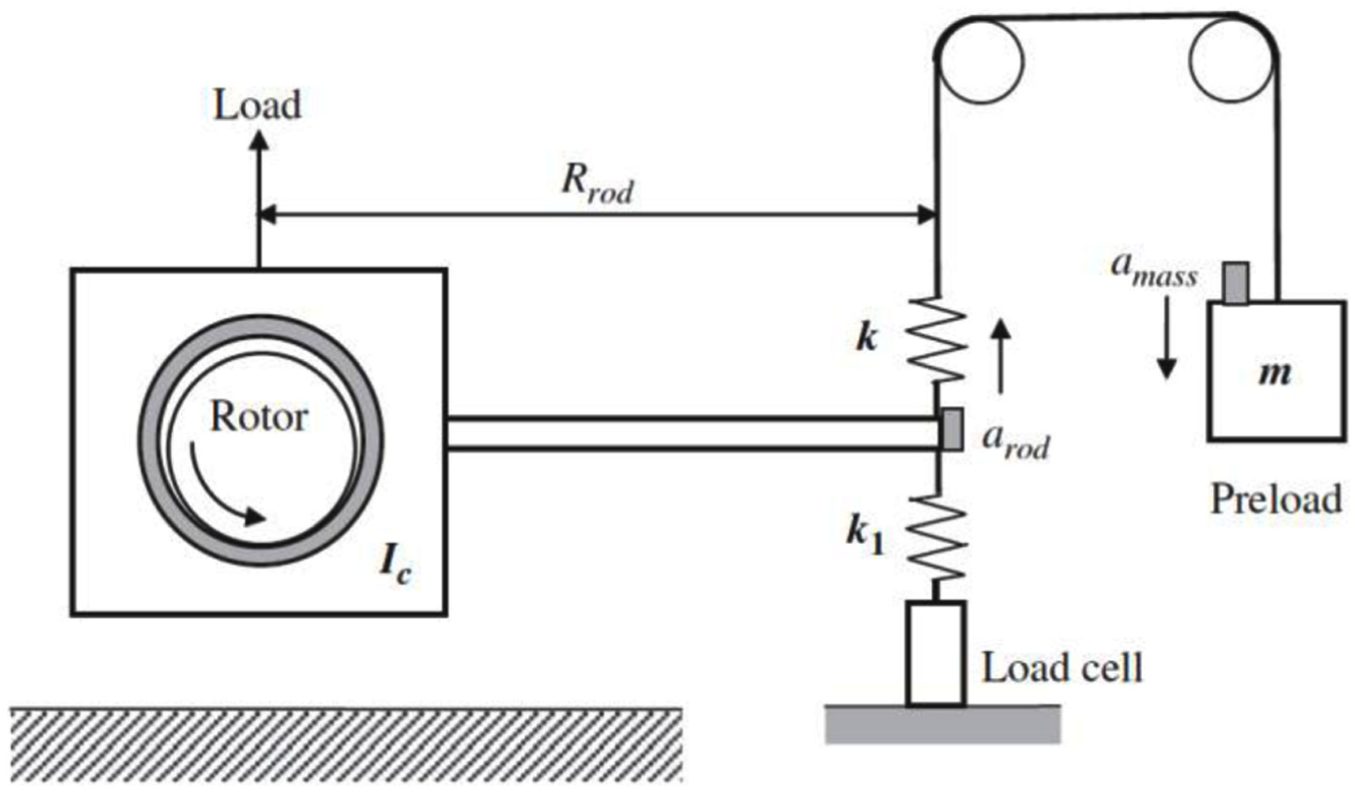
Measuring model of drag torque. 27
Applications of oil pad
Because of the advantages of high bearing capacity, high damping, and low wear, hydrostatic bearings are widely used in many engineering applications (Figure 11). The shape of the oil pad in hydrostatic bearings is classified as circular oil pad (Figure 12), rectangular oil pad (Figure 26), and journal bearing (Figure 33).
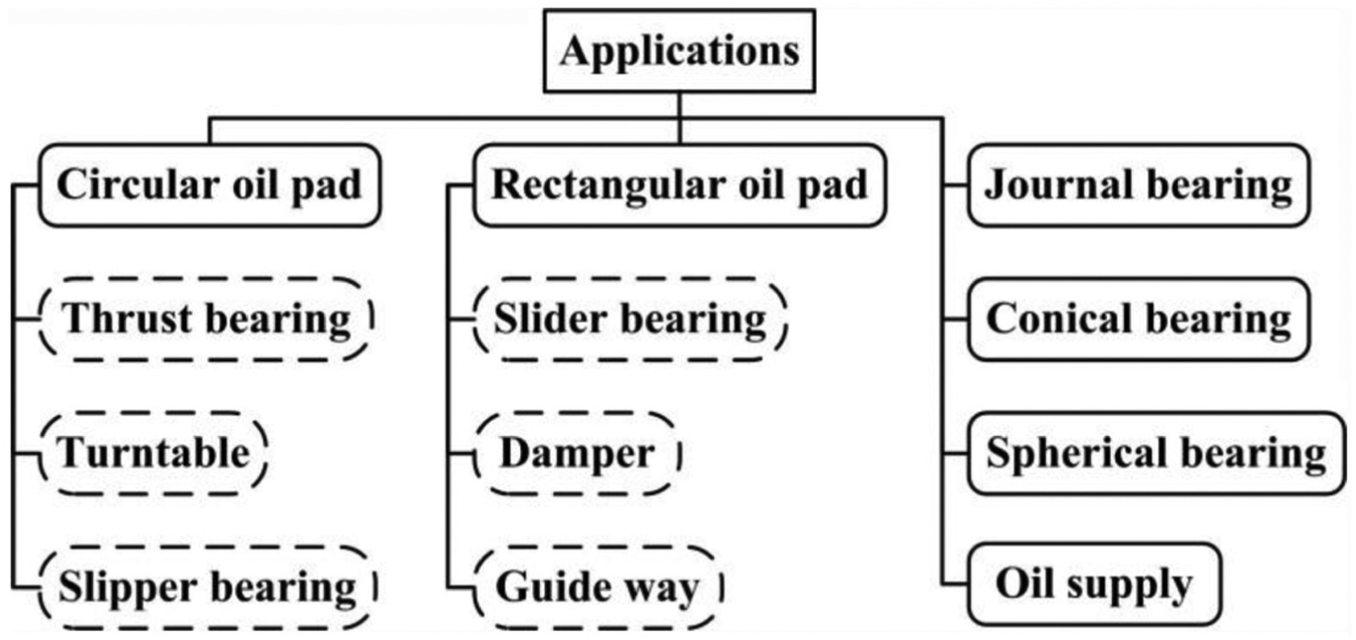
General applications of hydrostatic bearings.

Model of hydrostatic circular oil pad.
Research about hydrostatic bearings focuses on several spots such as bearing modeling, dynamic analysis, optimization, surface texturing, and error prediction. Studies about different bearing models highlight different key points (Table 3).
Comparison of research focuses.

Circular oil pad fits the Reynolds equation in cylindrical coordinates, and many scholars calculated the pressure distribution and load-carrying capacity of it analytically. Moreover, some researchers tried to introduce different types of surface textures to improve its supporting performance because a flat bearing surface is easy to be machined. Rectangular oil pad is suitable for the Reynolds equation of Cartesian coordinates and it is a good model for linear moving analysis. On the contrary, the curved bearing surface of the journal is hard to be machined. Therefore, studies about it usually focus on the bearing model and optimization of the film clearance. Conical journal bearing and spherical bearing are not commonly used in machine tools, so the studies about them focus on the computational research of bearing modeling.
Circular oil pad
Circular oil pad is usually used in thrust bearing and rotary moving bearings. Most circular oil pad has a round oil pocket concentric with oil pad, as shown in Figure 12.
Most of the articles (47) studying circular oil pad focus on the hydrostatic thrust bearing, while only a few deal with hydrostatic turntable (9%), slipper bearing (4%), and round sealing (4%). Among these articles, the bearing modeling or its improvement (32%) and surface texture introduction (31%) are distributed almost equally; other researches refer to bearing optimization and the study of dynamic characteristics (Figure 13).
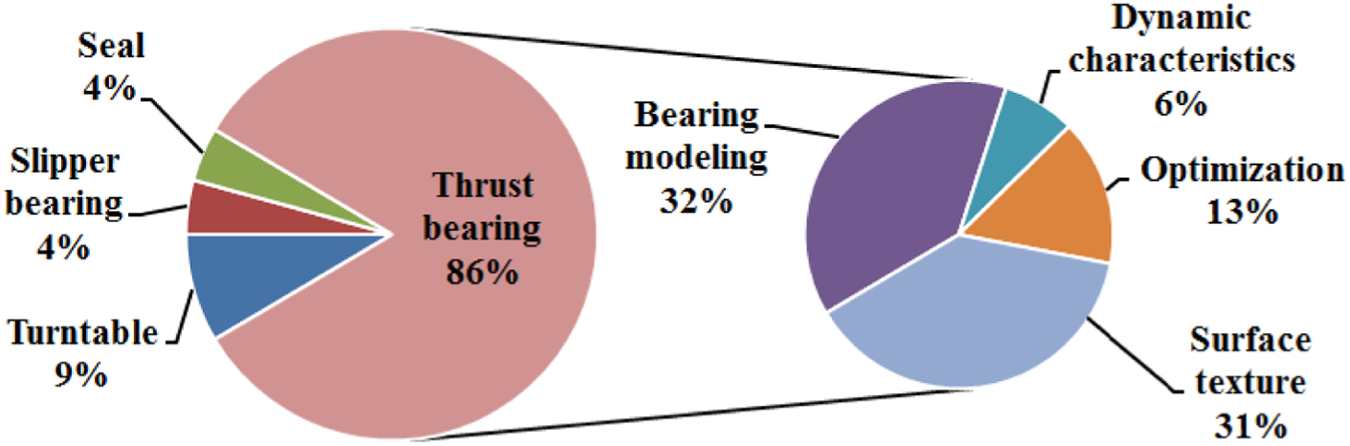
Overview of researches about circular oil pad.
A Van Beck and colleagues28–30 introduced the elastic support surface, incline supporting, and fan-shaped oil pocket in thrust bearing. Moreover, the authors applied an analytical method to calculate the bearing capability using the elastic supporting model shown in Figure 14. 30

Circular oil pads with elastic support. 30
ND Manring et al. 31 introduced the linear concave and convex deformation into the hydrostatic bearing and analyzed the effect on its carrying ability. The dimensionless carrying ability model under concave deformation is written by equation (18) and it is shown in Figure 15

where r0 is the radius of oil pocket, δ is the slope of linear deformation, and H is the film thickness.

Concave deformation of oil pad. 31
RAJ Van Ostayen et al. 32 introduced surface roughness into the elastic supporting model and studied the effects of surface roughness on the mixed lubrication model. J Shao et al. 33 carried out a numerical analysis using FVM and studied the heat effect on inclined surface under different cavity models. UP Singh et al.34–36 established an annular ring thrust bearing model (see Figure 16) and analyzed its static characteristics analytically.

Model of annular thrust bearing. 36
JE Garratt et al. 37 introduced centrifugal inertia effects into high-speed aerostatic thrust bearing to analyze its dynamic and static characteristics. BMA Maher 38 proposed an ellipse-shaped thrust bearing and compared its load-carrying capacity with circular and rectangular oil pads. Y Kang et al. 39 carried out a comparative research of closed-type thrust bearing supplied by constant oil pump and compensated by capillary restrictor. Figure 17 shows the oil supply model of closed-type thrust bearing.

Model of closed-type hydrostatic thrust bearing: 39 (a) capillary restrictors and (b) constant flow pumps.
M Gohara et al. 40 analyzed the carrying ability of thrust bearing supplied by membrane restrictor according to the coupling relationship between membrane deformation and pressure distribution. TA Osman et al. 41 introduced kinetic load to study the dynamic characteristics of ring thrust bearing and proposed an optimal flow rate to achieve a better supporting performance. YP Wang and D Kim 42 put forward a method for measuring the stiffness and damping on hybrid air foil bearings. NB Naduvinamani et al. 43 established a squeeze film model of ring thrust bearing to analyze the effect of pad structure on squeeze response time. Some parameter values from their research are shown in Table 4.
Some parameter values in engineering application. 42

E Solmaz et al. 44 calculated the minimum power consumption of oil pad based on the analytical formula of pump and friction power and proposed an optimal working film thickness. SC Sharma et al. 45 researched the influence of different shapes of oil pocket on the supporting capability of hydrostatic thrust bearings. Circular, rectangular, ellipse, and ring shape oil recesses are compared in the research; Figure 18 shows their main features.
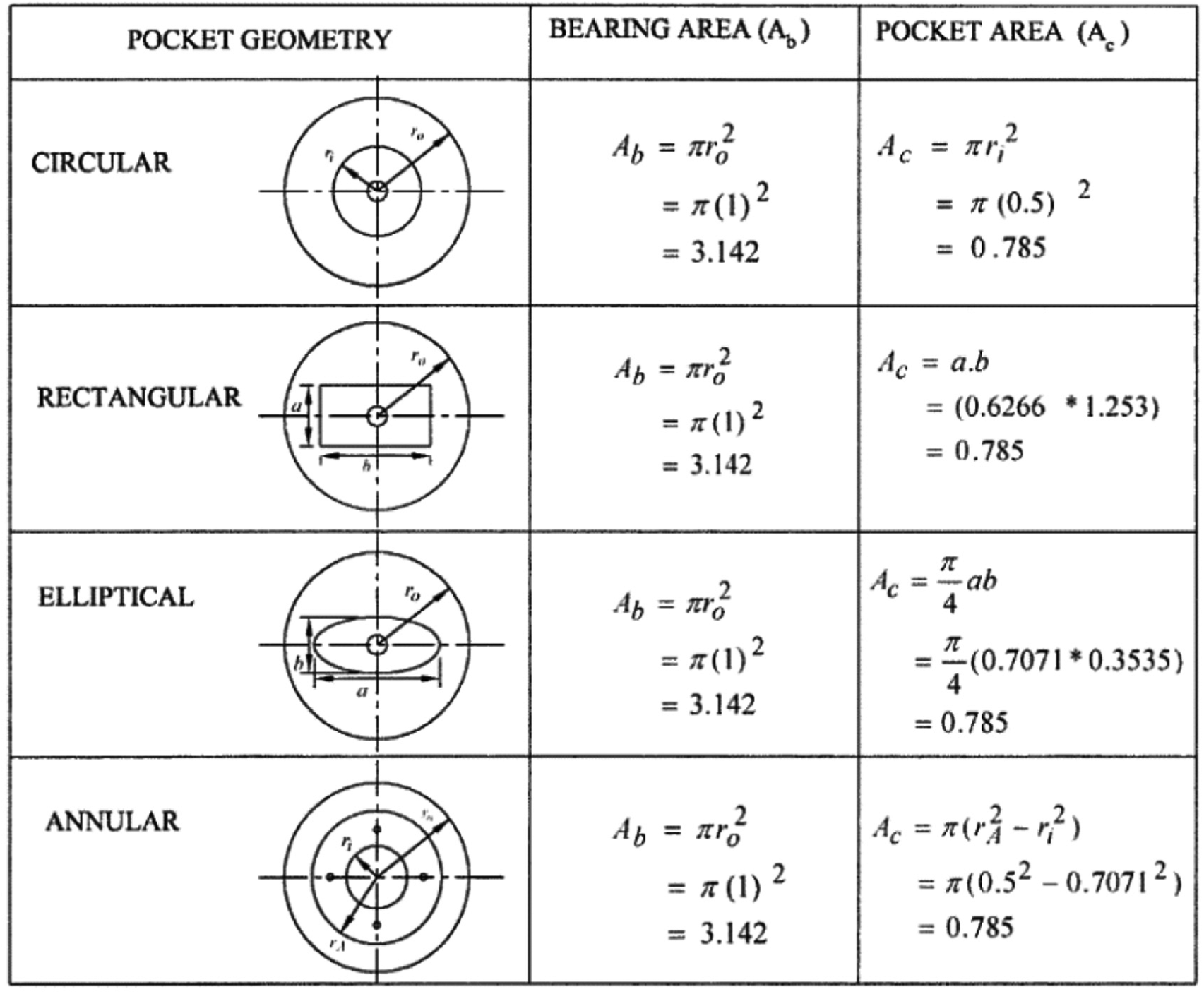
Geometric shapes of oil pocket. 45
OJ Bakker and RAJ Van Ostayen 46 analyzed the influence of the depth of oil pocket on the bearing capacity and concluded an optimal solution based on the analytical solution of load-carrying capacity of circular and ring thrust bearings. After carrying out a numerical simulation on the model of oil pad (see Figure 19), according to the results, F Shen et al. 47 revealed that circular oil recess provides higher pressure, while circular oil recess shows better stiffness.

Model of oil pads with different recess shapes: (a) elliptical pocket, (b) square pocket, (c) annular pocket, and (d) sector pocket. 47
SK Yadav and SC Sharma 48 evaluated the carrying capacity of the circular, annular, and sectorial oil pockets on hydrostatic thrust bearings and introduced non-Newtonian lubricant. H Sawano et al. 49 proposed a new type of oil recess with thin metal plate shown in Figure 20 to obtain a better dynamic stiffness.

Model of hydrostatic bearing with thin plate. 49
YK Younes 50 put forward a hydrostatic thrust bearing with shell shape waviness and carried out a numerical analysis. JR Lin 51 introduced a random function into the film thickness formula to simulate the effect of surface roughness on the carrying capability of thrust bearing. CW Wong et al. 52 studied an aerostatic thrust bearing with spiral grooves; the model is shown in Figure 21.
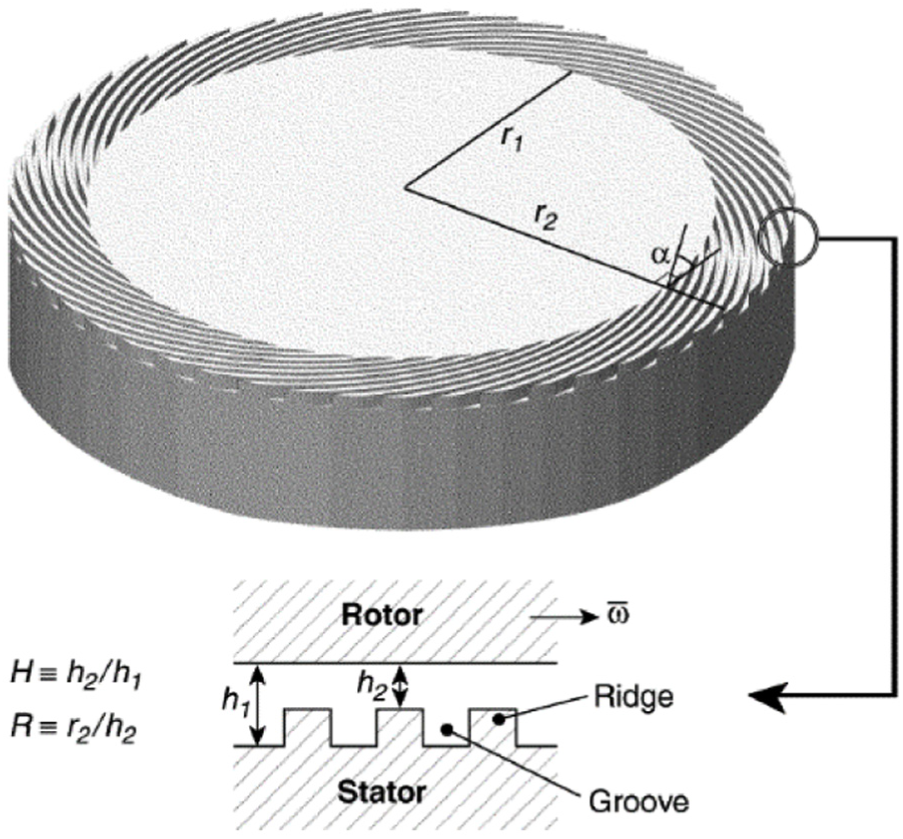
Model of hydrodynamic thrust bearing with spiral groove. 52
AW Yacout et al. 53 researched the thrust bearing analytically considering centripetal inertia and the surface roughness, and D Lee and D Kim 54 optimized the thrust air foil bearing by introducing surface texture to improve the dynamic supporting performance. DV De Pellegrin and DJ Hargreaves 55 conducted an isothermal and isoviscous analysis of hydrostatic thrust bearing with grooves to determine the optimal grove shape. X-Q Zhang et al. 56 studied the spiral-grooved aerostatic bearing mounted on a microengine. The grooves in spiral shape make the bearing more stable under the effect of high-frequency vibration; M Fesanghary and MM Khonsari 57 optimized the groove shape (see Figure 22) to obtain a better carrying performance.

The optimized groove geometry. 57
SC Sharma and SK Yadav 58 analyzed the effect of spherical and conical surface textures, respectively, on the carrying performance for non-Newtonian lubricant. X Meng et al. 59 compared round, rectangular, diamond, and triangle shapes of the texture on a mechanical seal. Z Hao and C Gu 60 introduced the cavitation effect in a hydrostatic thrust bearing with rectangular grooves, while M Zakir Hossain and M Mahbubur Razzaque 61 studied a thrust bearing model with grooves on its bearing surface. AM Gad and S Kaneko 62 introduced bump-shaped grooves (see Figure 23) into a foil thrust bearing and solved the coupling relationship between bump deformation and pressure distribution.
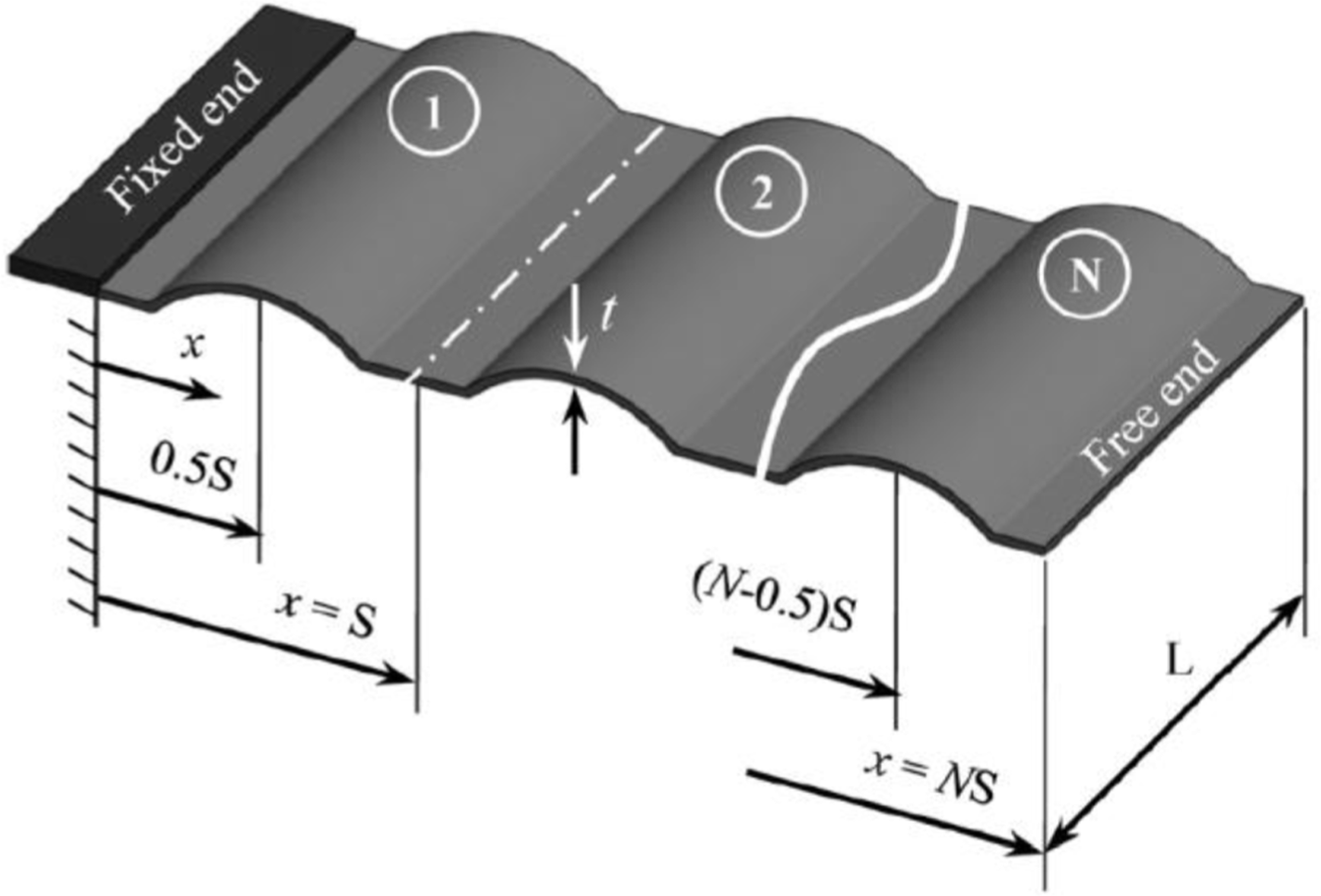
Geometry model of a bump foil strip. 62
M Mahbubur Razzaque and M Zakir Hossain 63 put forward a model of thrust bearing with grooves on one bearing surface and pores on the other one, and SK Yadav and SC Sharma 64 studied a thrust bearing with concave shape of circle texture lubricated by non-Newtonian fluid. Q Cheng et al. 65 conducted a particle swarm optimization (PSO) for hydrostatic turntable based on sensitivity analysis to obtain a more reliable film thickness. The model of hydrostatic turntable is shown in Figure 24.

Model of hydrostatic turntable. 65
Y Wang et al. 66 introduced thermal effect into hydrostatic turntable model and solved the Reynolds equation and energy equation. Z Liu et al. 67 analyzed the effects of heat and inclination partial load on the model of hydrostatic turntable.
HS Tang et al. 68 introduced thermal equilibrium clearance and solid thermal deformation into the model of slipper bearing shown in Figure 25 to analyze the heat effect.

Model of slipper bearing. 68
X Wang and A Yamaguchi69,70 studied the sealing characteristics of circular as a water seal part and analyzed the bearing performance and its power loss, proving a better sealing performance of elastic bearing surface.
Articles about circular oil pad are widely used in many situations, such as thrust bearing, turntable, sealing, and slipper bearing. Combined with different types of oil supply method, the carrying performance of circular oil pads can be controlled to fit their working condition. Circular oil pads are also good experimental objects to test speed influence and introduce surface texture.
Rectangular oil pad
Rectangular oil pad is easy to be manufactured because of its regular shape, and it is usually applied in linear moving guideways. A typical rectangular oil pad has rectangular oil pocket, as shown in Figure 26.
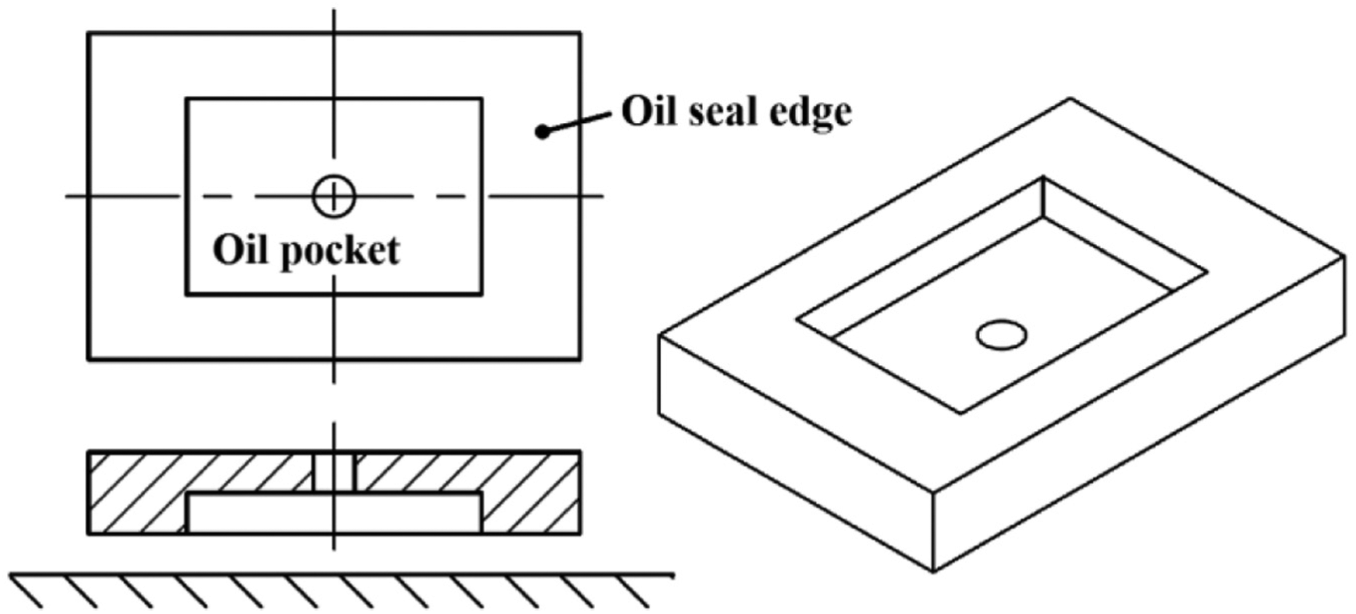
Model of hydrostatic rectangular oil pad.
Among the articles dealing with rectangular oil pad, most focus was on dynamic characteristics of the bearing (31%) and surface texture (25%), followed by studies on bearing modeling (12%), error analysis (13%), and optimization design (19%) (Figure 27).

Overview of researches about rectangular oil pad.
E Koc 71 introduced the analysis of misalignment plate lubrication into the gear meshing position, indirectly providing new ideas for rectangular bearing researches. A Van Beck and A Segal 72 introduced elastic rubber support into plate lubrication model and solved it numerically. The research provided a practical way to analyze the coupling of fluid and elastic solids. Figure 28 shows the elastic bearing model.

Model of elastic supporting. 72
A Bouzidane and colleagues73–76 researched dampers made up by three or four rectangular oil pads and studied its dynamic characteristics including stiffness and damp. Figure 29 shows the damper model with four oil pads.
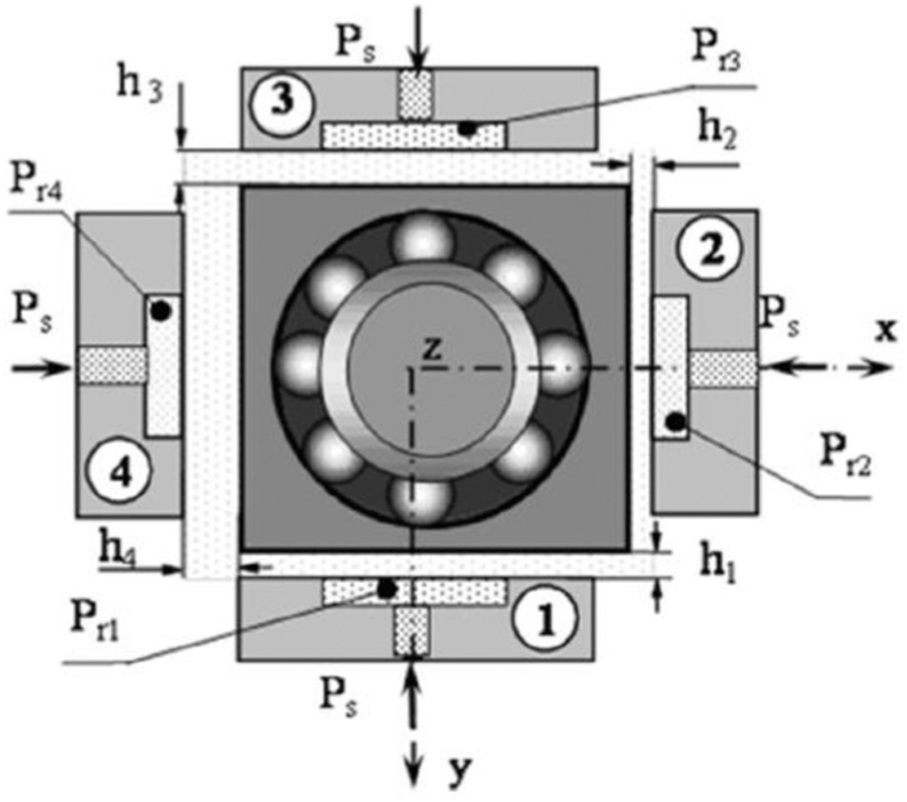
Model of squeeze film damper. 76
Y Du et al. 77 introduced compressible fluid in the simulation of rectangular oil pad and established the dynamic model of a hydrostatic guideway, while JS Oh et al. 78 used mixed two-probe method (MTPM) to measure the moving error of a hydrostatic guideway. Moreover, Z Wang et al., 79 based on the dynamic model of hydrostatic guideway shown in Figure 30, analyzed the relationship between oil supplying condition and moving error.
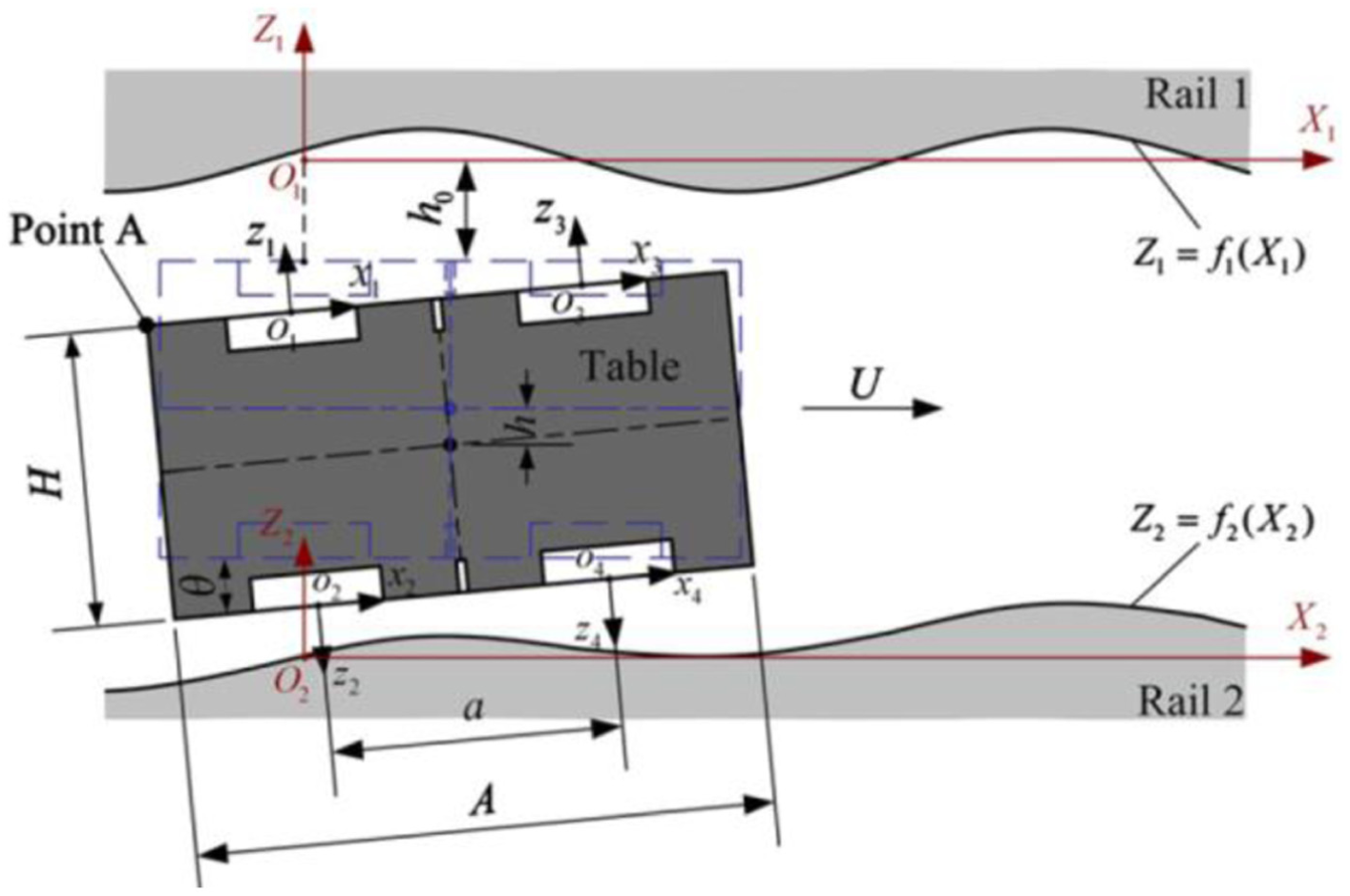
Hydrostatic guideway model moving with geometric errors. 79
M Qiu et al. 80 studied the effect of surface grooves on the supporting stiffness and friction coefficient of aerostatic bearings numerically. L Wang et al. 81 introduced elastic deformation into plate lubrication. The Reynolds equation was solved by FDM, and concave and convex grooves were compared by evaluating their influence on carrying capacity. J Ji et al. 82 researched the different effects of parabolic, triangle, and rectangular grooves on the supporting performance of rectangular oil pads. The parabolic groove model and its pressure distribution are shown in Figure 31.

The geometrical model and pressure distribution of parabolic grooves. 82
Using three-dimensional surface topography detection, E Qi et al. 83 analyzed the error averaging effects of hydrostatic guideway. SF Alyaqout and AA Elsharkawy 84 put forward an optimal film clearance to minimize the friction coefficient by evaluating a two-dimensional plate lubrication model, while SH Chang and YR Jeng 85 obtained an optimal working condition for stiffness maximization by modified particle swarm optimization (MPSO). Figure 32 shows the trend of the stiffness versus bearing load and the calculated bearing’s stiffness peak.

Peak point of bearing stiffness. 85
L Cai et al. 86 compared different contributions of each oil pad in the study of overturning problem for hydrostatic guideway. The authors proposed an optimal pad size allocation to improve the stiffness of guideway under inertia force impact.
Compared with circular oil pad, there are fewer researches studying about rectangular oil pad. The Reynolds equation in rectangular coordinates is hard to be simplified to determine an analytic solution. Flat bearing surface of rectangular is a good platform to test different types of texture.
Journal bearing
Oil recesses of hydrostatic journal bearing are circumferentially distributed around the central axis and they are usually used to lubricate the spindle of machine tools. Typical hydrostatic journal bearing has several oil pockets; Figure 33 shows where the pockets are located in each pad.

Model of hydrostatic journal bearing.
Among the 39 articles studying hydrostatic journal bearings, most of them deal with bearing modeling (61%); 13% is about dynamic characteristics, 18% is about optimal design, and 8% combine thrust bearing to establish a new model (Figure 34).

Overview of researches about journal bearing.
LA San Andres 87 studied the supporting performance of journal bearing lubricated by compressible fluid. Dynamic characteristics were calculated when the bearing is supplied by capillary restrictor and orifice restrictor, respectively. WB Rowe et al. 88 designed computing software according to the analytical solution of hydrostatic journal bearings. SC Jain et al. 89 used the analytical method to compare the influences of different restrictors on the carrying performance. R Sinhasan and PL Sah 90 introduced non-Newtonian fluid into a journal compensated by orifice restrictor and analyzed its non-linear dynamic characteristics. According to FEM analysis, SC Jain et al. 91 researched on the eccentricity effect on supporting ability of journal bearing. Based on Galerkin’s method, SC Sharma et al. 92 established a non-Newtonian fluid-lubricated journal bearing model compensated by orifice restrictor. JCT Su and KN Lie 93 compared the rotational effect on the load-carrying performance of hydrostatic and hydrodynamic journal bearings. The hole-entry model and porous model of hydrodynamic journal are shown in Figure 35.

Model of hydrostatic and hydrodynamic journal bearing: 93 (a) hole-entry hydrostatic journal bearing and (b) porous hydrodynamic journal bearing.
ZS Spakovszky and LX Liu 94 proposed an approximate analytical solution for ultra-short bearing model of aerostatic journal bearing. Using numerical simulation, L Ambrosoni and M Poli 95 analyzed the carrying capacity of coaxial floating sleeve to satisfy the high-speed/high-power working conditions. S Verma et al. 96 introduced micropolar lubricant into a multi-recess journal bearing. The numerical comparison of the results between Newtonian and micropolar lubricant is carried out by Galerkin’s technique. ER Nicodemus and SC Sharma 97 compared the Newtonian and micropolar lubricant influence on the load-carrying performance of multi-recess journal bearings and introduced wear effect. SK Guha 98 established a journal bearing model considering coupled stress lubrication; HC Garg et al. 99 studied the heat and non-Newtonian influence on slot-entry hybrid journal bearings. The operating parameters are shown in Table 5.
Operating parameters of hybrid and hydrodynamic bearing. 98

SC Sharma and N Ram 100 introduced micropolar lubricant into the oil supply model of slot-entry hybrid journal bearings. S Verma et al. 101 established a flexible multi-recess journal bearing with micropolar lubricant, and the comparison of the results between Newtonian and micropolar lubricant is shown in Figure 36.

Comparison of different lubricants in journal bearing. 101
ER Nicodemus and SC Sharma 102 introduced micropolar lubricant into journal bearings compensated by membrane restrictor. TC Hsu et al. 103 studied the influence of surface roughness and magnetic field on the carrying capability of journal lubricated by ferrofluids. P Liang et al. 104 put forward a method for identifying hydrostatic and hydrodynamic journal bearings. Q Lin et al. 105 calculated the moving trajectory of hydrostatic journal bearing considering the thermal influence and cavitation and carried out CFD analysis to study the fluid–structure interaction. DA Bompos and PG Nikolakopoulos 106 established a dynamic model of hydrostatic bearings lubricated by nano magnetorheological fluid, as shown in Figure 37. 106

Stiffness and damping coefficients of journal bearing. 106
G Dong et al. 107 researched a thermal elastohydrodynamic lubrication model for a tilting running roller. S Aksoy and MF Aksit 108 analyzed the carrying ability of aerostatic journal bearing based on three-dimensional thermal elastohydrodynamic lubrication.
M Cha et al. 109 established a non-linear dynamic model of a tilting pad journal bearing. D Chen et al. 110 studied the static and dynamic characteristics by analytical method. SM Lee et al. 111 conducted error analysis of a heavy hydrostatic journal bearing with multi-recesses. M Cha and S Glavatskih 112 proposed a computational method to research the dynamic moving trajectory of journal bearings. X Yang et al. 113 put forward a proportional–integral–derivative (PID) control strategy according to dynamic model of hydrostatic journal bearing. Figure 38 shows the proposed servo control model.
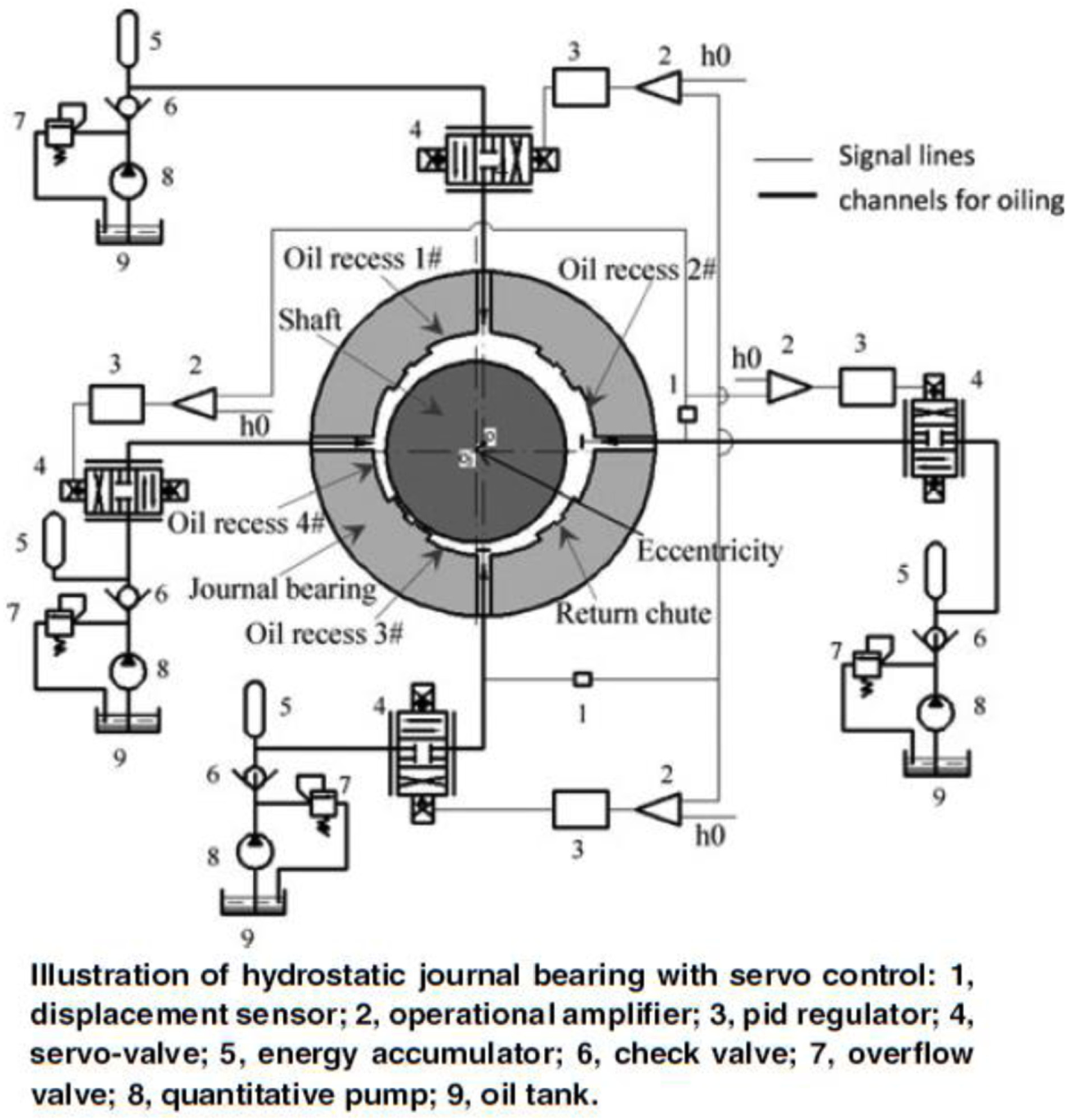
Servo control model of hydrostatic journal bearing. 113
SC Sharma et al. 114 compared the load-carrying performance of hydrostatic bearings with four and six oil pockets, respectively. The results in their research showed that journal bearing with six oil pockets has better dynamic characteristics but requires a higher oil supply rate. RQ Zhang and HS Chang 115 proposed a new structure in the model of floating ring gas bearing which is more stable at high-speed working conditions and studied it analytically. N Singh et al. 116 carried out a comparative research of different shapes for hydrostatic journal bearing. The rectangular-, circular-, ellipse-, and triangular-shaped oil recesses are shown in Figure 39. 116
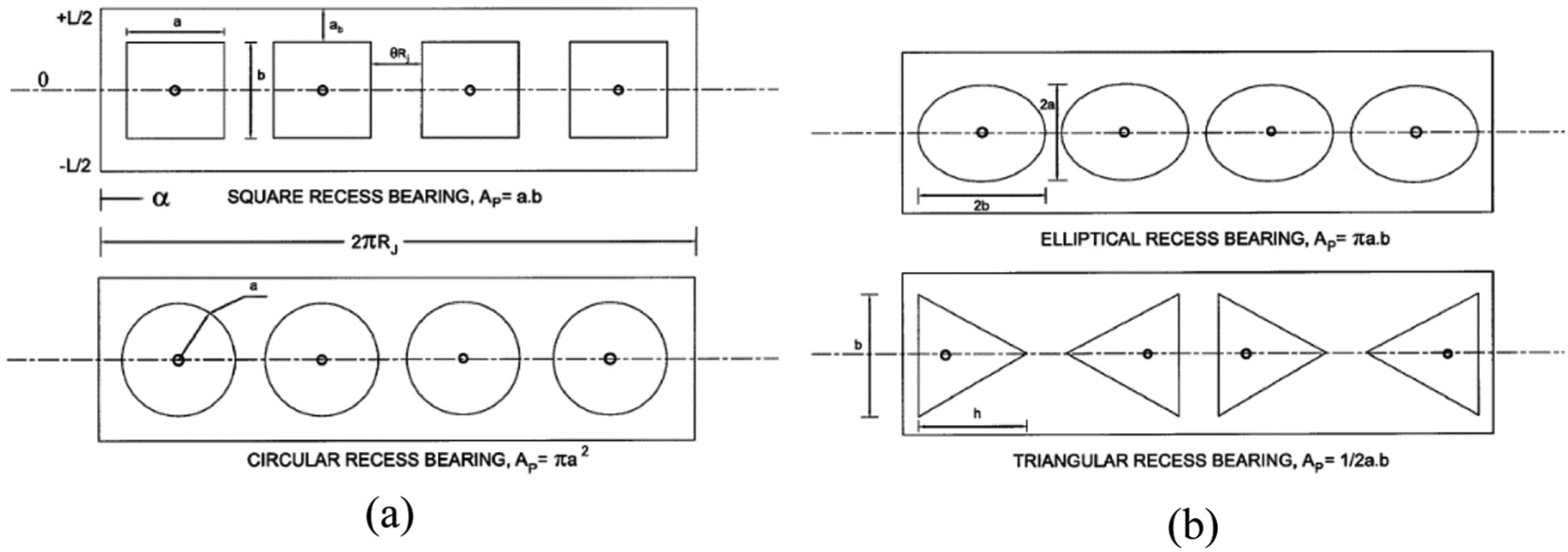
Models of different shape recesses: 116 (a) square and circular and (b) elliptical and triangular.
ER Nicodemus and SC Sharma 117 introduced micropolar lubricant into journal bearings compensated with orifice restrictor and compared the influence of round, rectangular, and triangular oil pockets on the supporting ability. R Bassani 118 proposed a model of self-controlled journal bearing running at a constant oil pumping rate. C Weißbacher et al. 119 put forward a two-lobe bore-shaped film clearance in hydrostatic journal bearings whose optimized film shape is shown in Figure 40.

Model of two-lobe bore-bearing contour. 119
CW Chan 120 carried out multi-objective PSO according to the bearing model of the hydrostatic journal bearing. LX Liu et al. 121 designed an aerostatic journal bearing combined with thrust bearing. H Guo et al. 122 carried out a comparison research of different depths of oil recess of journal–thrust bearing model. F Cheng and W Ji 123 combined water-lubricated hydrostatic journal bearing and aerostatic thrust bearing and studied the dynamic characteristics of the model in Figure 41.

Model of water–gas-lubricated journal bearing with thrust plate. 123
Eccentricity is inevitable in journal bearings because of its circumferential load structure. Non-linear behavior of carrying performance is more obvious in journal bearings. Therefore, many scholars conduct researches of bearing modeling and dynamic characteristics of journal bearing rather than optimization or surface texture.
Conical and spherical bearing
S Yoshimoto et al. 124 established water-lubricated conical model with spiral grooves and compared the carrying ability of rigid surface and compliant surface of the model shown in Figure 42.

Model of water-lubricated hydrostatic conical bearing. 124
NR Kane et al. 125 conducted both analytical and experimental researches of closed-type conical bearing and studied the supporting performance by evaluating supporting accuracy and stiffness. SC Sharma et al. 126 used FEM to analyze the carrying capability of four-pocket hydrostatic conical journal compensated by caterpillar restrictors. XB Zuo et al. 127 researched a slot-compensated hydrostatic conical bearing, while PG Khakse et al. 9 proposed a model of conical journal bearing without oil pockets and compensated with caterpillar restrictor which has thinner film thickness and higher precision. Figure 43 shows the model.

Model of non-recess hole-entry hydrostatic conical journal bearing. 9
H Guo et al. 128 calculated the dynamic characteristics of a capillary compensated deep–shallow pocket hybrid conical bearing. X Zuo et al. 129 carried out a comparative research of conical bearings compensated with variable slot and fixed slot. The results showed that variable slot ensures a better radial carrying capacity.
S Yuan and D Zhou 130 calculated the carrying ability of a spherical bearing by evaluating its equivalent area. C Xu and S Jiang131,132 established a self-compensated spherical bearing and analyzed its static and dynamic characteristics. X Bai et al. 10 researched the carrying ability of a spherical bearing with inner oil supply with the model in Figure 44.
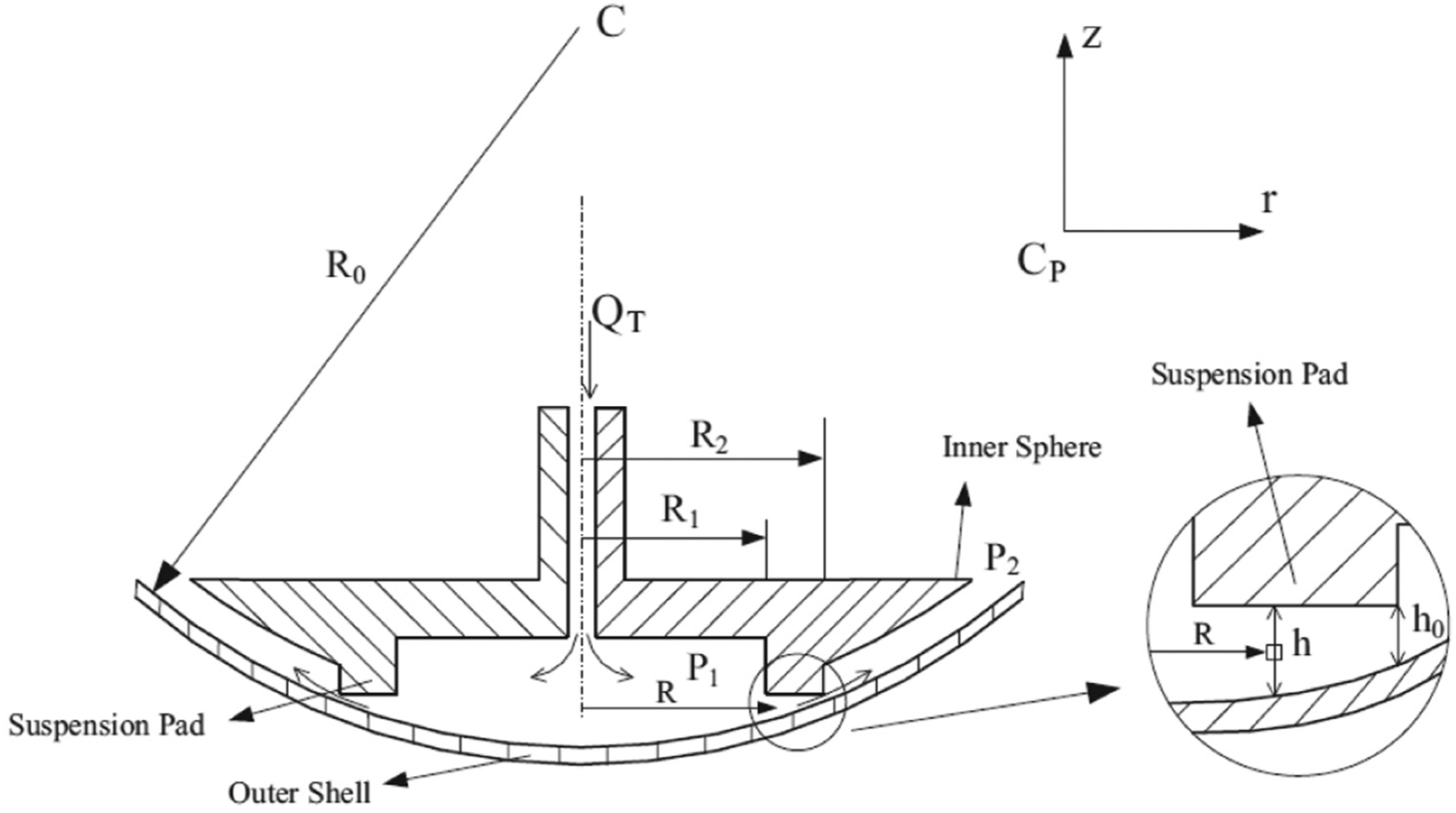
Model of spherical bearing surface. 10
Bearing surface of conical journal bearing is hard to be processed. The conical structure is also difficult to separate influence factors. And spherical bearing shares the same problem. New type bearings like conical journal bearing and spherical bearing reflect a wide range of application of hydrostatic systems.
Oil supply and compensation of hydrostatic bearing
Besides oil pad type, the oil supply method can influence the supporting performance. There are four common types of oil supply method: constant oil pump, capillary restrictor, membrane restrictor, and orifice restrictor. Y Kang et al. 39 provided the model of capillary restrictor and constant oil pump in Figure 17(a) and (b). M Gohara et al. 40 presented a membrane restrictor in their research in Figure 45.

Membrane restrictor. 40
SC Jain et al. 89 conducted a comparison research between membrane, constant flow valve, orifice, and capillary restrictor. SC Sharma et al. 92 showed a structural model of orifice restrictor in their research.
Future developments
Articles about hydrostatic bearings reviewed in this work contain basic theory and typical applications. Most researches in this review are conducted by the Reynolds equation which has been used for a century. The Reynolds equation shows its efficiency and accuracy in analyzing different types of hydrostatic bearings. However, the flow field in oil recess cannot be evaluated by the Reynolds equation which limits further study of oil pads. According to the study focus and research trend, future development is estimated as follows:
Many studies presented in this review started by calculating the carrying ability of a bearing. Basic theories were applied to solve the fluid properties in the oil pad, like the pressure distribution. Different types of oil pad fit different forms of the Reynolds equation. Rectangular oil pads fit Cartesian coordinates, while circular oil pads fit cylindrical coordinates. The Reynolds equation is a general formula that is also suitable for a new type of oil pads or their combinations. However, the introduction of non-Newtonian fluid challenged the classical equation because of the change in shear flow hypothesis in the derivation of the Reynolds equation. Furthermore, the Reynolds equation can only describe the pressure distribution in the oil sealing edge while the solution of flow field in oil pocket relies on N–S equation.
In the solution of the Reynolds equation, analytical solutions of the bearing load-carrying capacity are gradually developed from the equivalent area approximation to the analytical solution of the partial differential equation of Reynolds equation. With the development of solving techniques of partial differential equation, new outcomes for analytical resolution may exist. The improvement of computing speed helps the numerical solution being widely used, making the solution of Reynolds equation flexible and efficient. The emerging numerical solutions can be conveniently applied to the analysis of several types of oil pad bearing. New computational methods are usually applied to enhance the calculation accuracy and computing efficiency or improve the computational model.
Except for the pressure distribution in the oil pad, the oil supply is an important part of the analysis of the bearing carrying capacity. Caterpillar, orifice, and membrane restrictors are the commonly used compensation techniques. The servo oil pump with constant supply rate can ensure the pressure for the oil pad without restrictors and provide a practical method to adjust and control the carrying ability of hydrostatic systems. The application of magnetorheological fluid also is a new way to govern the load-carrying capacity of the hydrostatic bearings.
Many researches focus on the optimization of oil pads. Some of them introduced surface textures into the bearing plate and studied them both theoretically and experimentally by evaluating various affecting carrying abilities. Because of the difficulty in machining curve supporting surfaces, researches on structural optimization for journal bearing are less than that dealing with circular or rectangular bearings. Some studies proposed optimized oil pad arrangement at different positions of a machine tool, which means oil pads are redesigned to fit the load-carrying requirement at its position to enhance the overall performance. With the development of new optimization algorithms, the optimal design method of the hydrostatic bearing system is also continuously improving (Figure 46).
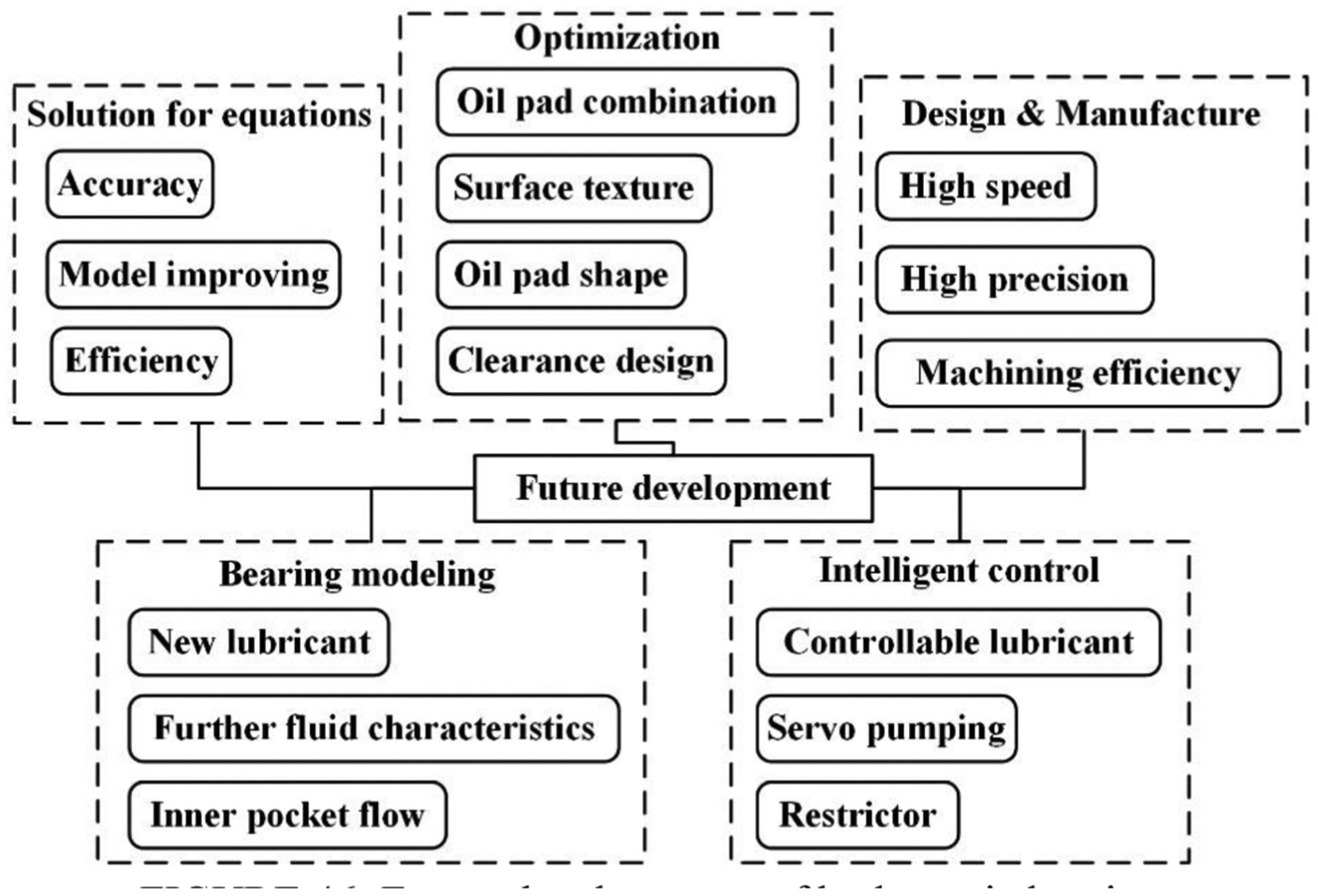
Future developments of hydrostatic bearings.
Researches of hydrostatic bearings will be more micro or more macro with the help of new bearing model, new type of oil pad, and new solution for equations. On a micro scale, the microscopic analysis of the limit of oil film may reveal the formation and collapse of thin film, which is still an important issue in hydrostatic system design. On the macroscopic scale, the study of combined bearing performance of multiple oil pads may improve the accuracy and reliability of machine tools in larger, heavier, and faster applications.
Footnotes
Handling Editor: Roslinda Nazar
Declaration of conflicting interests
The author(s) declared no potential conflicts of interest with respect to the research, authorship, and/or publication of this article.
Funding
The author(s) disclosed receipt of the following financial support for the research, authorship, and/or publication of this article: The authors would like to thank the National Natural Science Fund (51575009), Beijing Natural Science Fund (3162003), and Jing-Hua Talents Project of Beijing University of Technology for supporting the research.